How to Lower Cost Per Lead in 2026: 9 Proven Tactics
Your cost per lead is not a marketing number — it is a data-quality number. Here are nine tactics that cut CPL without cutting pipeline, plus the math to prove which one to run first.
TL;DR
- Cost per lead is a division problem: spend divided by qualified leads. Most teams shrink the numerator when the fastest wins are in the denominator — bad data, duplicate records, and leads that were never in your ICP.
- Bounced and unreachable contacts are silent CPL inflation. If 22% of a purchased list is undeliverable, your real CPL is 28% higher than the number in your dashboard.
- Blended CPL is a vanity metric. Split it by channel, by segment, and by stage (raw lead → MQL → SQL) or you will optimize the wrong line item.
- Owned-source prospecting (domain search + verification) typically lands between $8 and $40 per verified contact versus $150–$400 for paid-search demo requests in competitive B2B categories.
- The highest-leverage lever nobody runs: negative-keyword and exclusion hygiene on paid, plus deduplication before enrichment. Both are free and both compound.
What does cost per lead actually measure?#
Cost per lead (CPL) is total spend on a channel divided by the number of leads that channel produced in the same period. Simple formula, endless ways to lie to yourself with it.
The lies come from three places.
Spend is understated. Teams count ad spend and forget tooling, agency retainers, contractor hours, and the SDR salary that turned raw clicks into booked meetings. A $10,000 ad budget generating 100 leads looks like $100 CPL. Add a $4,000 agency fee and a half-loaded SDR at $3,500 for the period and your real CPL is $175.
Leads are overstated. A form fill from a student writing a thesis is not a lead. Neither is a duplicate submission, a role-based catch-all address, or a contact whose email hard-bounces. Every one of those inflates the denominator and makes a bad channel look efficient.
Time windows don't match. Spend lands in March; the leads it generated close in May. Comparing March spend to March leads on a 60-day consideration cycle produces noise, not insight.
Fix the definition before you try to fix the number. Here is the version worth tracking:
True CPL = (media + tooling + labor + data costs) / verified, in-ICP, deduplicated leadsThat denominator change alone often moves a reported CPL by 20–40%. Not because performance changed — because you stopped counting garbage.

Why is your cost per lead higher than it looks?#
Three quiet cost centers show up in almost every audit.
1. Undeliverable contacts. Industry bounce data consistently shows purchased and scraped lists running 15–30% invalid. If you paid $2,000 for 1,000 contacts, your headline CPL is $2.00. At 22% invalid, you actually bought 780 usable contacts — $2.56 each, a 28% increase you never recorded. Worse, high bounce rates damage sender reputation, which throttles the deliverability of every future campaign from that domain.
2. Duplicates across systems. The same person submits a webinar form, downloads a guide, and gets scraped by your data vendor. Three records, three "leads," one human. Most CRMs deduplicate on email string only, so j.smith@acme.com and john.smith@acme.com survive as separate rows.
3. Out-of-ICP volume. Broad-match paid keywords and ungated content pull in freelancers, students, and companies at 5 employees when you sell to 500-person orgs. Those leads consume SDR time — the most expensive resource in the funnel — and never convert.
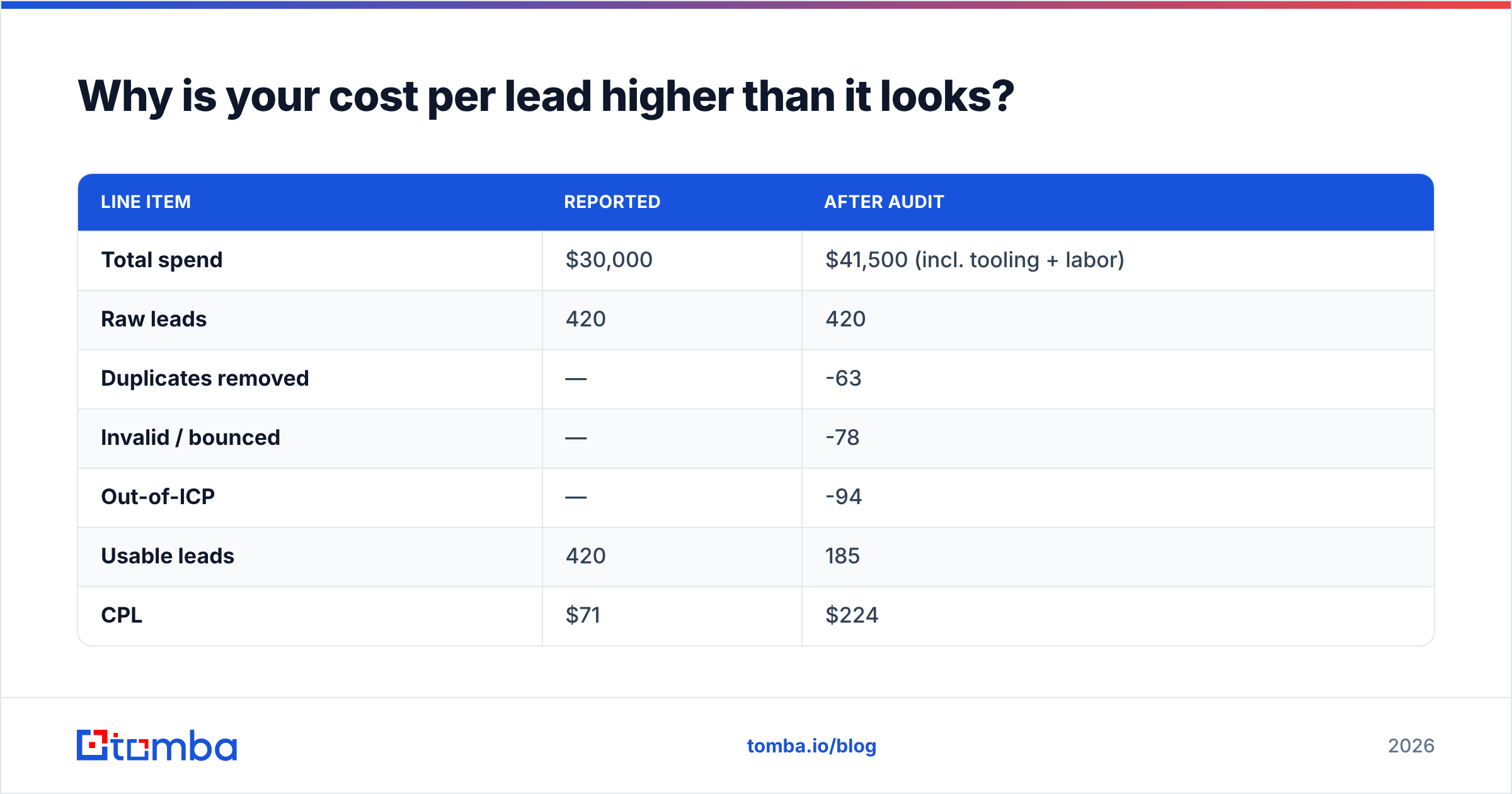
Run the numbers on a hypothetical quarter:
| Line item | Reported | After audit |
|---|---|---|
| Total spend | $30,000 | $41,500 (incl. tooling + labor) |
| Raw leads | 420 | 420 |
| Duplicates removed | — | -63 |
| Invalid / bounced | — | -78 |
| Out-of-ICP | — | -94 |
| Usable leads | 420 | 185 |
| CPL | $71 | $224 |
The $71 number is what most dashboards report. The $224 number is what you're actually paying. You cannot lower a cost you're measuring wrong.
How do you lower cost per lead by channel?#
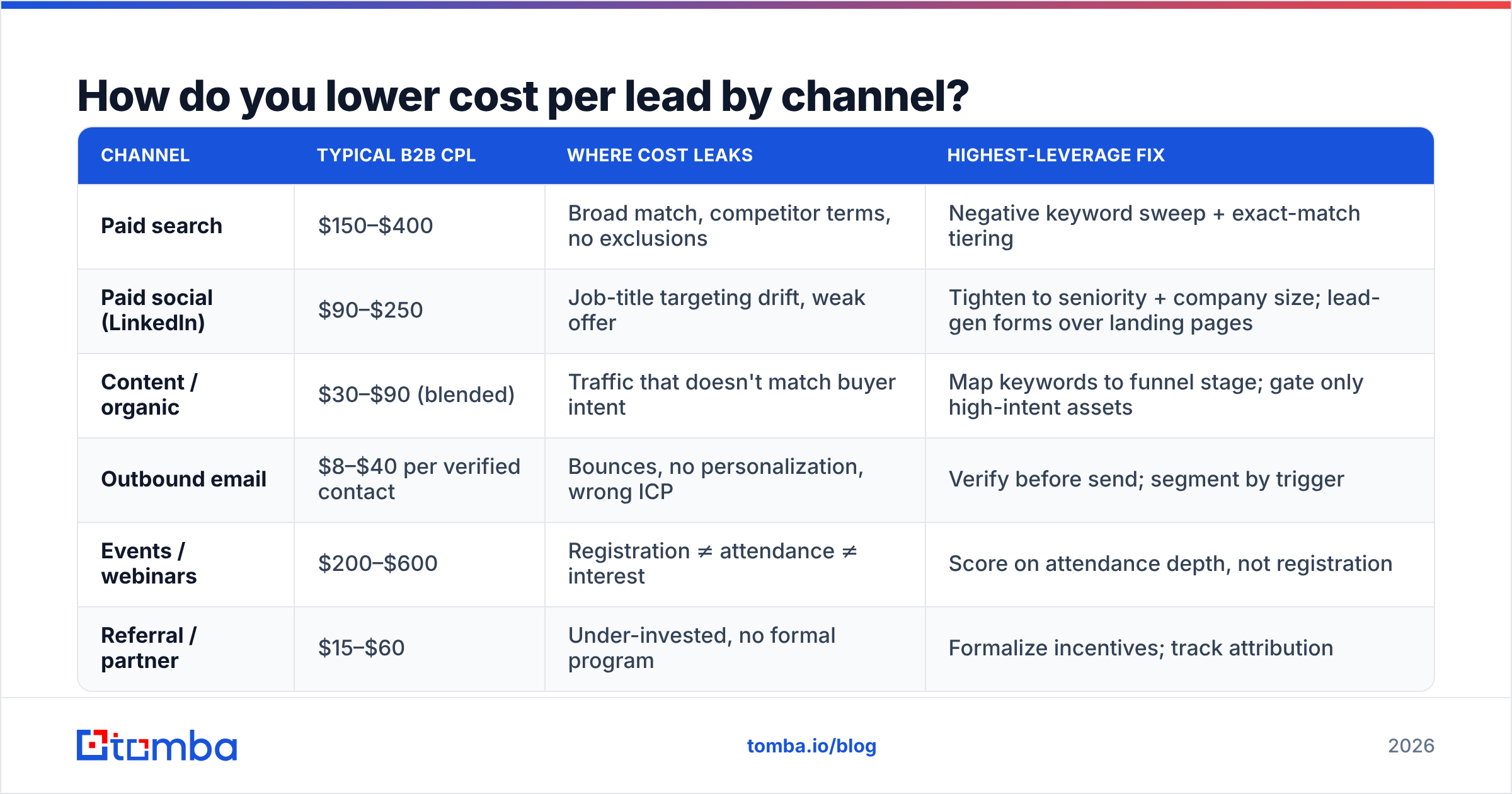
Different channels fail in different ways, so the fix is channel-specific. Here's where each one usually leaks and what typically moves the needle.
| Channel | Typical B2B CPL | Where cost leaks | Highest-leverage fix |
|---|---|---|---|
| Paid search | $150–$400 | Broad match, competitor terms, no exclusions | Negative keyword sweep + exact-match tiering |
| Paid social (LinkedIn) | $90–$250 | Job-title targeting drift, weak offer | Tighten to seniority + company size; lead-gen forms over landing pages |
| Content / organic | $30–$90 (blended) | Traffic that doesn't match buyer intent | Map keywords to funnel stage; gate only high-intent assets |
| Outbound email | $8–$40 per verified contact | Bounces, no personalization, wrong ICP | Verify before send; segment by trigger |
| Events / webinars | $200–$600 | Registration ≠ attendance ≠ interest | Score on attendance depth, not registration |
| Referral / partner | $15–$60 | Under-invested, no formal program | Formalize incentives; track attribution |
Ranges are directional and vary widely by category — enterprise cybersecurity CPL will sit far above the top of these bands, and SMB tools far below. Use your own baseline. The point is the shape: outbound-owned data and referral are structurally cheaper per contact than auction-based channels, because you're not bidding against competitors for the same click.
That doesn't mean kill paid. It means stop expecting paid search to carry the whole number. A portfolio that's 70% paid will always have a high blended CPL, because you're renting every lead at auction prices.
What are the nine tactics that actually lower CPL?#
Ordered by speed-to-impact. Run them roughly in this order.
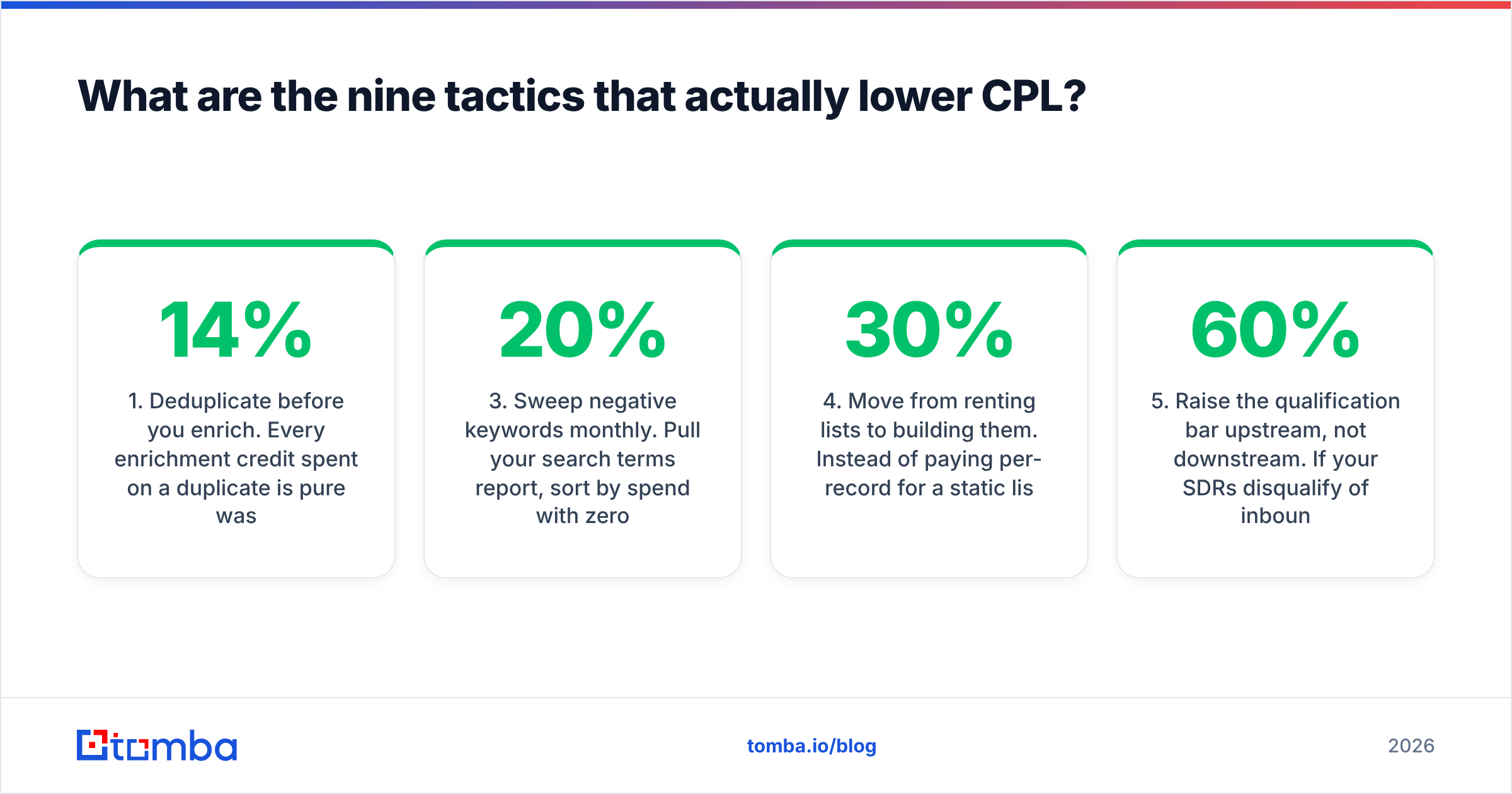
Deduplicate before you enrich. Every enrichment credit spent on a duplicate is pure waste. Normalize on domain + name fuzzy-match, not raw email string. A free pass with a remove duplicates tool on a 10,000-row list routinely strips 8–14% before you spend a cent on enrichment.
Verify every address before it enters a sequence. Bounces cost you twice: the wasted acquisition cost and the deliverability damage. Running a list through an email verifier first is the single cheapest CPL reduction available, because verification costs a fraction of acquisition.
Sweep negative keywords monthly. Pull your search terms report, sort by spend with zero conversions, and add exclusions. Most accounts that haven't done this in six months find 10–20% of spend going to terms that will never convert — "free," "jobs," "salary," "tutorial," competitor brand misspellings.
Move from renting lists to building them. Instead of paying per-record for a static list that decays at roughly 22–30% annually as people change jobs, build target-account lists and resolve contacts on demand. A domain search against 200 target accounts produces a current, ICP-matched list rather than a stale file someone else already emailed.
Raise the qualification bar upstream, not downstream. If your SDRs disqualify 60% of inbound, the filter belongs in the form and the targeting, not in a human's calendar. Add company-size and role fields; use progressive profiling so you're not trading form length for conversion rate.
Fix your offer before you fix your bid. A landing page converting at 1.8% versus 4.2% is a 2.3x CPL difference at identical spend. Offer quality — specificity, proof, and a low-friction next step — moves conversion rate more than bid tuning moves cost per click.
Score on behavior, not on form submission. A marketing qualified lead that visited pricing three times is worth ten that downloaded an ebook. Weight your scoring toward intent signals and let low-score leads sit in nurture instead of burning SDR hours.
Reallocate quarterly using CAC payback, not CPL. A channel with $300 CPL and a 22% close rate beats a channel with $80 CPL and a 2% close rate. Optimizing CPL in isolation systematically starves your best channels. Track cost per opportunity alongside it.
Recycle the closed-lost and no-response pile. The cheapest lead is one you already paid for. Re-verify contacts from 9–18 months ago, check for job changes, and re-approach with a new trigger. Acquisition cost: $0.

Is cheaper data actually cheaper?#
Not reliably. This is where a lot of CPL "optimization" backfires.
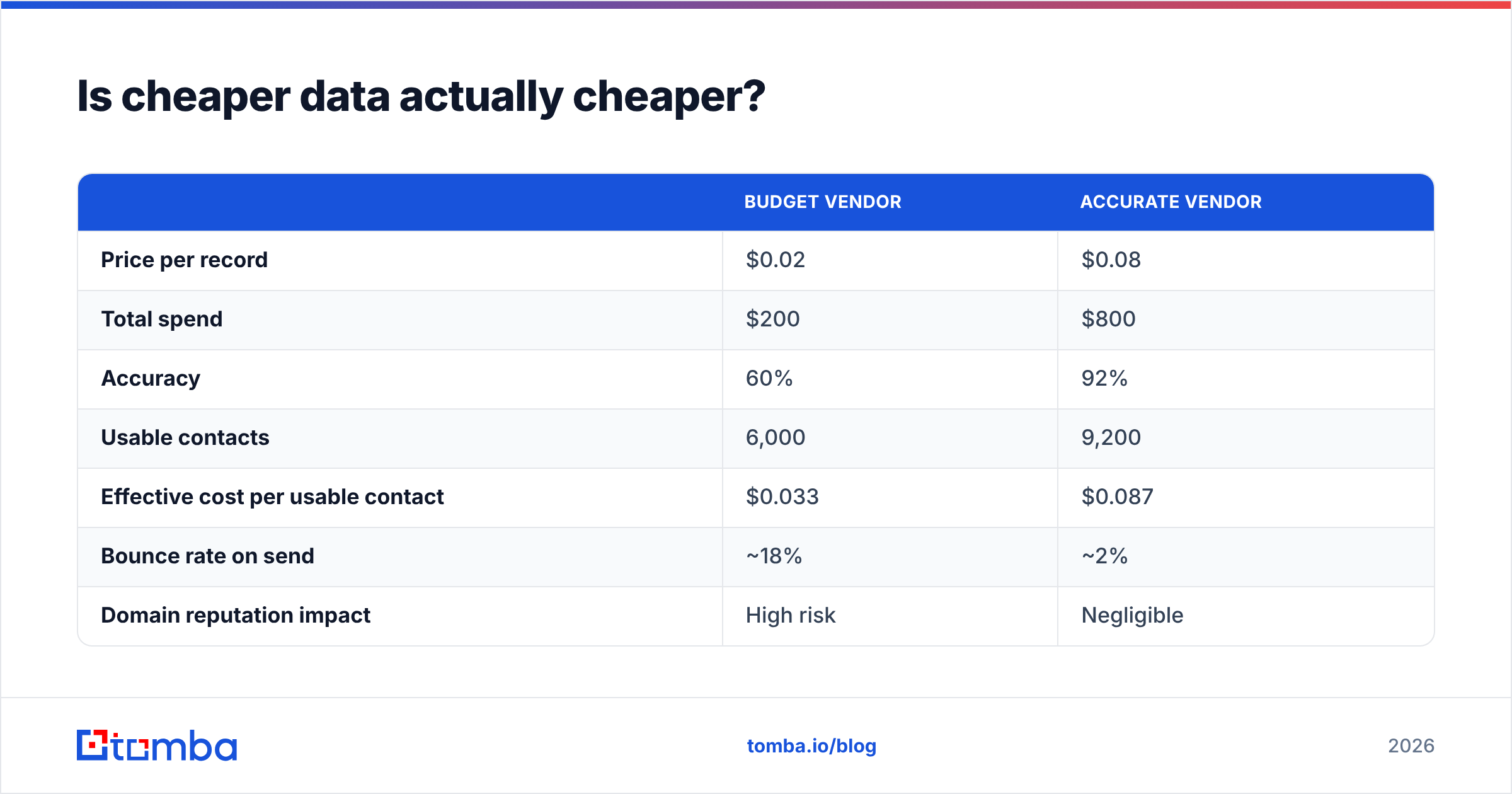
A vendor at $0.02 per record with 60% accuracy costs you more than a vendor at $0.08 per record with 92% accuracy, once you account for bounces, wasted sequence slots, and deliverability damage. Run the arithmetic on 10,000 records:
| Budget vendor | Accurate vendor | |
|---|---|---|
| Price per record | $0.02 | $0.08 |
| Total spend | $200 | $800 |
| Accuracy | 60% | 92% |
| Usable contacts | 6,000 | 9,200 |
| Effective cost per usable contact | $0.033 | $0.087 |
| Bounce rate on send | ~18% | ~2% |
| Domain reputation impact | High risk | Negligible |
| Re-verification cost | $120 | $0 |
The budget vendor still wins on raw cost-per-usable-contact — $0.033 versus $0.087. But add the 18% bounce rate throttling every subsequent campaign from your domain, and the SDR hours spent chasing dead addresses at roughly $35/hour loaded, and the ranking flips fast. Google's sender guidelines treat sustained high bounce rates as a spam signal; once you're filtered, your entire outbound CPL goes to infinity because nothing lands.
The honest framing: cheap data is fine for top-of-funnel volume plays where you'll verify anyway. It is a bad idea for a 200-account ABM list where each contact matters. Match data spend to account value.
Vendors worth evaluating in this space include BookYourData, which sells pay-as-you-go verified B2B contacts with no subscription commitment — a genuinely good fit if your buying is bursty and you'd rather not carry a monthly seat. Tomba sits at the other end of the workflow: it resolves contacts on demand from a domain or name rather than selling static files, which suits teams building fresh lists continuously. Both approaches beat scraping.
How should you structure your CPL reporting?#
Blended CPL tells you nothing actionable. Build the report with these cuts:
- By channel — the obvious one, but include organic with a fair allocation of content production cost.
- By stage — cost per raw lead, cost per MQL, cost per SQL, cost per opportunity. The ratios between these expose where qualification is leaking.
- By segment — enterprise CPL will be 4–8x SMB CPL and that's fine. Blending them hides both.
- By cohort month — attribute spend to the month it was spent, then track leads and pipeline forward from that cohort. This solves the time-window mismatch.
A practical target: get cost per SQL to under one-tenth of your average contract value. If ACV is $24,000, a $2,400 cost per SQL is defensible at a 25% close rate. If you're above that, the problem is usually conversion between stages, not top-of-funnel cost.
For teams running revenue operations properly, this report lives in the CRM and refreshes weekly. For everyone else, a spreadsheet updated monthly beats the dashboard nobody trusts.
What does a 90-day CPL reduction plan look like?#
Days 1–14: Audit. Pull true spend including labor and tooling. Deduplicate the database. Verify a random 500-contact sample from each source to establish real accuracy rates per vendor. Recalculate CPL honestly. Expect the number to go up — that's the point.
Days 15–30: Cut waste. Negative keyword sweep. Pause the bottom-quartile ad groups by cost-per-opportunity. Kill any data source under 80% verified accuracy. This phase costs nothing and typically recovers 10–20% of spend.
Days 31–60: Rebuild sourcing. Define the ICP tightly enough that a stranger could apply it. Build target-account lists from that definition. Resolve contacts with an email finder rather than buying static lists, and verify at the point of entry so nothing unverified reaches a sequence.
Days 61–90: Measure and reallocate. Compare cost per opportunity across every channel with the new, honest denominator. Shift 20% of budget from the worst channel to the best. Do not shift 100% — channel saturation is real, and the best channel at current volume may not be the best at 2x volume.
Teams that run this sequence typically see reported CPL rise in week two (honest accounting) and then fall 30–50% below the original honest baseline by day 90. The reported-CPL dip most teams chase in week one is usually just a measurement artifact.
What tools do you actually need?#
You need fewer than vendors would like you to believe. Three categories cover it:
- A data resolution layer — turns a company or a name into a current, verified contact. This is where Tomba pricing starts free at 25 searches/month, with Starter at $49/mo, Growth at $99/mo, and Pro at $249/mo for higher-volume teams.
- A verification layer — catches decay before it hits your sender reputation. Ideally this is the same vendor, called via API at the point of list entry so it's automatic rather than a manual batch job someone forgets.
- An attribution layer — your CRM, honestly configured. HubSpot and Salesforce both do multi-touch attribution adequately if someone maintains the fields.
Everything else — intent data, ABM platforms, visitor identification — is a layer you add once the basics report clean numbers. Adding intent data on top of a database with 22% invalid emails just makes the waste more expensive.
Where should you start this week?#
Pick the audit. Not the tactic — the audit. You cannot lower a number you're measuring wrong, and the single most common finding is that reported CPL is understated by 2–3x because the denominator includes leads that were never reachable.
Once you know the real number, the sequence is mechanical: dedupe, verify, exclude, rebuild sourcing, reallocate on cost per opportunity.
If the audit shows what it usually shows — that a meaningful share of your paid-for contacts are undeliverable or out-of-ICP — start by fixing sourcing at the point of entry. Tomba Email Finder resolves verified professional emails from a domain or a name, so your list is built current instead of bought stale. Free tier gives you 25 searches a month to test accuracy against your own target accounts before you commit to anything. Run it against 25 accounts you already have contacts for, compare the results, and let the match rate decide.
Related guides#
// get started
Find, verify and enrich your first contacts today
Start on the free plan with 25 searches a month, then scale when your team is ready.
Free plan · No credit card required · GDPR & CCPA
// about the author