How to Manage a Remote Sales Team in 2026: A Playbook
Remote sales teams fail for boring reasons: unclear pipeline hygiene, invisible activity, and coaching that never happens. Here is the operating system that fixes all three.
TL;DR
- Remote sales teams do not fail from lack of motivation. They fail from invisible pipeline, undefined rituals, and coaching that gets postponed forever.
- Replace surveillance with a small set of leading indicators: qualified conversations created, pipeline coverage, and stage-conversion by rep.
- Run a fixed weekly cadence — Monday commit, midweek deal desk, Friday pipeline review — and protect it like a customer meeting.
- Standardise your data layer first. Reps in five time zones cannot share prospecting judgment if half the contact records bounce.
- Coach recordings, not anecdotes. One 30-minute call review per rep per week beats four hours of status updates.
Why is managing a remote sales team harder than managing an office team?#
Because you lose the ambient signal. In an office you overhear a bad discovery call, notice a rep staring at a blank CRM screen, and correct it in 40 seconds. Remote, that same problem surfaces three weeks later as a missed quota.
Think of an office sales floor like driving with the windows down: you hear the engine knock before the dashboard warns you. Remote management is instrument flying. You only know what your instruments show, so the instruments have to be right.
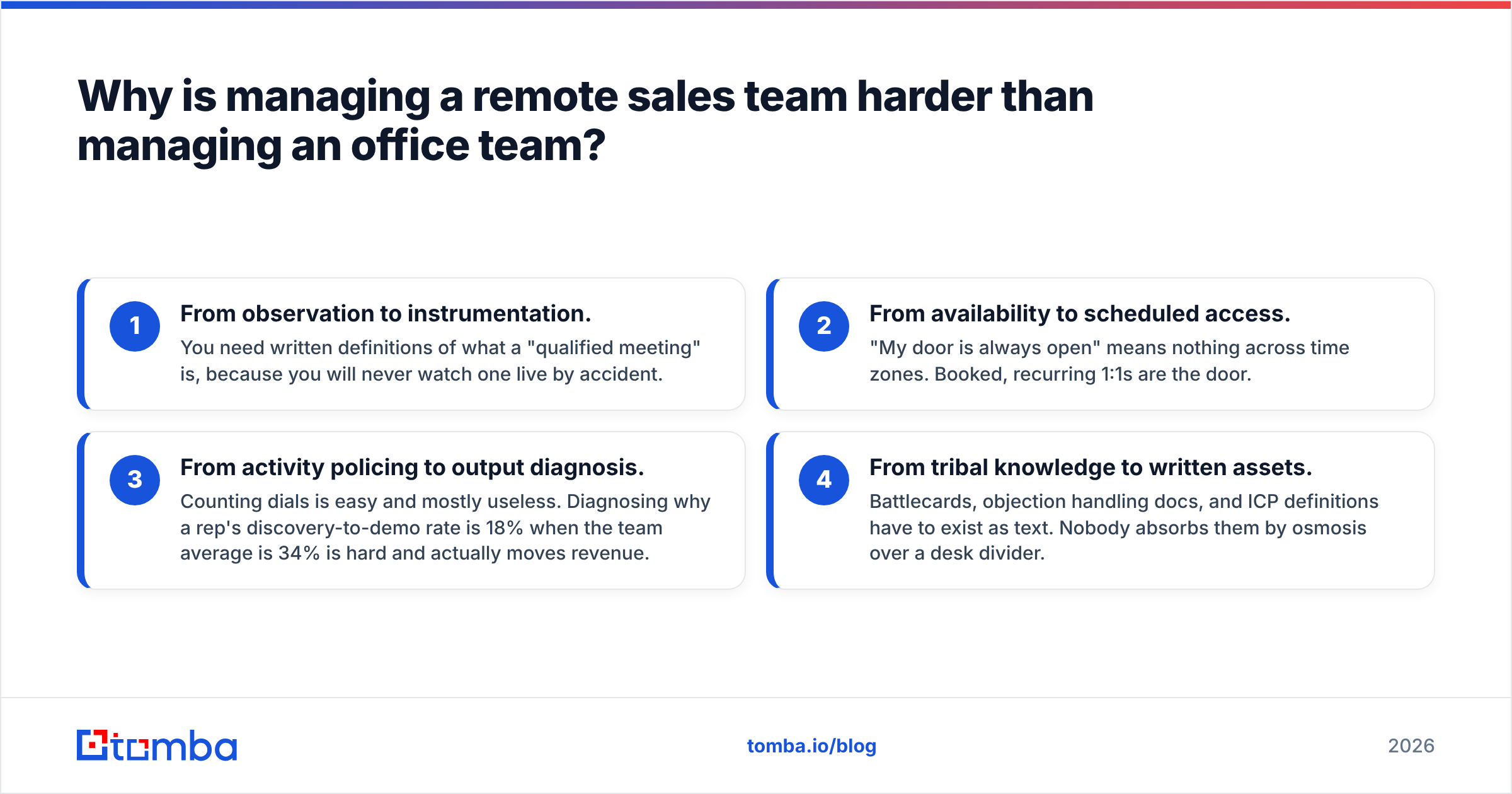
That changes what a manager's job actually is. Three shifts matter most:
- From observation to instrumentation. You need written definitions of what a "qualified meeting" is, because you will never watch one live by accident.
- From availability to scheduled access. "My door is always open" means nothing across time zones. Booked, recurring 1:1s are the door.
- From activity policing to output diagnosis. Counting dials is easy and mostly useless. Diagnosing why a rep's discovery-to-demo rate is 18% when the team average is 34% is hard and actually moves revenue.
- From tribal knowledge to written assets. Battlecards, objection handling docs, and ICP definitions have to exist as text. Nobody absorbs them by osmosis over a desk divider.

What does a remote sales team operating cadence look like?#
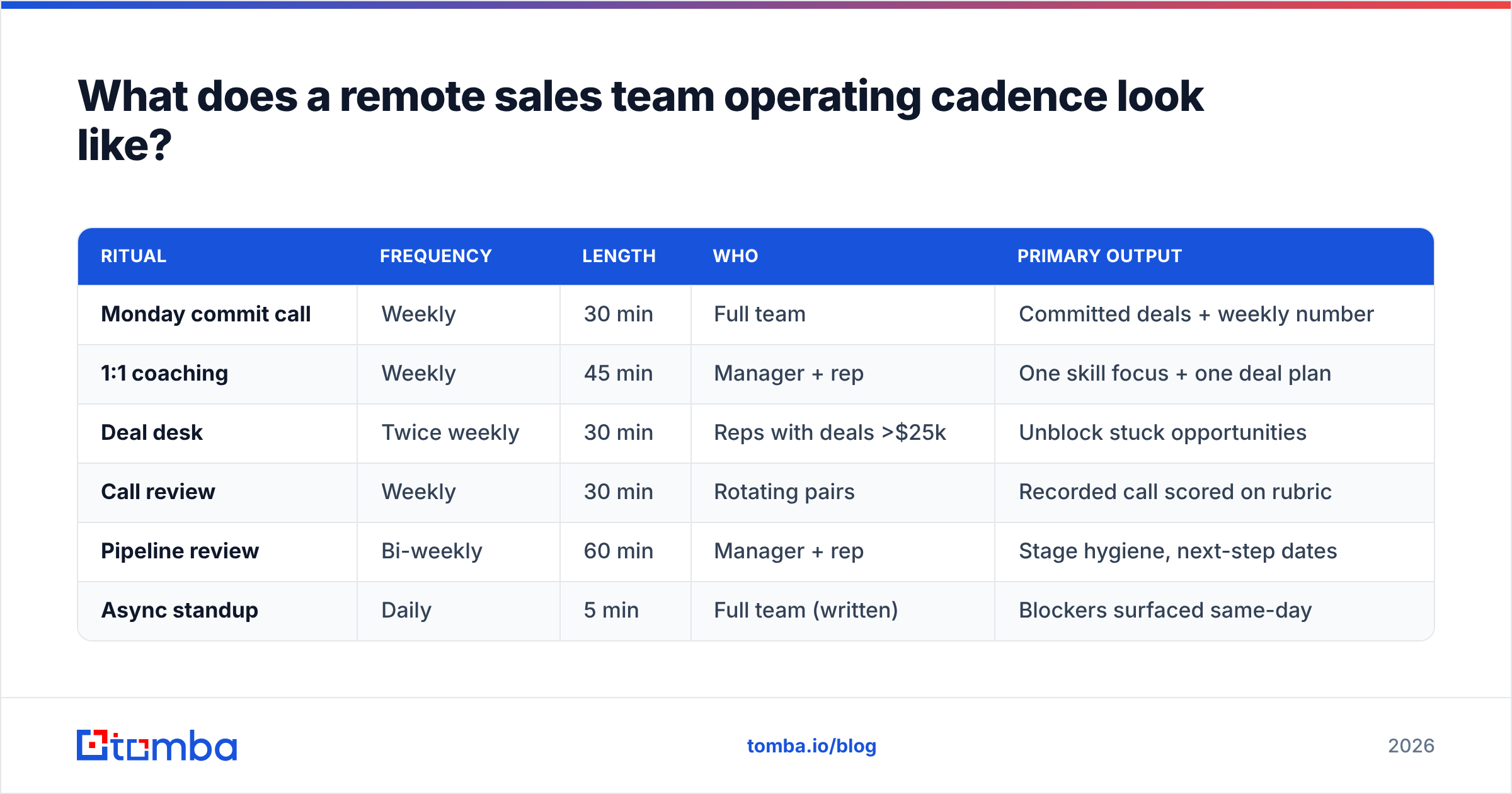
A cadence is your replacement for hallway proximity. Under-schedule and reps drift; over-schedule and you burn the selling hours you are paying for. The workable middle is roughly four hours of internal meeting time per rep per week, no more.
| Ritual | Frequency | Length | Who | Primary output |
|---|---|---|---|---|
| Monday commit call | Weekly | 30 min | Full team | Committed deals + weekly number |
| 1:1 coaching | Weekly | 45 min | Manager + rep | One skill focus + one deal plan |
| Deal desk | Twice weekly | 30 min | Reps with deals >$25k | Unblock stuck opportunities |
| Call review | Weekly | 30 min | Rotating pairs | Recorded call scored on rubric |
| Pipeline review | Bi-weekly | 60 min | Manager + rep | Stage hygiene, next-step dates |
| Async standup | Daily | 5 min | Full team (written) | Blockers surfaced same-day |
Two rules make this work. First, the async standup is written — Slack thread, not a call — so your rep in Lisbon is not dialling in at 11pm for Denver's morning. Second, the Monday commit call never becomes a status readout. Numbers go in the sheet before the meeting; the meeting is only for deals where the commit is in doubt.
If you run a distributed team across more than four time zones, split the commit call into two regional sessions rather than forcing one bad time on everyone. The cost of a duplicated 30-minute meeting is far lower than the cost of chronically disengaged reps.
Which metrics actually tell you if a remote rep is working?#
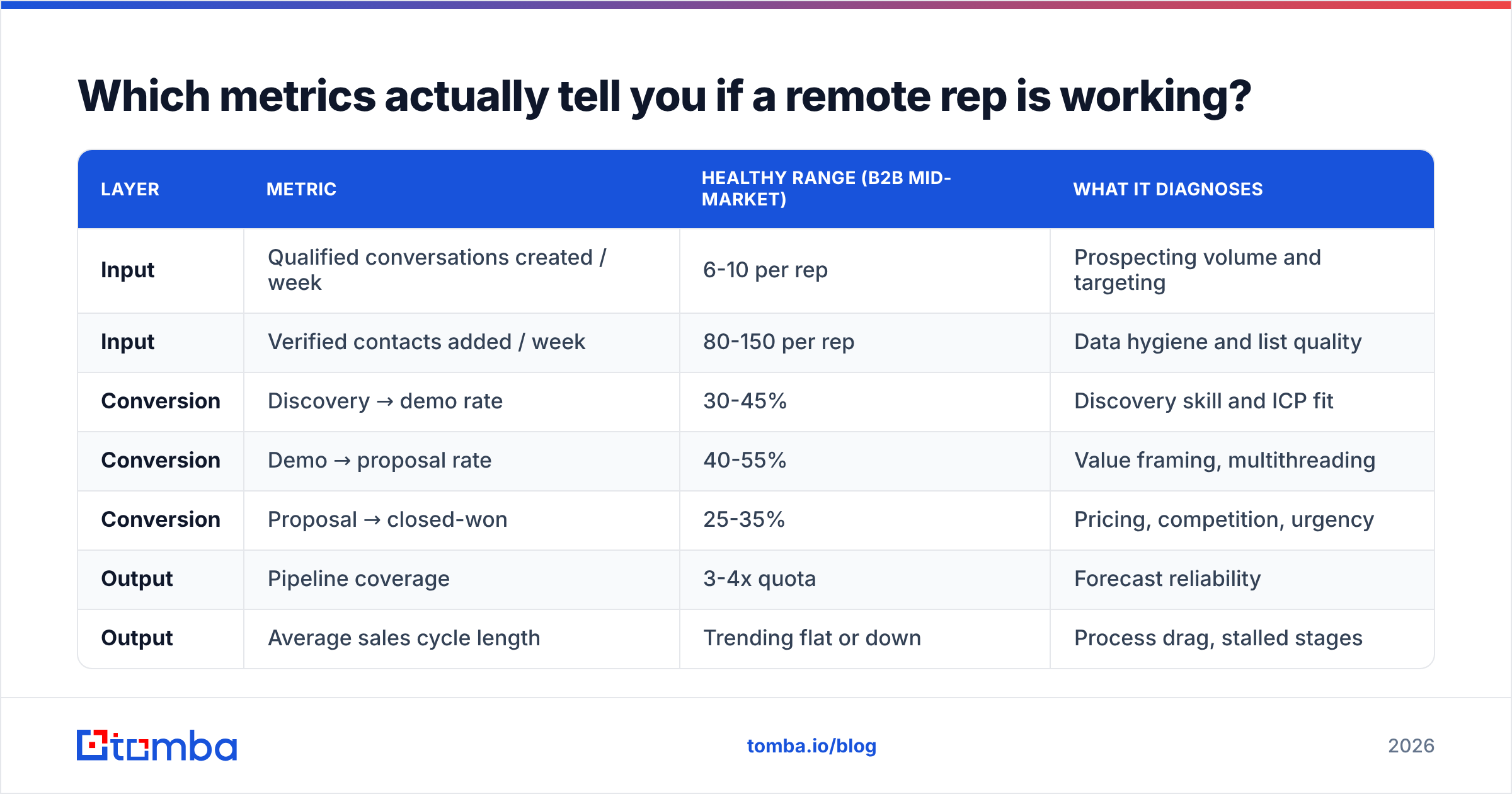
Stop measuring presence. Measure the three-layer stack: inputs you control, conversions you coach, and outputs you forecast.
| Layer | Metric | Healthy range (B2B mid-market) | What it diagnoses |
|---|---|---|---|
| Input | Qualified conversations created / week | 6-10 per rep | Prospecting volume and targeting |
| Input | Verified contacts added / week | 80-150 per rep | Data hygiene and list quality |
| Conversion | Discovery → demo rate | 30-45% | Discovery skill and ICP fit |
| Conversion | Demo → proposal rate | 40-55% | Value framing, multithreading |
| Conversion | Proposal → closed-won | 25-35% | Pricing, competition, urgency |
| Output | Pipeline coverage | 3-4x quota | Forecast reliability |
| Output | Average sales cycle length | Trending flat or down | Process drag, stalled stages |
The metric most remote teams skip is verified contacts added per week, and it is the one that quietly determines everything downstream. A rep who sourced 120 contacts from a scraped list where 30% bounce is not running the same experiment as a rep who sourced 120 verified contacts. Their reply rates are not comparable, so their coaching cannot be either. Standardise the sourcing layer with a shared email finder and a mandatory verification step before anything enters a sequence, and suddenly rep-to-rep comparisons mean something.
Watch your response rate at the team level too. If it drops across every rep in the same week, the problem is not the humans — it is deliverability, list quality, or a messaging change nobody flagged.
How do you coach reps you never see in person?#
Record everything, review selectively, coach one thing at a time.
The failure mode is a manager who watches 12 calls a week, gives every rep six pieces of feedback, and changes nobody's behaviour. The fix is a rubric and a single focus area per rep per month.
Build a five-line scoring rubric your team agrees on:
- Opening — did the rep earn the next 10 minutes in the first 60 seconds?
- Discovery depth — how many layers past the surface problem did they get?
- Multithreading — was a second stakeholder named and a path to them agreed?
- Next step — is there a specific date and agenda on the calendar before the call ends?
- Talk ratio — did the rep stay under 45% of airtime?
Score two calls per rep per week against that rubric. Share the scores in a shared doc so reps can see each other's — peer visibility does more for remote skill transfer than any manager lecture. Gong's research on sales conversations is a reasonable public benchmark set if you want external calibration for talk ratios and next-step rates.
Then pair reps for cross-review. A rep who scores a peer's call learns more than a rep who receives feedback, because scoring forces them to articulate the standard. Rotate pairs monthly so cliques do not form.
For onboarding, the remote-specific requirement is a written 30-60-90 with weekly checkpoints. In-office new hires learn by absorption. Remote new hires learn by explicit instruction or not at all. Budget roughly 40% more structured onboarding content than you would for an in-office equivalent.
What tools does a remote sales team actually need?#
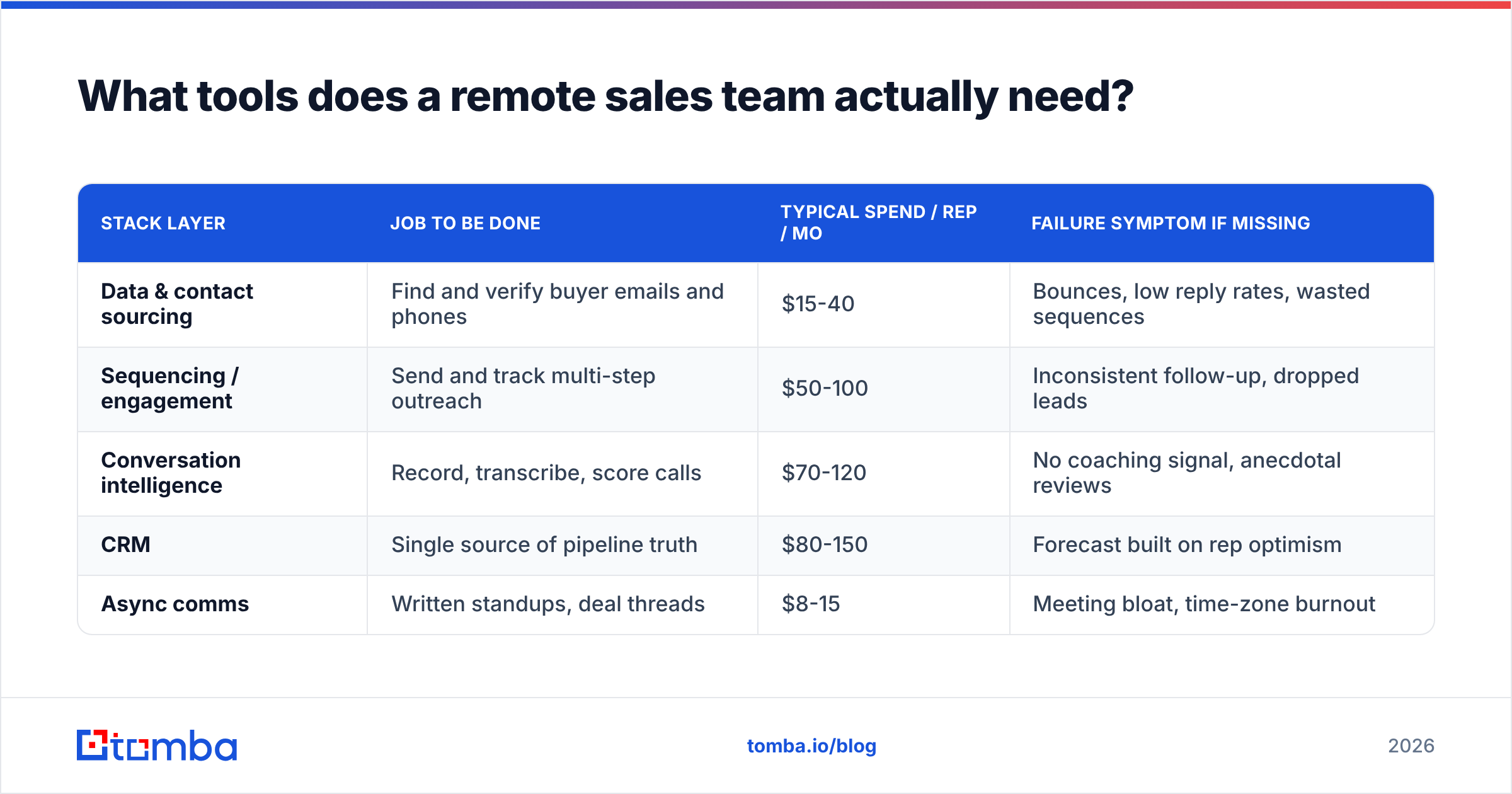
Fewer than vendors would like you to believe. The stack has four jobs: find contacts, sequence outreach, record conversations, and track pipeline. Everything else is optional until it demonstrably is not.
| Stack layer | Job to be done | Typical spend / rep / mo | Failure symptom if missing |
|---|---|---|---|
| Data & contact sourcing | Find and verify buyer emails and phones | $15-40 | Bounces, low reply rates, wasted sequences |
| Sequencing / engagement | Send and track multi-step outreach | $50-100 | Inconsistent follow-up, dropped leads |
| Conversation intelligence | Record, transcribe, score calls | $70-120 | No coaching signal, anecdotal reviews |
| CRM | Single source of pipeline truth | $80-150 | Forecast built on rep optimism |
| Async comms | Written standups, deal threads | $8-15 | Meeting bloat, time-zone burnout |
Note what is not on that list: activity-surveillance software, screen recorders, mouse-movement trackers. They correlate with attrition, not attainment, and they signal to good reps that you do not trust them. If you cannot tell whether a rep is working from their pipeline and call recordings, more surveillance will not help — your metric definitions are broken.
On the data layer specifically, centralise it rather than letting each rep buy their own tool. When 8 reps use 8 different sources, your CRM becomes a landfill of conflicting records. A single shared source with bulk email finder capability and API access means list-building becomes a repeatable process instead of eight private habits. If your reps live in spreadsheets, a Google Sheets integration removes the last excuse for uncleaned lists.
How do you keep remote reps motivated without micromanaging?#
Compensation, visibility, and autonomy — in that order.
Compensation. Remote teams are more comp-sensitive than office teams, because comp is the clearest signal in a low-signal environment. Keep plans to one page and no more than three components. If a rep cannot calculate their own commission in under two minutes, your plan is too complex and will breed distrust you cannot see.
Visibility. Public leaderboards work, but only when they include leading indicators, not just closed revenue. A ramping rep who is top of the team on qualified conversations created deserves visible credit even if their bookings are three months out. Post both boards.
Autonomy. Define the outcome and the guardrails, then stop specifying the method. Tell a rep they own 40 target accounts and need 8 qualified conversations a week; do not tell them which hours to prospect. Remote work's actual advantage is schedule control, and managers who claw it back get office-level output at remote-level coordination cost — the worst of both.
Also budget for real in-person time. Two on-sites a year, three days each, does more for trust than any virtual happy hour. Gartner's research on hybrid work consistently finds that intentional, purpose-built in-person time outperforms mandated office attendance for distributed knowledge teams.
How do you handle pipeline hygiene when nobody is watching?#
Automate the enforcement so it is not a personality conflict.
Set three non-negotiable CRM rules and enforce them with automation rather than nagging:
- Every open opportunity has a future-dated next step. No next step, no forecast inclusion. Run the report every Friday and the list of offenders is objective, not personal.
- Stage definitions are exit criteria, not vibes. "Discovery" ends when you have a documented pain, a budget range, and a named decision process — not when the rep feels good about it.
- Contact records require a verified email. Make verification a required field. Use an email verifier as a gate on import so unverifiable records never enter the pipeline in the first place.
The third rule catches more forecast rot than most managers expect. Deals where the only contact is a guessed address at a catch-all domain close at a fraction of the rate of deals with verified, multithreaded contacts. Making that visible in your CRM turns a data problem into a coachable pipeline problem.
For teams running enrichment at scale, wiring the Tomba API into your CRM's create-record flow means hygiene happens at write time. A rep cannot save a contact without a verified address because the system does it for them. That is the whole trick with remote hygiene: make the correct path the easy path, and stop relying on discipline you cannot observe.
What does a 90-day plan for a new remote sales manager look like?#
Days 1-30 — instrument. Do not change anything yet. Sit in on two calls per rep. Pull 90 days of historical conversion data and find the two worst stage transitions. Document current stage definitions, however bad they are. Meet every rep 1:1 and ask one question: "What slows you down that I can't see?"
Days 31-60 — standardise. Publish stage exit criteria. Install the meeting cadence. Roll out the call rubric and score your first calls yourself before delegating peer reviews. Consolidate the data layer to one sourcing tool and one verification standard. Expect friction here; reps who built private list-building workflows will resist, and the answer is to show them the bounce-rate delta rather than to argue about tools.
Days 61-90 — coach and cut. Now the metrics mean something. Identify the one skill gap that is costing the most revenue across the team and run a focused four-week program on it. Simultaneously, be honest about reps whose input metrics are healthy but whose conversion is structurally below team floor after adequate coaching — remote environments hide underperformance longer, and correcting late is worse for everyone including the rep.
By day 90 you should be able to answer, from a dashboard rather than from memory: which rep needs help, on which skill, in which deal stage. If you cannot, the instrumentation from days 1-30 was incomplete and you should go back rather than push forward.
Where should you start this week?#
Pick the one that is most broken. For most remote sales teams that is either the meeting cadence (too many status meetings, no coaching) or the data layer (every rep sourcing differently, bounce rates nobody tracks).
The data layer is the faster fix and the higher leverage one, because it makes every other metric trustworthy. Standardise on a single source for finding and verifying buyer contacts, gate it at CRM import, and give every rep the same starting quality. Tomba's email finder covers domain search, verification, and enrichment from one account with a free tier at 25 searches a month to test the workflow, then $49/mo on Starter and $99/mo on Growth once your team is committed — see Tomba pricing for how the plans map to team size. Get your reps working from the same clean data, and the coaching conversations that follow will finally be about selling instead of about spreadsheets.
Related guides#
Ready to find emails that actually work?
Join 150,000+ professionals who stopped guessing and started sending. Free credits on signup — no credit card required.
Get the Tomba newsletter
Practical outbound tactics and product updates — once every two weeks.
About the author