How to Market SaaS Software in 2026: A Practical Playbook
Most SaaS marketing advice stops at "do content and ads." This playbook breaks down the channels that actually move ARR in 2026, what each one costs, and how to pick the right motion for your price point.
TL;DR
- There is no single way to market SaaS software. Your annual contract value (ACV) decides your motion: under $1,000 ACV means self-serve and product-led growth; above $15,000 ACV means outbound and sales-led.
- The seven channels that reliably work in 2026 are SEO/programmatic content, outbound email, paid search, partner/integration marketing, community, product-led loops, and review sites. Everything else is a supporting act.
- Track payback period, not cost per lead. A $680 CAC is fine at $200/mo and fatal at $19/mo.
- Outbound is not dead — bad data killed it. Verified contact data changes reply rates more than any subject-line tweak.
- Pick two channels, run them for two quarters, and only then add a third. Most sub-$1M ARR teams fail by spreading across six.
What does "marketing SaaS software" actually mean in 2026?#
Marketing SaaS is not marketing a product. It is marketing a subscription decision that a buyer can reverse next month. That single fact reshapes everything: your job is not to close a sale, it is to shorten the time between "I have a problem" and "I have logged in and done the thing."
Three structural changes since 2023 matter for how you plan:
- Search traffic is compressed. AI overviews absorb informational queries. Thin "what is X" posts no longer earn clicks. Bottom-funnel comparison and pricing pages still do.
- Buying committees grew. Gartner's B2B buying research has consistently put the average enterprise software committee somewhere between six and ten people. You are not persuading one champion; you are arming one champion to persuade five colleagues.
- Free trials became free tiers. The default expectation is that a prospect can touch the product before talking to a human, even in mid-market.
So the practical question is not "how do I get more leads." It is: given my price point, which two channels produce a payback period my runway can survive?
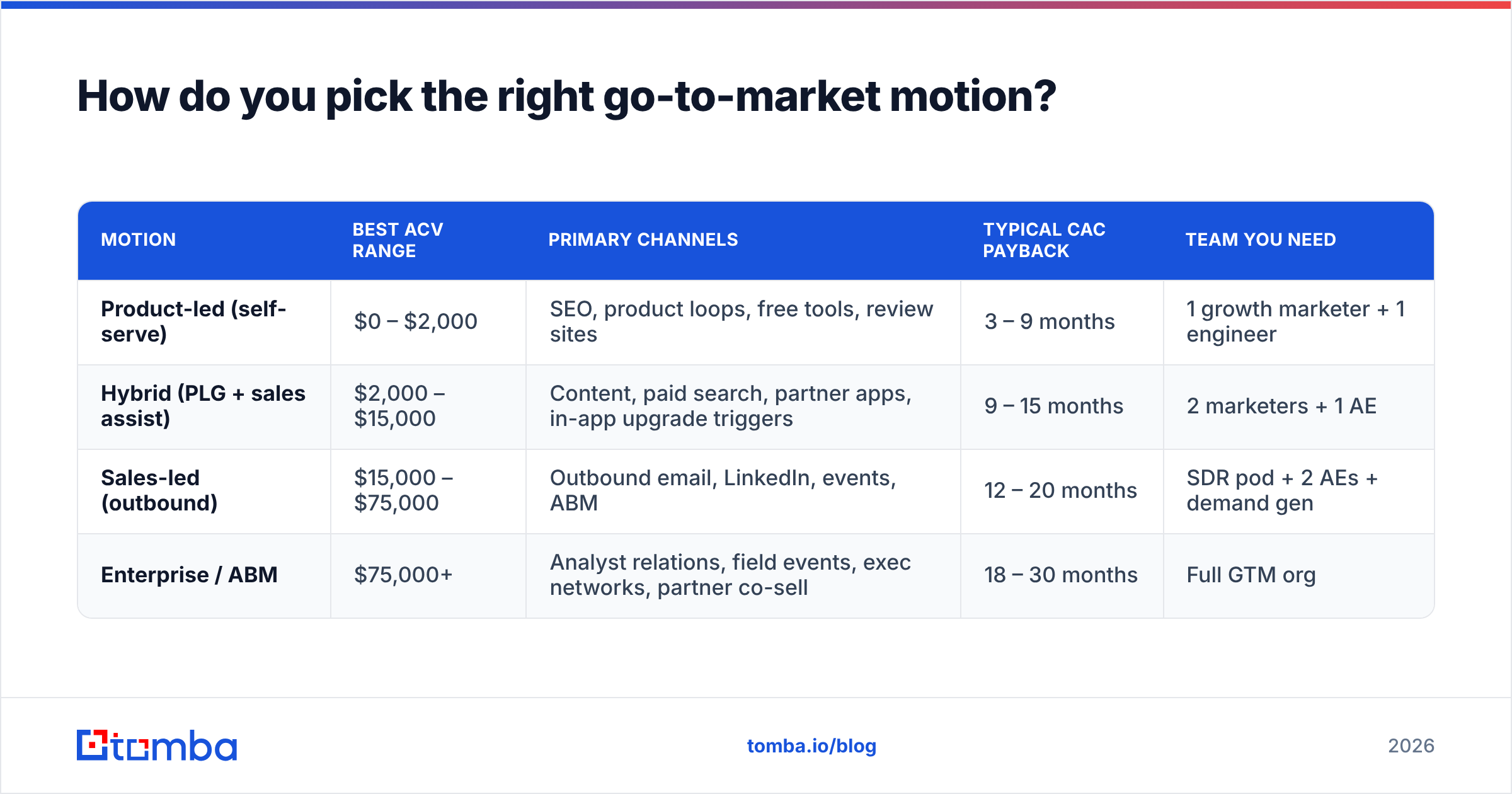
How do you pick the right go-to-market motion?#
Start with ACV. It is the single strongest predictor of what will work.
| Motion | Best ACV range | Primary channels | Typical CAC payback | Team you need |
|---|---|---|---|---|
| Product-led (self-serve) | $0 – $2,000 | SEO, product loops, free tools, review sites | 3 – 9 months | 1 growth marketer + 1 engineer |
| Hybrid (PLG + sales assist) | $2,000 – $15,000 | Content, paid search, partner apps, in-app upgrade triggers | 9 – 15 months | 2 marketers + 1 AE |
| Sales-led (outbound) | $15,000 – $75,000 | Outbound email, LinkedIn, events, ABM | 12 – 20 months | SDR pod + 2 AEs + demand gen |
| Enterprise / ABM | $75,000+ | Analyst relations, field events, exec networks, partner co-sell | 18 – 30 months | Full GTM org |
The mistake almost every founder makes is running a sales-led motion on a product-led price. If your plan is $29/month, an SDR costs you more per meeting than the customer's lifetime value. Conversely, running pure self-serve on a $40,000 contract leaves money on the table because nobody buys that on a credit card without a conversation.
Sorry — that placeholder needs to be clean:
Which SaaS marketing channels actually work?#
Here is the honest ranking, based on what consistently produces pipeline rather than impressions.
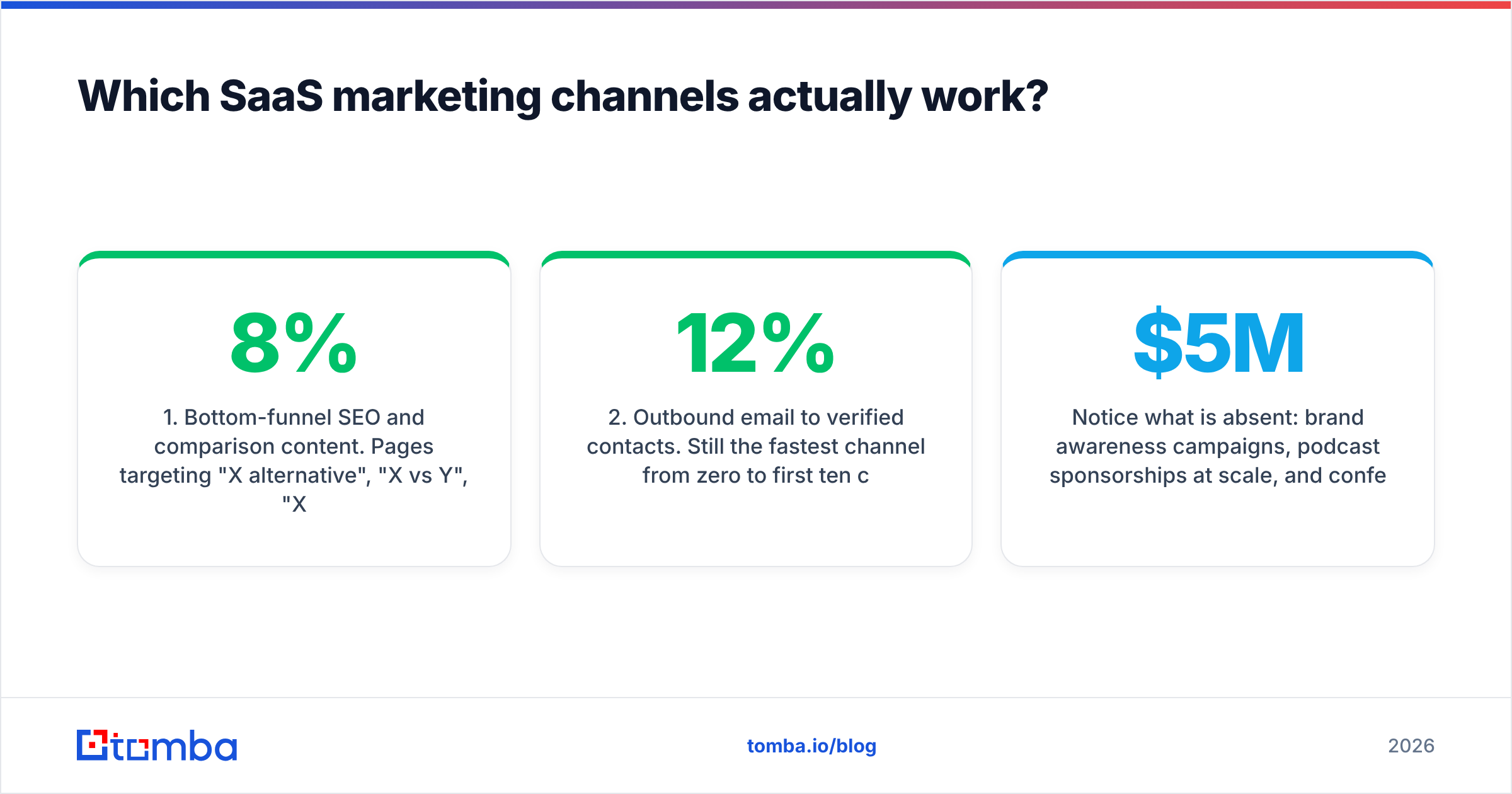
1. Bottom-funnel SEO and comparison content. Pages targeting "X alternative", "X vs Y", "X pricing", and "best tools for [job]" convert at 3–8% to trial, versus well under 1% for top-funnel explainers. This is where you spend first. A single well-maintained alternatives page can carry a company's organic pipeline for years.
2. Outbound email to verified contacts. Still the fastest channel from zero to first ten customers, because you control volume. The catch: it only works if your list is real. A 12% bounce rate does not just waste sends — it damages sender reputation and drags down every future campaign from that domain.
3. Paid search on high-intent terms. Competitor and category terms. Not "sales software" — "hubspot alternative for agencies". Expensive per click, cheap per closed deal.
4. Integration and marketplace listings. If you connect to Salesforce, HubSpot, Slack, or Shopify, their marketplaces are underpriced distribution. HubSpot's App Marketplace alone routinely drives meaningful install volume for niche tools with zero ad spend.
5. Review sites. G2 and Capterra profiles rank for your category terms and get cited in AI-generated buying summaries. Twenty real reviews beats a thousand ad impressions in a buying committee argument.
6. Free tools and calculators. Cheap to build, permanently linkable, and they qualify intent. A subject line generator or email warmup calculator pulls exactly the audience that will later buy the paid product.
7. Community and founder-led social. Slowest to compound, hardest to fake, highest trust ceiling. Works best when a technical founder is genuinely present.
Notice what is absent: brand awareness campaigns, podcast sponsorships at scale, and conference booths. They are not worthless — they are simply not first moves for a company under $5M ARR.
How do you build an outbound motion that does not burn your domain?#
Outbound has a reputation problem because most teams execute it badly. The mechanics that separate a 9% reply rate from a 0.8% reply rate are boring and mostly happen before a single word of copy is written.
Step 1 — Define the account list narrowly. "B2B SaaS companies" is not a list. "Series A–B SaaS companies with 20–80 employees running HubSpot and hiring SDRs" is a list. Use technographic and hiring signals to cut it.
Step 2 — Find the right person, not any person. Title-only targeting fills your sequence with people who cannot sign. Map the actual buyer for your ACV band: at $5K it is usually a director; at $50K it is a VP with a budget line.
Step 3 — Get verified contact data. This is the step teams skip, and it is the one that determines whether anything else matters. Pull contacts with an email finder, then run the whole list through an email verifier before it touches your sending tool. Aim for a bounce rate under 2%. Catch-all domains need separate handling — a catch-all verifier will tell you which ones are safe to send to rather than forcing you to guess.
Step 4 — Warm the domain and split the volume. Use a separate sending domain from your primary. Ramp over three to four weeks. Cap per-inbox volume at 30–50 sends per day.
Step 5 — Write for one problem, not your feature list. Two to four sentences. One specific observation about their business. One low-friction ask.
Step 6 — Measure reply rate and meeting rate. Open rate is now close to meaningless thanks to privacy proxies and image pre-fetching. If your dashboard leads with opens, you are optimizing a ghost.
The compounding effect matters here: clean data improves deliverability, deliverability improves reply rate, and reply rate improves your willingness to keep sending. Dirty data reverses all three at once.
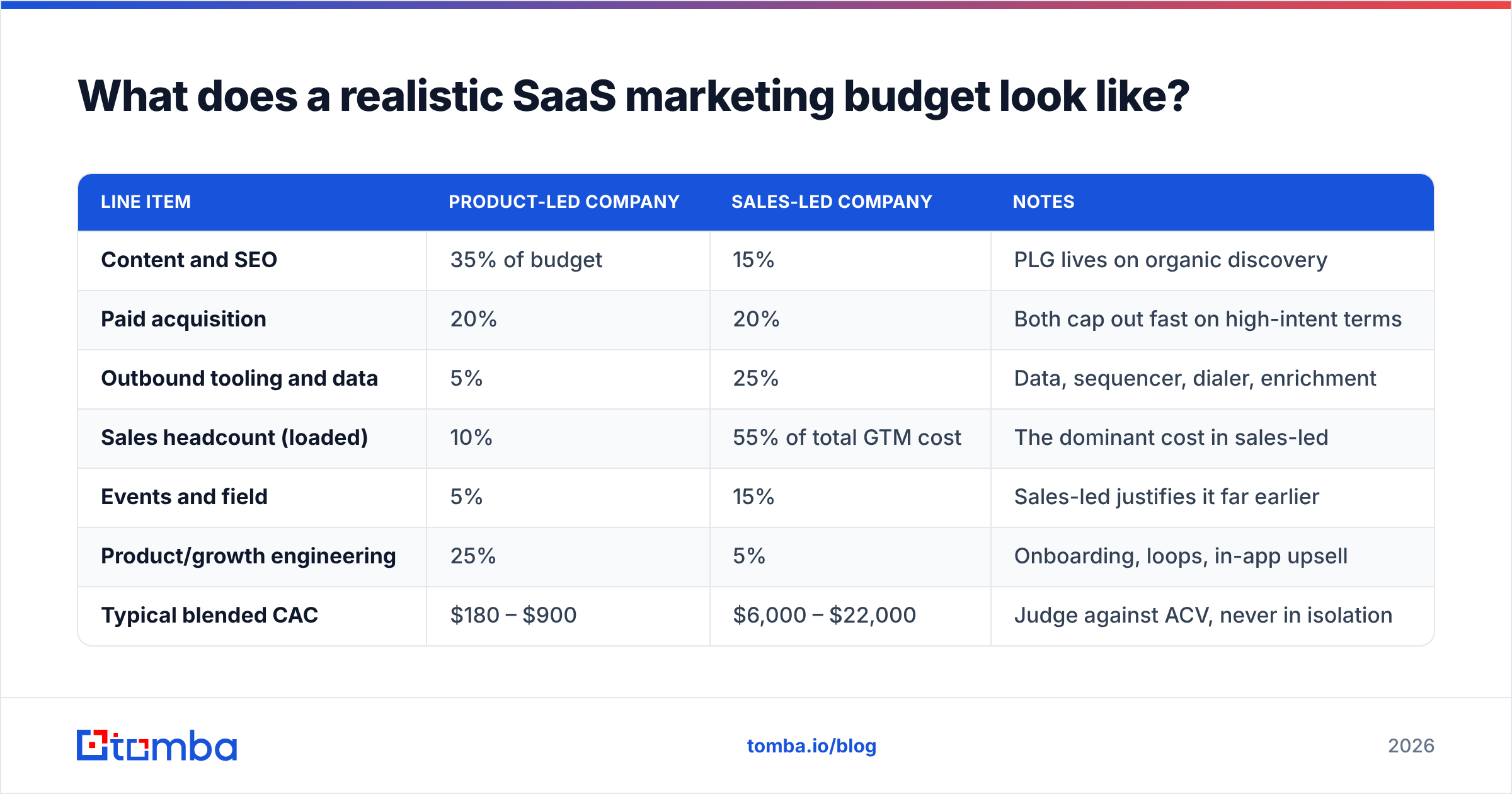
What does a realistic SaaS marketing budget look like?#
Benchmarks vary wildly by stage, so here is a comparison of how spend typically splits across the two dominant motions at roughly $1–3M ARR.
| Line item | Product-led company | Sales-led company | Notes |
|---|---|---|---|
| Content and SEO | 35% of budget | 15% | PLG lives on organic discovery |
| Paid acquisition | 20% | 20% | Both cap out fast on high-intent terms |
| Outbound tooling and data | 5% | 25% | Data, sequencer, dialer, enrichment |
| Sales headcount (loaded) | 10% | 55% of total GTM cost | The dominant cost in sales-led |
| Events and field | 5% | 15% | Sales-led justifies it far earlier |
| Product/growth engineering | 25% | 5% | Onboarding, loops, in-app upsell |
| Typical blended CAC | $180 – $900 | $6,000 – $22,000 | Judge against ACV, never in isolation |
Two rules to apply to any budget:
- Payback under 12 months for SMB, under 18 for mid-market. If you cannot model that, the channel does not qualify for spend yet.
- Never let one channel exceed 60% of pipeline. Single-channel companies are one algorithm update away from a bad quarter.

How does product-led growth change the marketing job?#
In a PLG company, the product is a marketing channel and marketing owns activation, not just acquisition. Three concrete implications:
- Instrument the aha moment. Define the single action that predicts retention — a first campaign sent, a first integration connected, a first report shared. Then measure the percentage of signups reaching it within seven days. That number is your real conversion rate.
- Build loops, not funnels. A loop is any mechanism where using the product generates new users: shared documents, public profiles, invite-a-teammate, embedded badges. One working loop outperforms three campaigns.
- Sell to the team, not the seat. Expansion revenue in PLG comes from seat growth. Your in-app messaging should make inviting a colleague the easiest action on the screen.
- Keep a sales-assist lane. Roughly 10–20% of self-serve signups are enterprise accounts in disguise. Route them to a human based on domain size and behavior, using contact enrichment to identify who just signed up from a 2,000-person company.
The trap in PLG is treating free users as a marketing metric. Fifty thousand free accounts that never activate cost you infrastructure and tell you nothing. Ten thousand activated accounts with a 4% paid conversion is a business.
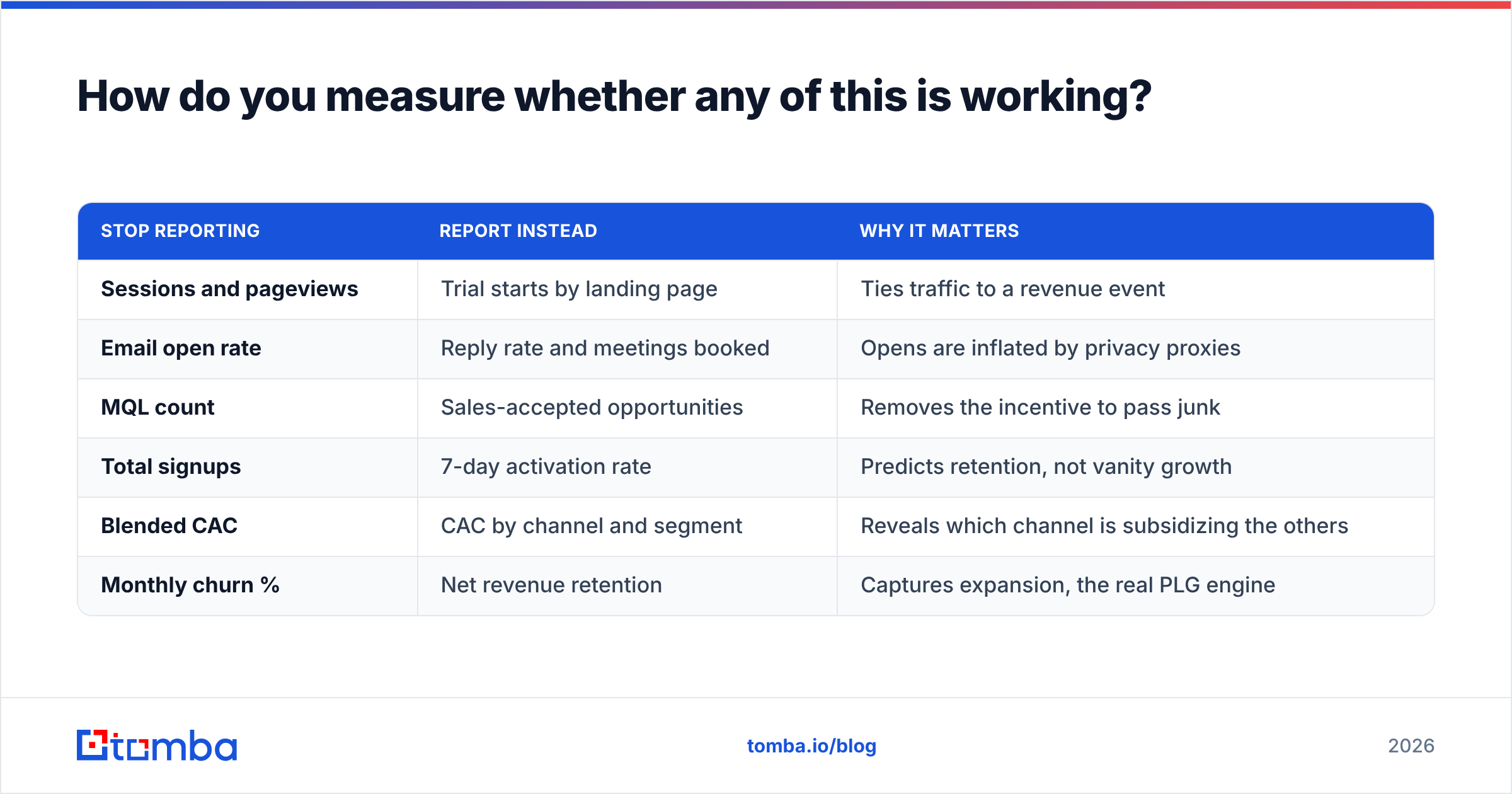
How do you measure whether any of this is working?#
Vanity metrics are the default failure mode of SaaS marketing. Replace them deliberately.
| Stop reporting | Report instead | Why it matters |
|---|---|---|
| Sessions and pageviews | Trial starts by landing page | Ties traffic to a revenue event |
| Email open rate | Reply rate and meetings booked | Opens are inflated by privacy proxies |
| MQL count | Sales-accepted opportunities | Removes the incentive to pass junk |
| Total signups | 7-day activation rate | Predicts retention, not vanity growth |
| Blended CAC | CAC by channel and segment | Reveals which channel is subsidizing the others |
| Monthly churn % | Net revenue retention | Captures expansion, the real PLG engine |
Set a review cadence: weekly for spend and pipeline, monthly for channel CAC, quarterly for payback and NRR. A channel gets two full quarters before you judge it — SEO in particular will look like a failure at month three and a bargain at month nine.
For a shared vocabulary across sales and marketing, keep definitions written down. If your team argues about what counts as an MQL, the argument is a symptom of missing revenue operations discipline, not a definitional dispute.
What is a realistic 90-day plan for a small team?#
If you have two marketers and limited budget, here is the sequence that produces the most pipeline per hour.
Days 1–30: foundation and one channel.
- Write three bottom-funnel pages: your top competitor alternative, a pricing/cost breakdown, and a "best tools for [specific job]" roundup.
- Claim and complete G2 and Capterra profiles. Ask ten happy customers for reviews.
- Build one target account list of 300 companies with verified contacts.
Days 31–60: add outbound and instrument.
- Warm two sending domains. Launch a 300-contact sequence with three touches.
- Install proper analytics: trial starts by source, activation rate, reply rate.
- Publish two more comparison pages.
Days 61–90: double down, kill the rest.
- Compare cost per opportunity across the two channels.
- Kill anything you started "because everyone does it" — the newsletter nobody opens, the TikTok experiment, the podcast.
- Scale the winner by 2x, not 10x. Channels break at scale in non-obvious ways.
Resist adding channel number three before day 90. The most common cause of flat SaaS growth is not a bad channel — it is four channels each run at 25% effort.
Where do most SaaS marketing plans go wrong?#
Five recurring failures, in rough order of how much damage they cause:
- Targeting a market too broad to message. "Any business with a website" produces copy nobody recognizes themselves in. Narrow until your headline feels almost too specific, then narrow once more.
- Building top-funnel content first. "What is customer success" ranks against a thousand competitors and converts at 0.3%. Start at the bottom of the funnel and work upward.
- Sending to unverified lists. Every hard bounce compounds against your domain. Verification is the cheapest insurance in the entire stack.
- Confusing activity with progress. Fifteen blog posts a month with no distribution plan is a content treadmill, not a channel.
- Ignoring the expansion motion. It is roughly five times cheaper to grow an existing account than to win a new one. If nobody owns expansion, you are refilling a leaking bucket with paid ads.
The counter to all five is the same: fewer bets, better measured, held longer.
Where should you start this week?#
Pick your motion from ACV, choose two channels, and fix your data before you scale volume. Marketing SaaS software is less about clever tactics than about running a small number of things consistently while measuring payback honestly.
If your next move is outbound — and for most sub-$1M ARR teams it should be, because it is the only channel where you control the volume dial — start with the contact layer. The Tomba Email Finder pulls verified professional email addresses by domain, name, or company, with a free tier of 25 searches per month to test list quality before you commit. Paid plans start at $49/month (Starter), $99/month (Growth), and $249/month (Pro); full Tomba pricing is public. Build one clean list of 300 accounts, verify it, and send. That single exercise will teach you more about your market than another quarter of blog posts.
Related guides#
// get started
Find, verify and enrich your first contacts today
Start on the free plan with 25 searches a month, then scale when your team is ready.
Free plan · No credit card required · GDPR & CCPA
Get the Tomba newsletter
Product and data updates
// about the author