How to Politely Ask Someone to Reply to an Email: 9 Examples
Nine copy-paste scripts for chasing a reply without sounding needy, plus the timing windows, subject lines, and one-question rule that actually get responses in 2026.
TL;DR
- The politest follow-up is the shortest one: one sentence of context, one specific question, one easy exit. Anything longer reads as pressure.
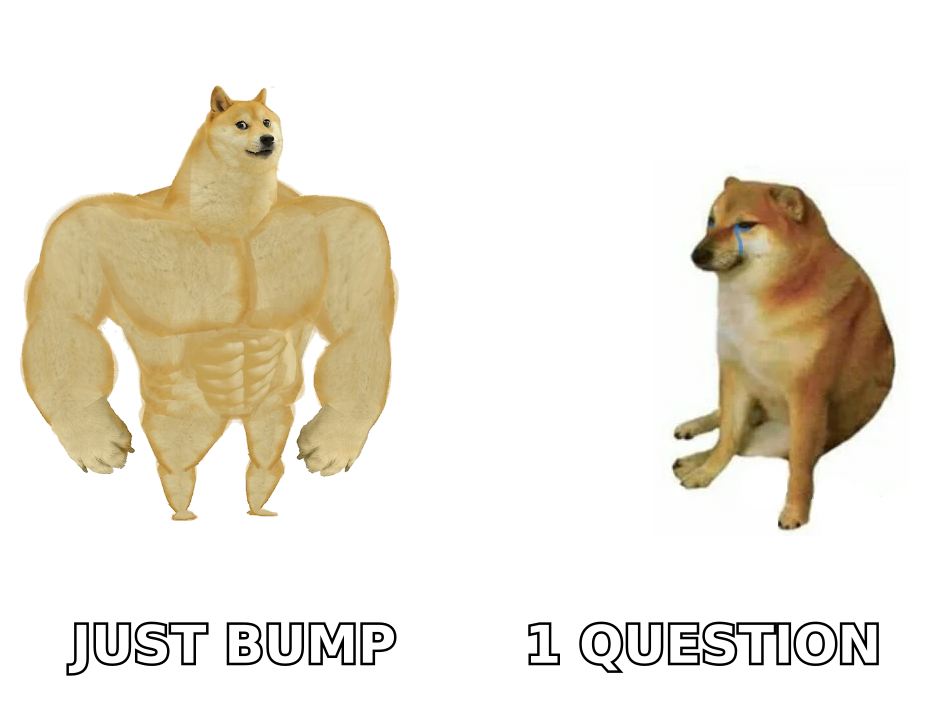
- "Just bumping this to the top of your inbox" is dead weight. Replace the bump with a new reason to reply — a deadline, a fresh data point, or a one-tap yes/no option.
- Wait 2–3 business days after the first send, then 4–7 days, then close the loop. Three touches on a warm thread is polite; six is harassment.
- Give people a graceful no. "If this isn't a priority right now, just reply 'not now' and I'll stop chasing" gets replies precisely because it lowers the cost of answering.
- None of it matters if the address is wrong. Verify before you chase — a bounced follow-up looks like silence and burns your sender reputation.
You wrote a good email. You got nothing back. Now you're staring at a blank reply box trying to work out how to ask again without sounding desperate, passive-aggressive, or like a subscription renewal notice.
This post gives you nine tested scripts, the timing rules behind them, and the psychological reason each one works. Copy them, change the nouns, send them.
Why do people ignore your first email?#
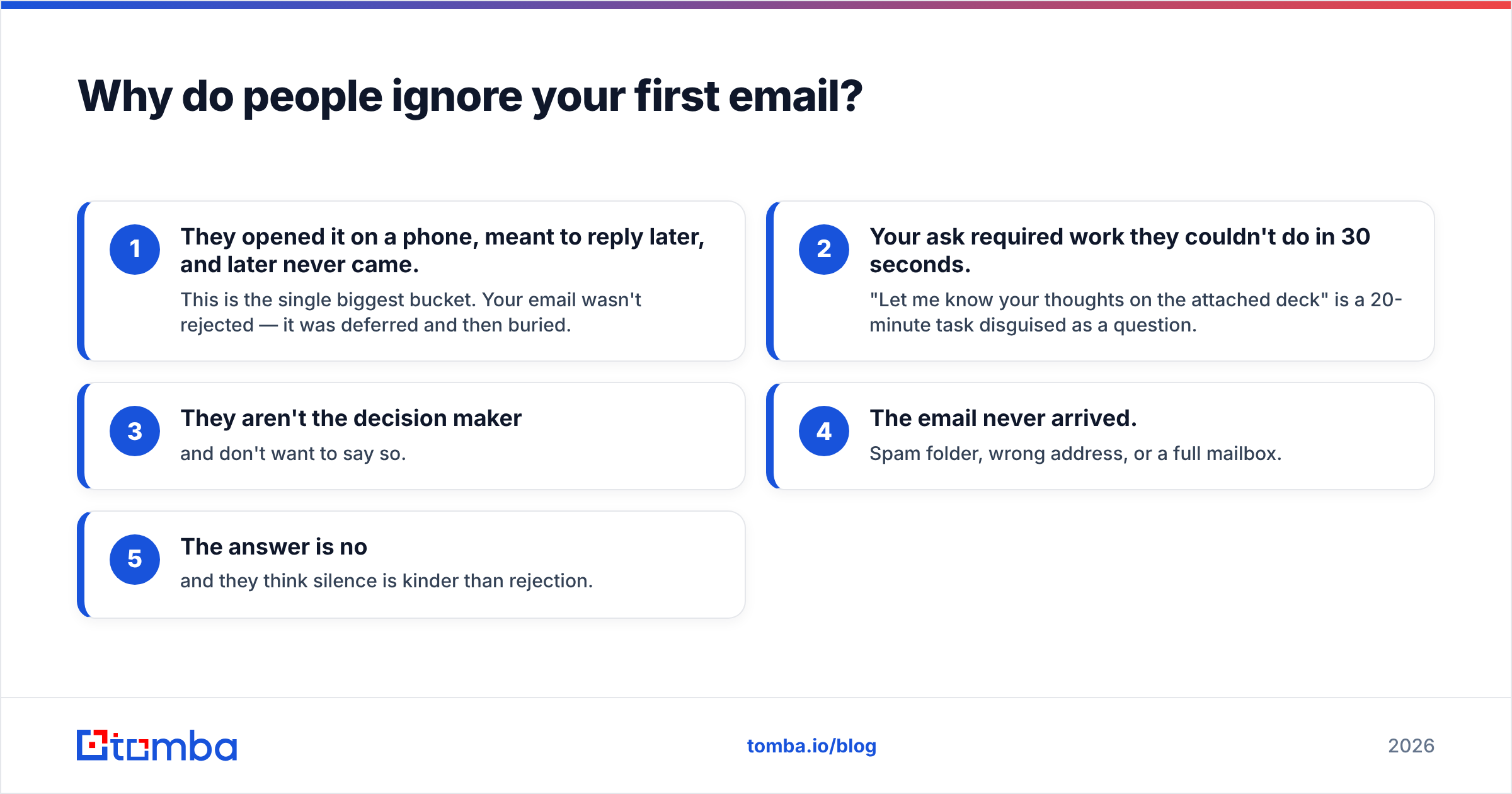
Almost never because they hate you. The realistic reasons, in rough order of frequency:
- They opened it on a phone, meant to reply later, and later never came. This is the single biggest bucket. Your email wasn't rejected — it was deferred and then buried.
- Your ask required work they couldn't do in 30 seconds. "Let me know your thoughts on the attached deck" is a 20-minute task disguised as a question.
- They aren't the decision maker and don't want to say so.
- The email never arrived. Spam folder, wrong address, or a full mailbox.
- The answer is no and they think silence is kinder than rejection.
Notice that only one of those five is "not interested." Four of the five are fixable with a better follow-up. That's why chasing works — response rate on sequences with two or three well-written follow-ups routinely beats single-send campaigns by a wide margin, and the lift comes from reaching the deferred pile, not from wearing people down.
What makes a follow-up polite instead of pushy?#
Politeness in email isn't about softeners like "I hope this finds you well." It's structural. A polite follow-up does four things:
- Acknowledges their time is scarce. No guilt, no "I've reached out three times."
- Carries its own context. They shouldn't have to scroll to remember who you are.
- Asks exactly one question that can be answered in under 15 seconds.
- Offers a clean exit. Explicit permission to say no or "not now."
The rudest follow-ups do the opposite: they reference how many times you've written, re-attach the same 12-slide deck, and end with an open-ended "thoughts?"
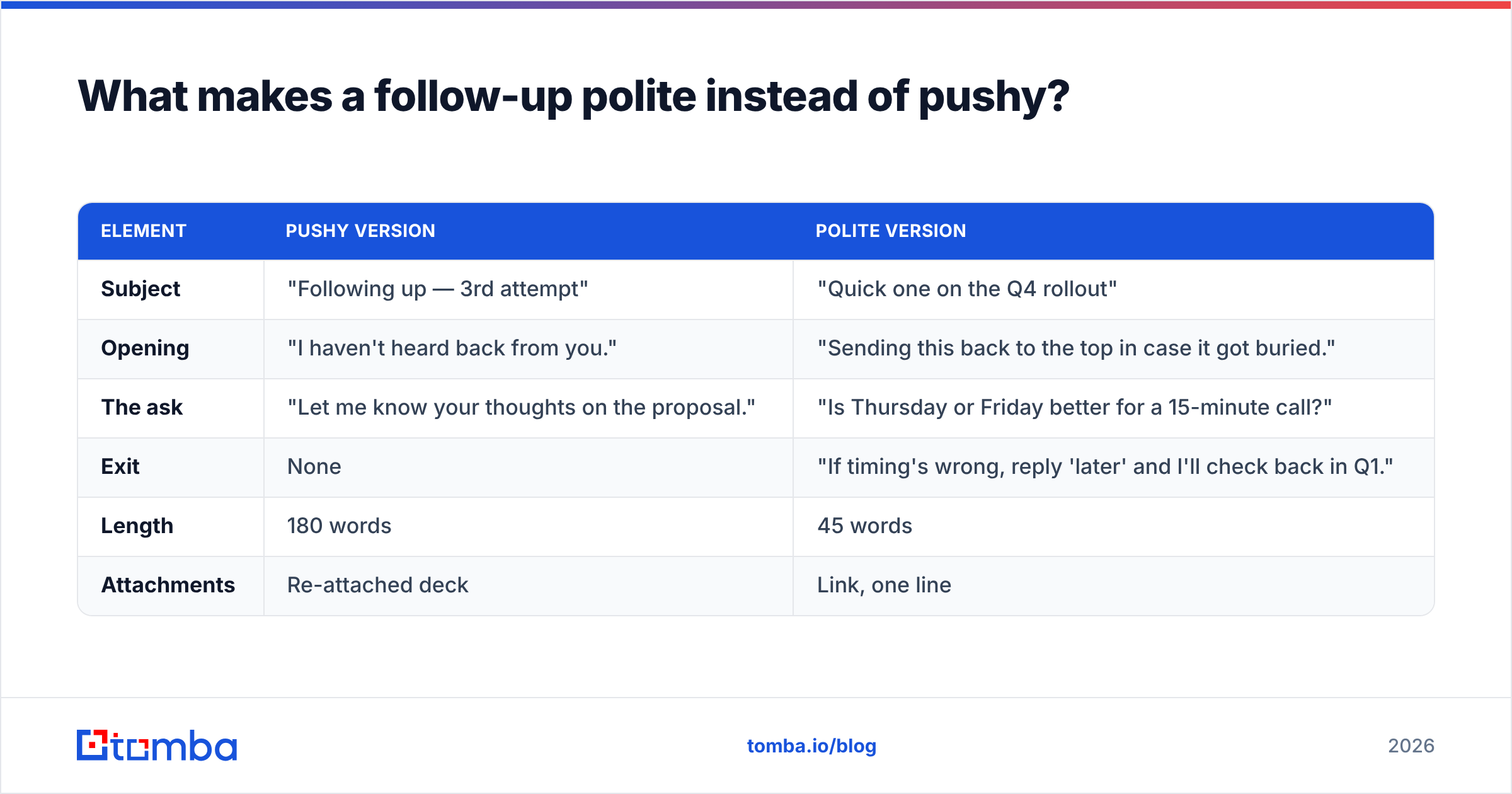
Here's the same ask written both ways.
| Element | Pushy version | Polite version |
|---|---|---|
| Subject | "Following up — 3rd attempt" | "Quick one on the Q4 rollout" |
| Opening | "I haven't heard back from you." | "Sending this back to the top in case it got buried." |
| The ask | "Let me know your thoughts on the proposal." | "Is Thursday or Friday better for a 15-minute call?" |
| Exit | None | "If timing's wrong, reply 'later' and I'll check back in Q1." |
| Length | 180 words | 45 words |
| Attachments | Re-attached deck | Link, one line |
The polite column isn't softer. It's more specific — and specificity is what makes replying cheap.
What are the best examples of how to politely ask someone to reply to an email?#
Nine scripts, sorted by situation. Each one is short on purpose. Fill the brackets and send.
1. The gentle bump (2–3 days after first send)#
Subject: Re: [original subject]
Hi [Name],
Floating this back up in case it slipped past — no urgency on my end.
The one thing I need from you: [single specific question].
If it's not the right time, just say the word and I'll circle back in [month].
[Your name]
Why it works: it removes the two things people dread — a long read and an obligation to explain themselves.
2. The one-question rewrite#
Hi [Name],
My last note asked for too much at once. Let me simplify: can you point me to whoever owns [area] at [Company]?
That's it — a name is plenty.
Why it works: you take the blame for the silence. People reply to emails that make them feel competent, not caught out.
3. The yes/no menu#
Hi [Name],
Easiest reply you'll send today — just pick a letter:
A) Interested, send times
B) Interested, but revisit in Q[X]
C) Not a fit, remove me
Any of the three helps me.
Why it works: it converts a writing task into a tapping task. Option C is not a loss — it clears your pipeline and it's the reason people trust you enough to pick A.
4. The deadline nudge#
Hi [Name],
Quick heads-up: [the pricing/the slot/the beta cohort] closes [date]. I didn't want you to find out after the fact.
Want me to hold a spot while you decide?
Why it works: real deadlines are the only ethical form of urgency. Never invent one — a fake deadline that quietly extends teaches people your emails aren't true.
5. The value-add follow-up#
Hi [Name],
Not chasing — just saw [specific report / competitor launch / regulation] and thought of your [team/problem].
[One-line insight, linked.]
Still happy to walk through how we'd handle it, but no pressure either way.
Why it works: it earns the second contact instead of just claiming it. This one can be sent to cold prospects without feeling like a chase.
6. The internal-stakeholder chase#
Hi [Name],
I need to close out [project] by [date] and I'm blocked on your [approval/numbers].
Can you either send it by [day], or tell me who can approve in your place?
Why it works: internally, politeness means clarity about the consequence, not vagueness about the ask.
7. The invoice or payment reminder#
Hi [Name],
Friendly reminder that invoice [#] for [$amount] came due on [date]. Copy attached in case it got lost.
If it's already in your payment run, ignore me entirely — and if there's a PO number I need to add, send it over and I'll re-issue today.
Why it works: it assumes competence rather than fault, and it names the most common real blocker (missing PO).
8. The job-application follow-up#
Hi [Name],
Following up on my application for [role], submitted [date]. I'm still very interested, and I know hiring timelines shift.
Is there an update on where the process stands, or a better time for me to check back?
Why it works: it asks about the process, not about you. That's a question a recruiter can answer without making a decision.
9. The breakup email#
Hi [Name],
I've sent a few notes about [topic] and haven't heard back — which usually means the timing is wrong, and that's completely fine.
I'm closing the file on my end. If things change, my door's open.
Good luck with [specific thing they're working on].
Why it works: it's the highest-reply-rate message in most sequences. Loss aversion does the work, and it costs you nothing because you were going to stop anyway.
You can pull additional starting points from our library of cold email templates and run any of the nine through a subject line tester before you send.
How long should you wait before following up?#
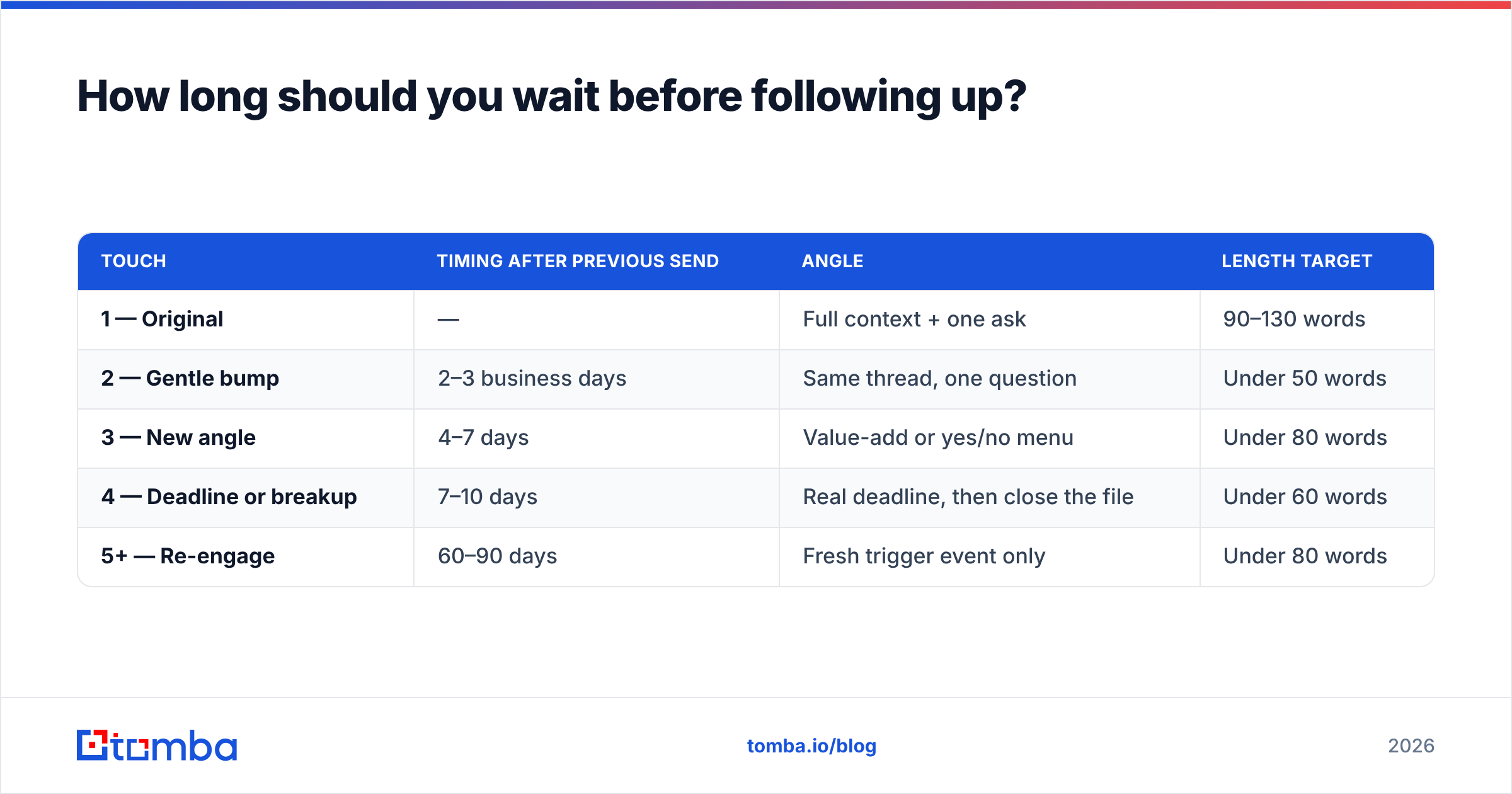
Waiting too long is as damaging as chasing too hard — after about ten days, the original context is gone and your follow-up reads like a cold email with awkward baggage.
Here's a cadence that respects people without letting threads die:
| Touch | Timing after previous send | Angle | Length target |
|---|---|---|---|
| 1 — Original | — | Full context + one ask | 90–130 words |
| 2 — Gentle bump | 2–3 business days | Same thread, one question | Under 50 words |
| 3 — New angle | 4–7 days | Value-add or yes/no menu | Under 80 words |
| 4 — Deadline or breakup | 7–10 days | Real deadline, then close the file | Under 60 words |
| 5+ — Re-engage | 60–90 days | Fresh trigger event only | Under 80 words |
Two rules override the table. First, reply in the same thread for touches 2 and 3 — it preserves context and keeps their inbox tidy. Break to a new subject line only when you're changing the angle entirely. Second, never follow up on a Monday morning or a Friday afternoon. Tuesday through Thursday, mid-morning in their timezone, is where deferred email gets rescued.
Also count the touches honestly. Three follow-ups on a warm thread is normal business practice. Six is the behavior that gets you marked as spam, and once enough people do that, your sender reputation drops and even your good emails stop landing.
Which phrases should you cut from every follow-up?#
Some phrases are so worn they signal "template" before the reader hits the second line. Swap them:
- "Just checking in" → "Wanted to close the loop on [specific thing]."
- "Circling back" → "Following up on the [date] question about [topic]."
- "Per my last email" → Delete it. There is no polite version; it always reads as a scold.
- "I hope this email finds you well" → Delete it. Start with the reason you wrote.
- "Let me know your thoughts" → Replace with a closed question they can answer in five words.
- "Sorry to bother you" → Delete it. Apologizing for existing invites the reader to agree that you're a bother.
- "ASAP" → Name the actual date. "By Thursday" is polite; "ASAP" is a demand with no information in it.
One more: stop counting your attempts out loud. "This is my fourth email" tells the reader they've already ignored you three times, which makes ignoring you a fourth time feel consistent rather than rude.
Is silence ever a deliverability problem, not a politeness problem?#
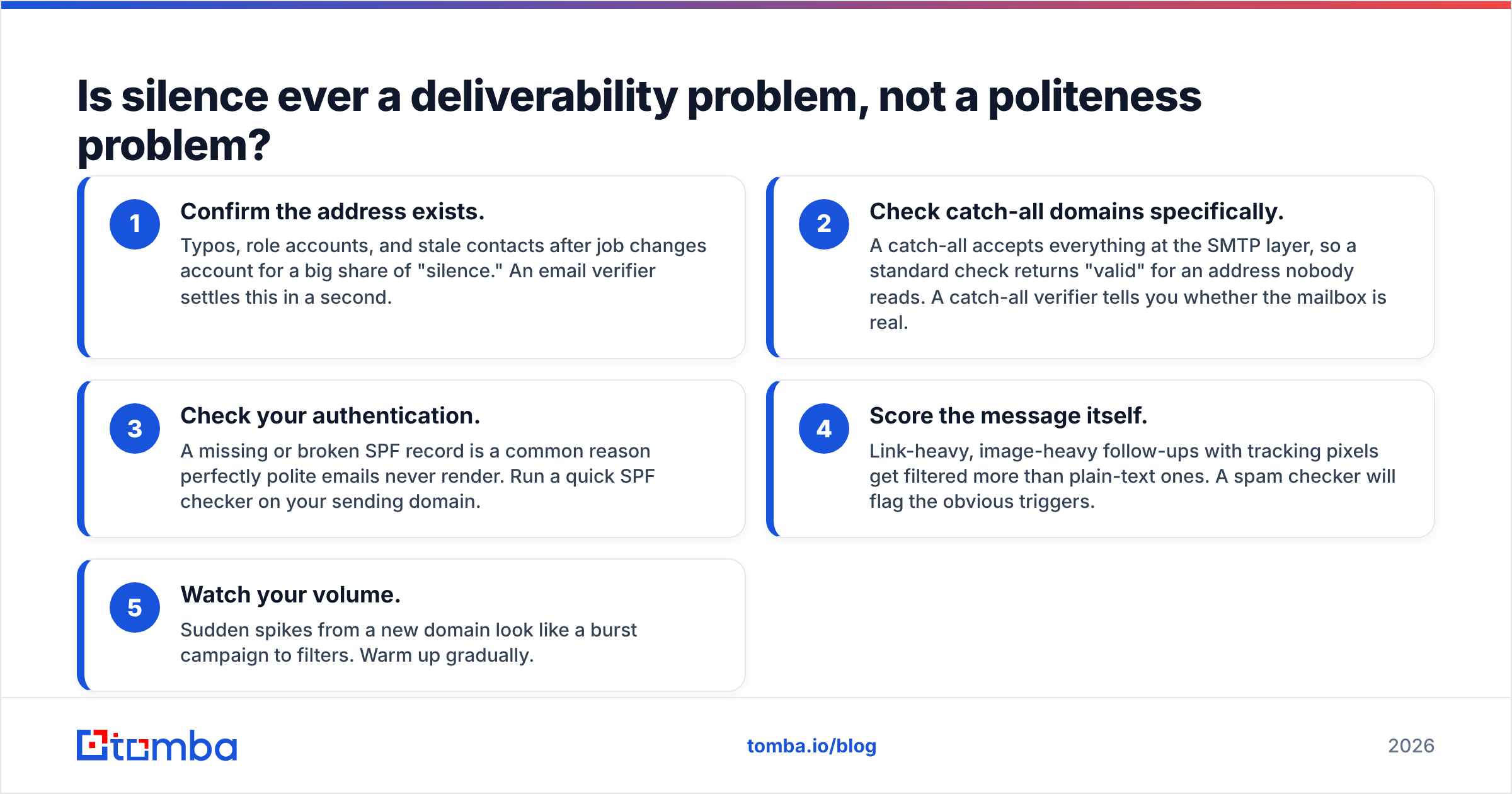
Yes — and this is the failure mode people miss. If your message landed in spam, or the address bounced silently through a catch-all domain, you're not being ignored. You're being unheard, and every extra follow-up makes it worse.
Run this checklist before you write a fourth follow-up:
- Confirm the address exists. Typos, role accounts, and stale contacts after job changes account for a big share of "silence." An email verifier settles this in a second.
- Check catch-all domains specifically. A catch-all accepts everything at the SMTP layer, so a standard check returns "valid" for an address nobody reads. A catch-all verifier tells you whether the mailbox is real.
- Check your authentication. A missing or broken SPF record is a common reason perfectly polite emails never render. Run a quick SPF checker on your sending domain.
- Score the message itself. Link-heavy, image-heavy follow-ups with tracking pixels get filtered more than plain-text ones. A spam checker will flag the obvious triggers.
- Watch your volume. Sudden spikes from a new domain look like a burst campaign to filters. Warm up gradually.
According to HubSpot's research on email engagement, a large share of deals close only after several follow-ups — but that only holds if the messages reach a human. Deliverability is the multiplier on every script above.
If you're chasing people whose addresses you inferred rather than confirmed, fix the input first. A domain search returns the verified addresses and email pattern for a company, which is a far better starting point than guessing firstname.lastname@ and hoping.
How do you write follow-ups at scale without sounding like a robot?#
The tension is real: personalization drives replies, and personalization doesn't scale by hand. Three practical compromises:
- Personalize the first line and the ask, template the rest. One genuinely specific sentence — about their recent launch, hire, or post — outperforms four paragraphs of generic flattery. Tools rated on G2's sales engagement category mostly compete on how well they support exactly this.
- Segment by trigger, not by title. "Companies that just posted a job for a [role]" gives you a real reason to write. "VPs of Marketing" gives you nothing.
- Cap the sequence in the tool, not in your head. Set a hard limit of four touches and let the software enforce the breakup email. Discipline you have to remember isn't discipline.
- Send from a real, monitored inbox. If replies land in a no-reply void, the politest email in the world produces nothing.
For teams working from a list of companies rather than a list of people, a bulk email finder plus a verification pass will do more for your reply rate than another week of copy tweaking. So will pulling in accurate context first — data enrichment turns a bare domain into a name, role, and company detail worth referencing in line one.
What does a good follow-up sequence look like end to end?#
Here's a complete four-touch sequence for a cold B2B outreach thread, so you can see how the scripts fit together:
Day 0 — Original. Specific problem, one line of proof, one closed question. Under 130 words.
Day 3 — Gentle bump (same thread). "Floating this back up — the one thing I need is whether [X] is even on your roadmap this year. A yes/no is plenty."
Day 9 — Value-add (new subject). Share the relevant benchmark, report, or competitor move. End with "happy to send the two-minute version if useful."
Day 17 — Breakup. Close the file. Leave the door open. Move them to a 90-day re-engagement list.
Four emails over roughly two and a half weeks. Every message under 100 words, every one with a single ask, and two of the four give the reader an explicit way to end it. That's what polite persistence looks like in practice — you're not asking them to reply seven times, you're giving them four cheap chances to.
Start with an address that actually works#
Every script here assumes your email reaches a real inbox. If you're following up into the void because the address was a guess, no amount of phrasing will save it.
Use the Tomba Email Finder to get verified, deliverable addresses by name and domain before you send the first message — then chase with confidence, knowing that silence means "busy," not "bounced." The free tier covers 25 searches a month so you can test it against your current list; paid plans start at $49/month on Starter, with Growth at $99/month if you're running volume. Full Tomba pricing is on the site.
Fix the list, shorten the follow-up, ask one question. That's the whole method.
Related guides#
Ready to find emails that actually work?
Join 150,000+ professionals who stopped guessing and started sending. Free credits on signup — no credit card required.
Get the Tomba newsletter
Practical outbound tactics and product updates — once every two weeks.
About the author