How To Prospect In Real Estate: A 2026 Playbook That Works
Most agents prospect by volume and burn out. Here is the channel-by-channel breakdown of what actually books listing appointments in 2026 — with real numbers, costs, and a weekly cadence you can copy.
TL;DR
- Prospecting in real estate is not one activity — it is seven channels with wildly different cost per appointment. Circle prospecting and expired listings still convert best per hour; paid portal leads cost the most per closed deal.
- The agents who hit 20+ transactions a year are not working more hours. They run a fixed weekly cadence, own a defined farm, and track conversations-to-appointments instead of dials.
- Commercial and investor prospecting is a different game from residential. It runs on decision-maker contact data — LLC owners, asset managers, property managers — which is where a B2B email finder beats a dialer list.
- Bad data kills more prospecting plans than bad scripts. Disconnected numbers and bounced emails inflate your effort per contact by 30-50%.
- Pick two channels, not seven. Run them for 90 days before judging.
What does prospecting actually mean in real estate?#
Prospecting is the work of starting conversations with people who might transact — not marketing at them and waiting.
That distinction matters. Running Facebook ads is lead generation: you spend money, leads arrive, you react. Prospecting is proactive: you decide who to talk to, you initiate, and you control the volume. Marketing is a faucet you pay to open. Prospecting is a well you dig once and pump daily.
The practical difference shows up in your calendar. Marketing produces leads unpredictably. Prospecting produces a predictable number of conversations per hour, and conversations convert to appointments at a rate you can measure. If you know that 100 dials yields 12 conversations yields 1.5 appointments, you can reverse-engineer any income goal.
Most agents fail here for one reason: they treat prospecting as something to do when the pipeline is empty. By then it is 90 days too late, because the lag between first touch and closed transaction in residential real estate typically runs 60-180 days.
Which real estate prospecting methods actually work in 2026?#
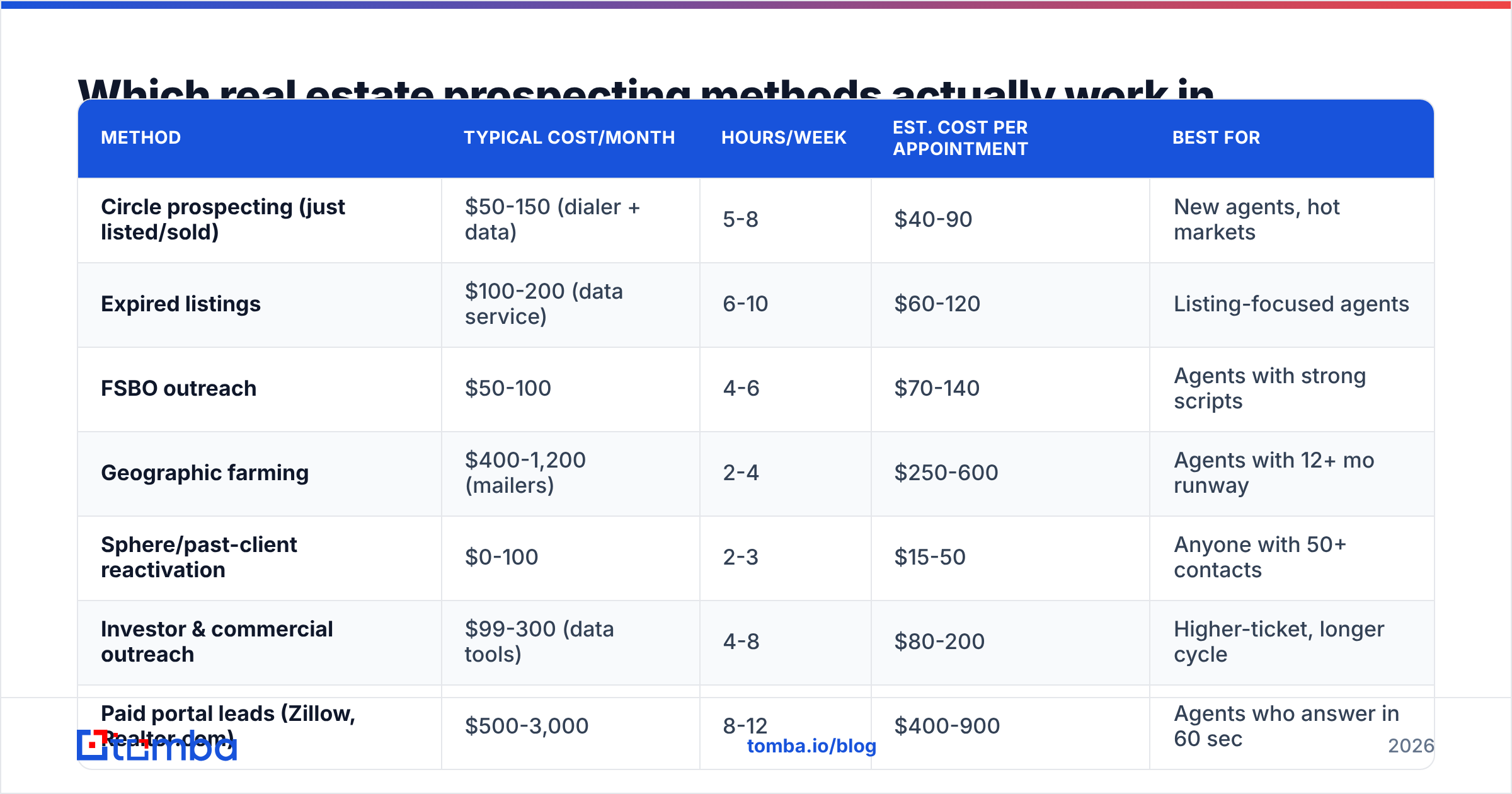
Here are the seven channels worth your time, with honest numbers. Treat the cost figures as directional — they vary by market, but the relative ranking holds.
| Method | Typical cost/month | Hours/week | Est. cost per appointment | Best for |
|---|---|---|---|---|
| Circle prospecting (just listed/sold) | $50-150 (dialer + data) | 5-8 | $40-90 | New agents, hot markets |
| Expired listings | $100-200 (data service) | 6-10 | $60-120 | Listing-focused agents |
| FSBO outreach | $50-100 | 4-6 | $70-140 | Agents with strong scripts |
| Geographic farming | $400-1,200 (mailers) | 2-4 | $250-600 | Agents with 12+ mo runway |
| Sphere/past-client reactivation | $0-100 | 2-3 | $15-50 | Anyone with 50+ contacts |
| Investor & commercial outreach | $99-300 (data tools) | 4-8 | $80-200 | Higher-ticket, longer cycle |
| Paid portal leads (Zillow, Realtor.com) | $500-3,000 | 8-12 | $400-900 | Agents who answer in 60 sec |
Two patterns jump out. First, the cheapest appointments come from people who already know you or already signaled intent — sphere, expired, FSBO. Second, the most expensive channel (paid portal leads) is the one most agents start with, because it requires no courage.
The National Association of Realtors member profile has consistently shown referrals and repeat business as the top source of business for experienced agents, while newer agents lean disproportionately on purchased leads. That gap is the whole story: the veterans prospect their sphere, the rookies buy their pipeline.
The five channels ranked by effort-to-payoff#
- Sphere reactivation — Highest ROI, lowest ego risk. Every past client and known contact gets a real touch four times a year. No script gymnastics, just a relevant reason to call.
- Circle prospecting — Call 100 homes around a just-listed or just-sold property. The listing gives you a legitimate reason to call, which is 80% of the battle.
- Expired listings — These sellers are motivated and pre-qualified as "wanted to sell." They are also annoyed and over-contacted, so speed and differentiation matter more than volume.
- Investor and commercial outreach — Slower to convert, far higher ticket. Runs on B2B contact data rather than homeowner phone lists.
- Geographic farming — The compounding play. Nothing happens for 6-9 months, then it never stops. Only start it if you can fund 12 months without flinching.
How do you prospect commercial and investor deals differently?#
You stop looking for homeowners and start looking for entities.
Residential prospecting targets a person at an address. Commercial and investor prospecting targets a decision maker inside an LLC, a fund, a property management company, or a corporate real estate team. The address on the deed is a registered agent in Delaware. The phone number on public record is a voicemail box nobody checks.
This is B2B prospecting wearing a real estate hat, and the toolkit changes accordingly:
- Identify the entity. Pull the owning LLC from county records or a data provider. Note the principal's name if disclosed.
- Map the company. Find the operating company behind the LLC — a management firm, a development group, a franchisee. Run a domain search against its website to see every professional email on that domain, along with names and job titles.
- Find the right seat. You want the acquisitions lead, asset manager, or director of real estate — not the general info@ inbox. Titles matter more than seniority here.
- Verify before you send. Run every address through an email verifier so your first impression is not a bounce notification on the recipient's mail server.
- Add a phone path. Commercial decision makers answer direct lines far more than mobile-averse consumers. A phone finder gives you a second channel for the same contact.
Two things make this channel worth the extra setup. Commission per transaction is multiples higher, and the contact universe is finite — you can realistically build a list of every multifamily owner with 20+ units in your metro and work it for years. You cannot do that with "everyone who might sell a house."
What does a weekly prospecting cadence look like?#
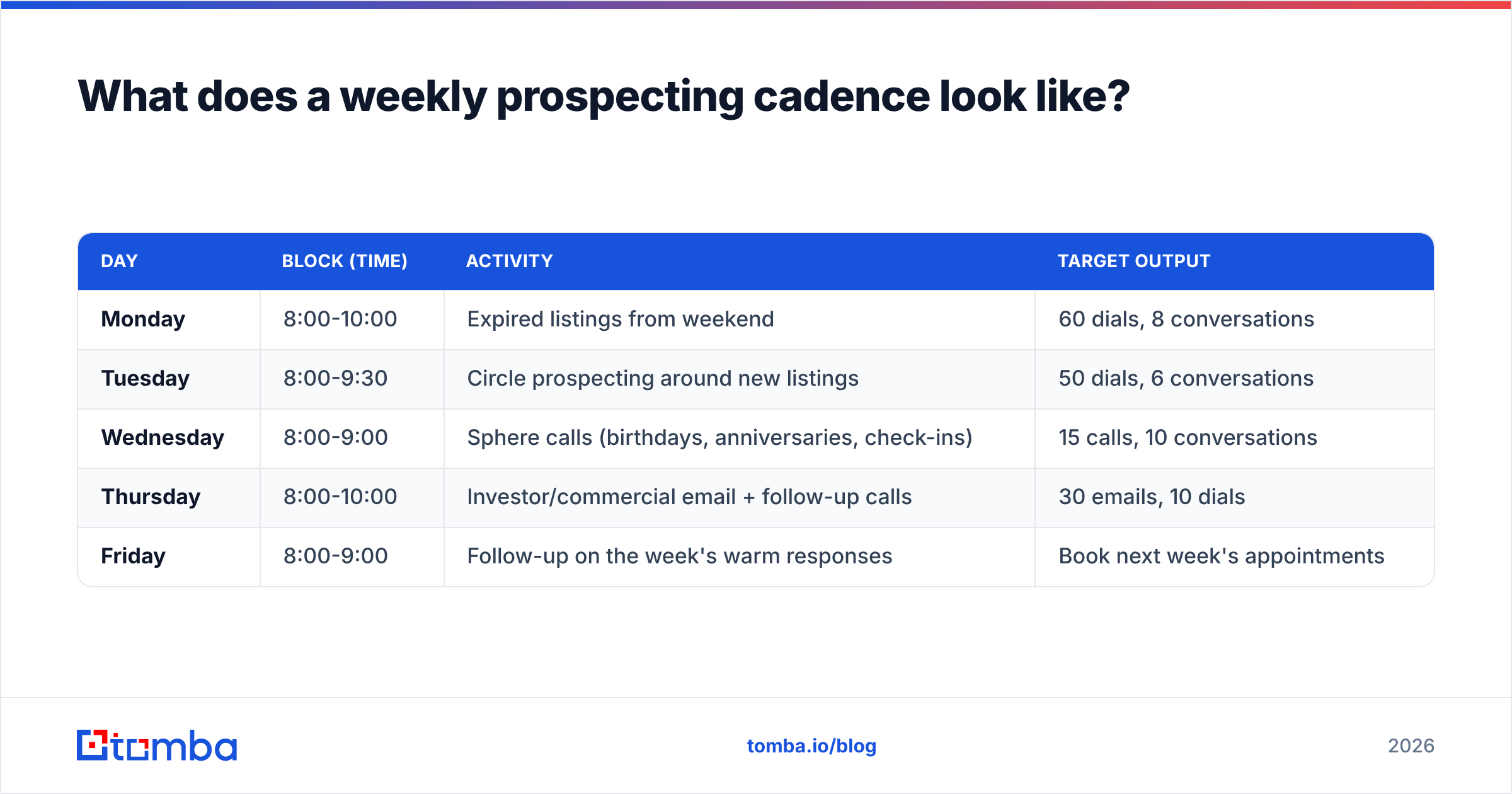
Consistency beats intensity. Here is a cadence that produces roughly 15-20 conversations per week without wrecking your schedule.
| Day | Block (time) | Activity | Target output |
|---|---|---|---|
| Monday | 8:00-10:00 | Expired listings from weekend | 60 dials, 8 conversations |
| Tuesday | 8:00-9:30 | Circle prospecting around new listings | 50 dials, 6 conversations |
| Wednesday | 8:00-9:00 | Sphere calls (birthdays, anniversaries, check-ins) | 15 calls, 10 conversations |
| Thursday | 8:00-10:00 | Investor/commercial email + follow-up calls | 30 emails, 10 dials |
| Friday | 8:00-9:00 | Follow-up on the week's warm responses | Book next week's appointments |
Three rules make this work.
Prospect first, admin later. If your prospecting block is at 3pm, it will not happen. Put it before the day can hijack you.
Count conversations, not dials. Dials measure suffering. Conversations measure progress. If your conversation rate drops below 8-10%, your data is the problem, not your work ethic.
Never end a call without a next step. "I'll follow up sometime" is how pipelines die. Every conversation ends with a calendar date or an explicit no.
Why does your contact data matter more than your script?#
Because a perfect script delivered to a disconnected number converts at zero percent.
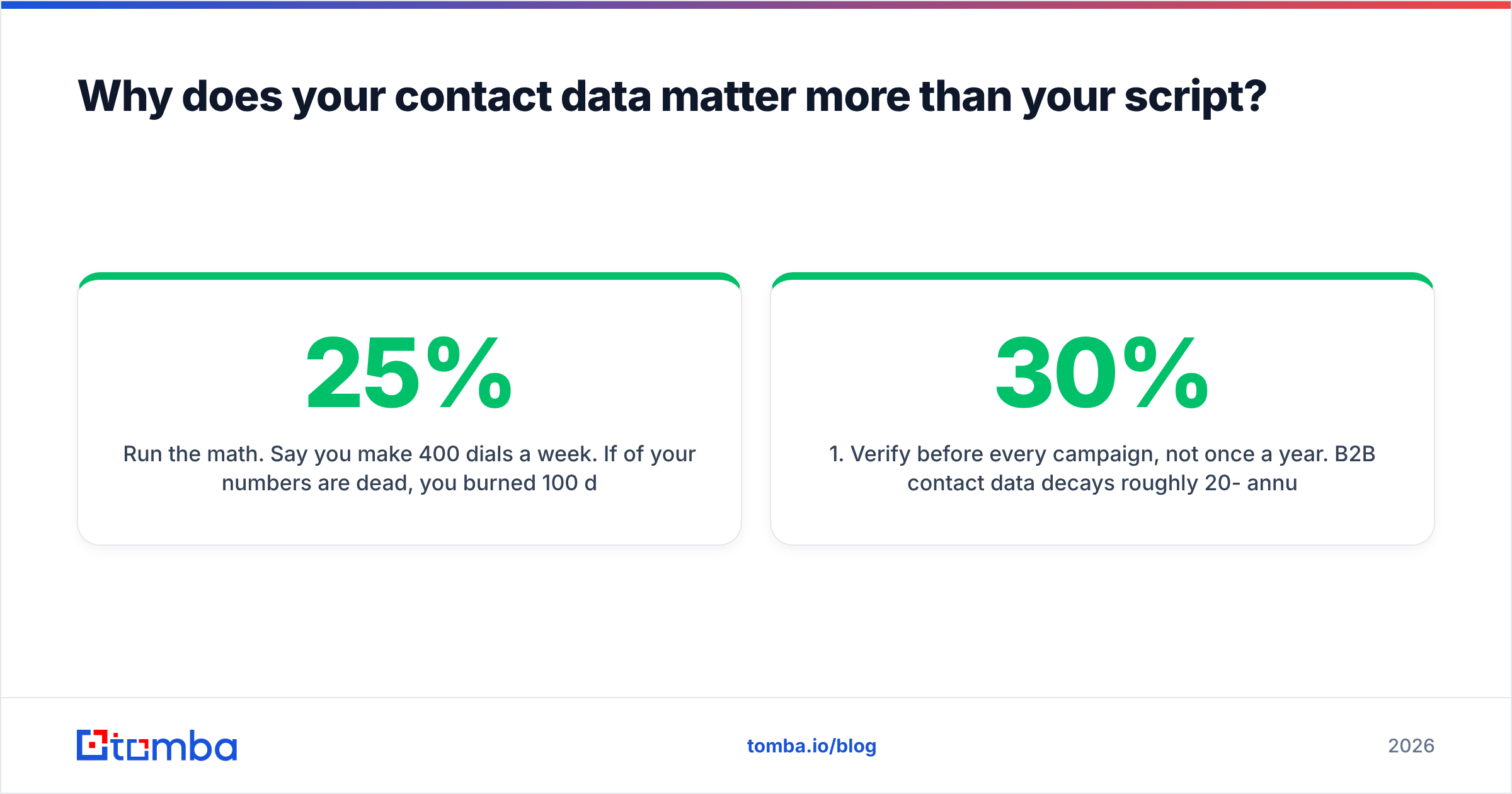
Run the math. Say you make 400 dials a week. If 25% of your numbers are dead, you burned 100 dials — roughly two hours — on silence. Now say 15% of your emails bounce. Not only did those prospects never hear from you, your sending domain took reputation damage that reduced deliverability for the messages that did reach real inboxes.
This is the quietest failure mode in prospecting. Agents blame their objection handling when the real problem is that they only spoke to 6 people instead of 11.
Data hygiene for real estate prospecting comes down to four habits:
- Verify before every campaign, not once a year. B2B contact data decays roughly 20-30% annually as people change roles. Property management staff turn over faster than that.
- Deduplicate ruthlessly. The same owner appearing under three LLCs looks like three prospects and feels like harassment. A remove duplicates pass takes 30 seconds.
- Check the pattern before guessing. If a firm uses first.last@domain.com, you can construct addresses reliably. If it uses initials or a catch-all, guessing wastes sends. A company email pattern check settles it.
- Watch your sender reputation. Bounces and spam complaints compound. If your open rates fall off a cliff, check email deliverability fundamentals before you rewrite another subject line.
For agents doing volume outreach to commercial contacts, a bulk email finder run against a list of target companies replaces about six hours of manual LinkedIn scraping per week. That is the entire argument for tooling: it does not make you better at prospecting, it removes the hours that were never prospecting in the first place.
What should you say? Scripts by channel#
Scripts are not about manipulation. They are about not freezing.
Circle prospecting opener:
"Hi, this is [name] with [brokerage]. I'm calling because we just sold the property on [street] for [price] — I wanted to let neighbors know before it hits the public sites. Are you two planning to stay in the neighborhood a while, or is a move on the radar in the next year or two?"
Expired listing opener:
"Hi [name], I saw your home came off the market yesterday. I'm not calling to relist it today — I'm calling because I sell in that area and I have a specific opinion on why it didn't move. Want to hear it, or have you already decided what you're doing next?"
Investor/commercial email:
Subject: [Property address] — off-market interest
[Name] — I represent buyers actively acquiring [asset type] in [submarket]. Two closed in the last 90 days at [cap rate / price per unit]. If [entity] would consider an off-market conversation on [address], I can send comps and a range before we talk. Worth a look?
Notice what each has in common: a specific, verifiable reason for the contact, and a question that is easy to answer honestly — including with a no. If you need help tightening the copy, cold email templates give you a starting frame you can adapt per market.
How do you measure whether prospecting is working?#
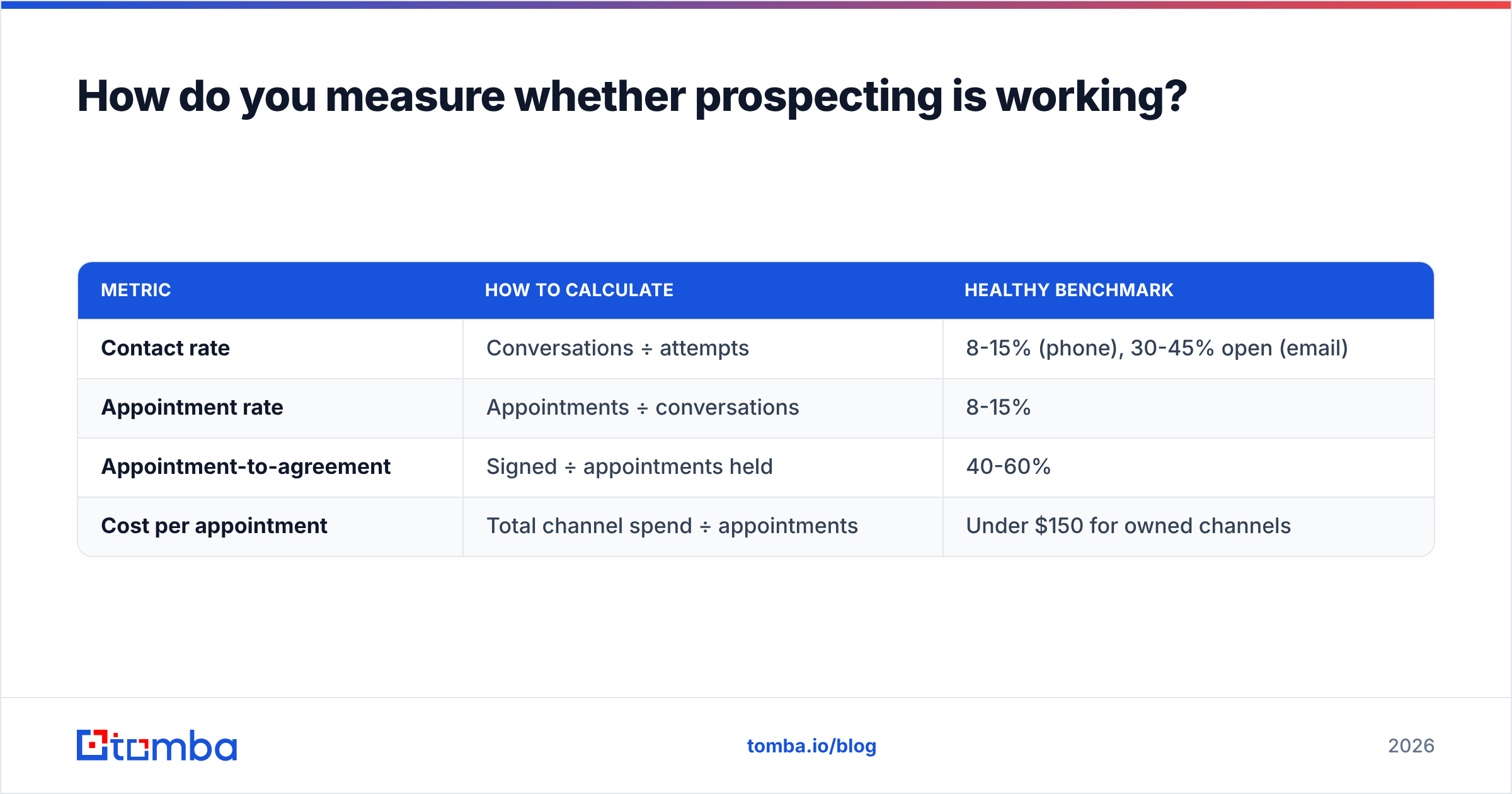
Track four numbers. Anything more and you will stop tracking.
| Metric | How to calculate | Healthy benchmark |
|---|---|---|
| Contact rate | Conversations ÷ attempts | 8-15% (phone), 30-45% open (email) |
| Appointment rate | Appointments ÷ conversations | 8-15% |
| Appointment-to-agreement | Signed ÷ appointments held | 40-60% |
| Cost per appointment | Total channel spend ÷ appointments | Under $150 for owned channels |
Review these monthly, not weekly — weekly samples are too noisy to mean anything. If contact rate is low, fix data. If appointment rate is low, fix script and offer. If appointment-to-agreement is low, fix your presentation. Each number points at a different problem, which is why tracking one blended "conversion rate" tells you nothing actionable.
Industry review sites like G2 are useful for comparing the dialers, CRMs, and data tools you will bolt onto this process — but read the reviews from users at your company size, not enterprise teams with different constraints. And whatever CRM you use, the rule is the same: if a conversation is not logged, it did not happen.
What is the 90-day plan to get started?#
Days 1-14: Pick two channels and build the list. One warm (sphere), one cold (expired, circle, or commercial). Build a clean, verified list of at least 500 contacts for the cold channel. Do not start dialing with a dirty list — you will draw the wrong conclusions from the results.
Days 15-60: Run the cadence without changing it. Same blocks, same days, every week. Log every conversation. Resist the urge to switch channels when week three feels slow. Week three always feels slow.
Days 61-90: Read the numbers and cut. Now you have enough sample to judge. Whichever channel produced a lower cost per appointment gets more hours. The other one either gets a script rewrite or gets dropped.
Most agents never reach day 61 because they change the plan at day 12. The plan is not the variable. Your consistency is.
Ready to build a prospect list that actually connects?#
If your prospecting is heading toward investors, commercial owners, property management firms, or any B2B counterparty, your bottleneck is contact data — not effort. Tomba's Email Finder locates verified professional email addresses by name, company, or domain, so your outreach reaches a real inbox on the first send. Start free with 25 searches a month; paid plans begin at $49/mo (Starter), with Growth at $99/mo and Pro at $249/mo as your list volume grows. Check the full Tomba pricing breakdown, then spend your next prospecting block talking to people instead of chasing bad numbers.
Related guides#
// get started
Find, verify and enrich your first contacts today
Start on the free plan with 25 searches a month, then scale when your team is ready.
Free plan · No credit card required · GDPR & CCPA
Get the Tomba newsletter
Product and data updates
// about the author