How To Qualify Leads in 2026: A Practical B2B Framework
Most B2B teams disqualify too late and waste months on deals that were never real. Here is a concrete, step-by-step system for qualifying leads — frameworks, scoring weights, data checks, and the questions that actually separate buyers from browsers.
TL;DR
- Qualification is a filtering process, not a single call. You qualify at three stages: data fit, engagement fit, and deal fit — each with its own disqualifiers.
- BANT still works for transactional deals under $10k. For anything with a committee, use MEDDPICC or a hybrid; BANT's "Authority" question falls apart the moment five people touch the decision.
- Bad contact data poisons qualification before a rep ever speaks. If 22% of your list bounces, your MQL-to-SQL rate is measuring your data vendor, not your buyers.
- Score on behavior and firmographics separately, then require both to cross a threshold. A CTO who never opened an email is not a hot lead.
- The fastest win most teams ignore: write down explicit disqualification criteria. Teams that can say "no" in week one close more in quarter one.
What does it actually mean to qualify a lead?#
Qualifying a lead means deciding, with evidence, whether a contact can and will buy from you in a defined timeframe — and killing the ones that can't fast enough that you don't burn a quarter finding out.
Think of it like triage in an emergency room. Nobody sorts patients by who arrived first or who is loudest. A nurse checks a handful of vitals in ninety seconds and routes accordingly. Lead qualification is the same job: a small number of checks, applied consistently, that route each contact to "work now," "nurture," or "drop."
The failure mode is universal. Reps treat qualification as an interrogation that happens once, on discovery call number one, using a checklist someone printed in 2015. Meanwhile the real signals — a bounced email, a title that doesn't exist anymore, a company that just froze hiring — were all available before anyone picked up a phone.
Qualification runs across three layers, and most teams only staff one of them:
- Data qualification — Is this a real person, at a real company, with a deliverable email and an accurate title? Fully automatable.
- Fit qualification — Does this company match your ICP on size, industry, tech stack, geography, and trigger events? Mostly automatable.
- Deal qualification — Is there a budget, a compelling event, an identified champion, and a decision process you can map? Only a human does this well.
Skip layer one and layers two and three inherit garbage. That is why teams with strong sales processes still see MQL-to-SQL conversion rates crater — they are qualifying against contact records that were wrong on arrival.
Sorry, correcting the format — the meme belongs inline as a standard image:

Which lead qualification framework should you use?#
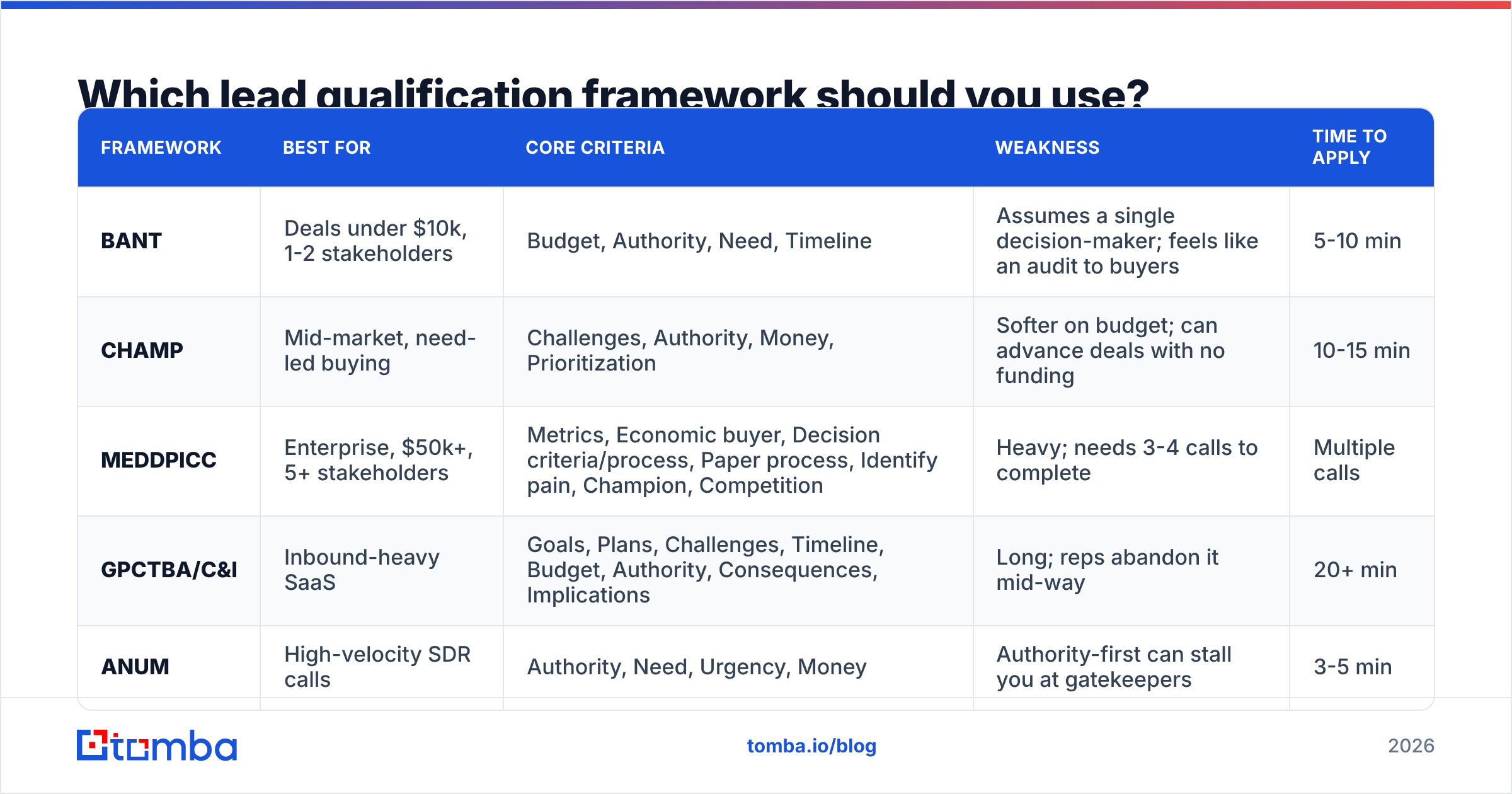
Pick your framework based on deal size and buying-committee complexity, not on what's fashionable. Here is the honest comparison:
| Framework | Best for | Core criteria | Weakness | Time to apply |
|---|---|---|---|---|
| BANT | Deals under $10k, 1-2 stakeholders | Budget, Authority, Need, Timeline | Assumes a single decision-maker; feels like an audit to buyers | 5-10 min |
| CHAMP | Mid-market, need-led buying | Challenges, Authority, Money, Prioritization | Softer on budget; can advance deals with no funding | 10-15 min |
| MEDDPICC | Enterprise, $50k+, 5+ stakeholders | Metrics, Economic buyer, Decision criteria/process, Paper process, Identify pain, Champion, Competition | Heavy; needs 3-4 calls to complete | Multiple calls |
| GPCTBA/C&I | Inbound-heavy SaaS | Goals, Plans, Challenges, Timeline, Budget, Authority, Consequences, Implications | Long; reps abandon it mid-way | 20+ min |
| ANUM | High-velocity SDR calls | Authority, Need, Urgency, Money | Authority-first can stall you at gatekeepers | 3-5 min |
The practical answer for most B2B teams in 2026: run ANUM or BANT at the SDR stage to decide whether a meeting is worth booking, then MEDDPICC from the AE's first call onward. The frameworks are not competitors — they operate at different resolutions. HubSpot's sales qualification guide makes the same layered argument, and it holds up in practice.
One warning about BANT. It was built by IBM in an era when one VP signed one purchase order. Gartner's research on the modern B2B buying journey puts the typical enterprise buying group at 6 to 10 stakeholders. Asking "are you the decision maker?" in that environment gets you a false yes and a stalled deal in month four.
How do you qualify leads step by step?#
Five steps, in order. Each one has a kill switch.
- Validate the contact data before anything else. Run the email through an email verifier and confirm the domain is live and not a catch-all trap. A lead you cannot reach is not a lead. If your list came from a scrape or a purchased CSV, expect 15-30% decay per year on job-change alone — kill anything that fails verification rather than "trying it once."
- Check firmographic fit against a written ICP. Employee count, revenue band, industry, region, and tech stack. Write the ICP down with numeric ranges, not adjectives. "Mid-market SaaS" is not an ICP; "B2B SaaS, 50-500 employees, US/EU, using HubSpot or Salesforce, Series A+" is. Anything outside the range goes to nurture, not to a rep.
- Score engagement separately from fit. Pricing-page visits, demo requests, repeat email opens from the same contact, and G2 category views are behavior. Behavior tells you when. Firmographics tell you whether. Require both to clear a bar before routing to sales.
- Confirm pain and a compelling event on the call. Not "would this be useful" — that gets a yes from everyone. Ask what happens if they do nothing for six months. If the honest answer is "nothing," you have interest, not a deal. Interest goes back to nurture.
- Map the decision process and name the champion. Who signs? Who can veto? What is the procurement path — legal review, security questionnaire, vendor onboarding? If the rep cannot name three humans and one date by end of call two, the deal is not qualified regardless of how good the conversation felt.
The step teams skip is the first one. It feels administrative. It is the highest-leverage filter you own, because every downstream metric — reply rate, meeting rate, MQL-to-SQL — is computed on top of it.
What data do you need before a rep touches the lead?#
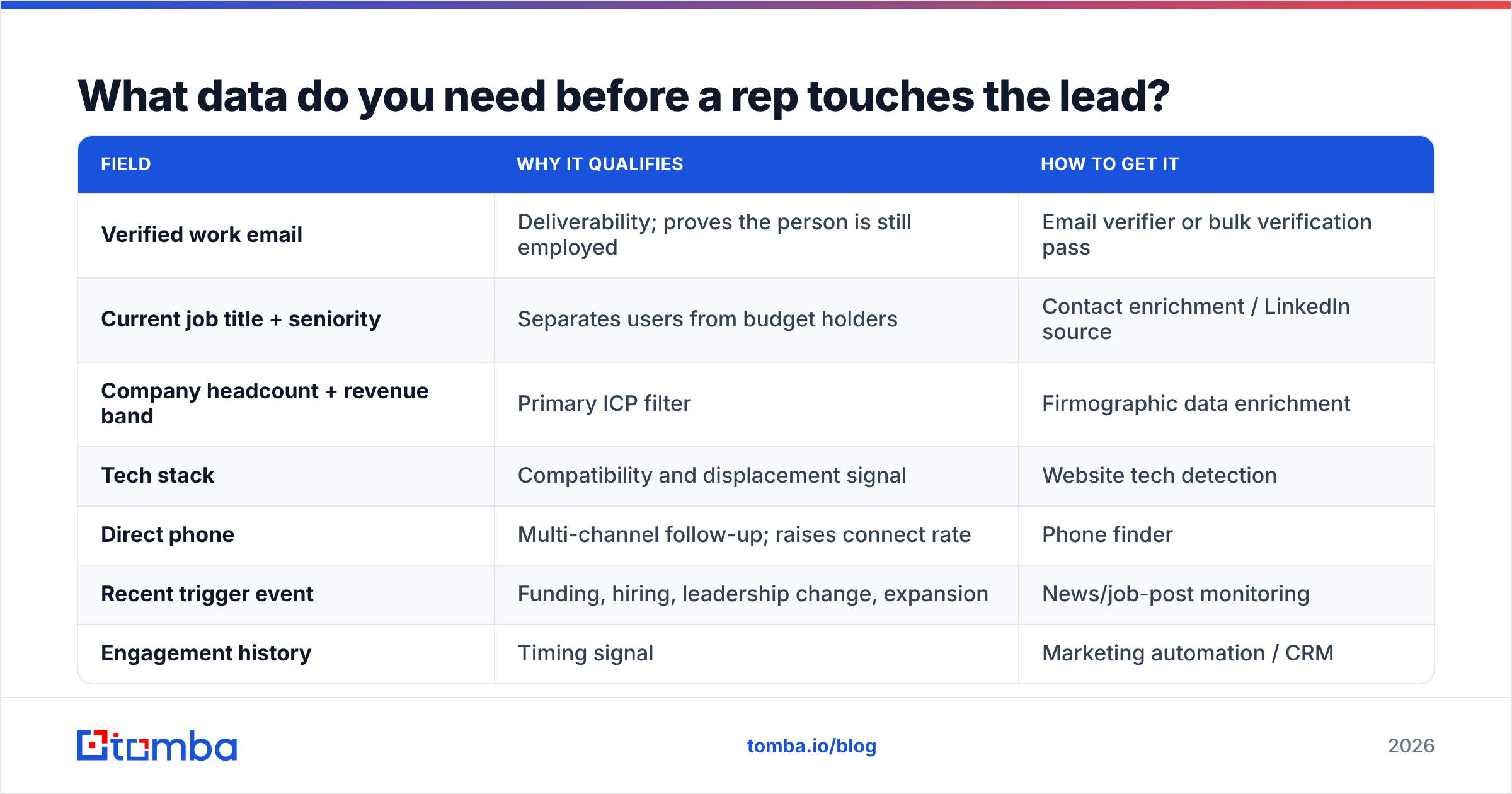
A qualified record has more than an email address. Here is what should be on the row before it reaches a human, and where it comes from:
| Field | Why it qualifies | How to get it |
|---|---|---|
| Verified work email | Deliverability; proves the person is still employed | Email verifier or bulk verification pass |
| Current job title + seniority | Separates users from budget holders | Contact enrichment / LinkedIn source |
| Company headcount + revenue band | Primary ICP filter | Firmographic data enrichment |
| Tech stack | Compatibility and displacement signal | Website tech detection |
| Direct phone | Multi-channel follow-up; raises connect rate | Phone finder |
| Recent trigger event | Funding, hiring, leadership change, expansion | News/job-post monitoring |
| Engagement history | Timing signal | Marketing automation / CRM |
Two of these deserve extra attention.
Catch-all domains. A large share of enterprise domains accept every address at the SMTP layer, which means standard verification returns "unknown" rather than valid or invalid. Teams handle this badly — they either send blind (and eat the bounces) or discard the entire segment (and lose their best accounts, since large enterprises are disproportionately catch-all). The right move is a dedicated catch-all verifier pass that uses pattern confidence and additional signals rather than SMTP alone.
Title decay. Titles rot faster than emails. Someone who was "Marketing Manager" in your CRM eighteen months ago may now be a Director at a different company. Re-enrich any record older than six months before a rep works it, or you will qualify against fiction.
How should you weight a lead scoring model?#
Scoring is where good intentions become bad math. The common mistake is a single additive score where a demo request and a headcount match contribute to the same number — so a perfect-fit company that has never engaged looks identical to a tiny startup that clicked five emails.
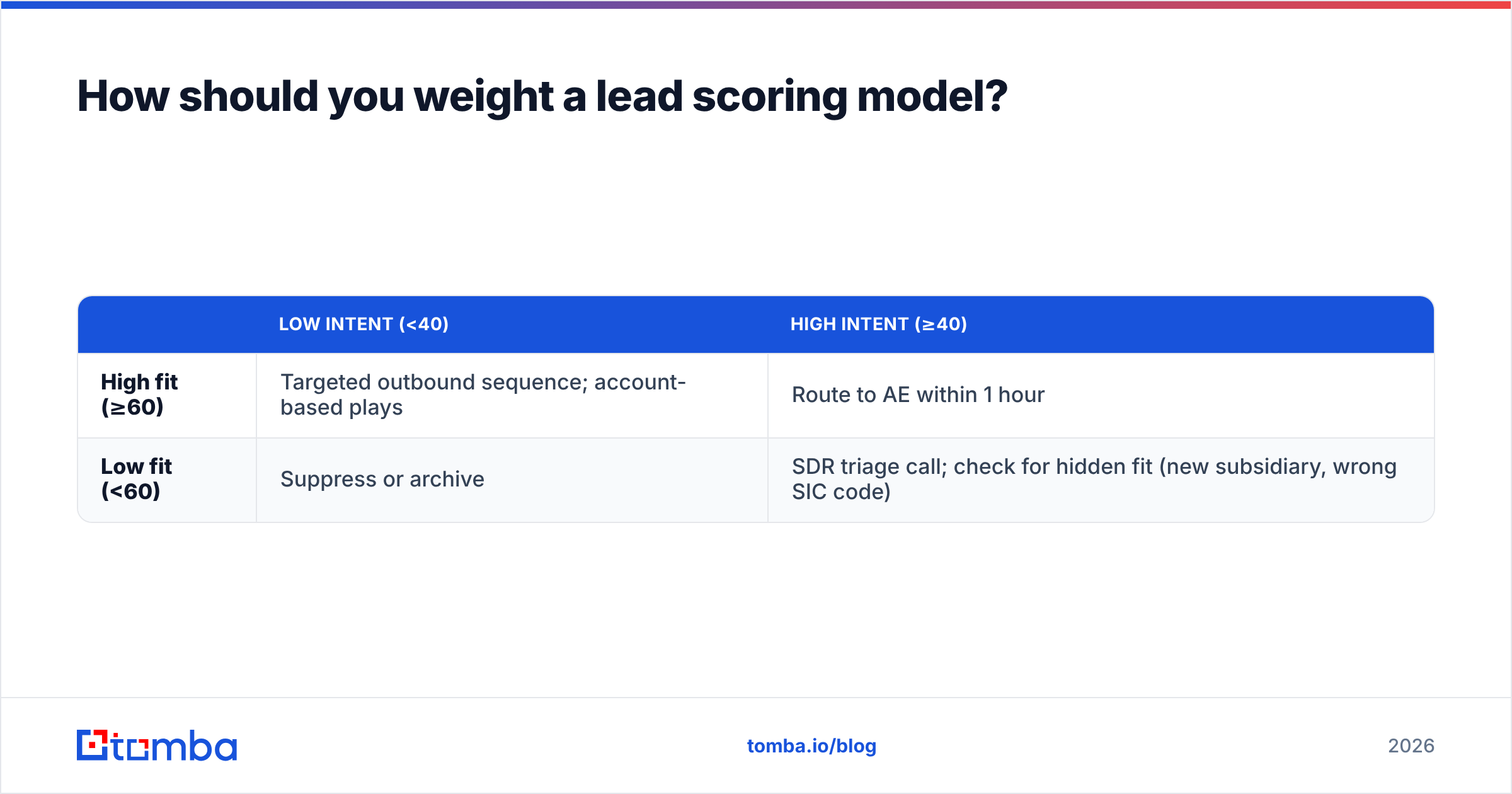
Use two axes and a routing matrix:
- Fit score (0-100) — firmographic and technographic match to written ICP. Static; recalculated on enrichment.
- Intent score (0-100) — behavioral signals with time decay. A pricing-page visit today is worth far more than one from March.
Then route:
| Low intent (<40) | High intent (≥40) | |
|---|---|---|
| High fit (≥60) | Targeted outbound sequence; account-based plays | Route to AE within 1 hour |
| Low fit (<60) | Suppress or archive | SDR triage call; check for hidden fit (new subsidiary, wrong SIC code) |
Sensible starting weights for a B2B SaaS fit score: headcount in range 25 points, industry match 20, tech stack match 20, geography 15, seniority of contact 10, funding stage 10. Negative scoring matters as much as positive — subtract for competitor domains, free-email addresses, student/academic domains, and job titles containing "intern," "student," or "consultant" if consultants aren't your buyer.
For intent, weight actions by cost-to-perform: pricing page 25, demo request 40, case study download 15, third-party review-site visit 20, email open 2, email click 8. Apply a 30-day half-life. Salesforce's overview of lead scoring models is a reasonable primer if you're building your first one.
Recalibrate quarterly against closed-won data. If your "hot" leads convert at the same rate as your "warm" ones, your model has no predictive power and is just adding ceremony.
When should you disqualify a lead?#
Immediately, and on written criteria. This is the single highest-ROI change most sales orgs can make, and it costs nothing.
Write a disqualification list and make it as specific as the ICP:
- No compelling event. They cannot articulate what breaks if they do nothing this year. Recycle to nurture with a 90-day timer.
- Budget structurally absent. Not "we haven't allocated" — that's a champion problem. "There is no line item and no path to create one this fiscal year" is a disqualifier.
- Blocked from the economic buyer. Two attempts, two refusals to introduce anyone above your contact. Your champion is not a champion.
- Requirements you will never meet. On-prem deployment, a compliance certification you don't hold, a language you don't support. Say so on call one and earn the referral.
- Undeliverable or unreachable after verification. No valid email, no phone, no LinkedIn response after a full sequence.
- Wrong company entirely. Headcount 8 when your ICP starts at 50. This should have been caught in step two — if it wasn't, fix the routing rules, not just this record.
The cultural blocker is that reps are measured on pipeline volume, so disqualifying feels like self-harm. Fix the incentive: measure SQL-to-close rate and pipeline hygiene alongside raw volume, and disqualification stops being punished. Teams that track win rate by qualification stage catch this problem quickly, because a bloated top-of-funnel shows up as a collapsing stage-two conversion.
What questions actually separate buyers from browsers?#
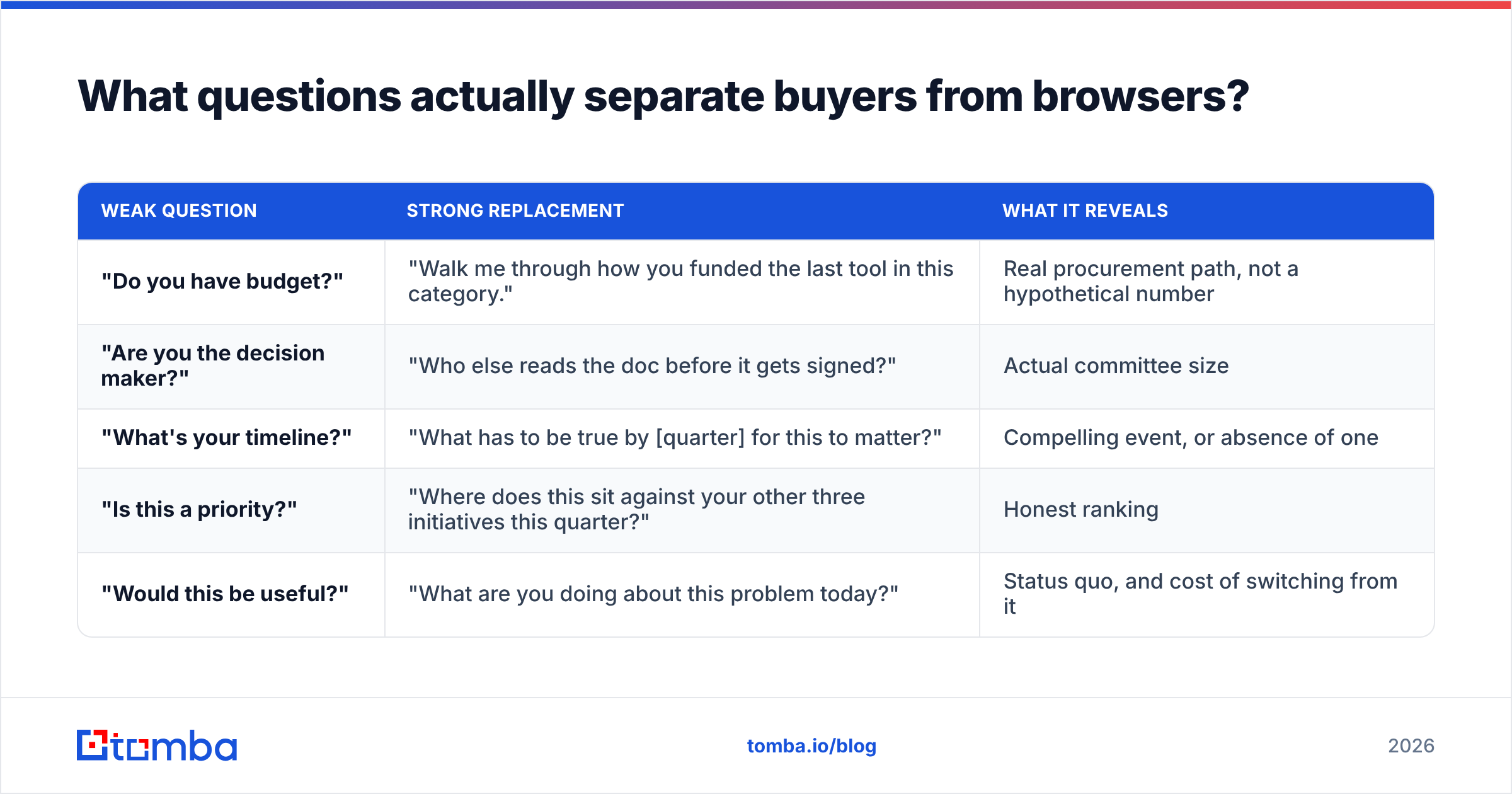
Discovery questions fail when they're answerable with "yes." Reframe every one to force specifics.
Weak versus strong, side by side:
| Weak question | Strong replacement | What it reveals |
|---|---|---|
| "Do you have budget?" | "Walk me through how you funded the last tool in this category." | Real procurement path, not a hypothetical number |
| "Are you the decision maker?" | "Who else reads the doc before it gets signed?" | Actual committee size |
| "What's your timeline?" | "What has to be true by [quarter] for this to matter?" | Compelling event, or absence of one |
| "Is this a priority?" | "Where does this sit against your other three initiatives this quarter?" | Honest ranking |
| "Would this be useful?" | "What are you doing about this problem today?" | Status quo, and cost of switching from it |
The pattern: replace yes/no with "walk me through," "who else," and "what happens if." Buyers who have a real problem answer these fluently and fast. Browsers stall, generalize, or redirect to features. That difference is your qualification signal — often more reliable than anything in the CRM.
One more test that costs nothing: ask for a small commitment at the end of every call. Access to a colleague, a document, a security review kickoff, a specific date. Genuine buyers say yes to small asks. If someone won't spend fifteen minutes introducing you to their ops lead, they will not spend $40k.
How do you keep the qualification system honest over time?#
Qualification decays like any other process. Three maintenance habits keep it working:
- Audit disqualified leads quarterly. Pull 30 records your team killed and check whether any of them bought from a competitor. If several did, your criteria are too tight and you're leaking revenue.
- Re-verify the database on a schedule. Contact data decays continuously; run bulk verification on the CRM every quarter and suppress anything that fails. This also protects email deliverability, since repeated bounces on a domain damage sender reputation long after the lead is gone.
- Close the loop from closed-won back to scoring. Every quarter, take the accounts that actually closed and check what their fit and intent scores were at MQL. If your best customers scored 45, your weights are wrong. Adjust and re-run.
It's also worth noting that qualification standards should differ by source. A lead from a G2 comparison page and a lead from a gated ebook are not the same asset and should not clear the same bar. Review sites like G2 capture buyers already in an evaluation, so they can skip several qualification steps that a content-download lead cannot.
Providers differ here too, and honestly so. Some teams prefer a curated, pre-verified database like BookYourData when they want a clean list with predictable coverage in specific verticals; others prefer a live-lookup approach that finds and verifies on demand against fresh sources. Both are defensible. The choice depends on whether your bottleneck is list breadth or data freshness — buy a static list if your ICP is stable, and use live enrichment if your targeting shifts month to month.
Start with the layer you control today#
The fastest improvement to your qualification process is not a new framework. It's making sure every record entering it is real: a deliverable address, a current title, a company that matches your written ICP. Fix that layer and your existing framework starts producing accurate signals instead of noise.
Tomba's Email Finder handles that first layer — find verified professional emails by name, company, or domain, with verification built in so unreachable contacts get filtered before a rep spends a minute on them. The free tier gives you 25 searches a month to test against your own list; paid plans start at $49/mo, with Growth at $99/mo and Pro at $249/mo. Check the full Tomba pricing if you're comparing per-credit costs, or run a slice of your CRM through it and see how much of your "qualified" pipeline was never contactable in the first place.
Related guides#
// get started
Find, verify and enrich your first contacts today
Start on the free plan with 25 searches a month, then scale when your team is ready.
Free plan · No credit card required · GDPR & CCPA
// about the author