How to Run a Sales Contest That Actually Lifts Pipeline
Most sales contests reward the rep who was already going to win. Here is a 7-step framework for designing contests that change behavior, plus the metrics, prize structures, and formats that hold up past week one.
TL;DR
- Most sales contests fail because they reward closed revenue, which your top rep was going to win anyway. Pick a metric the middle 60% of your team can actually move.
- Run contests short — 2 to 4 weeks. Anything longer and reps who fall behind in week one mentally check out.
- Team-based and bracket formats consistently beat winner-take-all leaderboards for participation, because a rep who is 30% behind still has a reason to dial.
- Cash is the weakest prize per dollar spent. Time off, visible status, and experience prizes outperform it in most published incentive research.
- Contests amplify whatever process you already have. If your contact data is stale, a contest just makes reps burn through bad records faster.
What is a sales contest, and what is it actually for?#
A sales contest is a time-boxed competition that rewards reps for hitting a specific, measurable behavior or outcome. That is the definition. The useful part is the second half of the sentence: a specific behavior.
Think of a contest like a spotlight, not a floodlight. Your comp plan is the floodlight — it pays for the whole job, all quarter, every quarter. A contest is a spotlight you point at one thing that is currently under-performing: discovery calls booked, multi-threaded deals, a stalled product line, pipeline coverage in a weak segment.
The failure mode almost every team hits is pointing the spotlight at the same place the floodlight already shines. You run a "most revenue closed" contest, your top AE wins for the fourth time, and the other nine reps quietly conclude that contests are a tax on their attention. Nothing changed. You spent $2,000 on a prize that reinforced a ranking everyone already knew.
Good contests do one of three things:
- Fix a leading-indicator gap. Pipeline generation is down, so you run a contest on qualified meetings booked — not deals closed.
- Shift focus to a neglected motion. New logo versus expansion, a product nobody sells, a vertical you just entered.
- Rebuild energy after a bad stretch. A short, high-participation contest after a rough quarter is a morale intervention with a scoreboard attached.
If your proposed contest doesn't map to one of those three, you're probably about to spend money on entertainment.
How do you choose the right contest metric?#
Start from the constraint, not the prize. Pull your pipeline data and find the stage where deals are leaking or where volume is thin. That leak is your metric.
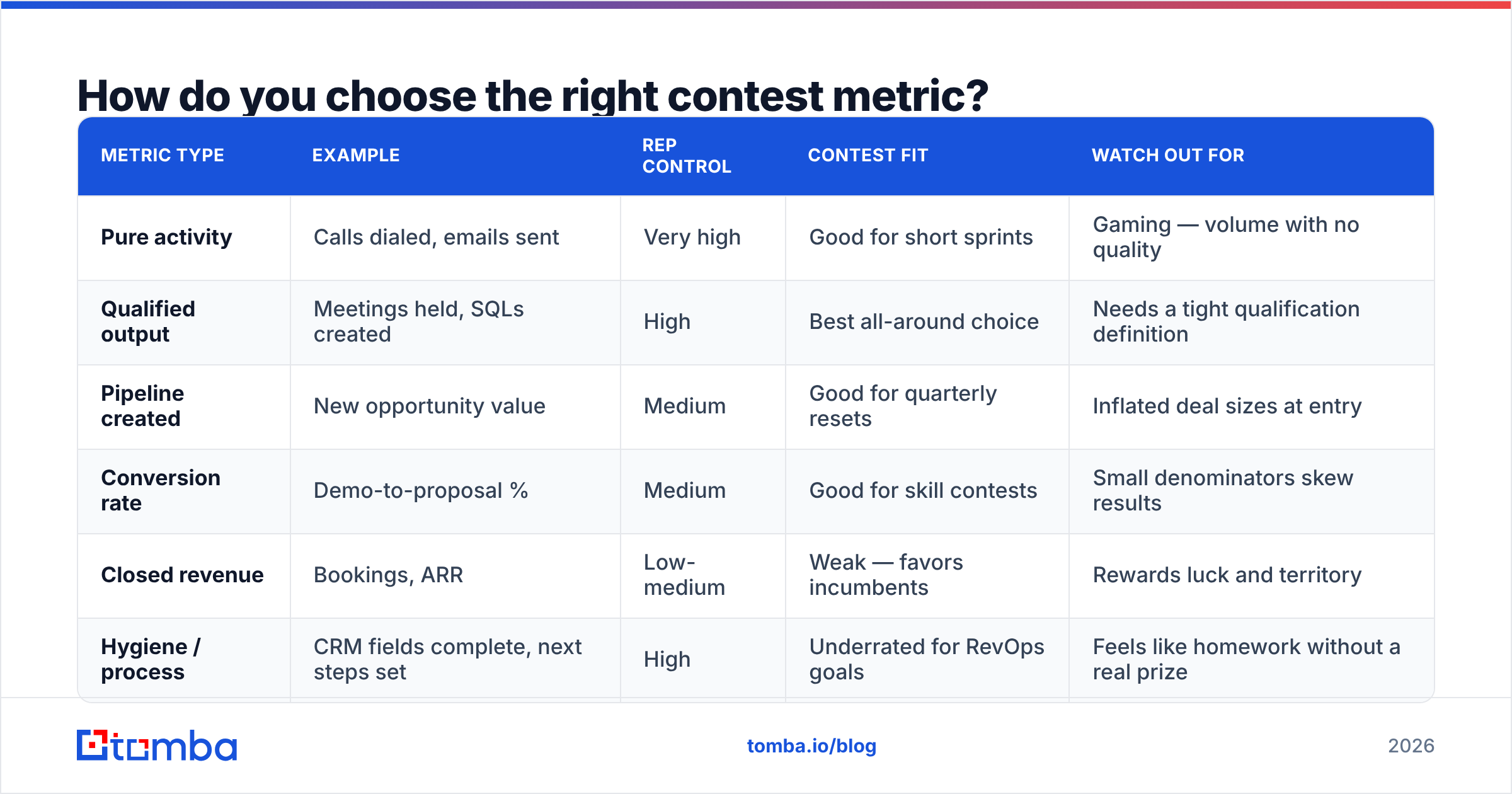
The test for a good contest metric is simple: can a median rep move it by 40% through effort alone, inside the contest window? Closed revenue usually fails that test — deal cycles are longer than your contest, and outcomes depend on factors reps don't control. Activity and mid-funnel metrics usually pass.
| Metric type | Example | Rep control | Contest fit | Watch out for |
|---|---|---|---|---|
| Pure activity | Calls dialed, emails sent | Very high | Good for short sprints | Gaming — volume with no quality |
| Qualified output | Meetings held, SQLs created | High | Best all-around choice | Needs a tight qualification definition |
| Pipeline created | New opportunity value | Medium | Good for quarterly resets | Inflated deal sizes at entry |
| Conversion rate | Demo-to-proposal % | Medium | Good for skill contests | Small denominators skew results |
| Closed revenue | Bookings, ARR | Low-medium | Weak — favors incumbents | Rewards luck and territory |
| Hygiene / process | CRM fields complete, next steps set | High | Underrated for RevOps goals | Feels like homework without a real prize |
A pattern worth stealing: run a compound metric so reps can't game one number. "Points" contests award 1 point per qualified conversation, 5 per meeting held, and 15 per opportunity created. Reps optimize the whole funnel instead of spamming the cheapest action. Your CRM should be able to score this automatically — if you're tallying it in a spreadsheet every night, the contest will die by week two from admin fatigue.

What are the best sales contest formats?#
Format matters more than prize size. The right structure keeps 100% of the team in the game; the wrong one produces two engaged reps and eight spectators.
The seven formats worth running:
- Team relay. Split the floor into 3-4 mixed-ability teams. Each team's score is the sum of members. Weak performers matter because the team needs their points, and strong reps start coaching — which is the real prize. Best default format for teams of 8+.
- Bracket / head-to-head. Seed reps into a single-elimination bracket, one-week rounds. Each matchup is its own contest, so a rep who loses a round can be out but a rep behind on total volume is never mathematically eliminated mid-round. High drama, very high engagement.
- Poker / raffle draw. Reps earn a card or raffle ticket per unit of activity. Best hand or drawn ticket wins. The randomness means the newest SDR can beat the veteran, which keeps the bottom half playing. Excellent for pure-activity sprints.
- Personal best (handicap). Score is percentage improvement over the rep's own trailing 30-day baseline, not absolute output. The only format where your quietest rep can genuinely win. Use when the goal is lifting the middle, not crowning a champion.
- Bingo card. A 5x5 grid of varied actions — "book a meeting with a VP+", "revive a closed-lost deal", "get a referral". Rewards breadth. Great for training new motions.
- Manager vs. team. The sales manager sets a number; if the team beats it collectively, the manager pays a shared prize (or takes the pie in the face). Cheap, funny, and it produces peer accountability instead of internal rivalry.
- Daily / power-hour sprints. Micro-contests inside a single day. Low stakes, immediate feedback, minimal admin. The best format for a Monday morning that needs a jolt.
The format-to-goal mapping is not arbitrary. If your goal is coaching transfer, run a team relay. If your goal is raw volume for two weeks, run a raffle. If your goal is confidence for a struggling rep, run personal-best.
How do you run a sales contest step by step?#
Seven steps. Skip any of them and you'll be debugging the contest mid-flight.
Step 1 — Define the business problem in one sentence. "Our SDR team booked 22% fewer meetings in August than July." Not "we want more energy." If you can't name the number that's wrong, don't run the contest.
Step 2 — Pick a metric a median rep can move. Use the table above. Write down the exact query or CRM report that produces the score. If you can't produce a scoreboard in under 60 seconds, pick a different metric.
Step 3 — Set the window: 2 to 4 weeks. Under two weeks, the behavior doesn't stick. Over four, mid-pack reps disengage. A month is the outer limit unless you're running weekly sub-rounds inside it.
Step 4 — Choose a format that keeps everyone alive. Default to team relay or bracket. Only run a flat leaderboard when your team is under six reps and roughly evenly skilled.
Step 5 — Design the prize ladder, not a single prize. One winner means one motivated rep. Prize ladders — first place, most improved, a random draw among everyone above a participation threshold — give three or four different reasons to keep going.
Step 6 — Publish the rules in writing before kickoff. Metric definition, disqualification rules, tie-breaker, exact end time. Every contest that ends in an argument ended in an argument because a rule was verbal. Include what counts as a "qualified" meeting — that's where 90% of disputes come from.
Step 7 — Broadcast the scoreboard daily. A Slack post at 9am, an office TV, an automated CRM dashboard. Visibility is the mechanism. A contest nobody can see the standings for is just a delayed bonus. Connect your stack with integrations so scoring and posting stay automatic rather than manual.
What prizes actually motivate sales reps?#
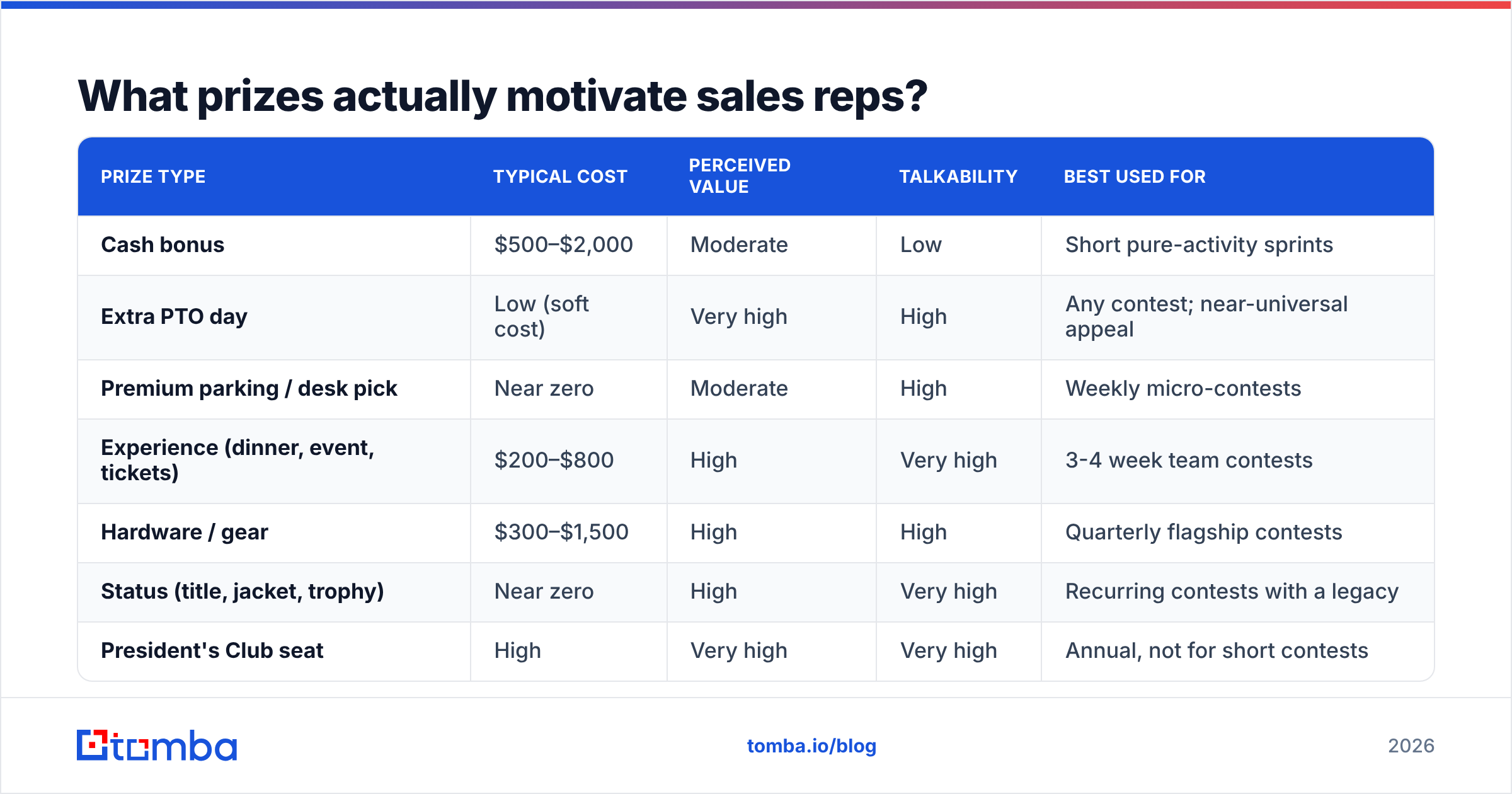
Cash is the default and it's usually the worst value per dollar. The reason is simple: cash gets absorbed into a bank account and is never mentioned again, while a non-cash prize gets talked about for months. Research on incentive design from firms like Gartner and the broader recognition literature has pointed at the same thing for years — the trophy value of a prize outlasts its cash value.
| Prize type | Typical cost | Perceived value | Talkability | Best used for |
|---|---|---|---|---|
| Cash bonus | $500–$2,000 | Moderate | Low | Short pure-activity sprints |
| Extra PTO day | Low (soft cost) | Very high | High | Any contest; near-universal appeal |
| Premium parking / desk pick | Near zero | Moderate | High | Weekly micro-contests |
| Experience (dinner, event, tickets) | $200–$800 | High | Very high | 3-4 week team contests |
| Hardware / gear | $300–$1,500 | High | High | Quarterly flagship contests |
| Status (title, jacket, trophy) | Near zero | High | Very high | Recurring contests with a legacy |
| President's Club seat | High | Very high | Very high | Annual, not for short contests |
| Manager does the chore | Zero | Moderate | Extreme | Manager-vs-team formats |
Two rules that hold up in practice. First, let winners choose from a menu — a $600 budget with three options beats a $600 prize you picked. Second, make the award public and slightly ceremonial. The 90-second announcement at the Monday meeting is doing more motivational work than the prize itself.
Why do most sales contests fail?#
Five failure modes account for nearly everything:
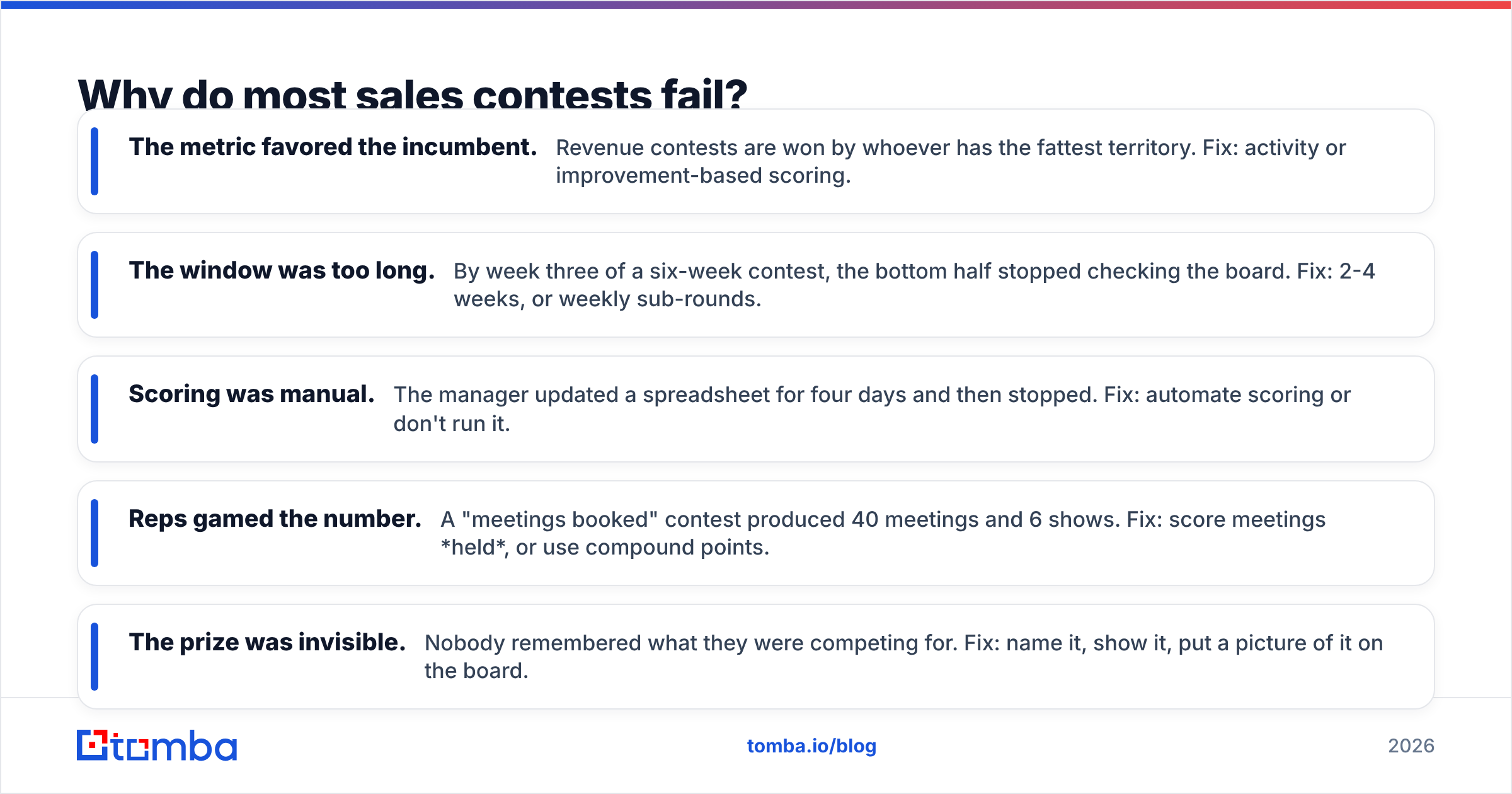
- The metric favored the incumbent. Revenue contests are won by whoever has the fattest territory. Fix: activity or improvement-based scoring.
- The window was too long. By week three of a six-week contest, the bottom half stopped checking the board. Fix: 2-4 weeks, or weekly sub-rounds.
- Scoring was manual. The manager updated a spreadsheet for four days and then stopped. Fix: automate scoring or don't run it.
- Reps gamed the number. A "meetings booked" contest produced 40 meetings and 6 shows. Fix: score meetings held, or use compound points.
- The prize was invisible. Nobody remembered what they were competing for. Fix: name it, show it, put a picture of it on the board.
There's a sixth that gets less airtime: the contest amplified a broken input. If your prospecting list is 30% bounced addresses, a dialing contest just means your team burns through bad data faster and your domain reputation takes the hit. A contest is a multiplier on the process underneath it — a multiplier on garbage returns more garbage, plus deliverability damage.
Before you run any outbound-volume contest, check the inputs. Run your target list through an email verifier so the extra activity actually lands, and confirm your response rate baseline is a data problem or a messaging problem before you throw incentives at it.
How do you measure whether the contest worked?#
Measure three things, and measure them against a baseline you captured before kickoff.
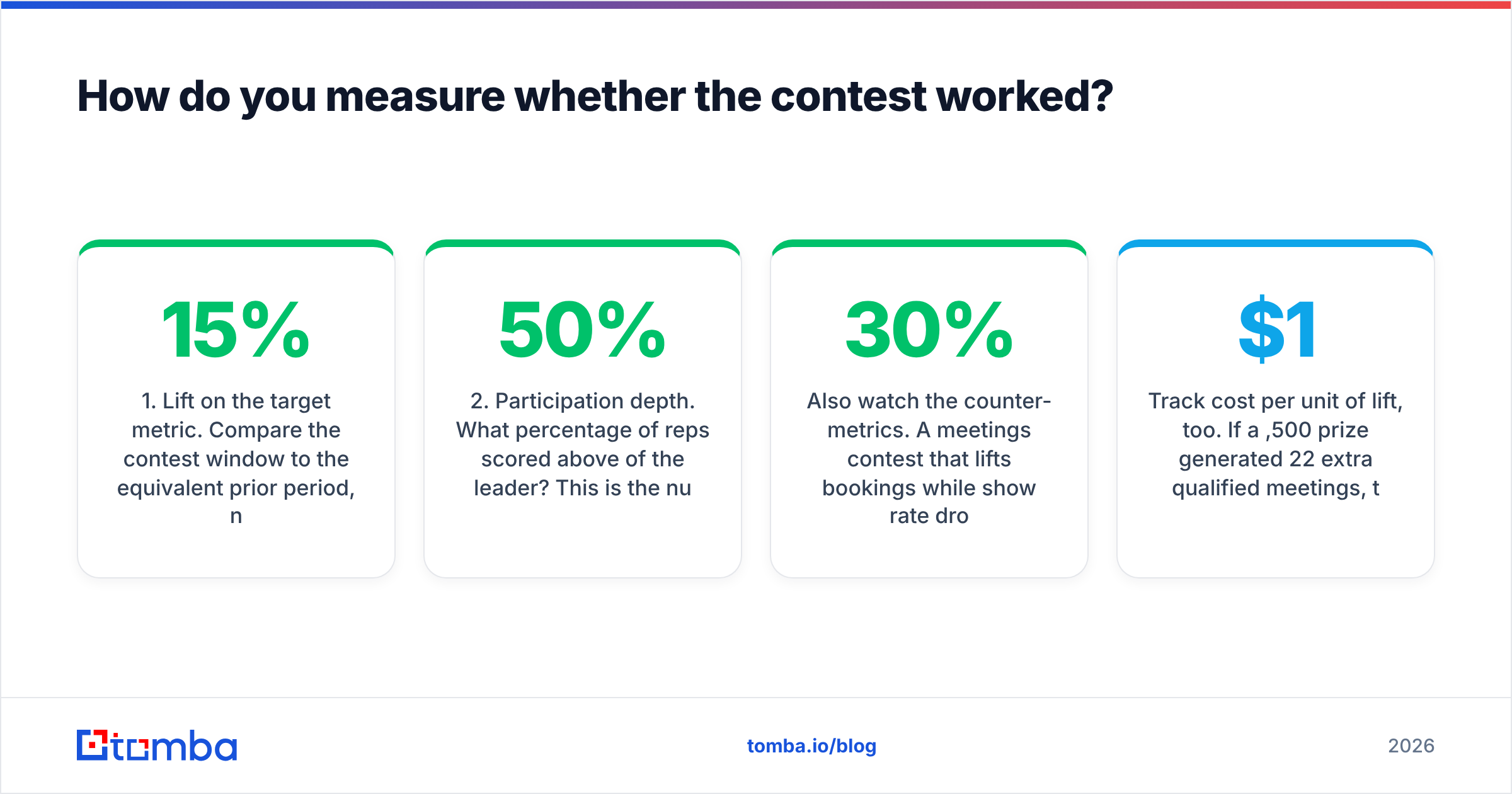
1. Lift on the target metric. Compare the contest window to the equivalent prior period, not to your best-ever week. A 15% lift on qualified meetings for a 3-week contest is a genuinely good result.
2. Participation depth. What percentage of reps scored above 50% of the leader? This is the number that tells you whether the format worked. If only two reps cleared that bar, your structure funneled all the motivation to the front-runners. Target 60%+ of the team above the halfway mark.
3. Decay. Check the target metric two and four weeks after the contest ends. Some drop is normal. A full return to baseline within 14 days means you rented behavior instead of building it, and the contest was entertainment. Persistent lift means the contest taught something — usually because the format forced coaching or exposed a new motion.
Also watch the counter-metrics. A meetings contest that lifts bookings 30% while show rate drops 20% netted you almost nothing. A dialing contest that spikes activity while opportunity quality craters is a loss. Pick one counter-metric per contest and put it on the same dashboard.
Track cost per unit of lift, too. If a $1,500 prize generated 22 extra qualified meetings, that's roughly $68 per meeting — compare that against what you pay for a meeting through paid channels and you'll know whether to run it again. Tools like G2's sales software category and vendor benchmark reports can give you rough external comparables, but your own historical cost per meeting is the only number that really matters.
What does a good contest look like end to end?#
Here's a worked example you can copy.
Situation: A 10-person SDR team. Meetings held dropped from 96 in July to 71 in August. Two reps account for 44% of output.
Design:
- Metric: points — 1 per connected conversation, 5 per meeting held, 10 per meeting held with a VP+ title
- Window: 3 weeks, Monday to Friday
- Format: team relay, three mixed teams of 3-4, drafted by the two lowest-performing reps (which quietly makes them team captains)
- Prizes: winning team gets a half-day Friday plus a $150-per-person experience budget; separate "most improved individual" award against a 30-day baseline; every rep above 150 points enters a raffle for a premium desk chair
- Scoreboard: automated CRM dashboard posted to Slack every morning at 9:00
- Counter-metric: meeting show rate, tracked on the same board
Why it works: the compound metric blocks gaming, the team format makes strong reps coach weak ones, the improvement award gives the bottom third a winnable race, and the raffle threshold keeps everyone above 150 points engaged to the last day. Three separate reasons to keep playing, one contest.
Before kickoff, the team spent half a day cleaning the target account list — verifying contacts, filling in missing direct dials, and removing duplicates. That prep is what made the volume increase produce meetings instead of bounces. If you're building or refreshing lists ahead of a contest, bulk email finder workflows and data enrichment will do in an afternoon what a rep would spend a week on manually.
Get the data right before you start the clock#
A sales contest multiplies whatever your team is already doing. Point it at the right metric, keep it short, structure it so the middle of the pack can win something, and automate the scoreboard — and you'll get a measurable lift that survives past the end date.
But none of that matters if your reps are dialing disconnected numbers and emailing addresses that bounce. Before your next contest kickoff, load your target accounts into Tomba Email Finder and build a verified contact list your team can actually run at. The free tier gives you 25 searches a month to test it, and paid Tomba plans start at $49/mo for teams that need volume. Clean inputs, clear rules, short window — that's the whole recipe.
Related guides#
Ready to find emails that actually work?
Join 150,000+ professionals who stopped guessing and started sending. Free credits on signup — no credit card required.
Get the Tomba newsletter
Practical outbound tactics and product updates — once every two weeks.
About the author