How to Scale Outbound Sales in 2026 Without Burning Your Domain
Most outbound teams scale volume before they scale data quality, and their reply rates collapse. Here is the sequencing that actually holds up past 10,000 sends a month.
TL;DR
- Scaling outbound is not "send more." It is raising the number of qualified conversations per rep-hour while keeping bounce rate under 2% and reply rate flat or rising.
- The order matters: fix data quality → fix infrastructure → fix segmentation → then add volume. Teams that reverse this burn domains in about six weeks.
- Your practical ceiling per mailbox is 30-50 cold sends/day. Scaling to 15,000 sends/month means ~12-15 mailboxes across 4-5 secondary domains, not one heroic inbox.
- Data decay is the silent killer: B2B contact data degrades roughly 22-30% per year, so a list built in January is measurably worse by June.
- Budget realistically. A 3-rep outbound motion doing 15k sends/month runs $600-$1,400/month in tooling before headcount.
What does "scaling outbound sales" actually mean?#
It means increasing qualified pipeline per unit of input — rep hours, dollars, or sends — without degrading the quality of any single touch.
Think of outbound like a municipal water system. You can raise pressure at the pump, but if the pipes are corroded, all you get is more leaks and brown water at the tap. Most teams "scale" by raising pressure: more sends, more sequences, more SDRs. The pipes — data accuracy, domain reputation, ICP definition, routing — stay corroded. Output goes up briefly, then falls below the starting point because deliverability collapses.
Here is the distinction that matters:
- Volume scaling — more emails, more dials, more connection requests. Linear cost, decaying returns, and it degrades the channel for everyone on your domain.
- Efficiency scaling — same volume, higher hit rate. Comes from better data, tighter segmentation, and better timing. Compounds.
- Leverage scaling — automation and API workflows that remove manual steps (list building, verification, enrichment, CRM hygiene). Frees rep hours for the parts humans do better.
- Channel scaling — adding phone, LinkedIn, and direct mail so a single prospect gets a coherent multi-touch sequence instead of five copies of the same email.
- Team scaling — adding SDRs, which should be last, because a new rep plugged into a broken system just breaks it faster.
Real scaling stacks 2, 3, and 4 before touching 1 and 5. If you only remember one thing from this post, remember that ordering.
Why do most outbound programs stall around 5,000 sends a month?#
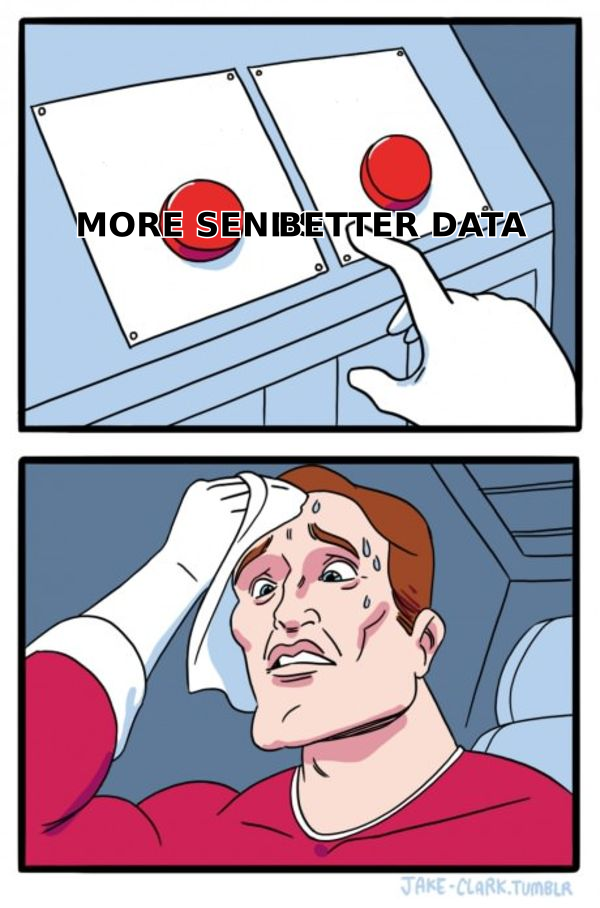
Because that is roughly where infrastructure limits and data decay start compounding at the same time.
At 1,000 sends/month, a single mailbox with mediocre data still produces meetings. Bounces get absorbed. Spam complaints are statistically invisible. At 5,000+, three things break simultaneously:
Deliverability breaks first. Google and Yahoo's bulk sender requirements — enforced since 2024 and tightened since — mean authenticated sending (SPF, DKIM, DMARC), one-click unsubscribe, and a spam complaint rate under 0.3% are non-negotiable. You can read the current thresholds directly in Google's sender guidelines. Cross 0.3% and your delivery rate falls off a cliff — not gradually, immediately.
Data quality breaks second. Job changes, company rebrands, and role churn mean your list rots continuously. When your bounce rate crosses 3-5%, mailbox providers read it as a signal that you bought a list. Which, statistically, is what a 5% bounce rate looks like.
Attribution breaks third. With three sequences you know what worked. With thirty, you cannot tell whether the winning variant was the copy, the segment, or the send time. Teams then optimize noise.
The fix for all three is upstream, not downstream. Better copy will not save a list where 12% of contacts left the company.
How do you build the data layer first?#
Start with verified, source-attributed contacts and treat your list as a perishable asset with an expiry date.
A workable data workflow at scale has four stages:
Stage 1 — Define the account list, not the contact list. Pull companies by firmographic and technographic filters first. Tech stack signals ("uses Segment," "runs Shopify Plus") predict fit far better than employee count alone.
Stage 2 — Map contacts per account. Use domain search to pull every discoverable address at a company, then filter by department and seniority. For a 200-person software company you might surface 40 addresses and keep six. That ratio is normal and healthy — you want selection, not everything.
Stage 3 — Verify before it touches a sequence. Every address goes through an email verifier with SMTP-level checking. Segment the output into valid, risky, catch-all, and invalid. Send to valid. Route catch-all domains through a catch-all verifier and treat survivors as a separate, lower-volume segment with its own reputation budget. Delete invalid — never "just try it."
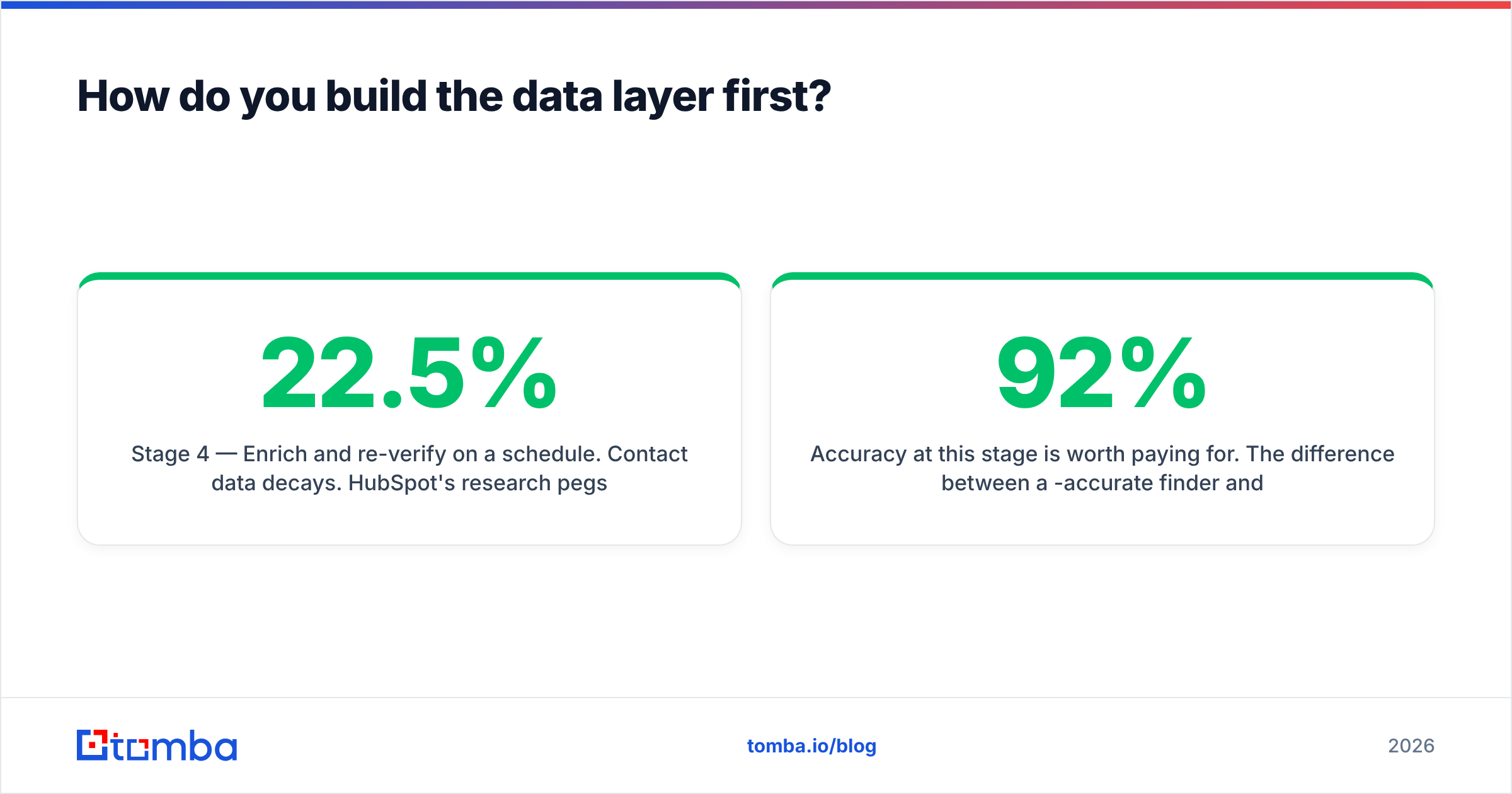
Stage 4 — Enrich and re-verify on a schedule. Contact data decays. HubSpot's research pegs B2B database decay around 22.5% annually, and roles in high-churn functions (SDR leadership, growth, RevOps) rot faster. Re-verify anything older than 90 days before it re-enters a sequence.

Accuracy at this stage is worth paying for. The difference between a 92%-accurate finder and a 78%-accurate one is not 14 percentage points of waste — it is the difference between a 2% bounce rate and an 8% bounce rate, and the second number gets your domain flagged.
What infrastructure do you need at each volume tier?#
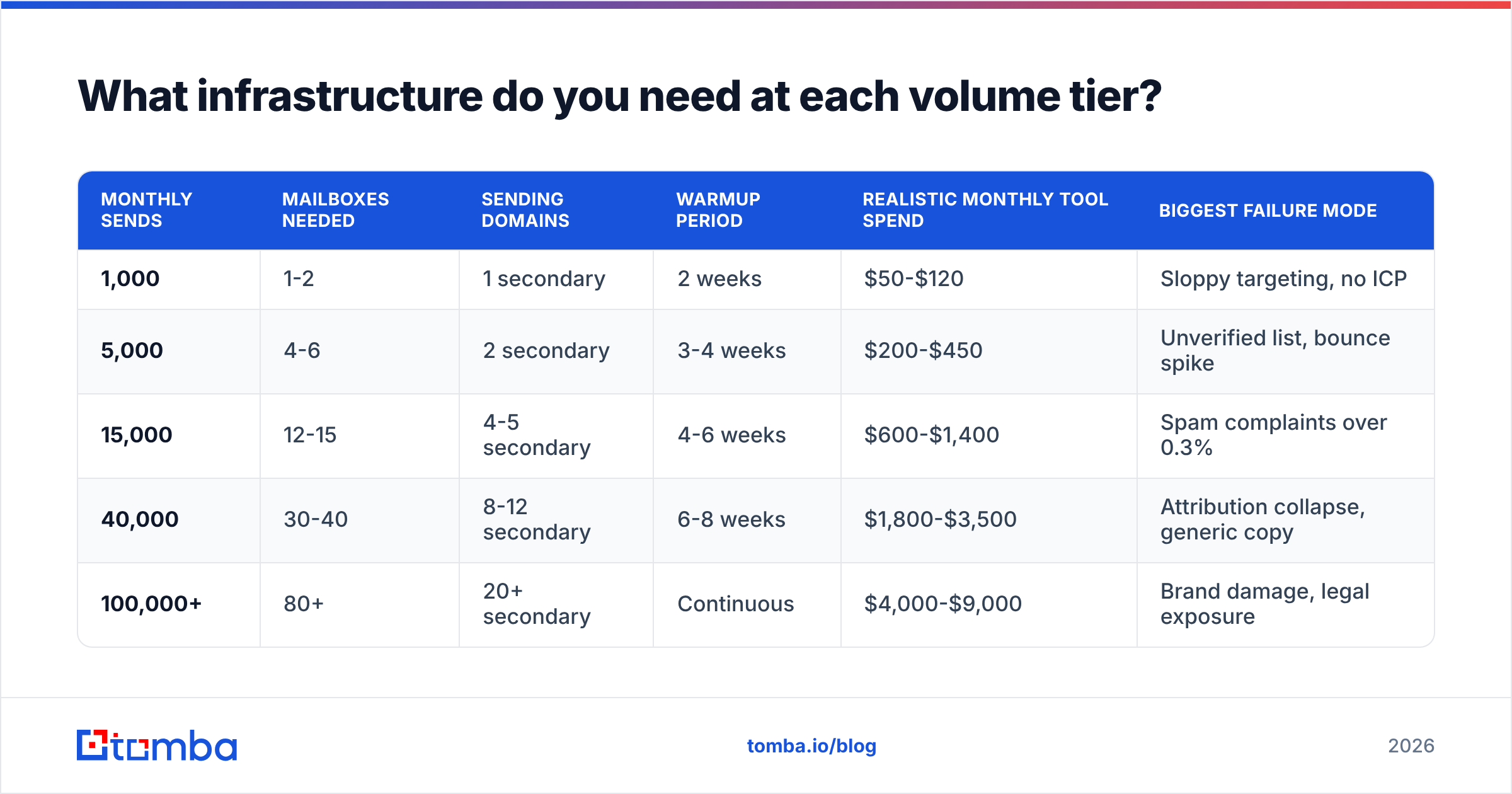
Here is the honest mapping from monthly send volume to the setup that supports it. These are working ranges from teams running cold outbound at each tier, not vendor marketing numbers.
| Monthly sends | Mailboxes needed | Sending domains | Warmup period | Realistic monthly tool spend | Biggest failure mode |
|---|---|---|---|---|---|
| 1,000 | 1-2 | 1 secondary | 2 weeks | $50-$120 | Sloppy targeting, no ICP |
| 5,000 | 4-6 | 2 secondary | 3-4 weeks | $200-$450 | Unverified list, bounce spike |
| 15,000 | 12-15 | 4-5 secondary | 4-6 weeks | $600-$1,400 | Spam complaints over 0.3% |
| 40,000 | 30-40 | 8-12 secondary | 6-8 weeks | $1,800-$3,500 | Attribution collapse, generic copy |
| 100,000+ | 80+ | 20+ secondary | Continuous | $4,000-$9,000 | Brand damage, legal exposure |
Three rules that hold across every row:
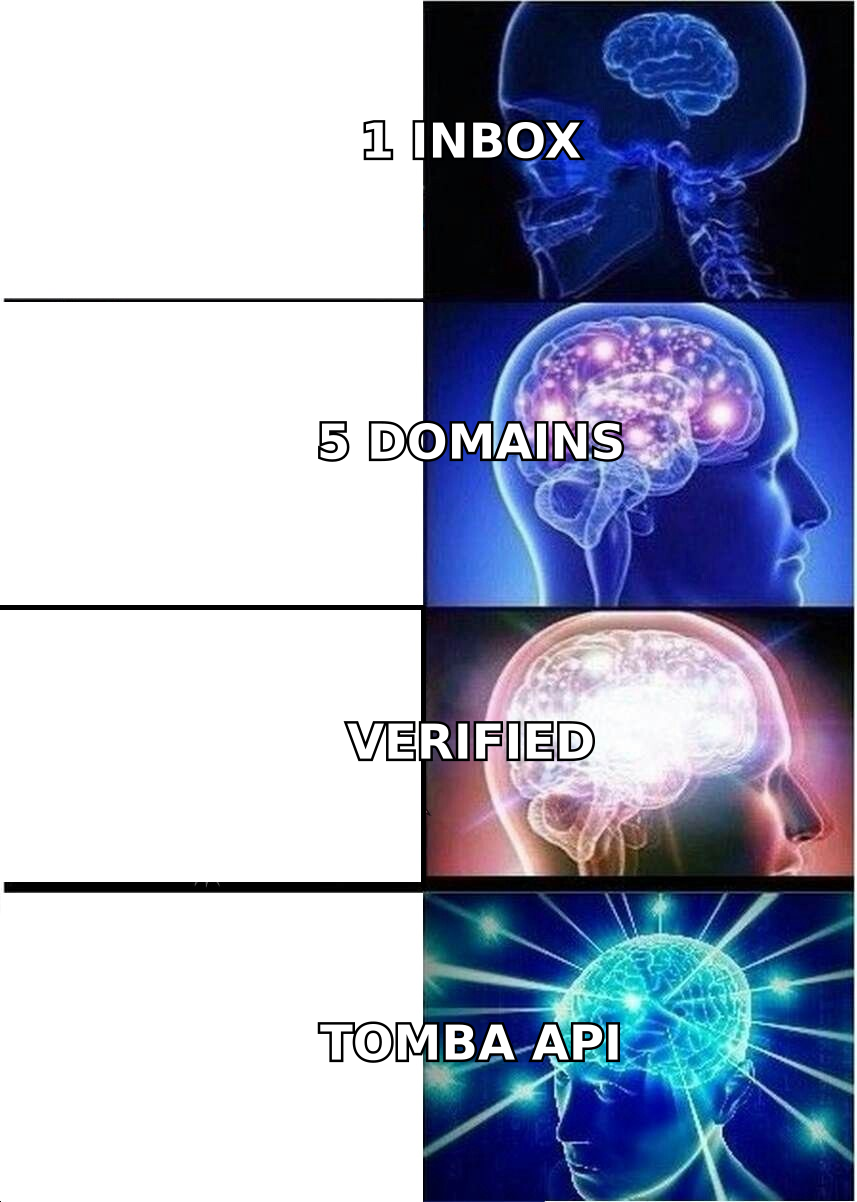
- Never send cold email from your primary domain. Buy lookalike domains (
getacme.com,acme-hq.com) and route cold traffic there. If a secondary burns, your billing and support email survives. - 30-50 sends per mailbox per day is the ceiling. Some tools claim 100+. You can do it. Your reply rate will not survive it.
- Warmup is not optional and not instant. A new domain needs 3-4 weeks of ramping before it carries real volume. Model it with a warmup calculator before you promise pipeline numbers to your board.
Which tools do you actually need, and where do they overlap?#
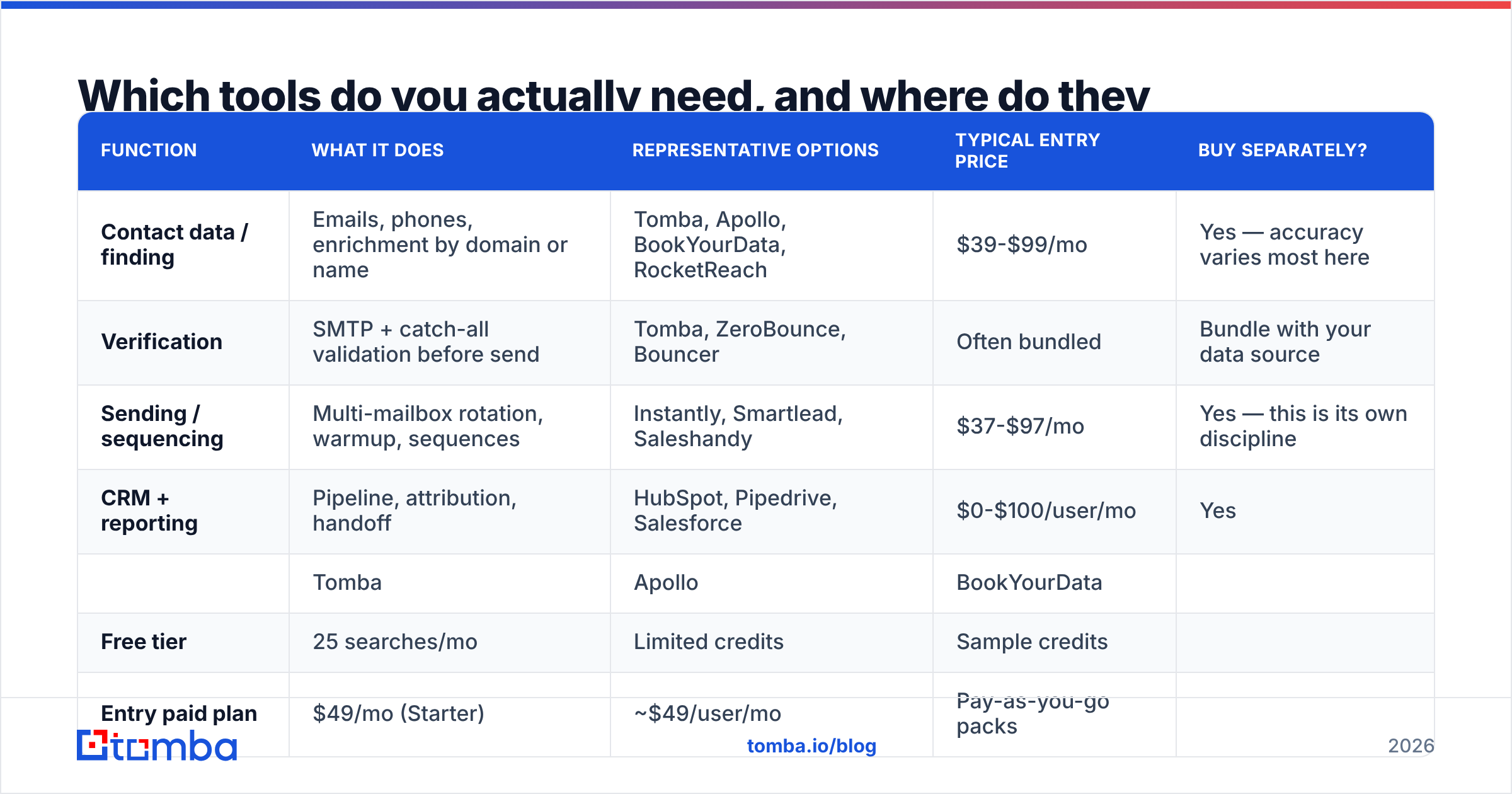
You need four functions: find, verify, send, and track. Some platforms bundle all four badly; most teams do better with a strong data layer plus a strong sending layer.
| Function | What it does | Representative options | Typical entry price | Buy separately? |
|---|---|---|---|---|
| Contact data / finding | Emails, phones, enrichment by domain or name | Tomba, Apollo, BookYourData, RocketReach | $39-$99/mo | Yes — accuracy varies most here |
| Verification | SMTP + catch-all validation before send | Tomba, ZeroBounce, Bouncer | Often bundled | Bundle with your data source |
| Sending / sequencing | Multi-mailbox rotation, warmup, sequences | Instantly, Smartlead, Saleshandy | $37-$97/mo | Yes — this is its own discipline |
| CRM + reporting | Pipeline, attribution, handoff | HubSpot, Pipedrive, Salesforce | $0-$100/user/mo | Yes |
On the data layer specifically, here is how the common choices compare for a scaling team:
| Tomba | Apollo | BookYourData | |
|---|---|---|---|
| Free tier | 25 searches/mo | Limited credits | Sample credits |
| Entry paid plan | $49/mo (Starter) | ~$49/user/mo | Pay-as-you-go packs |
| Mid tier | $99/mo (Growth) | ~$79-$99/user/mo | Volume packs |
| Bundled verification | Yes | Yes | Yes |
| Catch-all handling | Dedicated verifier | Basic flagging | Verified-at-purchase model |
| API + bulk | Full REST API, CLI, MCP | API on higher tiers | List export focused |
| Best fit | Teams automating find + verify in-pipeline | All-in-one prospecting + sequencing | Buying pre-verified lists by segment |

BookYourData is genuinely strong if your motion is "buy a clean list for a defined segment and go" — the verified-at-purchase model removes a whole workflow step. Apollo makes sense when you want prospecting and sequencing in one seat. Tomba fits when you are building an automated pipeline and want find + verify + enrich exposed as API calls your engineers can wire into a nightly job. Pick based on your motion, not on feature-count comparisons. Full Tomba pricing is public if you want to model per-credit cost against your volume tier.
How do you scale without your reply rate collapsing?#
Segment harder as volume rises, not less. This is counterintuitive and it is where most teams fail.
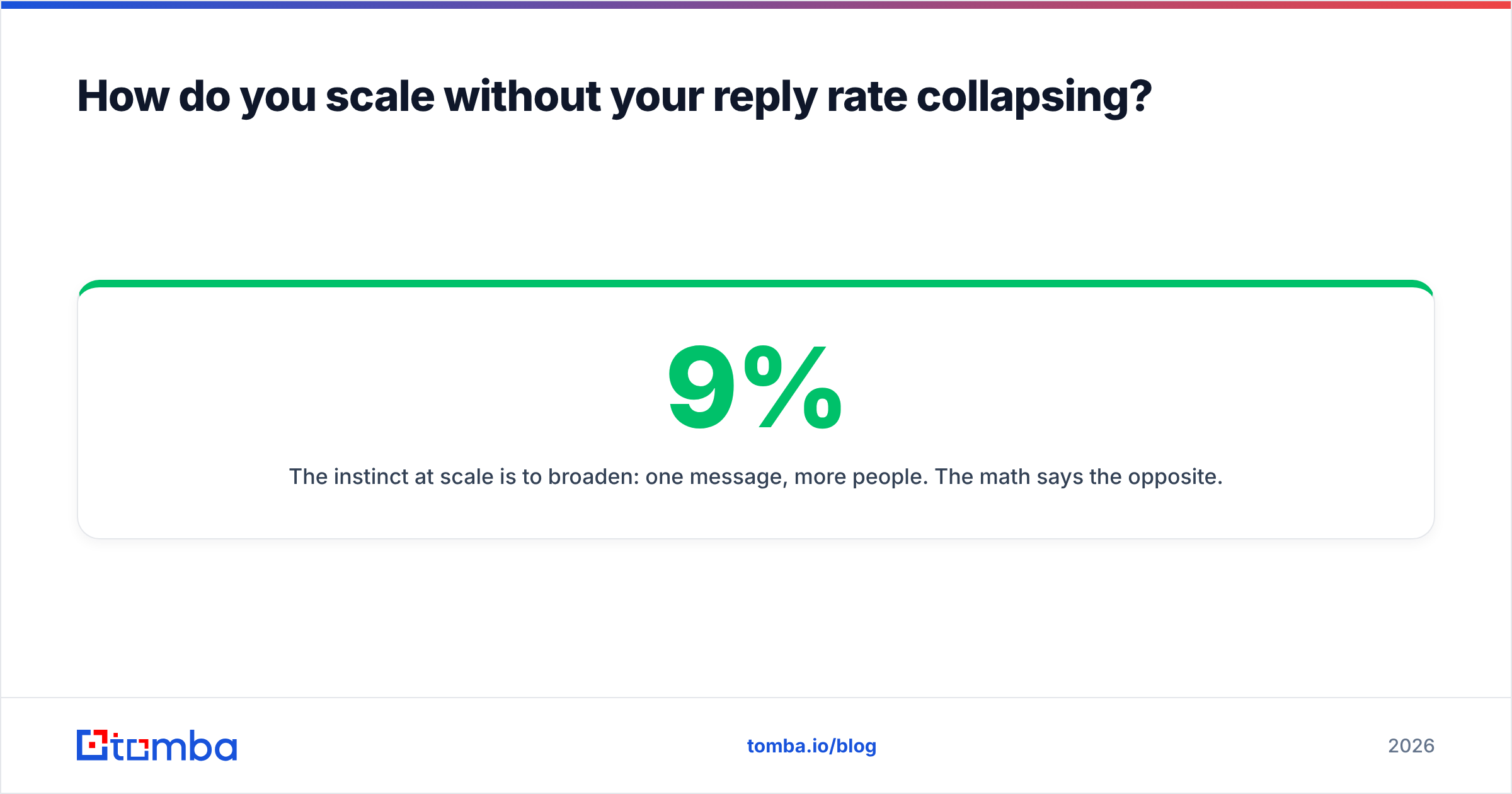
The instinct at scale is to broaden: one message, more people. The math says the opposite. If a tightly-segmented sequence to 200 people gets a 9% reply rate and a broad sequence to 2,000 gets 1.2%, the small one produces 18 replies and the big one produces 24 — for 10x the sends, 10x the reputation risk, and 10x the unsubscribes. Run five 200-person segments instead and you get 90 replies from the same 1,000 sends.
Practical segmentation axes that hold up:
- Trigger-based — funding round, new exec hire, job posting for a role your product supports, tech stack change. Highest reply rates, lowest volume.
- Technographic — what they already run. Lets you write a first line that could not have been sent to anyone else.
- Role + pain — not "VP Sales" but "VP Sales at a company that just posted three SDR reqs."
- Behavioral — site visitors, content downloaders, LinkedIn engagers. Warm enough to justify a different opening.
Then instrument it. Track reply rate, positive reply rate, and meetings booked per segment, not in aggregate. Aggregate metrics at scale are averages of things that should never have been averaged. Watch response rate as your primary health signal and bounce rate as your primary safety signal.
When should you add SDRs versus add automation?#
Add automation when the bottleneck is a repetitive task. Add headcount when the bottleneck is judgment.
Run this diagnostic on your current rep-hours:
- List building and research — automate it. This is API work: pull accounts, run bulk email finder jobs, verify, push to CRM. A nightly job replaces 6-10 hours/week per rep.
- Personalization of first lines — hybrid. AI drafts, rep edits the top 20% of accounts. Do not fully automate this; fully-automated personalization reads exactly like fully-automated personalization.
- Sequence management and follow-up timing — automate entirely. No human judgment adds value here.
- Handling replies, objections, and multithreading — human. This is the whole job. If your reps are not spending 60%+ of their time here, you have a tooling problem, not a headcount problem.
- Discovery and qualification calls — human, obviously.
- CRM hygiene and data entry — automate via integrations. Every hour a rep spends updating fields is an hour of negative ROI.
The benchmark to hold yourself to: a well-tooled SDR should generate 12-20 qualified meetings/month. If your reps are at 5-8, adding more reps multiplies a broken process. Gartner's sales research consistently finds that seller productivity is constrained more by non-selling activity than by effort, and outbound is the clearest example of that pattern.
What does a scaled outbound stack look like end to end?#
A concrete build for a team going from 3,000 to 15,000 sends/month over one quarter:
Weeks 1-2 — Foundation. Buy 4 secondary domains. Set up SPF, DKIM, DMARC on each. Provision 12 mailboxes. Start warmup. Meanwhile, rebuild the ICP definition from your last 20 closed-won deals, not from a whiteboard.
Weeks 3-4 — Data layer. Build the account list against the new ICP. Run domain search across every account, verify everything, and split into valid / catch-all / dead. Set up a re-verification job on a 90-day cycle. Wire the Tomba API or your chosen provider into whatever holds your list so enrichment is not a manual export-import loop.
Weeks 5-6 — Segments and copy. Build 5-8 segments with distinct value propositions. Write one 4-touch sequence per segment. Do not reuse copy across segments; if the copy works for two segments, your segments are the same segment.
Weeks 7-10 — Ramp. Bring mailboxes to full volume gradually. Watch bounce rate daily. If it crosses 2%, stop and re-verify before continuing. Watch spam complaints weekly against the 0.3% ceiling.
Weeks 11-13 — Optimize. Now, and only now, look at subject lines and copy variants. You have enough per-segment volume for the data to mean something.
The teams that fail at scaling skip weeks 3-4 because data work is boring and feels like it is not selling. It is the only part of this list that determines whether the rest works.
What should you measure?#
Five numbers, reviewed weekly:
- Bounce rate — target under 2%, panic above 3%. Leading indicator of data quality.
- Spam complaint rate — target under 0.1%, hard ceiling 0.3%. Leading indicator of targeting quality.
- Reply rate by segment — target 5%+ on tight segments. If it is falling as volume rises, you are broadening, not scaling.
- Positive reply rate — replies that are not "unsubscribe" or "wrong person." Target 30-40% of all replies.
- Meetings per rep per month — the only number your CFO cares about. Target 12-20.
Everything else is diagnostic. If those five are healthy, you can add volume. If any one is unhealthy, adding volume makes it worse at exactly the rate you add.
Start with the data layer#
Scaling outbound is mostly an exercise in refusing to skip steps. Verify before you send, segment before you scale, automate before you hire. The teams that hit 15,000 clean sends a month did not find a growth hack — they built a boring, reliable data pipeline and then turned up the volume on top of it.
If you are at the "our bounce rate is climbing and we do not know why" stage, start there. The Tomba Email Finder gives you source-attributed addresses with verification built in, plus a REST API, CLI, and bulk jobs so list building becomes a scheduled task instead of a rep's Tuesday. The free tier is 25 searches/month to test accuracy against a list you already know the answers to — which is exactly how you should evaluate any data vendor before you scale on top of it.
Related guides#
// get started
Find, verify and enrich your first contacts today
Start on the free plan with 25 searches a month, then scale when your team is ready.
Free plan · No credit card required · GDPR & CCPA
// about the author