How to Sell B2B SaaS in 2026: A Practical 7-Step Playbook
Most B2B SaaS deals die in the first 90 seconds of a discovery call, not in procurement. Here is the seven-step playbook top reps use to source, qualify, demo, and close software deals in 2026.
TL;DR
- Selling B2B SaaS is a sequencing problem, not a persuasion problem. Get the order right — ICP, trigger, contact data, discovery, tailored demo, mutual action plan, close — and objections mostly disappear.
- Your pipeline quality is capped by your contact data. A 40% bounce rate doesn't just hurt deliverability, it silently deletes a third of your addressable market from the funnel.
- Discovery beats demo. Reps who spend 12+ minutes on problem discovery before showing product close at materially higher rates than reps who demo in minute three.
- Pricing objections are almost always value-sequencing failures that surfaced late. Anchor on cost-of-inaction before you say a number.
- Multi-threading is the single highest-leverage habit: deals with 3+ engaged stakeholders survive champion turnover; single-threaded deals don't.
What does it actually mean to sell B2B SaaS?#
Selling B2B SaaS means convincing a group of people — not a person — to change a workflow they already tolerate, pay recurring money for the privilege, and defend that decision internally for the next twelve months.
That last clause is what makes SaaS different from selling a one-time product. You aren't closing a transaction; you're opening a subscription that has to survive renewal. Every shortcut you take to get the signature — overpromising, skipping the security review, selling to a champion with no budget authority — comes back as churn two quarters later.
Think of it like leasing an apartment rather than selling a car. The car buyer drives away and you never see them again. The tenant has to still be happy in month eleven, or you lose the revenue and eat the cost of finding a replacement. That reframing changes everything about how you qualify.
Three structural facts about the 2026 B2B SaaS buying process shape the playbook below:
- Buying committees have grown. Gartner's research on B2B buying consistently puts the typical enterprise software committee at six to ten stakeholders. Selling to one enthusiastic user is no longer a strategy.
- Buyers self-educate first. Most of the evaluation happens before you get a call. Your job in the first meeting is rarely to inform — it's to reframe.
- Budget scrutiny is permanent now. Post-2023 procurement discipline never relaxed. Every renewal is a re-buy, and every new logo needs a payback story in months, not years.
Which step do most reps get wrong first?#
They start with the pitch instead of the list. Here's the ordered playbook, and why each step exists.
| Step | What you do | Failure mode if skipped | Time cost |
|---|---|---|---|
| 1. Define ICP | Segment by firmographic + trigger, not just industry | Pipeline full of unqualifiable logos | 4-6 hrs, once |
| 2. Source contacts | Find verified decision-maker emails and direct dials | 30-45% bounce, domain reputation damage | Ongoing |
| 3. Multi-channel outreach | Email + LinkedIn + phone, sequenced | Sub-2% reply rates | 1-2 hrs/day |
| 4. Discovery | 12+ min of problem mapping before product | Feature-dump demo, no urgency | 30-45 min/deal |
| 5. Tailored demo | Show 3 workflows tied to their stated pain | "Send me a deck" purgatory | 45 min/deal |
| 6. Mutual action plan | Written steps, dates, owners, to signature | Deal slips a quarter | 15 min/deal |
| 7. Close + handoff | Commercials, security, onboarding brief | Churn at month 4 | 2-3 hrs/deal |
The compounding effect matters more than any single step. A 20% improvement at each of seven stages isn't a 20% improvement overall — it's a multiple.
How do you build an ICP that actually filters?#
Write it as an exclusion list, not an inclusion list.
Most ICP documents read like a wish list: "mid-market SaaS companies, 50-500 employees, US-based." That describes tens of thousands of companies and filters nothing. A useful ICP tells a rep who to disqualify in under 60 seconds.
- Firmographic floor and ceiling. Under 30 employees, they have no budget line. Over 2,000, you're in a 9-month procurement cycle you're not staffed for. Name the numbers.
- Technographic signal. If they run HubSpot and Outreach, your integration story lands. If they're on a homegrown CRM, expect a 3x longer sales cycle. Tools like a website tech stack check make this a 10-second qualification.
- A trigger event, not a static attribute. New VP of Sales hired, Series B announced, job posting for the role your product replaces, a competitor's logo on their site. Triggers are what turn a list into a reason to reach out this week.
- A named negative persona. Who has historically bought and churned? Write them down. Most teams can name this pattern in five minutes and have never documented it.
- Deal-size floor. If the ACV can't clear your fully-loaded cost of sale, the deal is a loss even when you win it.
Once the ICP is written, the list-building work becomes mechanical. Pull the company set, then find the people.

Where do you get contact data that doesn't bounce?#
This is the least glamorous step and the one that quietly determines your ceiling.
If you're emailing a list with a 40% invalid rate, three things happen simultaneously. Your sender reputation degrades, so even the valid addresses start landing in spam. Your reply-rate metrics become meaningless, so you can't tell whether your messaging is bad or your data is. And your rep burns hours on accounts that were never reachable.
The practical workflow:
- Start from the domain, not the person. A domain search returns every discoverable address at a company plus the pattern they use (
first.last@,finitial+last@). Once you know the pattern, you can construct and verify addresses for anyone on the org chart. - Verify before you send, always. A dedicated email verifier does the SMTP handshake, catches role accounts and disposable domains, and flags catch-all servers that will accept anything.
- Handle catch-alls deliberately. Roughly one in five B2B domains is catch-all, which means standard verification returns "unknown." A catch-all verifier is what separates usable data from a coin flip on those accounts.
- Add phone as a second channel. Email-only sequences cap out. Direct dials sourced through a phone finder turn a 2% reply rate into a 2% reply rate plus 8% connect rate.

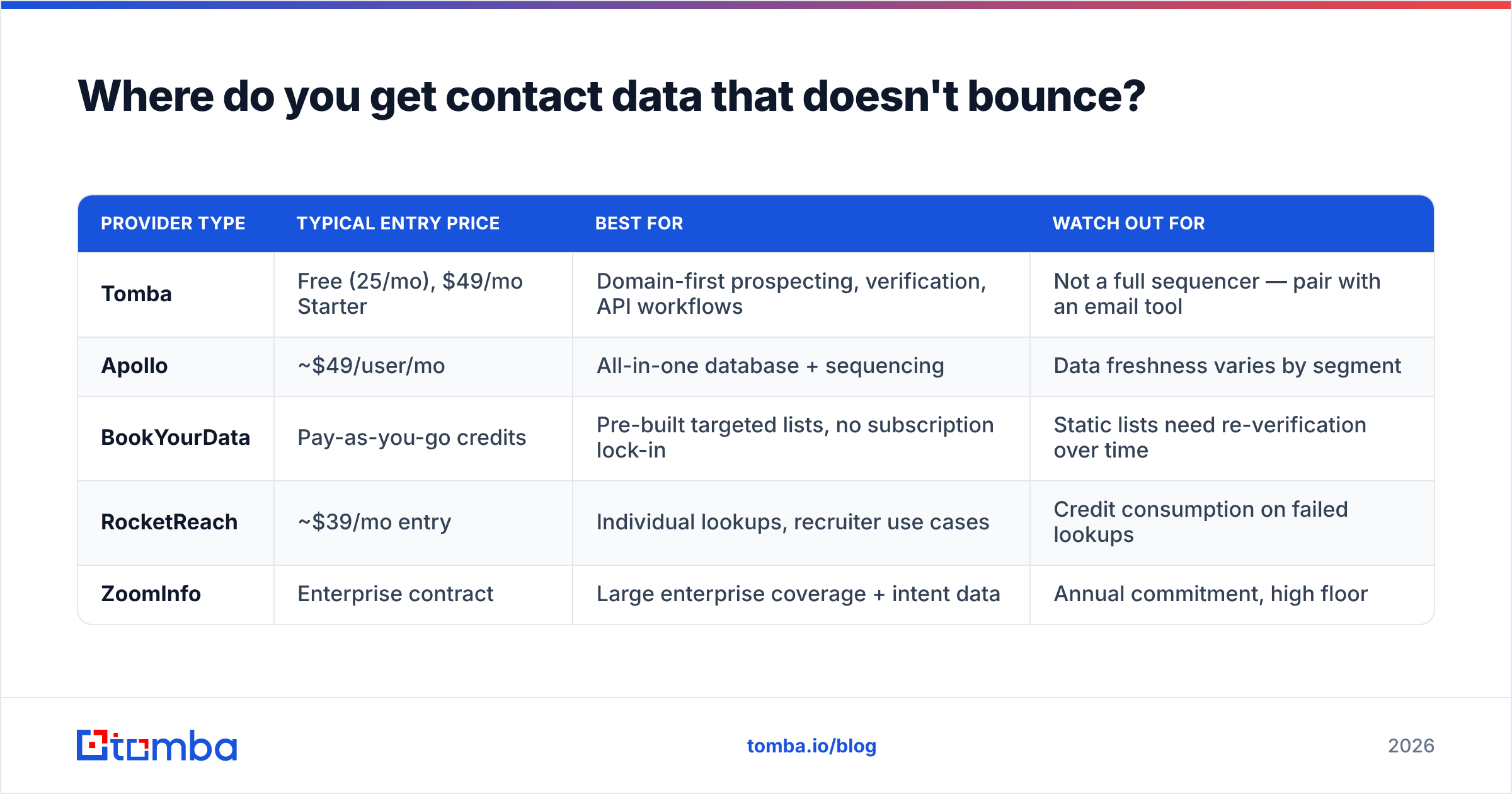
Tool selection here is mostly a cost-per-usable-contact question, not a feature question. A cheaper provider with 60% accuracy is more expensive than a pricier one at 92% once you account for wasted sends and reputation damage.
| Provider type | Typical entry price | Best for | Watch out for |
|---|---|---|---|
| Tomba | Free (25/mo), $49/mo Starter | Domain-first prospecting, verification, API workflows | Not a full sequencer — pair with an email tool |
| Apollo | ~$49/user/mo | All-in-one database + sequencing | Data freshness varies by segment |
| BookYourData | Pay-as-you-go credits | Pre-built targeted lists, no subscription lock-in | Static lists need re-verification over time |
| RocketReach | ~$39/mo entry | Individual lookups, recruiter use cases | Credit consumption on failed lookups |
| ZoomInfo | Enterprise contract | Large enterprise coverage + intent data | Annual commitment, high floor |

If you're evaluating swaps, the Apollo alternative breakdown covers where each model makes sense. And check current Tomba pricing against your monthly contact volume — the Growth tier at $99/mo covers most two-to-five rep teams comfortably.
What separates good discovery from a wasted 30 minutes?#
Good discovery produces a quantified cost of the status quo. Bad discovery produces a list of features they'd "find interesting."
The test is simple: after the call, can you write one sentence in the format "[Company] is losing [$X or Y hours] per [period] because [specific broken process], and they need it fixed by [date] because [external forcing function]"? If any bracket is empty, you don't have a deal — you have a conversation.
Questions that produce those brackets:
- "Walk me through what happens today, step by step." Not "what are your challenges." Process narration surfaces the friction they've normalized.
- "How many people touch that, and how long does it take them?" This is your quantification input. Get to hours and headcount.
- "What happens if you do nothing for another six months?" Cost of inaction. If the honest answer is "not much," you have a nice-to-have and should deprioritize the deal.
- "Who else feels this problem?" Your multi-threading map, handed to you voluntarily.
- "You've presumably looked at other options — what stopped you?" Reveals both competitive set and internal blockers you'd otherwise discover in week six.
Then shut up. The discipline that separates top reps is silence after a question. Count to four before filling the gap.

How should you run the demo?#
Show three workflows, in their language, using their data if you can get it.
The default SaaS demo is a guided tour of the product's navigation. It's the sales equivalent of reading someone the manual. What converts instead is a demo structured as three answers to three things they said on the discovery call.
Structure it like this:
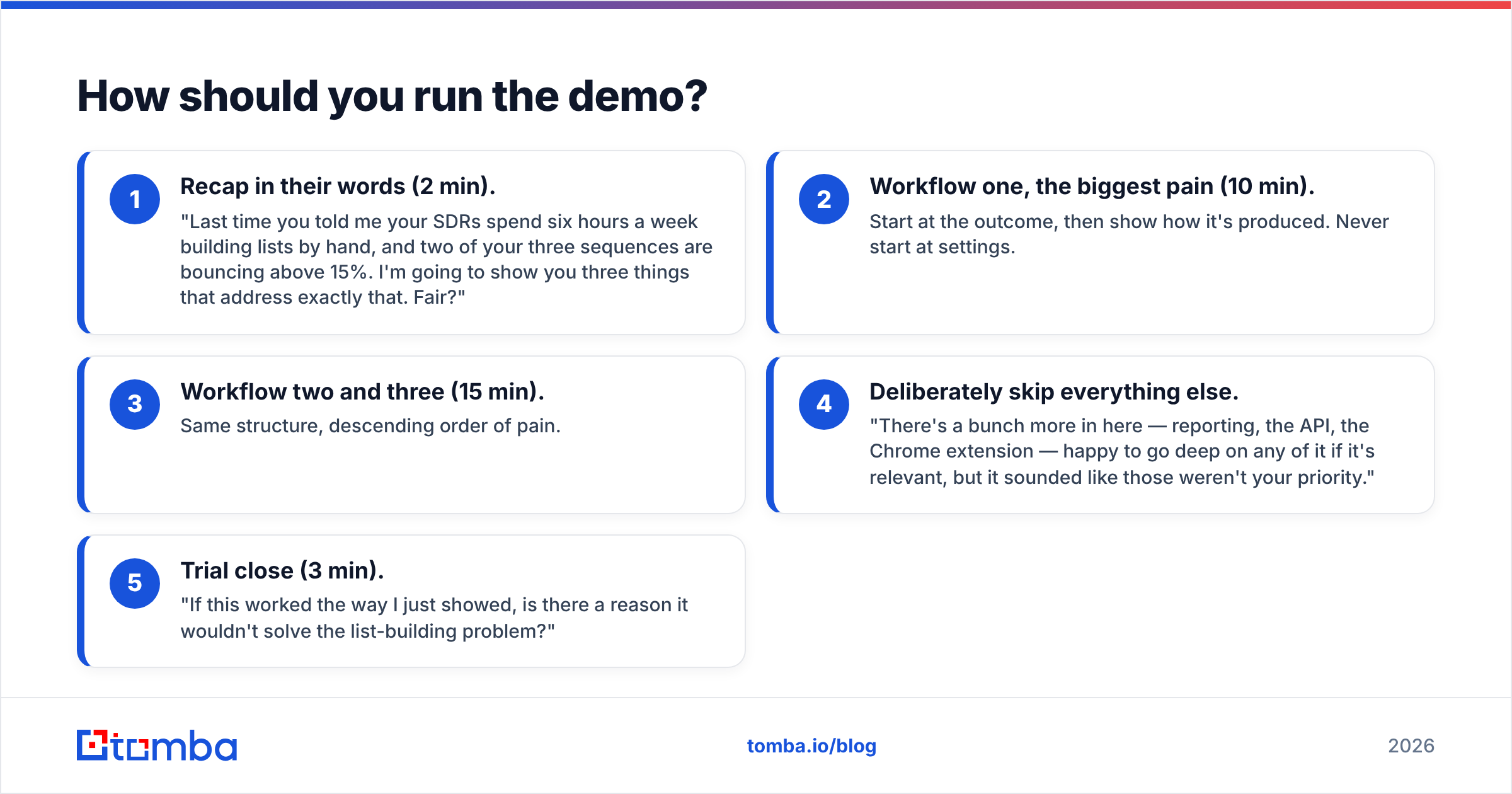
- Recap in their words (2 min). "Last time you told me your SDRs spend six hours a week building lists by hand, and two of your three sequences are bouncing above 15%. I'm going to show you three things that address exactly that. Fair?"
- Workflow one, the biggest pain (10 min). Start at the outcome, then show how it's produced. Never start at settings.
- Workflow two and three (15 min). Same structure, descending order of pain.
- Deliberately skip everything else. "There's a bunch more in here — reporting, the API, the Chrome extension — happy to go deep on any of it if it's relevant, but it sounded like those weren't your priority."
- Trial close (3 min). "If this worked the way I just showed, is there a reason it wouldn't solve the list-building problem?"
That last question is the most valuable 15 seconds of the call. A "no, that would solve it" is a commitment you can hold them to. Anything else is an objection you now get to handle live instead of by email three weeks later.
Send a follow-up within two hours with a short recap and one specific next step with a date. Generic "great chatting!" follow-ups are pipeline decay in written form. If you need a starting structure, the cold email templates library has post-demo formats worth adapting.
How do you handle pricing pushback without discounting?#
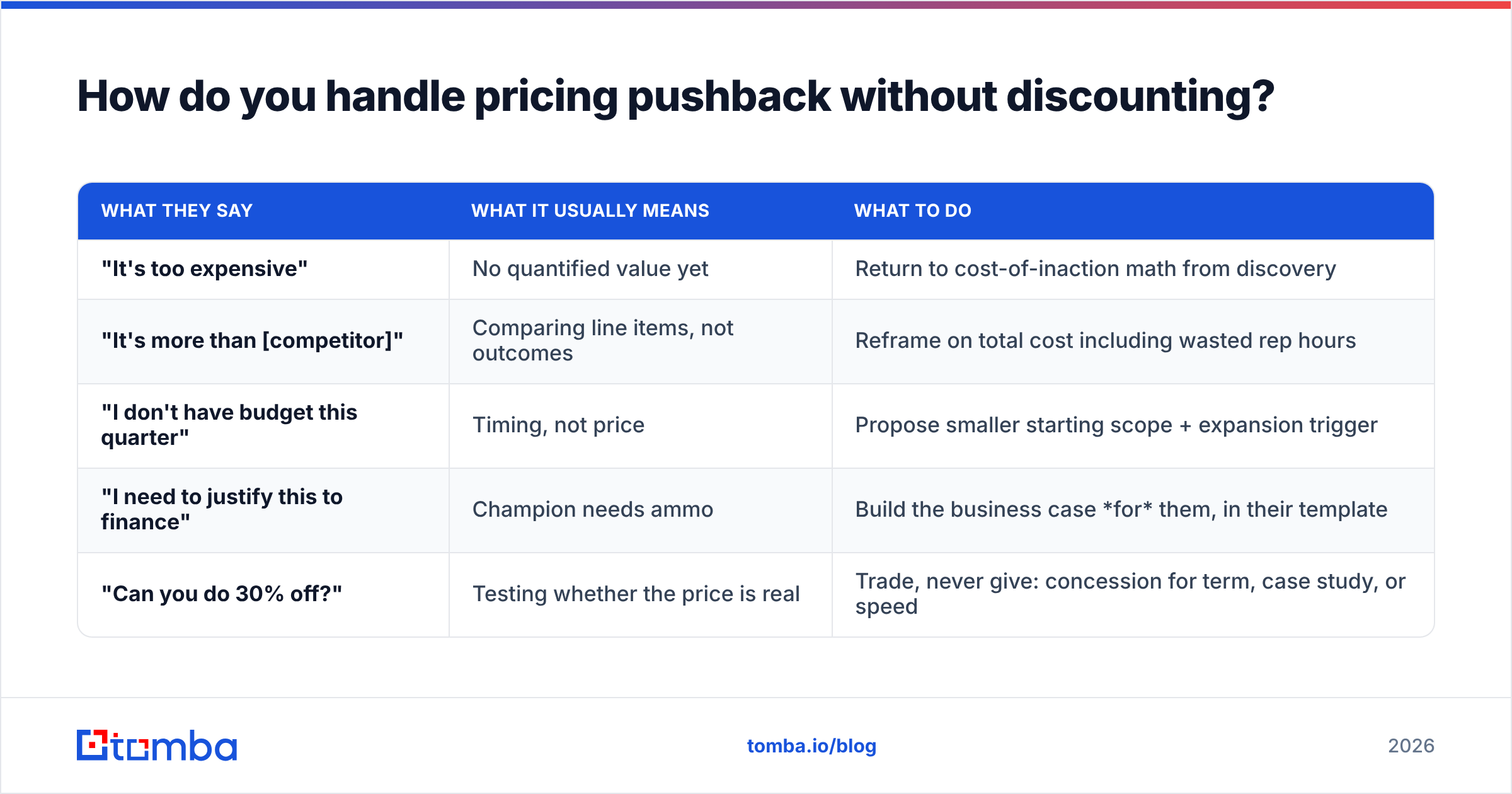
Diagnose before you concede. "That's expensive" means at least four different things, and each has a different response.
| What they say | What it usually means | What to do |
|---|---|---|
| "It's too expensive" | No quantified value yet | Return to cost-of-inaction math from discovery |
| "It's more than [competitor]" | Comparing line items, not outcomes | Reframe on total cost including wasted rep hours |
| "I don't have budget this quarter" | Timing, not price | Propose smaller starting scope + expansion trigger |
| "I need to justify this to finance" | Champion needs ammo | Build the business case for them, in their template |
| "Can you do 30% off?" | Testing whether the price is real | Trade, never give: concession for term, case study, or speed |
The structural fix is upstream. If pricing is a surprise at proposal stage, you sequenced badly. Give a range early — "teams your size typically land between $X and $Y annually" — during or right after discovery. It disqualifies the unqualifiable early and removes the sticker-shock moment entirely.
When you do discount, always trade for something: a longer term, a logo reference, a case study, an accelerated close date, or an executive intro to a sister division. A discount given for free teaches the buyer that your list price is fiction, which makes the renewal conversation worse.
What actually closes the deal?#
A mutual action plan and three engaged stakeholders. Everything else is technique.
The mutual action plan is a shared document — not a private forecast note — listing every step between today and go-live, with dates and named owners on both sides. Security review, legal redlines, procurement intake, kickoff scheduling. Send it as a draft and ask them to correct it. Buyers correct it, which means they've now co-authored their own timeline and it's much harder to slip quietly.
Multi-threading is what makes the plan survive contact with reality. Champions get promoted, reassigned, and laid off. A deal with one contact is a deal with one point of failure. Aim for the economic buyer, the technical evaluator, and the day-to-day user at minimum — and get them into at least one shared conversation before you send paper.
The close itself should be anticlimactic. If discovery quantified the pain, the demo mapped to it, pricing was ranged early, and the action plan was co-authored, signature is an administrative step. Dramatic closes are a symptom of a broken middle.
Then hand off properly. Write a two-paragraph internal brief for onboarding covering what they bought, what they expect in the first 30 days, and which metric they'll be judged on. That brief is your renewal insurance.
What's the fastest way to start?#
Pick one segment, build a list of 100 verified contacts, and run the full seven steps on it. Not 5,000 contacts across four segments — 100 in one. You'll learn more from a tight loop than from volume, and you'll find out within three weeks whether the ICP hypothesis holds.
The data step is the one people underestimate and the one that gates everything after it. If you want the list built and verified in an afternoon rather than a week, start with the Tomba Email Finder — search by domain or name, get the company's email pattern, and verify every address before it hits your sequencer. The free tier gives you 25 searches a month to test the workflow, and Starter at $49/mo covers a full first campaign. Build the list right, and the other six steps get dramatically easier.
Sources and further reading: Gartner's B2B buying research, HubSpot's sales statistics, and G2's SaaS buyer behavior reports.
Related guides#
// get started
Find, verify and enrich your first contacts today
Start on the free plan with 25 searches a month, then scale when your team is ready.
Free plan · No credit card required · GDPR & CCPA
Get the Tomba newsletter
Product and data updates
// about the author