How To Start An Email Professionally: 12 Proven Openers
Your first line decides whether the rest of the email gets read. Here are 12 tested professional email openers, the greetings to avoid, and a quick framework for picking the right one in under 10 seconds.
TL;DR
- The greeting is a formality; the first sentence after it is what decides whether anyone keeps reading. Spend your effort there.
- "Hi [First Name]," is the safest default in 2026 for almost every B2B context. "Dear Sir/Madam," "To Whom It May Concern," and "Hey!" all cost you credibility.
- Never open with "I hope this email finds you well" or a paragraph about yourself. Open with them — a trigger, a result, a specific observation.
- Formality is a dial, not a switch: adjust it by relationship, seniority, industry, and country.
- Getting the name and spelling right matters more than any opener template. A misspelled name or a
info@blast undoes a perfect first line.
Why does the first line of an email matter so much?#
Because most recipients never read the second one.
Think of a cold inbox like a hotel front desk at 8am. Twenty people are queued. The clerk has three seconds per person to decide who gets handled now, who gets handled later, and who gets waved off. Your subject line gets you into the queue. Your first line is what you say when you reach the desk.
Two structural facts make this worse than it sounds. First, most inbox clients show a preview snippet — roughly the first 90 to 140 characters of the body — right under the subject line. Your opener is doing double duty as ad copy before the email is ever opened. Second, a generic opener is the single strongest signal that an email is mass-sent. Recipients have learned that pattern, and they archive on pattern recognition, not on content.
So "how to start an email professionally" is really two questions stacked on top of each other:
- The greeting — the salutation line, which is a convention question with a mostly-known right answer.
- The opener — the first real sentence, which is a strategy question and where all the leverage lives.
Most advice spends 90% of its words on question one. We'll do the opposite.
What are the standard professional email greetings, ranked?#
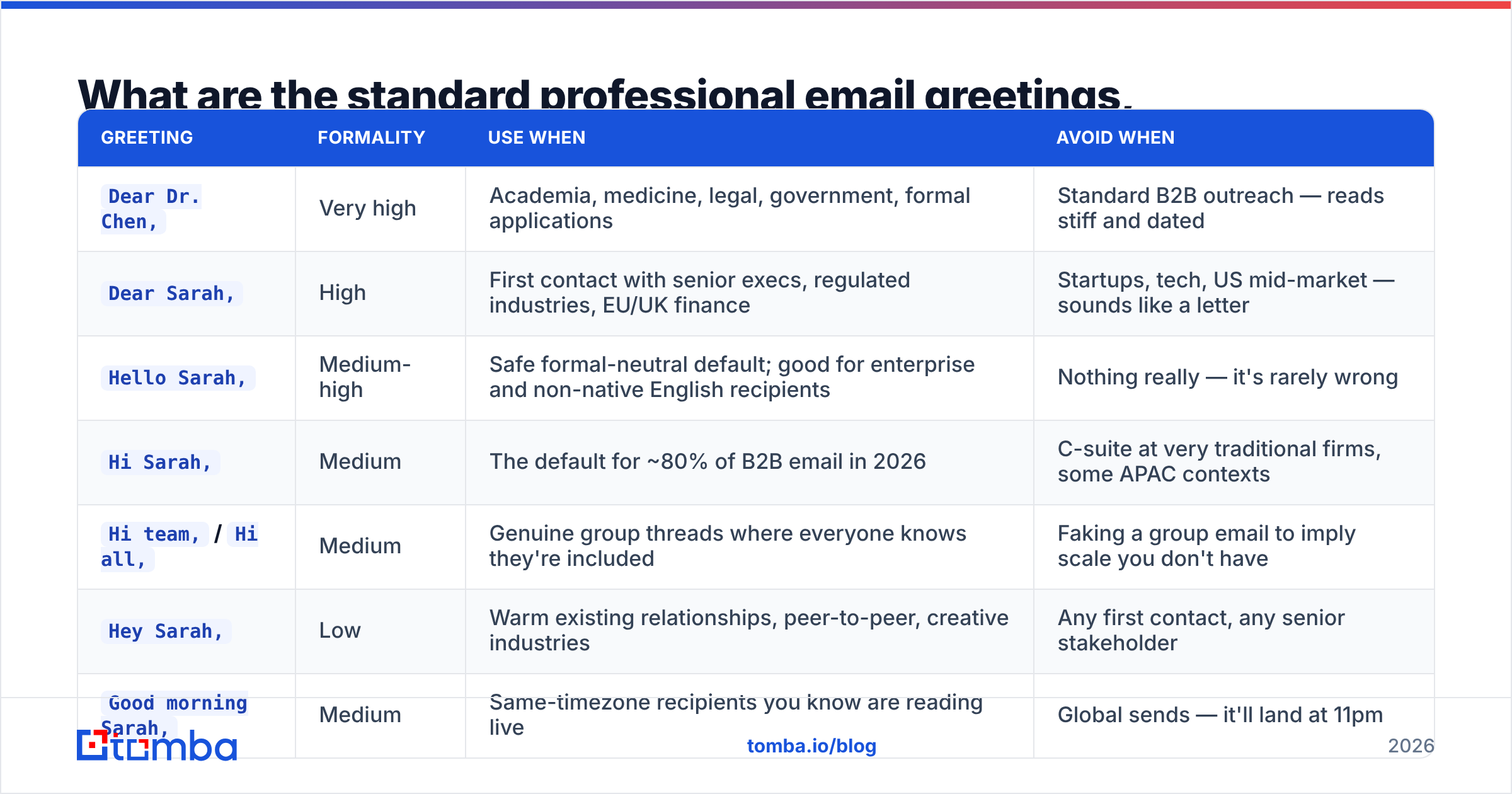
Here's the working hierarchy, from most formal to least, with when each is actually correct.
| Greeting | Formality | Use when | Avoid when |
|---|---|---|---|
Dear Dr. Chen, |
Very high | Academia, medicine, legal, government, formal applications | Standard B2B outreach — reads stiff and dated |
Dear Sarah, |
High | First contact with senior execs, regulated industries, EU/UK finance | Startups, tech, US mid-market — sounds like a letter |
Hello Sarah, |
Medium-high | Safe formal-neutral default; good for enterprise and non-native English recipients | Nothing really — it's rarely wrong |
Hi Sarah, |
Medium | The default for ~80% of B2B email in 2026 | C-suite at very traditional firms, some APAC contexts |
Hi team, / Hi all, |
Medium | Genuine group threads where everyone knows they're included | Faking a group email to imply scale you don't have |
Hey Sarah, |
Low | Warm existing relationships, peer-to-peer, creative industries | Any first contact, any senior stakeholder |
Good morning Sarah, |
Medium | Same-timezone recipients you know are reading live | Global sends — it'll land at 11pm |
To Whom It May Concern, |
Archaic | Almost never. Formal legal notices at absolute best | Anywhere you could have found a name |
Three rules that matter more than the ranking itself:
- Comma after the name, not a colon — unless you're writing an American formal business letter or a legal notice, where
Dear Ms. Ortiz:is still standard. - One line break after the greeting. Don't run the greeting into the first sentence.
- First name only, unless there's a reason not to. Titles are correct in academia, medicine, law, government, and much of Germany and Japan. Elsewhere they create distance.
When you genuinely don't have a name#
Sometimes you're writing to a support alias or a role-based inbox and there's no person behind it. In that order of preference:
Hi [Team name],— "Hi Support team," or "Hi Partnerships team," is specific and honest.Hi there,— informal but human. Acceptable for inbound replies and low-stakes notes.Hello,— plain, neutral, never offensive.Dear Hiring Manager,— fine for applications where the name is genuinely not published.
What you should almost never do is send a cold sales email to a nameless inbox at all. If the outreach matters, spend 40 seconds finding the actual human. A domain search returns the named contacts at a company along with their role, which converts "To Whom It May Concern" into "Hi Priya" before you've finished your coffee.
How do you write the opening line that comes after the greeting?#
Lead with the recipient, not yourself. That's the whole rule; everything below is implementation.
The failing pattern looks like this:
Hi Sarah,
My name is Marcus and I'm the Head of Growth at Acme, a platform that helps B2B teams streamline their revenue operations. I hope this email finds you well.
Three sentences in and Sarah has learned nothing about herself. The fix is to make the first sentence contain something only she would recognize.
Here are the twelve openers worth keeping, grouped by what they're actually doing:
Relevance openers — prove you're not blasting.
- The trigger event. "Saw you're hiring three SDRs in Berlin — usually that means the pipeline model is changing."
- The specific observation. "Your pricing page dropped the free tier last month. Curious whether that was a positioning call or a margin one."
- The mutual connection. "Dana Okoye suggested I reach out — she said you're rebuilding the outbound motion from scratch."
- The shared context. "We both spoke at SaaStock last year; I was two sessions after yours on the data track."
Value openers — lead with the outcome.
- The peer result. "A team roughly your size cut their bounce rate from 11% to under 2% in six weeks. Thought the approach might be relevant."
- The direct question. "How are you currently handling catch-all domains in your list hygiene?"
- The give. "I pulled a short teardown of your signup flow — three friction points, no pitch attached. Want it?"
Continuity openers — for warm and follow-up threads.
- The callback. "Following up on the API rate-limit question you raised Tuesday — we shipped the fix."
- The reason for timing. "You mentioned budget planning starts in October. It's October."
- The polite bump. "Bumping this in case it got buried — no reply needed if the timing's wrong."
Response openers — for inbound and replies.
- The thanks-with-substance. "Thanks for the detailed brief — the constraint on the SOC 2 timeline is the part I want to address first."
- The direct answer. "Short answer: yes, and here's what it would take."
Notice that none of them are about you. Your introduction can wait until sentence two or three, where it belongs, and where it now has a reason to exist.
What email openers should you never use?#
These are the ones that cost you replies, in rough order of how much damage they do.
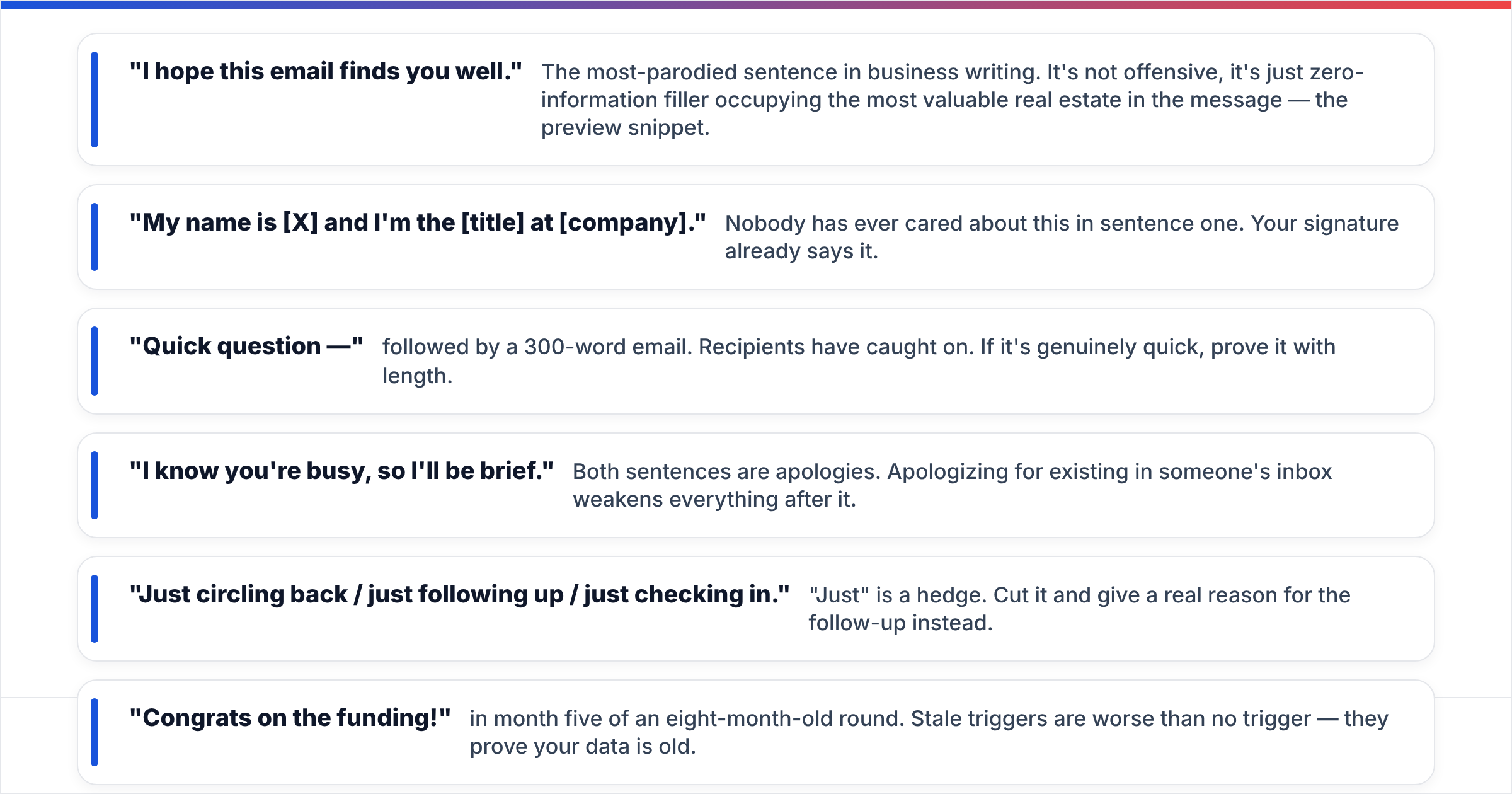
- "I hope this email finds you well." The most-parodied sentence in business writing. It's not offensive, it's just zero-information filler occupying the most valuable real estate in the message — the preview snippet.
- "My name is [X] and I'm the [title] at [company]." Nobody has ever cared about this in sentence one. Your signature already says it.
- "Quick question —" followed by a 300-word email. Recipients have caught on. If it's genuinely quick, prove it with length.
- "I know you're busy, so I'll be brief." Both sentences are apologies. Apologizing for existing in someone's inbox weakens everything after it.
- "Just circling back / just following up / just checking in." "Just" is a hedge. Cut it and give a real reason for the follow-up instead.
- "Congrats on the funding!" in month five of an eight-month-old round. Stale triggers are worse than no trigger — they prove your data is old.
- "Dear [First Name]" with the merge tag unrendered, or "Hi Sara," when she spells it Sarah. This is the fastest possible way to be deleted.
That last one deserves emphasis. Personalization tokens fail silently, and they fail at scale. Before a send, run the list through an email verifier to strip invalid addresses, and spot-check the name column for merge artifacts, all-caps imports, and full names sitting in a first-name field. A broken greeting isn't a style problem — it's a data problem wearing a style costume.
How formal should your email be? A quick decision framework#
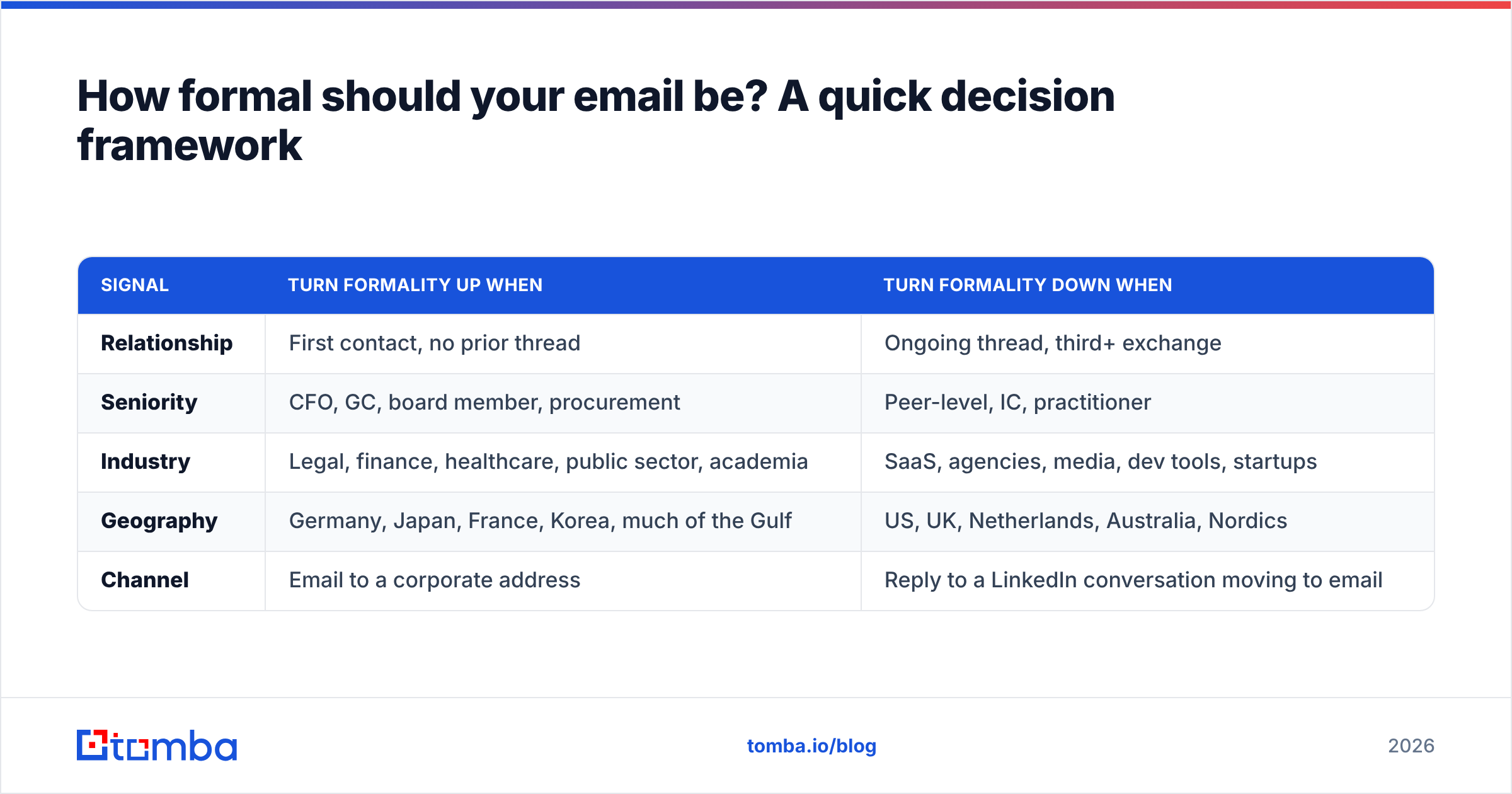
Formality isn't a personality trait, it's a calibration. Four dials:
| Signal | Turn formality up when | Turn formality down when |
|---|---|---|
| Relationship | First contact, no prior thread | Ongoing thread, third+ exchange |
| Seniority | CFO, GC, board member, procurement | Peer-level, IC, practitioner |
| Industry | Legal, finance, healthcare, public sector, academia | SaaS, agencies, media, dev tools, startups |
| Geography | Germany, Japan, France, Korea, much of the Gulf | US, UK, Netherlands, Australia, Nordics |
| Channel | Email to a corporate address | Reply to a LinkedIn conversation moving to email |
The practical shortcut: mirror them. If someone signs off "Best regards, Katherine Whitfield-Moore," you do not reply "Hey Kath." If they sign "— j", you can relax. On first contact with no signal at all, "Hi [First Name]," plus a specific first line is correct in almost every English-language B2B context, and it degrades gracefully if you've guessed wrong.
One cross-cultural note worth internalizing: in German business email, titles and surnames persist far longer into a relationship than an American sender expects, and dropping to first names before being invited to is a real misstep. In Japan, the honorific -san is expected and its absence is noticeable. The HubSpot blog on professional email has a good breakdown of the US conventions; assume they don't transfer wholesale.
What does a complete professional email opening look like?#
Structure, then three worked examples.
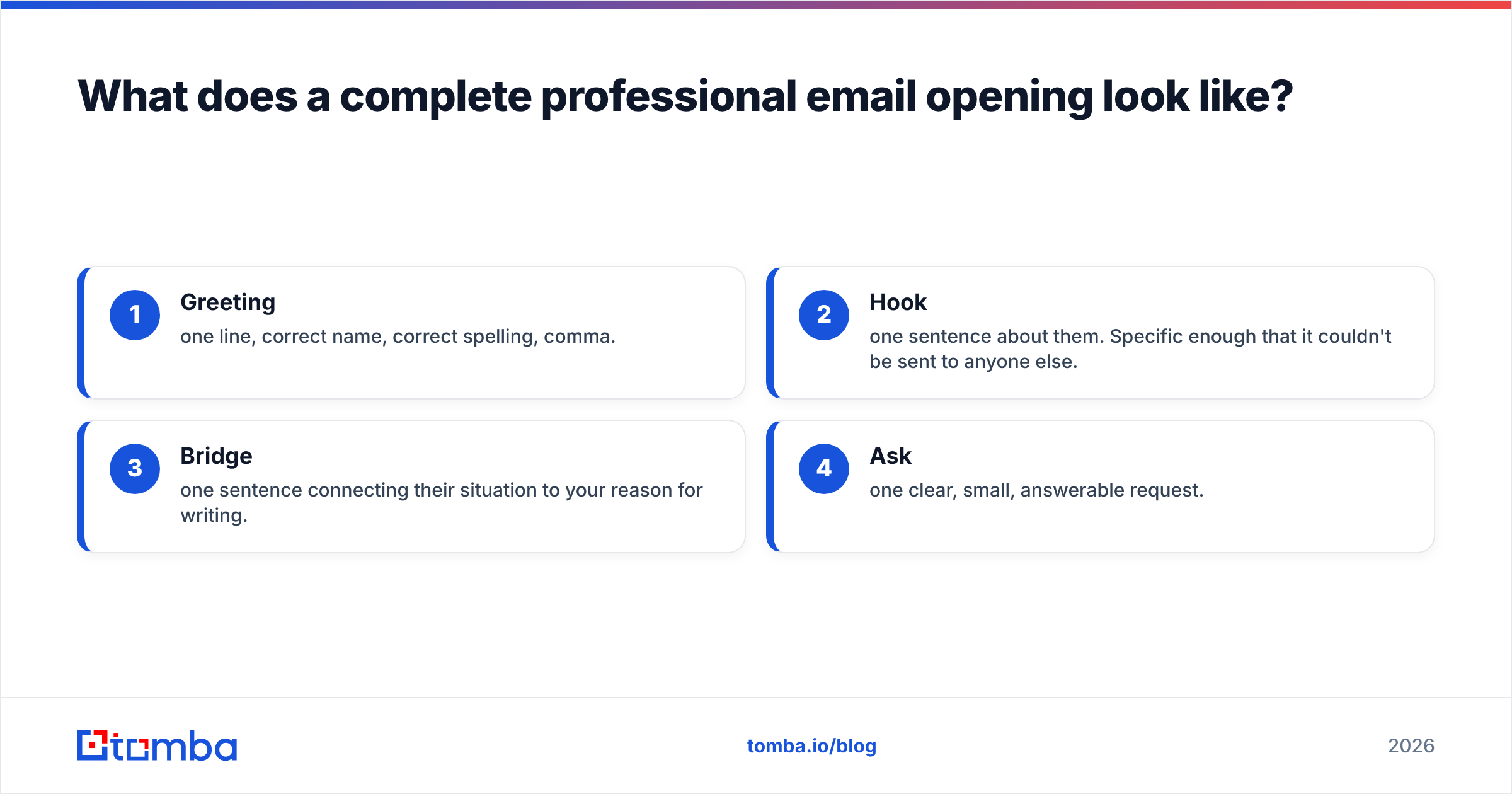
The anatomy:
- Greeting — one line, correct name, correct spelling, comma.
- Hook — one sentence about them. Specific enough that it couldn't be sent to anyone else.
- Bridge — one sentence connecting their situation to your reason for writing.
- Ask — one clear, small, answerable request.
Cold outreach:
Hi Priya,
Your team posted two RevOps roles in the last three weeks — usually a sign the reporting layer is being rebuilt, not just staffed.
We work with ops teams at that exact stage on contact-data hygiene, which is normally the thing that breaks first when the CRM gets re-modelled.
Worth a 12-minute call next week to see if the timing lines up?
Follow-up after silence:
Hi Priya,
Bumping this once — you mentioned planning kicks off in October, and it's the 6th.
If it's not a priority this quarter, say the word and I'll close the loop. If it is, I'll send the two-page version instead of asking for a call.
Reply to an inbound request:
Hello Marcus,
Thanks for the brief — the SOC 2 timeline is the constraint that matters most here, so I'll start there.
We can meet the November date, with one dependency on your side: SSO config needs to land two weeks before go-live.
Does a Thursday call work to walk through the sequencing?
Each one is under 70 words before the ask. That's not a rule, but it's a useful ceiling — the longer the runway, the more chances the reader has to bail.
How do you make sure the email actually arrives?#
A perfect opener is worthless in a spam folder, and this is where most "how to start an email professionally" advice stops short.
Three checks that gate everything above:
- The address must be real. Bounces are the fastest route to a damaged sender reputation, and reputation damage affects every email you send afterwards — including the ones to people who like you. Verify before you send, not after.
- The name must be clean. Imported lists carry all-caps names, "Dr." glued into the first-name field, and company names in the person column. Scan the column visually before every send.
- The domain must be authenticated. SPF, DKIM, and DMARC are table stakes since the 2024 Google and Yahoo bulk-sender rules; both providers now enforce authentication on volume senders. Run an SPF checker if you haven't touched your DNS in a year.
Where the address itself comes from matters too. Guessing at firstname.lastname@company.com works maybe 60% of the time depending on the industry — and every miss is a bounce. An email finder that returns a confidence score lets you separate the addresses you can send to today from the ones that need a catch-all check first. For patterns you want to confirm before a big send, the company email pattern tool tells you which format a given domain actually uses.
Frequently asked questions#
Is "Dear" too formal for business email in 2026? For most B2B outreach in English-speaking markets, yes — "Dear Sarah," reads like a letter rather than an email. It remains correct in legal, academic, medical, government, and many European finance contexts, and it's never rude, only distant.
Should I use the recipient's title? Only when it carries real weight: Dr., Prof., Judge, Rev., or when the local business culture expects surnames-plus-title (Germany, Japan, Korea). Otherwise a first name is warmer and just as respectful.
How long should the opening line be? One sentence, under 25 words, ideally under 15. It has to survive being truncated in a mobile preview pane.
Can I use emoji in a professional email opener? On first contact, no. In an established thread with someone who uses them, matching is fine. The asymmetry risk is entirely one-directional — nobody has ever lost a deal by omitting an emoji.
What if I get the name wrong? Correct it in the next message, once, briefly: "Apologies for the misspelling earlier — Siobhán." Don't write a paragraph about it. Over-apologizing draws more attention to the error than the error did.
Start with the right name and the right address#
Every opener in this post assumes one thing: that you know who you're writing to and that the address works. That assumption is where most outreach quietly fails — not in the greeting, but two steps before it.
Tomba's Email Finder returns verified professional addresses by name and domain, with a confidence score attached so you know which contacts are safe to send to. The free tier covers 25 searches a month, and paid plans start at $49/month if you're working a real list. Find the person first, then spend your effort on the sentence that actually earns the reply.
Related guides#
// get started
Find, verify and enrich your first contacts today
Start on the free plan with 25 searches a month, then scale when your team is ready.
Free plan · No credit card required · GDPR & CCPA
// about the author