How to Start Lead Generation Business in 2026: Full Playbook
A step-by-step breakdown of how to start a lead generation business in 2026 — pricing models that actually pay, the tool stack, first-client acquisition, and the margin math most agencies get wrong.
TL;DR
- Wondering how to start lead generation business operations in 2026? You sell qualified prospects or booked meetings to other companies. Tooling runs about $300–$900/month, not $10k.
- Pick one model before you pick tools: pay-per-lead, retainer, pay-per-meeting, or database/list building. Margins and cash flow differ wildly.
- Your data layer is the business. Bad emails destroy deliverability, and deliverability destroys the whole P&L.
- Niche down to one vertical and one buyer title for the first 6 months. Generalist lead gen agencies churn out fast.
- Realistic path: month 1 build stack and offer, month 2 land 1–2 pilot clients at $1,500–$3,000, month 4+ scale to $10k MRR with 4–6 accounts.
How to Start Lead Generation Business Operations: What You Sell#
A lead generation business finds buyers for other companies. You hand them over as a contact record, a warm reply, or a booked call. In short, you rent out a demand engine the client does not want to build in-house.
Think of it like a staffing agency for pipeline. The client has salespeople who can close but no one to close with. You supply the "with."
Four things get sold in this market, and they are not interchangeable:
- Raw contact data — verified emails, phone numbers, and firmographics matching an ICP. Lowest price point, highest volume, most commoditized.
- Engaged leads — contacts who replied, downloaded, or requested info. Mid-tier pricing, needs an outbound or content engine.
- Booked meetings — a calendar invite with a qualified decision-maker. Premium pricing ($150–$800 per meeting), highest operational load.
- Managed outbound as a service — you run the whole cold email, LinkedIn, and calling motion on a monthly retainer. Most predictable revenue, most delivery risk.
Most people asking how to start lead generation business ventures assume #3 is the goal. In practice, #1 and #4 fund the first year. They are simply easier to deliver week after week.

Which Business Model Should You Pick First?#
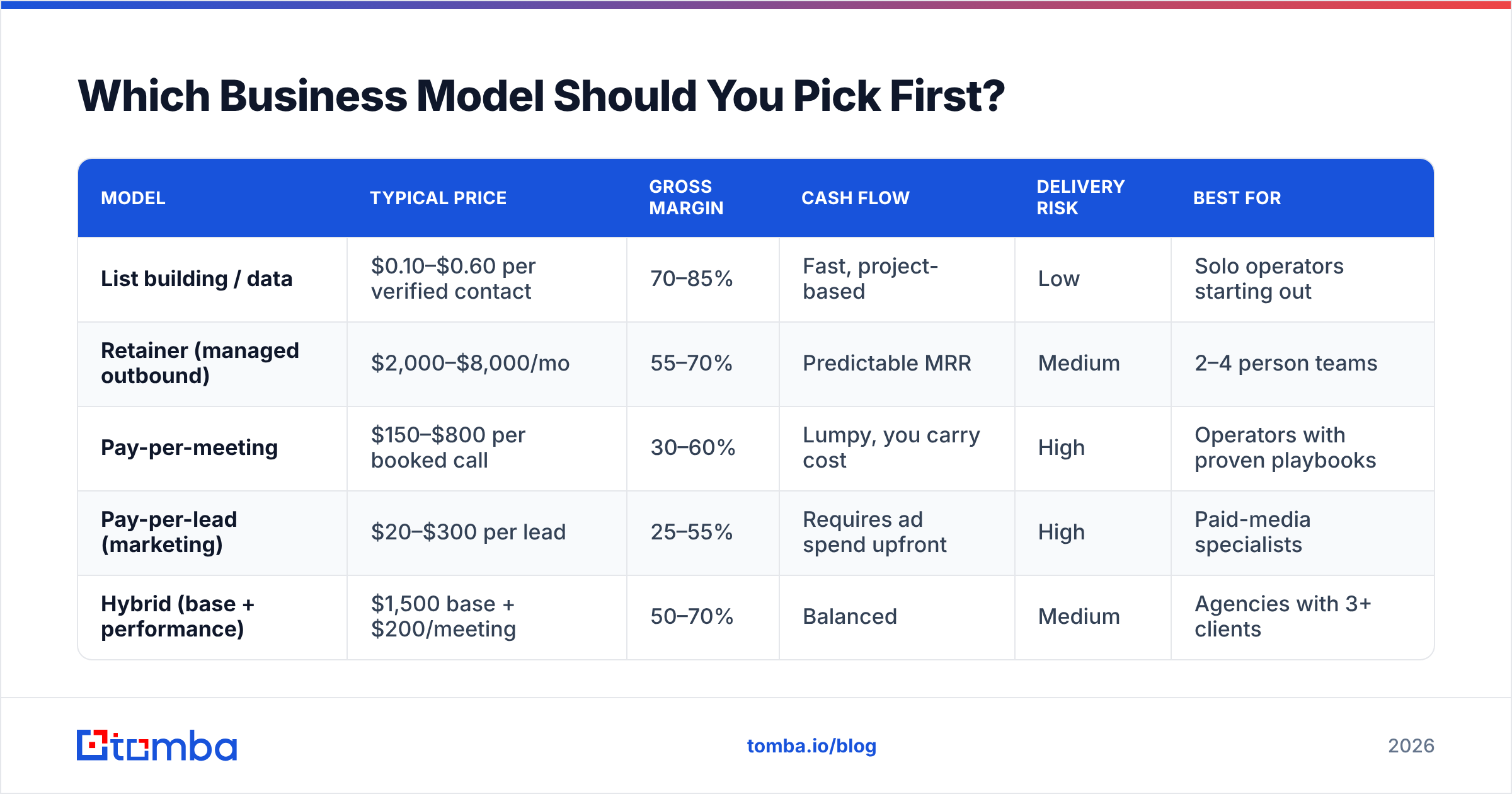
This one choice drives everything else: pricing, tools, hiring, and how fast you run out of cash.
| Model | Typical Price | Gross Margin | Cash Flow | Delivery Risk | Best For |
|---|---|---|---|---|---|
| List building / data | $0.10–$0.60 per verified contact | 70–85% | Fast, project-based | Low | Solo operators starting out |
| Retainer (managed outbound) | $2,000–$8,000/mo | 55–70% | Predictable MRR | Medium | 2–4 person teams |
| Pay-per-meeting | $150–$800 per booked call | 30–60% | Lumpy, you carry cost | High | Operators with proven playbooks |
| Pay-per-lead (marketing) | $20–$300 per lead | 25–55% | Requires ad spend upfront | High | Paid-media specialists |
| Hybrid (base + performance) | $1,500 base + $200/meeting | 50–70% | Balanced | Medium | Agencies with 3+ clients |
The honest read: start with list building or a small retainer. Pay-per-meeting looks clean on paper. But you absorb every cost of failure. If a campaign flops, you have burned six weeks of labor and tool credits for $0.
A hybrid deal works better. A small base fee covers your hard costs, and a per-meeting bonus adds the upside. Most steady agencies land there by year two.
What Does It Actually Cost to Start?#
Far less than the "start your agency" course sellers imply. Here's a realistic month-one stack for a solo operator running cold email:
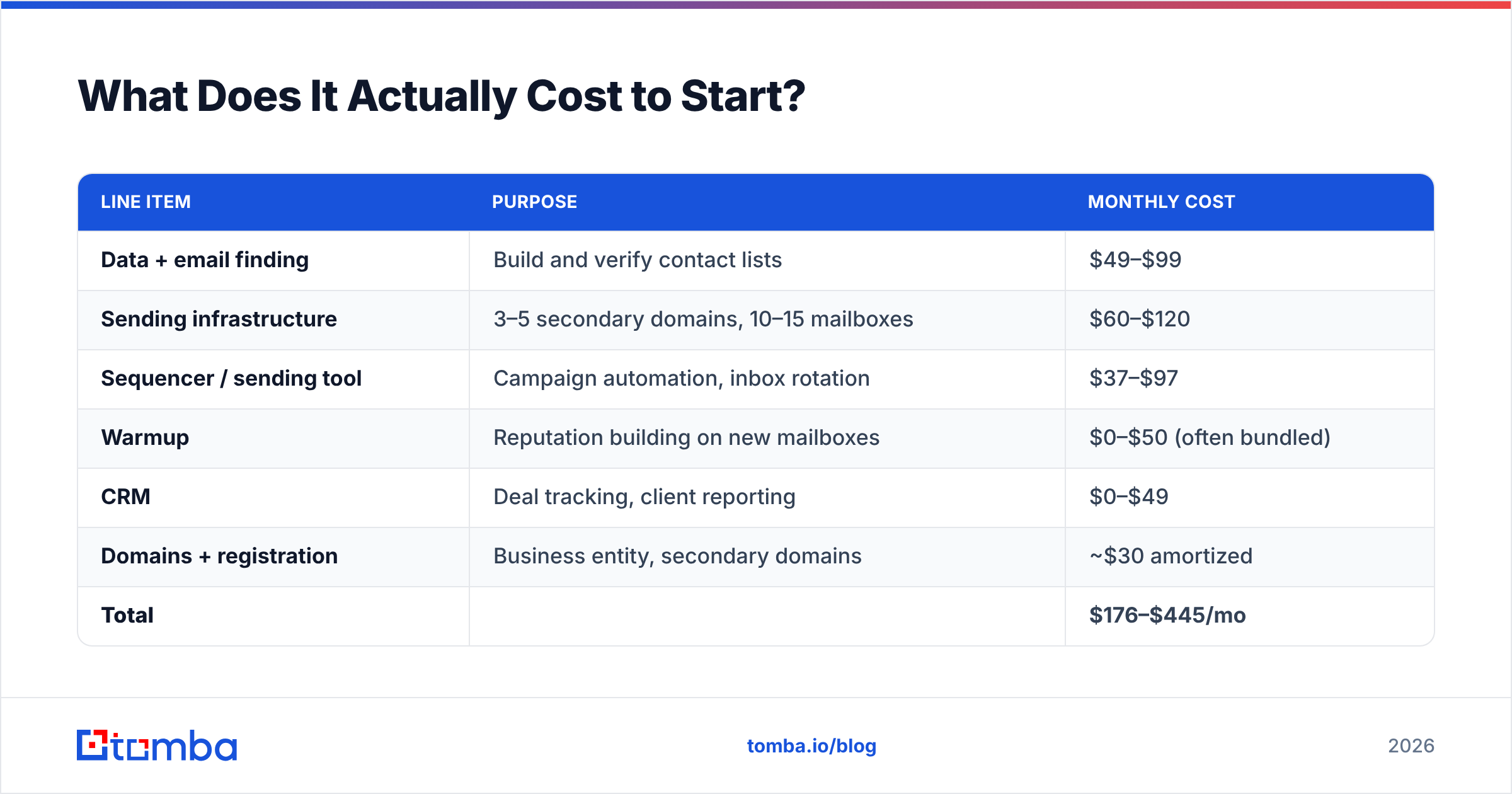
| Line Item | Purpose | Monthly Cost |
|---|---|---|
| Data + email finding | Build and verify contact lists | $49–$99 |
| Sending infrastructure | 3–5 secondary domains, 10–15 mailboxes | $60–$120 |
| Sequencer / sending tool | Campaign automation, inbox rotation | $37–$97 |
| Warmup | Reputation building on new mailboxes | $0–$50 (often bundled) |
| CRM | Deal tracking, client reporting | $0–$49 |
| Domains + registration | Business entity, secondary domains | ~$30 amortized |
| Total | $176–$445/mo |
Add a virtual assistant for list QA at $400–$800/month once you have two clients, and a copywriter or AI-assisted workflow for sequence variants.
The trap is inverting this budget. New operators spend $500/month on a sequencer and $0 on data quality. Then they wonder why open rates collapse. Your sending tool cannot rescue a list where 22% of addresses bounce.
On Tomba pricing, the Starter plan is $49/mo and Growth is $99/mo. For most solo agencies, that covers list building for three or four client accounts before you need to move up.
How Do You Build the Data Layer?#
Everything else sits on top of this. A lead generation business is a data-processing shop with a sales layer bolted on.
The workflow that holds up at volume:
- Define the ICP in machine-readable terms. Not "SaaS companies." Try "US-based B2B SaaS, 20–200 employees, Series A or later, using HubSpot, with a VP Marketing or Head of Demand Gen."
- Source the company list first. Job boards, funding news, tech-stack signals, conference lists, and review-site profiles on G2. Companies before contacts, always.
- Find the people. Use a domain search to pull every address at a target company, then filter to the titles you want. For named prospects from LinkedIn, run a LinkedIn finder pass.
- Verify before you send. Every address goes through an email verifier. Segment risky or unknown addresses instead of deleting them. Catch-all domains can go to a separate, low-volume campaign.
- Enrich for personalization. Job title, recent funding, tech stack, headcount growth. Two or three real variables beat a dozen generic merge tags.
- Deduplicate and suppress. Check the client's CRM exports and your own do-not-contact list before every send. Serious clients put this in the contract.
For agency-scale work, run steps 3–5 in batch. A bulk email finder pass on a 2,000-row company list takes twenty minutes. The same work one lookup at a time takes a week of VA time.
Why data accuracy decides your margin#
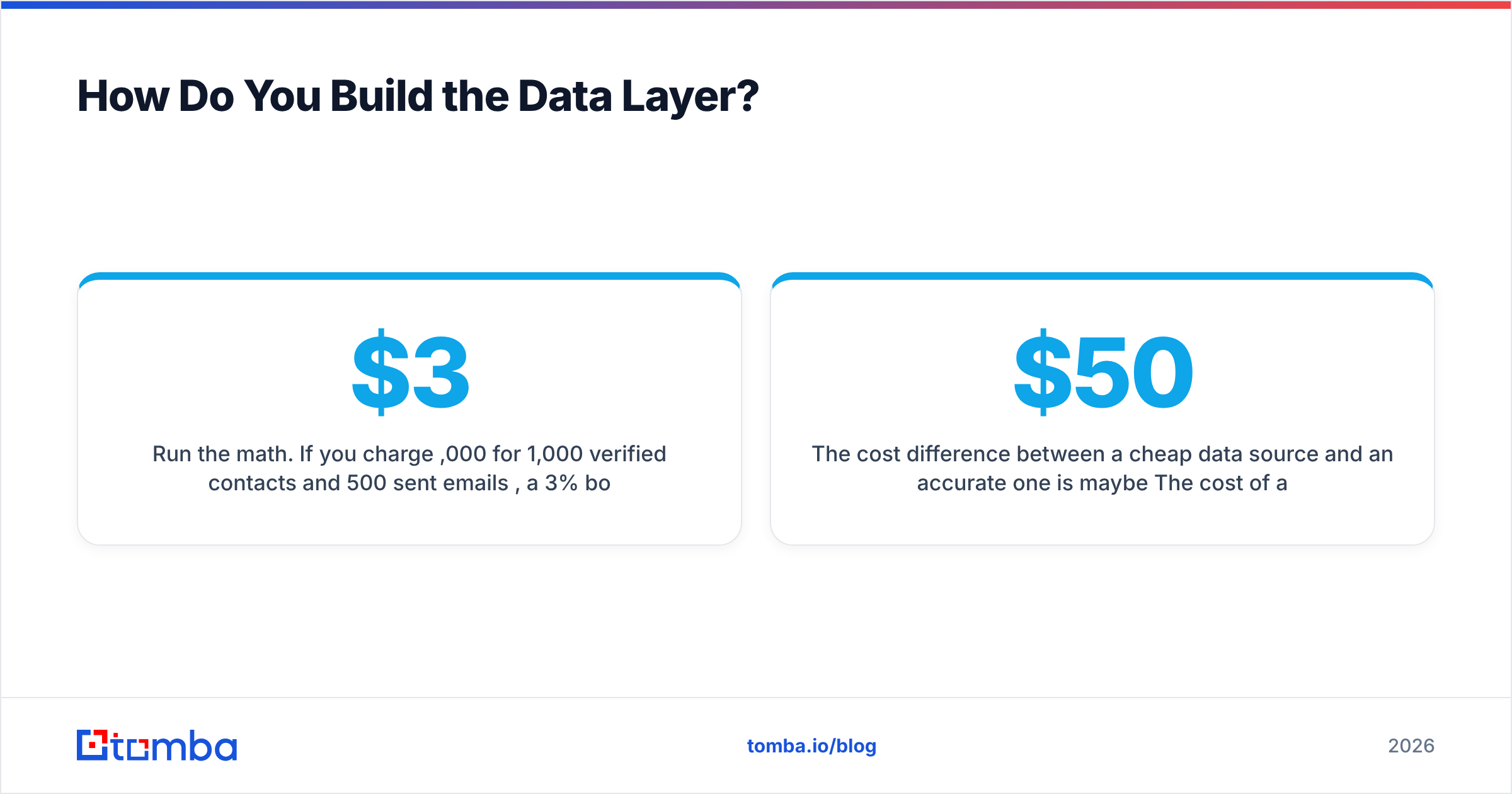
Run the math. Say you charge $3,000/month for 1,000 verified contacts and 500 sent emails per week. A 3% bounce rate keeps your domains healthy indefinitely.
A 12% bounce rate flags your sending domains inside two weeks. Now you buy and warm new ones. That is a three-week delay plus a client refund conversation.
The cost gap between a cheap data source and an accurate one is maybe $50/month. The cost of a burned domain reputation is the client.
Vendors publish accuracy claims. Treat them as marketing until you test. Buy a small credit pack from two or three providers, run the same 200-contact list through each, and measure the real bounce rate on a live send. That is your only true benchmark.
How Do You Land the First Three Clients?#
You use your own service on yourself. If you cannot book meetings for your own agency, you have no business selling the capability.
The founding-client sequence that works:
- Pick one vertical you have context in. Former recruiter? Sell to staffing firms. Ex-agency? Sell to marketing agencies. Domain knowledge is what makes your copy sound human.
- Build a 300-company target list in that vertical, with the founder or head of sales as the contact.
- Run a free-sample play. Send 10 verified, enriched contacts from their ICP with a one-line note: "Built these for you in 20 minutes. Want 500 more?" This beats a pitch deck by a mile.
- Price the pilot low but not free. $1,500 for a 30-day pilot with a defined deliverable (e.g., 750 verified contacts + 1,500 sent emails + weekly reporting).
- Over-deliver on reporting. Weekly Loom video walking through numbers. Clients churn from silence more than from bad results.
- Ask for the case study at day 30, not day 90. Momentum matters more than a perfect number.
Referral loops kick in around client four. Until then it is cold outbound plus whatever network you have.
Post your real campaign numbers in public: reply rates, subject lines, failures. That content converts better for lead gen agencies than any gated ebook.

What Legal and Compliance Rules Apply?#
This is where amateur operations get expensive fast, and it is the first thing sophisticated clients ask about.
- CAN-SPAM (US): Commercial email needs a valid physical address and a working opt-out. B2B cold email is legal. Deceptive headers and ignored unsubscribes are not. The FTC's compliance guide is short — read it once, properly.
- GDPR (EU/UK): You need a lawful basis, usually legitimate interest, plus a documented balancing test. Role-based work addresses carry less risk than personal ones. Honor deletion requests within 30 days.
- CASL (Canada): Stricter. Implied consent has narrow conditions and time limits. Many US agencies simply exclude Canada from cold campaigns.
- Client contracts: Define lead quality in writing. "Qualified" must mean something specific — title, company size, and a stated interest signal. Otherwise every invoice becomes a negotiation.
- Data processing agreements: Touch EU personal data on a client's behalf and you are a processor. You need a DPA. Keep a template ready.
Register an LLC or local equivalent. Carry basic professional liability insurance once you pass $5k MRR. Keep client data segregated per account. None of this is optional once a client's legal team reviews your contract.
Which Tools Do You Actually Need?#
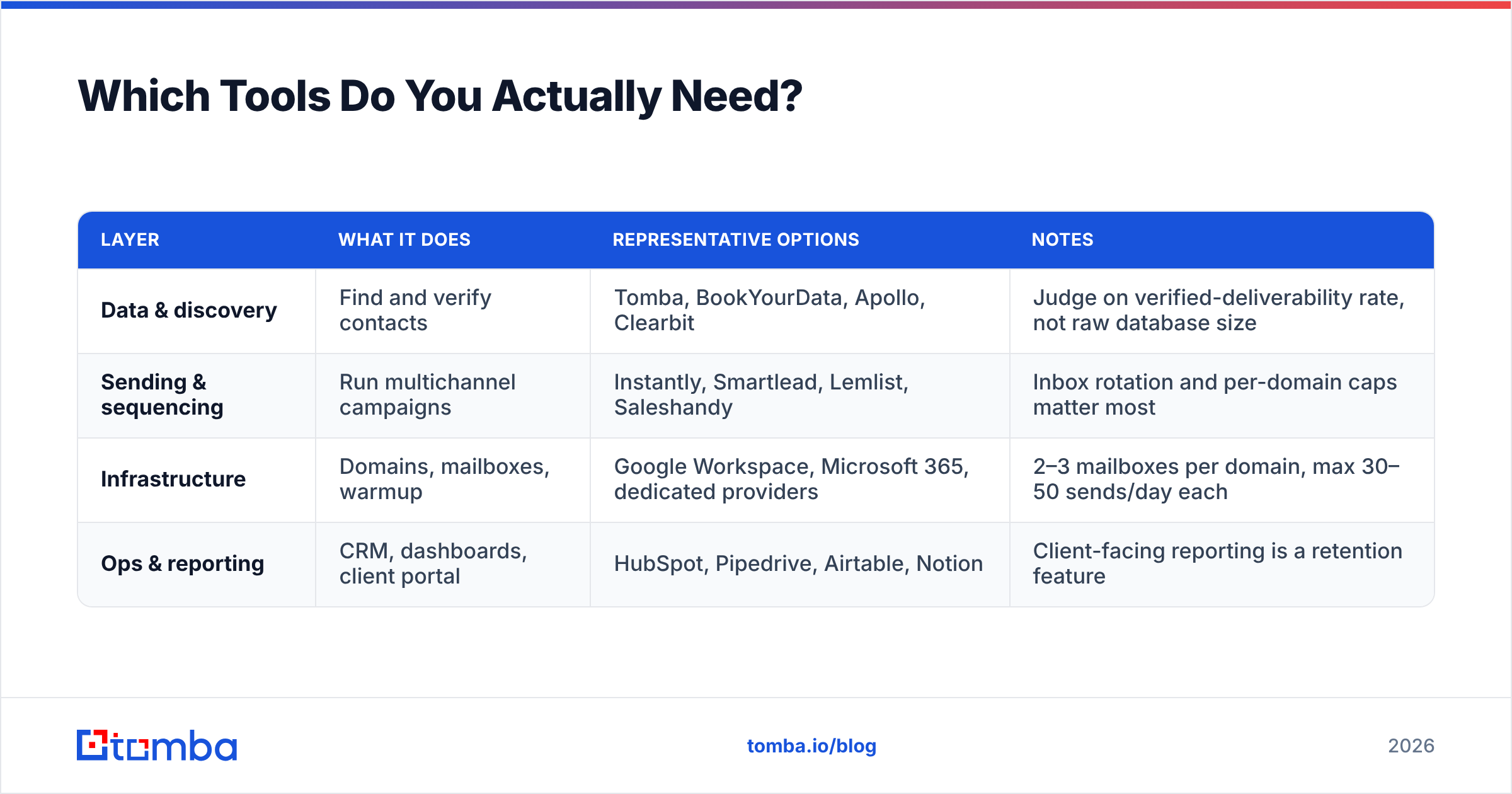
The stack sorts into four layers. Buy one tool per layer, not three.
| Layer | What It Does | Representative Options | Notes |
|---|---|---|---|
| Data & discovery | Find and verify contacts | Tomba, BookYourData, Apollo, Clearbit | Judge on verified-deliverability rate, not raw database size |
| Sending & sequencing | Run multichannel campaigns | Instantly, Smartlead, Lemlist, Saleshandy | Inbox rotation and per-domain caps matter most |
| Infrastructure | Domains, mailboxes, warmup | Google Workspace, Microsoft 365, dedicated providers | 2–3 mailboxes per domain, max 30–50 sends/day each |
| Ops & reporting | CRM, dashboards, client portal | HubSpot, Pipedrive, Airtable, Notion | Client-facing reporting is a retention feature |
A note on the data layer: providers source records in different ways. BookYourData leans on a pay-as-you-go verified database, which fits agencies with bursty project work. Tomba sells subscription credits across an email finder, verifier, and enrichment set, which suits recurring monthly list building. Apollo bundles data with sequencing — convenient, but it couples two decisions you may want to keep apart.
If you are comparing options, the Apollo alternative breakdown shows how the unbundled approach differs in practice.
For automation, connect the data layer straight to your CRM. The Tomba API or a Zapier integration removes the CSV shuffle that eats VA hours at scale.
How Do You Scale Past $10k Per Month?#
The bottleneck changes at each revenue tier, and misreading it is how agencies stall.
- $0–$3k MRR — the bottleneck is proof. You need one case study with real numbers. Do the work yourself. Do not hire.
- $3k–$10k MRR — the bottleneck is your time. Hire a VA for list building and QA first, not a salesperson. Write an SOP for every process while you still remember why each step exists.
- $10k–$30k MRR — the bottleneck is delivery consistency. Standardize onboarding, reporting cadence, and campaign templates. One account manager per 4–6 clients.
- $30k+ MRR — the bottleneck is client concentration. No single client above 25% of revenue. Add a second channel — partnerships, content, or paid — because pure cold outbound plateaus.
Two upgrades are worth making early. First, productize your offer into fixed tiers (Bronze/Silver/Gold with defined volumes) so you stop custom-quoting every deal. Second, build a reusable data asset: 40,000 verified contacts in one vertical becomes a suppression-checked B2B database you can license as a second revenue line.
Also watch the metric most agencies ignore: cost per booked meeting, all-in. Tools plus labor plus your own time, divided by meetings delivered. If that number exceeds what you charge, you are running a very sophisticated hobby. Track it monthly from day one.
What Kills Most Lead Gen Agencies?#
Five patterns, in rough order of frequency:
- No niche. Generic "we do B2B lead gen" positioning means competing on price against offshore shops charging $500/month.
- Deliverability collapse. Ignoring sender reputation until domains are blacklisted. Warm properly, cap volume, verify everything.
- Undefined quality criteria. "That lead wasn't qualified" is the most expensive sentence in this business. Define it in the contract.
- Founder-dependent delivery. Every campaign runs through your head, so you cannot take a week off, let alone scale.
- Chasing volume over fit. 5,000 sends to a loose list generates spam complaints and zero pipeline. 500 sends to a tight list generates meetings.
The agencies that survive treat this as an operations business, not a sales business. The sales part gets easy once delivery is genuinely good.
Start With the Data Layer#
Every step in this playbook — the pilot offer, the pricing model, the retention math — rests on one question. Are the contacts you deliver real and reachable? That is the one part you cannot outsource judgment on.
Build your first client list with Tomba's Email Finder. The free tier gives you 25 searches to test accuracy in your own vertical before you spend anything, and Starter at $49/mo covers your first two or three accounts.
Verify every address and measure your real bounce rate on the first send. Let that number, not a vendor's marketing page, tell you whether your data layer is good enough to build a business on.
Related guides#
// get started
Find, verify and enrich your first contacts today
Start on the free plan with 25 searches a month, then scale when your team is ready.
Free plan · No credit card required · GDPR & CCPA
// about the author