How to Thank Someone for Introducing You in Email (2026)
A warm intro is the highest-converting lead you will ever get. Here is exactly how to thank someone for introducing you in email, move to BCC, and reply fast enough to keep the goodwill.
TL;DR
- Reply within 2–24 hours. A warm intro decays fast, and the introducer's reputation is on the line the whole time you stay silent.
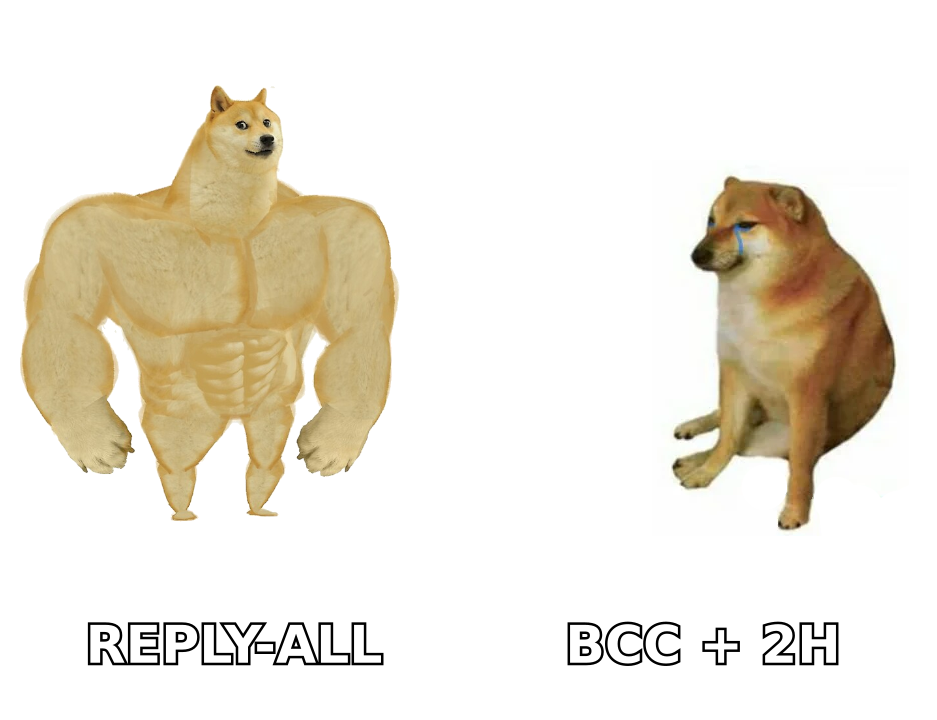
- Move the introducer to BCC in your first reply and say so explicitly ("moving Sarah to BCC to save her inbox"). This is the single most recognized signal that you know intro etiquette.
- Thank the introducer first, in one sentence, then pivot to the new contact with a concrete next step — not "let me know if you'd like to chat."
- Send a separate close-the-loop note to the introducer 1–2 weeks later telling them what happened. This is what makes people introduce you again.
- Use a template as scaffolding, not a script. The three variable parts are the specific thing you're thanking them for, the reason the intro matters, and the proposed next action.
Why does the thank-you reply to an intro matter so much?#
Because a warm introduction is borrowed credibility, and the interest on that loan is paid in speed and manners.
Think of it like being vouched for at a members' club. Someone signed you in at the door. If you wander off and don't acknowledge them, they don't just feel snubbed — the doorman notices, and next time they hesitate. Your introducer is spending social capital they've built over years. Every hour you leave the thread unanswered, that capital sits exposed.
The numbers back the urgency up. Referral-sourced pipeline consistently outperforms cold-sourced pipeline across nearly every measurable stage: higher reply rates, shorter cycles, better close rates. HubSpot's research on referrals has repeatedly found that referred prospects convert at multiples of cold ones. So an intro email is not just a nice message to answer politely. It is the highest-value inbound event most sellers, founders, and job seekers will get all quarter.
And yet the most common failure mode is embarrassingly simple: waiting. Waiting to write the "perfect" reply, waiting until you've researched the company, waiting until Monday. By then the new contact has cooled, the introducer has quietly noted your slowness, and you've turned a warm lead into a lukewarm one.
How fast should you reply to an introduction email?#
Within 2 hours if you can, within 24 hours always, and never past 48.
Here's the practical rule set, ordered by how much they matter:
- Same business day is the standard. If the intro lands at 4pm on a Friday, replying Saturday morning is fine and slightly impressive. Replying Tuesday is not.
- Speed beats polish. A three-sentence reply sent in 90 minutes outperforms a beautifully researched paragraph sent in three days. You can add depth in your second message.
- The introduced party should not have to reply first. If someone introduces A to B and B is the one being sold to, A (you) replies first. Making the busier, more senior person move first is a small but real status error.
- Acknowledge before you're ready. If you genuinely cannot write a proper reply, send a two-line holding message: thank the introducer, tell the new contact you'll follow up with specifics by tomorrow, and then actually do it.
- Never leave the introducer wondering. If the new contact goes dark on you, that's fine — but the introducer should still hear from you about the outcome.
What is the correct structure for a thank-you-for-the-intro email?#
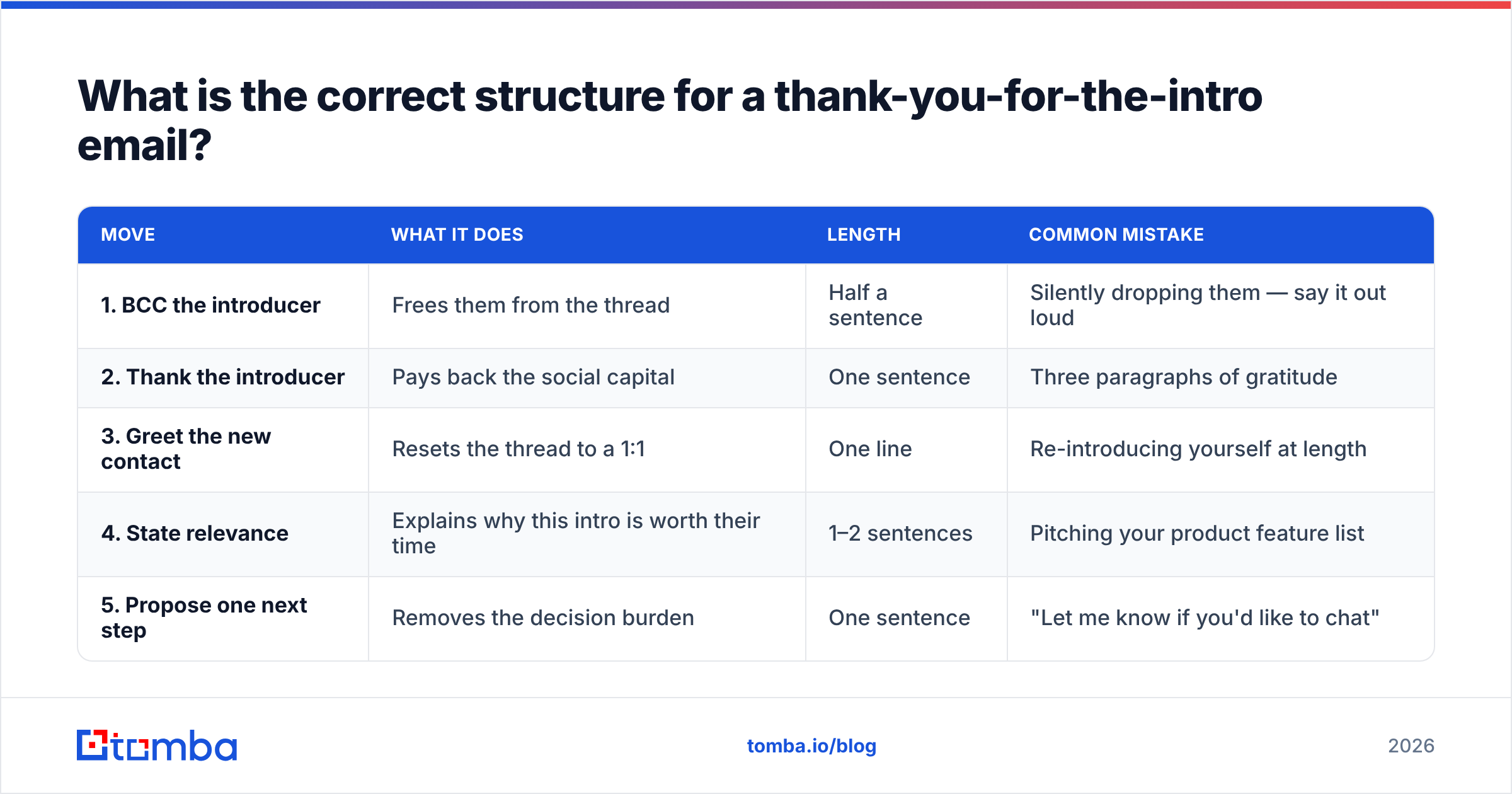
Five moves, in this order. Once you internalize the shape, you can write one in 90 seconds without a template.
| Move | What it does | Length | Common mistake |
|---|---|---|---|
| 1. BCC the introducer | Frees them from the thread | Half a sentence | Silently dropping them — say it out loud |
| 2. Thank the introducer | Pays back the social capital | One sentence | Three paragraphs of gratitude |
| 3. Greet the new contact | Resets the thread to a 1:1 | One line | Re-introducing yourself at length |
| 4. State relevance | Explains why this intro is worth their time | 1–2 sentences | Pitching your product feature list |
| 5. Propose one next step | Removes the decision burden | One sentence | "Let me know if you'd like to chat" |
The BCC move deserves its own note. When you write "moving Sarah to BCC so her inbox stays clean," you are doing three things at once: thanking her, releasing her from the obligation to follow the thread, and signalling to the new contact that you've done this before. It costs you six words. Skipping it means your introducer receives every scheduling message for the next two weeks — which is precisely how you become someone people stop introducing.
One more structural rule: do not reply-all with a long message and then try to move to BCC three emails later. The transition happens in your very first reply or it doesn't happen at all.
What are the best templates for thanking someone for an intro?#
Seven templates covering the situations you'll actually hit. Replace the bracketed parts and delete anything that doesn't apply — the worst version of any of these is the one you send verbatim.
1. The standard sales intro reply
Subject: Re: [Sarah] intro — [Your Company] × [Their Company]
Sarah, thank you for making this connection — moving you to BCC to spare your inbox.
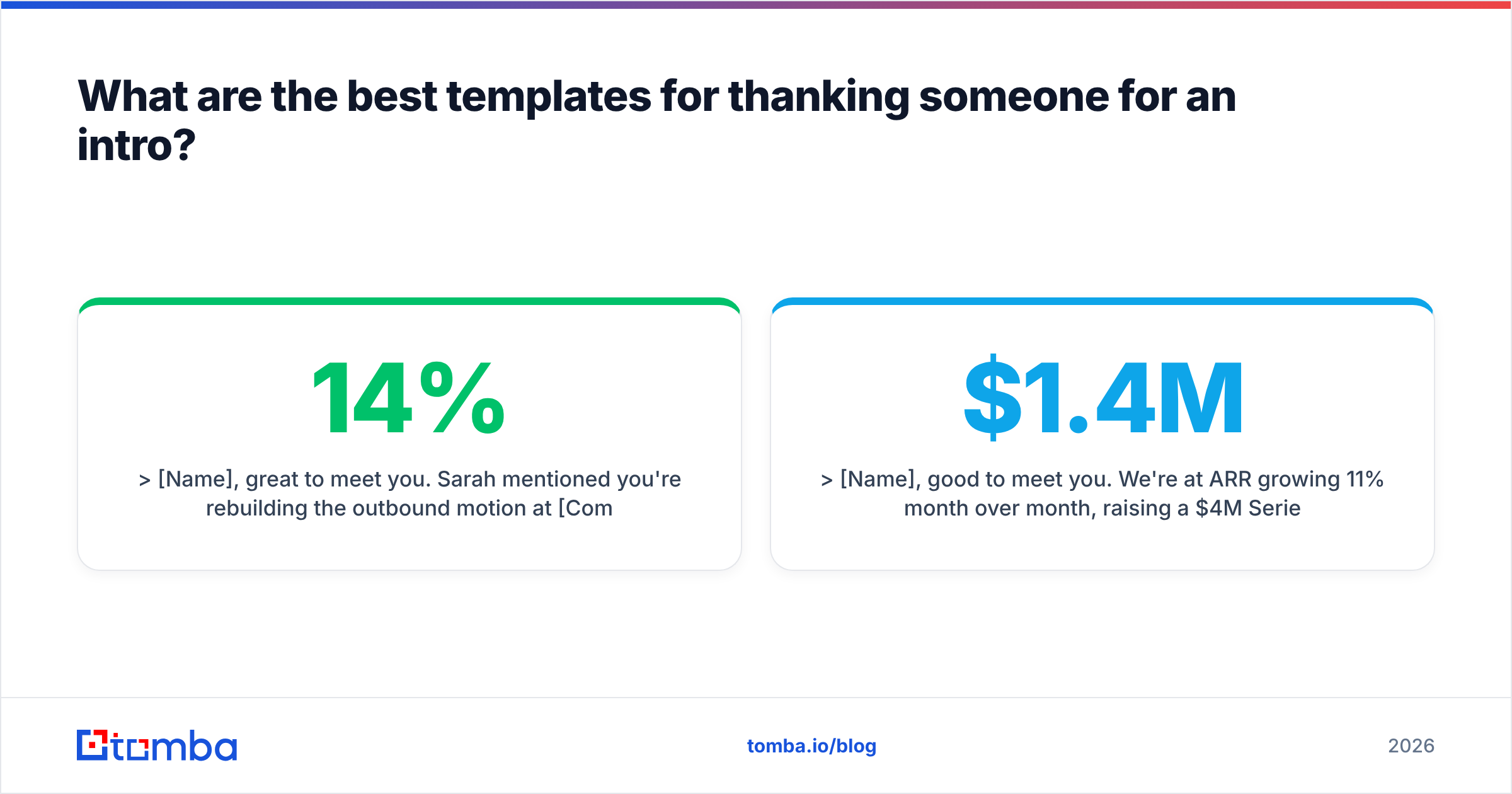
[Name], great to meet you. Sarah mentioned you're rebuilding the outbound motion at [Company] — we solved a similar data-quality problem for [comparable company] last year and cut their bounce rate from 14% to under 3%.
Are you open to 20 minutes Thursday or Friday? Here's my calendar: [link].
[Your name]
2. The short holding reply (when you're slammed)
Sarah — thank you, genuinely. Moving you to BCC.
[Name], I don't want to leave this sitting. I'm heads-down until tomorrow afternoon but I'll come back with something specific on [topic] by then. Looking forward to it.
3. The job-search intro
Marcus, I really appreciate you making this introduction — BCC'ing you here.
[Name], thanks for being open to the conversation. I've spent the last four years running lifecycle marketing at [Company], and Marcus thought the [Role] opening might overlap with that. I've attached a short summary rather than a full CV. Would a 15-minute call next week work?
4. The peer / advice intro
Priya, thank you — moving you to BCC.
[Name], Priya said you'd worked through the same pricing migration we're staring at now. I'm not looking to sell you anything; I'd just love 20 minutes of your thinking, and I'm happy to return the favour on [your area] any time.
5. The investor intro
Thanks so much for this, Dan — BCC'ing you.
[Name], good to meet you. We're at $1.4M ARR growing 11% month over month, raising a $4M Series A. Dan thought the thesis overlap was worth a conversation. Deck attached — happy to walk you through it live if it's useful.
6. Thanking someone who introduced you at an event (no email thread)
Subject: Thank you for the introduction to [Name]
Hi Lena — thank you for pulling [Name] over at the [Event] reception on Tuesday. That turned into the most useful conversation I had all week, and we're now talking about a pilot in Q2. I owe you one. If there's anyone in my network you'd like a door opened with, say the word.
7. The close-the-loop follow-up (send 1–2 weeks later)
Sarah — closing the loop on the [Company] intro. We had a call last Thursday, they're running a pilot starting the 14th, and it looks promising. Thank you again for the connection; it made a real difference. Anything I can do on your side?
Template 7 is the one almost nobody sends, and it's the one that most reliably produces a second introduction. People don't introduce you again because your thank-you was eloquent. They introduce you again because you told them the outcome and made them feel their vouching was well spent.
Should you thank the introducer publicly or privately?#
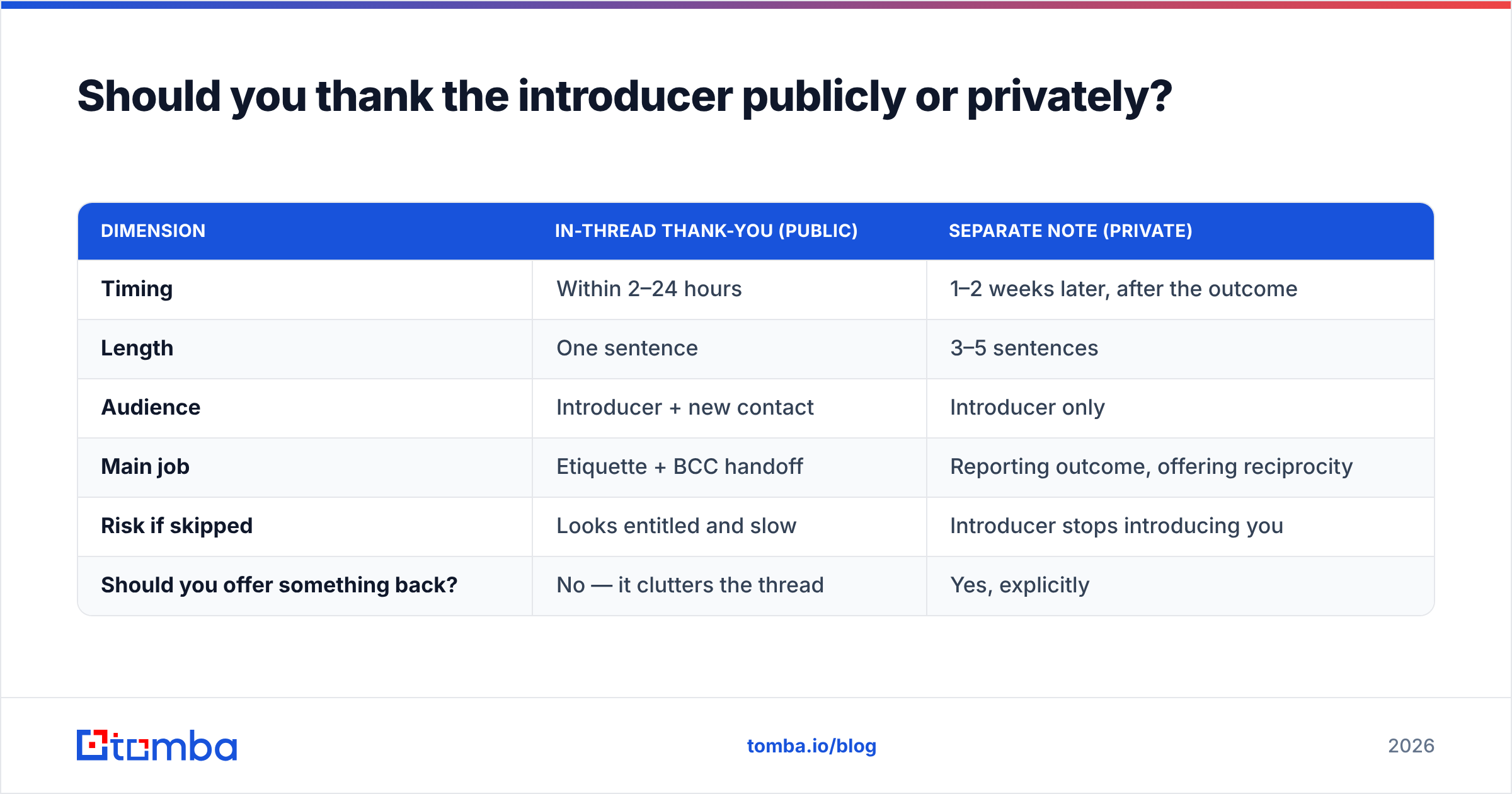
Both, but the public thank-you should be one sentence and the private one should carry the substance.
Here's how the two compare in practice:
| Dimension | In-thread thank-you (public) | Separate note (private) |
|---|---|---|
| Timing | Within 2–24 hours | 1–2 weeks later, after the outcome |
| Length | One sentence | 3–5 sentences |
| Audience | Introducer + new contact | Introducer only |
| Main job | Etiquette + BCC handoff | Reporting outcome, offering reciprocity |
| Risk if skipped | Looks entitled and slow | Introducer stops introducing you |
| Should you offer something back? | No — it clutters the thread | Yes, explicitly |
A small LinkedIn note works as a third layer if the relationship is genuinely warm, but it does not replace either of the above. And avoid the loud public shout-out post that tags your introducer — it reads as performance rather than gratitude, and plenty of people find it uncomfortable. Keep it in the inbox. If you want more on the relationship-building side, the mechanics of social selling apply here almost unchanged: give first, ask second, report back always.
What are the most common mistakes in intro thank-you emails?#
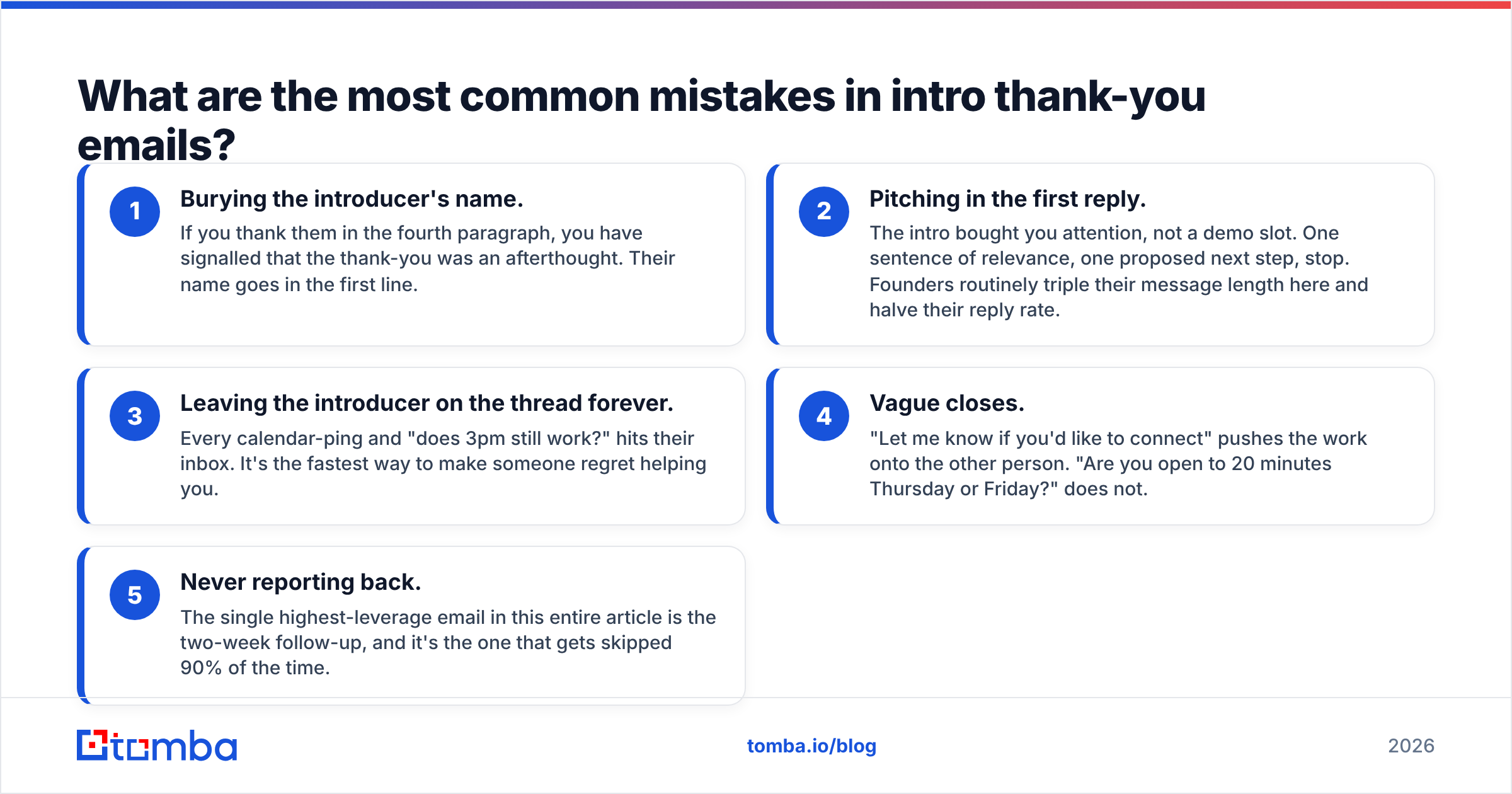
Five errors account for the overwhelming majority of botched intros.
- Burying the introducer's name. If you thank them in the fourth paragraph, you have signalled that the thank-you was an afterthought. Their name goes in the first line.
- Pitching in the first reply. The intro bought you attention, not a demo slot. One sentence of relevance, one proposed next step, stop. Founders routinely triple their message length here and halve their reply rate.
- Leaving the introducer on the thread forever. Every calendar-ping and "does 3pm still work?" hits their inbox. It's the fastest way to make someone regret helping you.
- Vague closes. "Let me know if you'd like to connect" pushes the work onto the other person. "Are you open to 20 minutes Thursday or Friday?" does not.
- Never reporting back. The single highest-leverage email in this entire article is the two-week follow-up, and it's the one that gets skipped 90% of the time.
A sixth, more technical mistake: sending your reply from an address or domain that lands in spam. If the intro thread moves off the original message — say you start a fresh thread with the new contact — your email deliverability suddenly matters. Run a quick check on your sending domain with an SPF checker before you assume silence means disinterest. A referral that never arrives looks identical to a referral that was ignored.
How do you turn one introduction into a repeatable referral habit?#
Treat introductions as a system with three inputs, not a series of lucky breaks.
- Make asking easy. Send your introducer a two-line forwardable blurb they can paste without editing. The easier you make the ask, the more intros you get. Never ask someone to "think of anyone who might benefit" — name the specific person or the specific profile.
- Always ask for double opt-in. The introducer checks with the target before connecting you. It costs a day and dramatically improves the quality of the intro, because the person on the other end actually agreed to hear from you.
- Track intros like pipeline. Log who introduced you to whom, when, and what came of it. Most CRMs handle this with a simple source field — see how Salesforce documents referral source tracking if you want a structured approach.
- Reciprocate before you're asked. The people who receive the most introductions are the ones who make the most. Once a quarter, look at your network and make two intros nobody requested.
- Fill the gaps yourself. Not every target has a mutual connection. When there's no warm path, you still need accurate contact data — that's where a domain search or a direct email finder lookup replaces the introduction you didn't get.
The compounding effect here is real. One well-handled introduction that ends with a close-the-loop note tends to produce a second introduction within a quarter. One badly handled introduction — slow, reply-all, no follow-up — quietly ends the relationship as a referral source, and you'll never be told that's what happened.
What should you do when the intro goes nowhere?#
Thank the introducer anyway, and tell them the truth.
If the new contact never replies, send this after two weeks: "Sarah — quick update on the [Company] intro. I followed up twice and haven't heard back, so I'm going to leave it there rather than keep pushing. Thank you all the same for making the connection — it was a good fit on paper and I appreciate you thinking of me."
Three things happen when you send that note. The introducer learns you're not a pest who will hound their contact indefinitely. They learn you close loops even when the news is bad. And, more often than you'd expect, they reply with "let me nudge them" — because now they know the ball was dropped on the other side.
Compare that to silence, where the introducer is left assuming either that it went great and you didn't bother telling them, or that it went badly and you're hiding it. Neither assumption helps you.
For the contacts who do go dark, don't over-invest in the same thread. Two follow-ups spaced a week apart, then move on. If the account still matters, build a proper outbound path to other stakeholders there rather than resurrecting a dead intro. Verified contact data and a fresh angle beat a fifth "just bumping this to the top of your inbox" every time — and you can check whether an address is even deliverable with a free email verifier before you assume you're being ignored.
Quick reference: intro reply checklist#
Before you hit send on any thank-you-for-the-intro email, confirm:
- Introducer moved to BCC, and you said so in the text
- Thank-you in the first line, one sentence, specific
- Relevance stated in 1–2 sentences, no feature list
- One concrete next step with a proposed time or a calendar link
- Reply sent within 24 hours of the intro landing
- Calendar reminder set for the close-the-loop note in 10–14 days
That last bullet is the whole game. Set the reminder when you send the reply, not later. Future you will not remember.
Where do you go when there's no one to introduce you?#
Warm intros are the best channel you have, and they will never be enough volume on their own. Most teams that live off referrals still need a way to reach the 90% of their ICP with no mutual connection — and that path starts with knowing who to contact and having an address that actually works.
Tomba's Email Finder gives you verified professional email addresses by name, domain, or company, so the accounts you can't get introduced to are still reachable. The free tier includes 25 searches a month, paid plans start at $49/mo, and you can see the full breakdown on Tomba pricing. Use the warm intros for the doors that are already open — and use accurate data for everything else.
Related guides#
// get started
Find, verify and enrich your first contacts today
Start on the free plan with 25 searches a month, then scale when your team is ready.
Free plan · No credit card required · GDPR & CCPA
Get the Tomba newsletter
Product and data updates
// about the author