How To Use Battle Cards In Sales: A 2026 Playbook
Most sales battle cards die in a shared drive. Here is how to build, deploy, and maintain competitive battle cards reps actually pull up mid-call — plus the templates and update cadence that keep them true.
TL;DR
- A sales battle card is a one-screen answer sheet for a specific competitive or objection scenario — not a competitor encyclopedia.
- The cards that get used share six blocks: trigger, positioning line, landmine questions, objection rebuttals, proof point, and disqualification criteria.
- Distribution beats design. A card living in a Notion folder gets opened once; the same card surfaced in your CRM deal view gets opened every week.
- Update on a trigger cadence (pricing change, competitor launch, three lost deals with the same reason) rather than a quarterly calendar ritual.
- Measure adoption with win rate against named competitors, not with "did people read it" pageviews.
What is a sales battle card, exactly?#
A battle card is a single-screen reference a rep pulls up while a deal is live, containing the exact language and questions they need for one specific situation.
Think of it like a chef's mise en place. The chef already knows how to cook; the prep station just means nothing has to be chopped mid-service. A battle card doesn't teach your reps to sell. It stops them improvising a competitor comparison at 3:47pm on a Thursday while a VP of Ops waits on Zoom.
That framing matters because most teams build the wrong artifact. They build a competitor dossier: funding history, org chart, product roadmap rumors, a SWOT grid. That document is useful — for product marketing. It is not a battle card. A rep with 40 seconds of silence to fill cannot scan a SWOT grid.
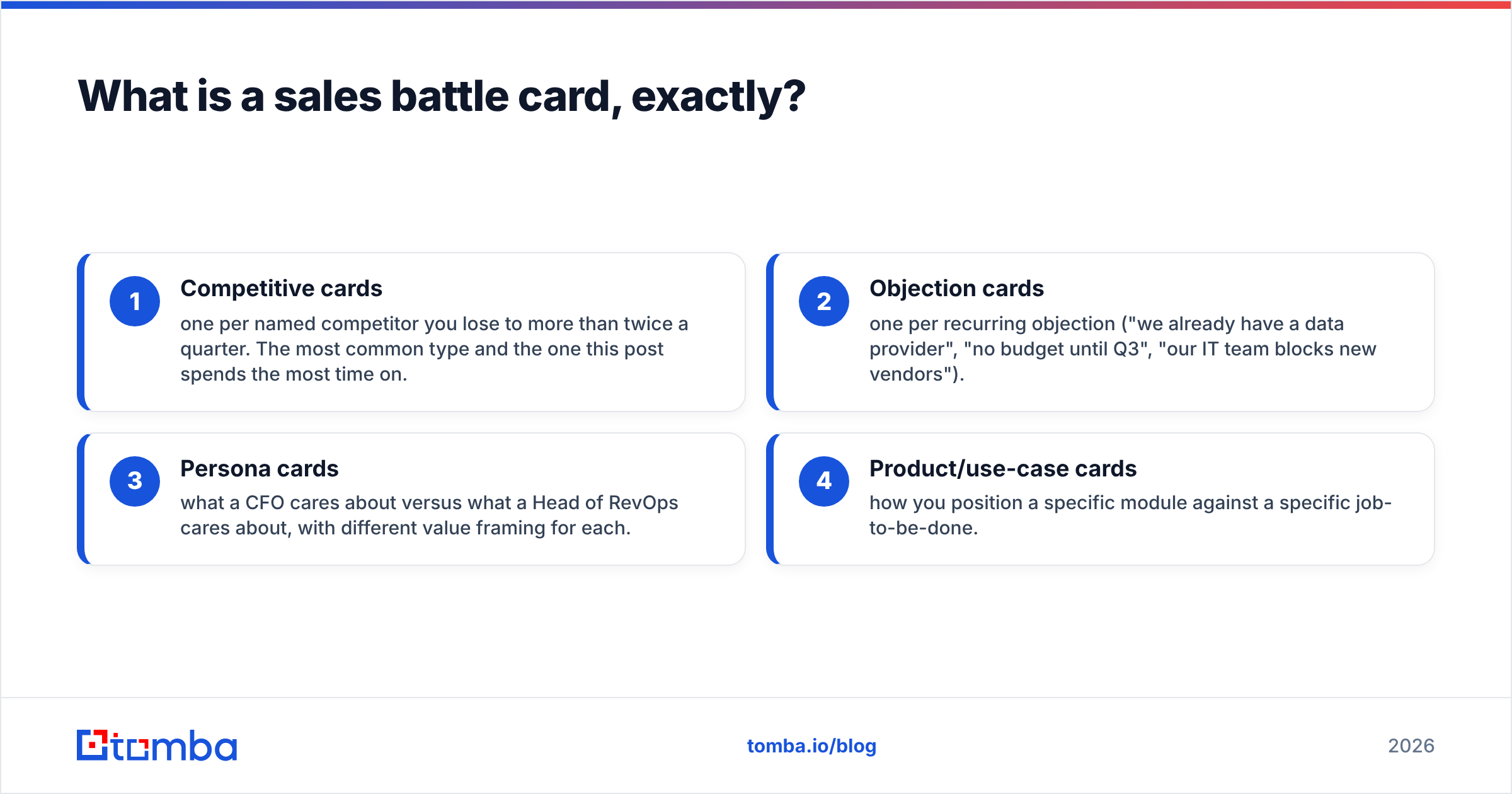
Four types of card cover almost every B2B scenario:
- Competitive cards — one per named competitor you lose to more than twice a quarter. The most common type and the one this post spends the most time on.
- Objection cards — one per recurring objection ("we already have a data provider", "no budget until Q3", "our IT team blocks new vendors").
- Persona cards — what a CFO cares about versus what a Head of RevOps cares about, with different value framing for each.
- Product/use-case cards — how you position a specific module against a specific job-to-be-done.
Start with competitive. It has the tightest link to revenue and the clearest feedback loop.
Why do most sales battle cards get ignored?#
Because they are written for the person who built them, not the person who uses them under pressure.
Three failure patterns account for nearly all of it:
- The card is too long. If a rep has to scroll, they will alt-tab back to the call instead. One screen, no scrolling, is the hard constraint.
- The card is in the wrong place. A PDF in a Google Drive folder called
/Enablement/Competitive/2025/FINAL_v3is functionally invisible. If it isn't one click from the deal record, it doesn't exist. - The card is stale. A rep who quotes an outdated competitor price in front of a prospect who just saw the new pricing page will never trust the card again. One bad data point poisons the whole system.

There is a fourth, quieter failure: the card is dishonest. If your competitive card claims a rival "has no API" and the prospect has been reading that rival's API docs all morning, you have handed them a reason to distrust everything else you say. Accurate, slightly unflattering-to-you positioning outperforms aggressive spin every single time. Gartner's B2B buying research has been consistent on this point for years: buyers who feel manipulated stall, and stalled deals rarely restart.
What goes on a battle card that reps actually use?#
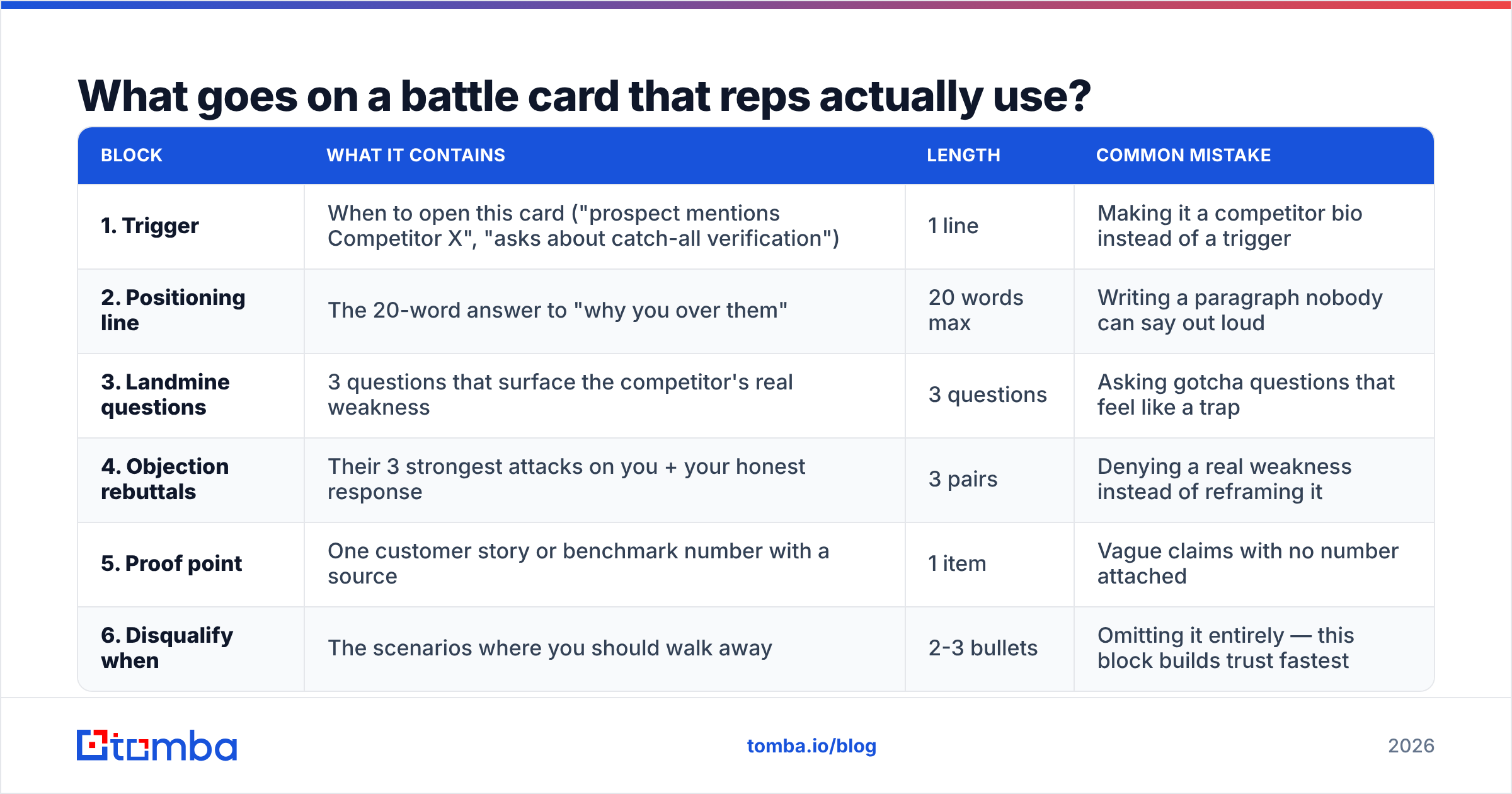
Six blocks. In this order. Nothing else.
| Block | What it contains | Length | Common mistake |
|---|---|---|---|
| 1. Trigger | When to open this card ("prospect mentions Competitor X", "asks about catch-all verification") | 1 line | Making it a competitor bio instead of a trigger |
| 2. Positioning line | The 20-word answer to "why you over them" | 20 words max | Writing a paragraph nobody can say out loud |
| 3. Landmine questions | 3 questions that surface the competitor's real weakness | 3 questions | Asking gotcha questions that feel like a trap |
| 4. Objection rebuttals | Their 3 strongest attacks on you + your honest response | 3 pairs | Denying a real weakness instead of reframing it |
| 5. Proof point | One customer story or benchmark number with a source | 1 item | Vague claims with no number attached |
| 6. Disqualify when | The scenarios where you should walk away | 2-3 bullets | Omitting it entirely — this block builds trust fastest |
That last block is the one teams skip and the one reps value most. Telling a rep "if they need on-prem deployment with a signed BAA, we lose — qualify out and save the cycle" earns more credibility with the sales floor than any positioning line.
A worked example: a data-vendor competitive card#
Say you sell B2B contact data and you keep running into another provider in deals. Here's the shape of a real card, using an honest framing between two capable tools:
Trigger: Prospect mentions they are also evaluating a bulk contact-list provider.
Positioning line: "They sell you a list. We give you verified contacts on demand plus an API, so your CRM never goes stale."
Landmine questions:
- "How often is the list refreshed, and what happens to records that decay between refreshes?"
- "When your SDRs need a contact that isn't in the purchased list, what's the workflow?"
- "Does the pricing scale with your team, or with the number of records you download?"
Objection rebuttals:
- "They're cheaper per record." — "Per record, yes. Compare cost per verified record after you strip bounces, and compare who covers the re-verification in month six."
- "They have more contacts in our vertical." — "Volume and accuracy are different metrics. Run 100 records from each through an email verifier and compare bounce rates before you decide."
- "We already bought a list this year." — "Then the question isn't replacing it — it's what you do with the 25-30% that decays before renewal."
Proof point: Cite your own measured bounce rate on a defined sample, with the date. Not "industry-leading accuracy."
Disqualify when: They need a one-time static list with no ongoing enrichment and no API. That's a different product category, and pretending otherwise wastes both calendars.
Notice what this card does not do: it doesn't call the competitor bad. BookYourData, for instance, is a genuinely strong option if a team's requirement really is a large verified list delivered as a file — and a card that pretends otherwise will get a rep publicly corrected. Framing the choice as different jobs rather than good versus bad is both more accurate and more persuasive.
Where should battle cards live?#
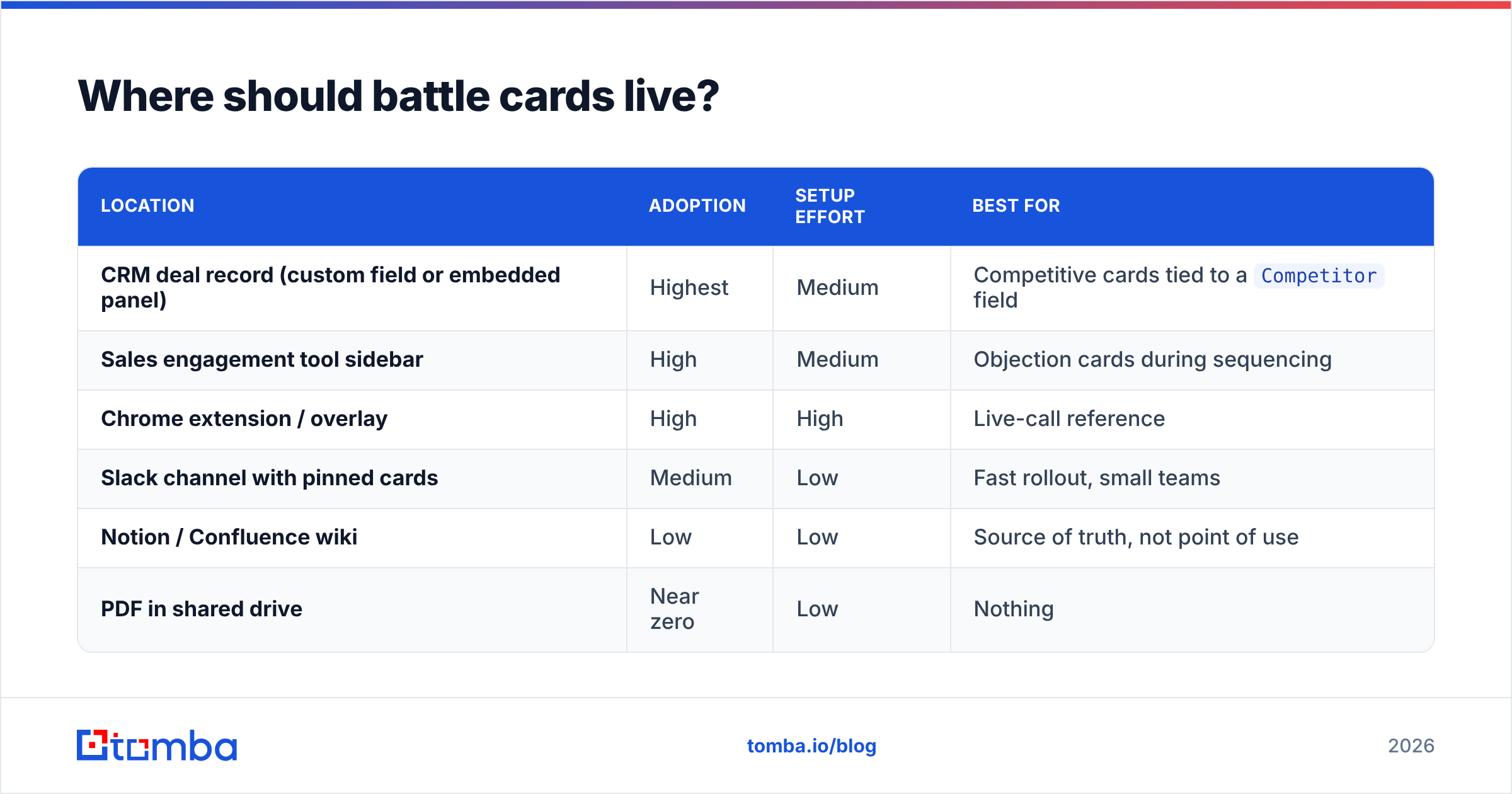
In the tool the rep already has open. Everywhere else is a filing cabinet.
Ranked by how much adoption you actually get:
| Location | Adoption | Setup effort | Best for |
|---|---|---|---|
| CRM deal record (custom field or embedded panel) | Highest | Medium | Competitive cards tied to a Competitor field |
| Sales engagement tool sidebar | High | Medium | Objection cards during sequencing |
| Chrome extension / overlay | High | High | Live-call reference |
| Slack channel with pinned cards | Medium | Low | Fast rollout, small teams |
| Notion / Confluence wiki | Low | Low | Source of truth, not point of use |
| PDF in shared drive | Near zero | Low | Nothing |
The practical setup for most teams: keep the canonical version in your wiki, then push a condensed version into the CRM. HubSpot's playbooks feature and Salesforce's equivalent both let you surface a card directly on the record — that's the whole trick. If you use Tomba, the same logic applies to prospect data: our HubSpot integration exists precisely so enriched contact data lands where the rep is already working rather than in a CSV they have to remember to open.
How do you build your first five battle cards?#
Work backward from lost deals, not forward from a competitor list.
Step 1 — Pull the loss data. Export every closed-lost deal from the last two quarters with a competitor named. Rank competitors by revenue lost, not by deal count. One enterprise loss usually outweighs six SMB losses.
Step 2 — Interview three people per card. The rep who lost the deal, the rep who won one against the same competitor, and if possible a customer who switched. Twenty minutes each. Record them. The winning rep's actual phrasing is your positioning line — you're transcribing, not authoring.
Step 3 — Verify every factual claim. Open the competitor's live pricing page, docs, and G2 reviews the day you write the card. Screenshot the pricing page and date the screenshot. Anything you can't source in five minutes gets cut.
Step 4 — Draft on one screen. Six blocks, hard stop. If it doesn't fit, your positioning isn't sharp enough yet.
Step 5 — Test it live before rollout. Give the draft to two reps for a week. Sit on three calls. The question isn't "do you like it" — it's "which line did you actually say out loud?" Cut everything they didn't use.
Step 6 — Ship with a 90-second Loom, not a training session. One rep demoing where the card lives and how they used it beats a 45-minute enablement webinar that nobody rewatches.
Five cards done this way beat twenty cards generated in a batch. Volume is how battle card programs die — reps stop trusting a library they can't hold in their head.
How often should you update battle cards?#
On triggers, not on a calendar. Quarterly reviews sound disciplined and produce stale cards for eleven weeks out of thirteen.
Set these triggers instead:
- Competitor changes pricing or packaging — update within 48 hours. This is the single highest-decay field on any card.
- Three losses cite the same new reason — the objection block is missing something. Add it.
- Competitor ships a feature you claimed they lacked — remove the claim immediately, before a rep gets embarrassed with it.
- Your own pricing or positioning changes — every card referencing it needs a pass.
- A rep flags an inaccuracy — fix same-day and tell the whole team you fixed it. Visible responsiveness is what keeps flags coming in.
- Quarterly sweep — a light pass to catch drift the triggers missed, not the primary mechanism.
Assign one named owner per card. "Product marketing owns battle cards" means nobody owns them. "Sarah owns the four cards for the mid-market segment" means they get updated.
How do you measure whether battle cards are working?#
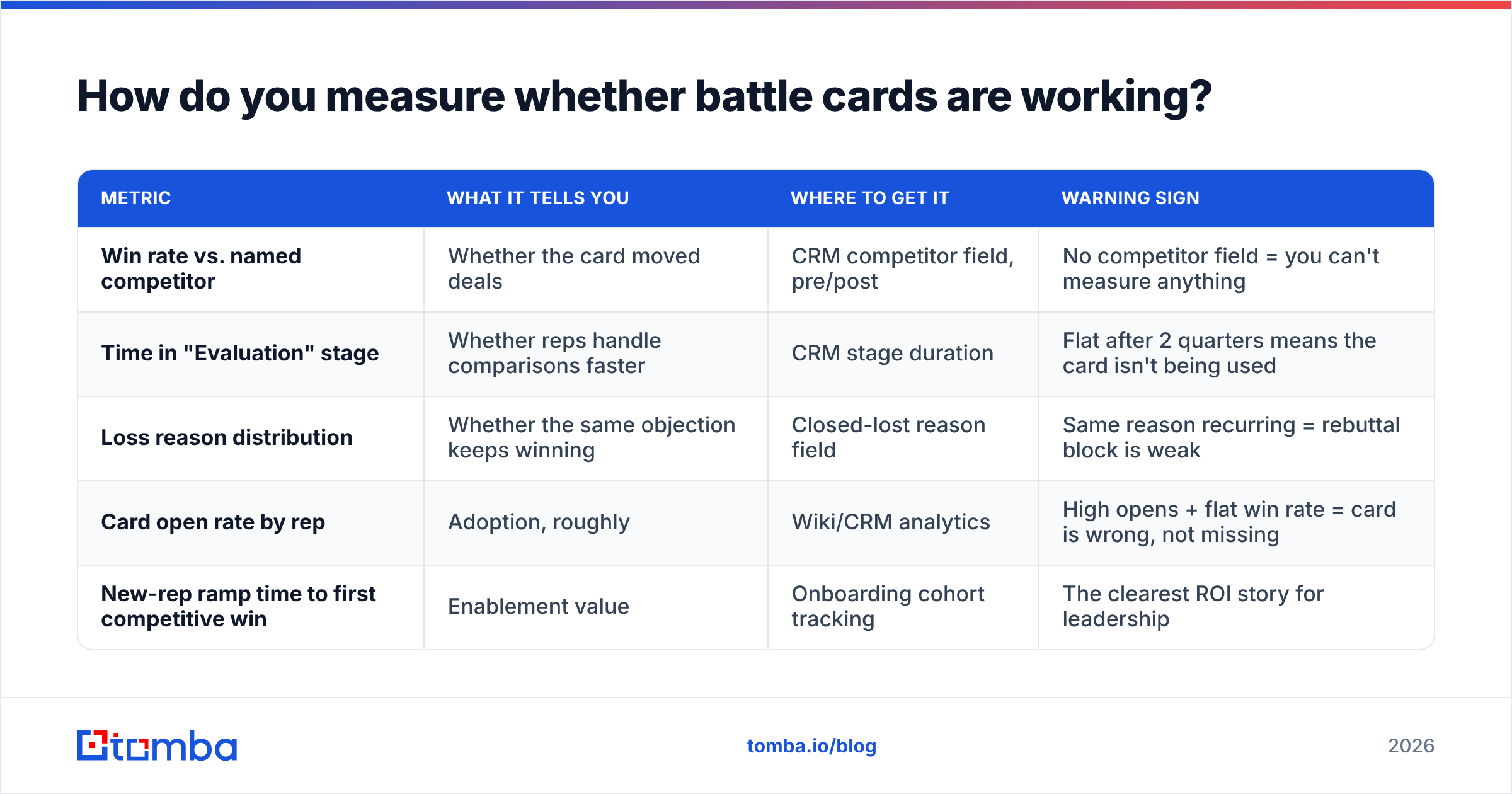
Track outcomes against the specific competitor the card covers, not consumption metrics.
| Metric | What it tells you | Where to get it | Warning sign |
|---|---|---|---|
| Win rate vs. named competitor | Whether the card moved deals | CRM competitor field, pre/post | No competitor field = you can't measure anything |
| Time in "Evaluation" stage | Whether reps handle comparisons faster | CRM stage duration | Flat after 2 quarters means the card isn't being used |
| Loss reason distribution | Whether the same objection keeps winning | Closed-lost reason field | Same reason recurring = rebuttal block is weak |
| Card open rate by rep | Adoption, roughly | Wiki/CRM analytics | High opens + flat win rate = card is wrong, not missing |
| New-rep ramp time to first competitive win | Enablement value | Onboarding cohort tracking | The clearest ROI story for leadership |
The prerequisite for all of it is a mandatory Primary Competitor field on every opportunity. Without it, you are guessing. Make it required on stage advancement past discovery, and accept the small amount of rep grumbling — it's the cheapest analytics investment in your entire revenue operations stack.
One honest caveat: battle cards rarely produce a clean, isolatable lift. They run alongside pricing changes, product launches, and hiring. Compare win rate against the specific competitor over two full quarters, control for deal size, and treat the result as directional. Anyone promising you a precise attributed number is selling something.
What are the most common battle card mistakes?#
- Writing them without reps. A card authored entirely by product marketing uses vocabulary no rep will say aloud. Source the language from call recordings.
- Attacking instead of differentiating. "Their support is terrible" is unverifiable and makes your rep look petty. "Their support is email-only on plans under $500/mo — here's their published SLA" is a fact the prospect can check.
- One giant card for all competitors. Reps need one card per competitor, findable by name in under three seconds.
- No disqualification block. Cards that only say "you can win" teach reps to burn cycles on unwinnable deals.
- Ignoring the buying committee. The card that works on a practitioner rarely works on the CFO. Either add a persona line to each block or build separate persona cards.
- Never sunsetting cards. Competitors get acquired, pivot, or exit your segment. A library that only grows becomes a library nobody trusts. Archive anything with zero opens in two quarters.
How do battle cards fit into the rest of your sales stack?#
They're the last mile, not the whole road. A perfect card is worthless if the rep is talking to the wrong person at the wrong company with a bounced email address.
The realistic sequence is: build a clean target list, find and verify the contact, run the sequence, then use the battle card at the moment a competitor enters the conversation. Cards work on live conversations — so the constraint upstream is almost always contact quality, not messaging quality. If 30% of your outbound bounces, no positioning line saves the quarter. That's why teams pair enablement work with a bulk email finder pass on the target account list before a competitive push, and why data enrichment on existing CRM records usually returns faster than another round of messaging work.
A reasonable division of labor:
- Data layer — verified contacts and enriched account records so reps reach real humans.
- Sequencing layer — the outreach tooling that gets the first meeting.
- Enablement layer — battle cards, call frameworks, objection handling for the conversations that follow.
- Analytics layer — the competitor field and loss reasons that tell you which cards to fix next.
Skip layer one and the other three optimize a funnel with a hole in the top.
Ready to fix the layer underneath your battle cards?#
The best competitive card in your industry can't help a rep who emailed john.smith@ at a company that uses jsmith@. Before your next competitive push, run the target account list through the Tomba Email Finder — verified, source-attributed contacts by domain, name, or company, with an API when you want it wired straight into your CRM. The free tier gives you 25 searches a month to sanity-check your list quality; paid plans start at $49/mo on Starter, with Growth at $99/mo when your team scales past a single prospector. Full Tomba pricing is public, no demo call required.
Get the contacts right first. Then the battle cards have something to work with.
Related guides#
Ready to find emails that actually work?
Join 150,000+ professionals who stopped guessing and started sending. Free credits on signup — no credit card required.
Get the Tomba newsletter
Practical outbound tactics and product updates — once every two weeks.
About the author