How To Use Spintax in Cold Email Without Killing Reply Rates
Spintax rotates wording across every send so no two cold emails look identical. Here's the exact syntax, where it helps deliverability, where it quietly destroys your reply rate, and how to test it.
TL;DR
- Spintax is a bracket-and-pipe syntax —
{Hi|Hello|Hey}— that tells your sending tool to pick one variant per email, so no two messages are byte-identical. - It helps with content-fingerprint filtering and shared-inbox pattern detection. It does not fix a bad domain, a cold IP, or a list full of dead addresses.
- Spin 2–4 short, low-risk elements (greeting, connector phrases, CTA verb). Do not spin your value proposition — that's how you get 8 versions where 6 are worse.
- Every variant must read naturally on its own. Write the sentence three times, then merge — never spin word-by-word inside a sentence.
- Verified contacts beat clever wording every time. A 30% bounce rate will sink you long before duplicate copy does.
What is spintax and how does it actually work?#
Spintax (spinning syntax) is a tiny markup language for text variation. You write one template containing multiple alternatives, and your sending tool randomly selects one option per placeholder at send time.
The syntax is three characters:
{option A|option B|option C}Curly braces open and close the spin block. Pipes separate the choices. Your sequencer picks one at random when it renders the email.
A full line looks like this:
{Hi|Hey|Hello} {{first_name}},

{Quick question|One quick thing|Saw something worth flagging} — {noticed|spotted}
your team is hiring three SDRs this quarter.
Render that 200 times and you get up to 36 distinct openings from a single template. Each recipient sees one clean sentence; the spam filter analyzing patterns across your whole sending volume sees 36 different content hashes instead of one repeated 200 times.
Think of it like a restaurant that serves the same dish but plates it differently for each table. The meal is identical in substance. What changes is the presentation — enough that a health inspector scanning for mass-produced trays doesn't flag the kitchen.
Technically, spintax is a shallow templating grammar. Most tools support nesting:
{Hi|{Hey|Hello} there}That resolves to Hi, Hey there, or Hello there. Nesting is legal in Instantly, Smartlead, Lemlist, Saleshandy, and most modern sequencers — but it's also where 90% of broken renders come from, so use it sparingly.
Why do cold emailers use spintax at all?#
Three reasons, in order of how much they actually matter.
- Content fingerprinting. Filters like SpamAssassin and proprietary ESP models hash message bodies. If 4,000 messages hitting a provider in one hour share the same hash, that's a bulk pattern. Spintax breaks the hash.
- Shared-inbox pattern detection. When you email 40 people at the same company, some of them forward to each other or share an inbox. Identical copy in three forwarded threads looks like spam to a human, not just a filter.
- Human variance. A rep sending manually never writes the exact same sentence 500 times. Spintax approximates that natural drift.
What spintax does not do is worth stating clearly. It will not rescue a domain with no SPF record, it will not offset a 25% bounce rate, and it will not make bad copy good. Google's own Postmaster Tools documentation puts authentication, complaint rate, and recipient engagement far above content variation in the ranking of what determines inbox placement. Spintax is a rounding-error optimization applied on top of fundamentals that must already be solid.
If your email deliverability is currently poor, spintax is not your fix. Fix authentication, warm the domain, and clean the list first.
How do you write spintax correctly?#
Here's the method that survives contact with a real campaign.
1. Write three complete versions of the email first. Not three word choices — three full drafts, each one you'd be happy to send as-is. This forces every variant to be independently good.
2. Diff them. Find the sentences that genuinely differ in phrasing but not in meaning. Those are your spin candidates.
3. Merge into spin blocks at the phrase level. Never spin single words inside a sentence you wrote once. Word-level spinning is what produces "Hey {{first_name}}, I stumbled your post" — grammatically broken and instantly recognizable as automated.
4. Cap it at 2–4 spin blocks per email. More blocks means exponential variant counts you cannot QA. Three blocks with three options each is 27 renders — already at the edge of what you can read through.
5. Render and read every variant before sending. Most tools have a preview or "spin test" button. Use it. If your tool doesn't have one, paste the template into a spintax tester and generate 20 samples.
Compare a bad and a good implementation:
BAD (word-level, 5 blocks, 240 variants):
{Hi|Hey|Hello} {{first_name}}, I {noticed|saw|spotted} you're {leading|heading|running}
{growth|marketing} at {{company}} and {wanted|figured I'd} reach out.

GOOD (phrase-level, 3 blocks, 27 variants):
{Hi|Hey} {{first_name}},

{Saw you're running growth at {{company}}|Noticed you took over growth at {{company}}|
You're leading growth at {{company}} — congrats on the funding round}.

{Worth a quick look?|Open to a 10-minute call?|Want me to send the breakdown?}
The second version has fewer variants, but every single one reads like a person wrote it.
Which spintax elements are safe to spin — and which aren't?#
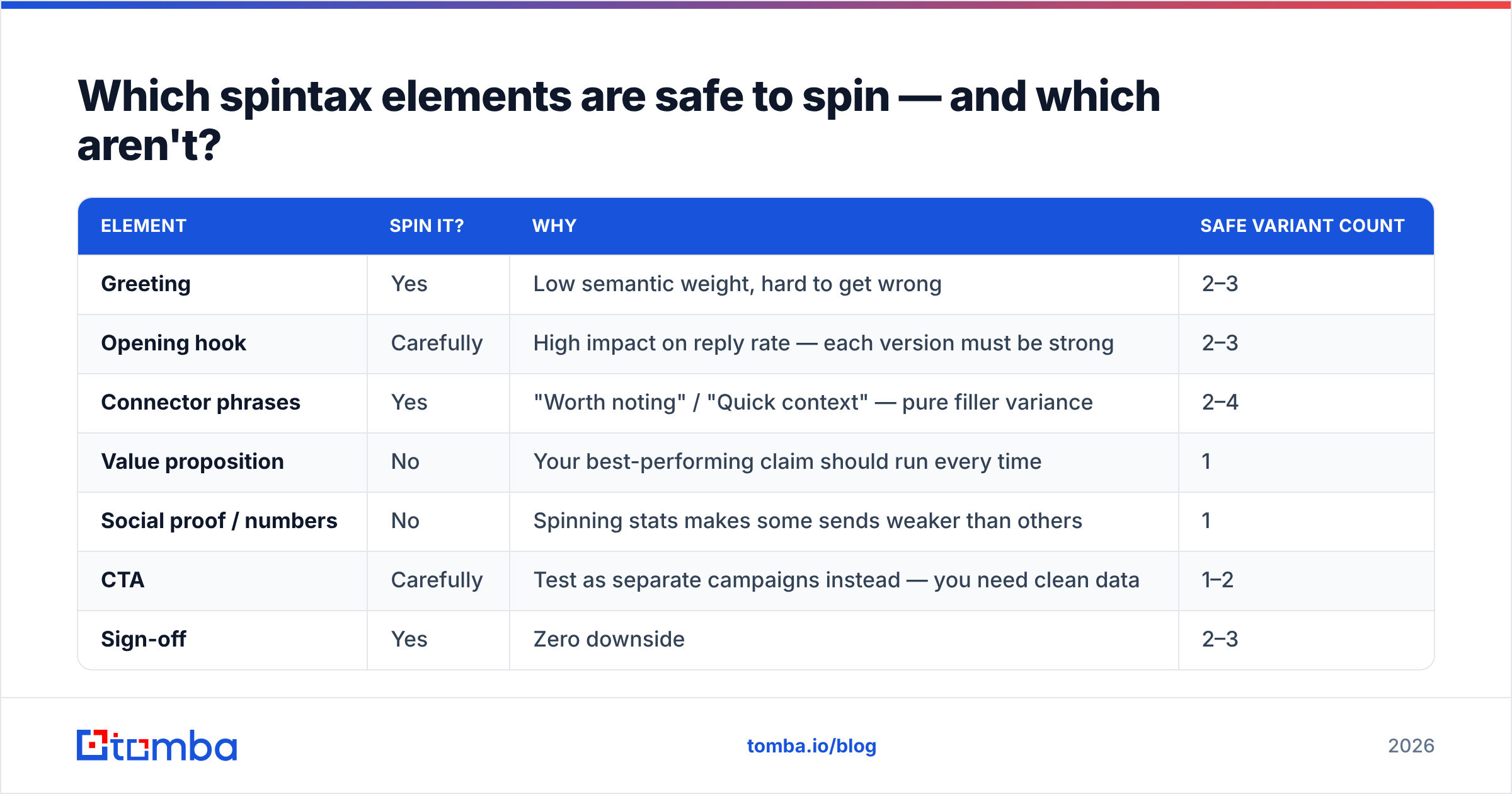
Not all parts of a cold email carry equal risk. Some elements tolerate variation; others break when you touch them.
| Element | Spin it? | Why | Safe variant count |
|---|---|---|---|
| Greeting | Yes | Low semantic weight, hard to get wrong | 2–3 |
| Opening hook | Carefully | High impact on reply rate — each version must be strong | 2–3 |
| Connector phrases | Yes | "Worth noting" / "Quick context" — pure filler variance | 2–4 |
| Value proposition | No | Your best-performing claim should run every time | 1 |
| Social proof / numbers | No | Spinning stats makes some sends weaker than others | 1 |
| CTA | Carefully | Test as separate campaigns instead — you need clean data | 1–2 |
| Sign-off | Yes | Zero downside | 2–3 |
| Subject line | Separately | Use A/B testing, not spintax — you need per-subject metrics | n/a |
The subject-line row matters most. If you spin your subject line, your open-rate data becomes an unusable average across variants you can't separate. Run subject lines as discrete A/B tests in your sequencer so each one gets its own numbers.
How much does spintax actually improve deliverability?#
Less than the discourse suggests, and here's the honest framing.
Vendors selling sequencers have an incentive to present spintax as a deliverability lever, because it's a feature they can ship. Independent testing tells a more modest story: content variation shifts inbox placement at the margin, while authentication, sender reputation, and list hygiene move it by an order of magnitude more.
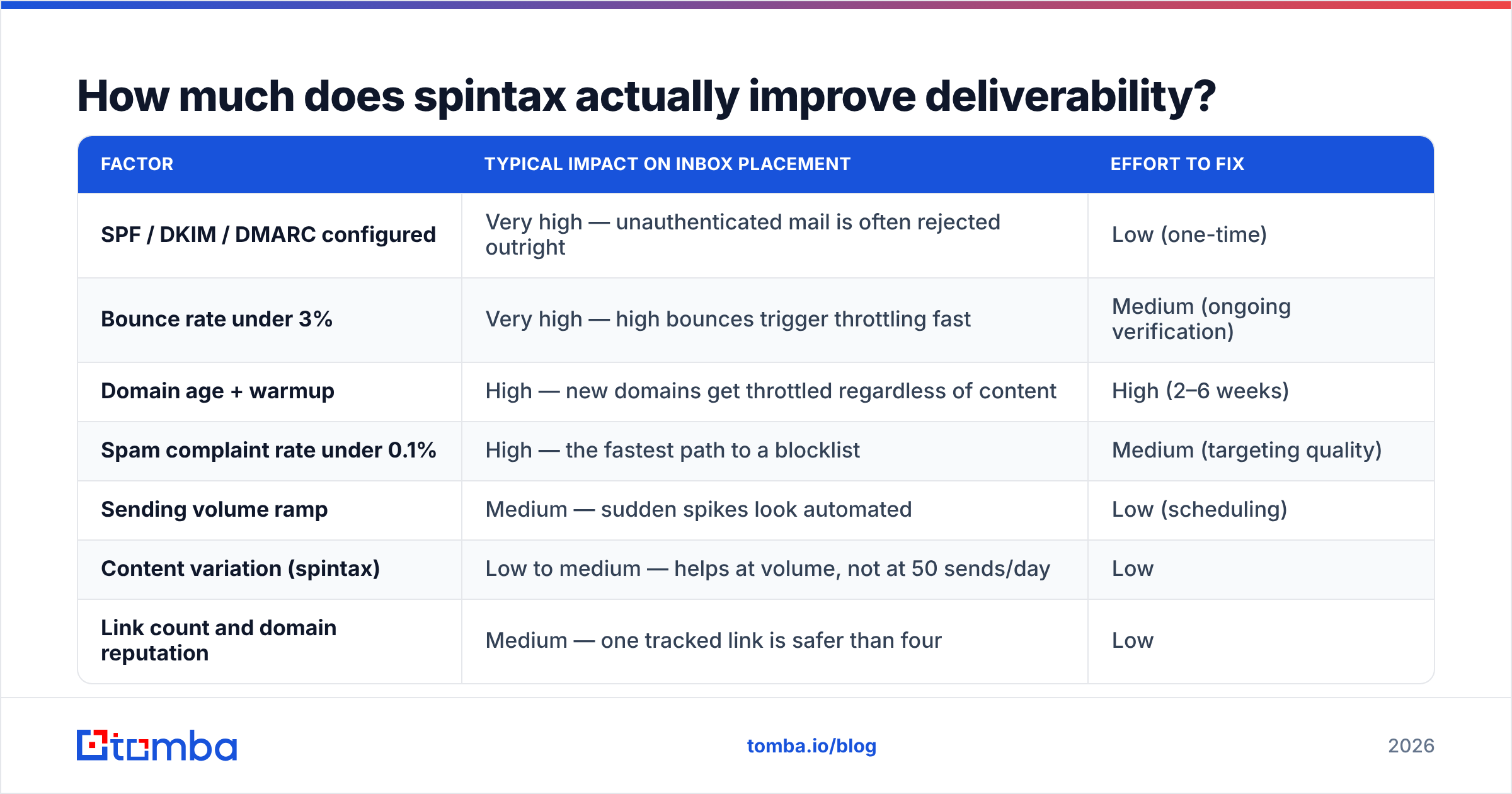
Here's a realistic hierarchy of what moves the needle:
| Factor | Typical impact on inbox placement | Effort to fix |
|---|---|---|
| SPF / DKIM / DMARC configured | Very high — unauthenticated mail is often rejected outright | Low (one-time) |
| Bounce rate under 3% | Very high — high bounces trigger throttling fast | Medium (ongoing verification) |
| Domain age + warmup | High — new domains get throttled regardless of content | High (2–6 weeks) |
| Spam complaint rate under 0.1% | High — the fastest path to a blocklist | Medium (targeting quality) |
| Sending volume ramp | Medium — sudden spikes look automated | Low (scheduling) |
| Content variation (spintax) | Low to medium — helps at volume, not at 50 sends/day | Low |
| Link count and domain reputation | Medium — one tracked link is safer than four | Low |
Read that table as a to-do order. If you're sending 60 emails a day from a properly authenticated, warmed domain to verified addresses, spintax will change your results very little. If you're sending 2,000 a day across 20 mailboxes, it starts to matter — because that's the volume at which fingerprinting kicks in.
Before you send anything, run your domain through an SPF checker and your copy through a spam checker. Those two five-minute checks will do more for your placement than any amount of spinning.
What are the three ways spintax backfires?#
Trap 1: Variant quality collapse. You write one great opening line and two mediocre ones to fill the block. Now a third of your sends use your weakest copy. The average result gets worse, and because you're spinning rather than A/B testing, you can't see which variant caused it. Rule: if a variant isn't as good as your best one, delete it.
Trap 2: Broken renders. Unclosed braces, stray pipes, and nested blocks produce output like {Hi|Hey Sarah, in a live send. This happens more than people admit — copy-paste from a doc that auto-converted a brace, or a nested block one level too deep. Always render 20 samples before launch.
Trap 3: Attribution blindness. With three spin blocks of three options, you have 27 message versions. If your reply rate drops from 4% to 2%, you have no idea which combination is responsible. Spintax and rigorous testing are in tension. Resolve it by keeping the tested elements fixed and only spinning the untested filler.
There's a fourth, subtler failure: over-spinning signals effort in the wrong place. Prospects who reply to cold email do so because the message was relevant, not because the greeting was novel. Time spent building a 200-variant template is time not spent on research and targeting.
Which tools support spintax, and how do they compare?#
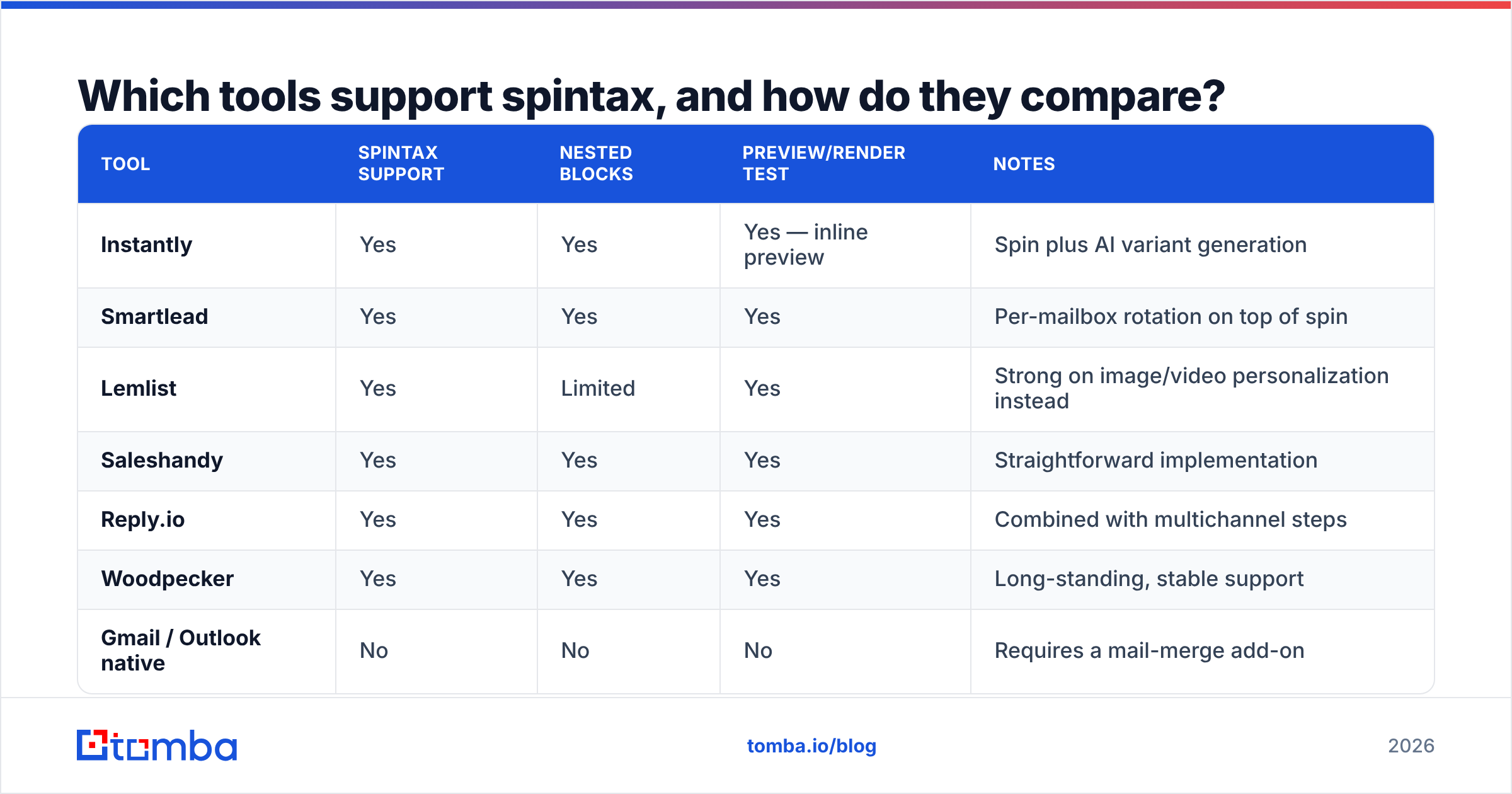
Most established sequencers support spintax natively. The differences are in preview tooling and nesting depth.
| Tool | Spintax support | Nested blocks | Preview/render test | Notes |
|---|---|---|---|---|
| Instantly | Yes | Yes | Yes — inline preview | Spin plus AI variant generation |
| Smartlead | Yes | Yes | Yes | Per-mailbox rotation on top of spin |
| Lemlist | Yes | Limited | Yes | Strong on image/video personalization instead |
| Saleshandy | Yes | Yes | Yes | Straightforward implementation |
| Reply.io | Yes | Yes | Yes | Combined with multichannel steps |
| Woodpecker | Yes | Yes | Yes | Long-standing, stable support |
| Gmail / Outlook native | No | No | No | Requires a mail-merge add-on |
If you're evaluating sequencers, check G2's outbound category for current user reviews rather than trusting any single vendor comparison — including this one. And if the tool you're on already handles the sending well but your data is the bottleneck, changing sequencers won't help.
For teams weighing a switch, our breakdowns of the Instantly alternative and Saleshandy alternative landscape cover feature parity in more detail.
Does spintax matter more or less than list quality?#
Less. Substantially less. This is the section most spintax guides skip.
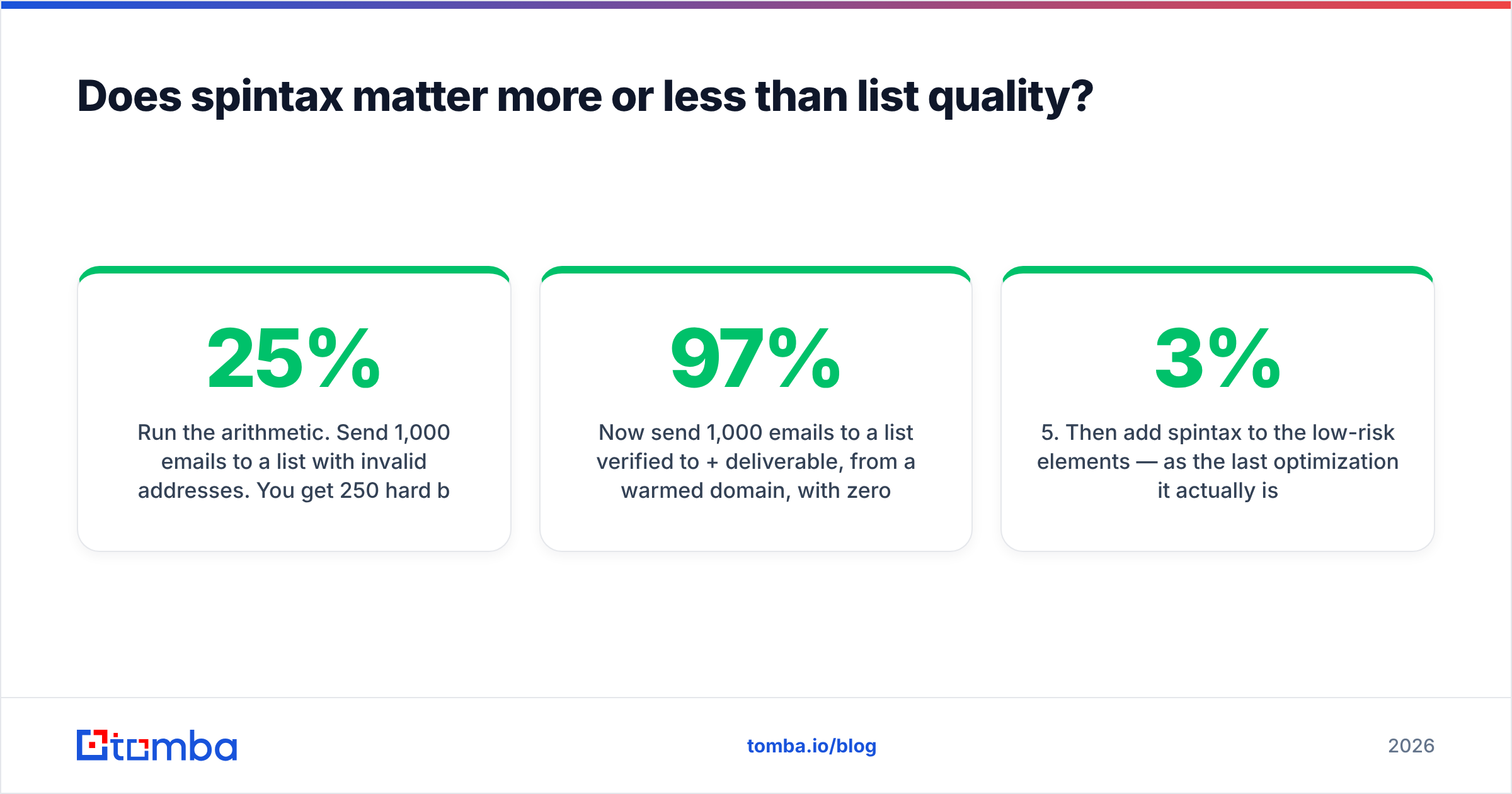
Run the arithmetic. Send 1,000 emails to a list with 25% invalid addresses. You get 250 hard bounces. At that bounce rate, most providers throttle or suspend the sending domain within days — and no amount of copy variation prevents it, because the failure happens at the SMTP handshake, before your body text is ever evaluated.
Now send 1,000 emails to a list verified to 97%+ deliverable, from a warmed domain, with zero spintax. Your placement will be fine.
The order of operations is:
- Build the list from a real source. Scrape-and-guess lists carry high invalid rates by construction. Use a domain search to pull actual contacts from a target company rather than permutating name patterns and hoping.
- Verify before sending. Run every address through an email verifier and drop anything that isn't confirmed deliverable. Catch-all domains need separate treatment — a catch-all verifier will tell you whether an accept-all response is meaningful.
- Authenticate and warm the domain. SPF, DKIM, DMARC, then a two-to-four week ramp.
- Write copy worth reading. One version, tested, honest.
- Then add spintax to the low-risk elements — as the last 3% optimization it actually is.
Teams that follow that order rarely have deliverability problems. Teams that start at step five almost always do.
What does a good spintax template look like end to end?#
Here's a complete template following every rule above — three spin blocks, phrase-level, all variants independently strong:
Subject: quick question about {{company}}'s SDR ramp

{Hi|Hey} {{first_name}},

{Saw {{company}} posted three SDR roles this month|Noticed {{company}} is
scaling the SDR team|{{company}} looks like it's doubling the SDR headcount} —
usually that means data volume becomes the bottleneck before headcount does.

We help teams pull verified contact data at the rate new reps can actually
work it, so ramp time doesn't stall on list-building.

{Worth 10 minutes next week?|Open to a quick look?}

Best,
{{sender_name}}
Twelve possible renders. Every one reads naturally. The value proposition and the proof claim are fixed, so your performance data stays interpretable. The spun elements — greeting, hook framing, CTA phrasing — carry low semantic risk.
That's the whole discipline: vary the packaging, never the argument.
Where should you start?#
Fix the inputs before you optimize the wrapper. Spintax is a finishing move, not a foundation — and it only pays off once your list is clean, your domain is authenticated, and your copy has been tested in a single fixed version first.
If your bounce rate is above 3%, that's the actual problem. Start with Tomba's Email Finder to source verified professional addresses by domain, name, or company, with every result validated before it reaches your sequencer. The free tier gives you 25 searches a month to test the data quality against your current list; paid plans start at $49/mo on Starter and scale to $99/mo on Growth — full Tomba pricing breaks down credits per tier. Get the list right, then spin the greeting.
Related guides#
// get started
Find, verify and enrich your first contacts today
Start on the free plan with 25 searches a month, then scale when your team is ready.
Free plan · No credit card required · GDPR & CCPA
// about the author