How to Write a Cold Email That Gets Replies in 2026
A line-by-line breakdown of how to write a cold email that actually gets answered: subject lines, openers, offers, CTAs, and the research that makes them land.
TL;DR
- A cold email that gets replies is short (50-125 words), built on one observed trigger, and asks for exactly one thing.
- Subject lines should read like an internal note from a colleague, not a campaign: 2-5 words, lowercase, no pitch.
- Personalization only pays when it changes the offer. "Loved your podcast" is decoration; "you just posted three SDR roles" is a reason to write.
- Verify before you send. A 5% bounce rate quietly destroys your domain reputation and every email after it.
- Follow-ups produce the majority of replies in most sequences — plan four to five touches before you write touch one.
What actually counts as a cold email in 2026?#
A cold email is a one-to-one business message to someone who has never engaged with you, sent because you have specific evidence they might need what you sell. Everything else — batch-and-blast, scraped lists, spun paragraphs — is spam wearing a suit, and inbox providers have gotten very good at telling the difference.
Two things changed the game recently. First, Google and Yahoo's bulk-sender requirements made authentication and complaint rates non-negotiable; you can read the current rules in Google's sender guidelines. Second, AI made generic personalization free, which means it's now worthless. When every prospect gets four emails a day that mention their recent funding round, the funding round mention stops signaling effort.
So the bar moved. Writing a good cold email in 2026 means being useful in under 125 words to someone who owes you nothing.
How do you write a cold email step by step?#
Here's the sequence that consistently outperforms improvisation. Do them in this order — most bad cold emails fail at step 1 or 2, not at the copy.
- Define the trigger. Something happened that makes this person a buyer now: a new hire, a tech-stack change, a job posting, a product launch, a competitor mention. No trigger, no email.
- Pick the single outcome. One metric you can move. Not "help with growth" — "cut your SDR ramp time from 90 days to 45."
- Write the offer before the email. If you can't state what the prospect gets in one sentence, the email will ramble to compensate.
- Draft the body at 60 words. Then add only what a skeptical reader would need to believe you. Most drafts get shorter, not longer.
- Write the subject line last. It should summarize the body, not tease it.
- Verify the address and warm the domain. Copy quality is irrelevant if you land in spam.
- Plan the follow-ups now. Write touches two through five in the same sitting, while the context is loaded.
What makes a cold email subject line get opened?#
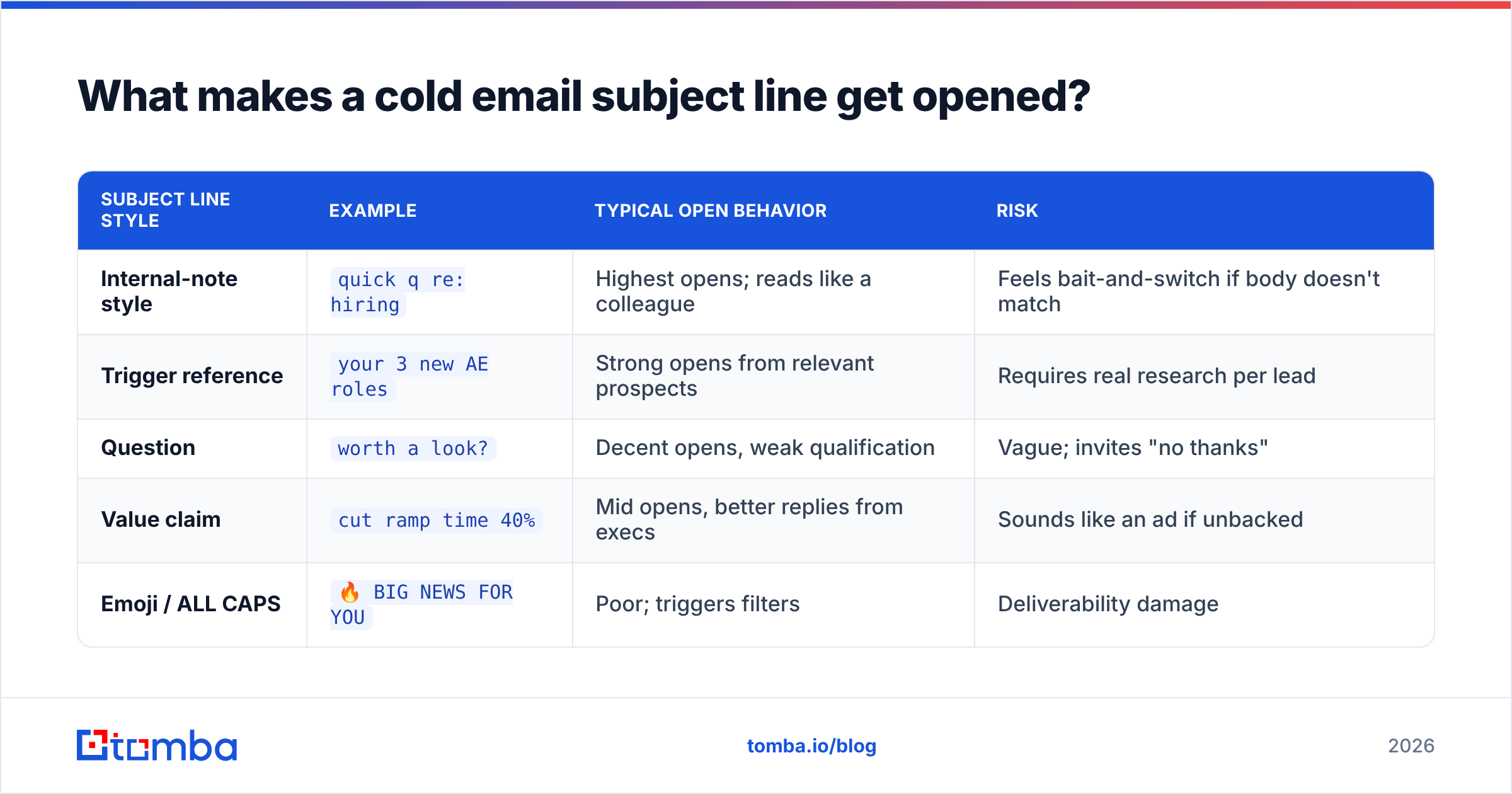
Short, specific, lowercase, and free of anything that smells like marketing. The subject line's only job is to look like a message from someone the prospect already works with.
| Subject line style | Example | Typical open behavior | Risk |
|---|---|---|---|
| Internal-note style | quick q re: hiring |
Highest opens; reads like a colleague | Feels bait-and-switch if body doesn't match |
| Trigger reference | your 3 new AE roles |
Strong opens from relevant prospects | Requires real research per lead |
| Question | worth a look? |
Decent opens, weak qualification | Vague; invites "no thanks" |
| Value claim | cut ramp time 40% |
Mid opens, better replies from execs | Sounds like an ad if unbacked |
| Emoji / ALL CAPS | 🔥 BIG NEWS FOR YOU |
Poor; triggers filters | Deliverability damage |
Three rules that survive every test I've seen:
- Keep it under 40 characters so mobile clients show the whole thing.
- Never put your company name in it. That converts a personal note into an ad.
- Match the body. If the subject says "your 3 new AE roles," the first sentence must be about those roles.
If you're stress-testing variants at volume, run them through a subject line tester before committing a whole sequence to one style.
What does a good cold email look like line by line?#
Every effective cold email has the same five moving parts. Here's a real-shaped example, annotated.
Subject: your 3 new AE roles
Hi Dana,
Saw you posted three AE openings this month — that usually means the team's about to double its outbound volume.
We built a lead-sourcing layer that cut new-rep ramp from 90 days to about 45 for two other Series B sales orgs, mostly by handing reps verified contacts on day one instead of week six.
Worth a 12-minute call next Tuesday or Wednesday?
— Mo
Breaking it down:
- Opener (1 sentence): the observed trigger, stated plainly. No compliments. It proves you looked.
- Bridge (1 clause): why the trigger implies a problem. This is where you earn the next sentence.
- Proof (1 sentence): a concrete before/after with a comparable company. Numbers beat adjectives.
- Ask (1 sentence): one specific, low-cost action with named days.
- Signature: name, role, company. No banner images, no quotes, no legal block on a first touch.
That's 71 words. The prospect can read it in a Slack-notification-sized glance, which is exactly the point.
Common failure modes to strip out: the "I hope this email finds you well" opener, the paragraph about your company's founding, the three-option CTA ("call, demo, or I can send a deck?"), and the P.S. stacking a second ask. Every one of those adds decision cost.
How much personalization is actually worth it?#
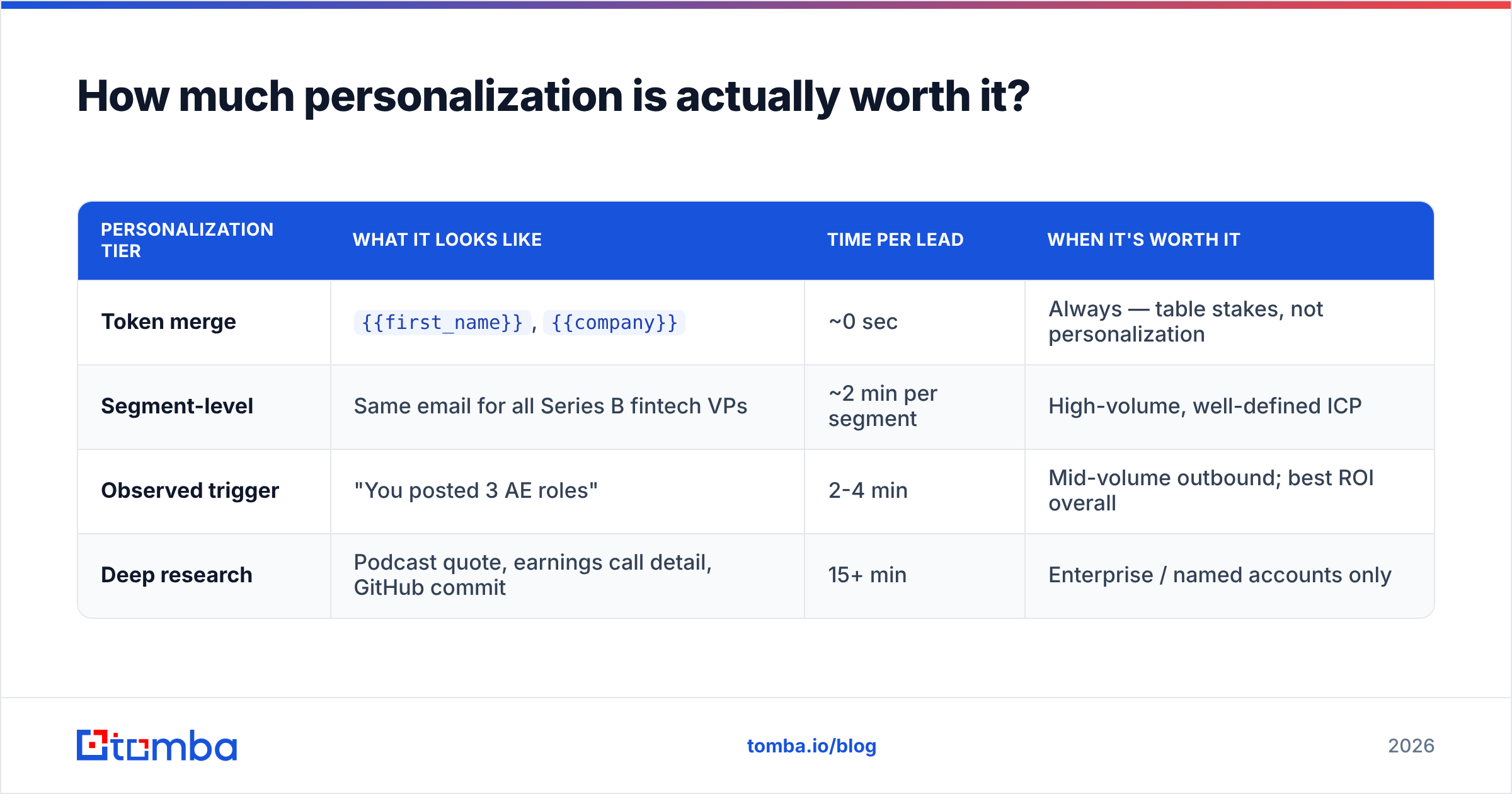
Only personalize where it changes the offer. That's the whole rule.
| Personalization tier | What it looks like | Time per lead | When it's worth it |
|---|---|---|---|
| Token merge | {{first_name}}, {{company}} |
~0 sec | Always — table stakes, not personalization |
| Segment-level | Same email for all Series B fintech VPs | ~2 min per segment | High-volume, well-defined ICP |
| Observed trigger | "You posted 3 AE roles" | 2-4 min | Mid-volume outbound; best ROI overall |
| Deep research | Podcast quote, earnings call detail, GitHub commit | 15+ min | Enterprise / named accounts only |
The mistake most teams make is spending deep-research time on segment-level deals. If your ACV is $6,000, a 15-minute research pass makes the math impossible. If it's $250,000, sending a token-merge email is malpractice.
The practical middle is trigger-based writing: one researched sentence, reusable structure, everything else templated. That's what lets a rep send 40 genuinely relevant emails a day instead of 12 artisanal ones or 400 ignored ones.

Does your cold email even reach the inbox?#
Copy is downstream of delivery. If 6% of your sends bounce, mailbox providers throttle you, and your beautifully written touch three lands in spam for everyone — including the prospects who were going to reply.
The checklist before any sequence goes live:
- Authenticate the domain. SPF, DKIM, and DMARC all passing. Confirm with an SPF checker and check your domain isn't listed with a blacklist checker.
- Use a separate sending domain. Never burn your primary company domain on outbound.
- Warm up for 3-4 weeks. Ramp volume gradually; a fresh domain sending 200/day on week one is a guaranteed spam folder.
- Verify every address. Bounces above 3% are a hard stop. Run lists through an email verifier and handle catch-all domains separately with a catch-all verifier.
- Cap daily volume per mailbox. 30-50 cold sends per inbox per day is the sane ceiling in 2026.
- Strip links and images from touch one. Both correlate with filtering on first contact.
Poor list hygiene is the single most common cause of a "our cold email doesn't work anymore" diagnosis. It's rarely the copy. Sourcing addresses through a proper email finder with verification built into the lookup removes most of this problem before it starts — you never import the bad address in the first place.
How many follow-ups should a cold email sequence have?#
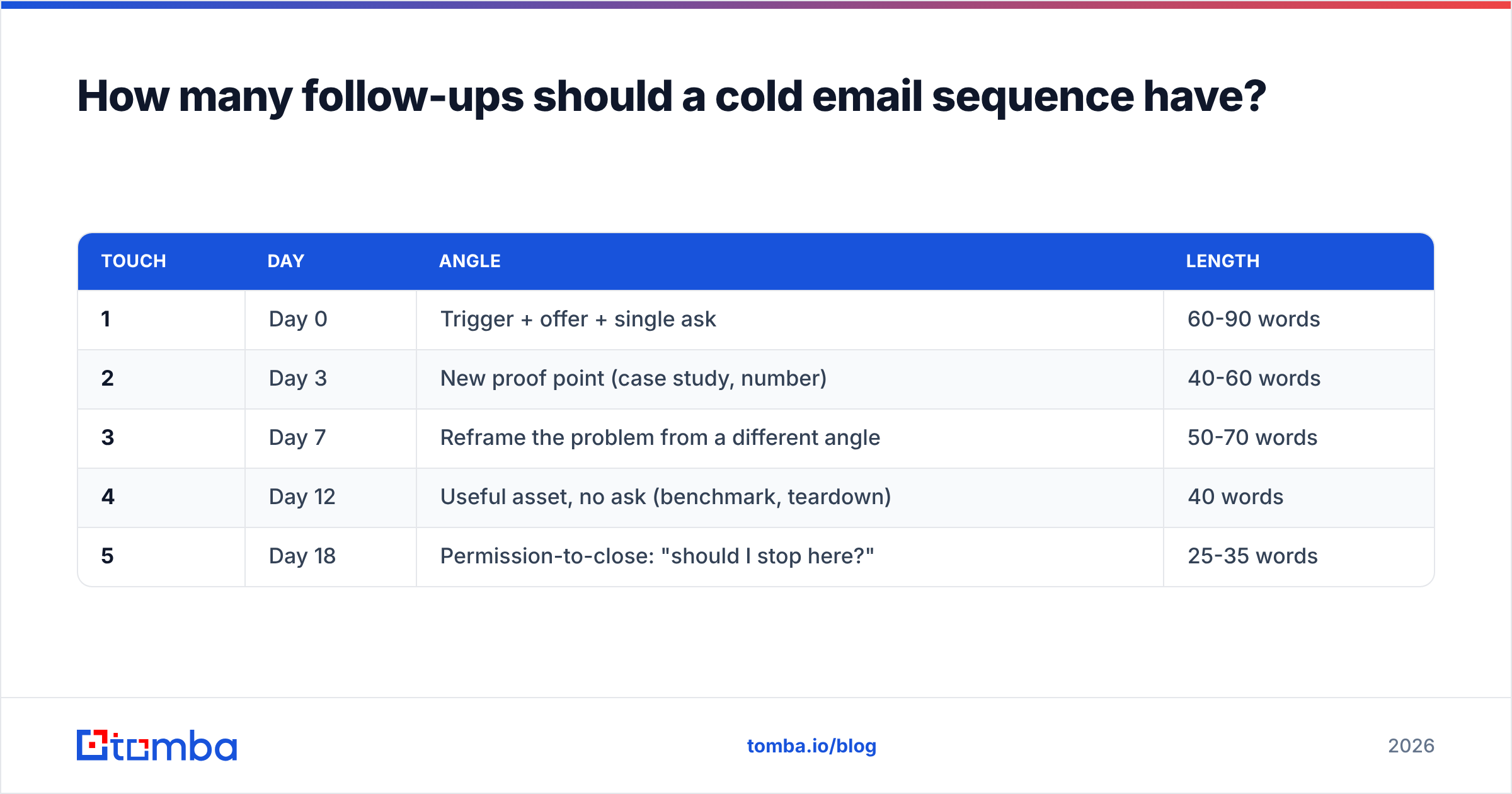
Four to five touches over 14-18 business days, each one adding something new. A "just bumping this" email is a withdrawal from an account you never funded.
| Touch | Day | Angle | Length |
|---|---|---|---|
| 1 | Day 0 | Trigger + offer + single ask | 60-90 words |
| 2 | Day 3 | New proof point (case study, number) | 40-60 words |
| 3 | Day 7 | Reframe the problem from a different angle | 50-70 words |
| 4 | Day 12 | Useful asset, no ask (benchmark, teardown) | 40 words |
| 5 | Day 18 | Permission-to-close: "should I stop here?" | 25-35 words |
The day-18 breakup email is consistently the second-highest replier in most sequences, because it costs the prospect nothing to answer and gives them an easy out. Ironically, a good chunk of those replies are "actually, let's talk."
Reply to your own thread rather than starting new ones. It preserves context, and threaded follow-ups get read more than orphaned ones. If you want to sanity-check what "normal" looks like for your segment, the definitions in Tomba's response rate glossary entry give you a baseline before you panic about a 4% number.
Which tools do you actually need to run this?#
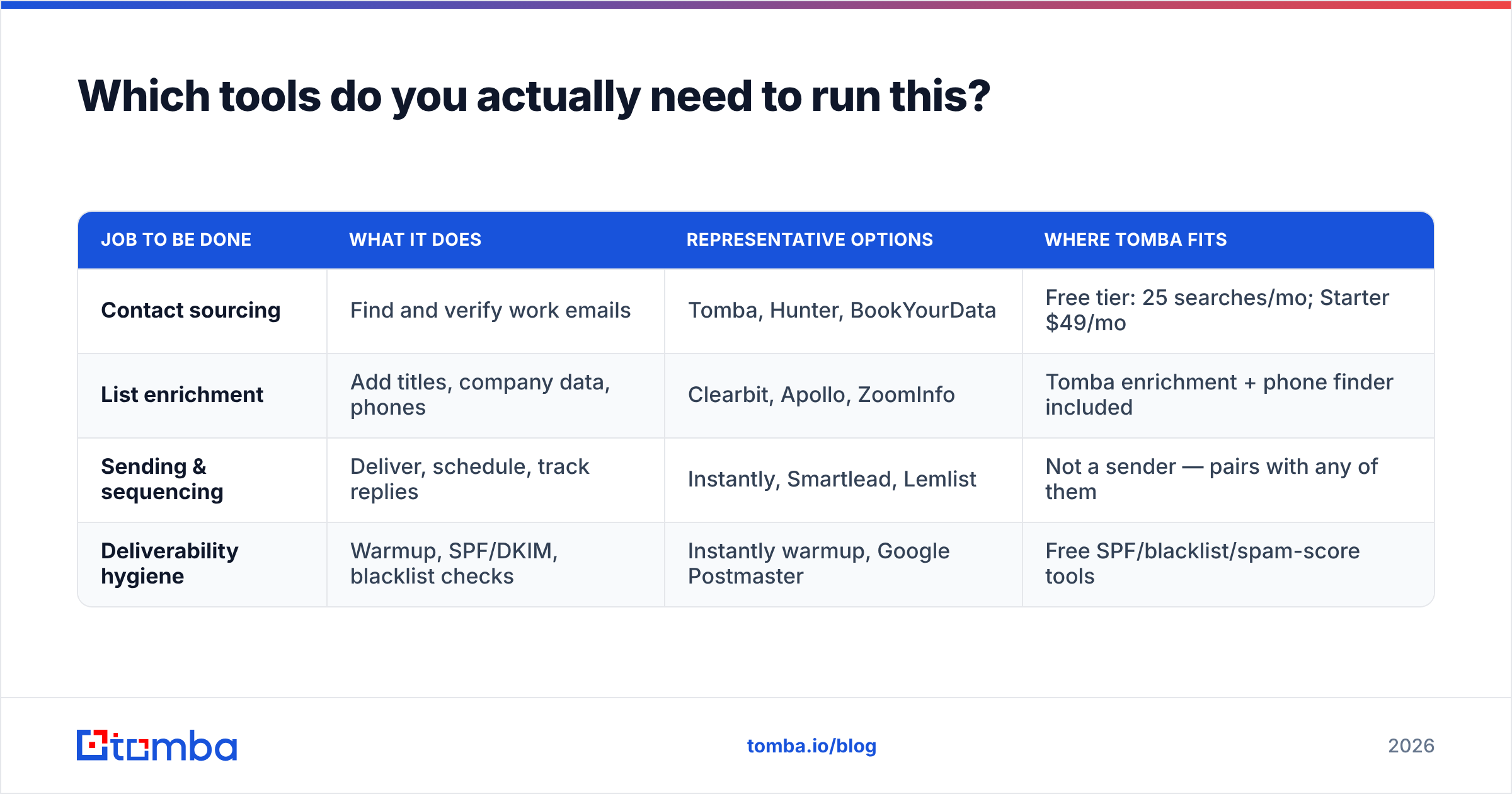
You need three categories, and you can start with fewer tools than most stacks suggest.
| Job to be done | What it does | Representative options | Where Tomba fits |
|---|---|---|---|
| Contact sourcing | Find and verify work emails | Tomba, Hunter, BookYourData | Free tier: 25 searches/mo; Starter $49/mo |
| List enrichment | Add titles, company data, phones | Clearbit, Apollo, ZoomInfo | Tomba enrichment + phone finder included |
| Sending & sequencing | Deliver, schedule, track replies | Instantly, Smartlead, Lemlist | Not a sender — pairs with any of them |
| Deliverability hygiene | Warmup, SPF/DKIM, blacklist checks | Instantly warmup, Google Postmaster | Free SPF/blacklist/spam-score tools |
Pricing shape matters more than feature count when you're starting. Tomba pricing runs a free tier at 25 searches/month, Starter at $49/mo, Growth at $99/mo, and Pro at $249/mo, which is the range where most 2-8 person outbound teams land. Enterprise data platforms typically start an order of magnitude higher and lock you into annual contracts before you've validated a single message.
Whatever you pick, check independent reviews on G2 rather than vendor comparison pages — including this one. Vendors grade their own homework.
A workable minimum stack for a solo founder: a finder with verification, one sending tool, and a spreadsheet. That's it. Add sophistication after you've proven the message converts, not before.
What are the most common cold email mistakes?#
Ranked by how much damage they do, worst first:
- Sending to unverified addresses. Kills the domain, invalidates all your other tests.
- No trigger. Produces emails that could go to 10,000 people, so they land with the weight of an ad.
- Multiple asks. "Reply, or book here, or check out this deck" converts worse than any one of them alone.
- Writing about yourself. Count the "we" and "our" in your draft. If it beats "you" and "your," rewrite.
- Giving up at touch two. Most sequences that "don't work" were abandoned before the majority of replies would have arrived.
- Optimizing subject lines while ignoring deliverability. A 12% open rate is usually a spam-folder problem, not a copy problem.
The diagnostic order is always the same: deliverability first, targeting second, offer third, copy fourth. Teams almost always debug in reverse.
Ready to write cold emails that land?#
Good copy on a bad list is a waste of a good sentence. Start with contacts you can trust: the Tomba Email Finder returns verified professional addresses by name, domain, or company, with confidence scoring on every result — and the free tier gives you 25 searches a month to test your message before you spend anything. Get the list right, then write the 70 words that earn the reply.
Related guides#
// get started
Find, verify and enrich your first contacts today
Start on the free plan with 25 searches a month, then scale when your team is ready.
Free plan · No credit card required · GDPR & CCPA
// about the author