How to Write a Proposal Email That Actually Gets Replies
Most proposal emails die because they lead with the sender, not the buyer. Here's the 7-part structure, three templates, and the follow-up cadence that turns a proposal email into a signed deal.
TL;DR
- A proposal email is not a proposal document. It is a 200-300 word decision request that makes saying "yes" the least effortful option on the recipient's screen.
- The seven parts that matter: subject line, context anchor, problem restatement, scope, pricing, single next step, and deadline. Cut anything else.
- Lead with the buyer's own words from the discovery call. Proposals that quote the prospect's stated problem verbatim convert far better than ones that open with "I'm excited to share."
- Send to a verified address on a warm thread. A perfect proposal that lands in spam or bounces off a stale contact is a zero.
- Follow up three times over 10 business days, each time adding something new — never "just circling back."
What is a proposal email, exactly?#
A proposal email is the message that asks a buyer to make a commercial decision. It either contains the offer itself or delivers a linked document with enough summary that the recipient could decide without opening the attachment.
Think of it like a restaurant check versus the menu. The menu (your full proposal deck) explains everything. The check is what the person actually signs. Most sellers hand over a menu and wonder why nobody pays.
That distinction matters because of how proposals get read. The first reader is usually your champion, skimming on a phone between meetings. They are not evaluating your methodology. They are deciding whether this is worth forwarding to the person who controls the budget. If your email does not survive a 20-second phone skim, the attachment never gets opened.
So the job of the proposal email is narrow: restate the problem in the buyer's language, state what you will do, state what it costs, and state the one action you need next.
Why do most proposal emails get ignored?#
Five failure patterns account for the overwhelming majority of dead proposals.
- It opens with the sender. "I'm excited to share our proposal for..." The buyer does not care about your excitement. The first sentence should be about their situation, not your feelings.
- It has no deadline. Without a date, a proposal has no reason to move to the top of anyone's queue. It sits in "later" forever, and "later" is where deals go to die.
- It buries the price. Hiding pricing on page six of a PDF signals that you are uncomfortable with your own number. Put it in the email body.
- It asks for too many decisions at once. "Let me know your thoughts on scope, timeline, the two pricing models, and whether you want the add-on." That is four decisions. Ask for one.
- It never arrives. Bad address, spam folder, or the contact left the company three months ago. This is more common than most teams believe — B2B contact data decays roughly 25-30% per year as people change roles.
That last point is the one nobody audits. Before you spend 40 minutes writing a proposal, spend 40 seconds confirming the address is live. Run it through an email verifier if the thread has been quiet for more than a few weeks, and check whether the buying committee has new members you should have on the CC line.
What are the seven parts of a proposal email?#
Here is the structure. Each part has a job, a target length, and a specific failure mode.
| Part | Job | Target length | Common failure |
|---|---|---|---|
| Subject line | Get opened by a skimmer | 4-7 words | Generic "Proposal" or "Following up" |
| Context anchor | Prove you listened | 1 sentence | Starts with "I'm excited" |
| Problem restatement | Mirror their words back | 2-3 sentences | Your framing, not theirs |
| Scope | Say what you'll actually do | 3-5 bullets | Vague deliverables, no owner |
| Pricing | Remove the guesswork | 1-3 lines | Hidden in an attachment |
| Single next step | Make yes frictionless | 1 sentence | Three competing asks |
| Deadline | Create a reason to act now | 1 line | Absent entirely |
The subject line#
Name the deliverable and the company. Proposal: Q4 onboarding revamp — Acme beats Proposal because it is searchable six weeks later when your champion is digging through their inbox for it. Avoid clever. This email is expected; you do not need a hook, you need a label.
If you want to pressure-test variants before sending, a subject line tester will flag length and spam-trigger issues faster than guessing.
The context anchor#
One sentence proving this is not a template blast:
"Following our call on the 3rd, where you flagged that new reps take about five months to hit quota — here's how we'd cut that."
This does two things at once. It time-stamps the relationship, and it demonstrates that you retained a specific detail. Both raise the odds the email gets read past line one.
The problem restatement#
Two to three sentences, in the buyer's vocabulary. If they said "our onboarding is a mess," do not translate that into "suboptimal enablement velocity." Use "mess." Quoting the prospect's own phrasing is the single highest-leverage edit you can make to a proposal email, because it removes the gap between what they think their problem is and what you are proposing to fix.
Scope#
Bullets. Each one has a verb, a deliverable, and a rough timeframe. "We'll audit your current 12-step onboarding flow and deliver a revised 6-step version by week three." Not "onboarding optimization."
Pricing#
In the body. Always. If there are tiers, give a maximum of three, and mark your recommendation. Buyers who have to hunt for a number assume they are being set up.
The single next step#
One ask. "Reply 'approved' and I'll send the SOW today" or "Grab 20 minutes here to walk through it with your CFO." Not both.
The deadline#
Real, not manufactured. "Pricing holds through the 30th because that's our fiscal quarter close" is honest and works. "Act now, offer expires!" reads as a scam and burns credibility.
What does a good proposal email actually look like?#
Three templates for the three most common situations. Adapt, do not copy verbatim.
Template 1 — After a discovery call#
Subject: Proposal: rep ramp-time fix — Northwind
Hi Dana,
On Tuesday you said new AEs take about five months to reach full quota, and that it's costing you roughly two deals per rep per year. Here's what we'd do about it.
Scope (8 weeks):
- Audit your current 12-step onboarding against call recordings from your top 3 reps — week 1-2
- Rebuild it into a 6-step certification path — week 3-5
- Run the first cohort with you co-facilitating — week 6-8
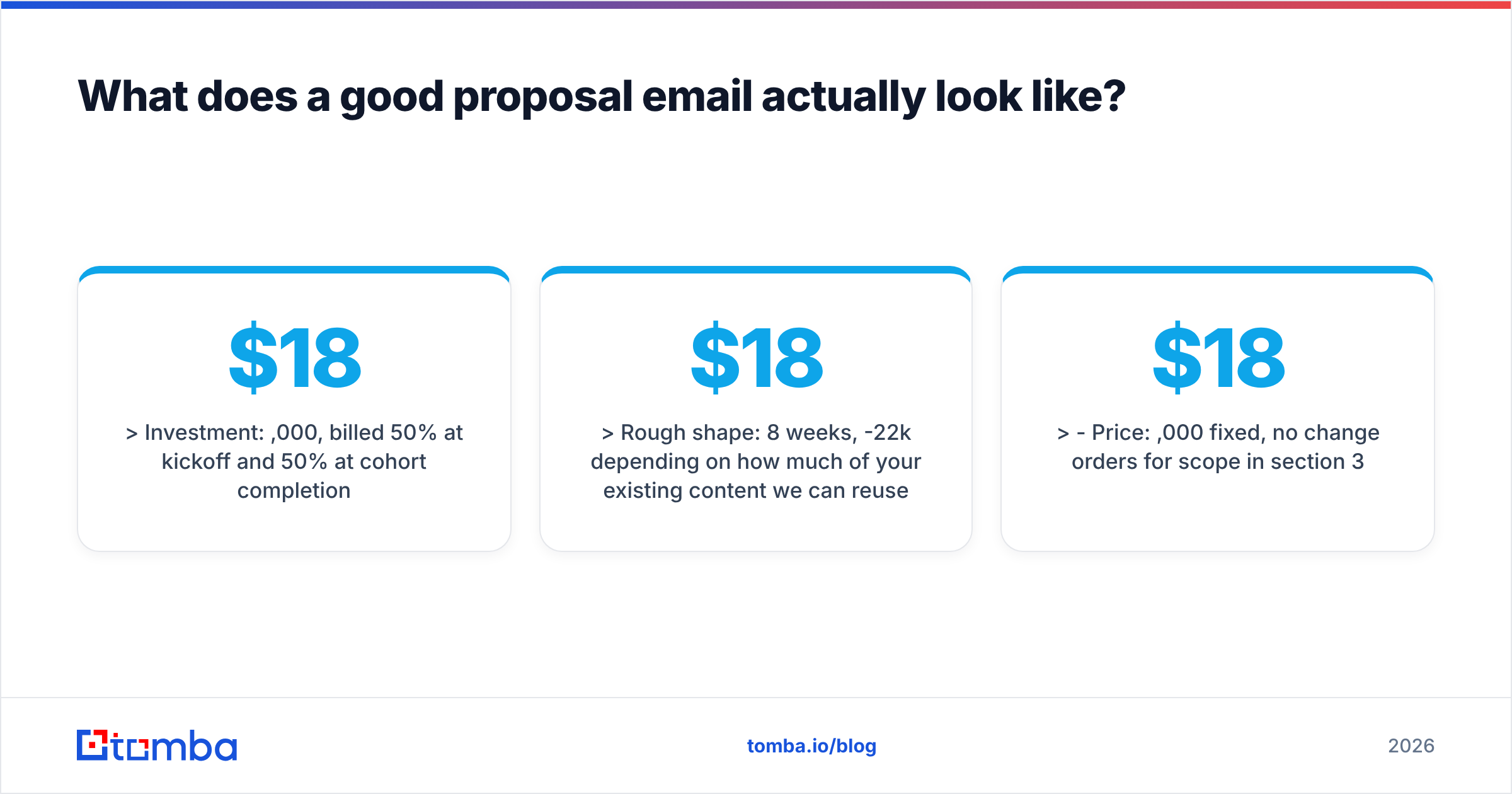
Investment: $18,000, billed 50% at kickoff and 50% at cohort completion.
If this looks right, reply "approved" and I'll send the SOW today. I'm holding the November cohort slot through Friday the 14th.
— Marcus
Word count: 148. It contains every one of the seven parts.
Template 2 — Cold or semi-warm proposal#
When there was no discovery call, you have to earn the right to propose. Lead with evidence you did homework, and make the ask smaller — a conversation, not a signature.
Subject: Idea for Northwind's Q1 SDR hiring push
Hi Dana,
Saw you're hiring six SDRs for Q1 (three roles posted last week). Teams scaling that fast usually hit the same wall: the ramp playbook that worked for 4 reps breaks at 10.
We rebuilt onboarding for two companies in the same spot last year; both cut ramp from ~5 months to ~3.
Rough shape: 8 weeks, $18-22k depending on how much of your existing content we can reuse.
Worth 20 minutes to see if it fits? Here's my calendar: [link]
— Marcus
Template 3 — Responding to an RFP or formal request#
Here the attachment is the deliverable, so the email's job is to summarize and route.
Subject: Northwind RFP #2291 — response attached
Hi Dana,
Full response attached (14 pages, per the RFP format). The short version:
- Approach: 6-step certification path replacing the current 12-step flow
- Timeline: 8 weeks from PO, first cohort certified by week 8
- Price: $18,000 fixed, no change orders for scope in section 3
- References: two comparable engagements, contacts in appendix C
Section 4 addresses your security questionnaire in full. If anything is missing for the committee review on the 22nd, tell me today and I'll turn it around before EOD.
— Marcus
How long should a proposal email be?#
Between 150 and 300 words for the email body. Everything beyond that belongs in an attachment or a linked doc.
The reason is mechanical, not stylistic. Mobile email clients show roughly 15-20 lines before the fold. Your ask needs to be above or immediately below that fold. A 700-word email pushes the "reply approved" line to a place nobody scrolls to.
This is also why the "hope this finds you well" opener is expensive. It costs you a line of prime real estate to say nothing.
How does a proposal email differ from a cold email?#
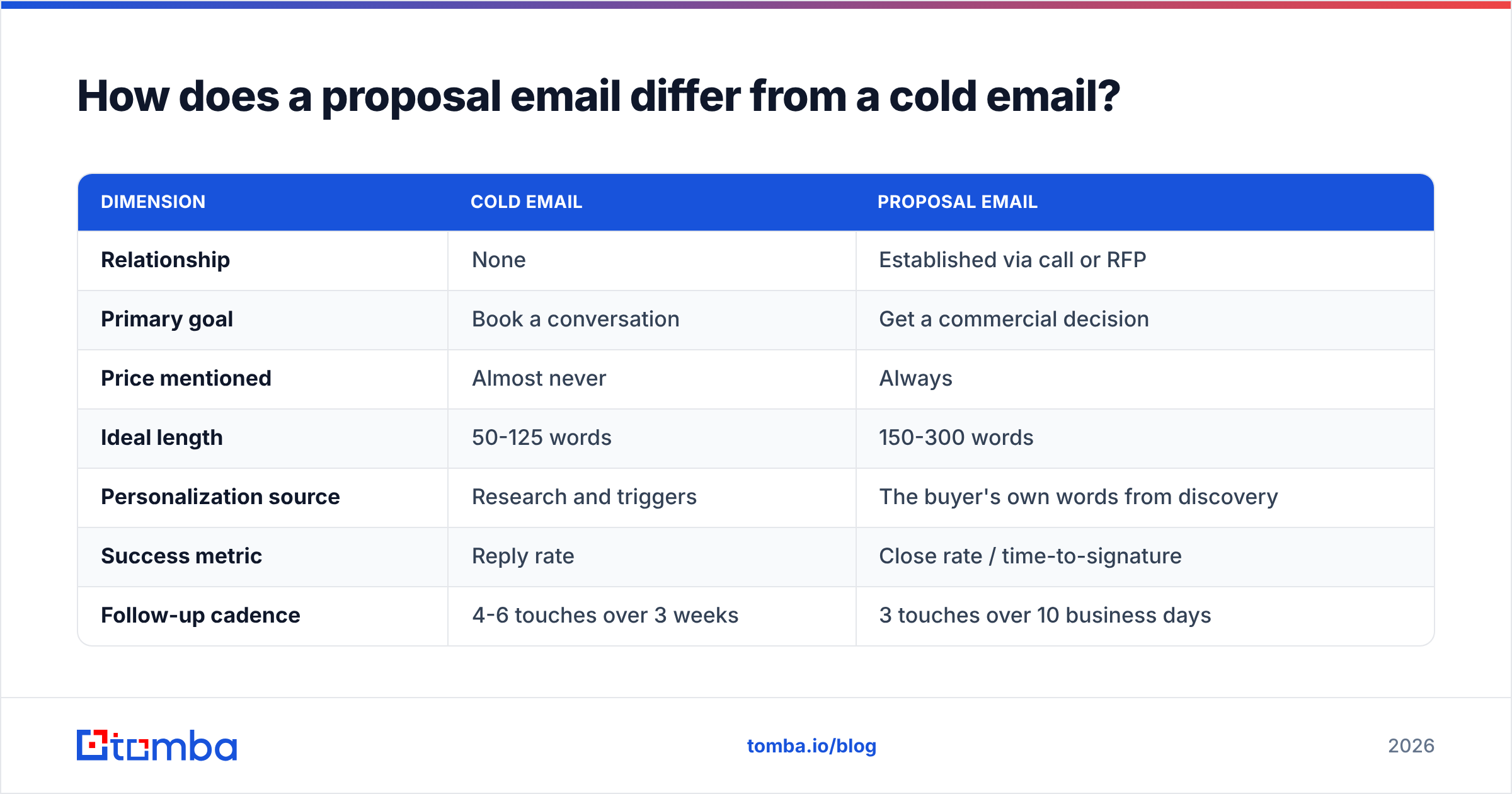
They look similar and behave completely differently. Confusing them is why a lot of proposals read like pitches.
| Dimension | Cold email | Proposal email |
|---|---|---|
| Relationship | None | Established via call or RFP |
| Primary goal | Book a conversation | Get a commercial decision |
| Price mentioned | Almost never | Always |
| Ideal length | 50-125 words | 150-300 words |
| Personalization source | Research and triggers | The buyer's own words from discovery |
| Success metric | Reply rate | Close rate / time-to-signature |
| Follow-up cadence | 4-6 touches over 3 weeks | 3 touches over 10 business days |
| Attachment | Never | Often (SOW, deck, contract) |
The practical implication: a cold email optimizes for curiosity, a proposal email optimizes for clarity. Curiosity gaps that work in prospecting ("noticed something odd about your careers page") actively hurt in a proposal, where any ambiguity reads as evasion. If you are still at the top of the funnel and need to reach the right person first, that is a sales prospecting problem, not a proposal problem — different tool, different email.
How should you follow up on a proposal email?#
Three touches over 10 business days, each adding new information. Never send a message whose entire content is "just checking in."
- Day 3 — Add a resource. "Sent this over Monday. Here's the case study from the client I mentioned — closest match to your setup." You are giving, not asking.
- Day 7 — Address the likely objection. "Guessing the 8-week timeline is the sticking point with Q4 crunch. We can compress to 6 by pushing the cohort to January. Want me to price that version?" You are removing a blocker.
- Day 10 — The close-the-loop message. "I'll assume the timing isn't right and stop following up. If that's wrong, just reply with a date and I'll pick it back up." This gets more replies than any other message in the sequence, because it gives the buyer permission to say no — which is easier than saying yes and easier than staying silent.
Two things to check before you blame the buyer for silence. First, confirm the message is actually landing — run your domain through an SPF checker and check whether attachments are pushing you into spam filters (large PDFs plus link-heavy bodies are a known trigger). Second, confirm the contact is still there. If your champion changed jobs mid-cycle, no cadence in the world saves the deal; you need a new contact at the account.
How do you make sure the proposal reaches the right people?#
A proposal email that only reaches your champion is a proposal email with one point of failure. Gartner's research on B2B buying has consistently found that a typical complex purchase involves six to ten decision-makers, each arriving with their own independently gathered information.
Practical steps:
- Ask on the call: "Who else needs to see this before it can move?" Then CC them, with permission.
- Map the committee before you send. Finance, security, and the direct manager of the end user are the three most common hidden blockers.
- Verify each new address before adding it to the thread. A bounce on a CC line looks careless in front of a buying committee. Use a bulk email finder when you need to add three or four stakeholders at once rather than guessing at formats.
- Give your champion a forwardable version. The email they can paste into Slack without editing. That means no "as we discussed" references that make no sense to a third party.
If you are unsure which people at the account are even relevant, a domain search across the company will surface titles and email patterns faster than manually crawling LinkedIn. And when you get a name but no address, an email finder closes that gap in seconds.
What should you never put in a proposal email?#
- A price you are not prepared to defend. If you discount the moment it is questioned, the original number was fiction and the buyer now knows it.
- More than one attachment. Two attachments doubles the chance one gets ignored and increases spam-filter risk.
- "Please let me know if you have any questions." It is a passive close that invites nothing. Replace it with the specific next step.
- Unexplained jargon from your own category. If the buyer has to Google a term in your proposal, you have added friction at the exact moment you needed none.
- A tracking pixel you then reference out loud. "I saw you opened this three times" is the fastest way to make a buyer uncomfortable. Use open data to time your follow-up, never to narrate it.
For the copy itself, HubSpot's sales research and Salesforce's State of Sales both consistently point in the same direction: buyers reward specificity and punish vagueness. Every abstraction you remove from a proposal is a small increase in the odds of a decision.
How do you know if your proposal email worked?#
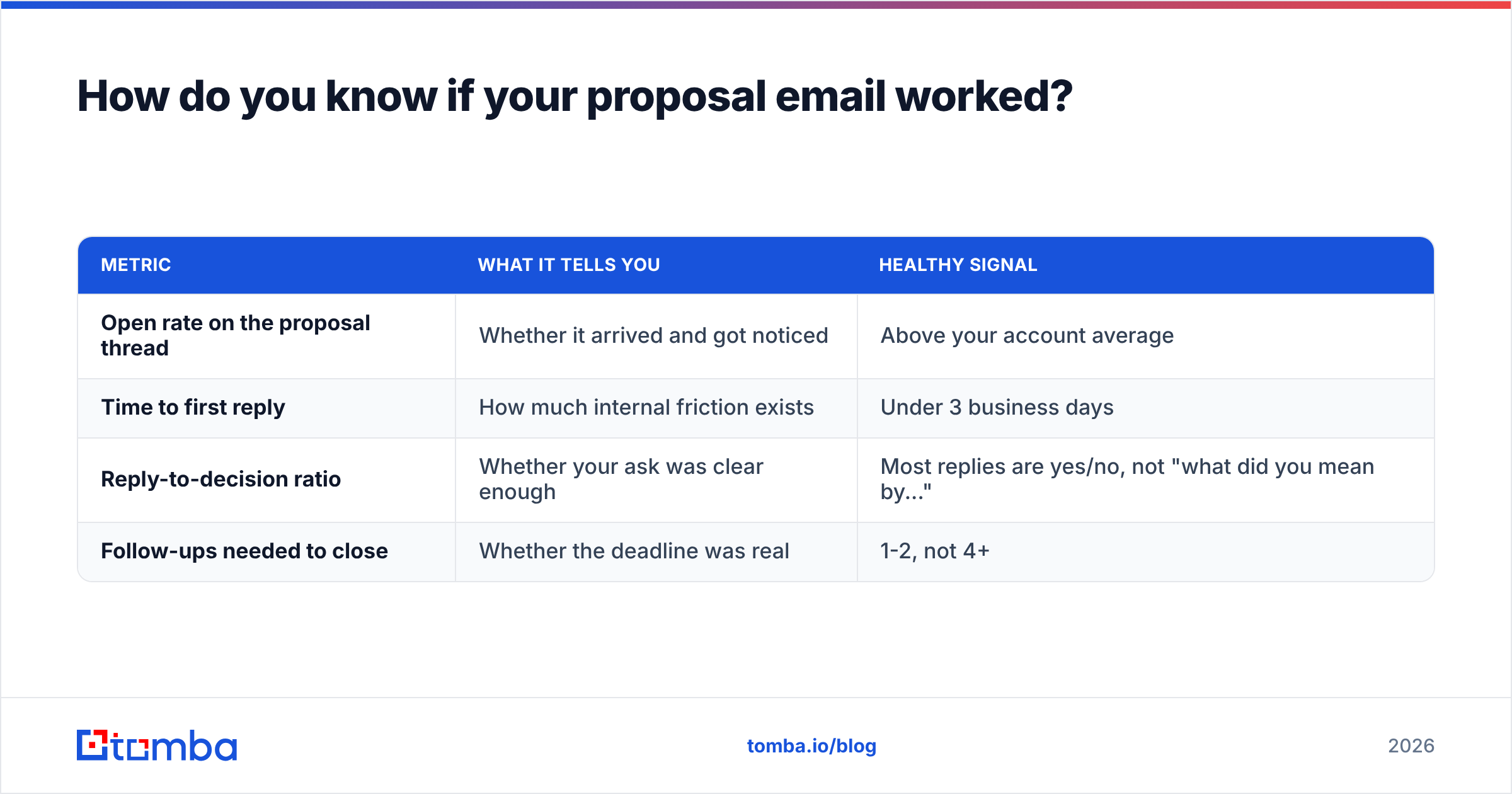
Track three numbers, not one.
| Metric | What it tells you | Healthy signal |
|---|---|---|
| Open rate on the proposal thread | Whether it arrived and got noticed | Above your account average |
| Time to first reply | How much internal friction exists | Under 3 business days |
| Reply-to-decision ratio | Whether your ask was clear enough | Most replies are yes/no, not "what did you mean by..." |
| Follow-ups needed to close | Whether the deadline was real | 1-2, not 4+ |
The most diagnostic of these is the fourth column of the third row: if most replies to your proposal are clarifying questions rather than decisions, your email failed at its actual job. It was a document, not a decision request. Rewrite the scope and pricing sections until the only reasonable replies are "yes," "no," or "here's my counter."
Put it into practice#
The structure is not complicated. Anchor in their words, state the scope, state the price, ask for one thing, set a date. Keep it under 300 words. Follow up three times with something new each time.
The part most teams skip is the boring one: making sure the email reaches a real inbox belonging to a person who still works there and still owns the budget. A proposal that never gets delivered has a 0% close rate regardless of how well it is written.
Before your next proposal goes out, run every address on the thread — champion, CC'd stakeholders, the finance contact you were told to loop in — through Tomba's Email Finder to confirm you have current, verified addresses. The free tier covers 25 searches a month, which is enough to check a full buying committee on a handful of deals; paid plans start at $49/mo if you are proposing at volume. Full Tomba pricing is on the site. Write the proposal well, then make sure it lands.
Related guides#
// get started
Find, verify and enrich your first contacts today
Start on the free plan with 25 searches a month, then scale when your team is ready.
Free plan · No credit card required · GDPR & CCPA
Get the Tomba newsletter
Product and data updates
// about the author