How To Write a Follow Up Email to a Customer That Gets Replies
Most customer follow-ups fail because they say nothing new. Here are the timing rules, the 6-part structure, and 5 copy-paste templates that actually pull replies in 2026.
TL;DR
- The single biggest reason follow-ups get ignored is that they add nothing. "Just checking in" gives the customer no new reason to reply — a fresh angle does.
- Send follow-up #1 within 48 hours of the first touch, then space the rest out: day 3, day 7, day 14, day 30. Four to six touches captures most of the replies you're going to get.
- Every good follow-up has six parts: context anchor, new value, one specific ask, low-friction exit, signature, and a subject line that continues the thread.
- Reply rates die at the inbox door, not the copy stage. Bounced or role-based addresses drag your sender reputation down before anyone reads a word.
- Use the five templates at the bottom as starting points — post-demo, post-quote, gone-quiet, renewal, and post-purchase check-in.
Why do most customer follow-up emails get ignored?#
Because they ask the customer to do work with no payoff. "Just following up on my last email" is a request for a status update on your deal, framed as if the customer owes you something. Nothing in it helps them.
Think of it like knocking on a neighbor's door. Knocking once and saying "hi, did you get my note?" gets a polite nod. Knocking with a package in your hand gets you invited in. Every follow-up needs a package — a new data point, a relevant case study, a shorter path to a decision, an answer to an objection they raised but never voiced.
The second reason is timing drift. A follow-up sent 11 days after a demo lands in a completely different context than one sent on day 3. The customer has moved on, spoken to two competitors, and forgotten your pricing structure. HubSpot's sales research has long shown that the majority of deals need multiple touches, yet most reps stop after one or two — which means the reps who keep going in a structured way pick up the deals everyone else abandoned.
The third reason is deliverability. If your follow-up never reaches the primary inbox, copy quality is irrelevant. Bounces on stale addresses, sending to info@ aliases, and unauthenticated domains all push messages to spam. Fixing email deliverability is a prerequisite, not an afterthought.
Wait — that's malformed. Here it is correctly:
What is the right structure for a follow-up email to a customer?#
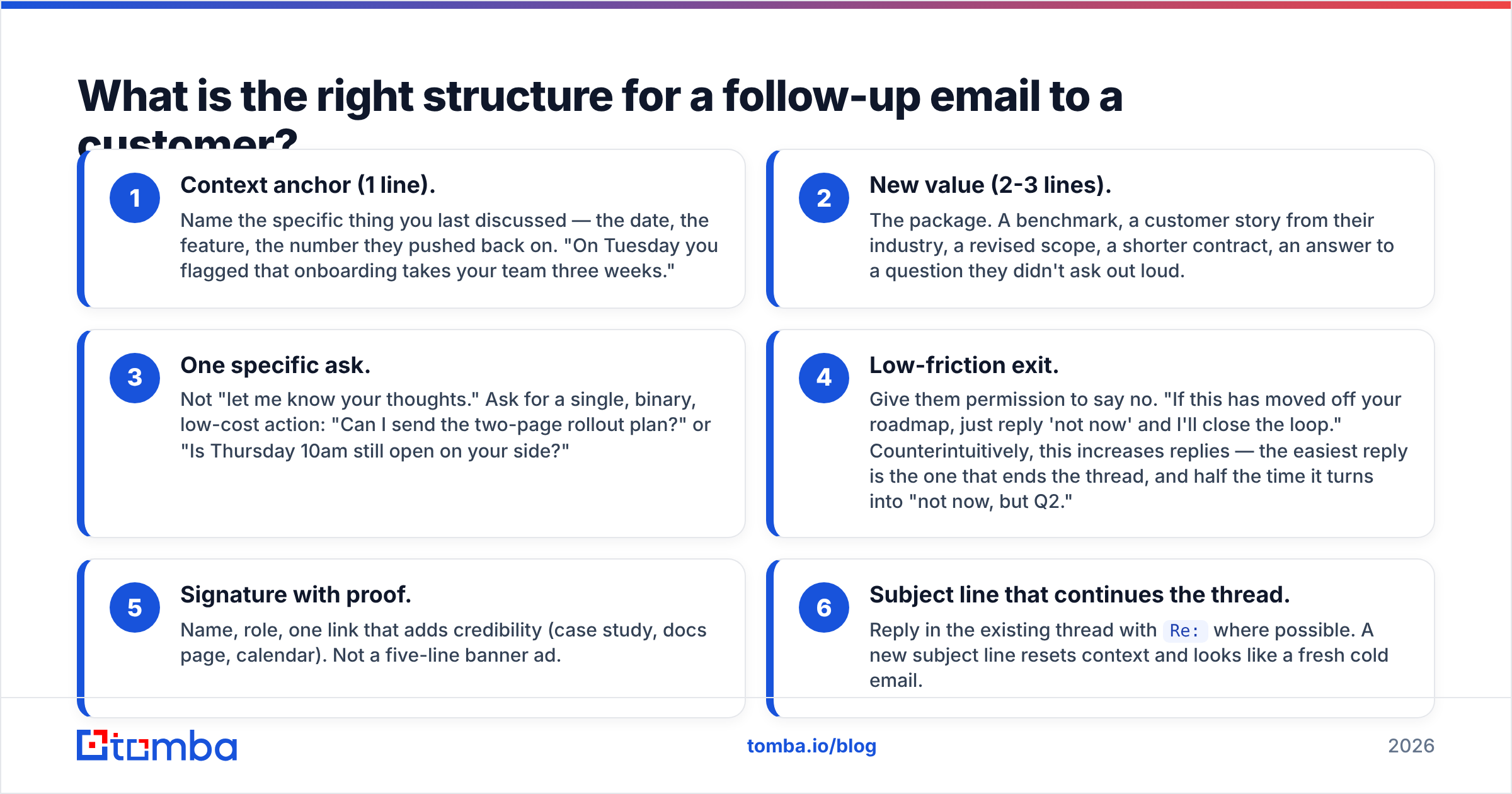
Six parts, in this order. Skip any of them and the email leaks.
- Context anchor (1 line). Name the specific thing you last discussed — the date, the feature, the number they pushed back on. "On Tuesday you flagged that onboarding takes your team three weeks."
- New value (2-3 lines). The package. A benchmark, a customer story from their industry, a revised scope, a shorter contract, an answer to a question they didn't ask out loud.
- One specific ask. Not "let me know your thoughts." Ask for a single, binary, low-cost action: "Can I send the two-page rollout plan?" or "Is Thursday 10am still open on your side?"
- Low-friction exit. Give them permission to say no. "If this has moved off your roadmap, just reply 'not now' and I'll close the loop." Counterintuitively, this increases replies — the easiest reply is the one that ends the thread, and half the time it turns into "not now, but Q2."
- Signature with proof. Name, role, one link that adds credibility (case study, docs page, calendar). Not a five-line banner ad.
- Subject line that continues the thread. Reply in the existing thread with
Re:where possible. A new subject line resets context and looks like a fresh cold email.
Keep the whole thing under 120 words. Follow-ups are read on phones, in gaps between meetings, with one thumb.
How long should you wait before sending a follow-up?#
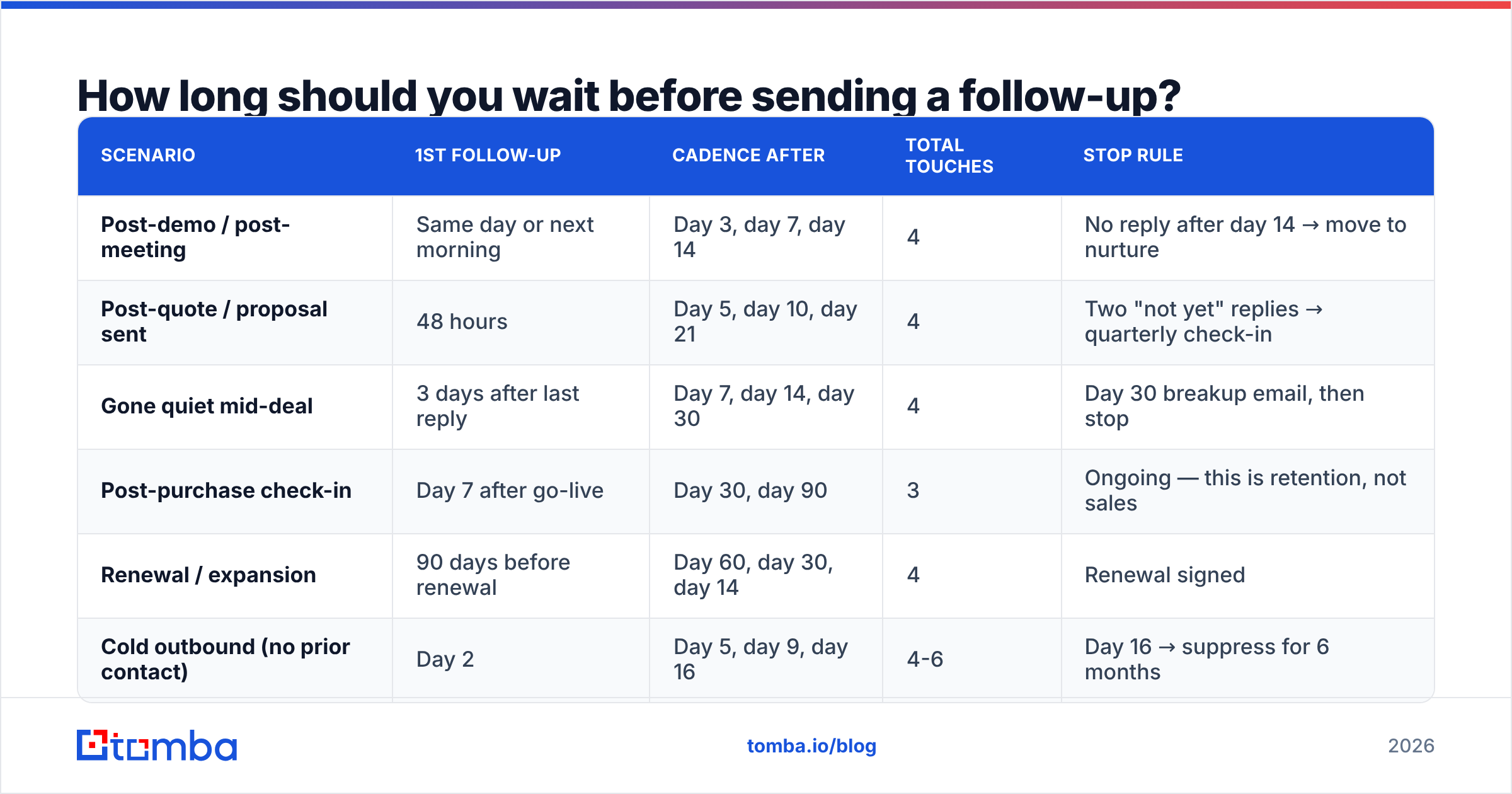
Match the cadence to the temperature of the conversation. A customer who just sat through a 45-minute demo is warm; a lead who downloaded a PDF six weeks ago is not.
| Scenario | 1st follow-up | Cadence after | Total touches | Stop rule |
|---|---|---|---|---|
| Post-demo / post-meeting | Same day or next morning | Day 3, day 7, day 14 | 4 | No reply after day 14 → move to nurture |
| Post-quote / proposal sent | 48 hours | Day 5, day 10, day 21 | 4 | Two "not yet" replies → quarterly check-in |
| Gone quiet mid-deal | 3 days after last reply | Day 7, day 14, day 30 | 4 | Day 30 breakup email, then stop |
| Post-purchase check-in | Day 7 after go-live | Day 30, day 90 | 3 | Ongoing — this is retention, not sales |
| Renewal / expansion | 90 days before renewal | Day 60, day 30, day 14 | 4 | Renewal signed |
| Cold outbound (no prior contact) | Day 2 | Day 5, day 9, day 16 | 4-6 | Day 16 → suppress for 6 months |
Two rules that override the table. First, never send two emails in the same 24 hours — it reads as anxiety. Second, if the customer gives you a date ("call me after the board meeting on the 12th"), that date replaces the cadence entirely. Following your sequence over their stated timeline is the fastest way to lose trust.
What should you say when the customer has gone completely quiet?#
Change the ask, not the volume. Silence usually means one of four things, and each has a different response:
- Priority shift. Their budget moved. Response: shrink the ask. Offer a pilot, a smaller scope, or a fixed date to revisit.
- Internal blocker. Someone above them said no. Response: arm your champion. Send a one-page internal business case they can forward without editing.
- Wrong contact. You're emailing someone who was never the decision maker. Response: find the right person rather than escalating volume with the wrong one.
- Genuinely not interested. Response: send the breakup email and free up your pipeline.
The wrong-contact case is the one most reps misdiagnose. If three well-written follow-ups produce nothing, the problem is often the address, not the copy. Use a domain search to map who else sits in that department, then confirm the address with an email verifier before you send. A message to a valid VP of Ops beats four perfect emails to a departed manager.
The breakup email works because it inverts the pressure. Something like:
Subject: Re: Onboarding rollout
Hi Dana — I've sent a few notes and haven't heard back, which usually means the timing isn't right. I'll stop reaching out for now. If the onboarding project comes back on the roadmap this year, reply to this thread and I'll pick it straight back up.
Roughly one in six of these gets a reply, and a chunk of those replies are "sorry — actually, let's talk."
How do you keep follow-ups out of the spam folder?#
Three layers, in order of impact.
Layer 1 — list hygiene. Every hard bounce damages your sender reputation. If you're following up with contacts pulled from a list, a CRM export from 2023, or a scraped source, verify before the first send. Role addresses (sales@, info@, support@) are the other silent killer — they route to shared inboxes where follow-ups die and complaints get filed.
Layer 2 — authentication. SPF, DKIM, and DMARC on the sending domain. Google and Yahoo both enforce bulk-sender requirements, and their sender guidelines are the closest thing to a rulebook. Run an SPF checker once and fix it permanently.
Layer 3 — behavior. Reply-heavy threads look human to filters. Plain text beats HTML for one-to-one follow-ups. No tracking pixel on every email, no five links, no attachments before a reply exists. If your first follow-up contains a PDF, expect the promotions tab.
Which follow-up templates actually work?#
Five templates, each mapped to a scenario from the cadence table. Replace the bracketed parts — do not send them raw.
1. Post-demo, day 1
Subject: Re: [Company] demo — the reporting piece
Hi [Name], thanks for the time yesterday. You mentioned reporting eats about six hours a week for your team. I pulled the exact view we'd set up for that — screenshot attached is skippable, but the short version is it runs on a schedule and lands in Slack.
Worth a 15-minute working session with [Analyst Name] to confirm it maps to your fields?
If this isn't a priority right now, tell me and I'll follow up in Q1.
2. Post-quote, day 2
Subject: Re: Proposal — [Company]
Hi [Name], the proposal I sent Tuesday assumed 40 seats and annual billing. Two quick alternates in case they help internally: 25 seats at the same per-seat rate, or quarterly billing with a 30-day out.
Which of the three should I formalize?
3. Gone quiet, day 7
Subject: Re: [Project name]
Hi [Name] — guessing something bigger landed on your desk. No problem.
One thing that came up since we spoke: [customer in their industry] hit [specific outcome] within [timeframe] using the same setup we scoped. Two-paragraph write-up here if it's useful for your internal case: [link]
Should I check back in 30 days, or park this?
4. Post-purchase check-in, day 7 after go-live
Subject: Week one — anything rough?
Hi [Name], you're seven days in. Two questions: what's working, and what's annoying?
I'd rather hear the annoying part now than at renewal. Reply with one line and I'll route it.
5. Renewal, 90 days out
Subject: [Company] renewal — [Month]
Hi [Name], your renewal lands [date]. Before it does, here's what your team did this year: [2-3 usage numbers].
Two options on the table for next term: same plan, or the expansion tier that covers [team they added]. Want me to price both?
For more starting points, the cold email templates library covers first-touch variants, and a subject line tester will flag the spam-trigger words before you hit send.
How do you scale follow-ups without sounding like a robot?#
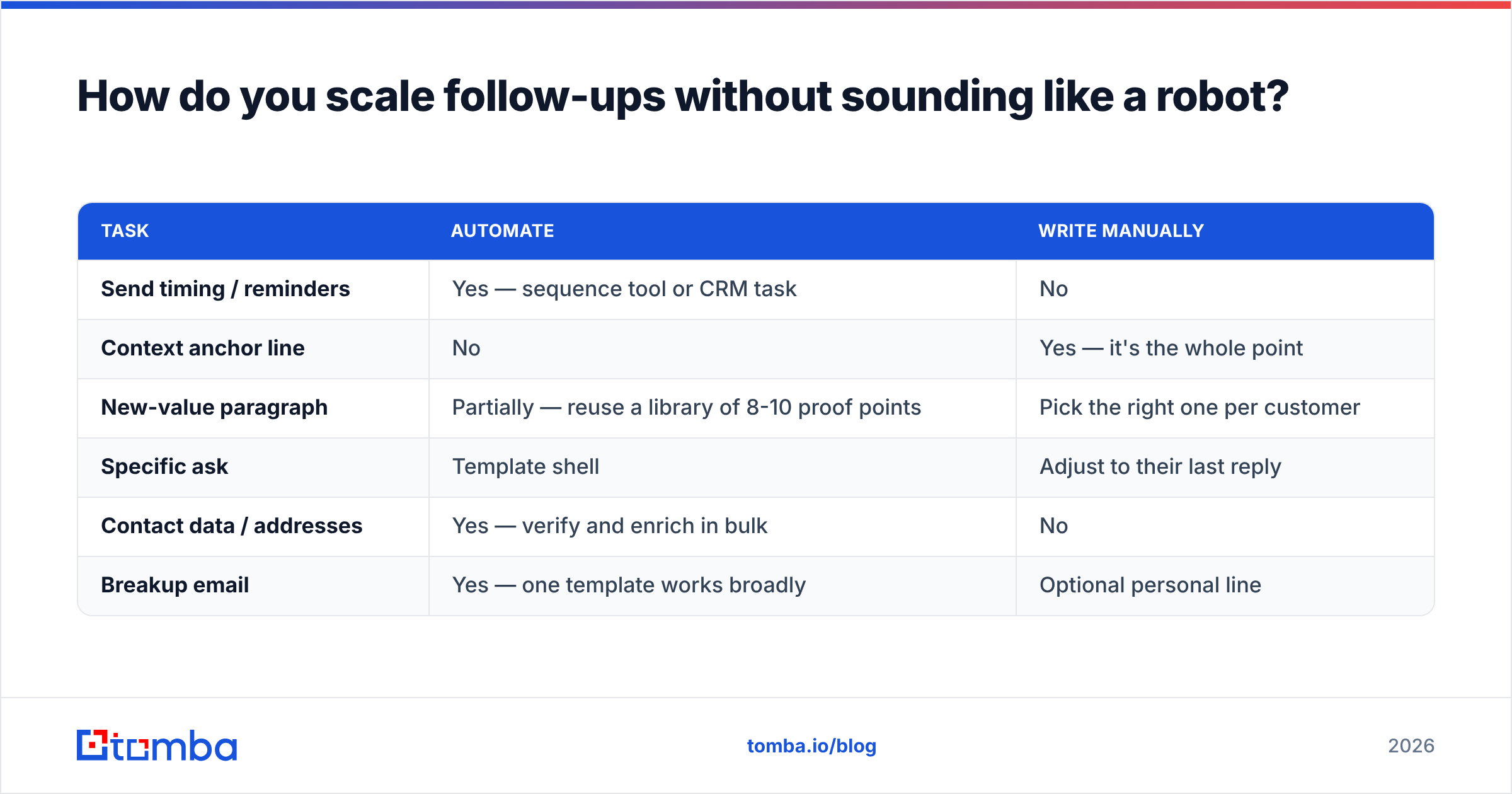
Automate the mechanics, keep the thinking manual. The rule of thumb: automate anything that would be identical across 50 customers, write by hand anything that references a specific conversation.
| Task | Automate | Write manually |
|---|---|---|
| Send timing / reminders | Yes — sequence tool or CRM task | No |
| Context anchor line | No | Yes — it's the whole point |
| New-value paragraph | Partially — reuse a library of 8-10 proof points | Pick the right one per customer |
| Specific ask | Template shell | Adjust to their last reply |
| Contact data / addresses | Yes — verify and enrich in bulk | No |
| Breakup email | Yes — one template works broadly | Optional personal line |
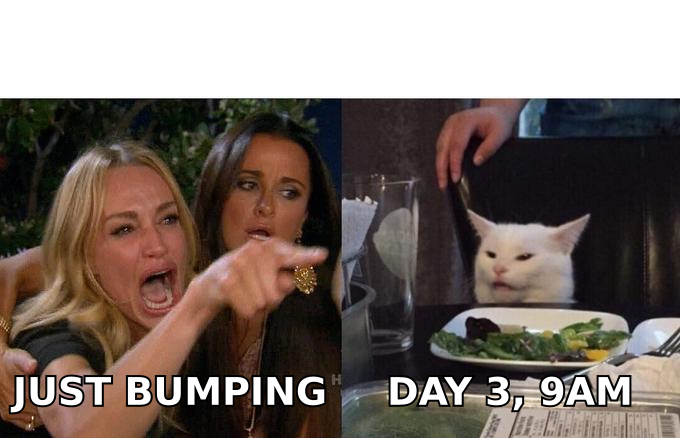
Two practical guardrails. First, cap sequence length at what you'd be comfortable defending in a phone call: four to six touches. Second, break automation the moment a human replies — nothing torches goodwill faster than an automated "just bumping this" arriving 20 minutes after the customer wrote back.
On the data side, keep your CRM clean before the sequence runs. Pulling verified addresses in bulk with a bulk email finder and enriching them with role and company context means your follow-ups reach the right person with the right framing. Peers in the space — G2's sales engagement category is a decent map of who does what — split roughly into sequencing tools, data providers, and hybrids; you generally want one of each rather than a single tool that does both badly.
What metrics tell you your follow-ups are working?#
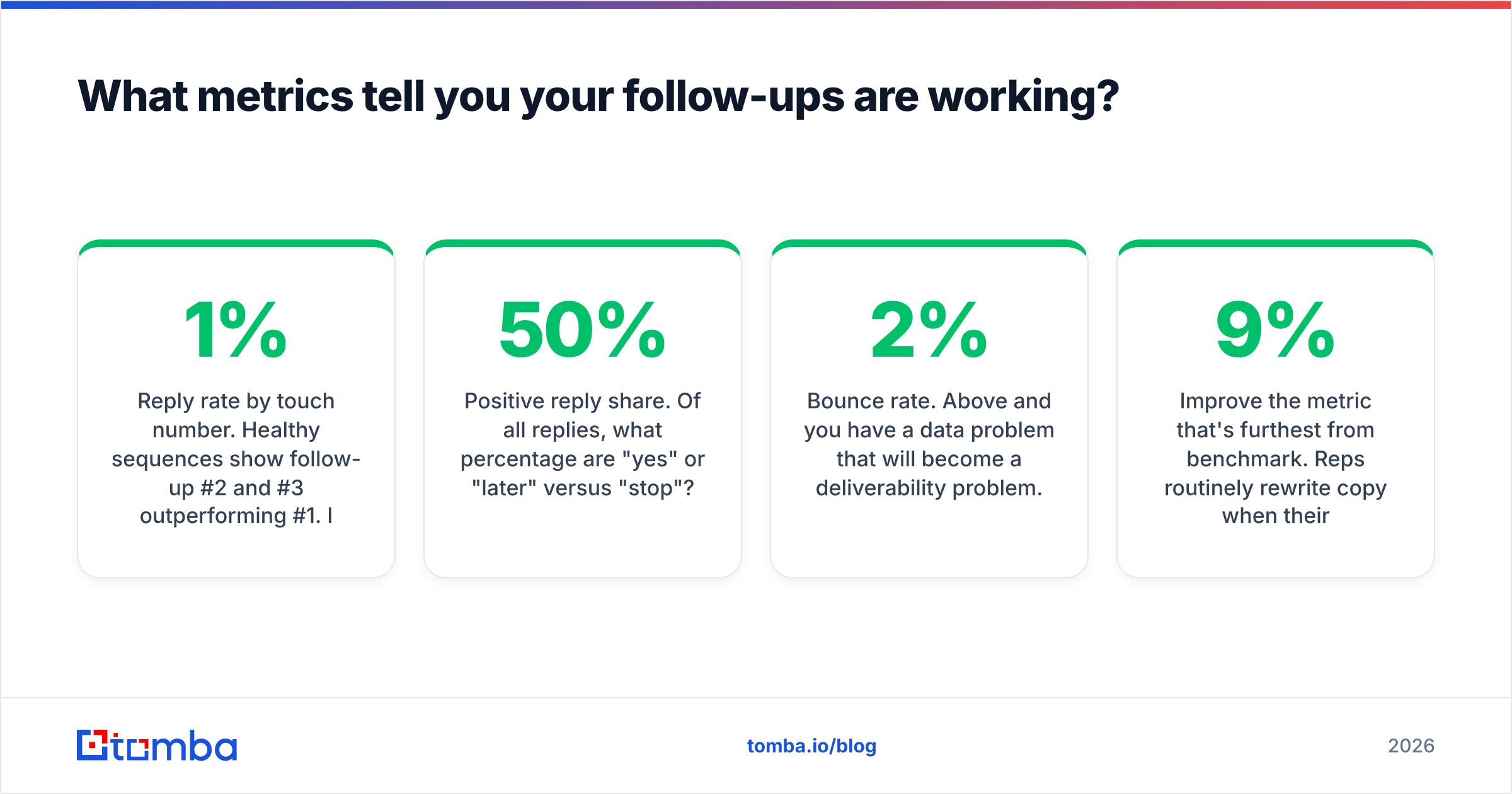
Track four, weekly:
- Reply rate by touch number. Healthy sequences show follow-up #2 and #3 outperforming #1. If touch #1 is your peak and everything after is under 1%, your follow-ups aren't adding value.
- Positive reply share. Of all replies, what percentage are "yes" or "later" versus "stop"? Under 50% positive means your targeting is off, not your copy.
- Bounce rate. Above 2% and you have a data problem that will become a deliverability problem. Verify before you blame the copy.
- Time-to-first-reply. If it's consistently 5+ days, your first touch isn't landing in the primary inbox.
Improve the metric that's furthest from benchmark. Reps routinely rewrite copy when their real problem is a 9% bounce rate — new words, same dead addresses, same result. Check the response rate definition you're using is consistent across the team before comparing anyone's numbers.
Ready to send follow-ups that actually reach the inbox?#
Great follow-up copy dies on a bad address. Before your next sequence goes out, run your contact list through the Tomba Email Finder to find and confirm the right professional address for each decision maker — by name, company, or domain. The free tier covers 25 searches a month so you can test it on a live list, and paid plans start at $49/mo with Growth at $99/mo; full Tomba pricing is on the site. Get the address right, then let the six-part structure and the five templates above do the rest.
Related guides#
Ready to find emails that actually work?
Join 150,000+ professionals who stopped guessing and started sending. Free credits on signup — no credit card required.
Get the Tomba newsletter
Practical outbound tactics and product updates — once every two weeks.
About the author