HubSpot vs Outreach: Which Sales Engagement Tool Wins in 2026
HubSpot Sales Hub and Outreach solve overlapping problems with very different philosophies. Here's an honest breakdown of pricing, sequencing power, data quality, and which one actually fits your team.
HubSpot vs Outreach comes down to one question. Do you want a CRM that also sends sequences, or a sequencing engine that sits on top of the CRM you already own? Here is how the two compare on price, sequence depth, AI, and data quality.
TL;DR
- HubSpot Sales Hub wins when you want CRM, marketing, and sequences in one system and your team is under ~50 reps. Sequences are good enough. The CRM underneath is excellent.
- Outreach wins when sequencing is the job. Think high-volume SDR teams, multi-channel plays, call coaching, and forecasting on top of an existing Salesforce instance.
- The real cost gap is wider than list price suggests. HubSpot charges per paid seat plus tiered platform fees. Outreach quotes by the year, with a floor that prices out small teams.
- Neither tool finds or verifies contact data. Both assume you arrive with clean emails — which is where most sequences die.
- Pick HubSpot if you are cutting tools. Pick Outreach if you have a CRM you plan to keep and need a strong execution layer on top.
What Are HubSpot Sales Hub and Outreach, Exactly?#
People compare HubSpot vs Outreach all the time. The two were built to solve different problems.
HubSpot Sales Hub is the sales module of a suite. The center of gravity is the CRM — contacts, companies, deals, tickets — with sequences, meeting links, quotes, and forecasting layered on top. If you already run HubSpot Marketing Hub, Sales Hub is the natural next step. Same contact records, same lists, same reports.
Outreach is a sales execution platform. It does not want to be your CRM. It wants to sit on top of Salesforce (or HubSpot) and shape what reps do all day: sequences, dialing, call recording, deal inspection, and AI-assisted forecasting. It was built for teams where 40 SDRs each touch 200 prospects a week. A manager there needs to know why Sequence C beats Sequence D.
The practical test: do you need a system of record, or a system of action? HubSpot is the first, with action bolted on. Outreach is the second, with no record of its own.

HubSpot vs Outreach: How Do They Compare Head-to-Head?#
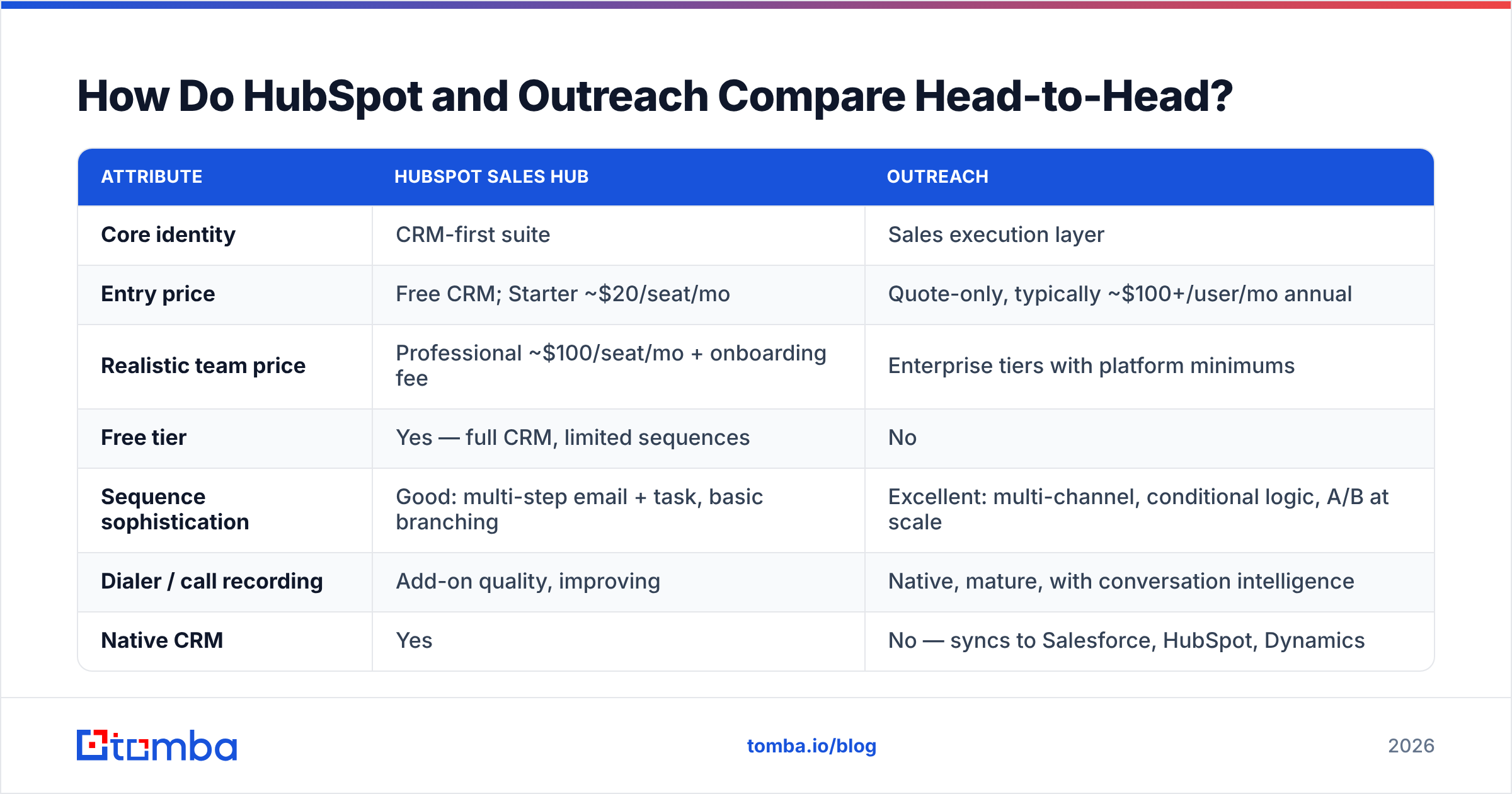
| Attribute | HubSpot Sales Hub | Outreach |
|---|---|---|
| Core identity | CRM-first suite | Sales execution layer |
| Entry price | Free CRM; Starter ~$20/seat/mo | Quote-only, typically ~$100+/user/mo annual |
| Realistic team price | Professional ~$100/seat/mo + onboarding fee | Enterprise tiers with platform minimums |
| Free tier | Yes — full CRM, limited sequences | No |
| Sequence sophistication | Good: multi-step email + task, basic branching | Excellent: multi-channel, conditional logic, A/B at scale |
| Dialer / call recording | Add-on quality, improving | Native, mature, with conversation intelligence |
| Native CRM | Yes | No — syncs to Salesforce, HubSpot, Dynamics |
| AI features | Breeze AI: drafting, summarizing, forecasting | Kaia/Smart Account Plan: call coaching, deal risk scoring |
| Admin overhead | Low — usable by a RevOps team of one | High — usually needs a dedicated admin |
| Best team size | 3–50 reps | 25–500+ reps |
| Contract flexibility | Monthly available on lower tiers | Annual, negotiated |
| Contact data included | Limited (Breeze Intelligence credits) | None — bring your own |
Two notes on that table. First, HubSpot's pricing is public and self-serve. Outreach's is quote-only, so your real number depends on how well your team negotiates. Second, HubSpot charges onboarding fees on the Professional and Enterprise tiers. They are one-time, but they are large, and they catch out people who budget from the per-seat number alone. Check HubSpot's own pricing page before you model anything.
Which One Has Better Sequences?#
Outreach, clearly. At high volume the HubSpot vs Outreach gap is not close.
HubSpot sequences cover the basics well: emails with delays, task reminders for calls and LinkedIn touches, auto-enrollment from workflows, and unenroll-on-reply. For eight AEs running a 5-touch cadence, that is all you need. It also helps that the sequence lives on the same record as the deal.
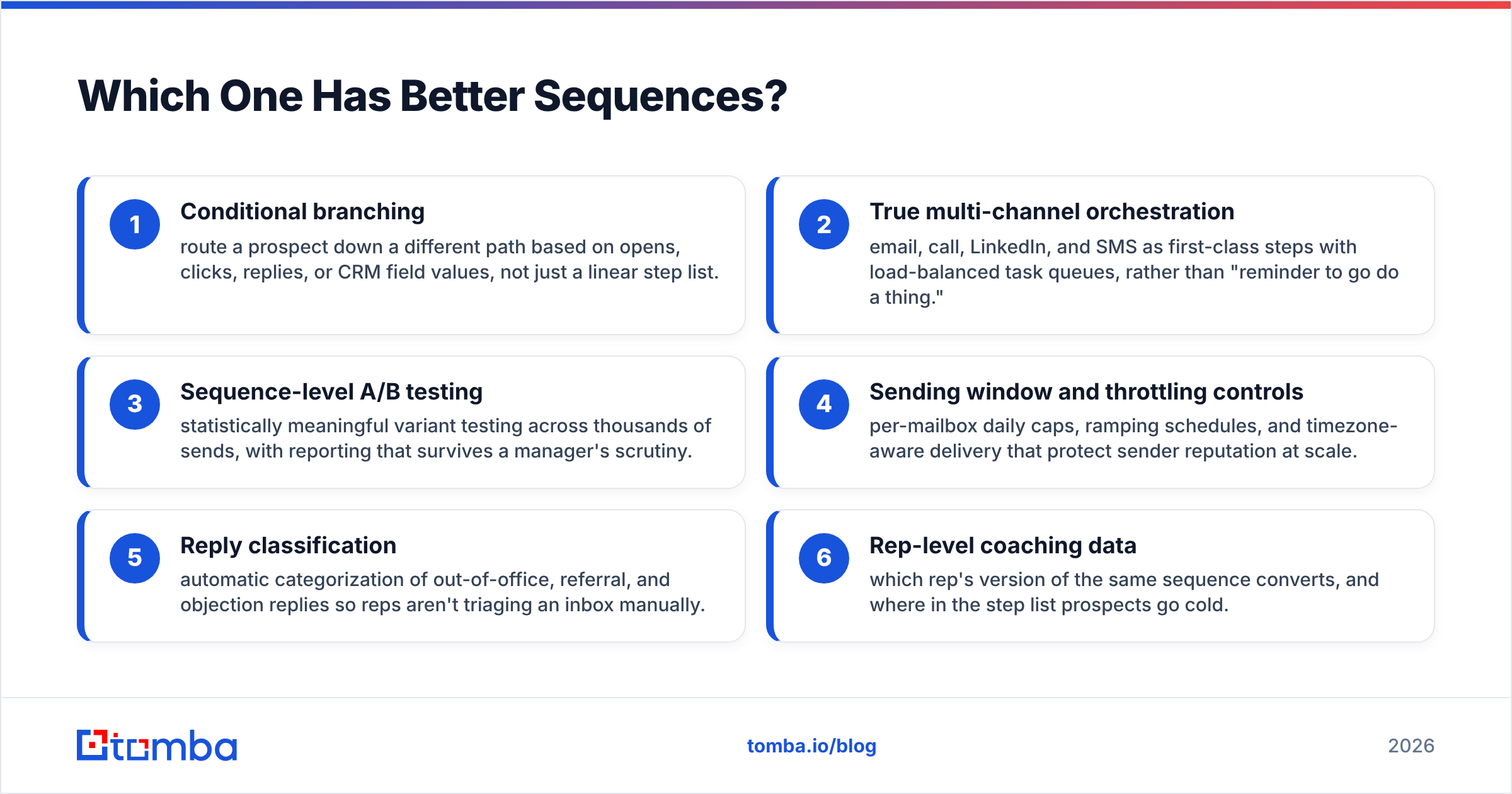
Outreach adds the things that start to matter once volume climbs:
- Conditional branching — send a prospect down a different path based on opens, clicks, replies, or CRM fields. Not just a linear step list.
- True multi-channel plays — email, call, LinkedIn, and SMS as real steps with balanced task queues, not "a reminder to go do a thing."
- Sequence-level A/B testing — variant tests across thousands of sends, with reporting a manager can trust.
- Send windows and throttling — daily caps per mailbox, ramp schedules, and timezone-aware delivery that protect sender reputation at scale.
- Reply sorting — out-of-office, referral, and objection replies get tagged for you, so reps stop triaging an inbox by hand.
- Rep-level coaching data — which rep's version of a sequence converts, and where in the step list prospects go cold.
If none of those six feel urgent, you do not need Outreach yet. That is not a slight. Most teams under 20 reps really don't.
Is HubSpot Good Enough to Skip Outreach?#
For most companies under $10M ARR: yes. The HubSpot vs Outreach call only gets hard above that line.
The honest case for HubSpot is consolidation math. Put your CRM, marketing automation, sequences, meeting scheduler, and reporting in one system, and the sync layer goes away. Sync is where revenue operations teams lose most of their time. Every Outreach-plus-Salesforce setup I have seen has someone whose part-time job is working out why an activity logged in one system never showed up in the other.
HubSpot also wins on time to value. A new rep can work in Sales Hub on day one. Outreach rollouts often take six to twelve weeks and need a solutions architect. That is not a defect. It is the price of all that flexibility, and you should budget for it.
Where HubSpot falls short:
- Deal inspection. Outreach's forecasting and deal-risk scores are built for a VP running a pipeline review. HubSpot's forecasting works, but it is shallower.
- Call-heavy motions. If your reps make 60 dials a day, Outreach's native dialer and call analysis are a different class from HubSpot's calling add-on.
- Sequence governance. Locking down which sequences reps can edit, approval steps, and content rules are Outreach strengths.
Cross-check both on G2's sales engagement category. The review split lines up almost exactly with team size.
What Do Both Tools Assume You Already Have?#
Clean contact data. Neither one supplies it at any real volume.
This is the part of the HubSpot vs Outreach comparison that decides whether either platform makes you money. Outreach will happily send a perfect 9-touch sequence to an address that bounced two years ago. HubSpot will enroll a contact whose email you guessed from a naming pattern, then log it as activity. The tooling sits downstream of the data.
Three failure modes to plan around:
- Bounce damage. A hard-bounce rate above 3% starts to hurt email deliverability across your whole domain — including the sequences that would have worked. Run every list through an email verifier before you enroll it, not after the complaints start.
- Catch-all domains. About a fifth of B2B domains accept every address at the SMTP layer, so a normal verifier returns "unknown." A catch-all verifier clears a good share of those instead of leaving you to guess.
- Stale data. Job-change rates in B2B run 20–30% a year. Contacts you enriched last year are decaying, whether or not your CRM shows it. Regular re-enrichment beats a one-time import.
The order that works: source and verify contacts first, then push them into the engagement platform you chose. Tools like the Tomba Email Finder or the email finder API cover the sourcing layer for a fraction of one extra Outreach seat. Both HubSpot and Outreach take clean CSV or API-fed contacts without complaint.
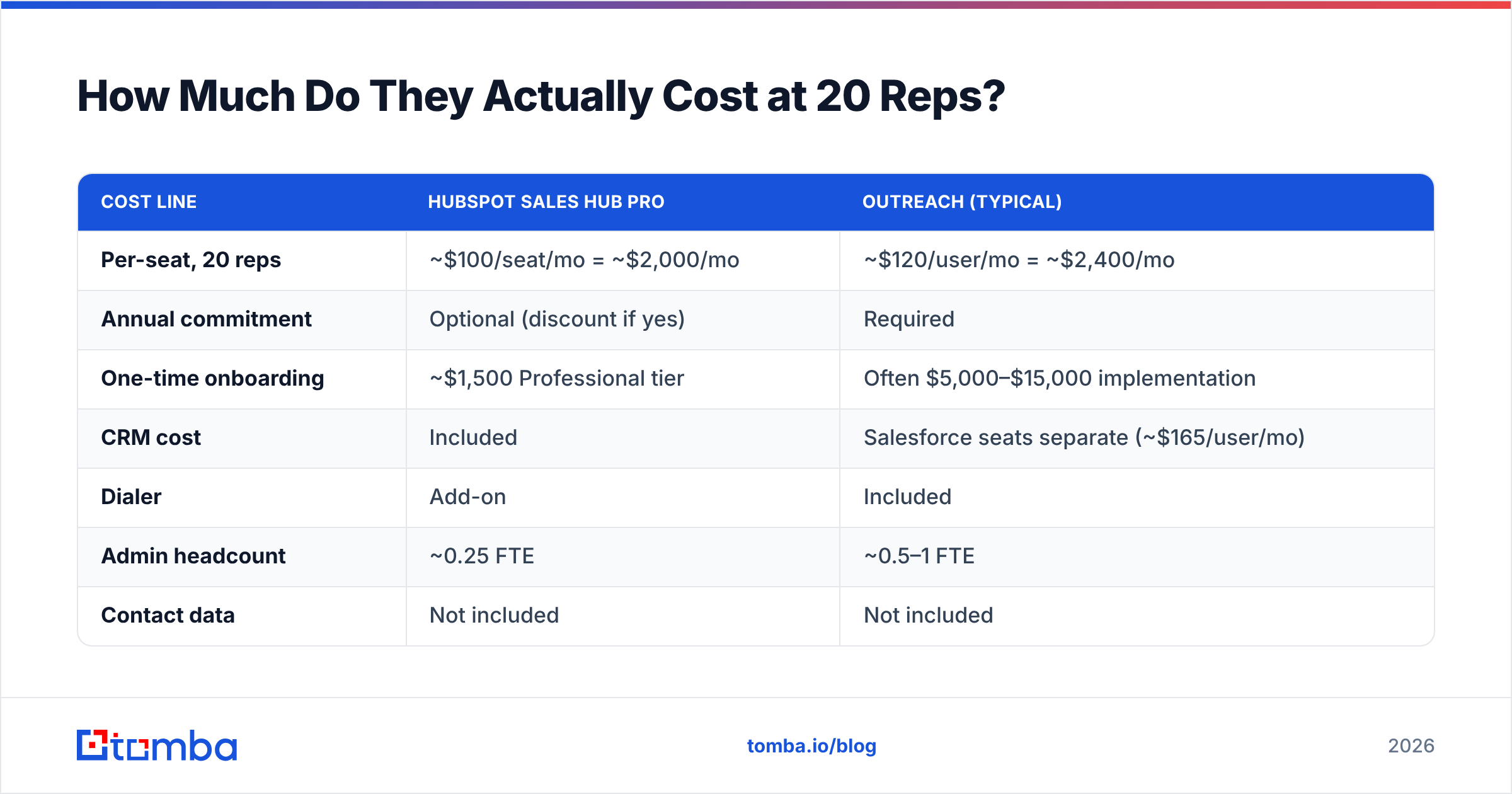
How Much Do They Actually Cost at 20 Reps?#
Model it honestly, because list price and invoice rarely match. Here is HubSpot vs Outreach at 20 reps.
| Cost line | HubSpot Sales Hub Pro | Outreach (typical) |
|---|---|---|
| Per-seat, 20 reps | ~$100/seat/mo = ~$2,000/mo | ~$120/user/mo = ~$2,400/mo |
| Annual commitment | Optional (discount if yes) | Required |
| One-time onboarding | ~$1,500 Professional tier | Often $5,000–$15,000 implementation |
| CRM cost | Included | Salesforce seats separate (~$165/user/mo) |
| Dialer | Add-on | Included |
| Admin headcount | ~0.25 FTE | ~0.5–1 FTE |
| Contact data | Not included | Not included |
| Realistic year-one | ~$26K | ~$70K+ with Salesforce |
That Salesforce line is the one people forget. Outreach's price is fair on its own. Outreach plus the CRM it needs is a different conversation. If you already pay for Salesforce, ignore that row and the gap narrows fast. If you do not, HubSpot's total cost is roughly a third.
Compare that against a data layer. Tomba pricing starts free at 25 searches a month, with Starter at $49/mo and Growth at $99/mo. Finding and verifying contacts is the cheap part of this stack. Reps arguing with a sequence builder is the expensive part.
Which Should You Choose?#
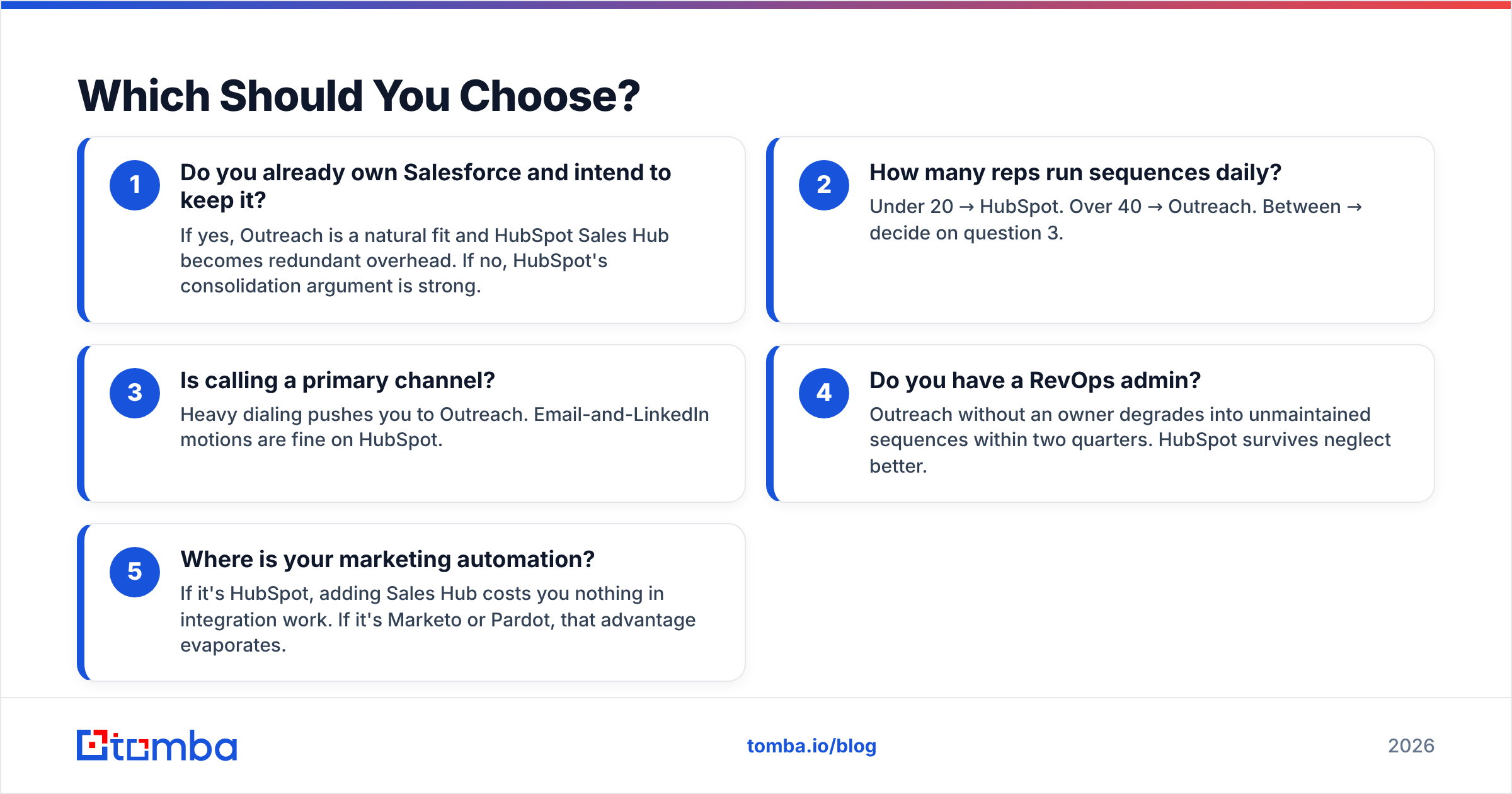
Answer these five questions, in order, and the HubSpot vs Outreach choice makes itself:
- Do you own Salesforce and plan to keep it? If yes, Outreach fits well and HubSpot Sales Hub becomes extra overhead. If no, HubSpot's consolidation case is strong.
- How many reps run sequences daily? Under 20 → HubSpot. Over 40 → Outreach. In between, go to question 3.
- Is calling a primary channel? Heavy dialing points to Outreach. Email-and-LinkedIn motions are fine on HubSpot.
- Do you have a RevOps admin? Outreach without an owner rots into stale sequences within two quarters. HubSpot survives neglect better.
- Where is your marketing automation? If it is HubSpot, adding Sales Hub costs you no integration work. If it is Marketo or Pardot, that edge is gone.
One pattern is worth naming. Plenty of teams buy Outreach to fix what was really a data problem. Reply rates were low, so they bought a better sequencer. The real cause was 22% invalid emails and loose targeting. A better execution layer scales whatever you feed it, in both directions.
What About Alternatives to Both?#
Neither tool is the only shape of answer. If the HubSpot vs Outreach shortlist feels wrong — one too light, the other too heavy — weigh these:
- Salesloft — Outreach's closest rival, usually rated a bit easier to run, at a similar price. Worth a parallel look; see the Salesloft alternative breakdown.
- Instantly / Smartlead — built for high-volume cold email, with inbox rotation and warmup baked in. Far cheaper and far narrower. Fine if outbound email is your whole motion.
- Apollo — bundles a contact database with sequencing, which looks great on paper. Data quality is the trade-off most teams report; the Apollo alternative comparison covers where it holds up.
- Reply.io — mid-market multichannel with better pricing than Outreach and more depth than HubSpot sequences.
- BookYourData — a strong pick if your bottleneck is the list itself, not the sending tool. Pay-as-you-go B2B contact data with verification included.
The honest read: this market has compressed. In 2026, the gap between HubSpot vs Outreach sequences matters far less than the gap in data quality feeding them. That is why sharp RevOps teams now spend more on their data layer and less on their sending layer than they did three years ago.
Frequently Asked Questions#
Can you use HubSpot and Outreach together? Yes. Outreach syncs both ways with HubSpot CRM, so HubSpot stays the record and Outreach becomes the execution layer. It is less common than the Salesforce pairing, but it is supported. It is also the right setup if you love the HubSpot CRM but have outgrown its sequences.
Does Outreach have a free trial? No public free tier, and no self-serve trial. Evaluation runs through a sales-led demo and, usually, a pilot with part of your team. Budget four to six weeks for a real test.
Is HubSpot's free CRM actually usable for outbound? For prospecting and pipeline tracking, yes. Sequences sit behind paid tiers and are capped on Starter, so a free-tier team hits a ceiling fast once volume rises.
Which has better deliverability? Neither platform changes deliverability much on its own. Your domain setup, list hygiene, and sending volume do. Outreach gives you finer throttling controls, which helps at scale. Both will burn a domain if you feed them unverified lists.
Start With the Data Layer#
Whichever platform you pick, the sequences only pay off if the addresses behind them are real. Fix the input before you sign an annual contract. Run your target accounts through the Tomba Email Finder to source verified professional emails by name and domain. Verify them in bulk, then import a list you can trust. The free tier covers 25 searches a month, so you can test accuracy on your own accounts first. Starter costs $49/mo — less than half a seat on either tool in this HubSpot vs Outreach matchup.
Related guides#
Ready to find emails that actually work?
Join 150,000+ professionals who stopped guessing and started sending. Free credits on signup — no credit card required.
Get the Tomba newsletter
Practical outbound tactics and product updates — once every two weeks.
About the author