12 Best Hunter Alternatives in 2026 (Free and Paid Tools)
Hunter is the default email finder, but it is not the cheapest or the most accurate option for every workflow. Here are 12 Hunter alternatives compared on price, credit rules, verification quality, and the jobs they actually fit.
TL;DR
- Hunter is a solid default, but most teams leave for one of three reasons: credit math that punishes failed searches, thin coverage outside North America and Western Europe, or the jump in price between the entry and growth tiers.
- The strongest general-purpose Hunter alternatives in 2026 are Tomba, Findymail, Prospeo, Snov.io, and Apollo — each wins on a different axis (API depth, deliverability guarantees, sequencing, database size).
- If your bottleneck is data quality rather than volume, look at tools that verify before charging you: Dropcontact, Findymail, and Tomba all lean this way.
- If you want contacts without a subscription, BookYourData's pay-as-you-go credits are the cleanest fit.
- Before you switch anything, run the same 100-row test list through two or three tools. Vendor-published accuracy numbers are marketing; your list is the benchmark that matters.
Why do people look for Hunter alternatives?#
Hunter (the original at hunter.io) more or less invented the mainstream domain-to-email workflow, and it still does that job well. The complaints that push people to shop around are consistent, and none of them are "the product is bad."
Credit consumption. On most plans, a search that returns nothing still counts against your quota on some tools and not on others. If you prospect into long-tail SMB domains, the difference between "charged for every lookup" and "charged only for a returned, verified address" can be 30-40% of your effective budget.
Coverage outside the core geographies. Hunter's index is strongest where its crawl is densest: US, UK, DACH, France. If you sell into LATAM, MENA, Southeast Asia, or Eastern Europe, hit rates drop and you end up stacking a second provider anyway.
The tier gap. The free plan is genuinely useful for a solo founder — until it isn't. The step from free to the entry paid plan, and then from entry to growth, is where teams start pricing out what a competitor charges for the same monthly volume.
Catch-all domains. Roughly a fifth of B2B domains are configured to accept everything. A finder that returns "unknown" on all of them is handing you a coin flip. Tools that run deeper catch-all verification meaningfully change how much of your list is actually mailable.
Missing adjacent data. Email is one field. If you also need direct dials, LinkedIn URLs, or firmographics, a single-purpose finder means another vendor, another API key, another invoice.
What should you actually compare in an email finder?#
Ignore the marketing accuracy percentages for a moment. These six attributes decide what a tool costs you in practice:
- Verified-only billing — Does a failed lookup burn a credit? This single policy can swing your real cost per contact by 2x.
- Verification depth — SMTP handshake only, or SMTP plus catch-all inference, role-account detection, and disposable-domain filtering? A finder that hands off to a separate email verifier is fine; a finder with no verification at all is a bounce generator.
- Coverage by region and company size — Test your actual ICP. Enterprise coverage is easy; a 15-person agency in Poland is the real exam.
- API and automation surface — Rate limits, bulk endpoints, native Sheets/Excel/CRM connectors, webhook support. If a human has to babysit a CSV, the tool is more expensive than its price tag.
- Credit rollover and overage terms — Monthly reset with no rollover is common and quietly punitive for seasonal prospecting.
- Compliance posture — GDPR/CCPA handling, opt-out processing, and whether the vendor documents where its data comes from. This is a procurement blocker at enterprise deals, not an afterthought.
How accurate are Hunter alternatives in 2026?#
Accuracy claims in this category are close to unfalsifiable because every vendor tests on a list that flatters its own index. What you can compare is methodology: which tools verify before returning a result, which return a confidence score you can threshold on, and which quietly return a pattern-guessed address with no validation behind it.

The practical test takes twenty minutes. Take 100 contacts you already have confirmed addresses for — past customers, inbound leads, anyone who has replied to you. Strip the emails. Run the names and domains through each tool. Then score three things: hit rate (returned an address), precision (returned the right address), and bounce rate on the addresses you didn't already know. A tool with a 60% hit rate and 98% precision beats a tool with an 85% hit rate and 80% precision, because the second one costs you sender reputation. If your bounce rate creeps above 3%, mailbox providers start throttling you regardless of how good your copy is — the mechanics of that are worth understanding at the SMTP level.
Which are the 12 best Hunter alternatives?#

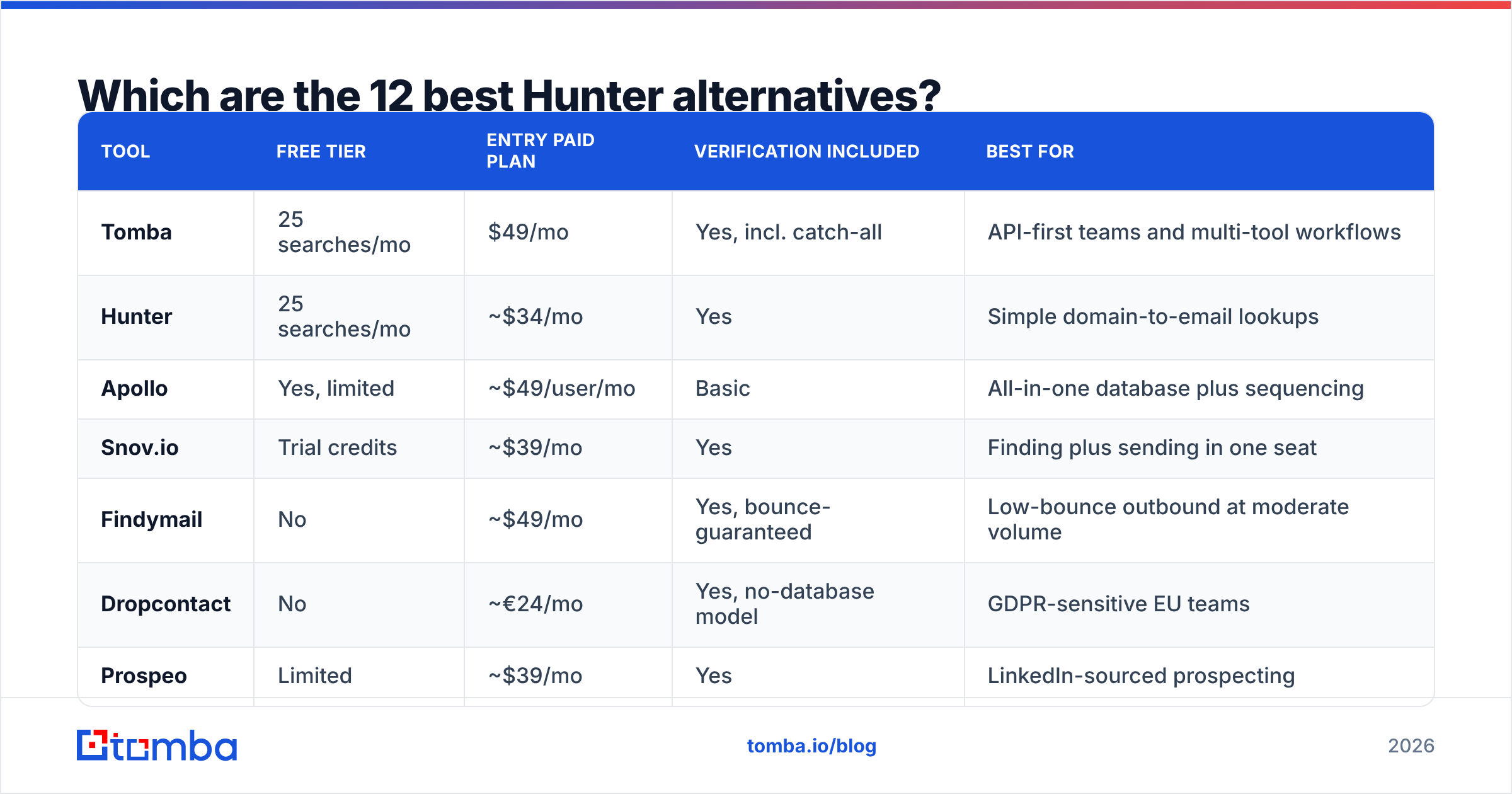
| Tool | Free tier | Entry paid plan | Verification included | Best for |
|---|---|---|---|---|
| Tomba | 25 searches/mo | $49/mo | Yes, incl. catch-all | API-first teams and multi-tool workflows |
| Hunter | 25 searches/mo | ~$34/mo | Yes | Simple domain-to-email lookups |
| Apollo | Yes, limited | ~$49/user/mo | Basic | All-in-one database plus sequencing |
| Snov.io | Trial credits | ~$39/mo | Yes | Finding plus sending in one seat |
| Findymail | No | ~$49/mo | Yes, bounce-guaranteed | Low-bounce outbound at moderate volume |
| Dropcontact | No | ~€24/mo | Yes, no-database model | GDPR-sensitive EU teams |
| Prospeo | Limited | ~$39/mo | Yes | LinkedIn-sourced prospecting |
| RocketReach | Limited lookups | ~$39/mo | Basic | Personal emails and direct dials |
| ContactOut | Limited | Paid, quote-based | Yes | Recruiters working in LinkedIn |
| Anymail Finder | Trial | ~$49/mo | Verified-only billing | Teams who hate paying for misses |
| Skrapp | 100 free/mo | ~$49/mo | Yes | LinkedIn Sales Navigator exports |
| BookYourData | Sample credits | Pay-as-you-go | Yes, 97% accuracy pledge | Buying lists without a subscription |
| Wiza | 20 free credits | ~$83/mo | Yes | Bulk LinkedIn list exports |
Prices are list prices at the time of writing and change often — check each vendor's own pricing page before you budget.
Tomba#
The closest structural competitor to Hunter: domain search, email finder, verifier, catch-all handling, phone finder, and enrichment under one account. The differentiators are API depth and breadth of surface — a REST API, CLI, MCP server, Chrome extension, Sheets and Excel add-ins, and native connectors for HubSpot, Salesforce, Pipedrive, and Zapier. Free tier is 25 searches/mo; paid starts at $49/mo (Starter), $99/mo (Growth), $249/mo (Pro), with Enterprise custom. Full Tomba pricing is public, which is more than you can say for a chunk of this category.
Pick it if: you want one vendor for finding, verifying, and enriching, and you plan to hit it programmatically.
Apollo#
Apollo is a different animal — a 200M+ contact database with sequencing, dialer, and basic CRM bolted on. If you're replacing Hunter and your outreach tool, the math often works. The trade-off is data freshness on the long tail and per-seat pricing that scales awkwardly for small teams. See the fuller Apollo alternative breakdown if that's the direction you're leaning.
Snov.io#
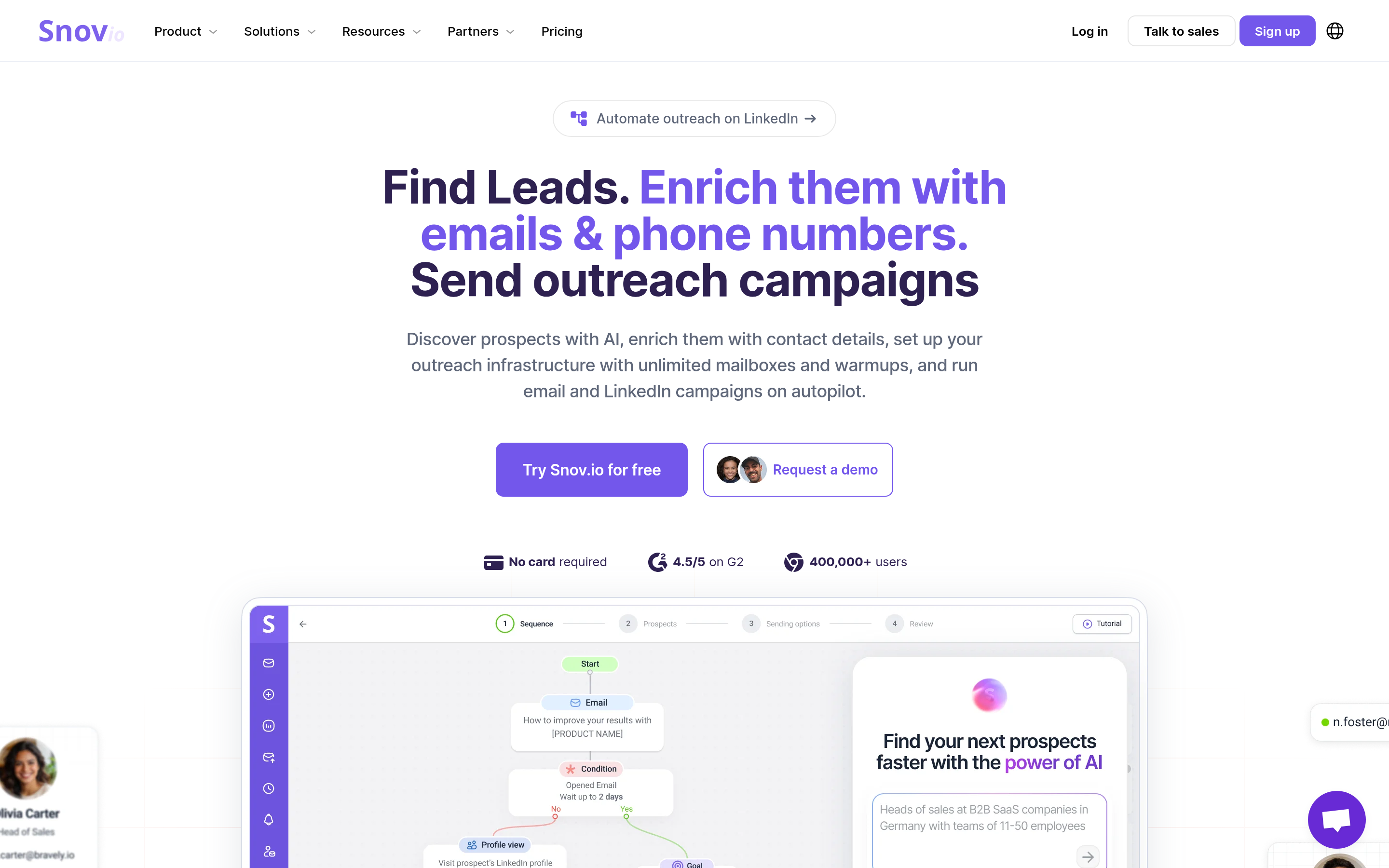
Finder, verifier, warm-up, and a sending engine in one seat, at a price point below most standalone sequencers. Coverage is mid-pack; the value is consolidation. Good for a two-person outbound team that doesn't want three subscriptions.
Findymail#
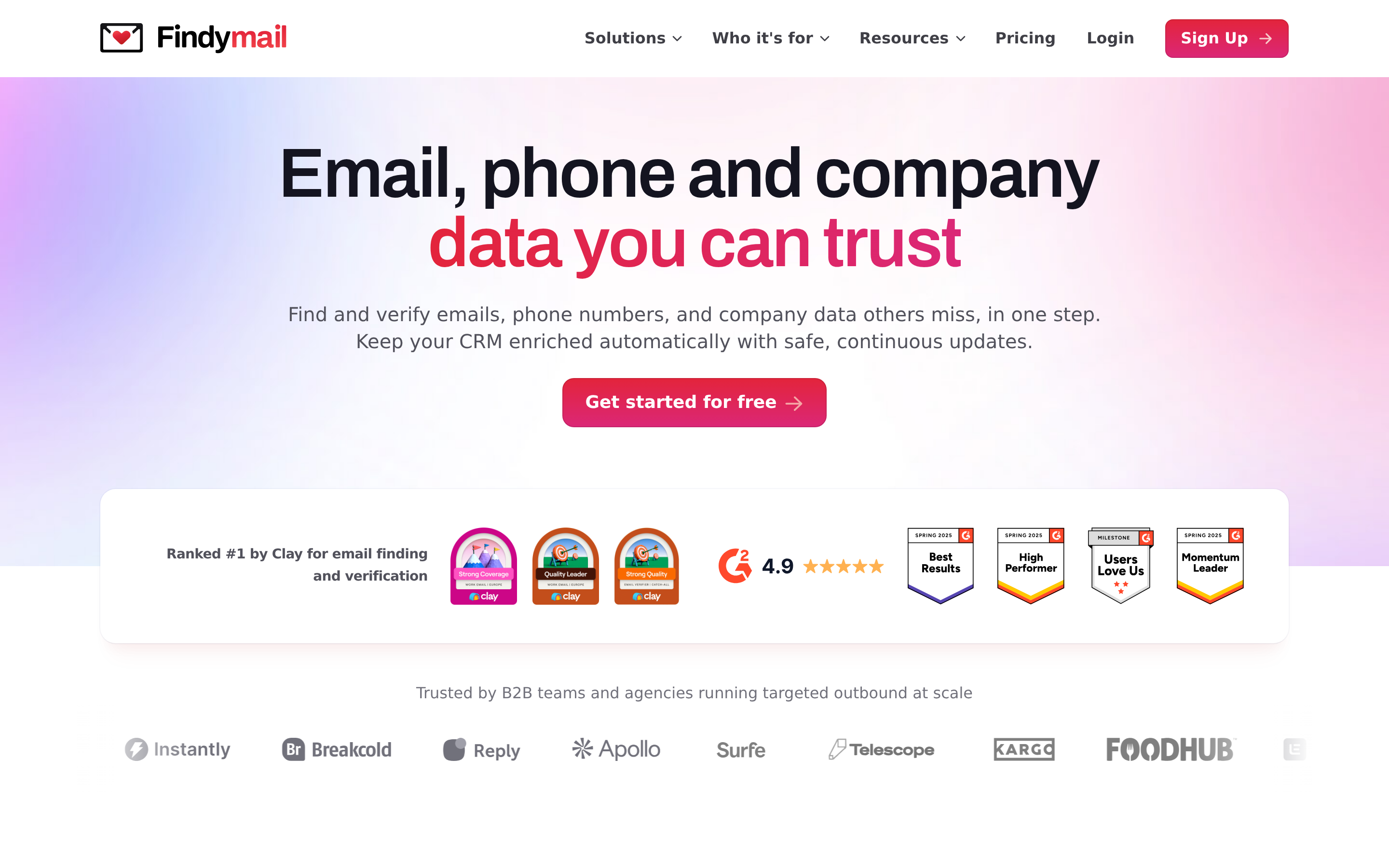
Built around a specific promise: you don't pay for emails that bounce. Bounce credits are refunded, which changes the economics if you send high volume into messy lists. Narrower feature set than Hunter — it's a finder, not a platform.
Dropcontact#
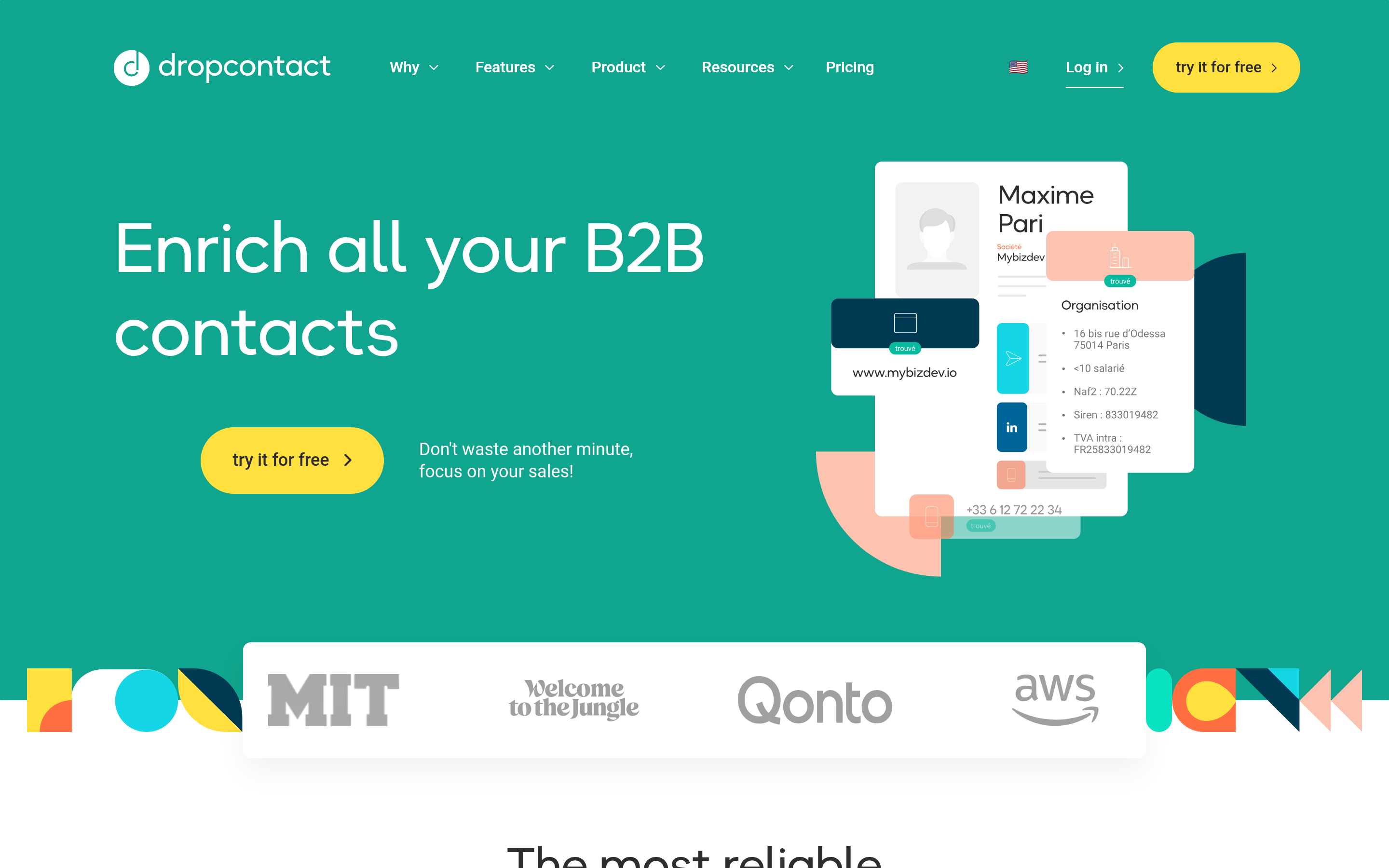
The unusual one. Dropcontact doesn't hold a contact database; it derives and verifies addresses algorithmically, which is why it's popular with EU teams who want a cleaner GDPR story. Excellent on French and broader European data, weaker on US mid-market.
Prospeo#
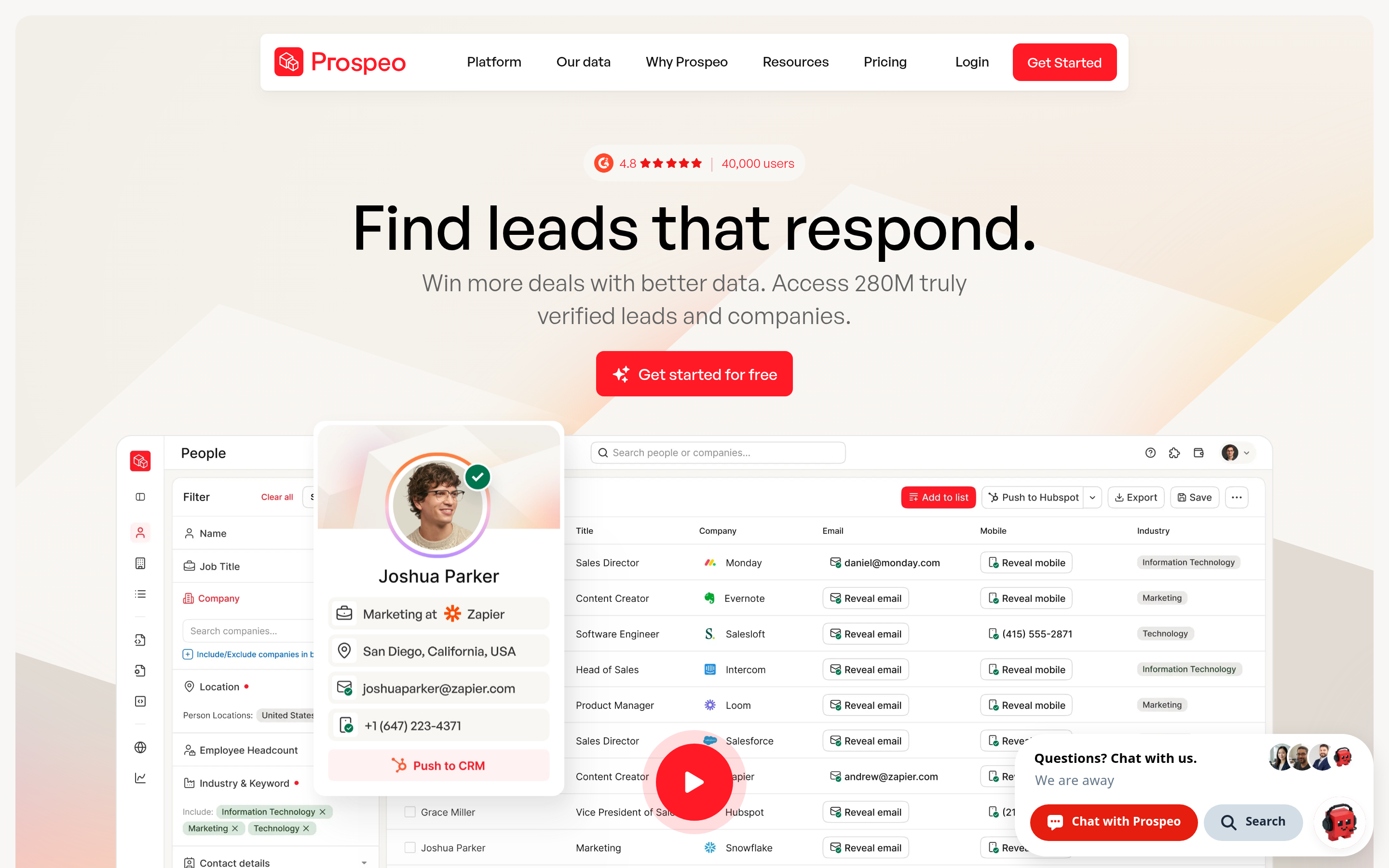
A LinkedIn-first finder with solid extraction from Sales Navigator and a reasonable entry price. If your prospecting starts in LinkedIn rather than a domain list, it fits the workflow better than Hunter does.
RocketReach#
Strongest when you need personal emails and mobile numbers rather than corporate patterns. Credit costs add up quickly at volume; treat it as a specialist, not a base layer. There's a RocketReach alternative comparison if you want the detail.
ContactOut#
Built for recruiters. Deep personal-email coverage, tight LinkedIn integration, opaque pricing. If you're sourcing candidates rather than buyers, it's often the better tool.
Anymail Finder#
Verified-only billing is the headline: if it can't verify, it doesn't charge. Simple, honest, and a good pairing with a broader database when you want a second-opinion lookup.
Skrapp#
Chrome-extension-led, tuned for pulling lists out of LinkedIn and company pages. Generous-ish free tier at 100 finds a month. Fewer bells than Hunter on the API side.
BookYourData#
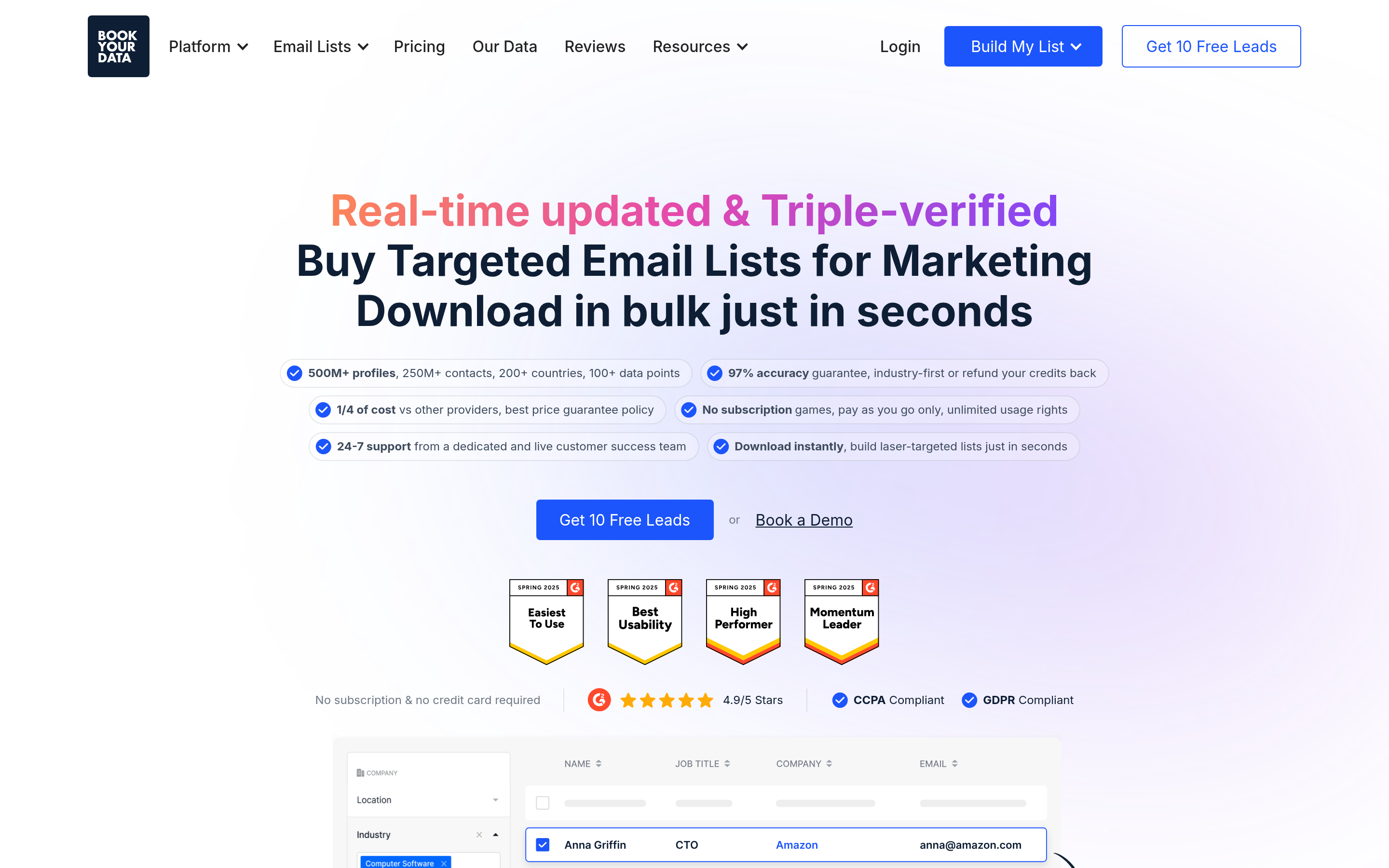
The pay-as-you-go option in a subscription-heavy category. You buy credits, filter a B2B database by role, industry, geography, and tech stack, and export — no monthly commitment, and the vendor backs its data with a stated accuracy guarantee and bounce refunds. That model suits teams running a few concentrated campaigns a year rather than a constant drip, and it removes the "I'm paying for credits I didn't use" problem entirely.
Wiza#
Purpose-built for exporting Sales Navigator searches at scale with verification attached. Higher entry price, but it replaces a scraper plus a verifier plus a cleanup step.

How do Hunter alternatives compare on price for the same volume?#
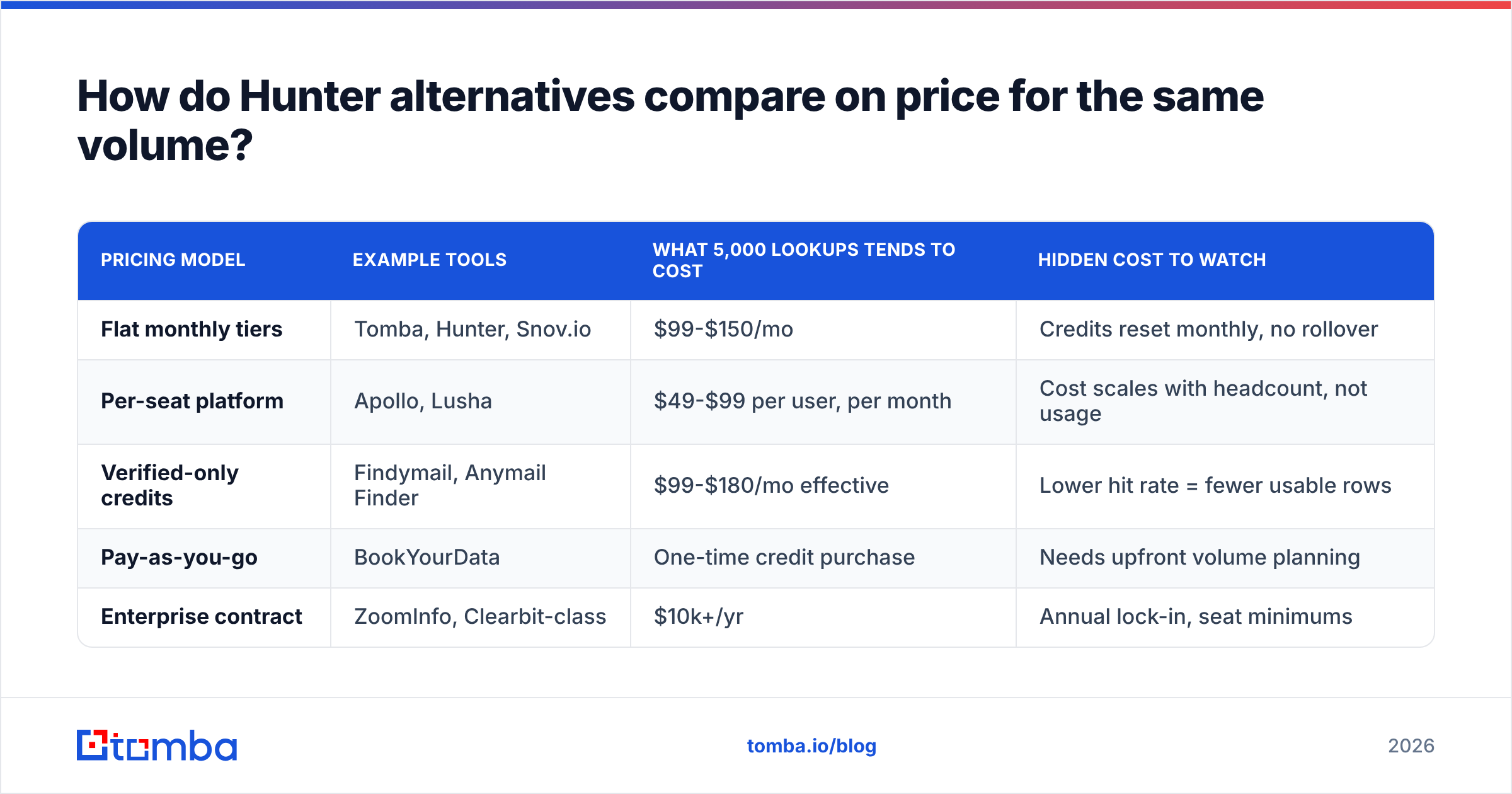
Headline prices mislead because credit definitions differ. Here's the same question — roughly 5,000 lookups a month — across the models:
| Pricing model | Example tools | What 5,000 lookups tends to cost | Hidden cost to watch |
|---|---|---|---|
| Flat monthly tiers | Tomba, Hunter, Snov.io | $99-$150/mo | Credits reset monthly, no rollover |
| Per-seat platform | Apollo, Lusha | $49-$99 per user, per month | Cost scales with headcount, not usage |
| Verified-only credits | Findymail, Anymail Finder | $99-$180/mo effective | Lower hit rate = fewer usable rows |
| Pay-as-you-go | BookYourData | One-time credit purchase | Needs upfront volume planning |
| Enterprise contract | ZoomInfo, Clearbit-class | $10k+/yr | Annual lock-in, seat minimums |
The number that matters is cost per verified, mailable contact, not cost per lookup. A $34/mo plan with a 45% usable hit rate is more expensive than a $99/mo plan with an 80% usable hit rate, and it's slower, because someone on your team is manually patching the gaps.
Which Hunter alternative fits your use case?#
- Solo founder, under 500 lookups/month — Stay on a free tier as long as you can. Tomba, Hunter, and Skrapp all have usable free plans; stack two of them and you have a few hundred free lookups a month.
- Agency running campaigns for multiple clients — You need bulk processing and clean per-client separation. Look at bulk email finder workflows and API access rather than a per-seat platform.
- Product or data team embedding lookups — API quality and rate limits decide this, not the UI. Compare docs before you compare prices; the Tomba API and Hunter's API are the two most documented in the category.
- EU-focused outbound with legal scrutiny — Dropcontact's no-database model plus documented processing is the path of least resistance.
- Recruiting — ContactOut or RocketReach. Corporate-pattern finders are the wrong shape for candidate sourcing.
- One-off list purchase, no subscription — BookYourData.
How do you migrate off Hunter without breaking anything?#
- Export everything first. Your saved leads, campaigns, and verification history. Don't cancel until the export is on disk.
- Run the 100-row overlap test. Same list, both tools, score hit rate and precision. Budget an afternoon.
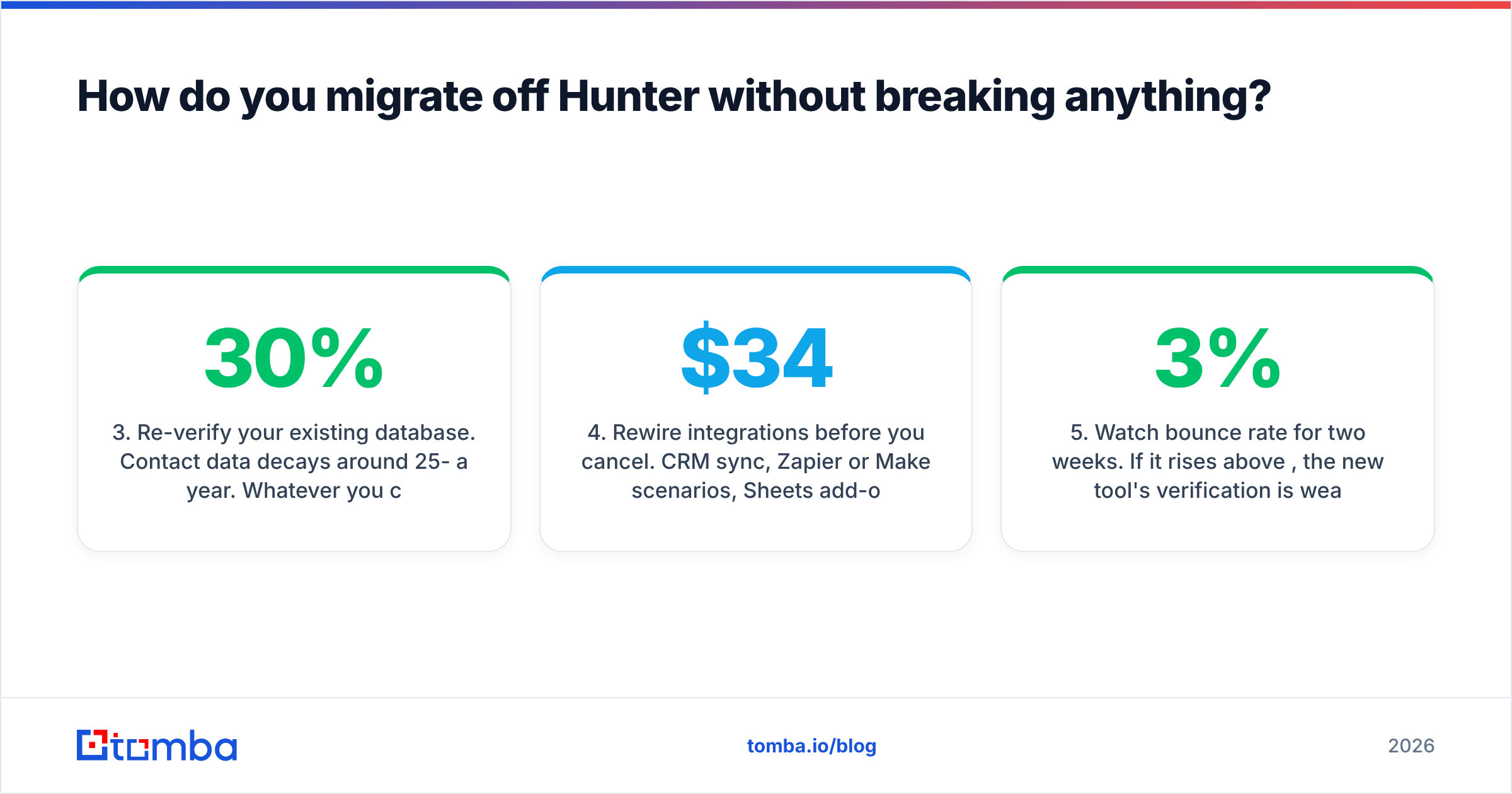
- Re-verify your existing database. Contact data decays around 25-30% a year. Whatever you carry over should be re-checked before the first send, ideally through a domain search pass that catches company moves and rebrands.
- Rewire integrations before you cancel. CRM sync, Zapier or Make scenarios, Sheets add-ons. Overlap the two subscriptions by one billing cycle — the $34 you save by cutting early is not worth a broken pipeline.
- Watch bounce rate for two weeks. If it rises above 3%, the new tool's verification is weaker than what you left, and you should either add a dedicated verifier or reverse the decision.
Is Hunter still worth keeping?#
Sometimes, yes. If your entire workflow is "paste a domain, get the pattern, email three people," Hunter's free and entry tiers are hard to argue with, and the product is stable and well-documented. The case for switching gets strong when any of these are true: you're programmatically calling the API, you sell outside the core Western markets, catch-all domains are eating a fifth of your list, or you've outgrown the entry tier and the next step up doesn't pencil out.
The honest answer for most teams is that this isn't a one-tool decision. A primary finder with broad coverage, plus a second-opinion tool for the misses, plus a verifier before every send, costs less than the bounces and wasted rep-hours of a single-source setup.
If you want to test that stack, start with the Tomba Email Finder free tier — 25 searches a month, no card, verification and catch-all handling included. Run it against the same 100 rows you'd give Hunter, compare precision rather than hit rate, and let your own list settle the argument. If it wins, Starter is $49/mo and the API, CLI, Sheets add-on, and CRM connectors come with it.
Related guides#
Ready to find emails that actually work?
Join 150,000+ professionals who stopped guessing and started sending. Free credits on signup — no credit card required.
Get the Tomba newsletter
Practical outbound tactics and product updates — once every two weeks.
About the author