Hunter vs Apolloio (2026): Which Email Tool Wins for You?
Hunter is a precision email finder. Apollo.io is a database plus a sequencer. They solve different problems at very different prices — here's which one your pipeline actually needs in 2026.
Hunter vs Apolloio is the wrong fight for most teams, because these are not the same kind of tool. Hunter finds and verifies emails at companies you already know. Apollo.io sells you the list of companies in the first place. Here is how to tell which one your pipeline needs in 2026.
TL;DR
- Hunter finds and verifies email, one domain at a time. It is fast and clean. It has no contact database of its own and only light sequencing.
- Apollo.io pairs a 275M+ contact database with a sequencer, dialer, and light CRM. More surface area, more to learn, and export limits that bite on cheap plans.
- Pick Hunter if you know your target accounts and just need verified addresses.
- Pick Apollo if you still have to find those accounts and want to sequence them in one seat.
- Neither is the cheapest path to verified email at volume. Tomba's email finder starts at $49/mo, with 25 free searches and a real API.
- One question settles most of this: do you need data discovery, or data verification?
What is Hunter, and what does it actually do?#
Hunter (hunter.io) is the tool most people meet first when they Google "find someone's email." Its core feature is domain search. Give it stripe.com and it returns the public addresses it has confirmed there. You also get the company's email pattern ({first}@, {f}{last}@) and a confidence score for each address.
Around that core sit four features: Email Finder (name + domain → address), Email Verifier, Campaigns (a basic cold email sender), and a browser extension. That is the whole product. Hunter has deliberately not become a database company.
The way to think about Hunter is a specialist locksmith. You bring the address, they open the door. They do not sell you a map of the neighborhood.
That focus is Hunter's strength and its ceiling. The confidence scoring is honest. Hunter tells you when an address is a guess from a pattern rather than a crawled, confirmed find. That is more transparency than most rivals offer. But if you have no target list yet, Hunter gives you nothing to prospect into.
What is Apollo.io, and how is it different?#
Apollo.io is a go-to-market platform. The database is the anchor: about 275 million contacts and 70 million companies. You can filter by title, headcount, tech stack, funding, and intent signals. On top of that sit sequences, a dialer, meeting scheduling, conversation intelligence, deal tracking, and Chrome-extension enrichment on LinkedIn.
Where Hunter is a locksmith, Apollo is a hardware superstore. Everything you might need is somewhere on the shelves, including things you will never use, and finding what you want takes a while.
The trade is real. Apollo replaces three or four tools for a small team: no separate data vendor, no separate sequencer, maybe no CRM early on. The cost is concentration. Your prospecting data, your sending, and your activity history all live with one vendor. Teams that later want a dedicated Apollo alternative for just the data layer find that untangling takes work.

Hunter vs Apolloio: how do they compare on features and price?#
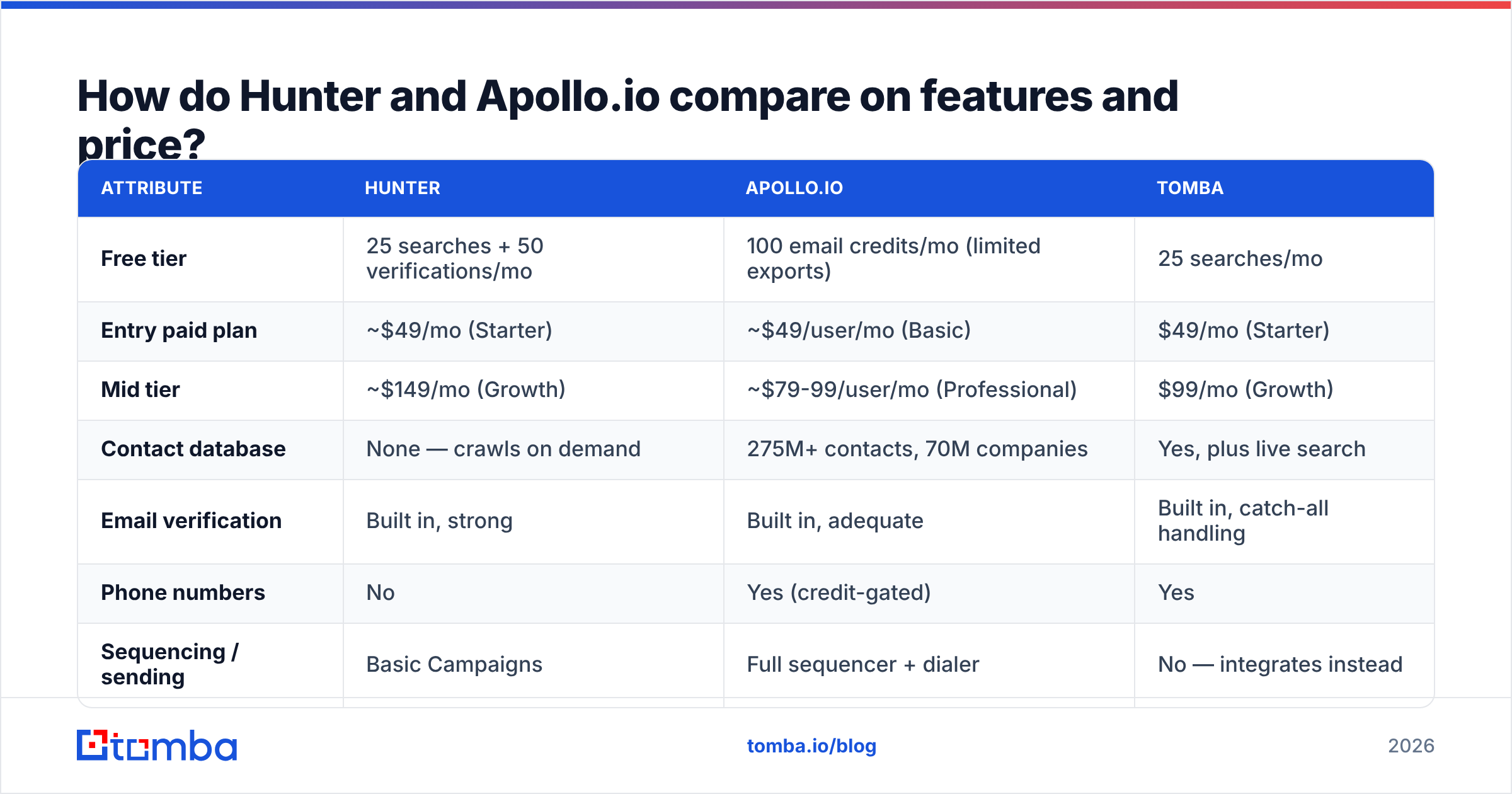
Here is the head-to-head on the attributes that change a buying decision. Prices are the published annual-billing rates as of early 2026. Check each vendor's page before you commit, because both have repriced in the last 18 months.
| Attribute | Hunter | Apollo.io | Tomba |
|---|---|---|---|
| Free tier | 25 searches + 50 verifications/mo | 100 email credits/mo (limited exports) | 25 searches/mo |
| Entry paid plan | ~$49/mo (Starter) | ~$49/user/mo (Basic) | $49/mo (Starter) |
| Mid tier | ~$149/mo (Growth) | ~$79-99/user/mo (Professional) | $99/mo (Growth) |
| Contact database | None — crawls on demand | 275M+ contacts, 70M companies | Yes, plus live search |
| Email verification | Built in, strong | Built in, adequate | Built in, catch-all handling |
| Phone numbers | No | Yes (credit-gated) | Yes |
| Sequencing / sending | Basic Campaigns | Full sequencer + dialer | No — integrates instead |
| API quality | Clean, well documented | Full but rate-limited on low tiers | REST API, CLI, MCP server |
| Per-seat pricing | No — account-wide | Yes — cost scales with headcount | No — account-wide |
| Best for | Verified email at known accounts | Discovery + outbound in one seat | Volume enrichment via API |
Two lines in that table matter more than the rest.
Per-seat pricing. Hunter and Tomba charge for the account. Apollo charges per user. A five-person SDR team on Apollo Professional runs roughly $400-500/mo before add-ons. The same team shares one $149 bucket on Hunter Growth. If you plan to hire, model the 12-month cost, not the sticker price.
Export limits. Apollo's credit system treats viewing a record and exporting it as different actions. The export caps on lower tiers are the most common complaint in Apollo reviews on G2. You can browse a list of 5,000 prospects and then find you can pull only a few hundred out this month.
Which one is more accurate?#
Accuracy is the wrong single question. Ask instead: accurate at what stage?
Hunter is more accurate on confirmed addresses because it admits when it is guessing. A pattern-derived address at 70% confidence is labeled that way. Apollo returns more addresses overall, but a real share of them are stale. Someone who left 14 months ago still shows up with an old work email, because B2B records decay at roughly 2-3% per month (Gartner and others have published on B2B data decay).
So Hunter gives you fewer addresses with cleaner labels. Apollo gives you more addresses with more noise. Neither is dishonest about it. They are built for different jobs.
Two things follow, depending on which one you buy.
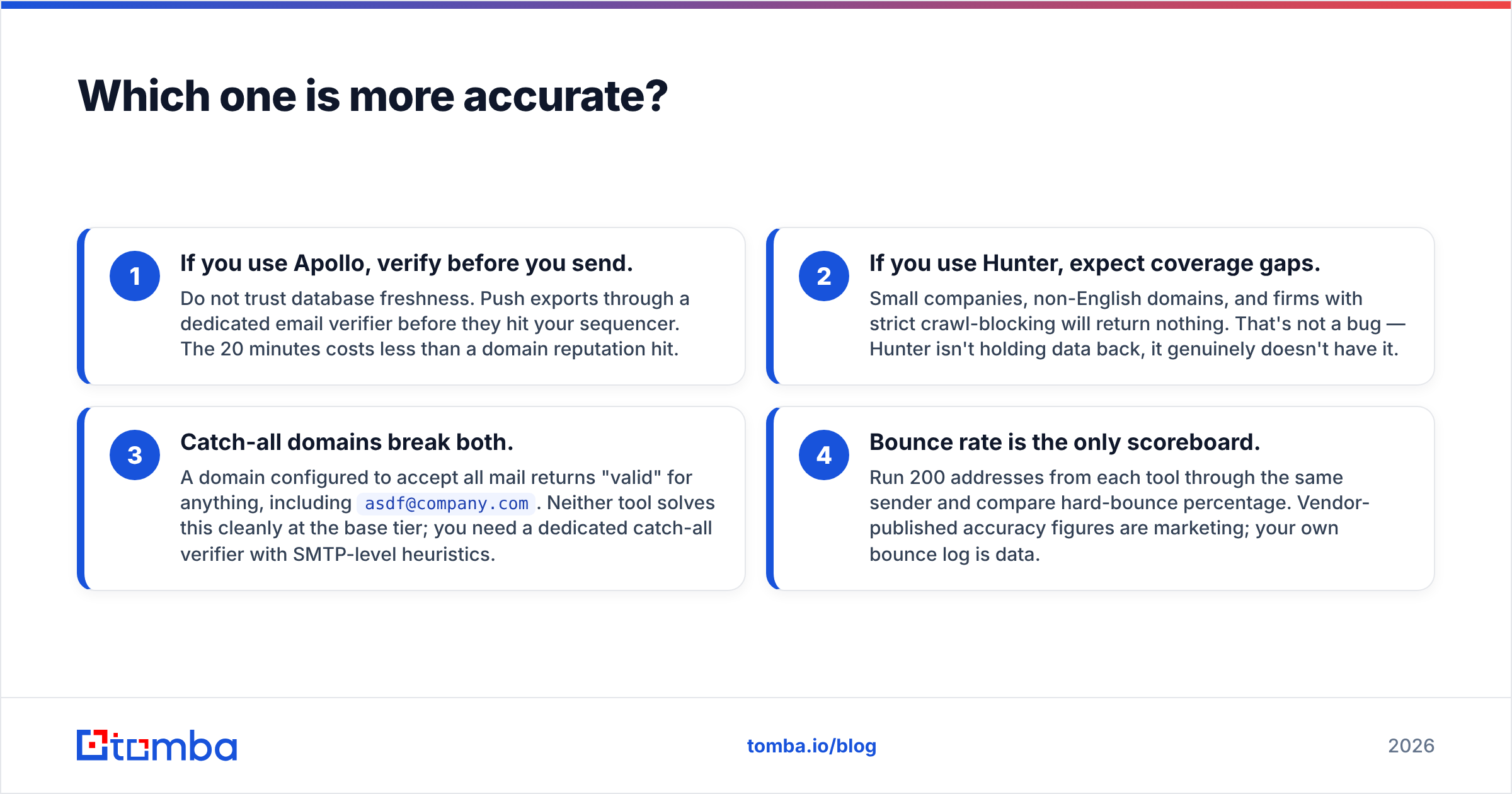
- If you use Apollo, verify before you send. Do not trust database freshness. Push exports through a dedicated email verifier before they hit your sequencer. Twenty minutes costs less than a domain reputation hit.
- If you use Hunter, expect coverage gaps. Small companies, non-English domains, and firms that block crawlers return nothing. Hunter is not holding data back. It simply does not have it.
Two more things are true of both tools.
- Catch-all domains break both. A domain that accepts all mail returns "valid" for anything, even
asdf@company.com. Neither tool solves this at the base tier. You need a catch-all verifier with SMTP-level heuristics. - Bounce rate is the only scoreboard. Run 200 addresses from each tool through the same sender and compare hard bounces. Vendor accuracy figures are marketing. Your own bounce log is data.
Is Apollo.io better than Hunter for cold outreach?#
For a solo founder or a two-person team starting outbound from scratch, yes. Apollo is the only one of the two that answers "who should I even contact?"
You can filter for Series A SaaS companies with 20-100 employees running HubSpot, pull 400 VP-of-Sales contacts, drop them into a sequence, and start sending within an hour. Hunter cannot do that. You would need a list source, Hunter for the emails, and a separate sender.
Three caveats before you take that as a recommendation.
Deliverability is on you either way. A bundled sequencer does not make your sending safer. Same domain warmup, same SPF record and DKIM setup, same need to keep bounce rates under 2%. Teams that assume the platform handles deliverability get burned fastest, because Apollo makes it easy to send volume you have not earned.
Apollo's sequencer is fine, not great. It handles straightforward multi-step cadences. If you want conditional branching, real A/B logic, or inbox rotation at scale, dedicated senders do it better. You will end up paying for both anyway.
The all-in-one discount shrinks fast. Past three seats, buying data and sending separately is often cheaper and better on both halves.
When does a third option beat both?#
One buyer is served badly by both tools: teams that enrich data in code, not in a UI.
Say your workflow is "a lead hits our form → enrich it → route it to the right rep." Then you do not want a prospecting interface at all. You want a fast, well-documented API with predictable pricing and no per-seat tax. Same story for a dev shop enriching a customer table, or an agency running enrichment for clients.
That is where Tomba, BookYourData, and Findymail fit. BookYourData is worth a look if you want prepaid, pay-as-you-go B2B lists with no subscription. It is a genuinely different commercial model, and for one-off campaign lists that model often wins.
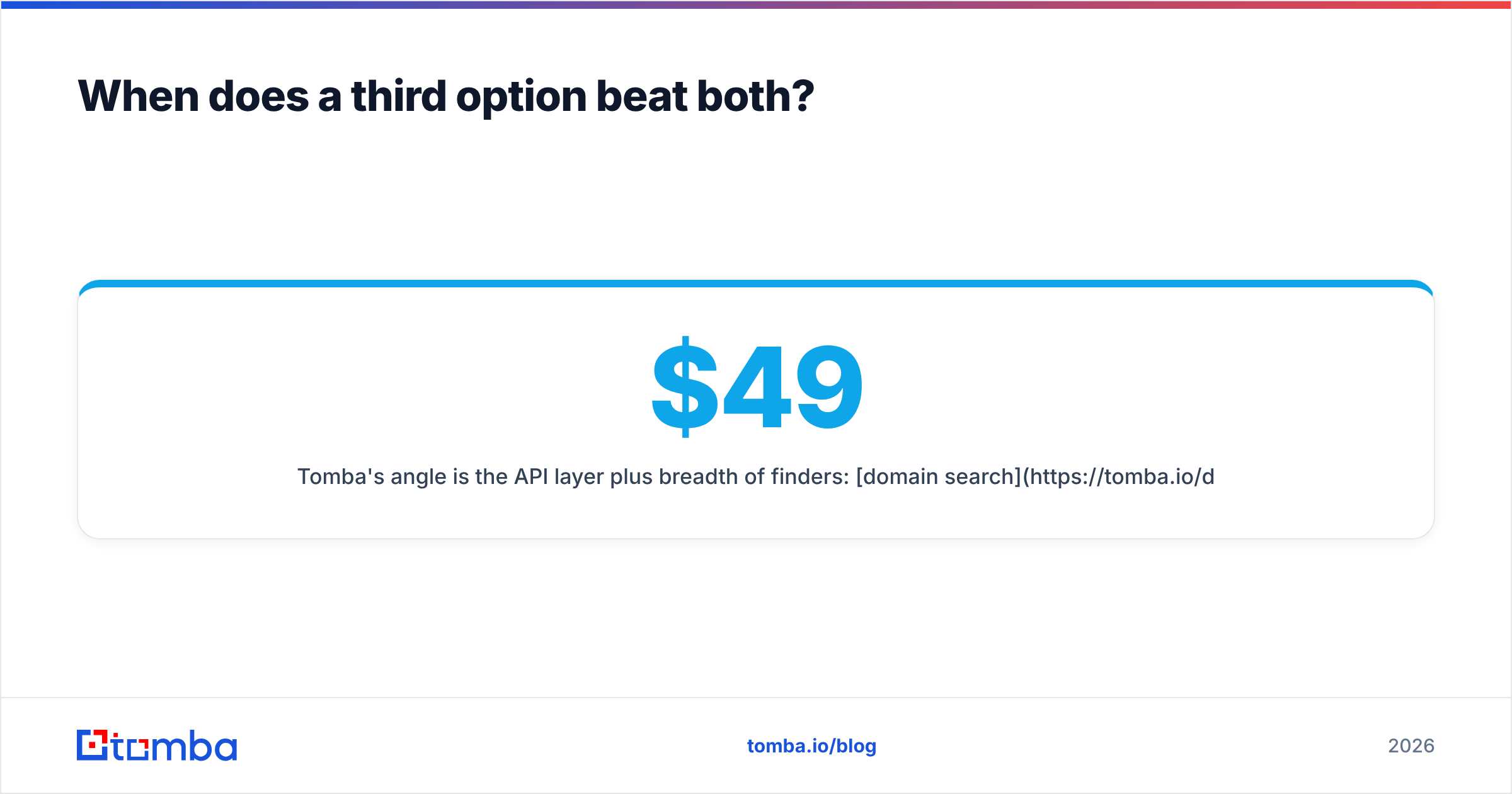
Tomba's angle is the API layer plus the breadth of finders: domain search, LinkedIn finder, author finder, phone finder, reverse email lookup, and bulk jobs. All of it sits under one account-wide plan rather than per-seat.
Starter is $49/mo, Growth $99/mo, Pro $249/mo — see Tomba pricing for credit allocations. There is also a CLI and an MCP server, which matters if you are wiring enrichment into agent workflows rather than spreadsheets.

What does the decision look like in practice?#
Run through these in order. The first "yes" is your answer.
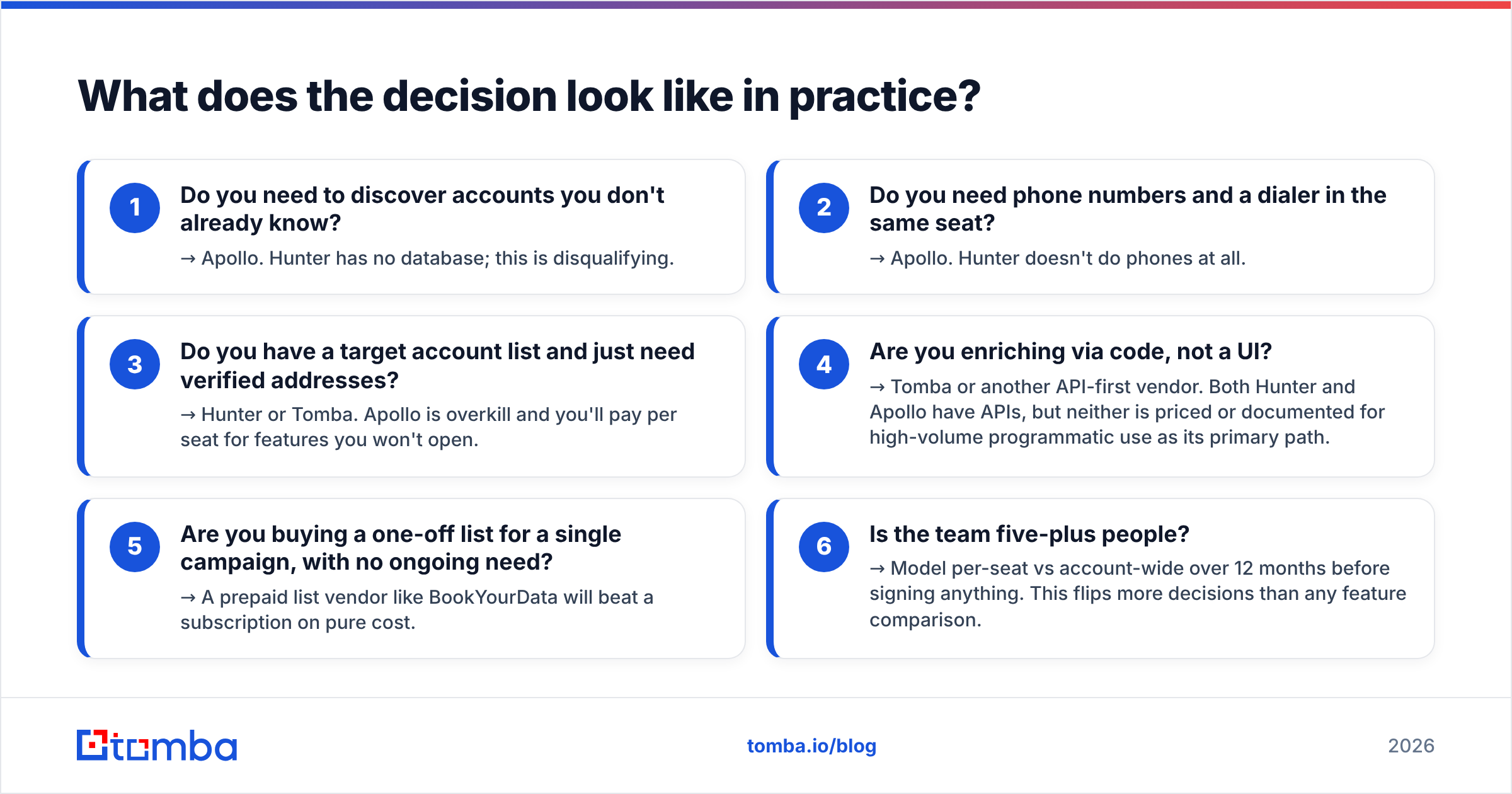
- Do you need to discover accounts you do not know yet? → Apollo. Hunter has no database, which is disqualifying here.
- Do you need phone numbers and a dialer in the same seat? → Apollo. Hunter does not do phones at all.
- Do you have a target account list and just need verified addresses? → Hunter or Tomba. Apollo is overkill, and you pay per seat for features you never open.
If none of those fit, keep going.
- Are you enriching through code, not a UI? → Tomba or another API-first vendor. Both Hunter and Apollo have APIs, but neither is priced or documented for high-volume programmatic use.
- Are you buying one list for one campaign, with no ongoing need? → A prepaid vendor like BookYourData beats a subscription on pure cost.
- Is the team five people or more? → Model per-seat against account-wide over 12 months before you sign. This flips more decisions than any feature comparison.
How should you test them before committing?#
Do not trust anyone's benchmark, including this one. Run your own in about 90 minutes.
Take 100 real target contacts. Use actual companies you want to sell to, not a curated list. Then work through four steps.
Step one. Run them through each tool's free tier. Hunter gives you 25 searches, Apollo gives 100 limited credits, Tomba gives 25 searches. You will have to sample, so use the same 25-contact subset in all three.
Step two. Record the found-rate (how many returned an address at all) and the confidence spread.
Step three. Send one genuinely useful email to each address from a warmed, non-primary domain. Measure hard bounces at 48 hours.
Step four. Compute cost per delivered address, not cost per credit. This is the only number that matters, and it often reorders the ranking.
Found-rates usually cluster on well-known companies and diverge sharply on smaller or non-US firms. Your ICP decides the Hunter vs Apolloio winner, which is why a generic verdict is worth less than 90 minutes of your own testing.
What about deliverability after you pick?#
Whichever tool wins, the address is only the first half. Your sender reputation decides whether verified addresses ever reach an inbox.
Minimum bar before you send at volume: SPF, DKIM, and DMARC on the sending domain. Use a dedicated sending domain, separate from your primary one. Warm it for two to four weeks, then ramp volume gradually.
Google and Yahoo now enforce their bulk sender rules, so the 0.3% spam-complaint threshold is a hard constraint. Read Google's own sender guidelines rather than a blog summary.
A clean list from Hunter, Apollo, or Tomba buys you a low bounce rate. It buys you nothing on complaint rate, which comes down to targeting and message quality. Both failure modes end the same way.
The verdict: Hunter vs Apolloio#
Hunter wins when your accounts are known and you value labeled confidence over raw volume. It is the cleaner tool, the easier tool, and account-wide pricing keeps it cheap for small teams.
Apollo.io wins when you need discovery, sequencing, and calling in one seat, and you accept database staleness and per-seat costs. For a founder-led sales motion under three seats, it is the highest-leverage single purchase in the category.
Neither is optimal if your enrichment happens in code, at volume, or across many client accounts. That is a different buying problem with different answers.
If your bottleneck is verified addresses rather than account discovery, start with the Tomba Email Finder. The free tier gives you 25 searches with no card, and Starter is $49/mo account-wide with no per-seat tax.
The same lookups run through the Tomba API, CLI, or Chrome extension, so you can test the UI today and wire it into your stack tomorrow. Run your own 25-contact bounce test against whatever you use now. That is the only comparison that settles this.
Related guides#
// get started
Find, verify and enrich your first contacts today
Start on the free plan with 25 searches a month, then scale when your team is ready.
Free plan · No credit card required · GDPR & CCPA
// about the author