Hunter vs Gatherer Sales: Which Rep Model Wins in 2026
Hunters open new logos, gatherers grow the ones you have. Most teams staff the split wrong and blame quota. Here's the honest comparison, the comp math, and how to decide.
TL;DR
- A hunter opens net-new logos: cold outbound, prospecting, first meetings, closing strangers. A gatherer (often called a farmer) grows existing accounts: renewals, expansion, upsell, referrals.
- The two roles fail for opposite reasons. Hunters starve without clean contact data. Gatherers starve without a book of accounts big enough to grow.
- Most teams under 20 reps should not split the roles at all. Below roughly $3M ARR, a hybrid rep with a hunting quota and a gathering floor beats a rigid split.
- Comp structure decides behavior more than job titles do. A 50/50 split with new-logo accelerators produces hunters; a 70/30 split with retention gates produces gatherers.
- The cheapest hunter upgrade is not more headcount — it's better data. Verified contacts raise connect rates far more reliably than another SDR seat.
What is the difference between hunter and gatherer sales roles?#
A hunter finds and closes revenue that does not exist yet. A gatherer protects and expands revenue that already does.
Think of a restaurant. The hunter is the person out on the street handing cards to strangers and filling tables that were empty. The gatherer is the server who notices you always order the same wine, remembers your anniversary, and turns a $40 check into a $110 one. Both add revenue. Only one of them is comfortable being told "no" nine times before lunch.
The technical version: hunters own top-of-funnel through close on net-new accounts. Their day is prospecting, list building, cold email, cold calls, LinkedIn, and discovery calls. Gatherers own post-sale revenue — renewals, expansion, cross-sell, and reference generation — inside an assigned book of business.
The terminology is old (it predates SaaS by decades) but the split persists because the underlying skills genuinely diverge. Rejection tolerance and pipeline creation are not the same muscle as relationship depth and account planning. A rep who is excellent at one is frequently mediocre at the other, and forcing both onto one person at scale produces a predictable failure: the rep does the comfortable half and quietly abandons the other.
Which half gets abandoned? Almost always prospecting. Servicing existing accounts is warmer, easier, and generates immediate positive feedback. Cold outbound generates silence. Left unmanaged, every hybrid rep drifts toward gathering.
Which sales model actually performs better?#
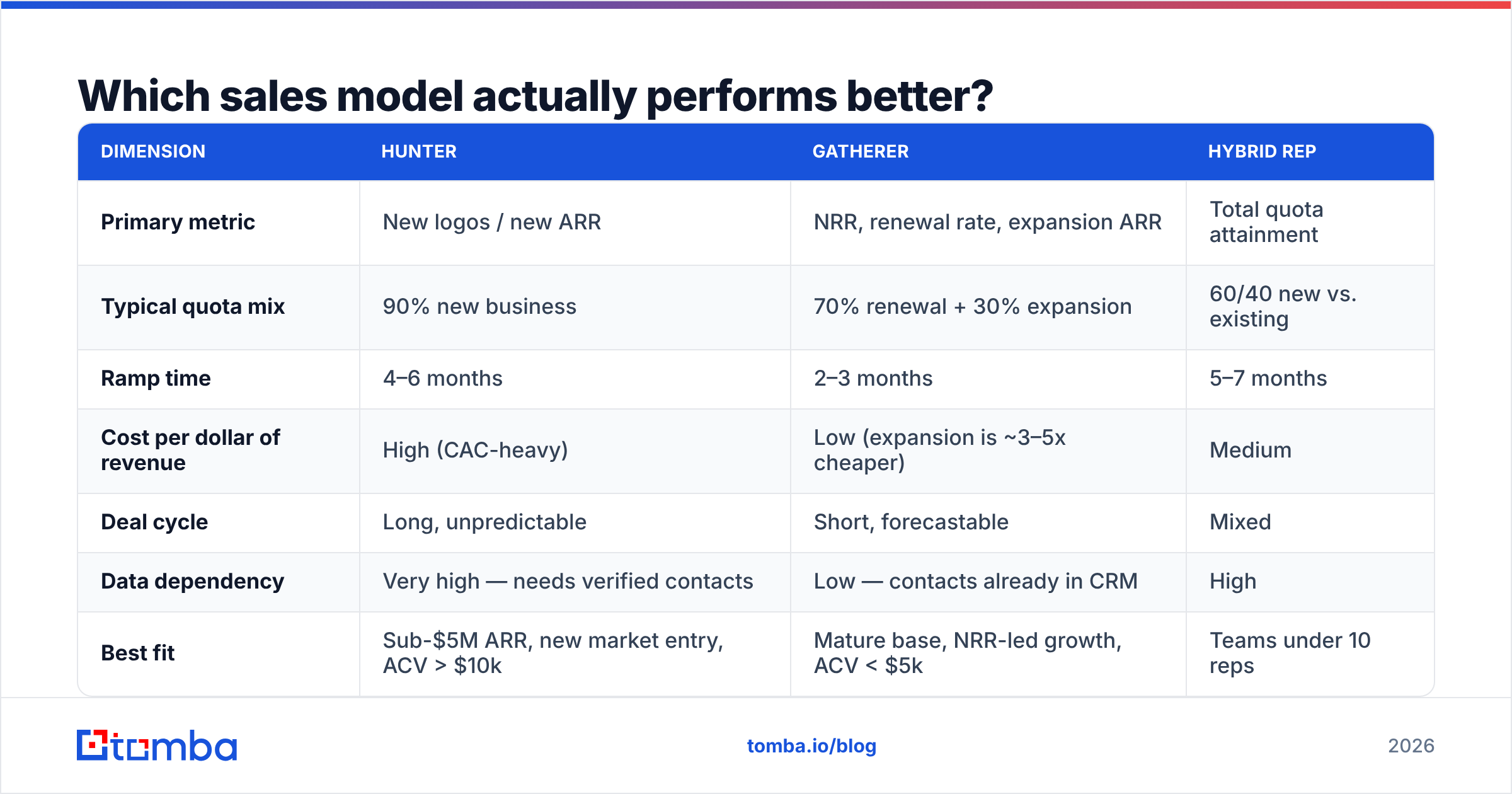
Neither. The right answer depends on your contract value, churn rate, and headcount — and the data backs a fairly boring conclusion: hunting drives growth rate, gathering drives growth efficiency.
| Dimension | Hunter | Gatherer | Hybrid rep |
|---|---|---|---|
| Primary metric | New logos / new ARR | NRR, renewal rate, expansion ARR | Total quota attainment |
| Typical quota mix | 90% new business | 70% renewal + 30% expansion | 60/40 new vs. existing |
| Ramp time | 4–6 months | 2–3 months | 5–7 months |
| Cost per dollar of revenue | High (CAC-heavy) | Low (expansion is ~3–5x cheaper) | Medium |
| Deal cycle | Long, unpredictable | Short, forecastable | Mixed |
| Data dependency | Very high — needs verified contacts | Low — contacts already in CRM | High |
| Best fit | Sub-$5M ARR, new market entry, ACV > $10k | Mature base, NRR-led growth, ACV < $5k | Teams under 10 reps |
| Fails when | Contact data is stale or unverified | Base is too small to expand | Manager doesn't enforce prospecting time |
The economics are not symmetrical. Acquiring a new customer costs multiples of what it costs to expand an existing one — a pattern documented across HubSpot's and Salesforce's own research and repeated in almost every SaaS benchmark report. That makes gathering look like the obviously smarter investment.
It isn't, for one reason: you cannot gather from a base you never built. Gathering is a compounding function applied to a starting number. If the starting number is small, compounding it produces a slightly less small number. Companies that over-index on gathering too early plateau at a ceiling set by their initial customer count, then discover they have no one left who knows how to run cold outbound.

When should you split the roles?#
Use headcount and ACV as the trigger, not ambition.
- Under 5 reps — do not split. Every rep hunts and gathers. Enforce prospecting with a calendar block, not a job title. Splitting here creates two under-utilized specialists instead of five productive generalists.
- 5–15 reps — split partially. Carve out 1–2 dedicated hunters (or SDRs feeding AEs) while the rest run hybrid books. This is where most teams get their first real answer about who actually enjoys cold outreach.
- 15–40 reps — split fully. Dedicated new-business AEs, dedicated account managers or CSMs, a clean handoff SLA, and separate comp plans. Below this size the coordination overhead exceeds the specialization gain.
- 40+ reps — split and sub-split. Hunters segment by vertical or region; gatherers segment by account tier. Add a dedicated expansion-only role if NRR is above 110%.
- ACV under $2k — skip hunters entirely. Below that price point, human-led cold outbound rarely pays back. Route budget to self-serve, product-led motion, and a small gathering team.
- New market or new product — hunt first, always. Even a gathering-heavy org needs a hunter squad for any segment where you have zero installed base to expand.
The handoff is where most splits break. If a hunter closes a deal and the gatherer inherits it with no context, the customer feels the seam within 30 days. Write down what transfers: the original pain, the champion, the promised outcomes, the timeline, and every commitment made during the sales cycle. A 15-minute recorded handoff call beats a CRM field every time.
Why do hunters fail more often than gatherers?#
Because hunters depend on something outside their control: data quality.
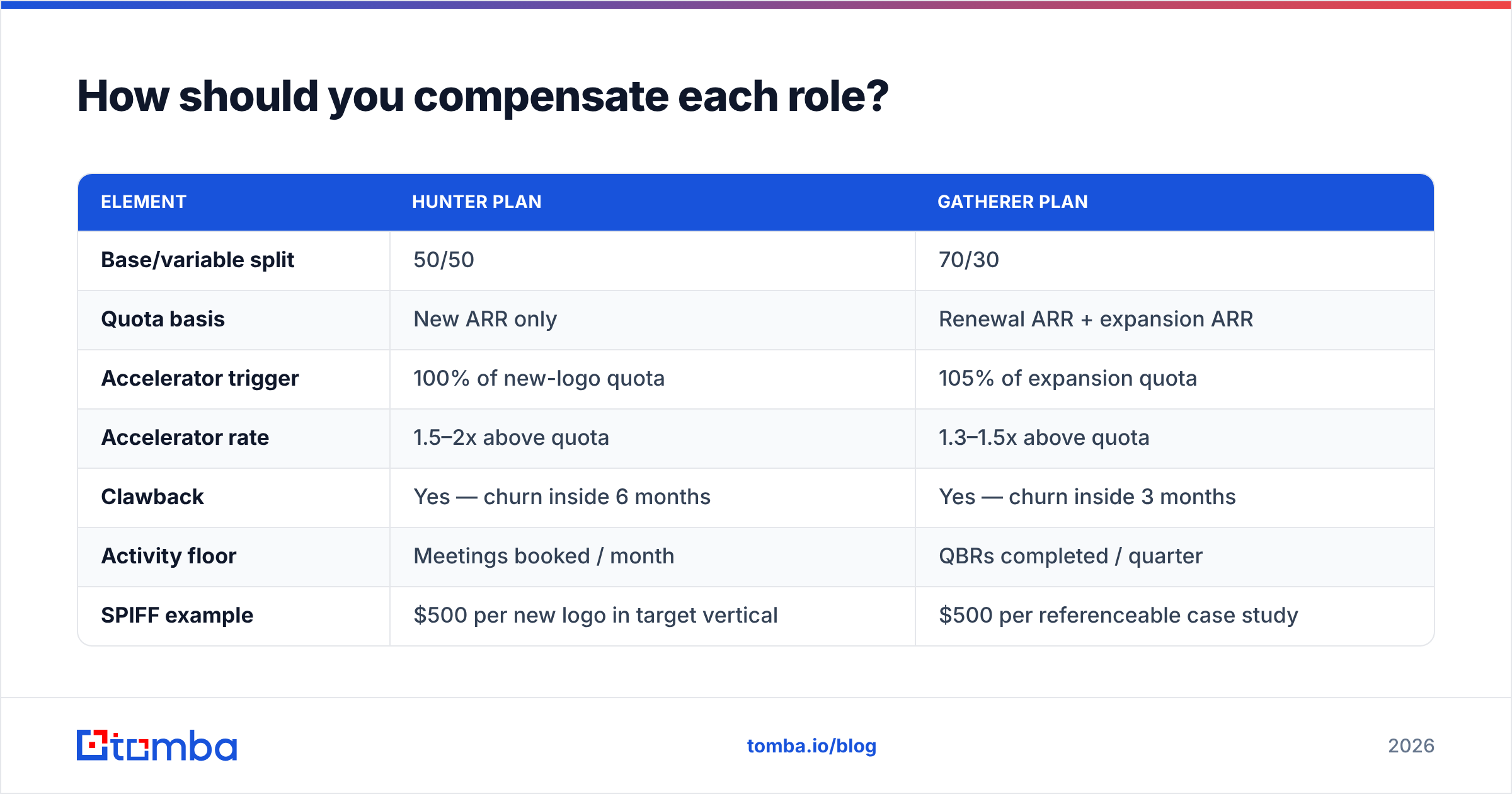
A gatherer starts every day with a known list of real people who already pay you. A hunter starts every day with a hypothesis. If the contact list is wrong — bad emails, wrong titles, departed employees — the hunter's effort produces nothing regardless of skill. That's the single most common cause of a "hunter who can't sell" who turns out to be a hunter who was handed a 34% bounce list.
Run the math. A hunter sending 60 emails a day at a 25% bounce rate is really sending 45. Those bounces also damage your sender reputation, which suppresses the deliverability of the 45 that did make it out. The rep now looks like a performance problem. They are a data problem wearing a performance problem's clothes.
Three fixes, in order of impact:
- Verify before send, not after bounce. Run every list through an email verifier before it enters the sequencer. Catch-all domains need a separate check — a plain SMTP ping returns "accept" for addresses that don't exist.
- Source contacts by role, not by scrape. A domain search that returns verified contacts with titles and departments beats a scraped list of every address on a website, because your hunter can filter to the four people who actually make the decision.
- Enrich before the first touch. Knowing headcount, tech stack, and funding stage before you write the email is the difference between a personalized opener and a mail-merge apology.
Gatherers fail for a quieter reason: they get comfortable. A gatherer with a healthy book and a 70/30 comp plan can hit quota by doing nothing except renewing. The fix is structural — put an expansion floor in the plan so pure renewal doesn't reach 100% attainment.
How should you compensate each role?#
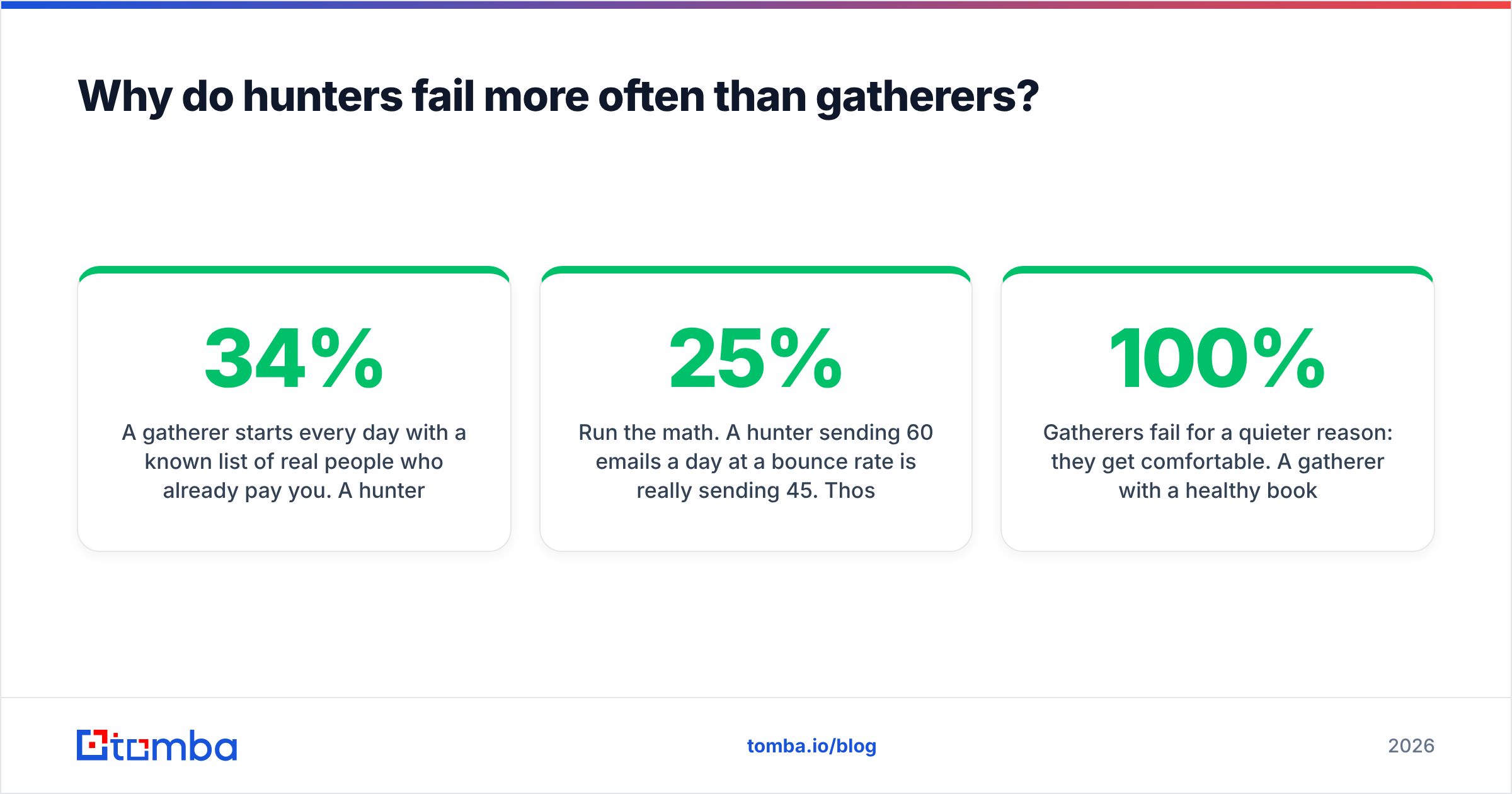
Comp is the actual job description. Everything else is decoration.
| Element | Hunter plan | Gatherer plan |
|---|---|---|
| Base/variable split | 50/50 | 70/30 |
| Quota basis | New ARR only | Renewal ARR + expansion ARR |
| Accelerator trigger | 100% of new-logo quota | 105% of expansion quota |
| Accelerator rate | 1.5–2x above quota | 1.3–1.5x above quota |
| Clawback | Yes — churn inside 6 months | Yes — churn inside 3 months |
| Activity floor | Meetings booked / month | QBRs completed / quarter |
| SPIFF example | $500 per new logo in target vertical | $500 per referenceable case study |
Two rules that matter more than the numbers:
Do not pay hunters on renewals. The moment a hunter earns residual income from a closed account, they stop hunting. It is not a character flaw; it's arithmetic. Renewal income is safer than new-logo income, so a rational rep optimizes for it.
Do not give gatherers a new-logo quota they can't influence. If a gatherer has no prospecting tooling, no list, and no SDR support, a new-logo number is a tax, not a target.
For a deeper breakdown of how attainment interacts with plan design, Gartner's sales-performance research is worth the read, and peer reviews on G2 will tell you which tooling each role actually adopts versus which one the CRO bought.

What tooling does each role need?#
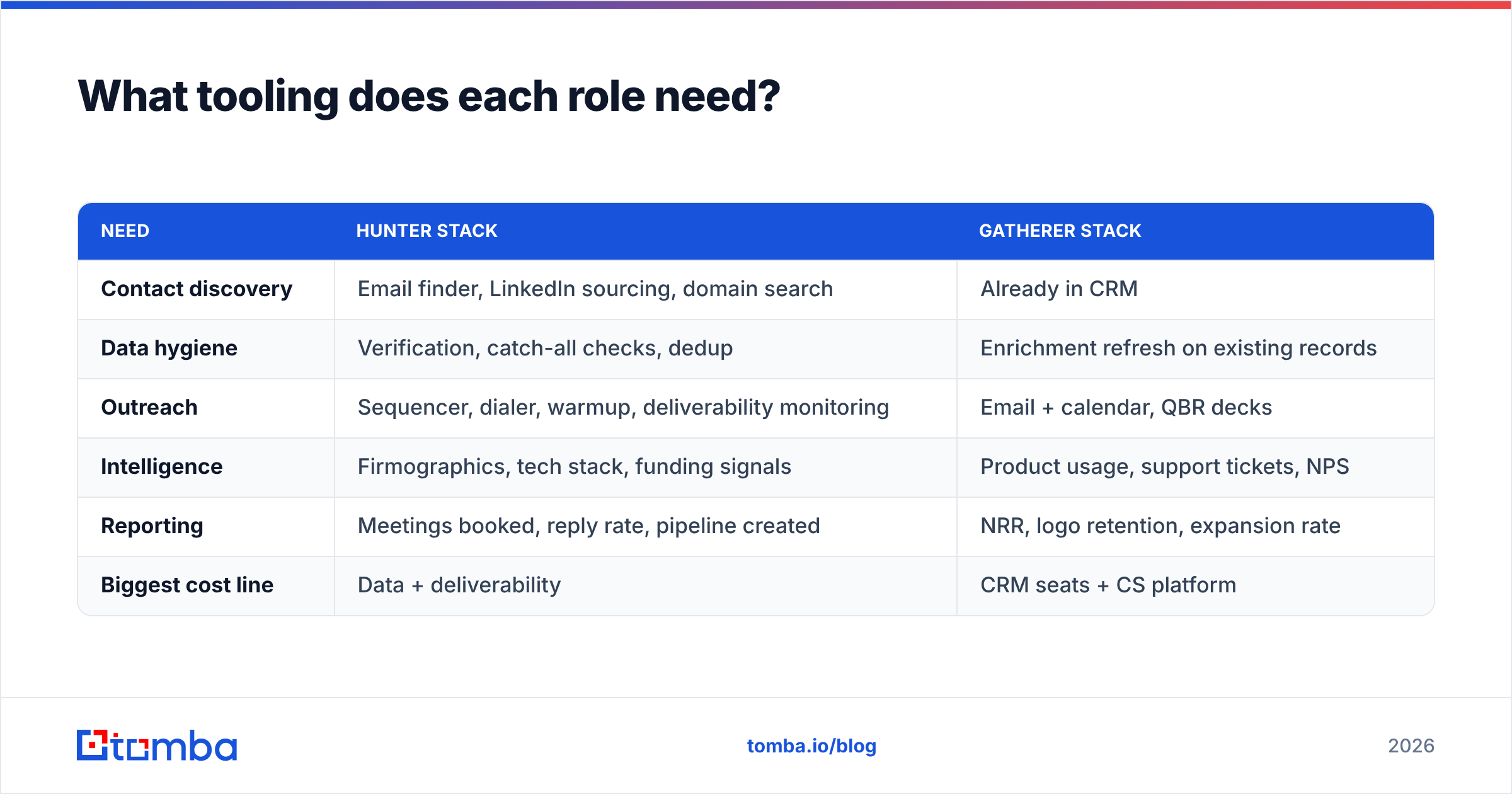
The stacks barely overlap, which is another argument for splitting comp before splitting headcount.
| Need | Hunter stack | Gatherer stack |
|---|---|---|
| Contact discovery | Email finder, LinkedIn sourcing, domain search | Already in CRM |
| Data hygiene | Verification, catch-all checks, dedup | Enrichment refresh on existing records |
| Outreach | Sequencer, dialer, warmup, deliverability monitoring | Email + calendar, QBR decks |
| Intelligence | Firmographics, tech stack, funding signals | Product usage, support tickets, NPS |
| Reporting | Meetings booked, reply rate, pipeline created | NRR, logo retention, expansion rate |
| Biggest cost line | Data + deliverability | CRM seats + CS platform |
A hunter's stack is mostly about turning an unknown company into a real human with a working inbox. That's where an email finder and a bulk enrichment step earn their keep — a rep who spends 90 minutes a day hand-hunting addresses is a rep running at 60% capacity.
Gatherers need almost none of that. Their leverage comes from usage data and relationship coverage: who else at the account should you know, and are they happy. The one data tool a gatherer genuinely benefits from is contact enrichment, because their champion changes jobs roughly every 20 months and nobody updates the CRM when it happens.
Budget accordingly. A common mistake is buying one expensive all-in-one platform and assigning it to everyone. Hunters end up paying for CS features they never open; gatherers pay for prospecting credits they never spend. Two focused tools usually cost less than one bloated one — worth checking against Tomba pricing, where the free tier gives 25 searches a month, Starter runs $49/mo, Growth $99/mo, and Pro $249/mo, so you can size seats to the role instead of the org chart.
Is the hunter/gatherer split still relevant in 2026?#
Yes, but the boundary moved. Two shifts changed the picture.
AI compressed the research half of hunting, not the persuasion half. Drafting a personalized opener now takes seconds. What didn't get easier is finding the right person and reaching them. If anything, the flood of AI-generated outbound made inbox competition worse, which raises the premium on accuracy: a well-targeted message to a verified decision-maker outperforms 500 generic sends by a wider margin than it did three years ago.
Product-led growth blurred the handoff. In PLG companies, the "hunter" is often the product, and humans enter after signup. That shifts the org toward gathering — but it does not eliminate hunting, because PLG rarely reaches enterprise buyers who never self-serve. The modern shape is a small, high-skill hunting team aimed at accounts the product can't reach on its own, plus a larger gathering org monetizing self-serve signups.
What's genuinely obsolete is the cultural version of the split — the idea that hunters are aggressive closers and gatherers are passive caretakers. That framing pushes good expansion reps out of the profession and rewards hunters for behavior that raises churn. Judge both by revenue retained plus revenue created, and the personality theater goes away.
A reasonable 2026 default for a team of ten: two dedicated hunters with excellent data tooling, six hybrid AEs with a mandatory prospecting block and an expansion floor, two account managers on the top 20 accounts by ARR. Revisit at 20 reps.
How do you transition an existing team?#
Do it in one quarter, not one week, and lead with the comp plan.
- Week 1–2: measure the current split. Pull the last four quarters and calculate what percentage of each rep's revenue came from new logos versus existing accounts. You will find at least one "hunter" whose number is 85% expansion.
- Week 3–4: draft two comp plans using the table above and model them against last year's actuals. If a plan would have paid a top rep less for the same performance, fix it before you announce it.
- Week 5–6: let reps self-select, then override. Ask everyone which role they want. Most will pick honestly. Override only where the historical data flatly contradicts the preference.
- Week 7–8: rebuild the data layer for hunters. Fresh verified lists, deliverability checks, warmup where needed. Do not launch a new hunting team on last year's CRM exports.
- Week 9–12: run the handoff SLA and measure the seam. Track 90-day churn on accounts transferred from hunter to gatherer. If it's above your baseline, the handoff is broken, not the model.
Skipping step 7 is the single most common failure. Teams announce the split, celebrate it, and hand the new hunters a contact list assembled by an intern in 2023. Sixty days later the split gets blamed for a data problem, and everything reverts.
Getting your hunters the data they actually need#
The split works when hunters can reach real people. Everything else — comp design, handoff SLAs, quota mix — is downstream of whether the contact in the sequence exists.
Tomba's Email Finder gives your hunting team verified professional email addresses by name, company, or domain, with confidence scoring so reps know what's safe to send. Pair it with the verifier before every campaign, and your outbound numbers start reflecting rep skill instead of list decay. Start free with 25 searches a month, or scale to Starter at $49/mo when the hunting motion proves out.
Related guides#
// get started
Find, verify and enrich your first contacts today
Start on the free plan with 25 searches a month, then scale when your team is ready.
Free plan · No credit card required · GDPR & CCPA
// about the author