Hunter vs Jet Leads Pro: Which Email Finder Wins in 2026?
One tool is the best-known name in email finding. The other is a low-profile challenger with aggressive claims and thin public documentation. Here is how Hunter and Jet Leads Pro actually stack up on accuracy, pricing, API access, and risk.
Hunter vs Jet Leads Pro is a lopsided matchup, and not for the reason you would guess. One tool shows its work. The other asks you to take its word. Here is what happens when you test both.
TL;DR
- Hunter is the safe default. It is the best-known email finder. It has public docs, a real API, and a free tier. But the mid-tier plans get expensive once you need volume.
- Jet Leads Pro is the riskier pick. Public docs are thin. No third-party accuracy test is widely cited. Pricing is not posted in one clear place. Treat every claim as unproven until you test it.
- Accuracy is the only metric that counts. Do not trust either vendor's number. Run the same 200 contacts through both tools. Then count bounces after you send, not "valid" labels.
Two more points decide most of these deals:
- Cost per verified email beats cost per credit. A $49/mo plan that returns 60% deliverable addresses costs more than a $99/mo plan that returns 92%.
- Want a middle path? Tomba's email finder gives you Hunter-style docs and API depth at a flatter price. Starter is $49/mo, Growth is $99/mo, and 25 free searches let you test first.
What are Hunter and Jet Leads Pro?#
Hunter (hunter.io) is the household name here. It launched in 2015 as Email Hunter. It built its index by crawling public web pages and mapping email patterns to domains. Today it sells four things: domain search, email finder, email verifier, and a light cold-email sender called Campaigns. It also ships a public API, a Chrome extension, Google Sheets and Excel add-ons, and native CRM connectors. You can read the whole product at hunter.io without talking to a rep. In this market, that alone stands out.
Jet Leads Pro sits at the other end. It is sold as a B2B lead and email-finding tool, usually bundled with list building and export. The trouble starts when you try to check it. There is very little you can verify on your own. Its G2 and Capterra footprint is nowhere near Hunter's. It publishes no accuracy method. Its pricing is not listed in one public place.
That gap is the real story. This is not "two mature platforms, pick a favorite." It is a documented leader against an unknown. Where I have no proof about Jet Leads Pro, I say so instead of making up a number.
Hunter vs Jet Leads Pro: how do the features compare?#
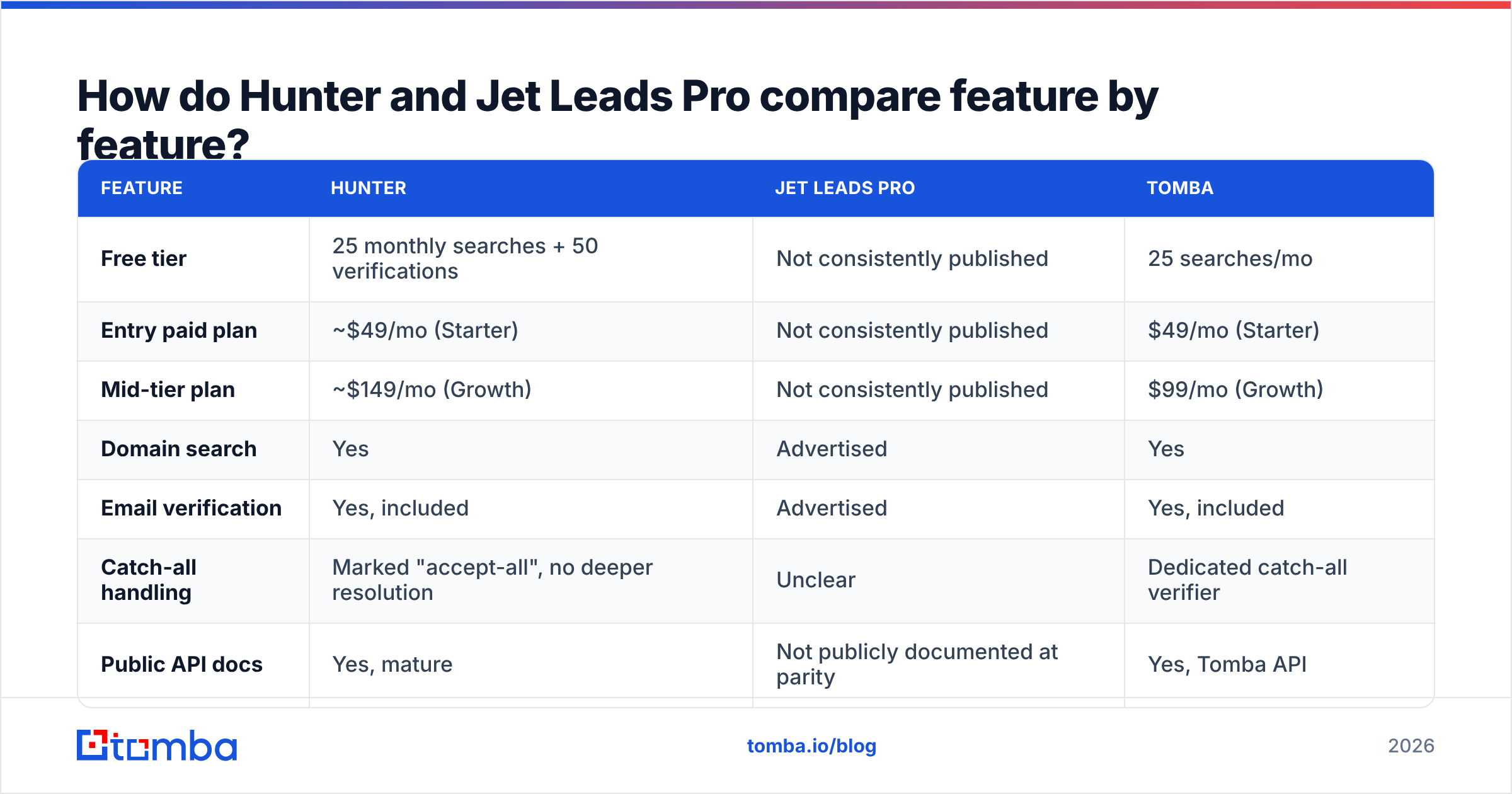
| Feature | Hunter | Jet Leads Pro | Tomba |
|---|---|---|---|
| Free tier | 25 monthly searches + 50 verifications | Not consistently published | 25 searches/mo |
| Entry paid plan | ~$49/mo (Starter) | Not consistently published | $49/mo (Starter) |
| Mid-tier plan | ~$149/mo (Growth) | Not consistently published | $99/mo (Growth) |
| Domain search | Yes | Advertised | Yes |
| Email verification | Yes, included | Advertised | Yes, included |
| Catch-all handling | Marked "accept-all", no deeper resolution | Unclear | Dedicated catch-all verifier |
| Public API docs | Yes, mature | Not publicly documented at parity | Yes, Tomba API |
| Chrome extension | Yes | Advertised | Yes |
| Phone numbers | No | Advertised in some tiers | Yes, phone finder |
| Independent review volume | High (thousands of reviews) | Low | Moderate and growing |
| Published accuracy method | Confidence score per result | Not published | Source-level confidence + SMTP check |
Notice the pattern. Hunter's column is full of plain yes-or-no answers. The Jet Leads Pro column is full of "advertised." That is not an attack. Plenty of good tools start small and thin on docs. But it is a buying signal. You may spend $2,000 a year here and build your whole outbound motion on top of it. "Advertised" is not the same as "documented."
Which tool is more accurate?#

The Hunter vs Jet Leads Pro accuracy question has no armchair answer. Mine included. Every vendor posts an accuracy number. Every number is measured a different way. None of them are audited. Hunter reports a confidence score on each result. That is more honest than a flat "98% accurate" banner, because it admits doubt row by row. Jet Leads Pro publishes no method I can point you to.
So run the test yourself. It takes about ninety minutes, and it settles the argument for good.
- Build a control list of 200 real prospects. Pull them from LinkedIn or a conference list. Mix company sizes: 50 under 50 staff, 100 mid-market, 50 enterprise. Small companies are where cheap databases fall apart.
- Run the same list through both tools. Same names, same domains, no cleanup in between. Export both sets of results.
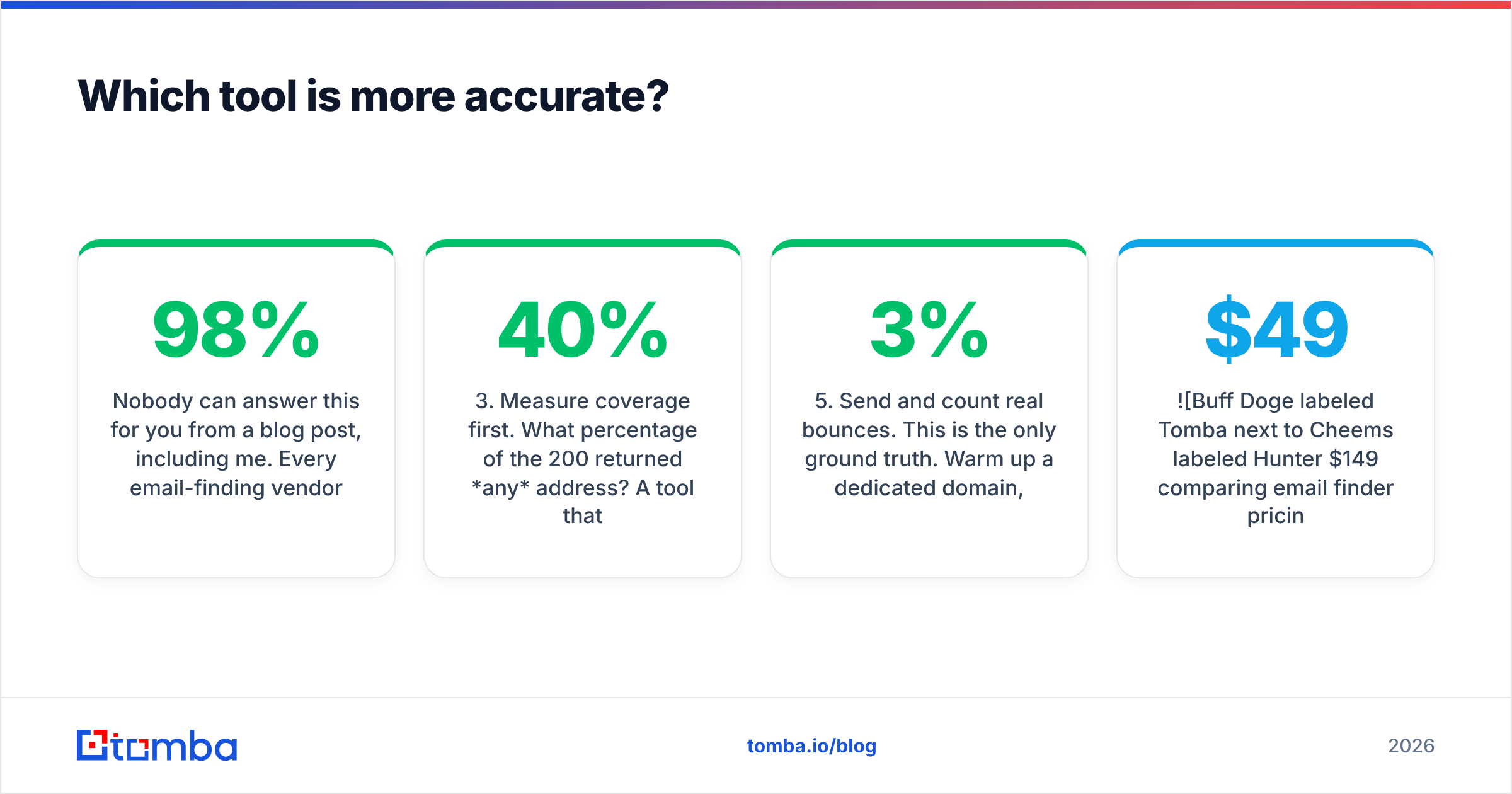
- Measure coverage first. How many of the 200 returned any address? A tool with 40% coverage at 99% accuracy is often worse for you than one with 85% coverage at 92%.
The last three steps are where most teams learn something new.
- Verify with a neutral third party. Do not let each tool grade its own homework. Push both files through an independent email verifier so the scoring matches.
- Send, then count real bounces. This is the only ground truth. Warm up a spare domain, send 100 from each set, and record hard bounces after 72 hours. Anything above 3% is hurting your sender reputation.
- Work out cost per verified email. Take the monthly plan cost and divide it by the addresses that survived step 5. That number is your real price.

I have watched teams run this test. Many find that their "cheap" tool costs 3x per usable contact. Coverage gaps never show up on a pricing page. They show up in your quota.
How does pricing actually compare?#
Hunter's list price has run about $49/mo for Starter, about $149/mo for Growth, and about $499/mo for Business. The free tier gives you 25 searches a month. The step from Starter to Growth is the pinch point. Most teams hit it around month three. You outgrow 500 searches, and your bill triples.
On price, Hunter vs Jet Leads Pro is not a fair fight. One vendor publishes, the other does not. I cannot quote Jet Leads Pro rates in good faith. If you are looking at it, ask for a written quote. Cover six things: the monthly credit allowance, whether a failed search burns a credit, whether verification credits are separate, rollover, per-seat charges, and the annual-versus-monthly gap. A vendor who will not put those in writing has told you something useful.
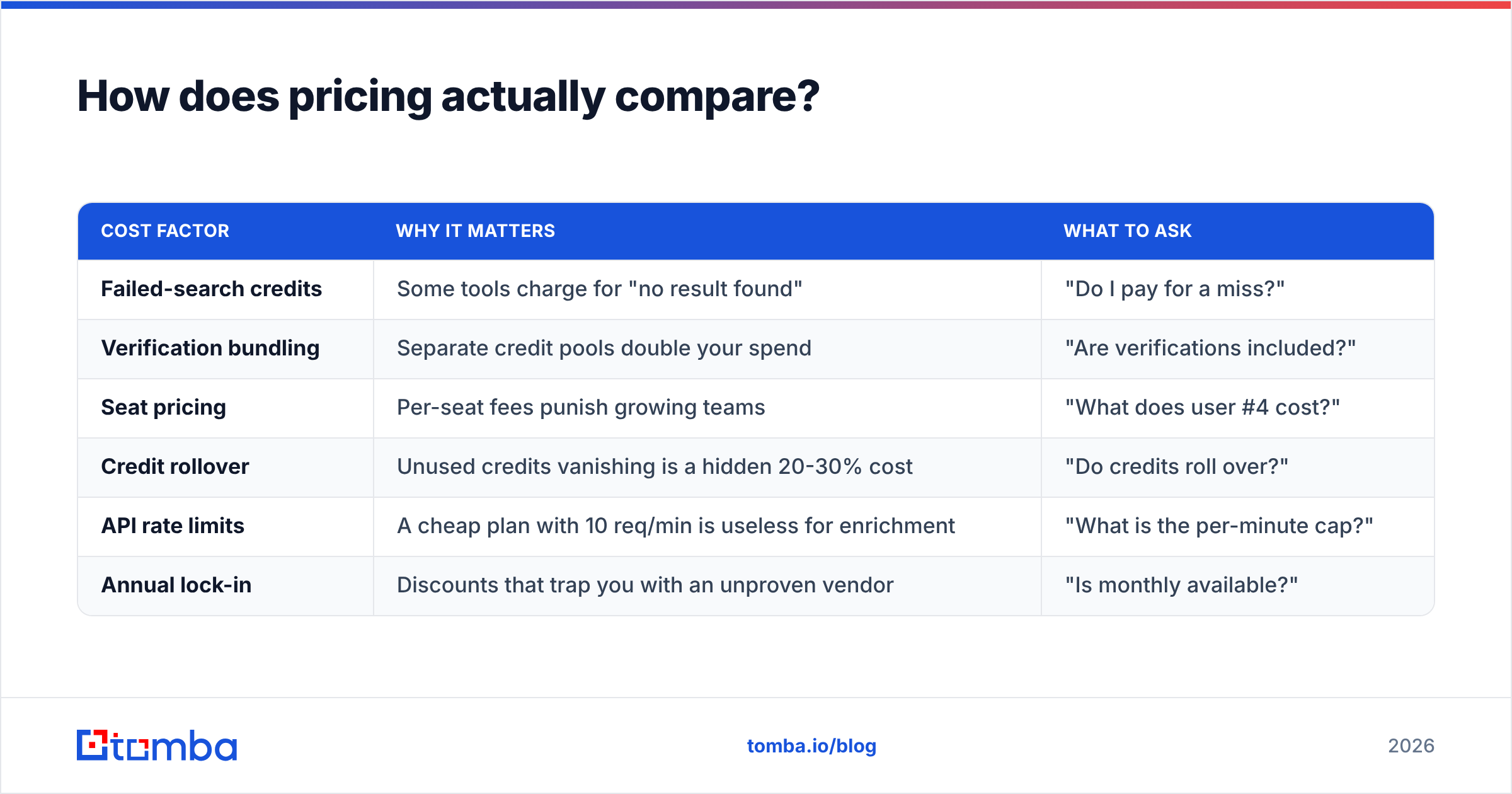
| Cost factor | Why it matters | What to ask |
|---|---|---|
| Failed-search credits | Some tools charge for "no result found" | "Do I pay for a miss?" |
| Verification bundling | Separate credit pools double your spend | "Are verifications included?" |
| Seat pricing | Per-seat fees punish growing teams | "What does user #4 cost?" |
| Credit rollover | Unused credits vanishing is a hidden 20-30% cost | "Do credits roll over?" |
| API rate limits | A cheap plan with 10 req/min is useless for enrichment | "What is the per-minute cap?" |
| Annual lock-in | Discounts that trap you with an unproven vendor | "Is monthly available?" |
For reference, Tomba's pricing runs Free (25 searches/mo), Starter $49/mo, Growth $99/mo, and Pro $249/mo. The point is the step size. Starter to Growth costs $50 more, not $100 more. That bracket is where most mid-sized outbound teams live.
Which one has the better API and integrations?#
Hunter wins this one outright, and it is not close. Its API has been public for close to a decade. The docs include real code samples. It shows up in enough third-party tools that you can usually find a ready-made connector. Say your job is to enrich every new signup row in your warehouse. Hunter is a known quantity, and your engineers can wire it up in an afternoon.
Jet Leads Pro has no API docs at that level. For a UI-only workflow, that may not matter. A rep looking up one contact at a time will never notice. For anything you want to automate, it rules the tool out until proven otherwise.
Weigh this heavily. Email finding is now a pipeline job, not a person job. The teams with real leverage call an email finder API inside their CRM, their signup flow, or their bulk enrichment jobs. They are not copy-pasting from a browser extension.

Where does each tool actually fit?#
Skip the universal winner. Match the tool to the job.
- Solo founder, 20 lookups a week — Take Hunter's free tier. 25 searches a month costs nothing, and the browser extension is genuinely good. There is no reason to gamble on an unproven vendor at this volume.
- Two-person SDR team, 500-1,500 contacts a month — This is the contested bracket. Hunter Starter works, but the Growth cliff arrives fast. Compare cost per verified email across Hunter, Tomba Growth at $99/mo, and any quote Jet Leads Pro will put in writing.
- Agency running lists for several clients — You need bulk processing, dedupe, and verification in one place. Pick the tool with the best bulk email finder and per-client credit tracking. Hunter handles this. Jet Leads Pro is unproven here.
The last three cases are where the two tools stop being interchangeable.
- Engineering-led enrichment in a product or warehouse — API maturity is the only test that counts. Hunter or Tomba. Do not build on an undocumented endpoint.
- Teams that need phone numbers too — Hunter does not do phones. That is a real gap, and it is why teams end up paying for two tools. If phone coverage matters, look for a vendor that ships both.
- Selling into catch-all-heavy markets (enterprise, finance, healthcare) — Most verifiers return "accept-all" and leave you guessing on 20-40% of your list. You need real catch-all resolution. Without it, you are blind on your best accounts.
What are the honest alternatives to both?#

If neither tool fits cleanly, you have real options. The market is mature enough now.
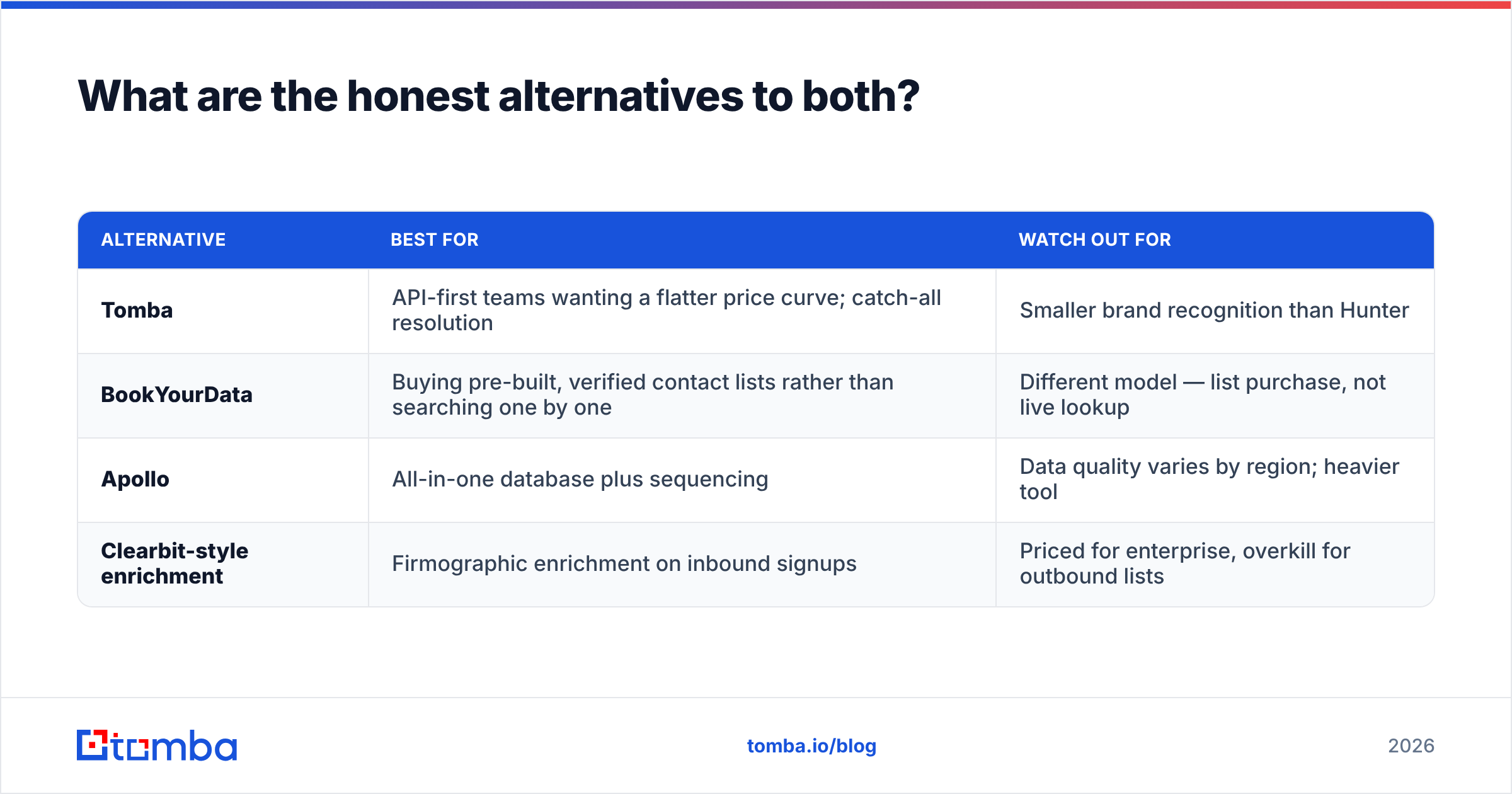
| Alternative | Best for | Watch out for |
|---|---|---|
| Tomba | API-first teams wanting a flatter price curve; catch-all resolution | Smaller brand recognition than Hunter |
| BookYourData | Buying pre-built, verified contact lists rather than searching one by one | Different model — list purchase, not live lookup |
| Apollo | All-in-one database plus sequencing | Data quality varies by region; heavier tool |
| Clearbit-style enrichment | Firmographic enrichment on inbound signups | Priced for enterprise, overkill for outbound lists |
BookYourData earns a mention because it solves a different problem well. Say you know the exact titles and industries you want. Buying a verified list can beat running thousands of one-off searches. Per usable contact, it is often cheaper. It is less a Hunter rival than a Hunter sidekick.
If your issue with Hunter is price and not product, read Apollo alternatives and similar comparison pages first. Do that before you sign an annual deal with a vendor you cannot check.
So, Hunter vs Jet Leads Pro: which one wins?#
Pick Hunter if you want docs, a stable API, and claims you can check before you pay. It is the lower-risk choice. Under a few hundred lookups a month, it is close to free.
Pick Jet Leads Pro only after your own bounce test. Not after a demo. Not after a case study on their site. Send real email to the addresses it finds, then count the hard bounces yourself. If it clears 3% at decent coverage, and they put pricing in writing, it earns a spot on your shortlist. If they will not, you have your answer.
Pick neither if the thing pushing you to switch is the price cliff between tiers. That problem has other fixes, and none of them add vendor risk.
Either way, the rule is the same. Measure cost per verified, delivered email. Never cost per credit. Marketing accuracy numbers cannot be proven or disproven. Your bounce rate can.
Want to run that 200-contact bounce test for free? Start with the Tomba Email Finder free tier. You get 25 searches a month, and no card is required. Put its output head-to-head against your current tool. If the numbers hold up, Starter is $49/mo and Growth is $99/mo, with the same API and catch-all resolution on every paid tier. If they do not, you lost ninety minutes and gained a real benchmark.
Related guides#
// get started
Find, verify and enrich your first contacts today
Start on the free plan with 25 searches a month, then scale when your team is ready.
Free plan · No credit card required · GDPR & CCPA
// about the author