Hunter vs Minelead: Which Email Finder Wins in 2026?
Hunter is the category veteran. Minelead is the cheap challenger with a generous free tier. We tested both on pricing, accuracy, API depth, and catch-all handling to see who actually deserves your budget in 2026.
TL;DR
- Hunter is the safer default: a 2010s-era veteran with the deepest integration ecosystem, the best-known Domain Search UI, and a free tier of 25 monthly searches. You pay for that maturity — plans start around $34/mo and scale steeply.
- Minelead is the budget play: a smaller Belgian/Moroccan-built email finder with a free plan that hands out 50 searches a month and paid tiers that undercut Hunter on raw credit price.
- Accuracy is the real separator. Hunter's confidence scoring and SMTP verification are more transparent; Minelead's results skew toward pattern-guessing on smaller domains and it gives you far less signal about why a result was returned.
- Catch-all domains break both. Neither tool resolves catch-all servers cleanly on its own — if 30%+ of your ICP sits behind Microsoft 365 catch-alls, you need a dedicated catch-all verifier layer.
- Our pick: Hunter if you need reliability and integrations; Minelead if you're a solo founder testing outbound on a shoestring; Tomba if you want Hunter-grade accuracy without Hunter's per-credit tax.
Choosing between Hunter and Minelead is really a choice between paying for maturity and paying for volume. Both find work emails from a name and a domain. Both expose an API. Both have a free tier. From there they diverge sharply — in data sourcing, in how honestly they report confidence, and in what happens when you push past a few thousand lookups a month.
This is a working comparison, not a spec dump. We looked at what each tool actually returns on hard domains, what the pricing does at scale, and where each one quietly fails.
What is Hunter and who is it for?#
Hunter (formerly Email Hunter) is the incumbent. Launched in 2015, it built the category vocabulary most people still use — "domain search," "email finder," "confidence score." Its index is built primarily from public web crawling: company sites, press pages, author bylines, public directories, and open repositories.
Hunter's core loop is simple. Give it a domain, and it returns every email address it has crawled for that domain plus the detected pattern ({first}.{last}@, {f}{last}@, etc.). Give it a name plus a domain, and it constructs the most likely address from the pattern and verifies it via SMTP.
Where Hunter earns its price:
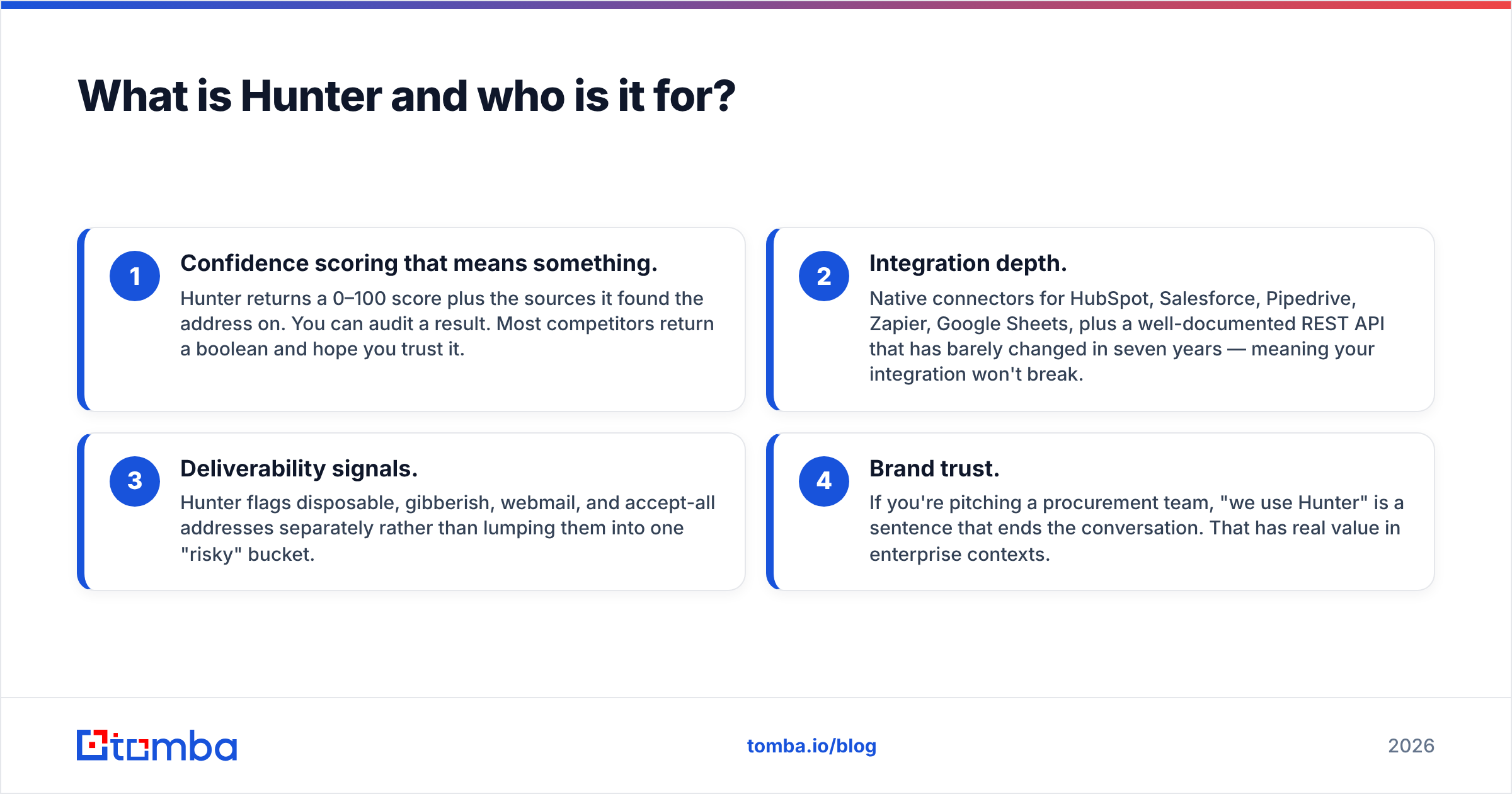
- Confidence scoring that means something. Hunter returns a 0–100 score plus the sources it found the address on. You can audit a result. Most competitors return a boolean and hope you trust it.
- Integration depth. Native connectors for HubSpot, Salesforce, Pipedrive, Zapier, Google Sheets, plus a well-documented REST API that has barely changed in seven years — meaning your integration won't break.
- Deliverability signals. Hunter flags disposable, gibberish, webmail, and accept-all addresses separately rather than lumping them into one "risky" bucket.
- Brand trust. If you're pitching a procurement team, "we use Hunter" is a sentence that ends the conversation. That has real value in enterprise contexts.
Where it frustrates people: credits are consumed aggressively, the free tier is thin at 25 searches per month, and the jump from the entry plan to anything that supports a real outbound motion is expensive.
What is Minelead and how is it different?#
Minelead is the challenger. It is a much younger, much smaller product that positions itself squarely against Hunter on price. Its pitch is straightforward: the same basic capability — domain search, email finder, bulk lookup, a Chrome extension, an API — for meaningfully less money, with a free tier that gives you 50 searches a month instead of Hunter's 25.
Minelead's data model leans harder on pattern generation. For large, well-crawled domains this is fine — the pattern is public and the SMTP check confirms it. For a 40-person SaaS company in Lisbon with no public team page, Minelead is far more likely to return a plausible-looking guess than to return nothing.
That distinction matters more than any pricing difference. A tool that returns nothing costs you a lead. A tool that returns a confident-looking guess costs you a bounce, and bounces cost you sender reputation.

Hunter vs Minelead: how do they compare on paper?#
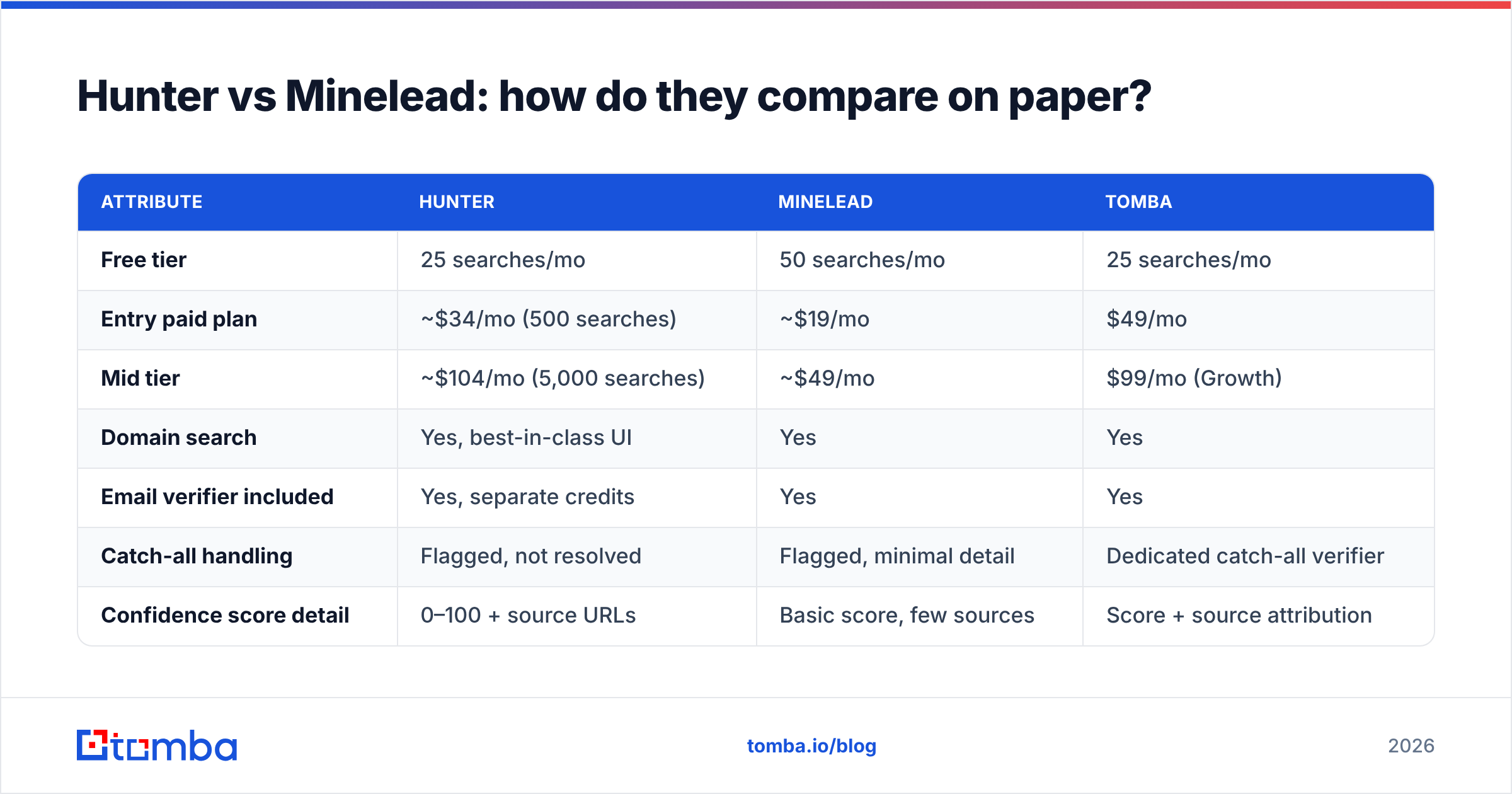
Here's the head-to-head on the attributes that actually change your workflow. Prices reflect publicly listed entry tiers as of 2026 and are billed monthly.
| Attribute | Hunter | Minelead | Tomba |
|---|---|---|---|
| Free tier | 25 searches/mo | 50 searches/mo | 25 searches/mo |
| Entry paid plan | ~$34/mo (500 searches) | ~$19/mo | $49/mo |
| Mid tier | ~$104/mo (5,000 searches) | ~$49/mo | $99/mo (Growth) |
| Domain search | Yes, best-in-class UI | Yes | Yes |
| Email verifier included | Yes, separate credits | Yes | Yes |
| Catch-all handling | Flagged, not resolved | Flagged, minimal detail | Dedicated catch-all verifier |
| Confidence score detail | 0–100 + source URLs | Basic score, few sources | Score + source attribution |
| Phone numbers | No | No | Yes (phone finder) |
| Native CRM integrations | HubSpot, Salesforce, Pipedrive, Zapier | Zapier, limited | HubSpot, Salesforce, Pipedrive, Zapier, Make, Airtable |
| API maturity | Very stable, 7+ years | Functional, thinner docs | Full REST API + CLI + MCP |
| Chrome extension | Yes | Yes | Yes |
| Best for | Teams that need reliability | Solo founders on a budget | Teams wanting accuracy at mid-market pricing |
The pattern is clear: Minelead wins on sticker price and free-tier generosity. Hunter wins on everything that becomes important once you're sending more than a few hundred emails a week.
Which one is more accurate?#
Accuracy is where the comparison stops being about money.
The honest answer: Hunter is more accurate on hard domains, and both tools are roughly equivalent on easy ones. For a Fortune 500 company with a public press page, any email finder in this category will return the right address. The differentiation happens on the long tail — the 20-to-200-person companies that make up most B2B ICPs.
Three things drive the gap:
- Crawl depth. Hunter's index has a decade of accumulated crawling behind it. Minelead's is younger and shallower, which means more reliance on generated permutations.
- Verification honesty. Hunter distinguishes between "verified via SMTP," "accepted by an accept-all server," and "pattern-inferred, unverified." Minelead's output collapses more of that nuance, so a
validfrom Minelead carries less information than avalidfrom Hunter. - Refusal behavior. A good email finder returns nothing when it doesn't know. Tools optimized for perceived hit-rate return a guess. Guessed addresses inflate your apparent coverage and destroy your bounce rate.

The practical test: run 100 contacts from your actual ICP through both free tiers before you pay either one. Don't test on Salesforce and Stripe — test on the mid-market companies you'll really be prospecting. Then send a verification pass through a third-party email verifier and count how many "valid" results survive.
If you want to measure this yourself rather than trusting any vendor's marketing page, G2's email-finder category has enough user-submitted reviews to spot the pattern — the complaints about each tool are more informative than the praise.
How does pricing actually compare at scale?#
Sticker price is misleading in this category because credits behave differently across vendors.
Hunter charges separately for searches and verifications. A single prospect can cost you two credits — one to find the address, one to confirm it. If you find 500 emails and verify all of them, your 500-search plan effectively became a 250-prospect plan.
Minelead's credits are cheaper per unit, but the plan ceilings are lower and the bulk workflow is less refined. If you're processing lists of 10,000+, you'll hit friction that a lower unit price doesn't compensate for.
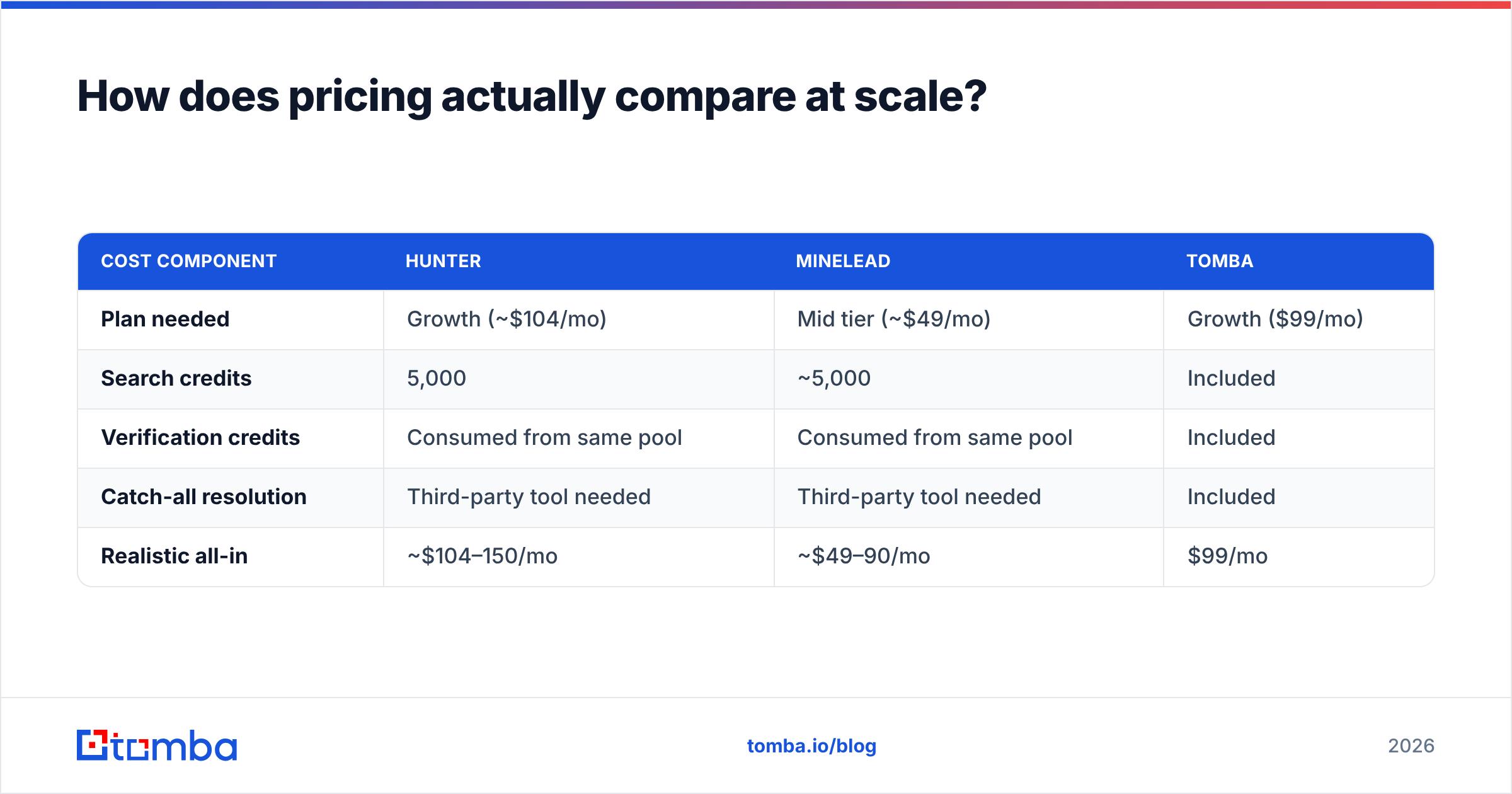
Here's the realistic monthly cost for a two-person outbound team doing 2,000 verified prospects per month:
| Cost component | Hunter | Minelead | Tomba |
|---|---|---|---|
| Plan needed | Growth (~$104/mo) | Mid tier (~$49/mo) | Growth ($99/mo) |
| Search credits | 5,000 | ~5,000 | Included |
| Verification credits | Consumed from same pool | Consumed from same pool | Included |
| Catch-all resolution | Third-party tool needed | Third-party tool needed | Included |
| Realistic all-in | ~$104–150/mo | ~$49–90/mo | $99/mo |
For a fair read on how this compares to full-suite platforms, note that tools like Apollo or BookYourData solve a different problem — they sell you a database plus a sending layer, while Hunter, Minelead, and Tomba sell you the find-and-verify primitive. BookYourData in particular is a solid choice if you'd rather buy a pre-built, human-verified list than run lookups yourself; it's a different purchase, not a worse one. If you want the platform route instead, see our breakdown of Apollo alternatives.

What about catch-all domains?#
This is the failure mode nobody's pricing page mentions.
A catch-all (or accept-all) mail server accepts every message sent to its domain, valid recipient or not. That means the standard SMTP handshake — the technique every email finder uses to verify — returns "accepted" for definitely.not.a.real.person@company.com. Roughly 20–30% of B2B domains are configured this way, and the share is rising as more companies move to Microsoft 365 with default routing.
Hunter flags these honestly. It'll tell you the result is accept_all and give you a lower confidence score. That's correct behavior — it just doesn't solve your problem. You still don't know if the address is real.
Minelead flags catch-alls too, but with less granularity, and its scoring tends to be more optimistic about them.
Neither tool resolves them. Resolving a catch-all requires additional signal: historical engagement data, secondary source corroboration, or probabilistic modeling against known-good patterns on the same domain. That's why a dedicated catch-all verifier exists as a separate product category — and why your bounce rate on catch-all-heavy lists will be worse than your tool's dashboard suggests.
If you're running cold outbound at any volume, understand that catch-all mishandling is one of the top three causes of degraded email deliverability. Google and Microsoft both tightened bulk-sender requirements, and Google's Postmaster Tools guidance is explicit that maintaining a low bounce rate is non-negotiable for bulk senders.

When should you pick Hunter?#
Pick Hunter when:
- You need integrations that don't break. Hunter's API and CRM connectors are the most battle-tested in the category. If your RevOps stack depends on an email-finder call inside an automation, stability is worth more than $30/mo.
- You're selling into enterprise. Procurement recognizes the name. Security reviews go faster.
- Your team includes non-technical users. Hunter's Domain Search interface is genuinely the best-designed in the category. A junior SDR can be productive in it in ten minutes.
- You're doing low-volume, high-value prospecting. 200 perfectly researched contacts a month? Hunter's credits go far enough and the accuracy is worth the premium.
Skip Hunter when your volume is high and your budget is fixed. The credit math gets punishing above 5,000 lookups a month.
When should you pick Minelead?#
Pick Minelead when:
- You're pre-revenue and testing. The 50-search free tier is genuinely useful for validating whether cold outbound works for your motion before you spend anything.
- Your ICP is large, well-known companies. Pattern-based finding works fine when the pattern is public. Minelead will match Hunter's results on these domains at a third of the cost.
- You're already verifying separately. If you run every result through a dedicated verification layer before sending, Minelead's weaker native verification matters much less. You're buying it as a cheap candidate generator, not a source of truth.
- You need a second opinion. Running the same list through two finders and taking the intersection is a legitimate accuracy strategy — and Minelead is cheap enough to be the second finder.
Skip Minelead when you're prospecting into small and mid-market companies at volume, or when a bounce is expensive. The savings evaporate the first time a guessed address lands you on a blocklist.
Is there a better option than both?#
Depends what you're optimizing for — but there's a structural gap between these two that's worth naming.
Hunter charges enterprise-adjacent prices for a single-purpose tool. Minelead charges startup prices but gives up accuracy and catch-all handling to get there. Neither includes phone numbers, neither resolves catch-alls, and both make you buy verification credits from the same pool as your search credits.
That gap is exactly where Tomba sits. Growth is $99/mo with catch-all verification, phone lookup, and enrichment included rather than metered separately. The free tier is 25 searches — same as Hunter's — but the paid tiers bundle capabilities the other two sell as add-ons or don't sell at all. Full Tomba pricing is public, and the data sources are documented rather than hand-waved.
Three specific advantages worth weighing:
- Catch-all resolution is native, not a bolt-on. No separate vendor, no second subscription.
- The API surface is wider. REST plus a Tomba CLI and an MCP server, which matters if you're wiring lookups into AI agents or internal tooling.
- Enrichment is included. Job title, company size, LinkedIn URL, and phone come back with the email rather than requiring a second vendor call.
None of that makes Hunter a bad choice. Hunter is a good product with a decade of refinement behind it, and if you're already deep in its ecosystem, switching costs may outweigh the savings. And Minelead does exactly what it says it does at a price that's hard to argue with for early-stage testing.
How should you actually decide?#
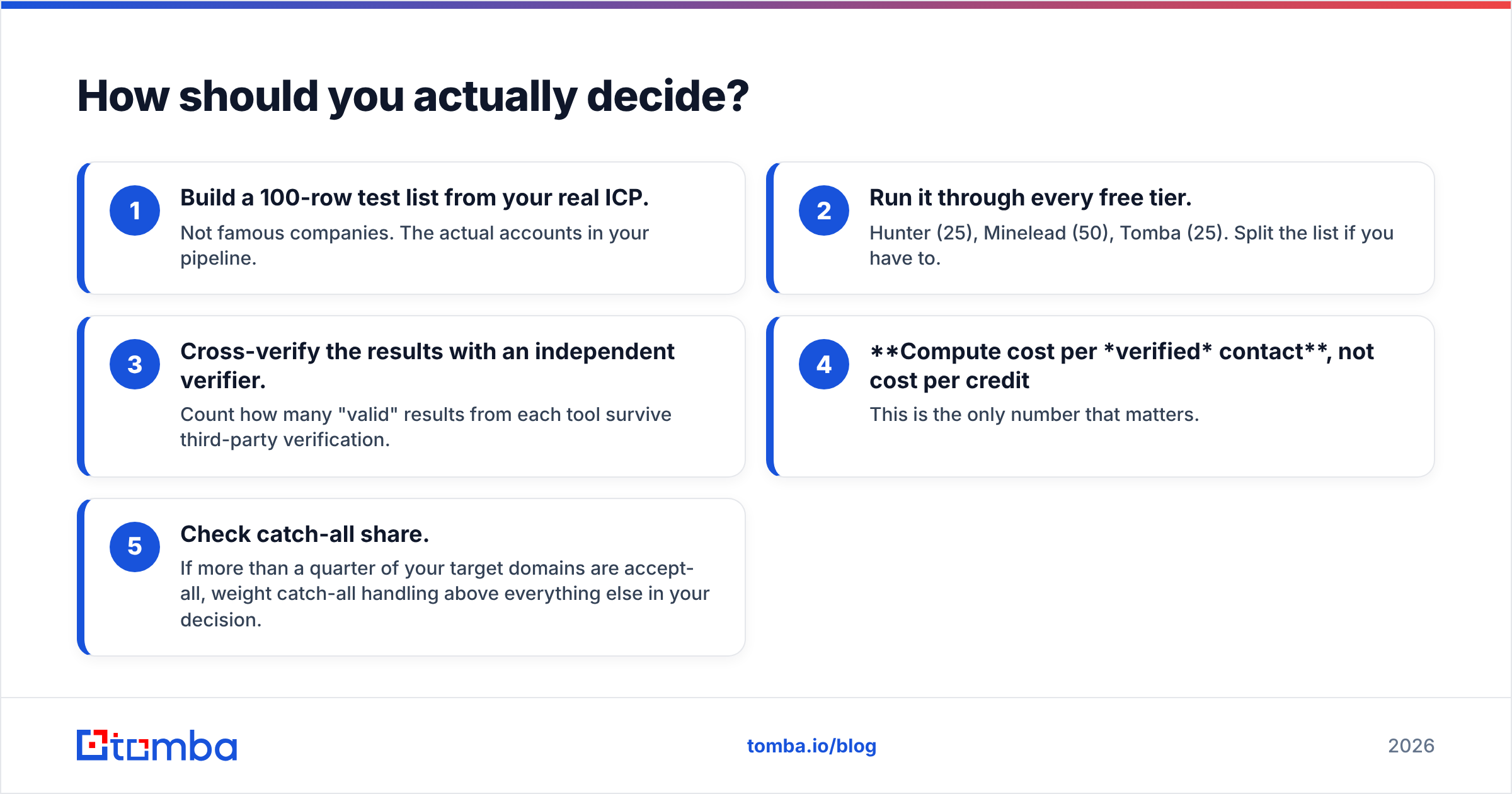
Run this sequence, in order:
- Build a 100-row test list from your real ICP. Not famous companies. The actual accounts in your pipeline.
- Run it through every free tier. Hunter (25), Minelead (50), Tomba (25). Split the list if you have to.
- Cross-verify the results with an independent verifier. Count how many "valid" results from each tool survive third-party verification.
- Compute cost per verified contact, not cost per credit. This is the only number that matters.
- Check catch-all share. If more than a quarter of your target domains are accept-all, weight catch-all handling above everything else in your decision.
Most teams skip step 4 and buy on sticker price. Then they wonder why their bounce rate is 8% and their response rate is falling.
The bottom line#
Hunter and Minelead are solving the same problem at opposite ends of the price-reliability curve. Hunter is the safe, integrated, well-documented incumbent that costs more than it probably should. Minelead is the honest budget option that's good enough for easy domains and risky on hard ones.
If your outbound depends on hitting real inboxes at mid-market companies — where catch-alls are common and public data is thin — neither entry tier is really built for that job.
Start with the Tomba Email Finder free tier and run the same 25 contacts you're about to test in Hunter and Minelead. Compare cost per verified contact, not cost per credit. If Tomba doesn't win on your list, you'll have learned that in an afternoon for nothing — and you'll have a much better basis for picking between the other two.
Related guides#
// get started
Find, verify and enrich your first contacts today
Start on the free plan with 25 searches a month, then scale when your team is ready.
Free plan · No credit card required · GDPR & CCPA
// about the author