ICP Segmentation in 2026: How to Tier Your Best-Fit Accounts
Most teams write one ICP paragraph and call it strategy. Here's how to segment an ICP into tiers you can actually route, price, and prospect against — with the data fields, scoring math, and tooling that make it stick.
TL;DR
- ICP segmentation splits your ideal customer profile into 3-4 tiers with different data signals, different messaging, and different cost-to-serve — not one paragraph that says "mid-market SaaS in North America."
- The tiers that actually move revenue are built from three data layers: firmographic (who they are), technographic (what they run), and behavioral (what they just did). Firmographics alone produce lazy lists.
- Segment sizing is the step teams skip. If your Tier 1 has 80 accounts, it's an ABM list, not a segment. If it has 40,000, you haven't segmented anything.
- Validate segments against closed-won data, not opinions. Win rate, sales cycle length, and 12-month net revenue retention per segment are the only scoreboard that matters.
- Tooling matters less than the field schema, but you still need a contact layer that can hydrate segment definitions into real, verified people — otherwise segmentation stays a slide.
What is ICP segmentation?#
ICP segmentation is the practice of breaking a single ideal customer profile into distinct, addressable sub-groups that each get their own targeting rules, message, channel mix, and sales motion.
Think of it like a restaurant's menu versus its kitchen. Your ICP is the menu — "we serve Italian food." Segmentation is the kitchen prep list: which dishes take 4 minutes and which take 40, which ingredients you stock daily, which orders you refuse during the dinner rush. The menu wins you customers. The prep list decides whether you make money on them.
Technically, an ICP describes account-level fit — company size, industry, geography, tech stack, funding stage, regulatory exposure. Segmentation adds a second axis: how much that fit is worth and what it costs to capture. A 200-person fintech and a 200-person marketing agency can both match your ICP on headcount and both be terrible neighbors on a target list, because one closes in 34 days and the other in 190.
The distinction matters because most GTM waste happens inside a correct ICP. Your reps aren't emailing random companies. They're emailing companies that technically qualify and structurally never buy.
Why does ICP segmentation matter more in 2026?#
Three things changed, and they compound.
Outbound volume stopped working as a lever. Inbox providers tightened bulk-sender enforcement, and the practical ceiling on cold volume per domain dropped hard. When you could send 400 emails a day per mailbox, a sloppy segment was survivable — you brute-forced past it. At 30-50 sends per mailbox, every wasted send is a real opportunity cost. Precision replaced volume as the only scalable input.
Buying committees got bigger and slower. Gartner's long-running research on B2B buying groups puts the typical enterprise purchase at 6-10 stakeholders, and that number hasn't shrunk. Segmentation determines which personas you need in a deal at all. A self-serve segment needs one champion; an enterprise segment needs a champion, a security reviewer, and a budget owner — three different data requirements, three different sequences.
AI made list-building cheap and list-quality the actual differentiator. Anyone can generate 50,000 rows now. What nobody can fake is knowing which 1,200 of those rows deserve a human touch this quarter.

What data actually defines a segment?#
Use three layers. Skip any one of them and the segment collapses into a job title filter.
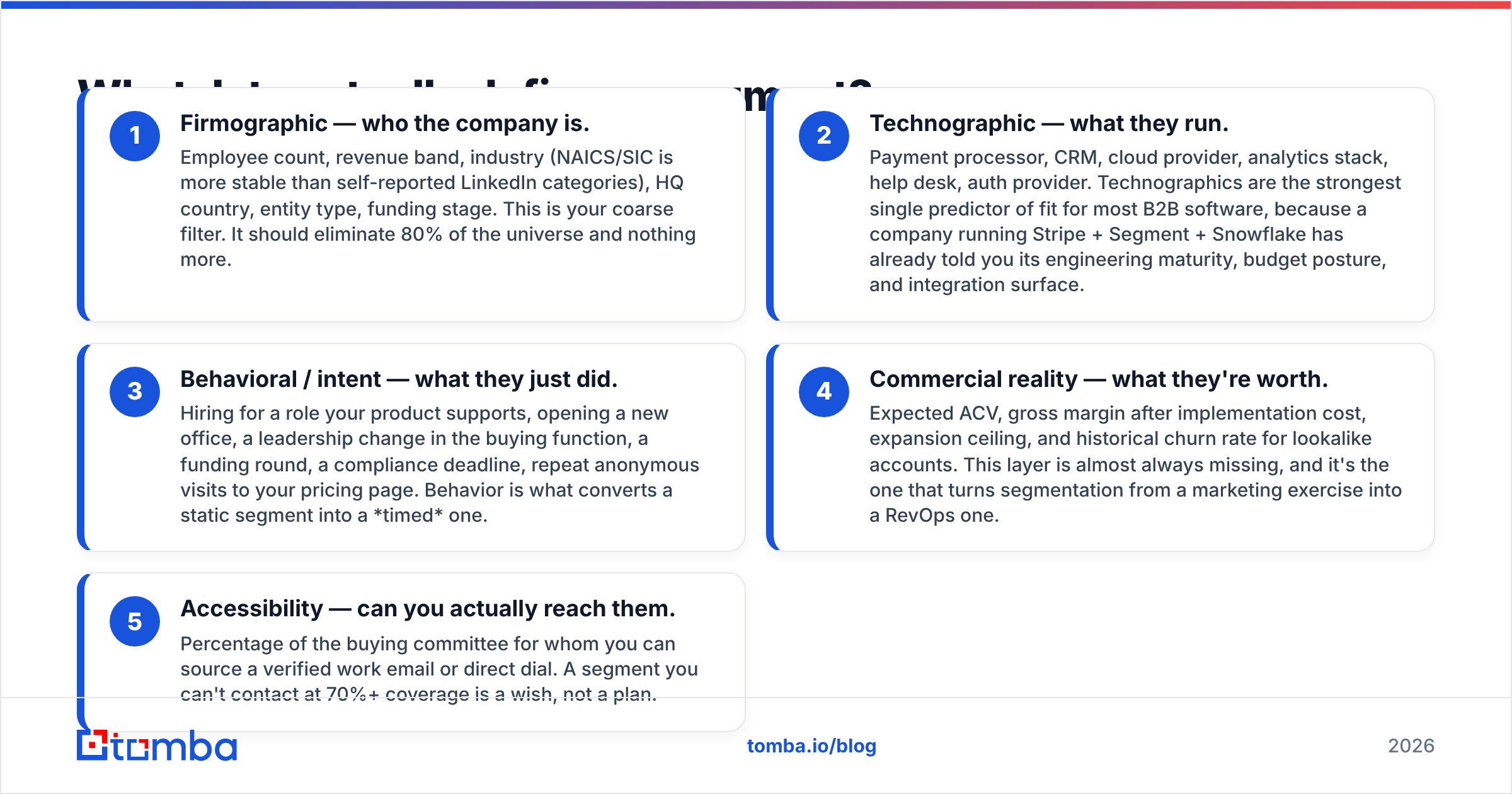
Firmographic — who the company is. Employee count, revenue band, industry (NAICS/SIC is more stable than self-reported LinkedIn categories), HQ country, entity type, funding stage. This is your coarse filter. It should eliminate 80% of the universe and nothing more.
Technographic — what they run. Payment processor, CRM, cloud provider, analytics stack, help desk, auth provider. Technographics are the strongest single predictor of fit for most B2B software, because a company running Stripe + Segment + Snowflake has already told you its engineering maturity, budget posture, and integration surface.
Behavioral / intent — what they just did. Hiring for a role your product supports, opening a new office, a leadership change in the buying function, a funding round, a compliance deadline, repeat anonymous visits to your pricing page. Behavior is what converts a static segment into a timed one.
Commercial reality — what they're worth. Expected ACV, gross margin after implementation cost, expansion ceiling, and historical churn rate for lookalike accounts. This layer is almost always missing, and it's the one that turns segmentation from a marketing exercise into a RevOps one.
Accessibility — can you actually reach them. Percentage of the buying committee for whom you can source a verified work email or direct dial. A segment you can't contact at 70%+ coverage is a wish, not a plan.
That last point is where most segmentation decks die. A beautiful Tier 1 definition that resolves to accounts where you can only find generic info@ addresses will underperform a scruffier Tier 2 you can actually reach. Coverage is a segment attribute. Treat it like one — a domain search sweep across a sample of 100 accounts per candidate segment tells you the answer in an afternoon.
How do you build ICP tiers that survive contact with a sales team?#
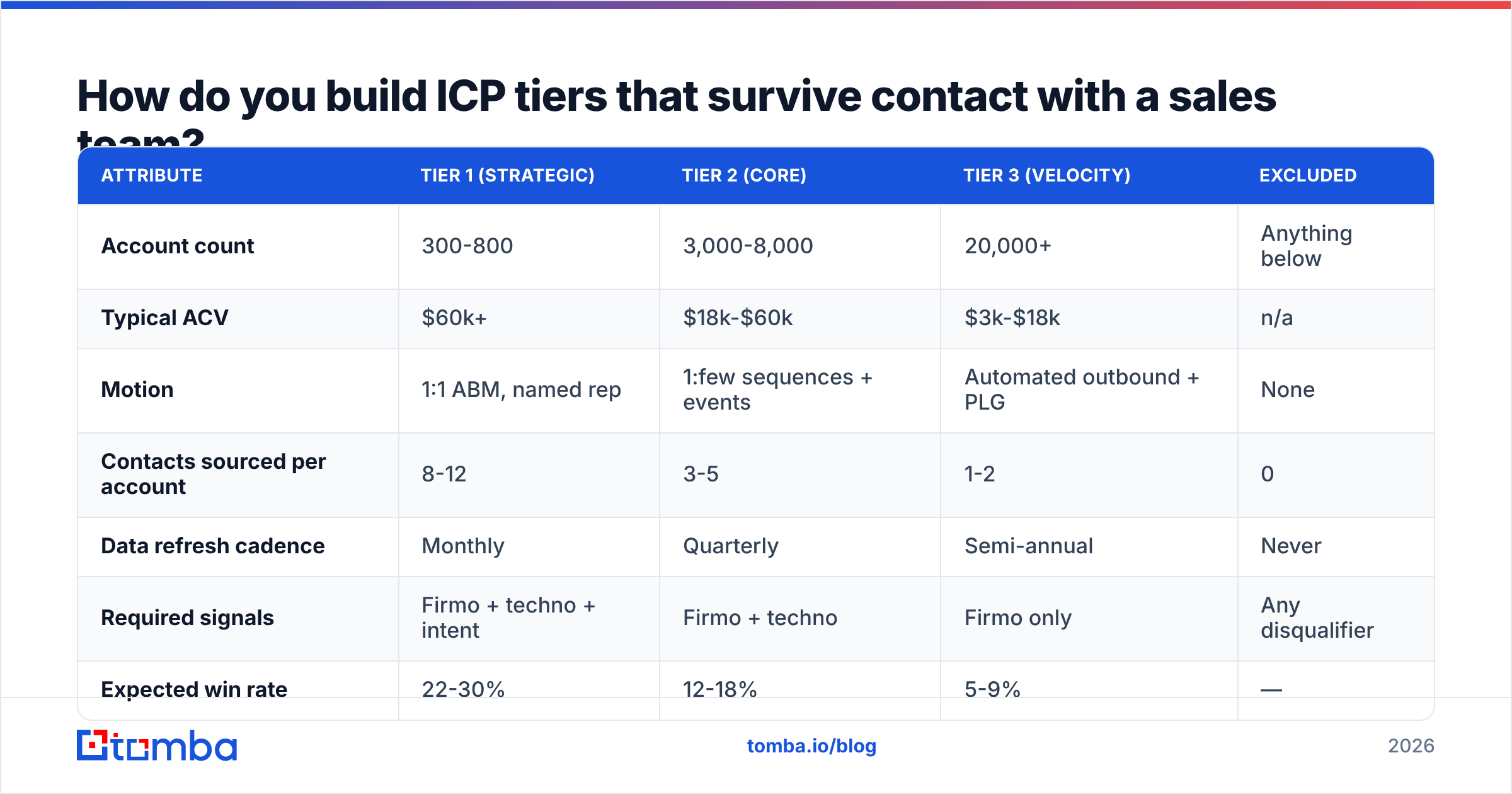
Build three tiers plus an explicit exclusion list. Four is the practical maximum before reps stop remembering which is which.
| Attribute | Tier 1 (Strategic) | Tier 2 (Core) | Tier 3 (Velocity) | Excluded |
|---|---|---|---|---|
| Account count | 300-800 | 3,000-8,000 | 20,000+ | Anything below |
| Typical ACV | $60k+ | $18k-$60k | $3k-$18k | n/a |
| Motion | 1:1 ABM, named rep | 1:few sequences + events | Automated outbound + PLG | None |
| Contacts sourced per account | 8-12 | 3-5 | 1-2 | 0 |
| Data refresh cadence | Monthly | Quarterly | Semi-annual | Never |
| Required signals | Firmo + techno + intent | Firmo + techno | Firmo only | Any disqualifier |
| Expected win rate | 22-30% | 12-18% | 5-9% | — |
| Cost-to-acquire ceiling | 1.2x ACV | 0.8x ACV | 0.3x ACV | — |
The win-rate column is the honest one. If your Tier 1 doesn't win meaningfully more often than Tier 3, you don't have tiers — you have a size sort. Rebuild using different signals.
The exclusion list deserves more respect than it usually gets. Write down the disqualifiers explicitly: industries with procurement cycles you can't fund, geographies where you can't support the timezone, company sizes below your minimum viable seat count, and any tech stack that makes integration impossible. Publish it. A rep who knows what not to work moves faster than one holding a vague positive definition.
Firmographic vs technographic vs behavioral segmentation: which wins?#
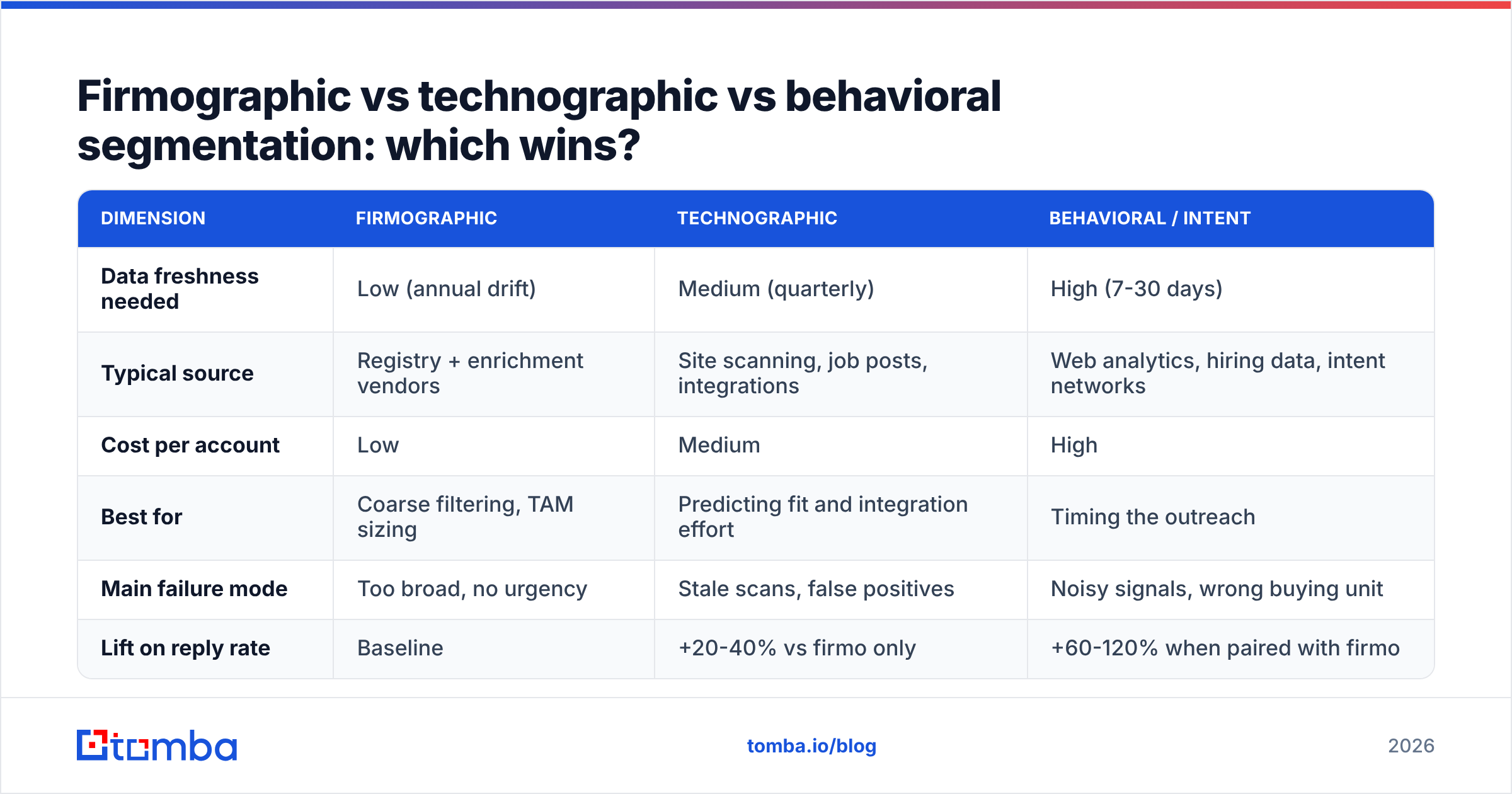
None of them alone. But they fail differently, and knowing the failure mode tells you which to lead with.
| Dimension | Firmographic | Technographic | Behavioral / Intent |
|---|---|---|---|
| Data freshness needed | Low (annual drift) | Medium (quarterly) | High (7-30 days) |
| Typical source | Registry + enrichment vendors | Site scanning, job posts, integrations | Web analytics, hiring data, intent networks |
| Cost per account | Low | Medium | High |
| Best for | Coarse filtering, TAM sizing | Predicting fit and integration effort | Timing the outreach |
| Main failure mode | Too broad, no urgency | Stale scans, false positives | Noisy signals, wrong buying unit |
| Lift on reply rate | Baseline | +20-40% vs firmo only | +60-120% when paired with firmo |
The practical sequence: firmographics to define the universe, technographics to rank it, behavior to schedule it. Universe → ranking → timing. Teams that lead with intent data and no firmographic base end up chasing well-timed outreach to companies that will never buy.
How do you size and validate a segment?#
Run four checks before a segment goes live.
1. TAM check. Count the accounts that match the definition. If the number is under ~150, you've defined a target account list, and you should manage it as ABM with named owners. If it's over ~50,000, you've defined a market, not a segment.
2. Historical back-test. Apply the segment definition retroactively to your last 8 quarters of closed-won and closed-lost. Compute win rate, median cycle length, median ACV, and 12-month retention. A segment that looks brilliant prospectively and underperforms historically is usually capturing a proxy variable — often "companies our best rep happened to work."
3. Coverage check. Sample 100 accounts. For each, try to source the full buying committee. Measure the share where you can reach at least 70% of required roles with verified contacts. Under 50% coverage, the segment is not workable at your current data stack. Running the sample through a bulk email finder and then a verification pass gives you a hard number instead of a hunch.
4. Message test. Can you write one specific, non-generic first line that is true for every account in the segment? If the only honest opener is "I saw you're a B2B company," the segment is too broad. This is the cheapest test and the one most likely to save you a quarter.
What tools do you need for ICP segmentation?#
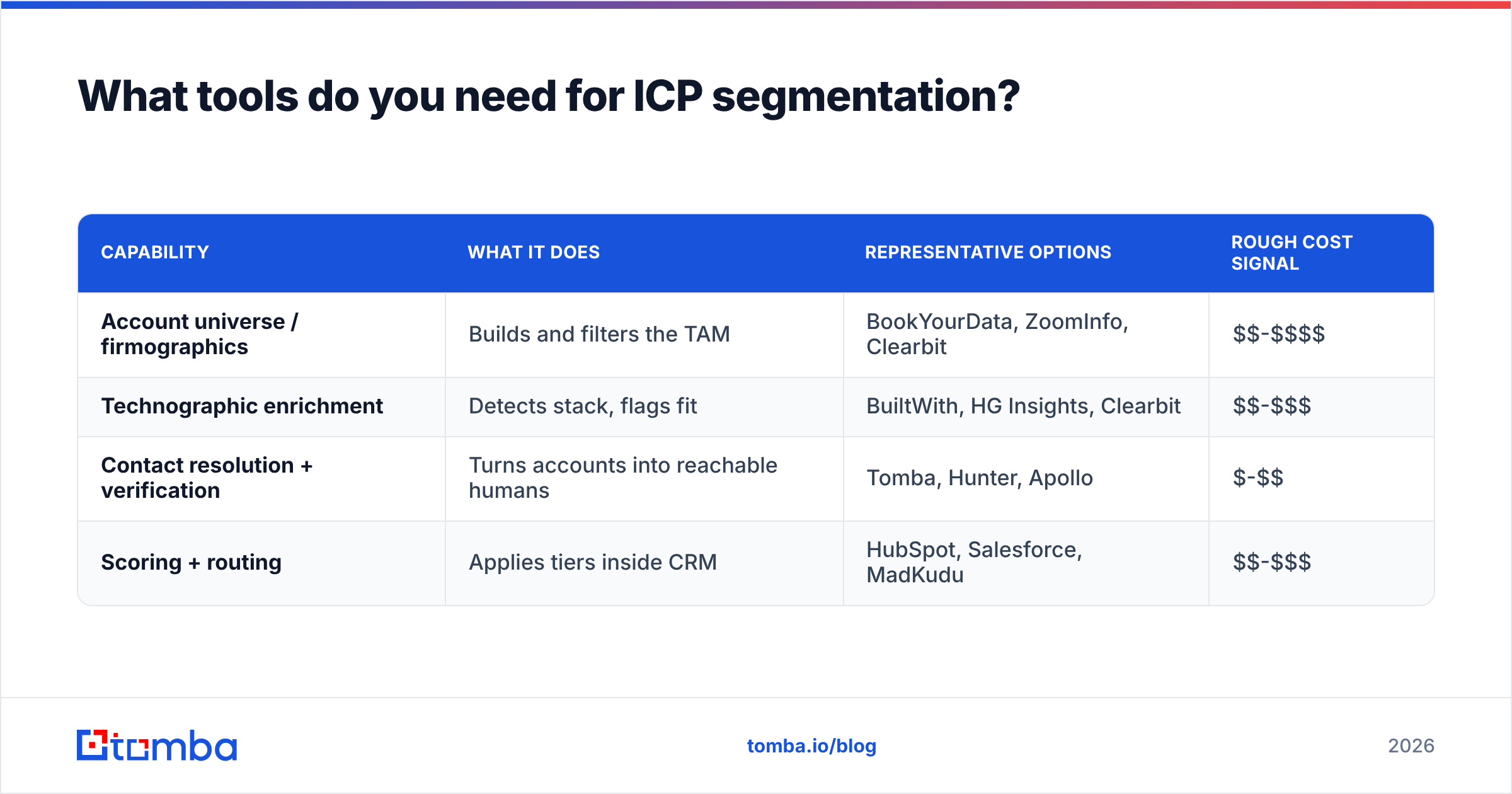
Fewer than vendors would like you to believe. You need four capabilities, and several tools cover more than one.
| Capability | What it does | Representative options | Rough cost signal |
|---|---|---|---|
| Account universe / firmographics | Builds and filters the TAM | BookYourData, ZoomInfo, Clearbit | $$-$$$$ |
| Technographic enrichment | Detects stack, flags fit | BuiltWith, HG Insights, Clearbit | $$-$$$ |
| Contact resolution + verification | Turns accounts into reachable humans | Tomba, Hunter, Apollo | $-$$ |
| Scoring + routing | Applies tiers inside CRM | HubSpot, Salesforce, MadKudu | $$-$$$ |
Two notes on selection.
BookYourData is worth a look when you want to purchase a bounded, pre-verified list for a specific segment rather than run continuous enrichment — it's a straightforward fit for teams that need a clean Tier 3 universe fast without committing to a platform contract. It solves a different problem than a continuous API-driven contact layer, and plenty of teams run both.
On the contact layer, price per resolved contact matters more than sticker price, because segmentation multiplies your lookup volume. Tomba pricing starts with a free tier at 25 searches/month, then Starter at $49/mo, Growth at $99/mo, and Pro at $249/mo, with an email finder API if you want segmentation to run as a scheduled job rather than a manual export. The relevant question isn't "which vendor has the biggest database" — it's "which one returns a verified contact for the accounts in my Tier 1," and you answer that with a 100-account bake-off, not a G2 grid. (Though G2 is a reasonable place to start a shortlist.)
For scoring and routing, resist buying anything new until your CRM's native scoring has failed you. HubSpot and Salesforce both handle three-tier account scoring natively. Most teams that buy a dedicated scoring tool did so because their data was dirty, not because their math was hard.
How do you operationalize segmentation without a six-month project?#
Ship it in one quarter, in this order.
Week 1-2: Define and back-test. Pull closed-won/lost, cluster by the three data layers, write three tier definitions and one exclusion list. Get the head of sales to sign it. Written approval prevents the slow drift back to "everyone is a prospect."
Week 3-4: Stamp the CRM. Add a single icp_tier picklist field on the account object. Not five fields — one, with the inputs stored separately. Backfill it. Every downstream report keys off this field, so it must be authoritative and it must be automated, never rep-editable.
Week 5-6: Hydrate contacts by tier. Tier 1 gets deep coverage — 8-12 verified contacts across the committee, refreshed monthly. Tier 3 gets one contact and no refresh. Run the sourcing as a batch job through data enrichment so the coverage rate is measurable rather than anecdotal.
Week 7-8: Split the plays. Different sequence templates, different channel mix, different SLAs per tier. Tier 1 inbound leads get a 5-minute response SLA; Tier 3 gets an automated nurture. This is where segmentation converts into money.
Week 9+: Instrument and review. Report win rate, cycle length, ACV, and pipeline coverage by tier in every forecast call. If tier isn't in the forecast deck, the field will rot inside two quarters. This is standard revenue operations hygiene — the segmentation is only as durable as the reporting that depends on it.
What mistakes kill ICP segmentation?#
- Segmenting by persona instead of account. "VP of Marketing" is not a segment. It's a role that exists in both your best and worst accounts.
- Too many tiers. Five tiers means reps use two and ignore three. Three tiers plus exclusions is the ceiling.
- Never re-running the back-test. Markets drift. Re-validate every two quarters against fresh closed-won data.
- Letting reps edit the tier field. Within a month, every account a rep likes becomes Tier 1.
- Ignoring cost-to-serve. A segment with great win rates and brutal support load is a margin problem wearing a growth costume.
- Building on unverified contact data. Segment definitions that resolve to bounced addresses inflate your apparent TAM and destroy sender reputation at the same time. Run every sourced list through an email verifier before it touches a sending domain.
- Treating catch-all domains as unreachable. A large share of enterprise domains are catch-all, and writing them off silently removes some of your best accounts from Tier 1. Handle them explicitly with catch-all verification rather than deleting them.
What does good look like after two quarters?#
Concretely: Tier 1 wins at roughly 2-3x the rate of Tier 3, your cost per opportunity drops even as total send volume falls, and your forecast calls stop arguing about whether a deal is "a good fit" because the field already answered it. Pipeline coverage becomes predictable per tier, which is the point — segmentation is ultimately a forecasting tool that happens to improve targeting.
If none of that shows up, the problem is almost always the data layer underneath, not the tier logic on top. Segments built on stale firmographics and unverified contacts produce confident-looking dashboards and flat revenue.
Start with the reachability layer. Segment definitions are free; verified humans inside those segments are not. Run your Tier 1 account list through the Tomba Email Finder to see what real coverage looks like across your best-fit accounts — the free tier covers 25 searches a month, which is enough to sanity-check a segment before you commit budget to it. If the coverage number comes back strong, you have a segment. If it doesn't, you just saved yourself a quarter.
Related guides#
// get started
Find, verify and enrich your first contacts today
Start on the free plan with 25 searches a month, then scale when your team is ready.
Free plan · No credit card required · GDPR & CCPA
// about the author