Ideal Customer Profile: How to Define and Use One in 2026
Most B2B teams write an ideal customer profile once, file it in Notion, and never use it again. Here is how to build one from closed-won data, test it, and wire it into your prospecting list.
TL;DR
- An ideal customer is an account-level definition — firmographics, technographics, and trigger events — not a persona with a stock photo and a name like "Marketing Mary."
- Build it from your closed-won data, not a brainstorm. Pull your best 20-40 accounts, find what they share, and write down the three attributes that actually predict revenue.
- Test it: a real ideal customer profile (ICP) should shrink your target list, not grow it. If yours produces 40,000 accounts, it is a market segment, not an ICP.
- The ICP is worthless until it becomes a list. Convert attributes into search filters, then find verified contacts at those accounts.
- Re-score quarterly. ICPs decay when you move upmarket, change pricing, or ship a feature that opens a new segment.
What is an ideal customer, exactly?#
An ideal customer is the account type that gets the most value from your product in the shortest time, at the lowest cost to acquire and serve. That last clause is where most definitions fall apart. Plenty of teams define "ideal" as "biggest logo we ever closed" and then spend two years chasing enterprise deals that take 11 months and churn at renewal.
The honest definition is economic. An account belongs in your ideal customer profile when it clears four bars at once:
- It converts at an above-average rate. Your win rate against this segment beats your blended win rate by a meaningful margin.
- It closes faster than average. Shorter sales cycles mean lower CAC and less pipeline rot.
- It retains. Net revenue retention above 100% inside the segment, or at minimum no elevated churn.
- It expands or refers. The account grows seats, adds products, or sends you similar accounts.
If a segment only clears one or two bars, it is a viable customer, not an ideal one. That distinction matters because sales capacity is finite. Every rep-hour spent on a viable account is an hour not spent on an ideal one.

How is an ideal customer profile different from a buyer persona?#
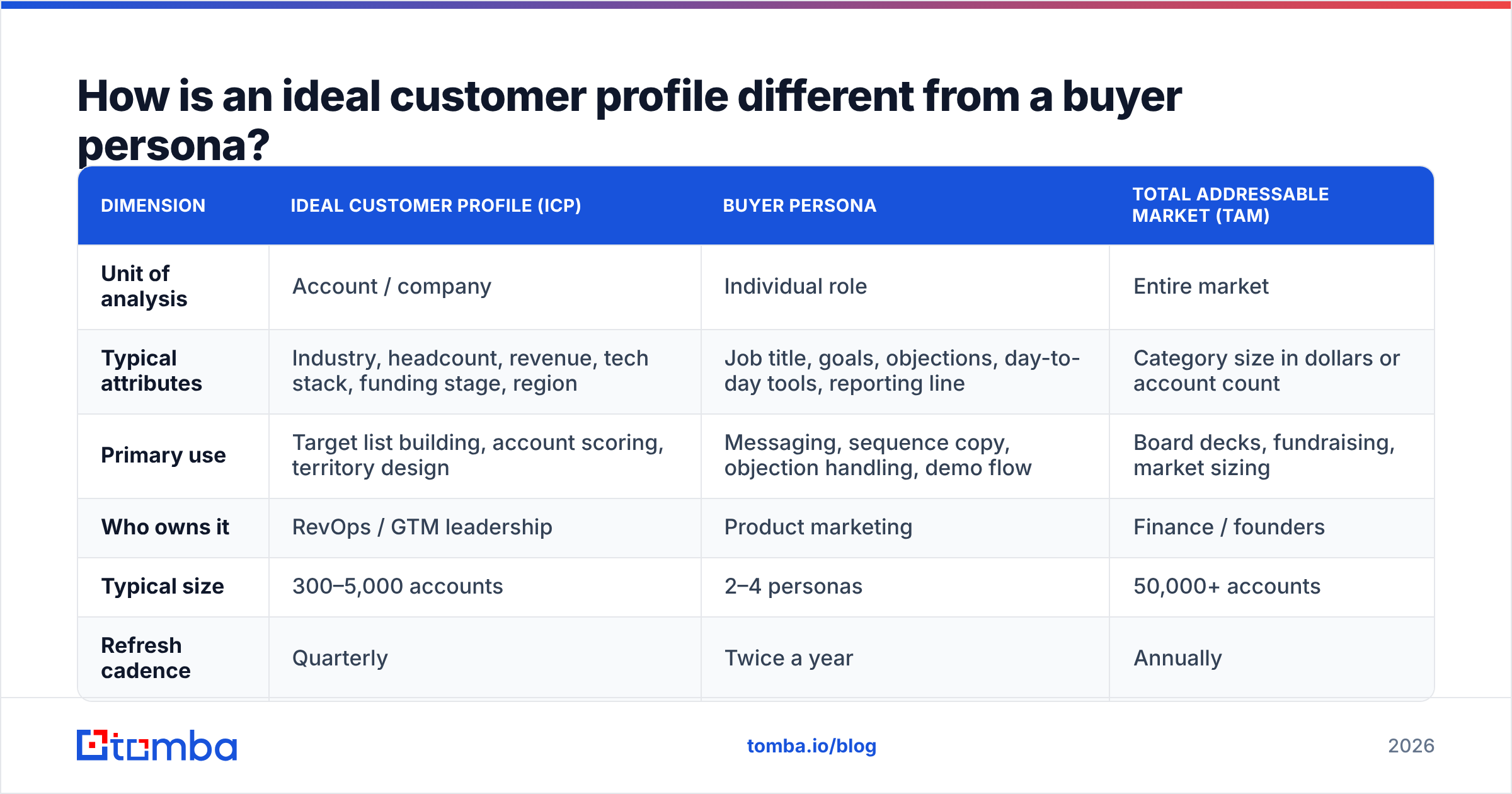
They operate at different levels, and conflating them is the most common ICP mistake in B2B. The ICP describes the company you sell to. The persona describes the human inside that company who signs, uses, or blocks the deal.
| Dimension | Ideal customer profile (ICP) | Buyer persona | Total addressable market (TAM) |
|---|---|---|---|
| Unit of analysis | Account / company | Individual role | Entire market |
| Typical attributes | Industry, headcount, revenue, tech stack, funding stage, region | Job title, goals, objections, day-to-day tools, reporting line | Category size in dollars or account count |
| Primary use | Target list building, account scoring, territory design | Messaging, sequence copy, objection handling, demo flow | Board decks, fundraising, market sizing |
| Who owns it | RevOps / GTM leadership | Product marketing | Finance / founders |
| Typical size | 300–5,000 accounts | 2–4 personas | 50,000+ accounts |
| Refresh cadence | Quarterly | Twice a year | Annually |
You need all three, and they nest. TAM is everyone who could theoretically buy. The ICP is the slice worth spending money on. Personas are the people inside ICP accounts you actually write to. A sequence targeted at the right persona inside a wrong-fit account still fails — you just fail with better copy.
Which attributes actually belong in an ideal customer profile?#
Start with the ones you can filter on. An attribute that cannot be turned into a search query is a nice observation, not a targeting criterion. "They value data quality" is unfilterable. "They run HubSpot and have 3+ SDRs listed on LinkedIn" is filterable.
Group your attributes into four buckets:
- Firmographic — headcount, revenue band, industry (use the specific sub-vertical, not "SaaS"), geography, entity type, funding stage. These are the cheapest to source and the easiest to over-weight.
- Technographic — the tools already in the stack. This is the single most underused ICP dimension in B2B. If your product replaces or plugs into a specific tool, the presence of that tool is a stronger buy signal than headcount ever will be.
- Behavioral / trigger — hiring for a role your product supports, recent funding round, a new VP of Sales, opening a second office, a pricing page change, appearing on a review site comparison page. Triggers give you timing, which is the difference between a cold email and a relevant one.
- Operational fit — do they have the budget authority, the compliance posture, the integration surface, and the internal owner needed to actually deploy you? A perfect firmographic match with no admin to own the rollout will stall in onboarding.
A practical rule from working with outbound teams: your ICP should end up with three to five hard filters and two to three soft signals. Fewer than three and your list is noise. More than seven and you have described exactly your six existing customers, which is not a market.
How do you build an ideal customer profile from closed-won data?#
Skip the workshop. Open your CRM.
Step 1 — Export your closed-won accounts from the last 12–18 months. Include deal value, sales cycle length, source, and current status (active, churned, expanded). If you have fewer than 20 closed-won deals, supplement with closed-lost and look at which segments got furthest.
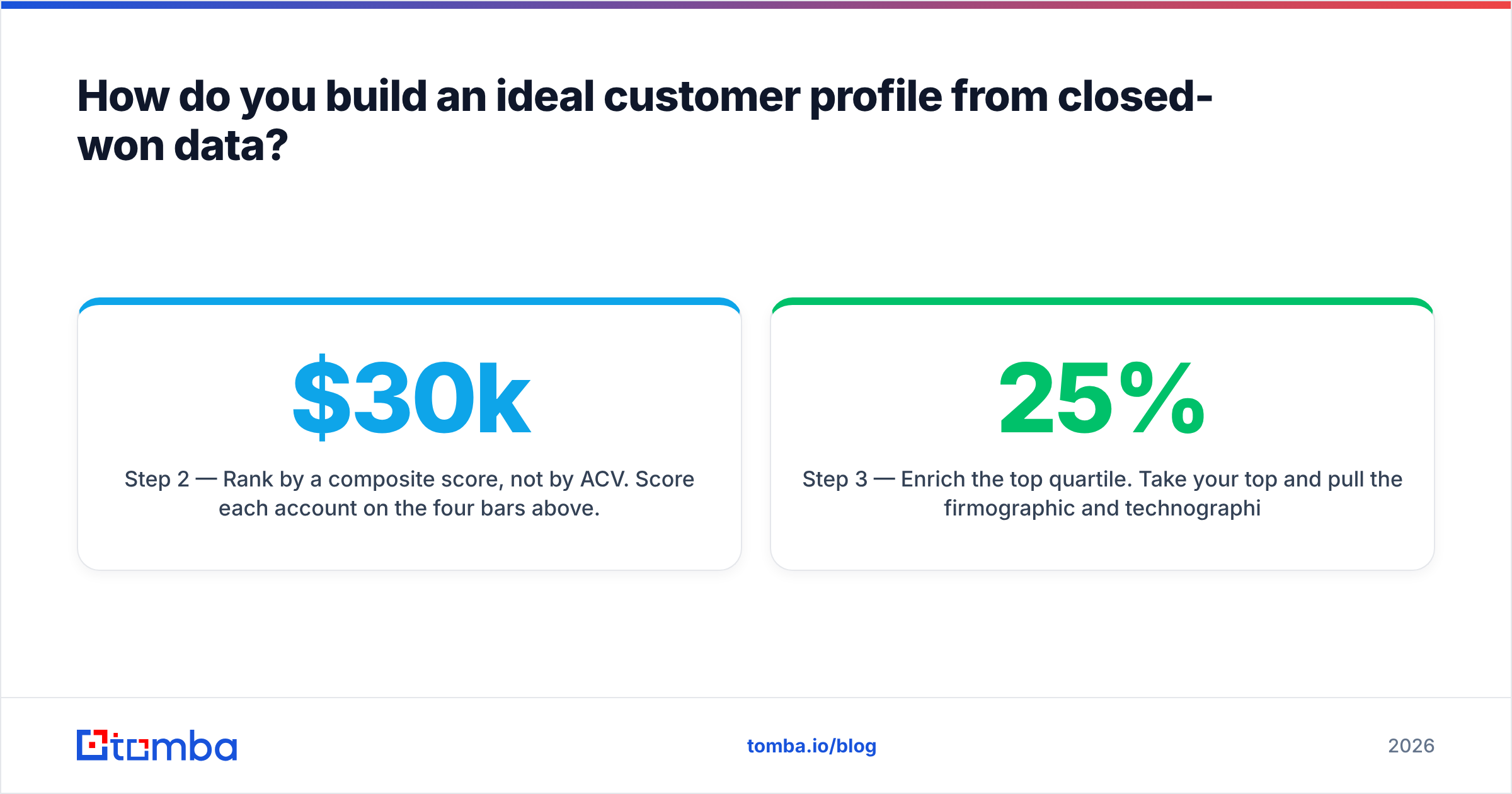
Step 2 — Rank by a composite score, not by ACV. Score each account on the four bars above. A $30k account that closed in 5 weeks and expanded twice outranks a $90k account that took 9 months and downgraded at renewal. This step alone changes most teams' idea of who their ideal customer is.
Step 3 — Enrich the top quartile. Take your top 25% and pull the firmographic and technographic data you did not capture at signup. This is where data enrichment does the heavy lifting — you need consistent, structured attributes across accounts, not whatever your reps happened to type into a free-text field in 2024.
Step 4 — Find the overlaps that are non-obvious. Everyone finds "they're all B2B SaaS." Keep going. Do they all use the same CRM? Are they all between Series A and Series B? Do they all have a support team but no dedicated ops hire? Do they all sell to a technical buyer themselves? The useful pattern is usually two or three layers down.
Step 5 — Write it as a filter, not a paragraph. The output should look like a query:
B2B SaaS companies, 50–250 employees, Series A or B, running HubSpot or Salesforce, with 2+ open SDR/AE roles posted in the last 90 days, headquartered in North America or Western Europe.
That is something you can hand to an SDR, a data provider, or an API. "Growth-stage companies that care about pipeline efficiency" is not.
Step 6 — Validate against closed-lost. Run your new filter against accounts you lost. If your ideal customer definition also describes half your losses, the filter is not discriminating — add a dimension.
What does a good ICP scorecard look like in practice?#
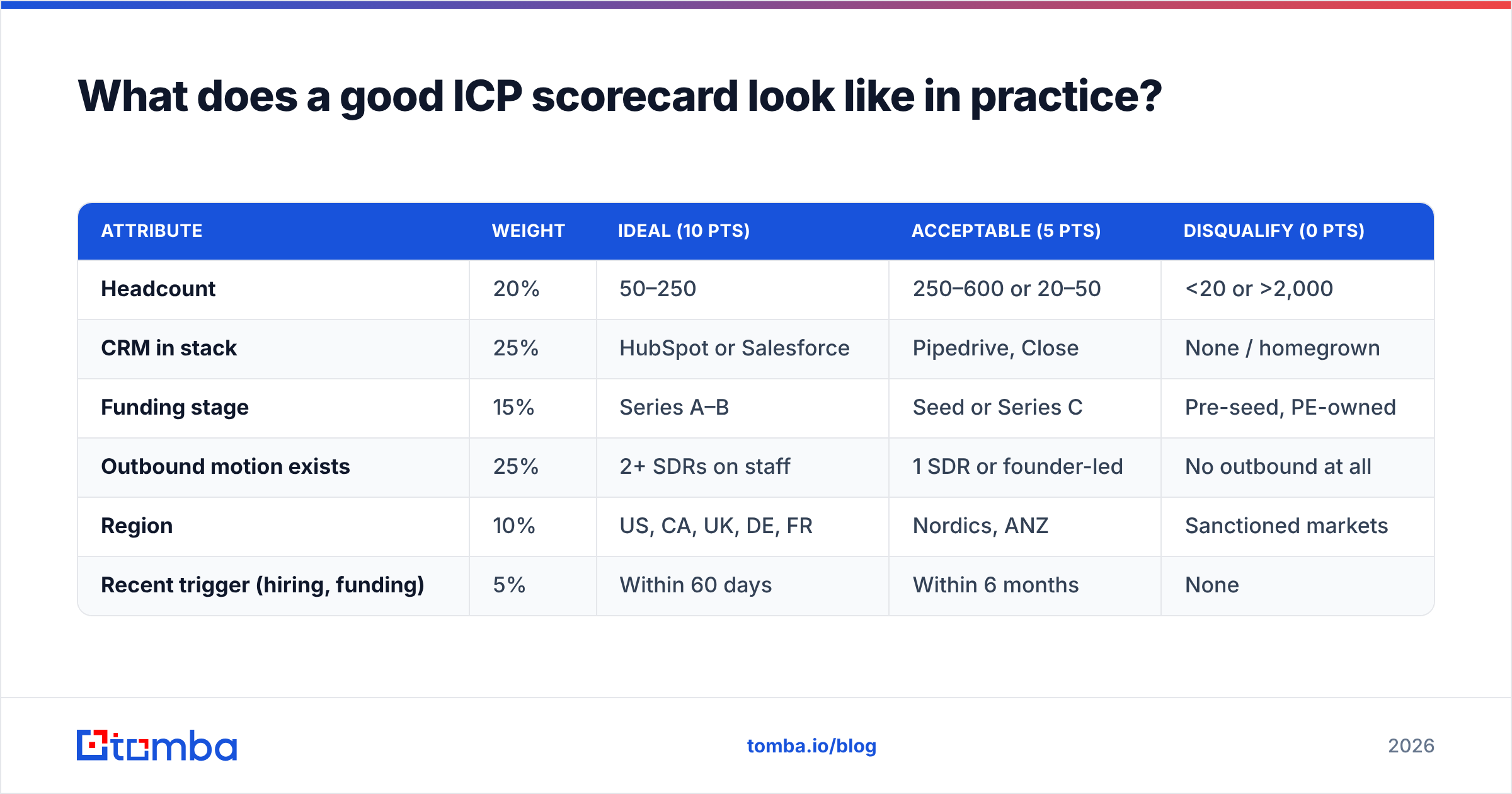
Turn the definition into weighted scoring so it survives contact with a real pipeline. Attributes are not equally predictive, and a scorecard forces you to say which ones matter.
| Attribute | Weight | Ideal (10 pts) | Acceptable (5 pts) | Disqualify (0 pts) |
|---|---|---|---|---|
| Headcount | 20% | 50–250 | 250–600 or 20–50 | <20 or >2,000 |
| CRM in stack | 25% | HubSpot or Salesforce | Pipedrive, Close | None / homegrown |
| Funding stage | 15% | Series A–B | Seed or Series C | Pre-seed, PE-owned |
| Outbound motion exists | 25% | 2+ SDRs on staff | 1 SDR or founder-led | No outbound at all |
| Region | 10% | US, CA, UK, DE, FR | Nordics, ANZ | Sanctioned markets |
| Recent trigger (hiring, funding) | 5% | Within 60 days | Within 6 months | None |
Score every account 0–100 before it enters a sequence. Accounts above 70 get personalized, multi-channel treatment. Accounts 40–70 go into lighter automated sequences. Below 40, they do not get worked at all — they go to a nurture list or get ignored. That triage is the entire point of having an ideal customer profile.
Gartner's research on B2B buying consistently finds that buying groups have grown to six to ten stakeholders, which means every wrong-fit account you work multiplies wasted effort across a whole committee. You can read more on how buying group complexity affects targeting in Gartner's B2B sales research.
How do you turn an ideal customer profile into an actual list?#
This is the step most ICP guides skip, and it is the only step that produces revenue. A definition sitting in a Google Doc has never booked a meeting.
The workflow has three stages:
- Source the accounts. Use your filters against a data source — a B2B database, a review-site export, a job-board scrape, or an industry association list. Aim for 300–1,500 accounts per quarter per rep, not 20,000.
- Find the right people. For each account, identify the persona set: the economic buyer, the champion, and the likely blocker. Then get contact data. A domain search returns the email addresses associated with a company domain along with the naming pattern, which lets you cover an entire account rather than one contact at a time.
- Verify before you send. ICP-perfect accounts do you no good if 22% of your emails bounce and your domain reputation tanks. Run every address through an email verifier before it enters a sequence, and treat catch-all domains as a separate bucket with their own handling.

Note the sequencing: account first, contact second, verification third. Teams that reverse this — buying a giant contact list and then trying to filter it into an ICP — end up with a list shaped by whatever the vendor happened to have, not by what actually converts for them.
What are the most common ideal customer profile mistakes?#
Writing it once and never revisiting it. Your ICP has a shelf life. Price changes, new features, a new competitor, or a shift upmarket all invalidate parts of it. Re-run the closed-won analysis every quarter. It takes an afternoon.
Confusing your best-fit customer with your loudest customer. The account that gives the most feedback and shows up in every case study is not necessarily the one with the best unit economics. Check the numbers.
Defining the ICP too broadly to be useful. If your definition covers 40,000 accounts, it is a market segment. The test is simple: can a rep look at an account and answer "in or out" in under ten seconds? If not, tighten it.
Ignoring negative criteria. An explicit disqualification list is as valuable as the inclusion list. Industries with procurement cycles you cannot survive, company sizes with no budget owner, regions you cannot support — write them down so reps stop working them.
Treating the ICP as sales-only. Product marketing should be writing to it, product should be prioritizing for it, and customer success should be flagging non-ICP accounts as churn risks at onboarding, not at renewal. HubSpot's overview of ideal customer profile methodology makes the same cross-functional point, and it holds up in practice.
Building it from opinion instead of data. The founder's intuition about who the ideal customer is was correct at 10 customers and is probably wrong at 200. Data beats memory.
How do you know your ideal customer profile is working?#
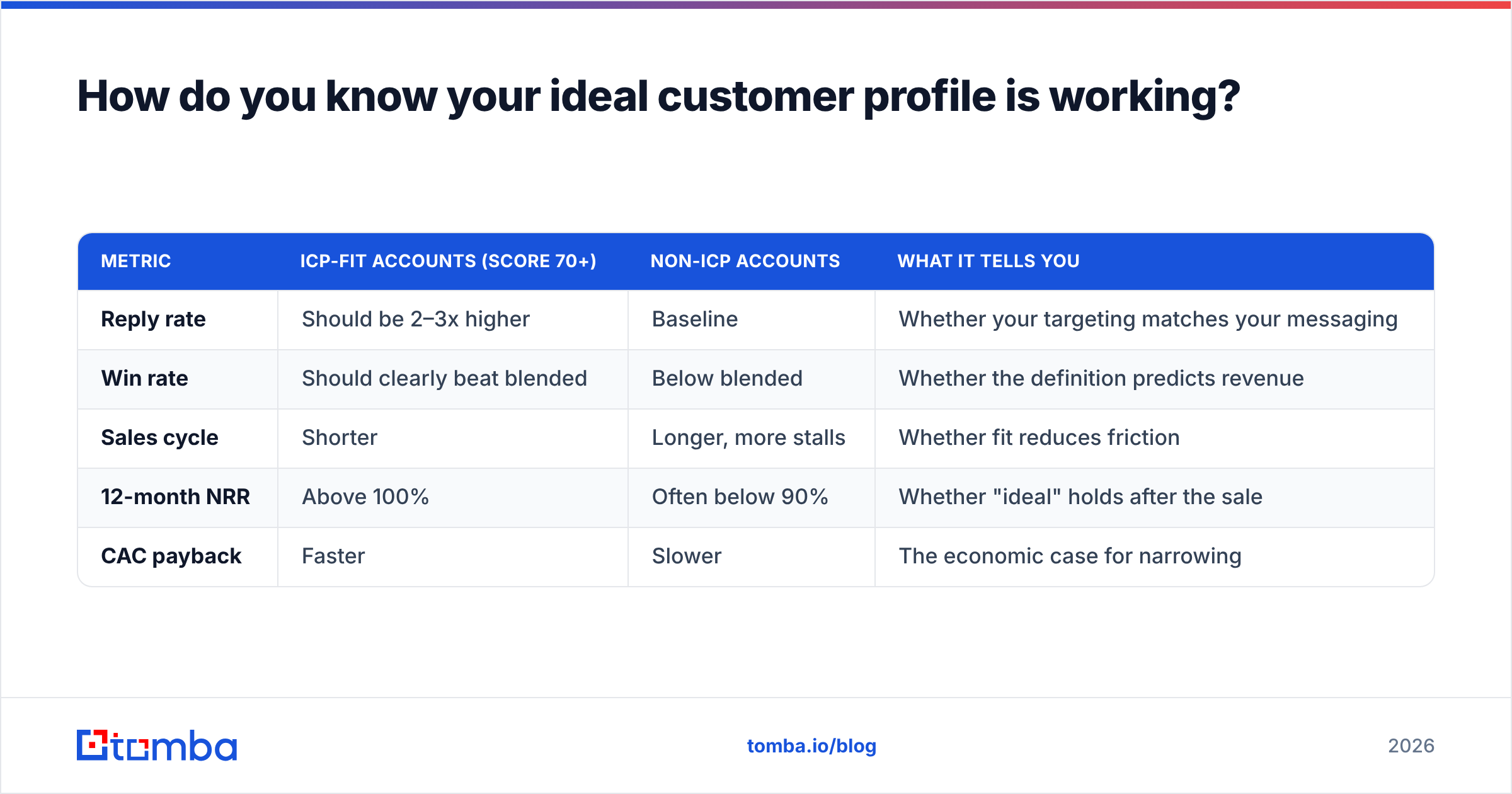
Measure four things, quarterly, split by ICP-fit tier:
| Metric | ICP-fit accounts (score 70+) | Non-ICP accounts | What it tells you |
|---|---|---|---|
| Reply rate | Should be 2–3x higher | Baseline | Whether your targeting matches your messaging |
| Win rate | Should clearly beat blended | Below blended | Whether the definition predicts revenue |
| Sales cycle | Shorter | Longer, more stalls | Whether fit reduces friction |
| 12-month NRR | Above 100% | Often below 90% | Whether "ideal" holds after the sale |
| CAC payback | Faster | Slower | The economic case for narrowing |
If ICP-fit accounts do not outperform non-ICP accounts on at least three of these, your definition is decorative. Rebuild it from the closed-won data and pick different attributes.
One caution on the response rate metric specifically: a jump in replies after an ICP refresh can also come from better copy shipped at the same time. Change one variable per quarter if you want a clean read.
Do smaller teams need a formal ICP?#
Yes, and arguably more than large teams do. A 200-rep organization can absorb the cost of a fuzzy ICP through sheer volume. A three-person team cannot. With limited capacity, the accounts you choose not to work matter more than the ones you do.
The lightweight version for a small team: 15 closed-won accounts, four shared attributes, one disqualification rule, and a scorecard on a single spreadsheet tab. Review it after every 20 deals. That is enough structure to stop a founder-led sales motion from drifting into "anyone who books a call."
For teams evaluating data vendors at this stage, credible options range from self-serve email finders to curated list providers like BookYourData, which sells pre-built, filtered contact lists — a reasonable fit when you want a static list matching firm filters rather than an API-driven workflow. Compare on match rate against your ICP filters, not on total database size. A provider with 400M contacts and a 30% match on your specific segment is worse than one with 100M and a 70% match. Check independent reviews on G2 before committing to an annual contract.
Put your ideal customer profile to work#
The gap between a documented ICP and pipeline is contact data. Once you know exactly which accounts qualify, you need verified email addresses for the right people inside them — at volume, and without burning your sender reputation on bounces.
That is what Tomba Email Finder is for. Feed it a domain or a name-plus-company and get back a verified professional email with a confidence score and the sources behind it. Start on the free tier with 25 searches a month to sanity-check your ICP list quality, then move to Starter at $49/mo or Growth at $99/mo as your account list grows; see Tomba pricing for the full breakdown. Build the profile from your closed-won data, turn it into 500 named accounts, and let the finder handle the rest.
Related guides#
// get started
Find, verify and enrich your first contacts today
Start on the free plan with 25 searches a month, then scale when your team is ready.
Free plan · No credit card required · GDPR & CCPA
// about the author