What Is an Ideal Customer Profile? The 2026 B2B Playbook
Most B2B teams write an ideal customer profile once, file it in a doc, and keep emailing everyone anyway. Here is how to build an ICP from real data, score accounts against it, and turn it into a list your reps will actually work.
TL;DR
- An ideal customer profile (ICP) describes the company you should sell to, not the person you email. Confusing the two is the single most common ICP failure.
- A useful ICP in 2026 is built from closed-won data, not from a brainstorm. Pull your last 30-50 wins, find the firmographic and behavioural attributes they share, then test whether those attributes predict retention — not just first purchase.
- Your ICP is worthless until it becomes a filter. That means a scored, tiered account list with real contact data attached, refreshed at least quarterly.
- The typical B2B team over-indexes on employee count and industry, and ignores the two signals that predict fit best: tech stack and buying trigger.
- Tight ICPs shrink the list and grow the pipeline. Sending 200 well-researched emails to fit accounts beats 5,000 sprayed at a purchased database almost every time.
What is an ideal customer profile?#
An ideal customer profile is a written description of the type of organisation that gets the most value from your product, in the shortest time, at the lowest cost to serve — and therefore renews, expands, and refers.
Think of it like a fishing chart rather than a portrait. A portrait tells you what one fish looks like. A chart tells you which waters to drop the line in, at what depth, in which season. The ICP is the chart. It is about where you fish, not who you talk to once you get a bite.
Technically, an ICP is a set of attributes with thresholds attached. Not "mid-market SaaS companies," but "B2B SaaS companies, 50-400 employees, Series A through C, running HubSpot or Salesforce, with at least 3 open SDR roles in the last 90 days, headquartered in North America or Western Europe." The second version can be queried. The first one can only be argued about in a meeting.
The distinction matters because everything downstream inherits it. Your list-building, your data enrichment, your routing rules, your ad audiences, your pricing packaging, and your product roadmap all point back at whatever the ICP says. A vague ICP produces a vague pipeline.

How is an ICP different from a buyer persona or TAM?#
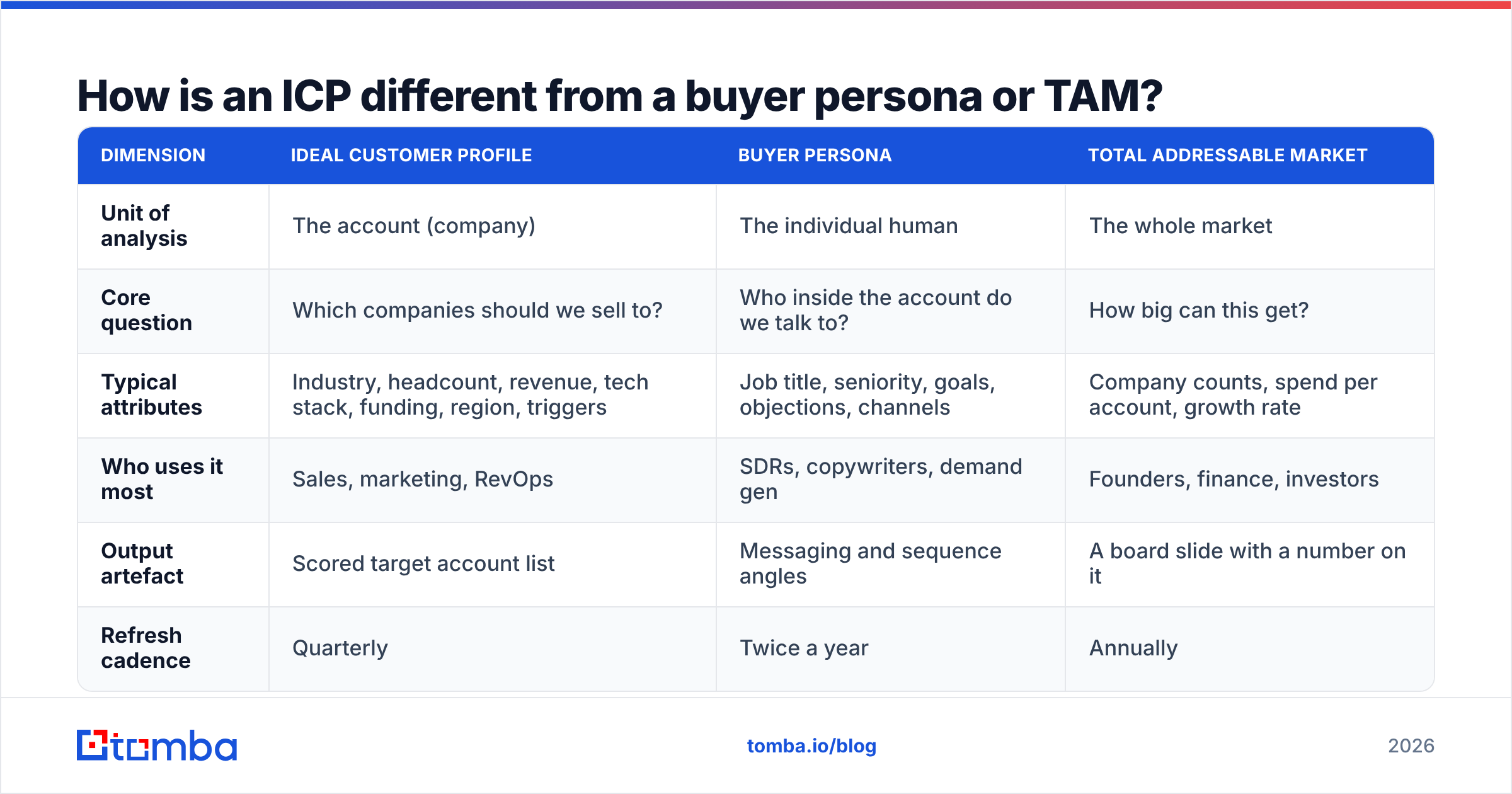
These three get used interchangeably in most sales meetings, and they answer completely different questions. Here is the split:
| Dimension | Ideal Customer Profile | Buyer Persona | Total Addressable Market |
|---|---|---|---|
| Unit of analysis | The account (company) | The individual human | The whole market |
| Core question | Which companies should we sell to? | Who inside the account do we talk to? | How big can this get? |
| Typical attributes | Industry, headcount, revenue, tech stack, funding, region, triggers | Job title, seniority, goals, objections, channels | Company counts, spend per account, growth rate |
| Who uses it most | Sales, marketing, RevOps | SDRs, copywriters, demand gen | Founders, finance, investors |
| Output artefact | Scored target account list | Messaging and sequence angles | A board slide with a number on it |
| Refresh cadence | Quarterly | Twice a year | Annually |
The practical rule: TAM tells you the size of the pond, the ICP tells you where in the pond to fish, and the persona tells you what bait to use. You need all three, in that order. Teams that skip straight from TAM to persona end up with beautifully written cold emails going to companies that were never going to buy.
If you want a formal grounding for the segmentation logic underneath all of this, the market segmentation literature is the origin story — the ICP is just B2B segmentation with a revenue filter bolted on.
What data belongs in a 2026 ICP?#
Six attribute families cover almost every workable ICP. Pick two or three from each of the first three groups and one hard filter from the rest — more than eight total criteria and your list collapses to nothing.
- Firmographics — headcount, revenue band, funding stage, ownership (VC-backed vs bootstrapped vs PE), HQ country and operating regions. These are cheap to source and easy to filter on, which is exactly why they are also the least differentiating on their own.
- Technographics — what they already run. If your product plugs into Salesforce, "runs Salesforce" is a far stronger predictor than "has 200 employees." Tech stack is the most underused fit signal in B2B, and it is publicly detectable on most company websites.
- Buying triggers — hiring for roles that imply your problem, new funding round, a new VP in the function you sell into, an acquisition, a compliance deadline, a public migration announcement. Triggers do not tell you whether an account fits; they tell you when to contact one that already does.
- Operational fit — do they have the team, budget, and process maturity to actually implement you? A 12-person company with no RevOps function will churn out of a RevOps-heavy tool no matter how excited the founder is on the demo.
- Economic fit — expected contract value against expected cost to serve. Segments that buy readily but consume double the support hours are not ideal customers, they are expensive customers.
- Negative criteria — the anti-ICP. Industries you cannot support, regions where compliance kills the deal, company sizes where the sales cycle exceeds the payback period. Write these down explicitly. An exclusion list saves more rep hours than any inclusion list.
Notice that four of the six require data you do not have in your CRM today. That gap is where most ICP projects quietly die.
How do you actually build an ICP from your own data?#
Do not start with a workshop. Start with a spreadsheet of everyone who already paid you.
Step 1: pull the win list. Export your last 30-50 closed-won accounts. If you do not have 30, use every customer you have and accept that the conclusions are directional. Add a column for net revenue retention or renewal status at 12 months.
Step 2: split winners from survivors. Rank customers by a composite of contract value, gross margin, retention, and expansion. Take the top quartile. These are your actual ideal customers. The middle is noise and the bottom quartile is your anti-ICP in disguise.
Step 3: enrich every row. Append headcount, revenue, funding, industry, region, and tech stack to each account. This is grunt work if done manually and about twenty minutes if you push the domains through a B2B database or an enrichment API and let it fill the columns.
Step 4: look for over-representation, not frequency. The mistake here is subtle. If 40% of your customers are agencies, that may just mean agencies are 40% of the market you emailed. What matters is the ratio: what share of contacted agencies converted, versus the base rate. Over-representation relative to outreach volume is a real signal. Raw counts are not.
Step 5: sanity-check against losses. Run the same enrichment on closed-lost and churned accounts. If an attribute shows up equally in both piles, it is not predictive. Drop it. This step alone usually kills two or three of the criteria the sales team was certain about.
Step 6: write it as a query. The final ICP should be expressible as a filter you can run: industry IN (...) AND headcount BETWEEN 50 AND 400 AND tech_stack CONTAINS 'HubSpot' AND region IN (...). If you cannot express it as a query, you cannot build a list from it, and it will stay a document.
Step 7: size it. Run the query against a data source and count. Under 300 accounts and your ICP is too narrow to sustain a full-time rep. Over 20,000 and it is too loose to prioritise. The workable band for most mid-market B2B teams is roughly 1,000-8,000 accounts per territory.
How do you score and tier accounts against the ICP?#
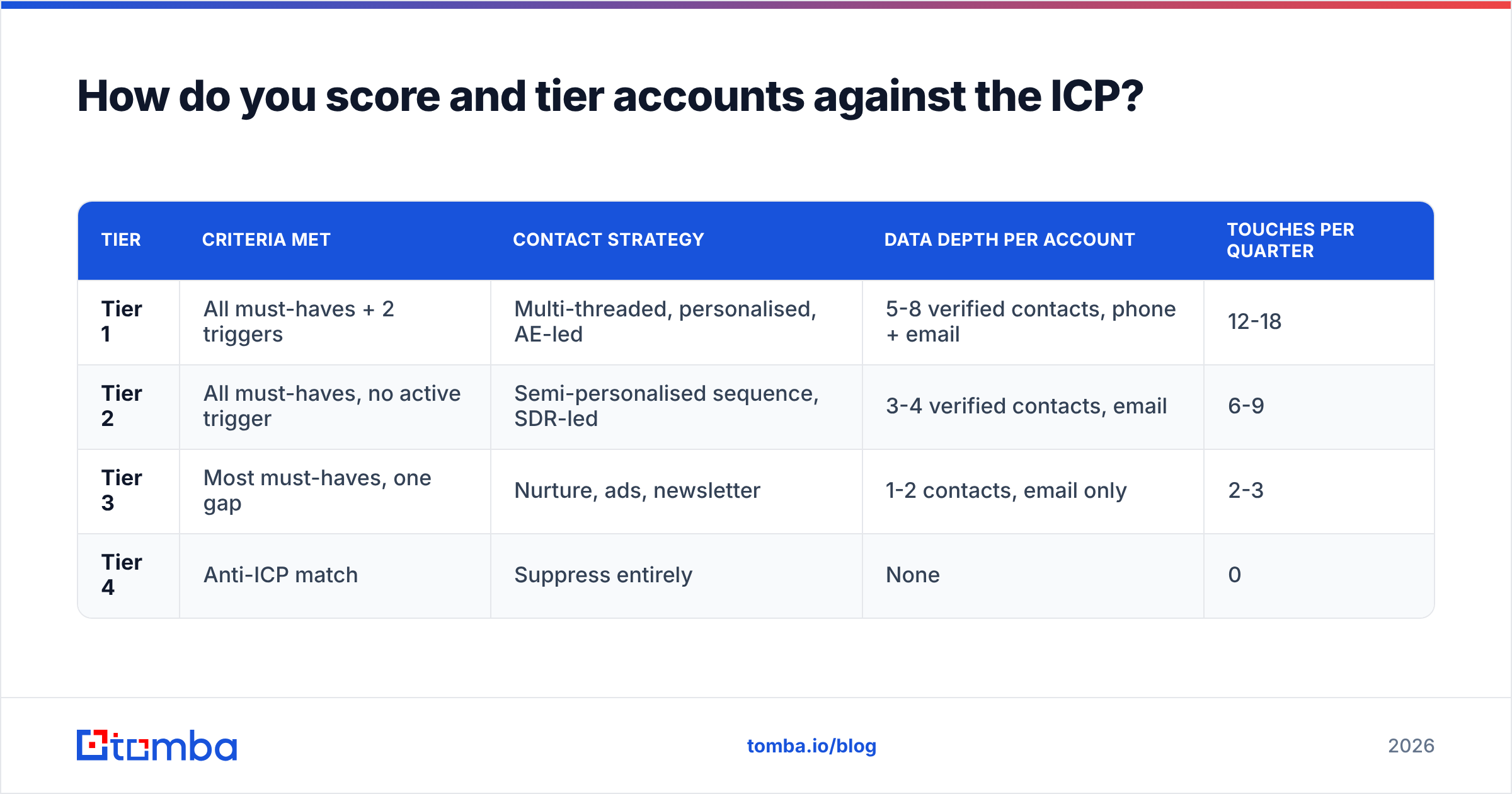
Binary fit / no-fit is too blunt for anything past a seed-stage motion. Use tiers, and attach a service level to each one so the tiering has teeth.
| Tier | Criteria met | Contact strategy | Data depth per account | Touches per quarter |
|---|---|---|---|---|
| Tier 1 | All must-haves + 2 triggers | Multi-threaded, personalised, AE-led | 5-8 verified contacts, phone + email | 12-18 |
| Tier 2 | All must-haves, no active trigger | Semi-personalised sequence, SDR-led | 3-4 verified contacts, email | 6-9 |
| Tier 3 | Most must-haves, one gap | Nurture, ads, newsletter | 1-2 contacts, email only | 2-3 |
| Tier 4 | Anti-ICP match | Suppress entirely | None | 0 |
Two rules keep this honest. First, weight the criteria — a technographic match that historically doubles win rate should not score the same as being in the right country. Second, cap Tier 1 at whatever your team can genuinely work. If a rep can research and multi-thread 40 accounts a quarter, Tier 1 has 40 accounts in it, not 400. Tiering exists to enforce scarcity of attention.
For the definitional plumbing around how scored accounts become sales-ready, it is worth aligning the ICP tiers with how your team defines a marketing qualified lead — otherwise marketing scores on one axis and sales works another.
What does it take to operationalise an ICP?#
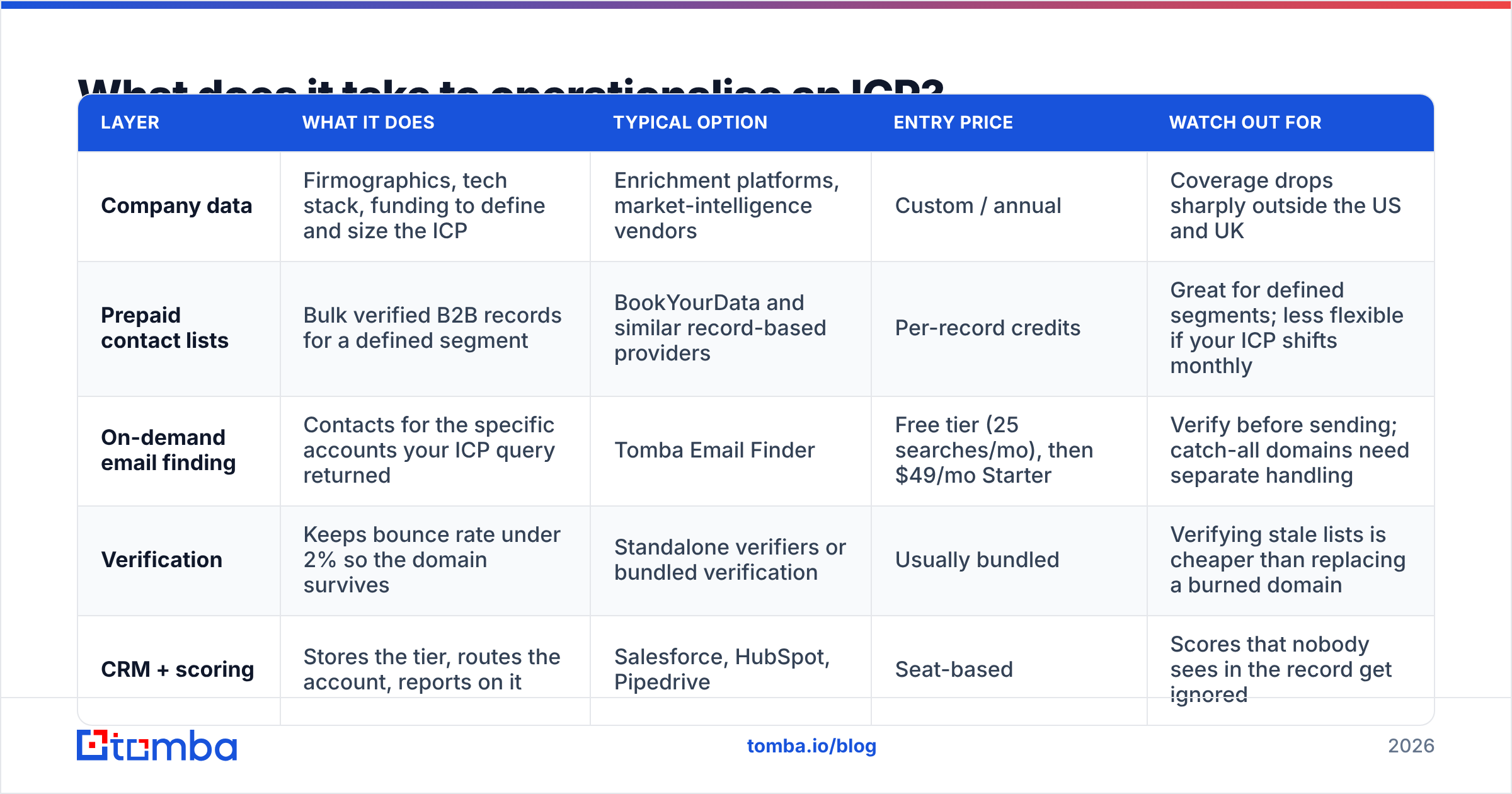
An ICP becomes real when three things exist: a query, a list, and contact data attached to that list. Here is roughly what each layer costs and what it does.
| Layer | What it does | Typical option | Entry price | Watch out for |
|---|---|---|---|---|
| Company data | Firmographics, tech stack, funding to define and size the ICP | Enrichment platforms, market-intelligence vendors | Custom / annual | Coverage drops sharply outside the US and UK |
| Prepaid contact lists | Bulk verified B2B records for a defined segment | BookYourData and similar record-based providers | Per-record credits | Great for defined segments; less flexible if your ICP shifts monthly |
| On-demand email finding | Contacts for the specific accounts your ICP query returned | Tomba Email Finder | Free tier (25 searches/mo), then $49/mo Starter | Verify before sending; catch-all domains need separate handling |
| Verification | Keeps bounce rate under 2% so the domain survives | Standalone verifiers or bundled verification | Usually bundled | Verifying stale lists is cheaper than replacing a burned domain |
| CRM + scoring | Stores the tier, routes the account, reports on it | Salesforce, HubSpot, Pipedrive | Seat-based | Scores that nobody sees in the record get ignored |
The stack choice depends on how stable your ICP is. If you sell into a fixed, well-defined segment that barely changes, a prepaid record provider is efficient and predictable. If your ICP shifts as you test segments — which is normal below $10M ARR — on-demand lookup against a live query is cheaper, because you only pay for the accounts you actually decided to work this month. Plenty of teams run both: a bulk foundation plus targeted lookup for new segments. Compare the full Tomba pricing tiers against your monthly account volume before committing to either model, and if you are enriching thousands of rows at once, a bulk email finder run is far less painful than one-by-one lookups.
Whatever you pick, verify. A tight ICP with a 12% bounce rate performs worse than a loose ICP with a clean list, because the deliverability damage carries into every future send.
How often should you refresh your ICP?#
Quarterly for the data, annually for the definition.
The data ages fast. Headcounts change, funding rounds close, tech stacks migrate, and roughly 25-30% of B2B contact records go stale every year through job changes alone. An account list built in January is measurably worse by April. Re-run the enrichment on your Tier 1 and Tier 2 lists every quarter and re-verify contacts before any major campaign.
The definition should move more slowly. Changing your ICP every six weeks means you never accumulate enough closed-won data to know whether the last version worked. Set a review at the end of each quarter, but only change the criteria if you have evidence: win rate by segment, cycle length by segment, retention by segment. Anecdotes from the last three deals are not evidence.
The exception is a genuine product or pricing shift. Ship a new tier, move upmarket, or add a major integration, and the ICP should be rebuilt from scratch rather than patched. Analyst coverage of shifting B2B buying behaviour — Gartner's sales research is a reasonable free starting point — is useful for pressure-testing whether the segment itself is changing under you.
What are the most common ICP mistakes?#
Writing the ICP from ambition instead of evidence. Everyone wants enterprise logos. If your last 40 wins were all 80-person companies, your ICP is 80-person companies, regardless of what the board deck says.
Confusing "who replies" with "who buys." Some segments answer cold emails enthusiastically and never sign. Score on closed-won and retained, never on reply rate.
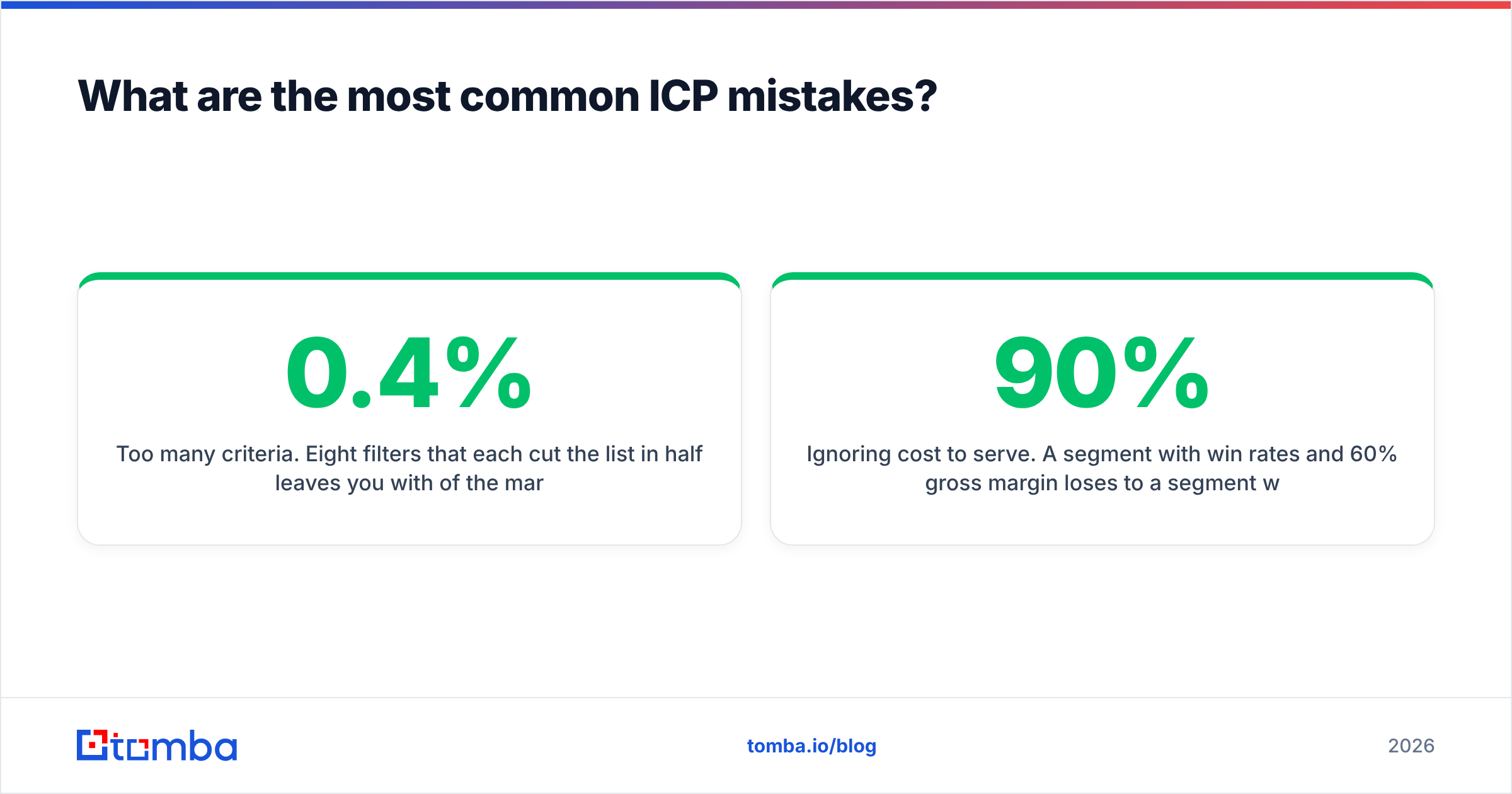
Too many criteria. Eight filters that each cut the list in half leaves you with 0.4% of the market. Rank criteria into must-have (three or four maximum) and nice-to-have (everything else, used for scoring rather than filtering).
No anti-ICP. Without written exclusion rules, reps will work any account that shows interest, and a third of your support load will come from customers you should never have signed.
Never operationalising it. The ICP lives in a doc, the CRM has no fit field, the sequences target everyone, and six months later someone runs the workshop again. If the ICP does not change what lands in a rep's queue on Monday morning, it does not exist.
Ignoring cost to serve. A segment with 90% win rates and 60% gross margin loses to a segment with 40% win rates and 85% margin. Model both. Peer reviews on comparison sites like G2 are useful here for spotting which segments a category typically over-serves.
What is the fastest way to test a new ICP hypothesis?#
Run a 200-account experiment. Define the segment as a query, pull 200 matching accounts, enrich three to five contacts per account, verify them, and run a single four-touch sequence with messaging written specifically for that segment. Hold everything else constant.
You are looking for three numbers over six to eight weeks: positive reply rate, meeting-booked rate, and meetings that survive to a second call. That last one is the real signal. High reply rates with no second calls means you found a curious segment, not a buying one.
Two hundred accounts is small enough to run in a fortnight and large enough to be worth reading. Run one hypothesis per quarter, keep the winners, and your ICP tightens on evidence rather than opinion.
Where to start this week#
Pick your last 40 closed-won accounts, enrich them, and find the two attributes that show up far more often than your outreach volume would predict. That is the seed of a real ideal customer profile — everything else is refinement.
When you have the query and the account list, the bottleneck becomes contact data: getting verified, current email addresses for the specific people inside those specific companies. That is exactly what the Tomba Email Finder is built for — search by domain, name, or company, verify before you send, and start on the free tier at 25 searches a month before deciding whether $49/mo Starter or $99/mo Growth matches your account volume. Build the list your ICP actually points at, and let the rest of the market belong to someone else.
Related guides#
// get started
Find, verify and enrich your first contacts today
Start on the free plan with 25 searches a month, then scale when your team is ready.
Free plan · No credit card required · GDPR & CCPA
// about the author