Inbound and Outbound Marketing Strategy: The 2026 Playbook
Inbound builds compounding trust but takes 9 months. Outbound books meetings in 3 weeks but decays without data hygiene. Here is how to run both without burning budget on either.
TL;DR
- Inbound and outbound are not rivals. They are two different cost curves: inbound is high upfront cost with compounding returns, outbound is linear cost with instant returns. Most B2B teams need both, weighted by runway.
- Expect 6-9 months before content-led inbound produces meaningful pipeline. Expect 3-4 weeks for a well-targeted outbound sequence to book first meetings.
- The single biggest failure point in outbound is not copy — it is contact data. Bounce rates above 3% will strangle your domain reputation before your message ever gets read.
- The highest-ROI move in 2026 is the overlap layer: using intent signals from your inbound traffic to prioritize outbound targets.
- Budget rule of thumb: pre-product-market-fit, weight 70/30 toward outbound. Post-PMF with a proven ICP, invert it.
What Is an Inbound and Outbound Marketing Strategy?#
An inbound and outbound marketing strategy is a coordinated plan that uses two opposite motions to fill the same pipeline. Inbound pulls buyers toward you — blog posts, SEO, free tools, webinars, community, product-led signups. Outbound pushes your message to a defined list — cold email, cold calls, LinkedIn outreach, paid ABM display, direct mail.
The useful mental model is a fishing analogy. Inbound is building a lake and stocking it: enormous effort before a single fish appears, then years of catches with modest maintenance. Outbound is going out on the boat with a net: you catch something today, and you catch nothing the day you stay home.
Technically, the difference is who initiates the first meaningful interaction. In inbound, the buyer raises their hand — they searched, they read, they downloaded, they signed up. In outbound, you raise it for them. That distinction changes everything downstream: message framing, qualification thresholds, sales cycle length, and how you measure success.
Where teams go wrong is treating these as ideological camps. "Cold email is dead" and "content marketing is a money pit" are both things people say when one channel failed for reasons that had nothing to do with the channel.

How Do Inbound and Outbound Actually Compare?#
Here is the honest side-by-side, based on typical mid-market B2B SaaS benchmarks. Your numbers will vary by ACV and category competitiveness.
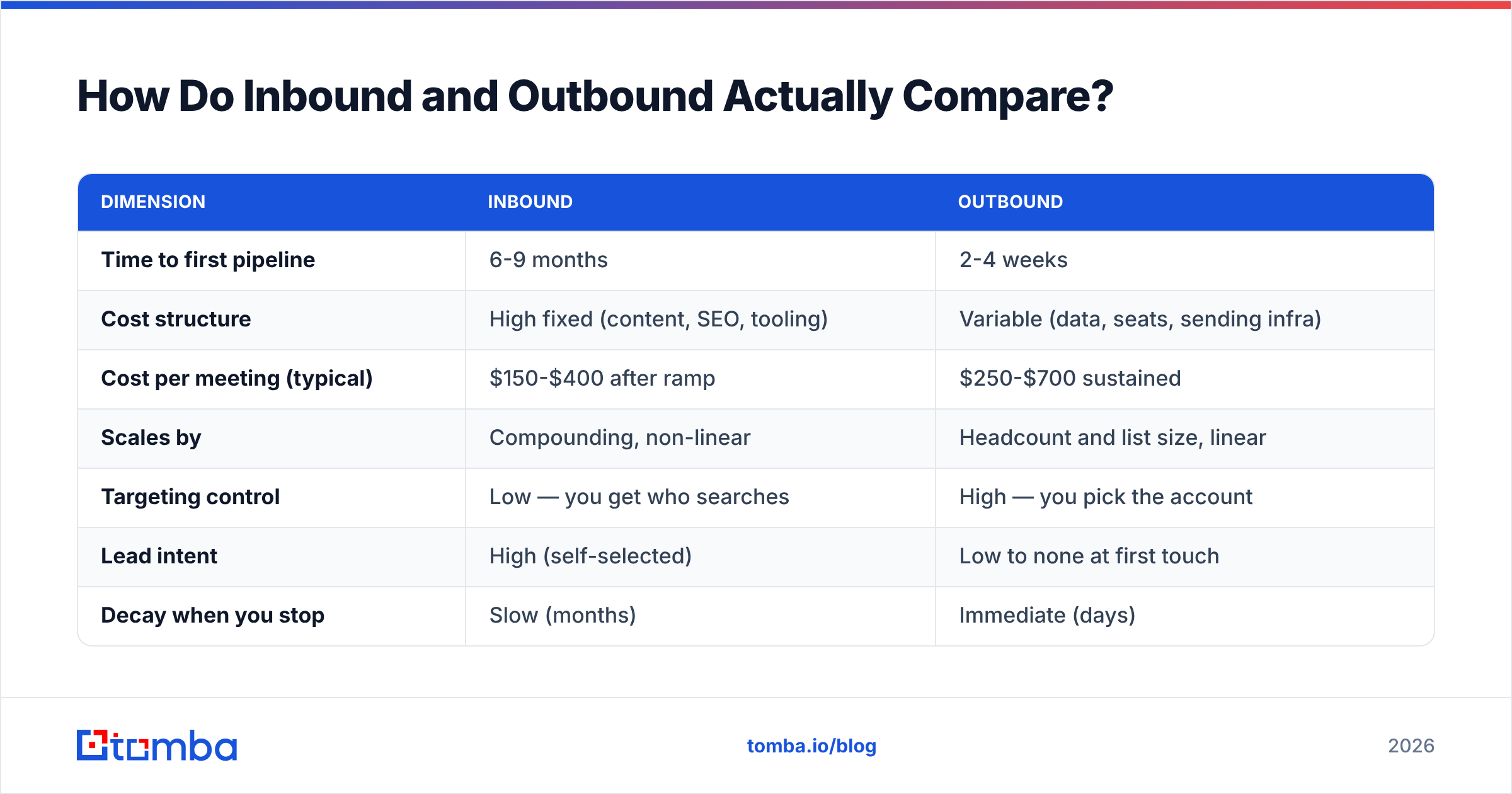
| Dimension | Inbound | Outbound |
|---|---|---|
| Time to first pipeline | 6-9 months | 2-4 weeks |
| Cost structure | High fixed (content, SEO, tooling) | Variable (data, seats, sending infra) |
| Cost per meeting (typical) | $150-$400 after ramp | $250-$700 sustained |
| Scales by | Compounding, non-linear | Headcount and list size, linear |
| Targeting control | Low — you get who searches | High — you pick the account |
| Lead intent | High (self-selected) | Low to none at first touch |
| Decay when you stop | Slow (months) | Immediate (days) |
| Typical close rate | 8-15% of MQLs | 1-3% of contacted |
| Best for | Established category, known problem | New category, defined ICP, high ACV |
| Main failure mode | Publishing without distribution | Bad data and generic messaging |
Two rows deserve extra attention.
"Decay when you stop." This is the real argument for inbound. A post that ranks keeps working while you sleep, while you are on holiday, and while your SDR team is between hires. Outbound stops the moment the sequences pause. That asymmetry is why mature companies keep investing in content even when outbound looks cheaper per meeting this quarter.
"Targeting control." This is the real argument for outbound. If you sell compliance software to Series B fintechs in the Nordics, roughly nobody is searching for you. Inbound cannot manufacture demand that does not yet exist as a search query. Outbound can walk up to all 340 of those companies this month.
When Should You Lead With Outbound?#
Lead with outbound when any of the following is true:
- Your category has no search volume. If your keyword research returns fewer than 500 monthly searches across your entire topic cluster, SEO will not save you. Go get the accounts directly.
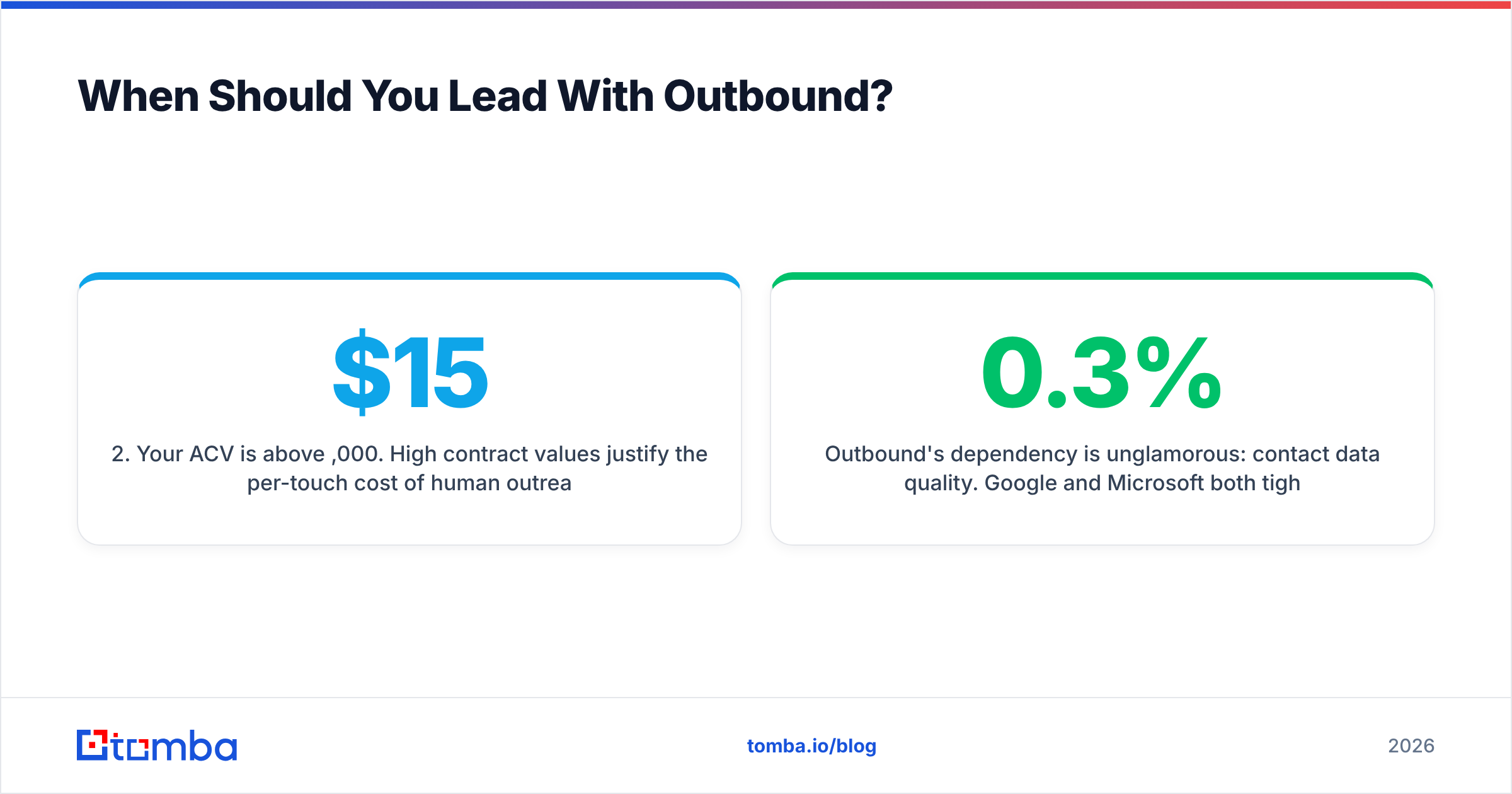
- Your ACV is above $15,000. High contract values justify the per-touch cost of human outreach. At $50/month self-serve pricing, outbound economics rarely work.
- You have under 12 months of runway. Inbound will not return capital in time. You need meetings on the calendar this quarter, not next year.
- Your ICP is small and knowable. If your total addressable market is 2,000 companies, a list is a viable strategy. If it is 2 million SMBs, it is not.
- You are testing positioning. Outbound gives you a feedback loop measured in days. You can test five value propositions in two weeks and read the reply rates. Inbound feedback loops run in quarters.
Outbound's dependency is unglamorous: contact data quality. Google and Microsoft both tightened bulk-sender enforcement in 2024 and have not loosened since — Google's bulk sender guidelines put a hard spam-complaint threshold at 0.3% and require authenticated sending. High bounce rates signal list purchasing to the receiving mail server, and once your domain reputation drops, even your good emails land in spam.
That is why serious outbound teams verify before they send. Running a list through an email verifier to strip invalid and risky addresses costs a fraction of a cent per record and protects an asset — your sending domain — that takes months to rebuild. For domains that accept everything at the SMTP layer, a dedicated catch-all verifier is the difference between a usable segment and a coin flip.
When Should You Lead With Inbound?#
Lead with inbound when demand already exists and you just need to capture it.
The tell is search volume. If prospects are typing "best [your category] software" into Google 8,000 times a month, that demand is being harvested by whoever ranks. Ignoring it is leaving revenue for competitors to collect. G2's buyer behavior research consistently finds that most B2B buyers complete a majority of their evaluation before contacting any vendor — which means the content they read during that phase is doing the selling whether you wrote it or not.
Inbound also wins on trust. A prospect who found you through a genuinely useful guide arrives with warmth that no cold sequence can manufacture. Close rates on inbound-sourced deals typically run 3-5x higher than outbound-sourced, and the sales cycle is shorter because half the education already happened.
The catch nobody mentions: inbound is not "write blog posts." It is content plus distribution plus technical SEO plus conversion architecture. Teams that publish 40 posts into a void and conclude "inbound doesn't work" skipped three of the four. HubSpot's inbound methodology documentation is still the clearest free explanation of how those pieces connect.
How Do You Combine Both Without Doubling the Budget?#
This is where the real leverage sits, and most teams miss it because the two functions report to different people.
The combination play is simple: let inbound tell outbound who to call.
Your website already knows things your SDRs do not. Which companies visited your pricing page three times this month? Which ones read two competitor-comparison posts and then left? Those accounts have intent but never filled out a form — 97-98% of B2B traffic never does. Identifying them with visitor identification turns anonymous traffic into a prioritized outbound list where the "cold" outreach is not actually cold.
Here is what a combined operating model looks like in practice:
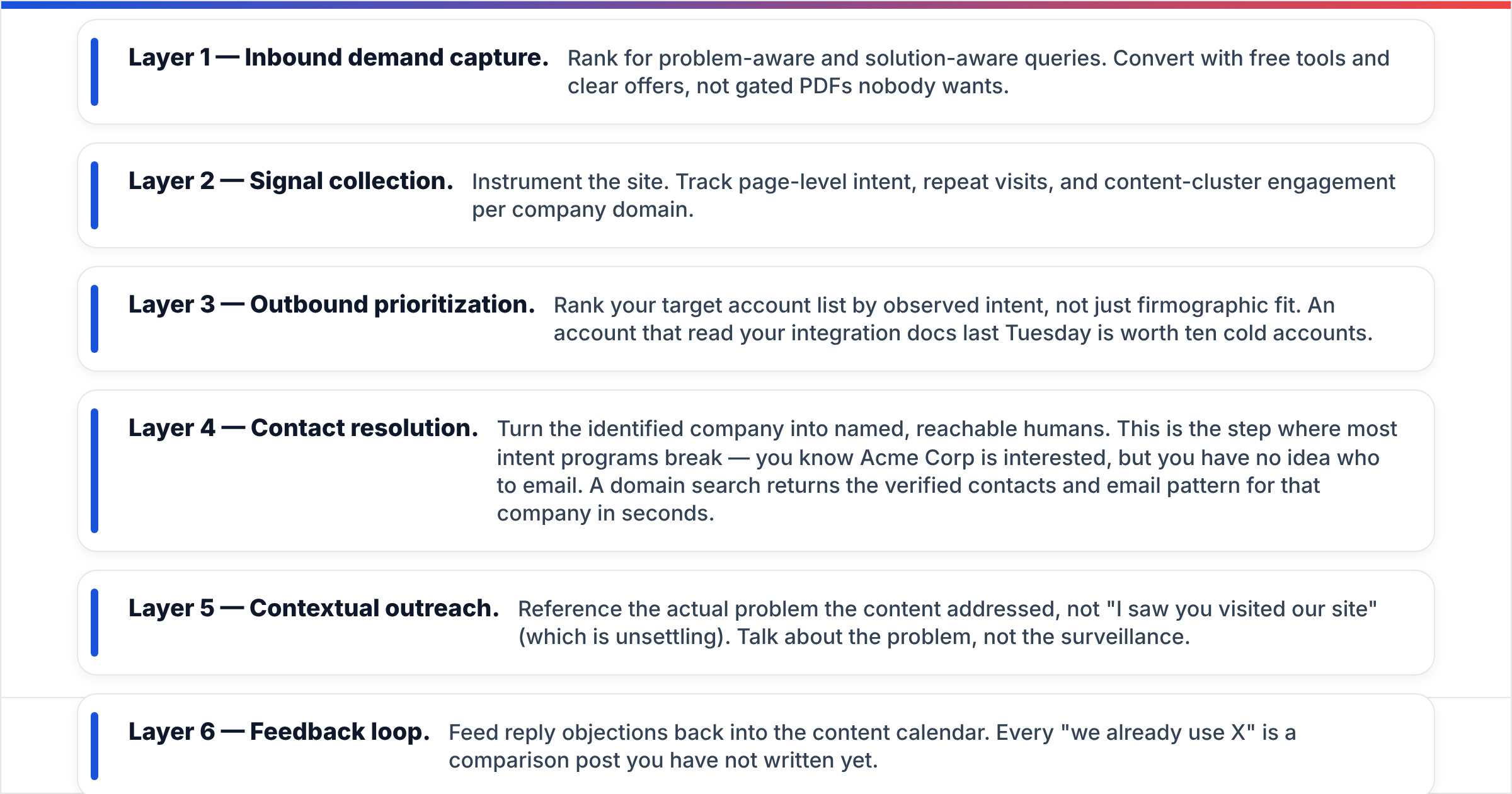
- Layer 1 — Inbound demand capture. Rank for problem-aware and solution-aware queries. Convert with free tools and clear offers, not gated PDFs nobody wants.
- Layer 2 — Signal collection. Instrument the site. Track page-level intent, repeat visits, and content-cluster engagement per company domain.
- Layer 3 — Outbound prioritization. Rank your target account list by observed intent, not just firmographic fit. An account that read your integration docs last Tuesday is worth ten cold accounts.
- Layer 4 — Contact resolution. Turn the identified company into named, reachable humans. This is the step where most intent programs break — you know Acme Corp is interested, but you have no idea who to email. A domain search returns the verified contacts and email pattern for that company in seconds.
- Layer 5 — Contextual outreach. Reference the actual problem the content addressed, not "I saw you visited our site" (which is unsettling). Talk about the problem, not the surveillance.
- Layer 6 — Feedback loop. Feed reply objections back into the content calendar. Every "we already use X" is a comparison post you have not written yet.

What Does the Combined Tech Stack Cost?#
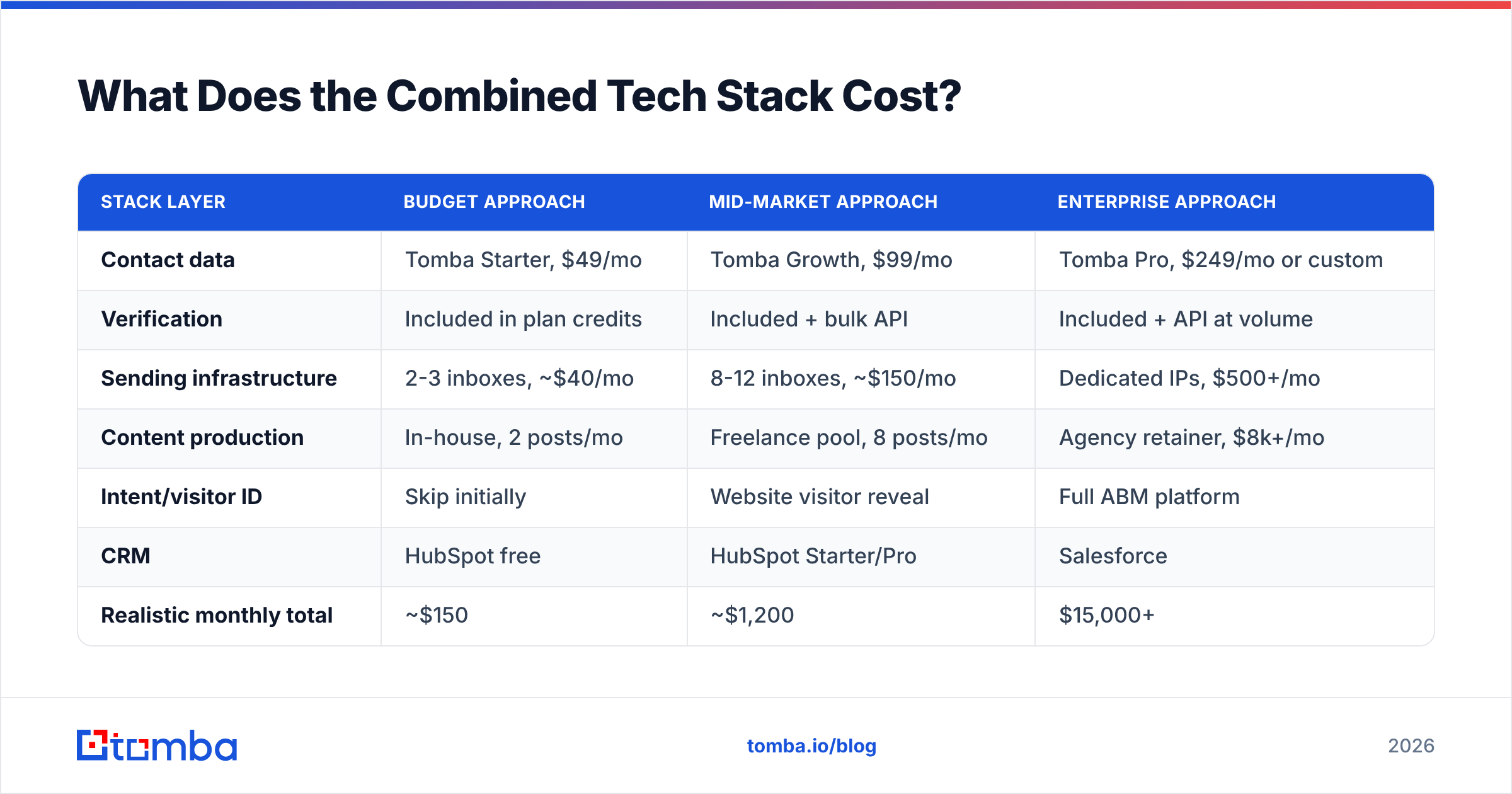
You do not need an enterprise suite to run this. Here is a realistic comparison of stack approaches for a 5-person GTM team.
| Stack layer | Budget approach | Mid-market approach | Enterprise approach |
|---|---|---|---|
| Contact data | Tomba Starter, $49/mo | Tomba Growth, $99/mo | Tomba Pro, $249/mo or custom |
| Verification | Included in plan credits | Included + bulk API | Included + API at volume |
| Sending infrastructure | 2-3 inboxes, ~$40/mo | 8-12 inboxes, ~$150/mo | Dedicated IPs, $500+/mo |
| Content production | In-house, 2 posts/mo | Freelance pool, 8 posts/mo | Agency retainer, $8k+/mo |
| Intent/visitor ID | Skip initially | Website visitor reveal | Full ABM platform |
| CRM | HubSpot free | HubSpot Starter/Pro | Salesforce |
| Realistic monthly total | ~$150 | ~$1,200 | $15,000+ |
The budget column is not a toy. A two-person team with $49/month in data tooling, a verified list of 1,500 well-chosen contacts, and eight solid blog posts can absolutely book 15 meetings a month. Volume is not the constraint at small scale — precision is.
Note that data providers differ in coverage philosophy. Tools like BookYourData lean toward pre-built, ready-to-download lists with guaranteed accuracy rates, which suits teams that want a static list delivered fast. Real-time finders like Tomba resolve contacts on demand against live sources, which suits teams building continuously from changing target accounts. Both are legitimate — the question is whether your motion is batch or continuous. If you compare providers, look at where the data comes from before you look at the price.
How Do You Measure Each Motion Fairly?#
The most common measurement mistake is applying outbound metrics to inbound and concluding inbound failed.
Use different scorecards:
Inbound scorecard
- Organic sessions to high-intent pages (not total traffic — total traffic is vanity)
- Assisted conversions, tracked over a 90-day window minimum
- Share of branded search over time
- Content-influenced pipeline, not just last-touch attribution
Outbound scorecard
- Reply rate segmented by list quality tier
- Positive reply rate specifically (not "any reply")
- Bounce rate — treat anything above 3% as a data emergency
- Meetings held, not meetings booked (no-show rate reveals targeting quality)
Attribution honesty matters here. The B2B buying journey involves multiple stakeholders and dozens of touches across months. Any model that assigns 100% of credit to one touch is telling you a comfortable story. Run multi-touch attribution or, if that is beyond your stack, run holdout tests: pause outbound to one segment for a month and watch what actually happens to pipeline.
Also track a metric most teams ignore: cost to re-acquire. If you stopped all spend today, how much would it cost to get back to current pipeline in 90 days? Inbound's answer is usually "very little for a while." Outbound's answer is "the full cost, immediately." That number is the real ROI difference between the two, and it never shows up in a monthly CAC report.
What Are the Most Common Mistakes?#
Spraying outbound at a poorly defined ICP. If your list criteria are "companies with 50-500 employees in North America," you do not have an ICP, you have a filter. Add the qualifier that actually predicts fit — a technology they run, a role they recently hired, a funding event, a compliance deadline.
Gating content that should be free. A gated PDF that could have been a ranking blog post trades thousands of visitors for two hundred email addresses, most of them fake. Gate the calculator, not the guide.
Sending from your primary domain. Cold outreach belongs on a secondary domain with its own warmup schedule and authentication records. Check your setup with an SPF checker before the first send, not after deliverability tanks.
Writing outbound copy like a landing page. Landing page copy is broadcast. Outbound copy is a message from one person to another person about one specific problem. If your first line could be sent to 5,000 people unchanged, it will perform like it was.
Abandoning inbound at month four. Month four is exactly when the curve is still flat and the temptation to cut is highest. Content SEO results are back-loaded — the compounding shows up in months 7-12. Cutting at four means you paid the full cost and collected none of the return.
Treating the two teams as separate P&Ls. When content and SDR budgets compete, the overlap layer never gets built, and you lose the compounding advantage that makes the combination worth running at all.
Which Should You Choose in 2026?#
The short answer: run outbound to survive, build inbound to compound, and connect them so each makes the other cheaper.
If you have to sequence it — and most teams with finite budgets do — start outbound. It funds the runway, validates your positioning in weeks instead of quarters, and generates the objection data that makes your inbound content actually good. Then reinvest a fixed percentage of outbound-sourced revenue into content, so inbound grows without ever requiring a scary standalone budget decision.
The teams that win in 2026 are not the ones that picked the right channel. They are the ones whose outbound targets are chosen by inbound signals, and whose inbound topics are chosen by outbound objections.
Ready to build the contact layer underneath both motions? Whether you are resolving intent signals into named buyers or building a target list from scratch, it starts with accurate contact data. The Tomba Email Finder locates verified professional email addresses by name, domain, or company — with verification built into the same workflow, so your bounce rate stays low and your sending domain stays healthy. Start free with 25 searches a month, or scale up from $49/month on Starter. Check Tomba pricing to find the tier that matches your send volume.
Related guides#
Ready to find emails that actually work?
Join 150,000+ professionals who stopped guessing and started sending. Free credits on signup — no credit card required.
Get the Tomba newsletter
Practical outbound tactics and product updates — once every two weeks.
About the author