Inbound Lead Generation for SaaS Companies: 2026 Playbook
Inbound works for SaaS until the pipeline math stops working. Here is what actually generates qualified demos in 2026 — channel economics, CAC benchmarks, and the enrichment layer that makes inbound pay.
TL;DR
- Inbound lead generation for SaaS companies still works, but the cost curve moved: blended CAC on content-led acquisition rose roughly 35-60% between 2022 and 2026 as AI Overviews absorbed informational clicks.
- The channels that still pay back inside 12 months are bottom-of-funnel comparison content, free tools/PLG surfaces, and product-adjacent integrations — not top-of-funnel thought leadership.
- Most SaaS inbound programs leak in the same three places: form abandonment, unrouted MQLs, and anonymous traffic that never converts. All three are fixable with enrichment rather than more traffic.
- Treat inbound as a demand capture channel and outbound as demand creation. Blending them without labeling them is why so many pipeline reviews go sideways.
- A realistic 2026 inbound stack costs $500-$1,500/month for a seed-to-Series-A team, with data enrichment being the cheapest line item and the highest leverage.
What is inbound lead generation for SaaS companies?#
Inbound lead generation is the practice of getting buyers to raise their hand first — through search, content, free tools, communities, or product-led surfaces — instead of interrupting them cold.
For SaaS specifically, inbound has a shape that other industries do not have. Your product lives on the same internet where your buyers research. Someone can go from a Google query to a signup in ninety seconds without ever speaking to a human. That compression is the entire strategic advantage of SaaS inbound, and it's also why so many teams over-invest in the awareness end of the funnel and starve the part that actually converts.
Here's the honest structure of a modern SaaS inbound motion:
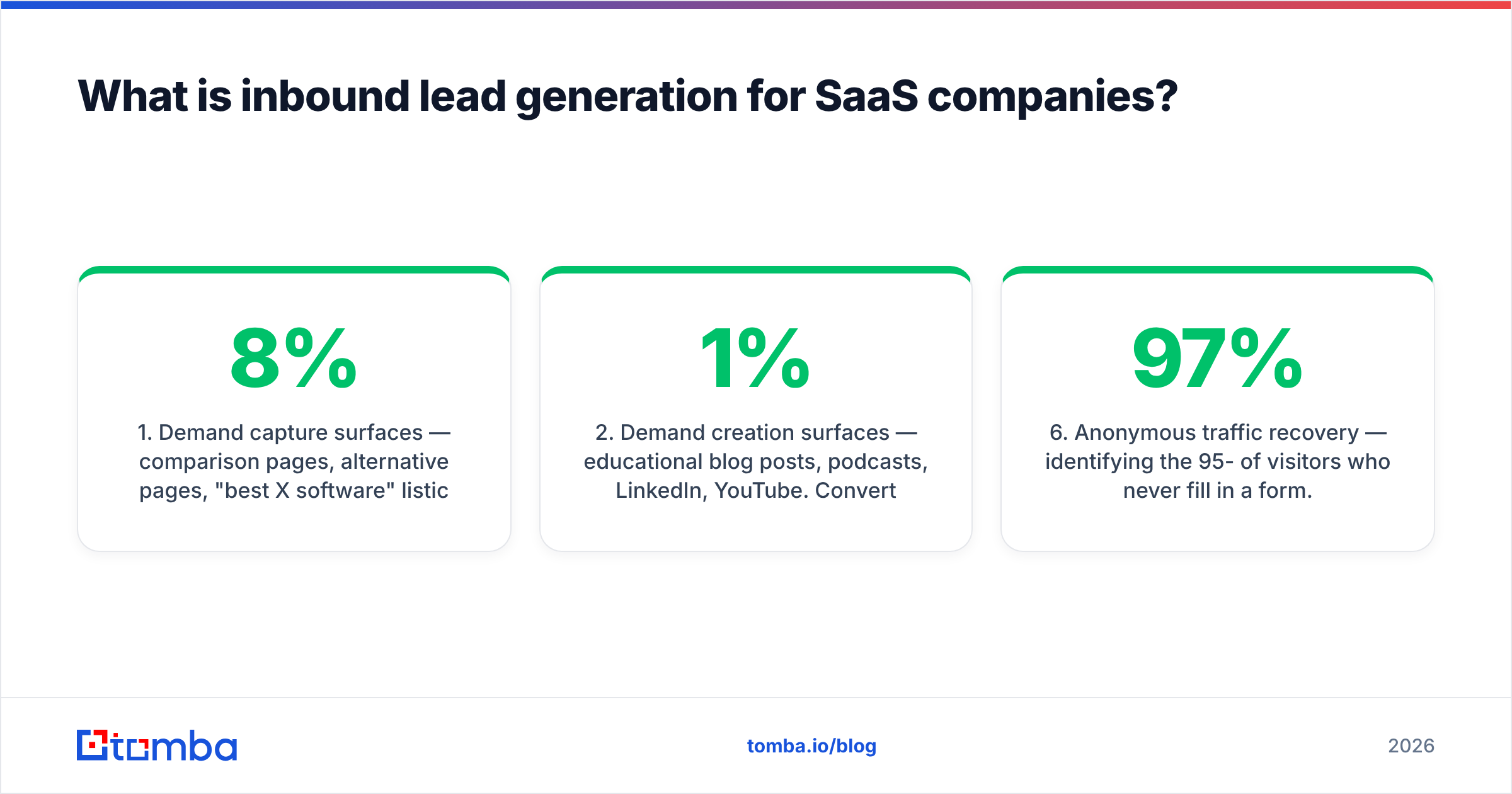
- Demand capture surfaces — comparison pages, alternative pages, "best X software" listicles, and high-intent product queries. These convert at 3-8% visitor-to-trial because the buyer already knows they have a problem.
- Demand creation surfaces — educational blog posts, podcasts, LinkedIn, YouTube. Convert at 0.3-1%, but they feed the retargeting pool and the branded search volume that capture surfaces harvest.
- Free tools and calculators — a free email checker, a pricing calculator, a template generator. These sit between the two: they rank for informational queries but produce a product experience.
- Product-led surfaces — freemium tiers, in-product invites, shared workspaces. The cheapest lead source you will ever have, and the hardest to build.
- Community and integration ecosystems — marketplace listings, partner directories, and app stores. Slow to compound, but the traffic arrives pre-qualified.
- Anonymous traffic recovery — identifying the 95-97% of visitors who never fill in a form. This is the newest lever and the one most teams have not touched.
The mistake is treating these as one bucket called "inbound" with one CAC number. They have wildly different economics, and averaging them hides the channel that's actually carrying the program.
Why did SaaS inbound get harder in 2026?#
Three structural changes, none of which are reversing.
AI answer surfaces ate the informational click. When a buyer asks "what is lead scoring," they now get a synthesized answer above the fold. Publishers across B2B software have reported informational-query click-through declines in the 25-40% range since 2024. The queries that survive are the ones where a human wants to compare, price, or verify something — because those require a decision, and people don't outsource decisions to a summary box.
Form fills collapsed as a signal. Buyers know that a form means a sequence. The share of B2B buyers who complete the buying journey anonymously before contacting sales keeps climbing; Gartner's B2B buying research has documented that buyers spend the majority of their evaluation time away from vendor-facing channels entirely. Your form is not the top of the funnel anymore. It's near the end of it.
Paid amplification got more expensive. LinkedIn CPCs in B2B software categories routinely clear $12-$18. That pushes the payback period on paid inbound past the point where seed-stage teams can sustain it.
None of this means inbound is dead. It means the middle of the funnel — generic educational content with a gated PDF at the end — stopped working, and everyone who built their program on that middle is feeling it.
How does inbound compare to outbound for SaaS pipeline?#
They solve different problems and fail in different ways. Here's the comparison that matters when you're allocating budget.
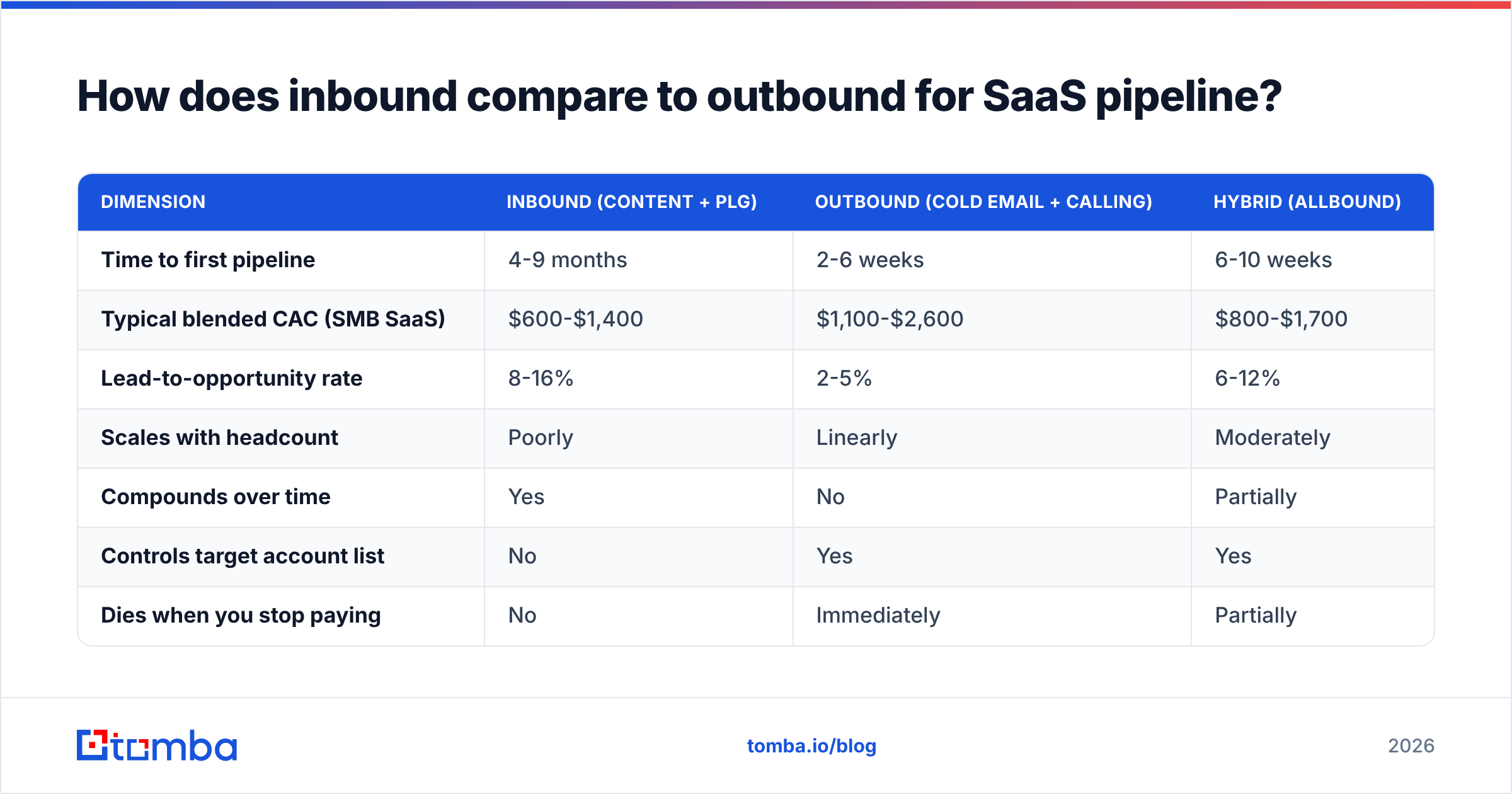
| Dimension | Inbound (content + PLG) | Outbound (cold email + calling) | Hybrid (allbound) |
|---|---|---|---|
| Time to first pipeline | 4-9 months | 2-6 weeks | 6-10 weeks |
| Typical blended CAC (SMB SaaS) | $600-$1,400 | $1,100-$2,600 | $800-$1,700 |
| Lead-to-opportunity rate | 8-16% | 2-5% | 6-12% |
| Scales with headcount | Poorly | Linearly | Moderately |
| Compounds over time | Yes | No | Partially |
| Controls target account list | No | Yes | Yes |
| Dies when you stop paying | No | Immediately | Partially |
| Data cost per month | Low ($0-$100) | Medium ($100-$500) | Medium |
| Best for | PLG, self-serve, $50-$5k ACV | Enterprise, $25k+ ACV | Most Series A-B teams |
The pattern in the data is consistent: inbound wins on efficiency, outbound wins on control and speed. If you need pipeline this quarter, outbound. If you need pipeline that costs less every quarter, inbound. Most companies that hit efficient growth are running both and — critically — attributing them separately.
One nuance that gets lost: inbound leads are not automatically better leads. An inbound lead from a "free tools" page at a 12-person agency is worth a fraction of an outbound-sourced conversation with a 400-person target account. Sorting by source instead of by fit is how teams end up with a busy SDR team and a flat revenue line.
Which inbound channels actually pay back for SaaS?#
Ranked by payback period observed across B2B SaaS teams in the $1M-$20M ARR band.
1. Comparison and alternative pages. The highest-converting page type in SaaS, full stop. Someone searching "Apollo alternative" or "Tool A vs Tool B" has a budget, a timeline, and a shortlist. Conversion rates of 5-12% visitor-to-trial are normal. These pages also survive AI answer surfaces better than anything else, because comparison requires judgment.
2. Free tools. A genuinely useful tool that solves one narrow job earns links, ranks for tool-intent queries, and demonstrates product quality before anyone signs up. The build cost is real — expect 2-6 engineering weeks — but a good tool generates leads for years with near-zero marginal cost.
3. Integration and marketplace listings. If you integrate with HubSpot, Salesforce, or Slack, their directories send small but extraordinarily well-qualified traffic. HubSpot's App Marketplace is the clearest example: buyers browsing it have already bought the adjacent product and have a specific gap to fill.
4. Product-led signups with enrichment. Freemium is a lead-generation channel disguised as a product tier. The catch: a free signup with a Gmail address and no company data is nearly useless to sales. Enrichment converts it into a routable, scoreable record.
5. Bottom-of-funnel blog content. "How to do [job your product does]" posts. Lower intent than comparison pages, higher volume, still convert at 1-3%.
6. Top-of-funnel thought leadership. Real value, terrible attribution, 12-24 month payback. Do it when you can afford it, not before.
Notice what's missing: gated whitepapers. In 2026 the gated-PDF play mostly generates addresses of people who wanted a PDF. If you gate anything, gate a tool or a benchmark dataset — something whose value is genuinely tied to identity.
Where do SaaS inbound programs leak the most pipeline?#
Three leaks, in order of how much revenue they quietly cost.
Leak one: anonymous traffic#
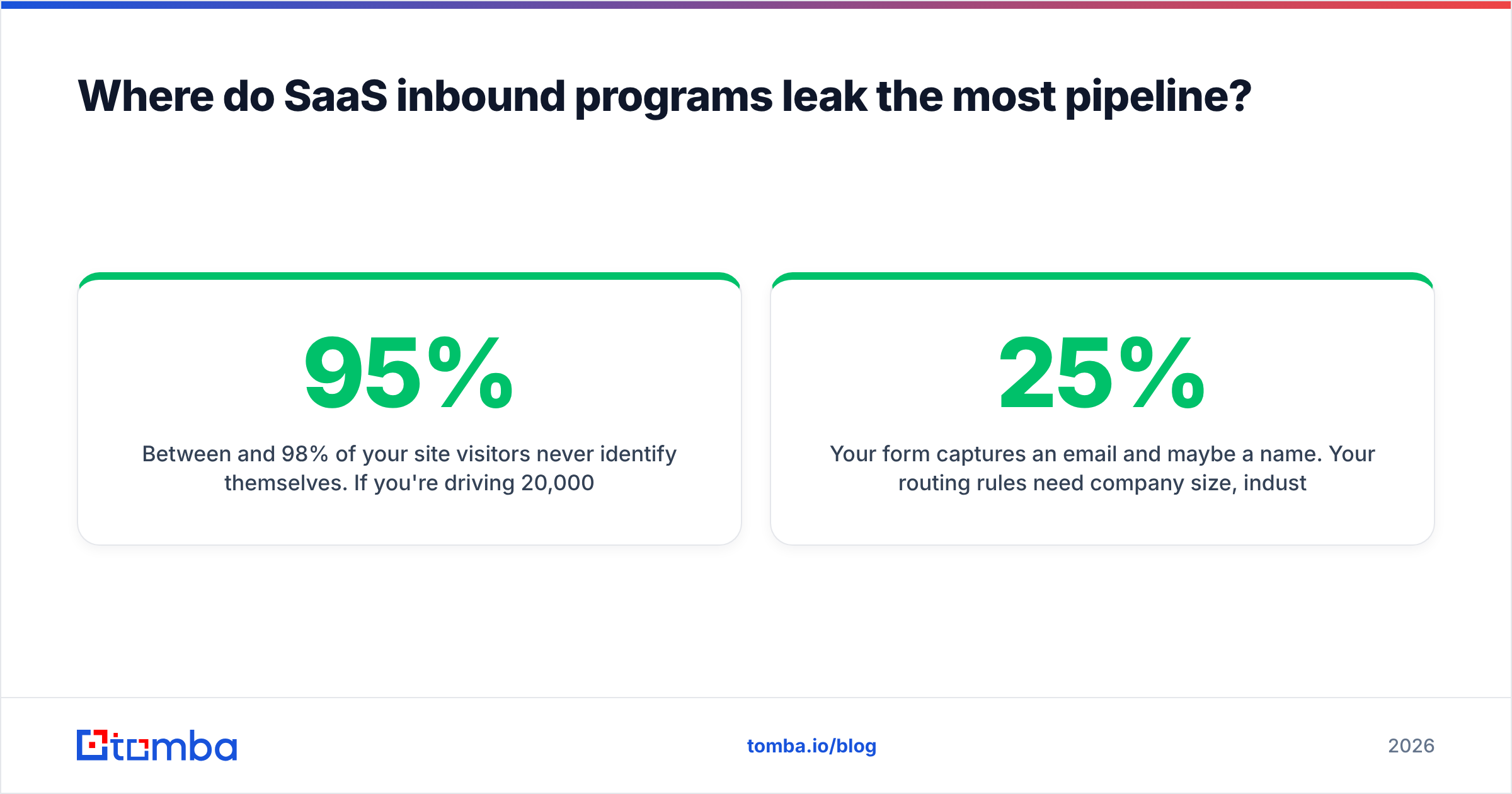
Between 95% and 98% of your site visitors never identify themselves. If you're driving 20,000 monthly visitors and converting 2%, you have 400 known leads and 19,600 anonymous ones. Some meaningful slice of those anonymous visitors are in-market accounts reading your pricing page.
Website visitor identification closes part of this gap by resolving company-level traffic, which lets you fire a targeted campaign at accounts already researching you. It won't identify individuals, and any vendor claiming otherwise at scale is overselling. But knowing that four people from a 600-person fintech read your pricing page twice this week is actionable in a way that a traffic chart is not.
Leak two: dirty and incomplete lead records#
Your form captures an email and maybe a name. Your routing rules need company size, industry, and role. That gap gets filled one of three ways: more form fields (which cuts conversion 10-25% per added field), manual SDR research (expensive and slow), or automated data enrichment at the point of capture.
The third option is the only one that scales. Capture email only, enrich in the background, route on enriched attributes. Conversion stays high, routing stays accurate.
There's a second-order problem here too: a meaningful share of inbound form submissions contain typo'd, disposable, or role-based addresses. Running an email verifier at capture keeps your nurture sequences from burning sender reputation on addresses that will never resolve.
Leak three: slow and unmatched routing#
Speed-to-lead research has held steady for over a decade: responding within five minutes dramatically outperforms responding within an hour. Yet most SaaS teams route inbound demo requests through a nightly enrichment batch and a morning SDR queue. By the time anyone calls, the buyer has booked a demo with two competitors.
What does a realistic 2026 SaaS inbound stack cost?#
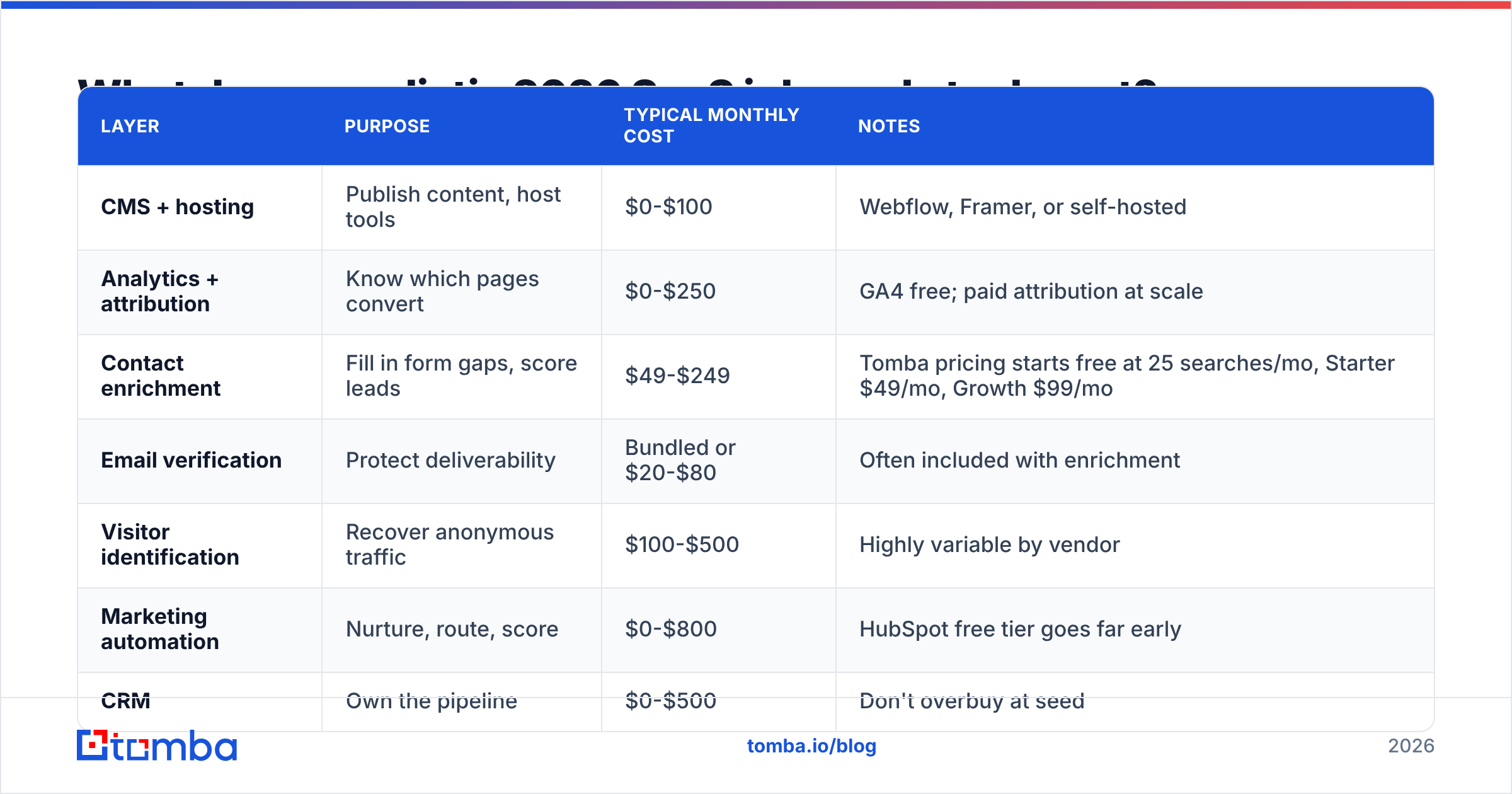
You do not need a $6,000/month martech stack to run this. Here's what a seed-to-Series-A team actually needs, with honest pricing.
| Layer | Purpose | Typical monthly cost | Notes |
|---|---|---|---|
| CMS + hosting | Publish content, host tools | $0-$100 | Webflow, Framer, or self-hosted |
| Analytics + attribution | Know which pages convert | $0-$250 | GA4 free; paid attribution at scale |
| Contact enrichment | Fill in form gaps, score leads | $49-$249 | Tomba pricing starts free at 25 searches/mo, Starter $49/mo, Growth $99/mo |
| Email verification | Protect deliverability | Bundled or $20-$80 | Often included with enrichment |
| Visitor identification | Recover anonymous traffic | $100-$500 | Highly variable by vendor |
| Marketing automation | Nurture, route, score | $0-$800 | HubSpot free tier goes far early |
| CRM | Own the pipeline | $0-$500 | Don't overbuy at seed |
| Realistic total | $500-$1,500 | Scales with volume, not headcount |
The enrichment line is the one people under-invest in. It's typically 5-15% of stack cost and it's what makes every other layer work — routing rules, lead scores, and personalization all depend on having attributes beyond an email address.
If your inbound volume is genuinely high, look at bulk enrichment rather than per-record API calls, and connect it directly to your CRM via the HubSpot integration or Zapier so records are enriched before a human ever sees them.
How do you measure inbound lead generation properly?#
Stop reporting MQLs as a headline number. Report these five instead.
1. Pipeline per published asset. Not traffic. Not rankings. Dollars of pipeline traceable to each page, measured on a 90-day lag. This kills your worst content faster than any audit.
2. Blended CAC by channel, not overall. Your comparison pages might have a $300 CAC while your podcast has a $9,000 CAC. The blended number ($1,100) tells you nothing useful and encourages you to keep funding both equally.
3. Time-to-first-touch on inbound demo requests. Measured in minutes, tracked per rep, reviewed weekly. This single metric moves inbound conversion more than most content investments.
4. Enriched-record completeness. What percentage of inbound leads have firmographic data attached within an hour of capture? If it's under 80%, your routing and scoring are running on guesses.
5. Inbound-to-opportunity rate by fit tier. Segment inbound leads into ICP-fit tiers before measuring conversion. A 4% overall inbound-to-opp rate might be 14% for tier-one fit and 0.8% for everyone else — which is a completely different strategic conclusion than "inbound converts at 4%."
For a fuller vocabulary on the metrics side, G2's B2B buyer behavior research and your own closed-won cohort analysis will get you further than any generic benchmark report. And if terms like MQL or response rate mean different things to marketing and sales in your company, fix that definition mismatch before you fix anything else — it's the root cause of more pipeline arguments than any tool.
What should you build first if you're starting from zero?#
A 90-day sequence that consistently produces pipeline, in order:
Days 1-30 — Capture what already exists. Build your comparison and alternative pages. Fix your pricing page. Put email-only forms on everything and enrich behind them. Set a five-minute routing SLA. This phase produces pipeline from traffic you already have, which is why it goes first.
Days 31-60 — Build one free tool. Pick the narrowest useful job adjacent to your product. Ship it, make it genuinely good, and don't gate it. Link it from your top-ranking pages.
Days 61-90 — Layer in demand creation. Now start the blog cadence, the LinkedIn presence, the podcast — whatever your team can sustain. You're building the pool that your capture surfaces will harvest in months 6-18.
The order matters more than the tactics. Teams that start at day 61 spend a year producing content that has nowhere good to send its traffic.
One more thing worth saying plainly: inbound and outbound are not opposing philosophies. Some of the best-performing SaaS teams use inbound signals — a pricing page visit, a tool usage session, a doc download — as the trigger for outbound. That's not cold email. That's warm outreach to someone who already showed intent, and it converts at multiples of either channel alone. Providers like BookYourData and Tomba both serve this middle ground well, and the choice usually comes down to whether you want a pre-built database or on-demand lookup.
Ready to plug the enrichment gap in your inbound funnel?#
The fastest fix in this whole article is also the least glamorous: stop asking your inbound forms to collect data you can look up automatically. Capture the email, enrich everything else, route on real attributes, and let your team spend its time on conversations instead of research.
Tomba's Email Finder handles the lookup side — finding and confirming professional addresses by domain, name, or company — and pairs with the verifier and enrichment endpoints through a single API. The free tier gives you 25 searches a month to test it against your own inbound records, and Starter runs $49/mo when you're ready to wire it into production routing. Run it against last month's inbound leads first; the completeness gap you find will tell you exactly how much pipeline you've been leaving on the form.
Related guides#
// get started
Find, verify and enrich your first contacts today
Start on the free plan with 25 searches a month, then scale when your team is ready.
Free plan · No credit card required · GDPR & CCPA
Get the Tomba newsletter
Product and data updates
// about the author