Inbound Lead Qualification in 2026: Frameworks, Scoring, and Speed
Most inbound leads get scored on the wrong signals and routed hours too late. Here's how to qualify inbound demand with data you can verify, and a response window buyers actually reward.
TL;DR
- Inbound lead qualification is the process of deciding, fast, which self-identified prospects deserve a human and which deserve automation. It is a routing decision, not a scoring ritual.
- Most scoring models fail because they weight behavior (page views, email opens) over fit (company, role, budget authority). Fit data is the part you can actually verify.
- BANT, MEDDIC, CHAMP, and GPCTBA all work for outbound. On inbound, you need a two-layer model: automated fit filtering first, human discovery second.
- Speed beats sophistication. A rough score routed in five minutes outperforms a perfect score routed in five hours, and the research on that is not close.
- The cheapest accuracy win is enrichment: turn a form fill with a personal Gmail address into a verified work email, company size, and job title before the lead ever hits a rep's queue.
What is inbound lead qualification?#
Inbound lead qualification is the process of evaluating prospects who came to you — filled a form, booked a demo, started a trial, downloaded a report — and deciding what happens next: sales-ready and routed to a rep, nurture-ready and routed to marketing, or disqualified and routed nowhere.
The distinction from outbound qualification matters. In outbound, you qualify before you spend effort: you pick accounts, verify contacts, then reach out. In inbound, effort has already been spent — by the buyer. Your job is triage, not selection. And triage has a clock on it.
That clock is why so many inbound programs underperform. Teams build elaborate scoring models with 30 weighted attributes, then let leads sit in a queue overnight while the model recalculates. The buyer, meanwhile, has filled out three other forms.
A working definition: inbound lead qualification is the fastest defensible decision you can make about a lead's fit, intent, and ownership. Fastest, defensible, and decision — all three words carry weight.
Why do most inbound qualification systems fail?#
Four failure modes show up repeatedly, and they compound.
1. Behavioral scoring is treated as fit scoring. Someone who read six blog posts is engaged. That does not mean they can buy. A student researching a term paper and a VP of Revenue Operations evaluating vendors generate identical behavioral signatures. If your model gives both of them 45 points, your model is measuring curiosity, not qualification.
2. Form data is taken at face value. Roughly a third of B2B form submissions contain a personal email, a placeholder company name, or a job title typed as "manager." You cannot route on data the buyer had no incentive to enter accurately.
3. The MQL threshold is set by committee, not by outcome. Most teams pick a score cutoff — 70 points, say — because it produces a volume marketing is comfortable delivering. Nobody back-tests it against closed-won. A marketing qualified lead definition that has never been validated against pipeline is a vanity threshold.
4. Routing latency destroys whatever accuracy you built. The classic Harvard Business Review study on online sales leads found that firms responding within an hour were roughly seven times more likely to have a meaningful conversation with a decision-maker than those responding an hour later — and sixty times more likely than firms waiting 24 hours. Fifteen years later, buyer patience has not improved.
Put those together and you get the common outcome: a scoring model that is directionally wrong, fed by unverified data, calibrated to an arbitrary number, and executed too slowly to matter.

Which qualification framework should you use for inbound?#
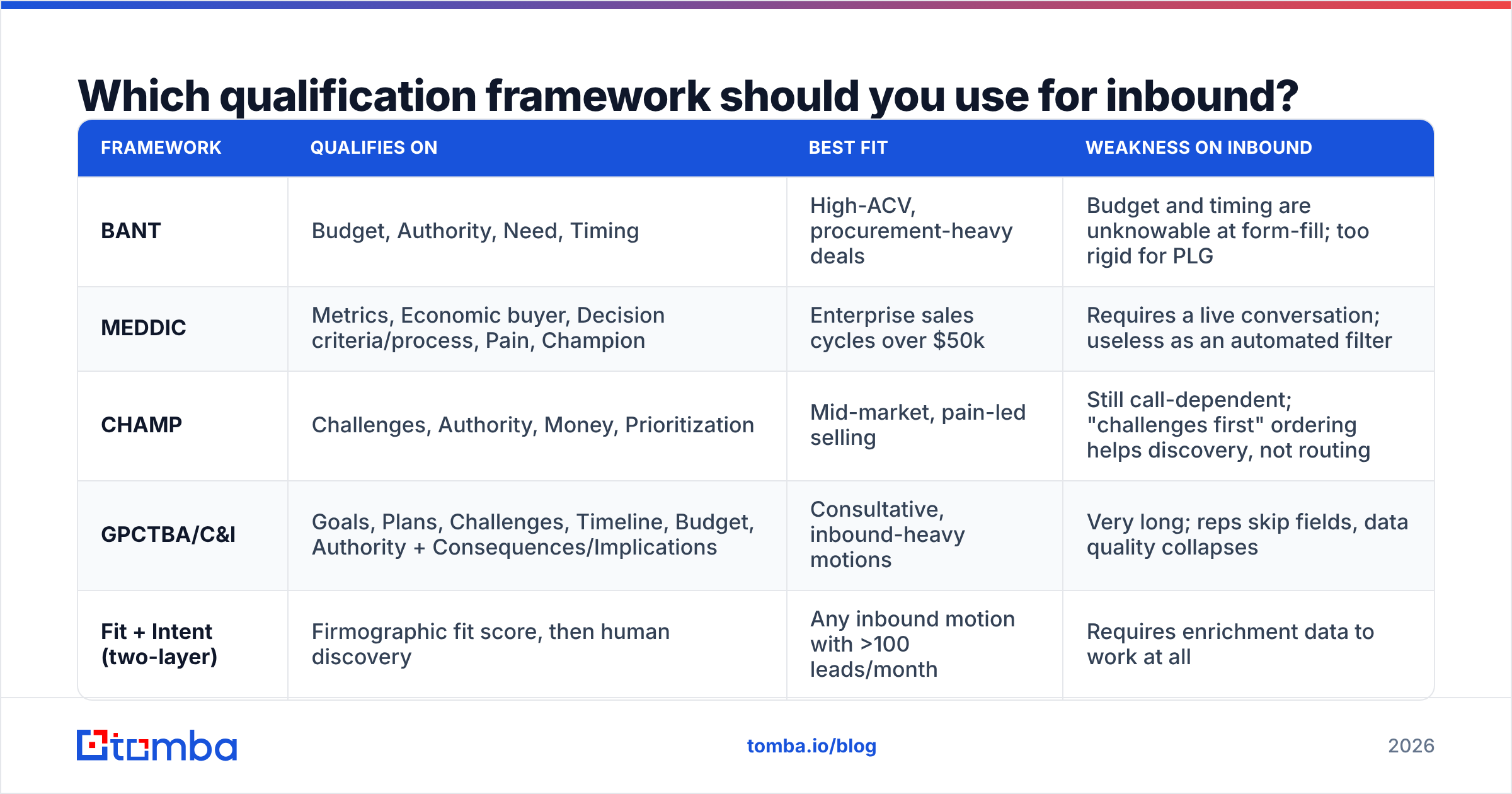
Short answer: none of the classic ones on their own. They were built for rep-led discovery calls, and inbound qualification has to happen before a call exists. Use them as the second layer, after automated fit filtering.
Here is how the common frameworks actually behave when you point them at inbound volume.
| Framework | Qualifies on | Best fit | Weakness on inbound |
|---|---|---|---|
| BANT | Budget, Authority, Need, Timing | High-ACV, procurement-heavy deals | Budget and timing are unknowable at form-fill; too rigid for PLG |
| MEDDIC | Metrics, Economic buyer, Decision criteria/process, Pain, Champion | Enterprise sales cycles over $50k | Requires a live conversation; useless as an automated filter |
| CHAMP | Challenges, Authority, Money, Prioritization | Mid-market, pain-led selling | Still call-dependent; "challenges first" ordering helps discovery, not routing |
| GPCTBA/C&I | Goals, Plans, Challenges, Timeline, Budget, Authority + Consequences/Implications | Consultative, inbound-heavy motions | Very long; reps skip fields, data quality collapses |
| Fit + Intent (two-layer) | Firmographic fit score, then human discovery | Any inbound motion with >100 leads/month | Requires enrichment data to work at all |
The two-layer model is the one to build. Layer one is automated and answers a single question: could this company plausibly buy from us? Layer two is human and answers everything else.
How do you score inbound leads without guessing?#
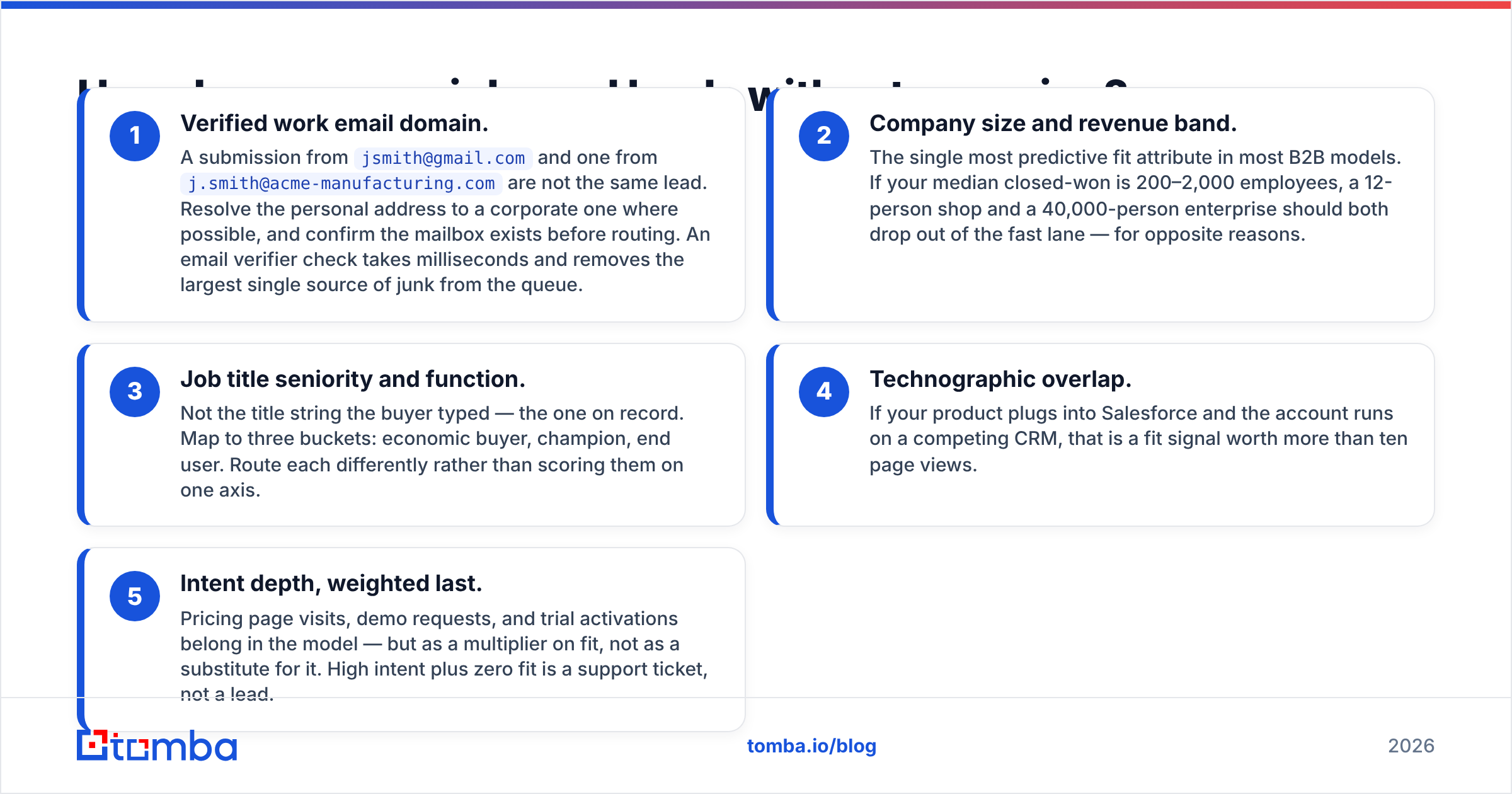
Build the fit score from attributes you can verify externally, not attributes the buyer typed. Five inputs cover most B2B cases:
- Verified work email domain. A submission from
jsmith@gmail.comand one fromj.smith@acme-manufacturing.comare not the same lead. Resolve the personal address to a corporate one where possible, and confirm the mailbox exists before routing. An email verifier check takes milliseconds and removes the largest single source of junk from the queue. - Company size and revenue band. The single most predictive fit attribute in most B2B models. If your median closed-won is 200–2,000 employees, a 12-person shop and a 40,000-person enterprise should both drop out of the fast lane — for opposite reasons.
- Job title seniority and function. Not the title string the buyer typed — the one on record. Map to three buckets: economic buyer, champion, end user. Route each differently rather than scoring them on one axis.
- Technographic overlap. If your product plugs into Salesforce and the account runs on a competing CRM, that is a fit signal worth more than ten page views.
- Intent depth, weighted last. Pricing page visits, demo requests, and trial activations belong in the model — but as a multiplier on fit, not as a substitute for it. High intent plus zero fit is a support ticket, not a lead.
Weight fit at roughly 70% of the composite score and intent at 30% until you have enough closed-won data to fit the weights empirically. Then re-fit them quarterly. A model nobody recalibrates is a model quietly drifting away from your ICP.
The practical blocker is that most of those five attributes are not in the form. That is what data enrichment is for: take the one field you trust — usually the email or the domain — and append the rest before the record ever reaches routing logic.
How fast does inbound lead response actually need to be?#
Fast enough that the buyer is still in the tab they submitted from.
The consistent finding across two decades of research — Gartner's sales research and vendor studies alike — is that response-time decay is steep and front-loaded. Contact rates fall off a cliff after the first five minutes, then decline gently. There is very little practical difference between responding in three hours and responding the next morning; there is an enormous difference between five minutes and thirty.
That has a direct architectural consequence: your qualification logic must run in under a minute, or it must run after the first touch. If enriching, scoring, and routing takes eight minutes, you have already lost most of the advantage the score was supposed to buy you.
Two designs that work:
- Synchronous enrichment. Call an enrichment API on form submit, score inline, route immediately. Adds 200–800ms to the submission. This is the right default when your volume is manageable and your provider has real-time endpoints.
- Optimistic routing with async correction. Route everyone to an SDR queue instantly on a crude rule (work email + non-competitor domain), then let enrichment reorder the queue within 60 seconds. Nobody waits; the score still lands before the rep dials.
Avoid the third pattern, which is what most teams accidentally build: nightly batch enrichment, morning scoring, mid-morning routing. It is operationally tidy and commercially useless.

What should your inbound qualification stack look like?#
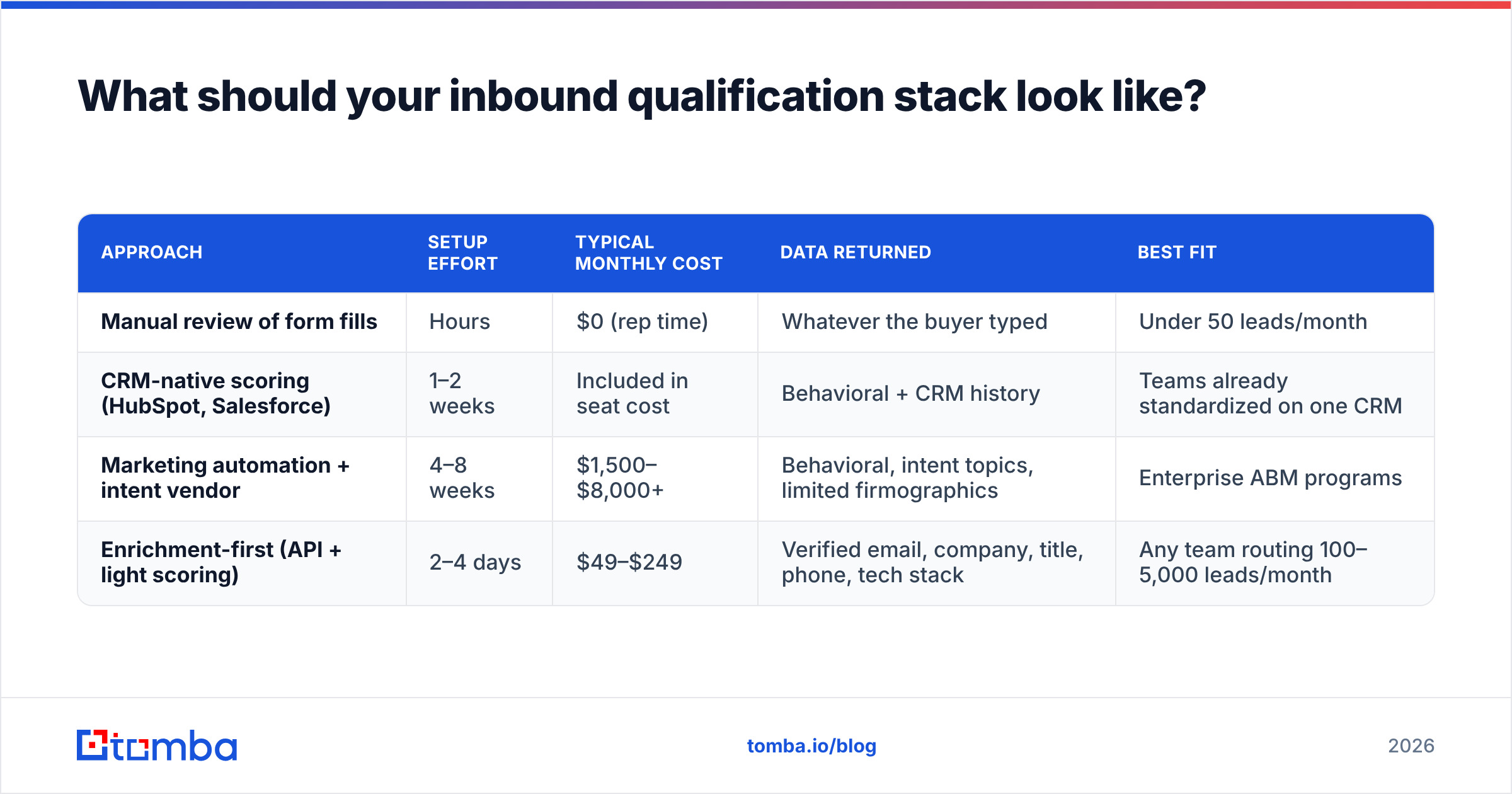
You have four realistic architectures. The differences are cost, latency, and how much of the fit data you actually get.
| Approach | Setup effort | Typical monthly cost | Data returned | Best fit |
|---|---|---|---|---|
| Manual review of form fills | Hours | $0 (rep time) | Whatever the buyer typed | Under 50 leads/month |
| CRM-native scoring (HubSpot, Salesforce) | 1–2 weeks | Included in seat cost | Behavioral + CRM history | Teams already standardized on one CRM |
| Marketing automation + intent vendor | 4–8 weeks | $1,500–$8,000+ | Behavioral, intent topics, limited firmographics | Enterprise ABM programs |
| Enrichment-first (API + light scoring) | 2–4 days | $49–$249 | Verified email, company, title, phone, tech stack | Any team routing 100–5,000 leads/month |
For most B2B teams under $20M ARR, the enrichment-first path wins on payback speed. Tomba pricing starts with a free tier at 25 searches per month, Starter at $49/mo, Growth at $99/mo, and Pro at $249/mo — which means the fit layer of your qualification model costs less than a single wasted SDR hour per week.
If you want a broader view of the category before committing, the lead capture and enrichment categories on G2 are a reasonable neutral starting point for user-reported accuracy and support data.
One more source worth wiring in: anonymous traffic. A meaningful share of your highest-fit accounts research you for weeks and never fill a form. Website visitor reveal turns some of that traffic into named accounts you can qualify with the same model — inbound intent without the inbound form.
How do you set the MQL threshold correctly?#
Back-test it. Do not vote on it.
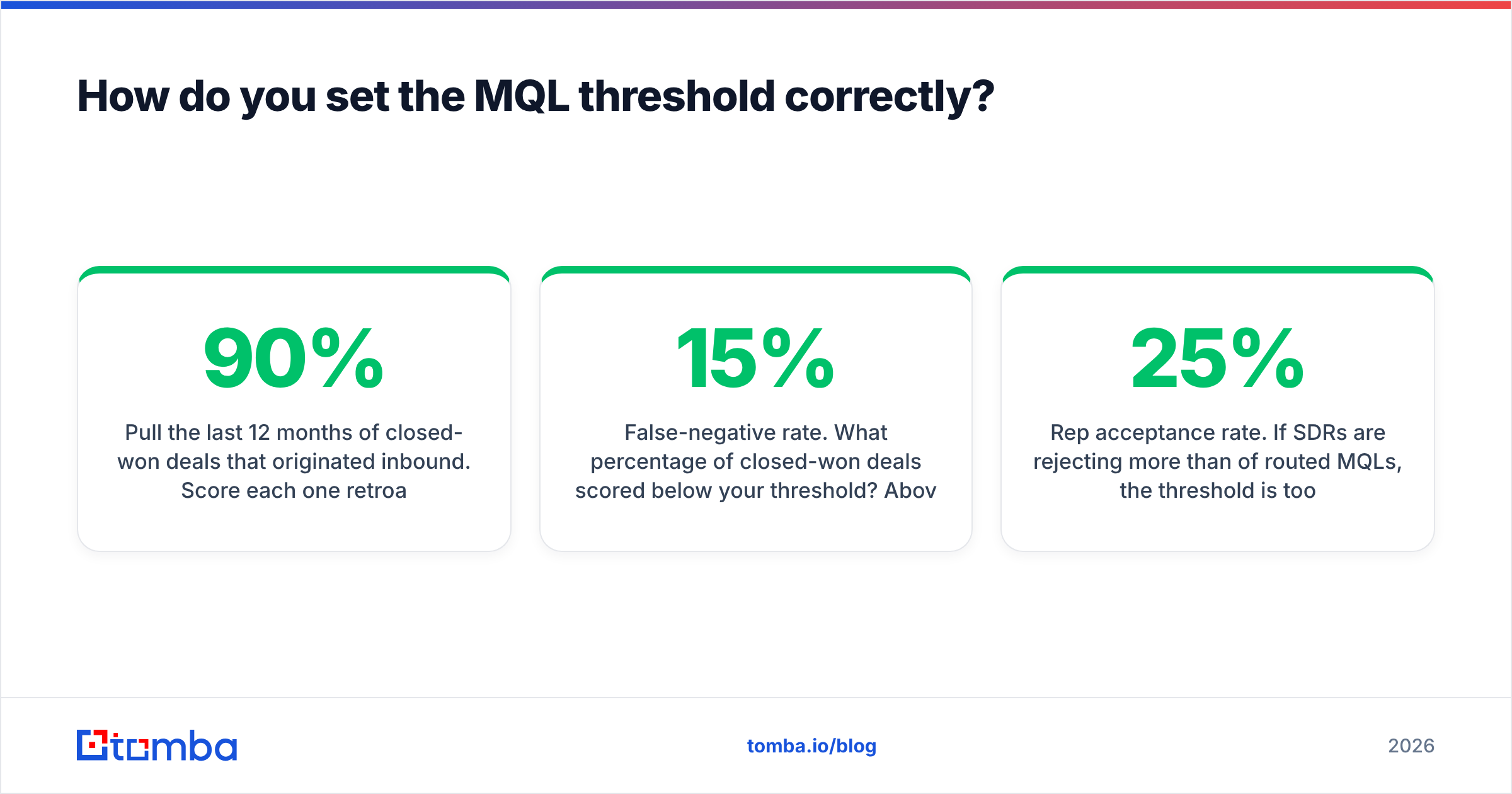
Pull the last 12 months of closed-won deals that originated inbound. Score each one retroactively with your current model, using the data as it existed at form-fill. Plot the distribution. Your threshold belongs at the score where you capture roughly 85–90% of eventual closed-won while cutting the largest possible share of volume.
Three checks to run afterward:
- False-negative rate. What percentage of closed-won deals scored below your threshold? Above 15% and your model is systematically blind to a segment — usually a vertical or a company-size band you underweighted.
- Rep acceptance rate. If SDRs are rejecting more than 25% of routed MQLs, the threshold is too low or the fit attributes are wrong.
- Time-to-first-touch by score band. High-score leads should be touched fastest. In practice they often are not, because routing rules and rep capacity are decoupled from scoring. Fix the capacity model, not the score.
What are the most common inbound qualification mistakes?#
- Disqualifying on company size alone. A 30-person company owned by a 5,000-person parent is an enterprise lead wearing a disguise. Check the corporate hierarchy before you cut.
- Treating free-email signups as garbage. In some markets — agencies, consultants, founders — a Gmail address is the professional address. Resolve it rather than discarding it.
- Scoring email opens. Since Apple Mail Privacy Protection, open data is largely noise. Keep clicks, drop opens.
- Letting the model run untouched for a year. ICPs shift. So do the products. A stale model is worse than no model, because it carries false authority.
- Routing without contact data. A qualified lead with no verified phone number or deliverable email is a qualified lead the rep cannot reach. Verification belongs inside qualification, not after it.
How do you operationalize this in one sprint?#
A realistic two-week build:
- Days 1–2. Define fit attributes and pull the closed-won back-test data. Write the ICP down in one paragraph that a rep can repeat from memory.
- Days 3–5. Wire enrichment to your form handler. Every submission gets domain, company size, seniority, and a verified email before it hits the CRM.
- Days 6–8. Build the fit score (70%) and the intent multiplier (30%). Keep it under ten attributes. Complexity you cannot debug is complexity you will not maintain.
- Days 9–10. Set routing rules with an explicit SLA per band: five minutes for the top band, one hour for the middle, automated nurture for the rest.
- Days 11–14. Instrument it. Track acceptance rate, time-to-first-touch, and score-to-close by band. Review in 30 days.
The tooling matters less than the sequence. Enrich before you score, score before you route, and measure the routing rather than the scoring.
Where does Tomba fit into this?#
The fit layer of inbound qualification lives or dies on contact data quality. If you want the verified work email, company, title, and phone behind every form fill — before a rep sees it — start with the Tomba Email Finder. Free tier gives you 25 searches a month to test the model against your own back-test data, and the API drops straight into your form handler when you are ready to run it in production. Qualify on data you verified, not data the buyer typed.
Related guides#
// get started
Find, verify and enrich your first contacts today
Start on the free plan with 25 searches a month, then scale when your team is ready.
Free plan · No credit card required · GDPR & CCPA
// about the author