Inbound Sales Development Representative: The 2026 Guide
Inbound SDRs work the leads that already raised a hand — but most teams staff, measure, and pay the role wrong. Here's what the job actually covers, how it differs from outbound, what it costs, and when it pays for itself.
TL;DR
- An inbound sales development representative qualifies and routes demand that already exists — form fills, demo requests, trial signups, content downloads, chat conversations — instead of cold-starting conversations from a list.
- The job is not "easier" than outbound. It is a speed-and-triage job: response time, routing accuracy, and disqualification discipline decide whether pipeline gets created or leaks.
- Typical US comp in 2026 lands around $50k–$62k base and $72k–$88k OTE, slightly below outbound SDR comp, with quota expressed in qualified meetings held rather than meetings booked.
- The single highest-leverage fix for most inbound teams is not more headcount — it is enrichment plus a sub-five-minute response SLA on high-fit leads.
- Hire an inbound SDR when you consistently generate 250+ hand-raisers a month and AEs are spending more than 20% of their week qualifying them.
What is an inbound sales development representative?#
An inbound sales development representative is the person who catches the leads your marketing already earned, decides which ones are real, and hands the good ones to an account executive with enough context to run a first call.
The everyday analogy: an outbound SDR is a street team handing out flyers to strangers. An inbound SDR is the host at a busy restaurant door — people already walked in, and the host's job is to figure out fast who has a reservation, who is just looking at the menu, and who needs to be seated at the right table before they wander off.
Technically, the role sits between demand generation and closing. Marketing produces a marketing qualified lead; the inbound SDR converts it (or doesn't) into a sales-accepted opportunity. The title varies by company — Inbound SDR, MDR (Market Development Rep), LDR (Lead Development Rep), LQR — but the function is the same.
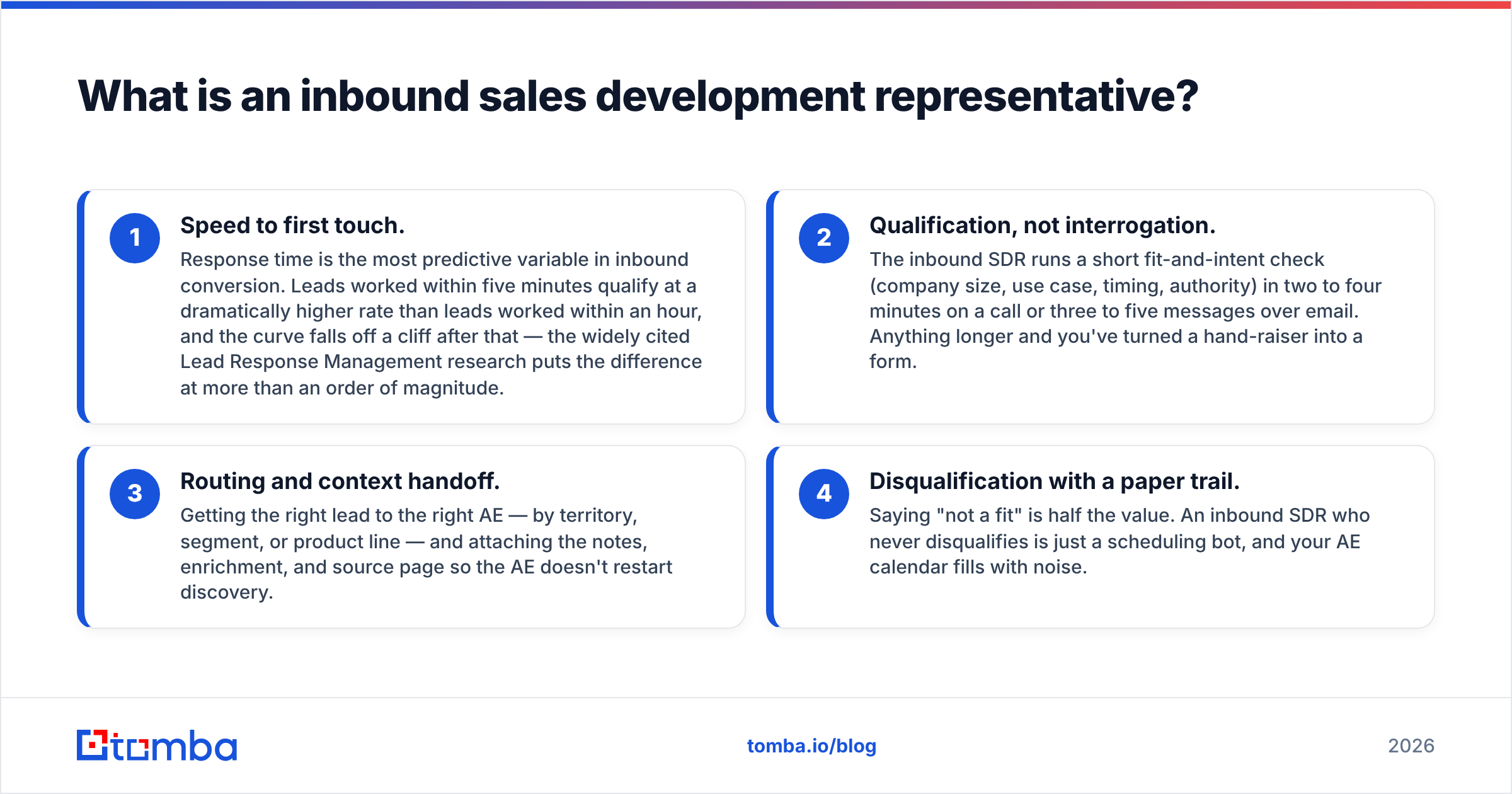
Four things define the role, and every one of them is a place teams get sloppy:
- Speed to first touch. Response time is the most predictive variable in inbound conversion. Leads worked within five minutes qualify at a dramatically higher rate than leads worked within an hour, and the curve falls off a cliff after that — the widely cited Lead Response Management research puts the difference at more than an order of magnitude.
- Qualification, not interrogation. The inbound SDR runs a short fit-and-intent check (company size, use case, timing, authority) in two to four minutes on a call or three to five messages over email. Anything longer and you've turned a hand-raiser into a form.
- Routing and context handoff. Getting the right lead to the right AE — by territory, segment, or product line — and attaching the notes, enrichment, and source page so the AE doesn't restart discovery.
- Disqualification with a paper trail. Saying "not a fit" is half the value. An inbound SDR who never disqualifies is just a scheduling bot, and your AE calendar fills with noise.
How is an inbound SDR different from an outbound SDR?#
Same title family, genuinely different jobs. Confusing them is why so many SDR hires fail in their first six months — you hire a hunter and give them a triage queue, or vice versa.
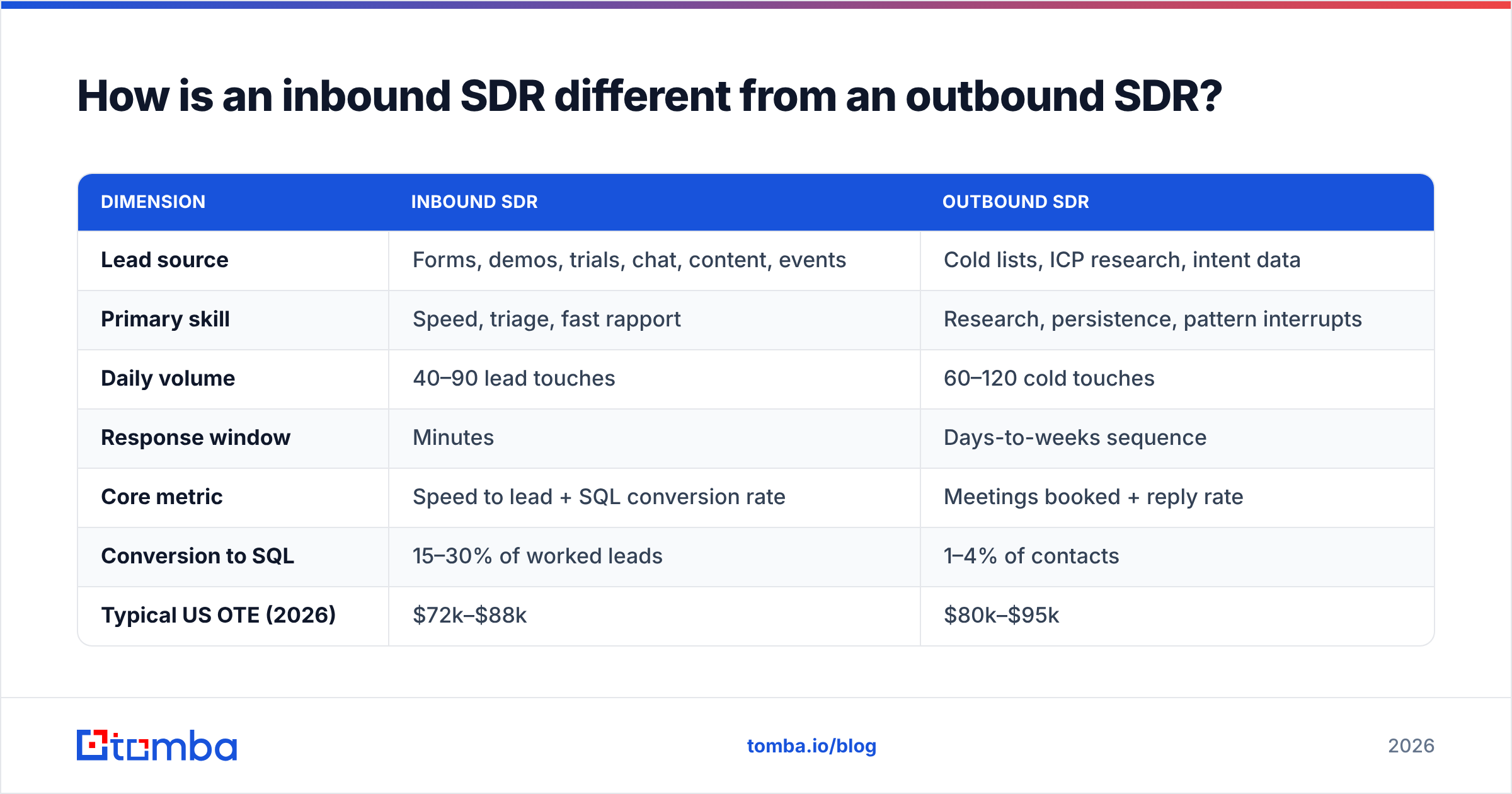
| Dimension | Inbound SDR | Outbound SDR |
|---|---|---|
| Lead source | Forms, demos, trials, chat, content, events | Cold lists, ICP research, intent data |
| Primary skill | Speed, triage, fast rapport | Research, persistence, pattern interrupts |
| Daily volume | 40–90 lead touches | 60–120 cold touches |
| Response window | Minutes | Days-to-weeks sequence |
| Core metric | Speed to lead + SQL conversion rate | Meetings booked + reply rate |
| Conversion to SQL | 15–30% of worked leads | 1–4% of contacts |
| Typical US OTE (2026) | $72k–$88k | $80k–$95k |
| Ramp time | 3–5 weeks | 6–10 weeks |
| Tooling weight | CRM, routing, chat, enrichment | Prospecting DB, email finder, sequencer, dialer |
| Failure mode | Slow response, over-qualifying | Bad data, burned domains |
The comp gap is real but smaller than people assume, and it is shrinking. Inbound SDRs increasingly own outbound follow-up on unconverted leads, which blurs the line — a pattern Gartner's sales research has tracked as "hybrid SDR" for several cycles now.
One nuance worth stating plainly: inbound SDRs handle warmer conversations, so weak reps can hide there longer. Outbound exposes a bad rep in three weeks. Inbound can hide one for two quarters because the pipeline arrives regardless. Measure conversion rate, not activity, or you will not notice.
What does an inbound SDR actually do all day?#
Here is a realistic 2026 day, not the job-description version:
- First 30 minutes: clear the overnight queue. Trials from other timezones, weekend demo requests, chat transcripts. Enrich anything missing a work email or phone, then triage by fit score.
- Core hours in blocks: work the live queue with an SLA timer running. High-fit leads get a call within five minutes plus an email; mid-fit get an email and a task; low-fit get a nurture tag and a polite decline.
- Midday: recycled-lead outbound. Every inbound SDR should have a standing list of leads that went dark 30–60 days ago. This is where inbound SDRs earn their keep — the list is warm, the data is already in the CRM, and nobody else is working it.
- Afternoon: handoff hygiene. Confirm meetings, write pre-call briefs, chase no-shows, log disqualification reasons with an actual reason code.
- End of day: feedback loop to marketing. Which campaign produced junk, which page produced buyers, which form field is lying.
That last one is underrated. The inbound SDR is the only human who reads every lead your marketing team produces. If they aren't reporting back weekly, you're wasting your best source of channel-quality data.
Why does data quality decide whether the role works?#
Because a lead you cannot reach is not a lead. It's a row.
Inbound forms are optimized for conversion, which means they ask for as little as possible — often just a personal Gmail address and a first name. That's fine for a newsletter and useless for qualification. The inbound SDR's real bottleneck is turning a thin form fill into a reachable, scorable contact before the five-minute window closes.
The fix is enrichment at the point of capture, not at the point of outreach:
- Work email resolution. A free-mail signup from a real company should be resolved to the corporate address before routing. Tools like Tomba Email Finder and its email finder API do this inline so the record is complete when the SDR opens it.
- Deliverability check. Bouncing your first reply to an inbound lead is an own goal — and repeated bounces damage the domain your whole team sends from. Run every captured address through an email verifier before the first send.
- Firmographic fill. Employee count, industry, tech stack, and country drive routing. Without them, "route by segment" is a coin flip. Contact enrichment fills these from the domain alone.
- Phone append. Speed-to-lead calling is impossible if you only have an email. A phone finder append on high-fit leads is often the difference between a 20% and a 35% connect rate.
- Deduplication against the CRM. The single most common inbound failure is an SDR cold-calling a lead who is already in an AE's open opportunity.
Teams that skip enrichment usually compensate by adding form fields. That trade is almost always negative: every additional required field costs conversion, and you can infer most of what you asked for from the email domain anyway.
Which metrics should an inbound SDR own?#
Pick five. More than that and nobody optimizes anything.
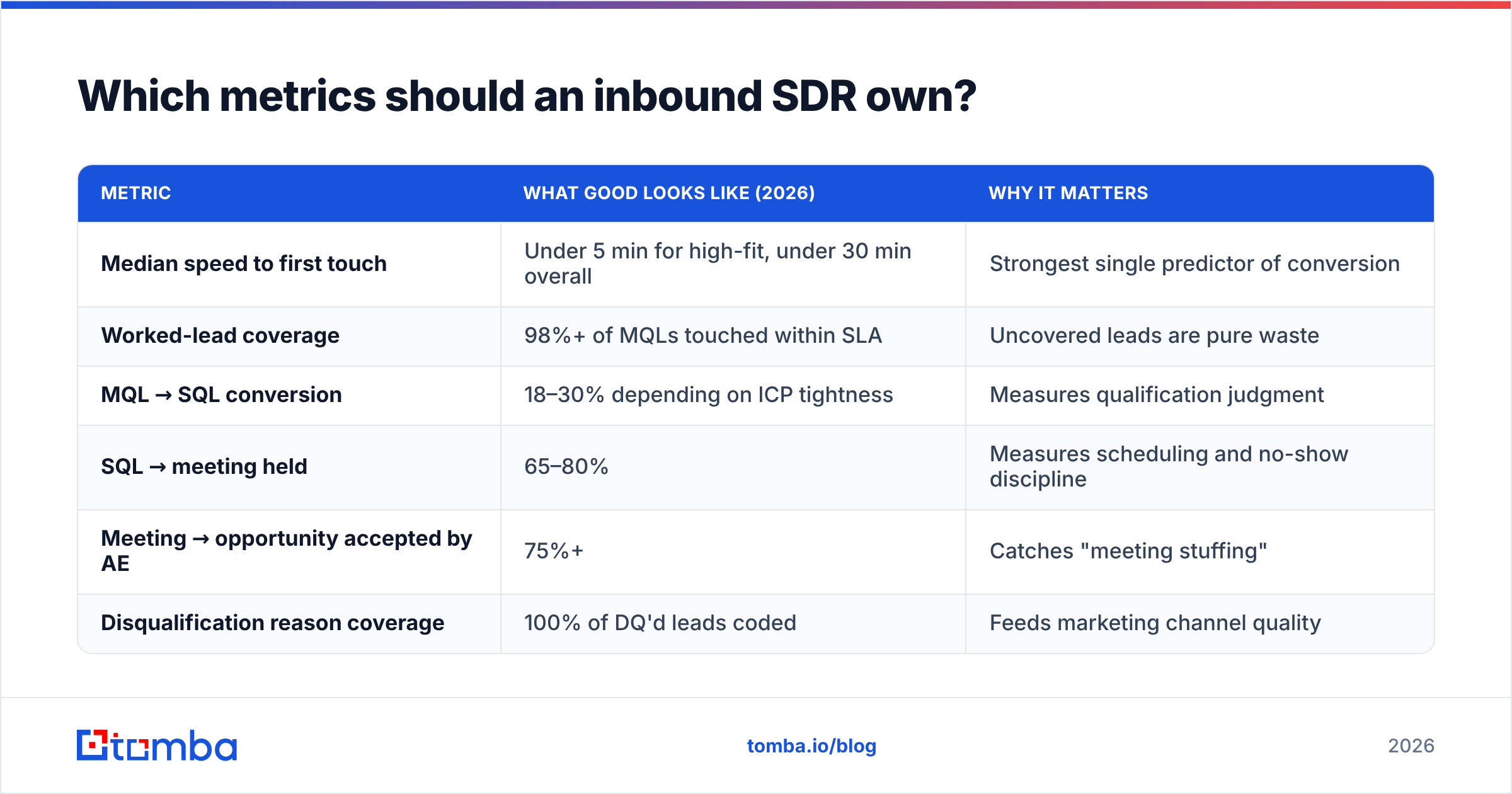
| Metric | What good looks like (2026) | Why it matters |
|---|---|---|
| Median speed to first touch | Under 5 min for high-fit, under 30 min overall | Strongest single predictor of conversion |
| Worked-lead coverage | 98%+ of MQLs touched within SLA | Uncovered leads are pure waste |
| MQL → SQL conversion | 18–30% depending on ICP tightness | Measures qualification judgment |
| SQL → meeting held | 65–80% | Measures scheduling and no-show discipline |
| Meeting → opportunity accepted by AE | 75%+ | Catches "meeting stuffing" |
| Disqualification reason coverage | 100% of DQ'd leads coded | Feeds marketing channel quality |
Two anti-metrics to avoid making primary: raw activity counts (calls dialed, emails sent) and meetings booked. Booked-not-held is the oldest gaming vector in sales development. Pay on held-and-accepted, and the behavior follows. HubSpot's ongoing sales benchmark research has shown this shift across most mature SDR orgs.

Does AI replace the inbound sales development representative in 2026?#
Partly — and the part it replaces is the part nobody enjoyed.
What AI agents now handle reliably:
- Instant first-touch acknowledgment and simple scheduling
- Enrichment, dedupe, scoring, and routing
- Drafting the follow-up sequence for unconverted leads
- Transcribing and summarizing qualification calls into CRM notes
- After-hours coverage in timezones you don't staff
What still needs a human:
- Judgment calls on ambiguous fit ("500-person company, but the buyer is a two-person innovation team")
- Multi-threading when the form-filler isn't the buyer
- Handling the annoyed prospect who already talked to someone at your company
- Anything requiring a real objection response rather than a canned one
- The feedback loop to marketing about why a channel is producing junk
The realistic 2026 pattern is one inbound SDR supervising an AI-assisted queue that would have needed three people in 2022 — higher leverage per head, higher bar per hire. If you're staffing an inbound motion from scratch, plan for fewer, stronger reps and a bigger tooling line item. Salesforce's Sales Cloud and every major sales engagement platform now ship agentic lead handling natively, so the tooling is table stakes rather than a differentiator.
The role that disappears is "inbound SDR who copies form data into the CRM and books a calendar link." The role that grows is "inbound SDR who owns conversion rate on demand the company paid a lot of money to generate."
What tools does an inbound SDR need?#
Keep the stack small enough that the SLA timer never waits on a tab load.
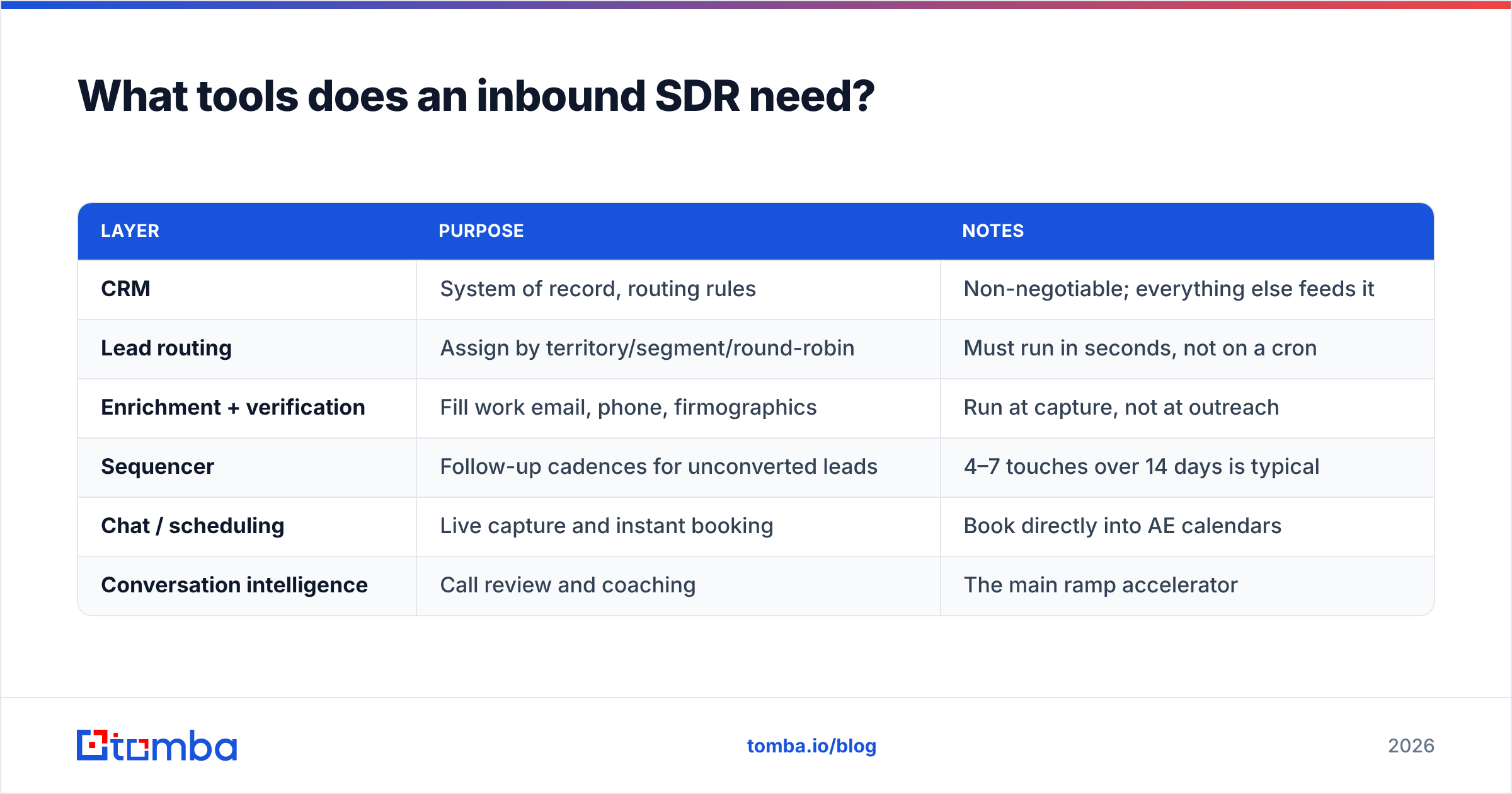
| Layer | Purpose | Notes |
|---|---|---|
| CRM | System of record, routing rules | Non-negotiable; everything else feeds it |
| Lead routing | Assign by territory/segment/round-robin | Must run in seconds, not on a cron |
| Enrichment + verification | Fill work email, phone, firmographics | Run at capture, not at outreach |
| Sequencer | Follow-up cadences for unconverted leads | 4–7 touches over 14 days is typical |
| Chat / scheduling | Live capture and instant booking | Book directly into AE calendars |
| Conversation intelligence | Call review and coaching | The main ramp accelerator |
Budget reality: enrichment and verification together typically run $50–$250 per SDR per month at inbound volumes — Tomba pricing starts free at 25 searches and moves to $49/mo Starter, $99/mo Growth, and $249/mo Pro for teams handling higher lead flow. Compared to a $75k+ OTE hire whose output depends entirely on data completeness, that is the cheapest line in the stack. Cross-check any vendor claim on G2 before you commit — inbound teams have very different accuracy needs than pure outbound teams, because a single bounced reply to a hand-raiser is far more costly than a bounce in a cold sequence.
How do you hire and ramp an inbound SDR?#
Hire for: demonstrated urgency, written clarity, comfort being told "no" politely, and genuine curiosity about the product. Inbound leads ask real questions in the first 60 seconds; a rep who can't answer them loses credibility instantly.
Skip: the classic "sell me this pen" test. It measures outbound improv, not triage judgment. Better exercise — hand the candidate ten anonymized real leads and 15 minutes, and ask them to rank, route, and write the first message to the top three. You'll learn more in that exercise than in three interviews.
Ramp plan (30 days):
- Week 1: product, ICP, disqualification criteria, CRM hygiene. Shadow the queue read-only.
- Week 2: work low-fit leads only, full SLA. Every message reviewed before send.
- Week 3: full queue with a 50% quota. Daily call review, 15 minutes.
- Week 4: full quota, weekly review. First marketing feedback report due.
Comp structure: 65/35 base-to-variable is standard for inbound. Tie variable to meetings held and accepted, with an accelerator on opportunities that reach a defined stage. Add a small quality kicker for disqualification-reason coverage if data hygiene is a chronic problem — it works, and it costs almost nothing.
Is the inbound SDR role worth it for your team?#
Run the arithmetic before you run the job posting.
Hire when: you generate 250+ hand-raisers per month, AEs spend more than 20% of their week qualifying, and your median response time is over an hour. At that point, a single inbound SDR who moves median response from 60 minutes to 5 typically lifts SQL conversion enough to cover their fully loaded cost within two quarters.
Don't hire yet when: volume is under ~100 leads a month, your ICP is undefined, or your CRM data is so poor that routing is guesswork. Fix enrichment, routing, and disqualification criteria first — those cost hundreds of dollars, not six figures. A new SDR dropped into a broken funnel just becomes a well-paid symptom of the same problem.
The honest middle case: many mid-market teams get most of the benefit by giving an existing AE a two-hour daily triage block plus automated enrichment and routing, then hiring the dedicated inbound SDR one quarter later once volume proves out. That sequencing is unglamorous and almost always correct.
Before you add headcount, make sure the leads you already have are actually reachable. Most inbound queues are half-empty records — personal email addresses, missing phone numbers, no company data — and no SDR, human or AI, converts what they can't contact. Start with Tomba Email Finder to resolve form fills into verified work emails at the moment of capture. The free tier covers 25 searches a month so you can test it against last week's leads before you commit to anything, and the API drops straight into your existing routing flow.
Related guides#
// get started
Find, verify and enrich your first contacts today
Start on the free plan with 25 searches a month, then scale when your team is ready.
Free plan · No credit card required · GDPR & CCPA
Get the Tomba newsletter
Product and data updates
// about the author