Inbound SDR vs Outbound SDR: Roles, Quotas, and Pay in 2026
Inbound and outbound SDRs share a title and almost nothing else. Here is how the two roles differ on quota, ramp, comp, tooling, and cost per meeting, plus which one to hire first.
Inbound SDR vs outbound SDR is a hiring choice, not a job-title debate. Both roles book meetings for the same AEs. After that, almost nothing about the two jobs matches.
TL;DR
An inbound SDR works leads that already raised a hand. An outbound SDR creates demand from a cold list. Same title, different job, different hire.
Inbound SDRs ramp in roughly 3-6 weeks and book meetings at a much higher rate per touch. Outbound SDRs take 8-12 weeks and need 8-15x more activity per meeting.
Outbound only works when the contact data is right. Bad emails destroy outbound economics faster than bad copy does.
Most teams under $5M ARR should staff inbound first, then add outbound once a repeatable ICP exists.
Do not put both jobs on one person unless you time-block the calendar and score them on two separate scorecards.
Inbound SDR vs outbound SDR: what is the difference?#
An inbound SDR responds. An outbound SDR initiates.
Think of it like a restaurant. The inbound SDR is the host at the door. People already walked in, so the job is to seat the right ones fast and keep the wrong ones off the AE's calendar. The outbound SDR hands out flyers three blocks away, trying to convince someone who was not planning to eat that tonight is the night.
Technically, both roles sit at the top of the funnel. Both hand qualified meetings to an account executive. Everything after that diverges: the trigger, the tempo, the tooling, the metrics, and the personality that survives the job.
Inbound SDRs (sometimes titled MDR, or market development rep) work a queue: demo requests, pricing-page form fills, content downloads, free-trial signups, chat conversations, webinar registrants. Speed to lead is the whole game. Answer in five minutes and you connect at about 30%. Wait an hour and the same lead connects at 5%.
Outbound SDRs (BDRs at most companies) work a territory: a named account list, a persona definition, and a sequence. Nobody is waiting for the call. The job is research, targeting, and personalization at scale. It also takes the resilience to make 60 dials into silence and start again tomorrow.
The confusion is expensive. Companies hire "an SDR," give them a mixed workload, then wonder why pipeline is flat. The two jobs pull against each other by design. Inbound rewards interruption: drop everything, that form just came in. Outbound rewards long blocks of focus.
How do inbound and outbound SDR roles compare side by side?#
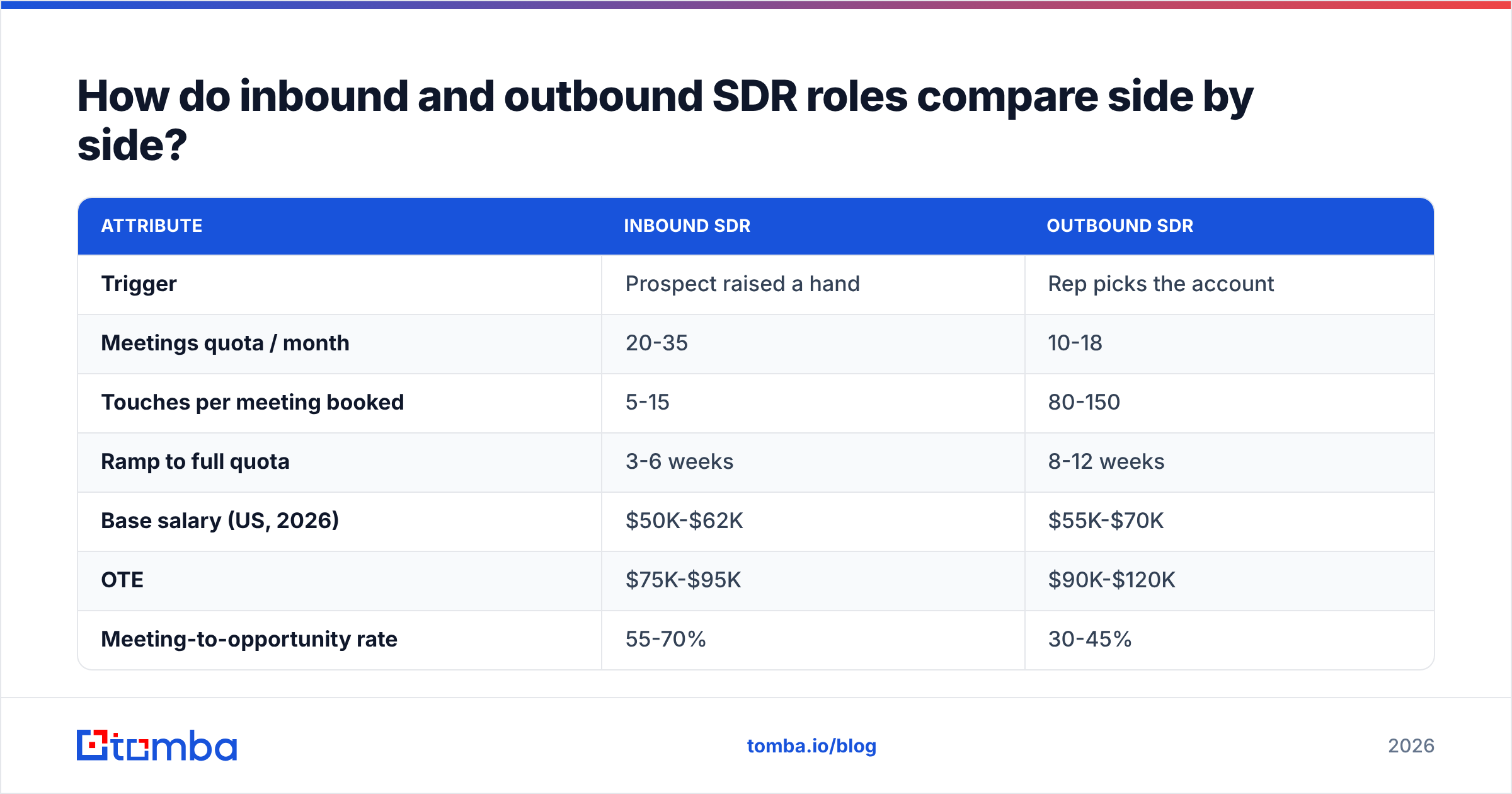
Here is the honest scoreboard. Numbers below reflect typical B2B SaaS ranges with ACVs between $10K and $60K — your mileage shifts with deal size and market.
Attribute
Inbound SDR
Outbound SDR
Trigger
Prospect raised a hand
Rep picks the account
Meetings quota / month
20-35
10-18
Touches per meeting booked
5-15
80-150
Ramp to full quota
3-6 weeks
8-12 weeks
Base salary (US, 2026)
$50K-$62K
$55K-$70K
OTE
$75K-$95K
$90K-$120K
Meeting-to-opportunity rate
55-70%
30-45%
Data spend per rep / year
$600-$1,500
$2,500-$6,000
Annual attrition
25-35%
35-50%
First hire at
Pre-product-market fit
Post-PMF, ICP defined
Primary failure mode
Slow response time
Bad list, bad data
Two lines matter more than the rest. Outbound costs more per meeting and produces meetings that convert worse. That is not a flaw — it is the price of demand you created rather than demand you caught. Outbound data spend also runs 3-4x higher, because outbound reps burn contact records the way a delivery fleet burns fuel.

What does an inbound SDR actually do all day?#
Five things, in priority order:
Speed to lead. Call every high-intent form fill within five minutes, not five hours. This one habit explains most of the gap between good and bad inbound teams.
Multi-threaded follow-up. A demo request from a manager needs the VP looped in before the AE call. Otherwise the meeting stalls at "I need to check with my boss."
Disqualification. Half of inbound is students, competitors, job seekers, and companies 10x too small. Saying no fast protects AE calendars.
Lead-source feedback. The inbound SDR hears first when a paid campaign sends the wrong persona. That loop back to marketing is worth as much as the meetings.
Enrichment before the call. A bare form fill needs company size, funding, tech stack, and title attached before the rep dials. Contact enrichment turns it into a real qualification call.
Notice what is missing: list building. An inbound SDR who spends two hours a day building lists is an outbound SDR with a slower queue.
What does an outbound SDR actually do all day?#
The shape is inverted — long blocks, cold context, and a heavy dependency on data:
Account research and tiering. Which 250 accounts this quarter, and why those. Trigger events, hiring signals, funding, tech-stack changes.
Contact discovery. Finding the actual decision maker plus two adjacent stakeholders, then getting deliverable addresses and direct dials for each.
Sequence execution. Email, call, LinkedIn, repeat across 12-18 touches over three to four weeks.
Personalization at the tier level. Not "I saw you went to Michigan" — a relevant observation about the account's market, stack, or growth stage that applies to a segment of 20 similar companies.
List hygiene. Removing bounced, job-changed, and unresponsive contacts so the domain stays healthy.
Step 2 and step 5 are where outbound programs quietly die. A rep with a 12% bounce rate is not just wasting sends. They are damaging sender reputation for the whole domain, which then drags down results for the reps sitting next to them.
Inbound SDR vs outbound SDR: which model builds better pipeline?#
Inbound produces better pipeline per meeting. Outbound produces better pipeline per target account.
That distinction settles most of the argument. Measure on conversion rate and inbound wins every time. The lead already knows who you are, so a 55-70% meeting-to-opportunity rate is normal. Measure on control and outbound wins. You can decide today that you want 40 meetings with logistics firms in the Midwest, then start creating them next week. Inbound cannot be aimed at a segment. It delivers whoever showed up.
Practical rule for 2026 planning:
Inbound-heavy if your category has established search demand, your content engine works, and your ACV is under $25K.
Outbound-heavy if you sell to a narrow named list, your ACV is over $40K, or you are entering a market where nobody is searching for your category yet.
Both once inbound covers 40-60% of pipeline and you need the rest to be predictable.
Industry sales resources from HubSpot's sales blog and Salesforce both land in the same place: the mix is a function of category maturity, not preference.
How much does each SDR role cost per meeting?#
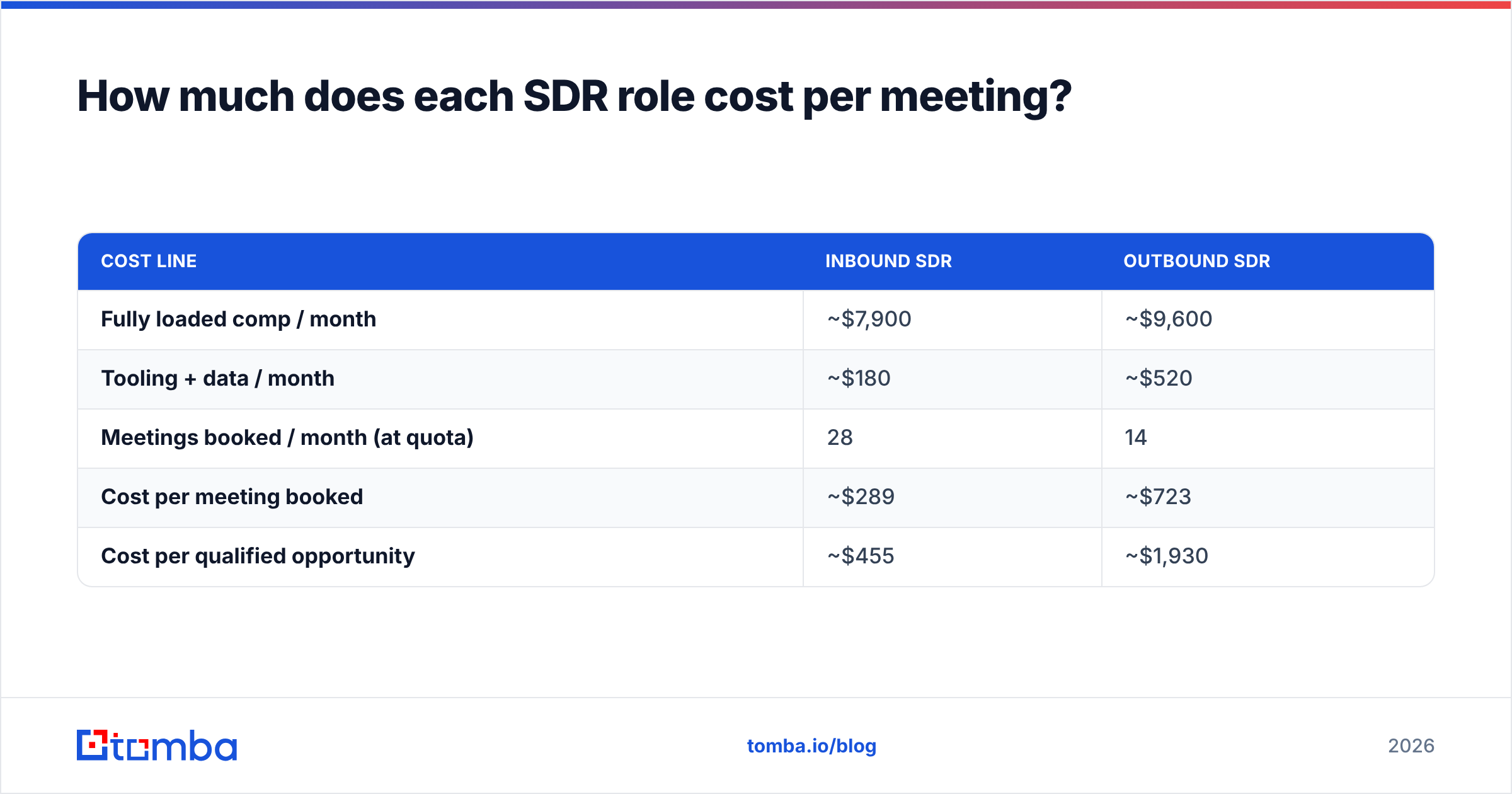
Run the math before you run the job posting.
Cost line
Inbound SDR
Outbound SDR
Fully loaded comp / month
~$7,900
~$9,600
Tooling + data / month
~$180
~$520
Meetings booked / month (at quota)
28
14
Cost per meeting booked
~$289
~$723
Cost per qualified opportunity
~$455
~$1,930
The outbound number looks brutal at first. But inbound cost per meeting leaves out the marketing spend that created the lead. Add $200-$900 of blended CAC per inbound lead and the gap narrows sharply — sometimes it closes entirely.
What does not narrow is the data dependency. Cut outbound data quality by 20% and cost per opportunity moves the wrong way immediately. Every bad record eats a touch slot, a send, and a piece of domain reputation.
Why does contact data decide the outbound SDR's fate?#
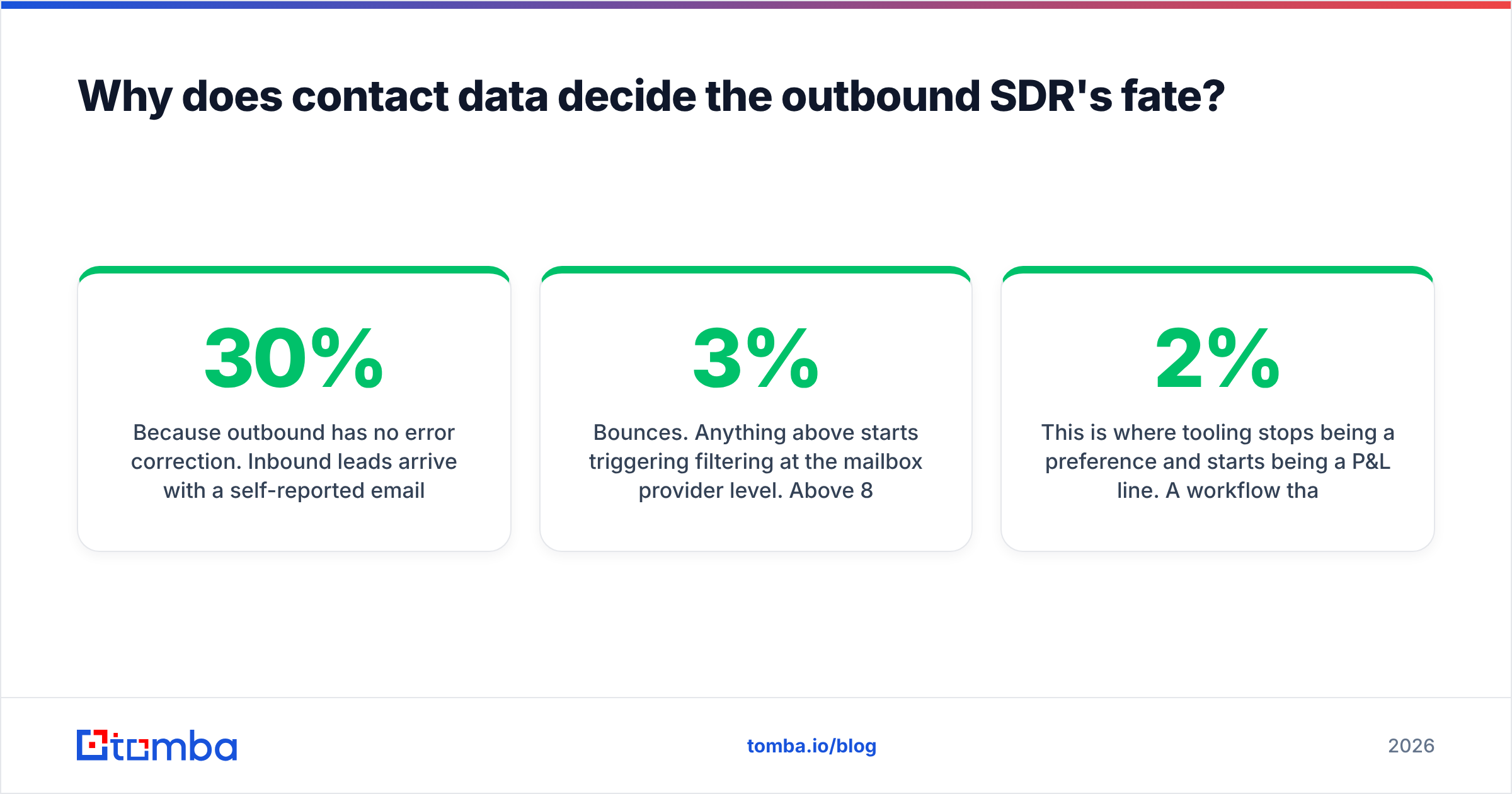
Because outbound has no error correction. Inbound leads arrive with a self-reported email that the prospect actually monitors. Outbound contacts are built — pattern-matched, scraped, or bought. And roughly 25-30% of B2B contact records go stale each year through job changes alone.
Three failure modes follow:
Bounces. Anything above 3% starts triggering filtering at the mailbox provider level. Above 8% you are looking at domain-level damage that takes weeks to repair.
Right company, wrong person. The rep books a meeting with someone who cannot buy. This shows up as a healthy meeting rate and a terrible opportunity rate.
Deliverable but dead. Catch-all domains accept everything and route nothing. The rep sees no bounce and assumes the message landed.
This is where tooling stops being a preference and becomes a P&L line. Run a domain search to map the org. Use an email finder to build the specific contact. Then run an email verifier with catch-all handling before you send. That workflow is the difference between a 2% bounce rate and a 14% one. Tomba's Free tier covers 25 searches a month for testing it; Starter runs $49/mo and Growth $99/mo, both inside the tooling budget for one outbound rep.
Inbound SDRs need the same stack for a different reason: enrichment. The form gave you an email. You still need the title, the headcount, and the two other stakeholders to multi-thread.

Which SDR should you hire first?#
Hire inbound first if you have inbound. That sounds circular, so here is the threshold. Are you getting more than roughly 60 qualified hand-raises a month, with AEs calling them back themselves? That is a staffing problem an inbound SDR solves within a month.
Hire outbound first only when all three are true:
You can name the 500 accounts you want. Not a persona — a list.
At least three customers in that segment closed and stayed.
You have budget for 6 months of runway, because outbound at month two tells you nothing.
The most common expensive mistake in 2026 is still hiring an outbound SDR to fix a positioning problem. If AEs cannot say why the ICP should switch, an outbound rep will not discover it for them at 80 dials a day , If you need immediate outbound capacity without committing to full-time overhead, you can hire a freelance SDR from platforms like Toptal to test new markets or fill short-term pipeline gaps before building an in-house team.
Can one person do both inbound and outbound?#
Yes, badly, unless you structure it.
If headcount forces a hybrid, use hard time blocks: inbound queue owned from 8:00-11:00 and 2:00-4:00, outbound blocks in the remaining hours with notifications off. Then score them on two separate lines — inbound response time and inbound meetings held, outbound accounts touched and outbound meetings held. A single blended quota always collapses into inbound-only, because inbound is easier and the rep is rational.
The hybrid also needs tooling that neither pure role does. Run bulk email finder once a week for the outbound blocks, so list building never bleeds into the queue. Fire data enrichment automatically on inbound form fills, so the rep never researches a lead by hand while it goes cold.
Check comparative tooling reviews on G2's sales engagement category before you commit. The hybrid stack is the hardest one to get right, and vendor fit varies more than in either pure role.
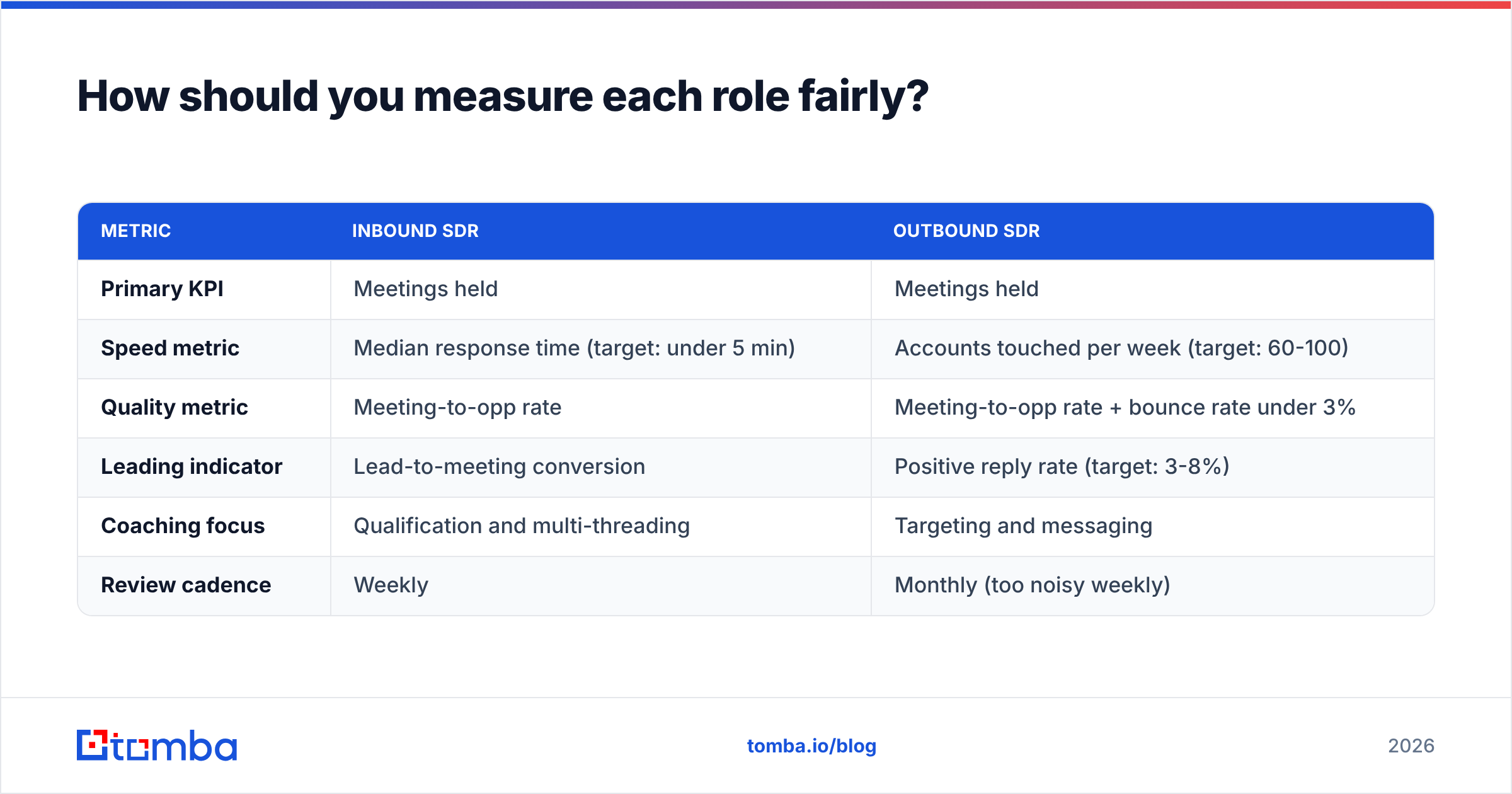
How should you measure each role fairly?#
Different jobs, different scorecards:
Metric
Inbound SDR
Outbound SDR
Primary KPI
Meetings held
Meetings held
Speed metric
Median response time (target: under 5 min)
Accounts touched per week (target: 60-100)
Quality metric
Meeting-to-opp rate
Meeting-to-opp rate + bounce rate under 3%
Leading indicator
Lead-to-meeting conversion
Positive reply rate (target: 3-8%)
Coaching focus
Qualification and multi-threading
Targeting and messaging
Review cadence
Weekly
Monthly (too noisy weekly)
One rule that saves arguments: never compare an outbound rep's response rate to an inbound rep's. They are measuring different physics.
What's the verdict for 2026?#
Inbound SDR vs outbound SDR is a question of order, not quality. Catch demand before you create it. Catching is cheaper, and it teaches you what your ICP sounds like. Then build outbound on top of what inbound taught you. Fund the data side properly, because outbound with stale contacts is just an expensive way to hurt your domain.
If you are staffing outbound this quarter, start with the contact layer rather than the sequencer. Tomba's Email Finder builds verified contacts by domain, name, or company. Verification and catch-all handling run in the same workflow. Your outbound SDR spends the day talking to real people, not rebuilding a list that decayed while they dialed. Start free with 25 searches, then scale on Starter at $49/mo when the motion works.
Related guides#
// get started
Find, verify and enrich your first contacts today
Start on the free plan with 25 searches a month, then scale when your team is ready.
Free plan · No credit card required · GDPR & CCPA
// about the author