InboxAlly Pricing, Reviews, Pros and Cons: 2026 Breakdown
InboxAlly sells inbox placement, not sending. Here is what the plans really cost, what users praise and complain about, and when a verified list plus warmup beats paying for seed engagement.

TL;DR — InboxAlly pricing in 2026
- InboxAlly is a seed-list service. A pool of real inboxes opens your mail, reads it, and replies. They also drag it out of spam. Gmail then learns that people want your email.
- InboxAlly pricing scales with seed inboxes and daily send volume, not with contacts. Entry plans start near $149 a month. Big plans run past $1,000. Check the live page, since tier names change often.
- Reviews like the results. They knock two things: the cost, and the fact that it repairs your sender score but never your list.
- It is a repair tool. It is not a sending app, not a verifier, and not a data source. Budget for those on their own.
- Bad addresses cause most spam problems. If that is your case, clean the list first. It costs far less than InboxAlly pricing.
What is InboxAlly and what does it actually do?#
InboxAlly builds good signals for the domain you send from. Think of a café that pays cheerful regulars to show up. Gmail and Outlook watch how people treat your mail. So the tool supplies people. Real seed inboxes open your note, scroll it, click, and reply. Best of all, they pull it out of spam and back to the main tab.
Here is the flow. You add the seed addresses to your list. You send your normal campaign to them and to real leads at once. The pool then acts on a clock you set. Over a few weeks the signal adds up. Gmail learns that mail from your domain gets read, not trashed. Now we can weigh InboxAlly pricing against that one job.
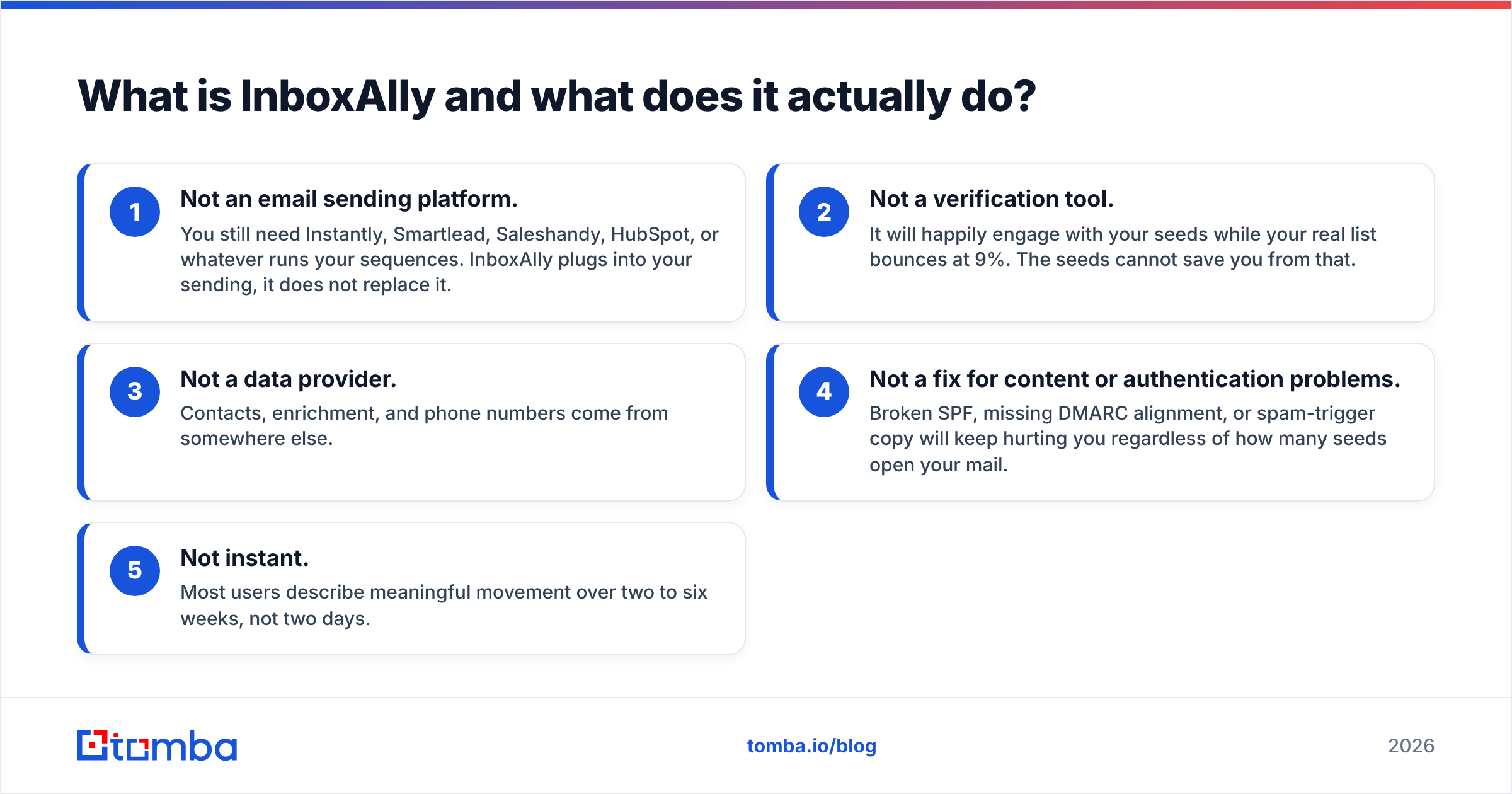
The job is real, but it is narrow. Be clear on what the tool is not:
- Not a sending app. You still need Instantly, Smartlead, Saleshandy, or HubSpot to run your steps. It plugs into your sending. It does not replace it.
- Not a verifier. It will work your seeds while your real list bounces at 9%. Seeds cannot save you from that.
- Not a data source. Contacts, job titles, and phone numbers come from somewhere else.
- Not a fix for setup or copy. A broken SPF record or spammy words will still hurt you.
- Not instant. Most users see real change in two to six weeks, not two days.
Want the background? Our glossary entry on email deliverability covers the four signals inbox providers weigh. Those are sender score, setup, engagement, and list hygiene. This tool moves one of the four.
How much does InboxAlly cost in 2026?#
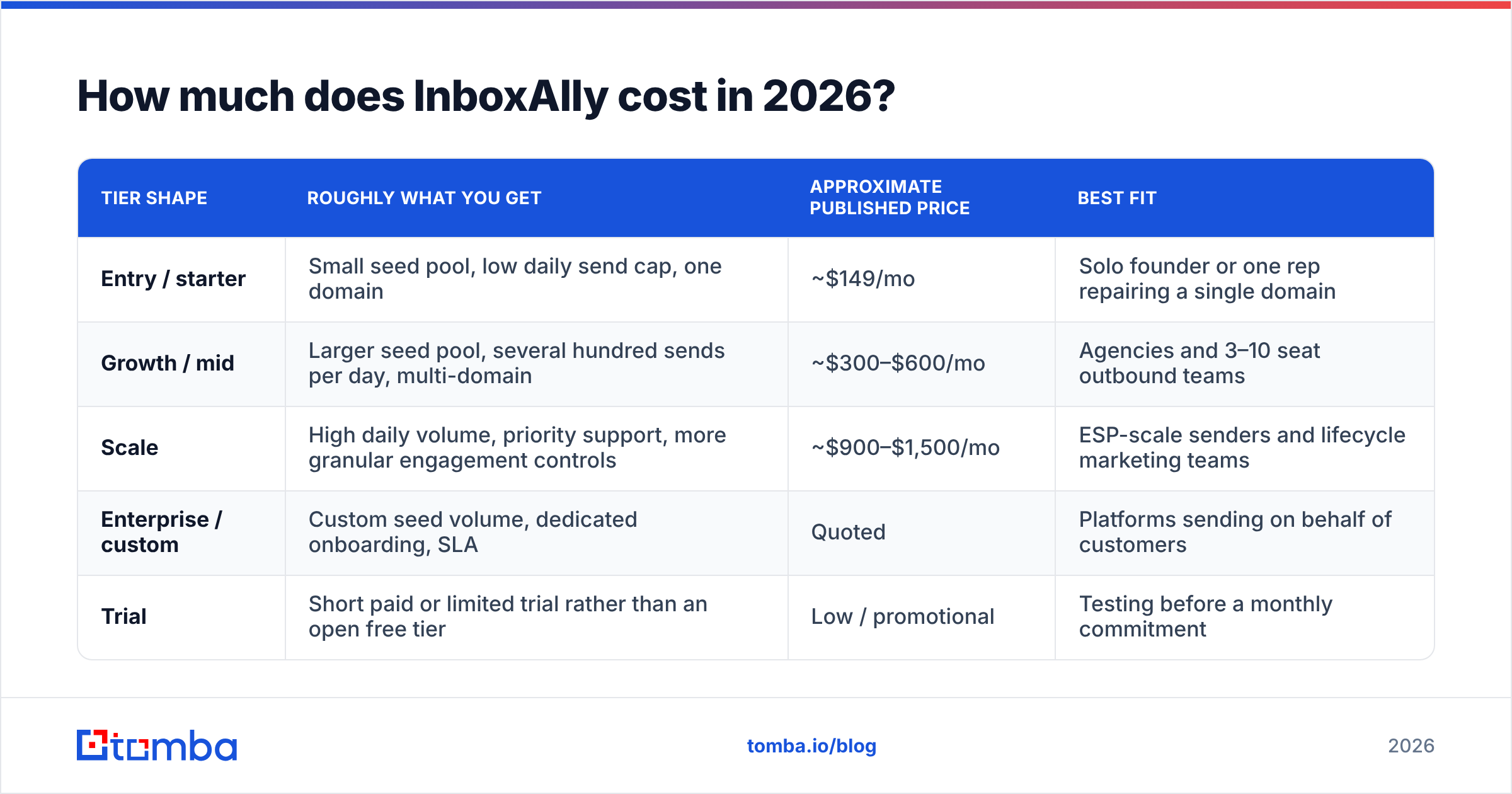
InboxAlly pricing rests on two things. First, how many seed inboxes touch your mail. Second, how many emails a day you push through. Seats and contacts matter far less. Here is the shape of the ladder on inboxally.com today. Treat each figure as rough. Tier names and caps change more often than most SaaS price pages.
| Tier shape | Roughly what you get | Approximate published price | Best fit |
|---|---|---|---|
| Entry / starter | Small seed pool, low daily send cap, one domain | ~$149/mo | Solo founder or one rep repairing a single domain |
| Growth / mid | Larger seed pool, several hundred sends per day, multi-domain | ~$300–$600/mo | Agencies and 3–10 seat outbound teams |
| Scale | High daily volume, priority support, more granular engagement controls | ~$900–$1,500/mo | ESP-scale senders and lifecycle marketing teams |
| Enterprise / custom | Custom seed volume, dedicated onboarding, SLA | Quoted | Platforms sending on behalf of customers |
| Trial | Short paid or limited trial rather than an open free tier | Low / promotional | Testing before a monthly commitment |
Two details matter more than the sticker price.
There is no real free tier. With a verifier you can burn free credits to test it first. Here you must pay before you learn how your own domain reacts. Plan for one full month as a test cost.
The cost repeats by design. A good sender score is not a one-time buy. Teams who quit after a good month often slide back to spam in four to eight weeks. That happens when the root cause never changed: cold volume, a thin list, few replies. So a "$149 fix" turns into an $1,800 a year bill. That is the part of InboxAlly pricing most buyers miss.

What do InboxAlly reviews actually say?#
Scores on G2, Trustpilot, and cold email groups are good. This is not a tool with a trust problem. The same themes come up again and again.
What reviewers praise:
- Real spam-to-inbox movement. One line repeats: "we sat in spam on Gmail, and three weeks later we were in the main tab."
- A clear dashboard. Charts per provider (Gmail, Outlook, Yahoo) give you a before and after you can show a client.
- Fast help. Setup support comes up a lot, and it counts. A bad seed setup can waste a month.
- Agency leverage. One plan can cover many client domains, so agencies see the best return.
What reviewers criticize:
- The cost. The top gripe is not "it failed." It is "it worked, and it costs more than the tool I send with." That is the core knock on InboxAlly pricing.
- Gains fade after you quit. Placement slips once the seeds stop. To many buyers that feels like renting an inbox, not fixing one.
- It hides list problems. If your bounce rate is the real issue, the chart looks better while the harm goes on.
- Setup work. You must add seeds, throttle sends, and keep seeds out of your reports. In some tools that takes real effort.
- The rules keep moving. Gmail and Yahoo raised the bar for bulk senders, as Google's sender guidelines spell out. No seed service gets you a pass.
The honest read: the tool does what it claims. Whether InboxAlly pricing is worth it hangs on one question. Is your sender score the real bottleneck?
What are the pros and cons of InboxAlly?#
Pros
- It moves the signal you cannot fake. Cold mail earns almost no warm replies. Nobody writes back to 96% of your sends. Seeds fill that gap.
- It repairs, not just guards. Warmup tools keep a healthy domain safe. This is one of the few tools that digs a burned domain out of spam.
- You see each provider. Learning that you are fine on Outlook but buried on Gmail changes what you fix.
- It works with any sending tool. No switch, no move.
- It is fast enough to matter. Weeks, not quarters.
Cons
- Costly per result. For one domain at low volume, the bill can top your whole sending stack.
- You rent the gain. Value stops when payment stops, unless you fix root causes too.
- No list hygiene. It does nothing about dead addresses, guesses, or role accounts.
- No setup fix. SPF, DKIM, and DMARC gaps still cost you. Run an SPF checker and a blacklist checker first.
- Some doubt the model. Paid opens are not real interest, and providers keep getting better at spotting the gap.
Is InboxAlly worth it compared to the alternatives?#
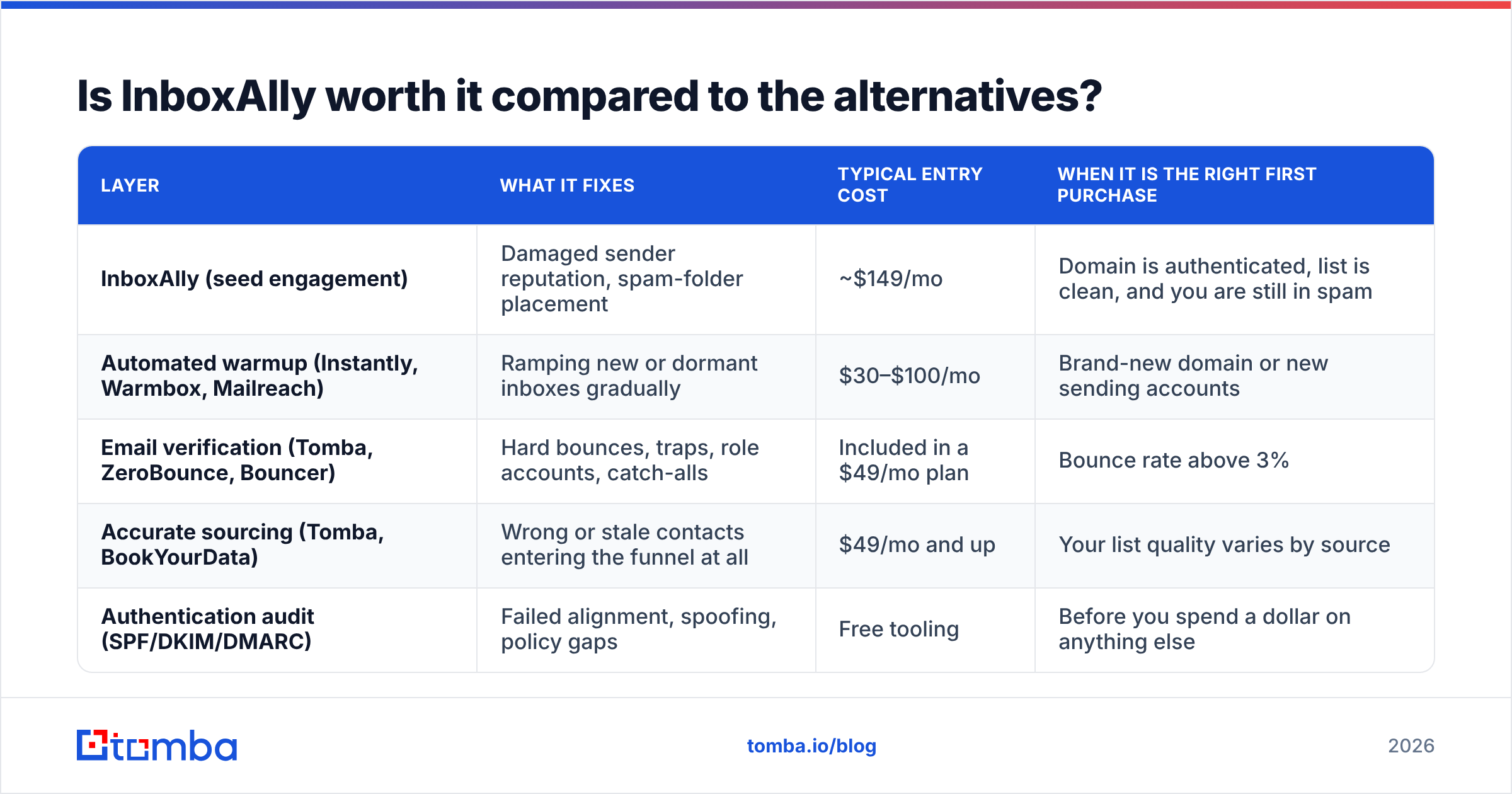
The right question is not "this seed tool or that one." It is "which layer am I paying to fix?" These tools work as a team more often than they compete.
| Layer | What it fixes | Typical entry cost | When it is the right first purchase |
|---|---|---|---|
| InboxAlly (seed engagement) | Damaged sender reputation, spam-folder placement | ~$149/mo | Domain is authenticated, list is clean, and you are still in spam |
| Automated warmup (Instantly, Warmbox, Mailreach) | Ramping new or dormant inboxes gradually | $30–$100/mo | Brand-new domain or new sending accounts |
| Email verification (Tomba, ZeroBounce, Bouncer) | Hard bounces, traps, role accounts, catch-alls | Included in a $49/mo plan | Bounce rate above 3% |
| Accurate sourcing (Tomba, BookYourData) | Wrong or stale contacts entering the funnel at all | $49/mo and up | Your list quality varies by source |
| Authentication audit (SPF/DKIM/DMARC) | Failed alignment, spoofing, policy gaps | Free tooling | Before you spend a dollar on anything else |
Read the table top to bottom and the order gets clear. Setup checks are free. Address checks are cheap, and they stop the harm you later pay InboxAlly pricing to undo. Warmup is cheap cover. Seed work costs the most. It is also the only layer that just cleans up a mess. So it should be the last thing you buy, not the first.

Who should buy InboxAlly — and who should skip it?#
Buy it if:
- Your mail lands in spam on a big provider, even though SPF, DKIM, and DMARC all pass.
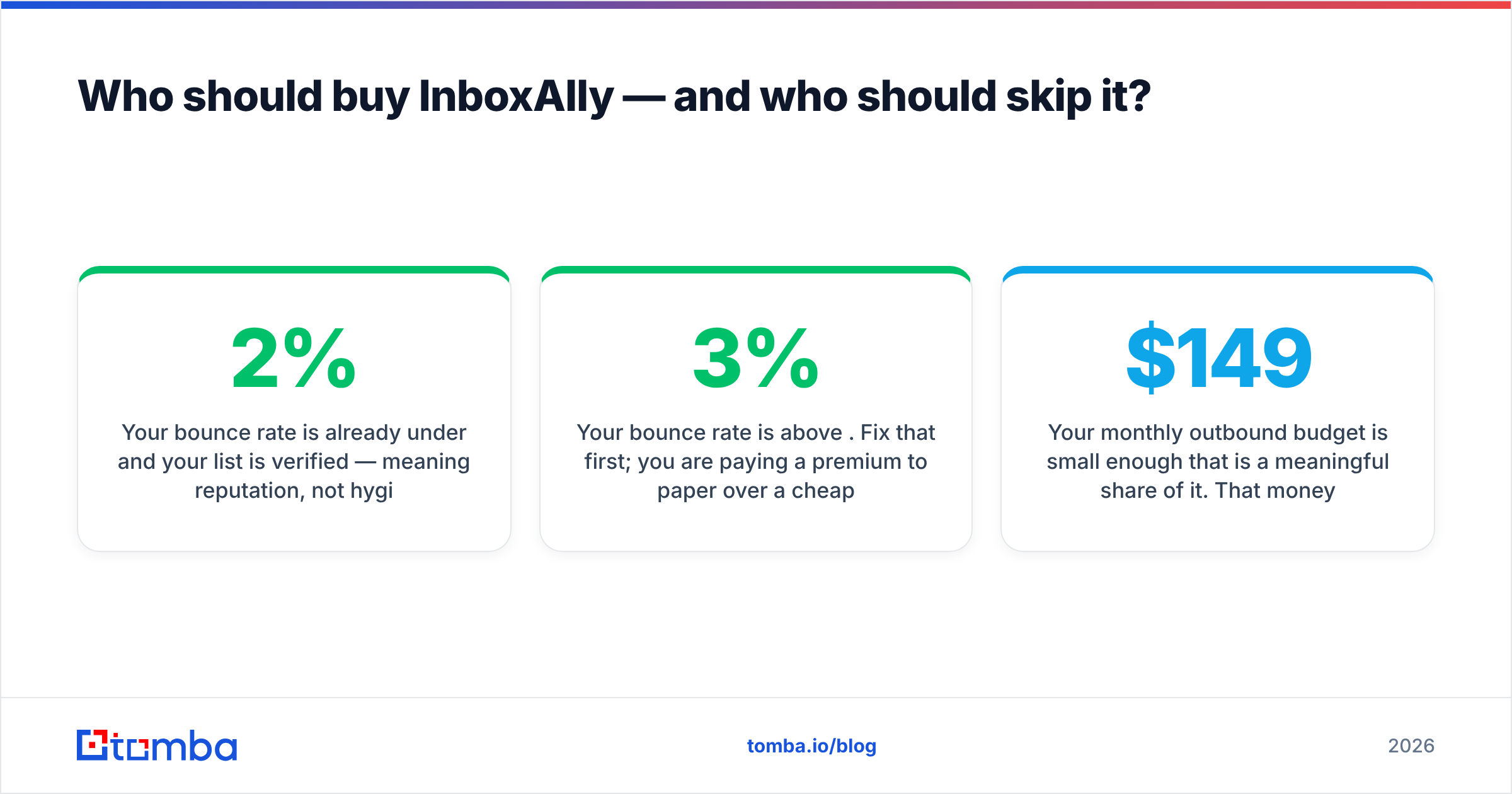
- Your bounce rate is under 2% and your list is clean. Sender score is the last problem left.
- You run an agency, so one plan can cover many client domains.
- You have a key domain you cannot afford to burn and swap.
Skip it if:
- Your bounce rate is over 3%. Fix that first. You would pay a lot to hide a cheap problem.
- You send from a brand-new domain. A normal warmup ramp is the right tool. Our email warmup calculator gives you the schedule free.
- Nobody writes back, because your aim or your copy is off. Seeds cannot save a weak offer.
- The first rung of InboxAlly pricing is a big share of your monthly budget. That money buys better contacts.
How do you cut deliverability spend before you subscribe?#
Most spam problems trace back to who you emailed, not how. Work this list before you sign up for a monthly seed bill.
- Check every address first. Run the list through an email verifier and drop the unknowns. Hard bounces burn a domain fast, and you can stop all of them.
- Handle catch-all domains on purpose. Many B2B domains accept every address at the gate. A catch-all verifier shows which ones are worth the risk.
- Use patterns you can confirm. A known company email pattern beats a guess. That gap is the space between a 1% and a 9% bounce rate.
Those three steps fix the input. The next three fix your habits.
- Fix setup before behavior. Add SPF, DKIM, and a DMARC record at
p=nonewith reports. It is free, it is required, and many domains still lack it. - Ramp volume like a human. A new inbox that jumps from zero to 200 sends a day makes its own problem.
- Track replies, not opens. Replies are the signal that counts most, and no service can buy you those.
Do all six, and many teams find the spam problem just goes away. No seed plan needed. The teams still stuck are the ones this tool was built for. They also get better results, because the base is finally solid.
The verdict on InboxAlly pricing#
InboxAlly is a good tool with a narrow job and a high price. If your sender score is the bottleneck, few tools move the needle like it. The reviews back that up. If list quality is the bottleneck — and for most cold outbound teams it is — InboxAlly pricing buys you a year of hiding a symptom.
Start upstream instead. Tomba's Email Finder pulls verified work addresses from real, cited sources. Checks run in the same flow. It starts free at 25 searches a month, and Starter is $49/mo. See Tomba pricing for the full ladder. Clean what goes in, and you may never pay to fix what comes out.
Related guides#
// get started
Find, verify and enrich your first contacts today
Start on the free plan with 25 searches a month, then scale when your team is ready.
Free plan · No credit card required · GDPR & CCPA
Get the Tomba newsletter
Product and data updates
// about the author