Inboxlogy Pricing, Reviews, Pros and Cons (2026 Guide)
Inboxlogy sells discounted Google Workspace and Microsoft 365 mailboxes for cold email, from about $2.80 per inbox. Here is what the pricing really costs at scale, what reviewers praise, and where it falls short.
TL;DR
- Inboxlogy is not a sending platform. It is a cold email infrastructure vendor that resells authorized Google Workspace and Microsoft 365 mailboxes with DNS, SPF, DKIM and DMARC pre-configured.
- Published pricing sits roughly between $2.80 and $8 per mailbox per month, with the $2.80 rate reserved for 500+ mailbox orders. Pre-warmed inboxes are listed around $4.99. No setup fee, monthly billing, cancel anytime.
- Review sentiment is genuinely strong — roughly 4.7/5 on G2 across ~180 reviews and 4.5/5 on Trustpilot — with support responsiveness the most repeated compliment.
- The two recurring complaints: provisioning can be slow and manual, and the headline price only applies at volumes most teams never reach.
- Cheap mailboxes do not fix a bad list. Infrastructure spend is wasted if 20% of your contacts bounce — verification and accurate sourcing come first.
What is Inboxlogy, exactly?#
Inboxlogy is a done-for-you cold email infrastructure provider. Think of it as a car leasing company rather than a car manufacturer: it does not build Google Workspace or Microsoft 365, it buys seats in bulk as an authorized reseller, configures them, and hands you the keys with your name on the registration.
Practically, that means you tell Inboxlogy how many sending domains and how many mailboxes per domain you want. It registers or connects the domains, provisions the mailboxes on real Google or Microsoft tenants (US or EU IPs), sets SPF, DKIM and DMARC records automatically, and gives you admin ownership plus OAuth or app-password credentials to plug into Instantly, Smartlead, Reply.io, Lemlist, or whatever sequencer you already run.
That distinction matters more than most buyers realize. Inboxlogy does not write your copy, build your lists, or send your campaigns. It sells the pipes. Everything upstream — who you email and whether those addresses are real — is still your problem, and it is the part that actually determines whether your email deliverability holds up.
Alongside the mailboxes, Inboxlogy bundles a few utility tools: an AI spam checker, a basic email verifier, and an inbox health check. Treat these as convenience features, not as replacements for dedicated tooling.
How does Inboxlogy pricing actually work?#
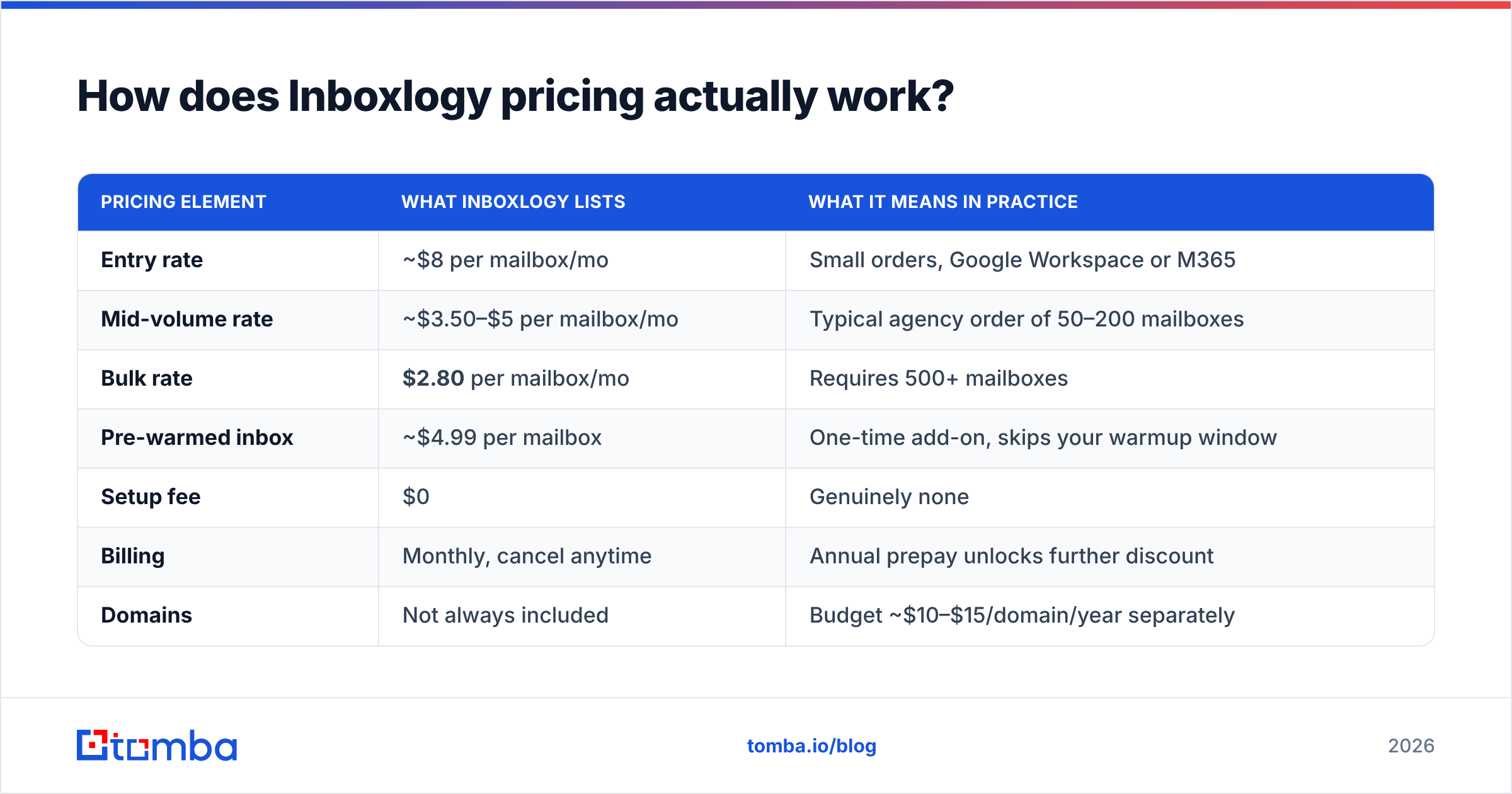
Inboxlogy prices per mailbox, per month, and the rate slides down as your order size goes up. Here is how the published tiers on the Inboxlogy pricing page break down at the time of writing.
| Pricing element | What Inboxlogy lists | What it means in practice |
|---|---|---|
| Entry rate | ~$8 per mailbox/mo | Small orders, Google Workspace or M365 |
| Mid-volume rate | ~$3.50–$5 per mailbox/mo | Typical agency order of 50–200 mailboxes |
| Bulk rate | $2.80 per mailbox/mo | Requires 500+ mailboxes |
| Pre-warmed inbox | ~$4.99 per mailbox | One-time add-on, skips your warmup window |
| Setup fee | $0 | Genuinely none |
| Billing | Monthly, cancel anytime | Annual prepay unlocks further discount |
| Domains | Not always included | Budget ~$10–$15/domain/year separately |
The headline "$2.80 per mailbox" is real, but it is a 500-unit price. If you are a two-person agency spinning up 30 mailboxes across 10 domains, you are paying closer to $5–$8 each — call it $150–$240/month, plus domain registration.
That is still meaningfully below list price on the underlying products. Google Workspace Business Starter and Microsoft 365 Business Basic both sit in the $6–$8.40 per user per month range at list, before any reseller discount. Inboxlogy's margin comes from volume purchasing, which is exactly what an authorized reseller is supposed to do.
What are you actually paying for per mailbox?#
If you strip the marketing away, five things are bundled into that per-mailbox price. Judge the value against these, not against the sticker.
- A legitimate tenant seat. Not an SMTP relay, not a shared IP pool — a real Google Workspace or Microsoft 365 account you own at the admin level. This is the single biggest reason people pay a premium over cheap SMTP.
- Automated DNS authentication. SPF, DKIM and DMARC written for you across every domain. Doing this manually for 40 domains is an afternoon of copy-paste errors; you can spot-check the result with a free SPF checker before you send anything.
- US or EU IP selection. Useful if you sell into the EU and want regional sending origin, or if you are managing GDPR-sensitive outreach.
- One-click sequencer connection. OAuth or app passwords that drop straight into your sending tool without a support ticket.
- Optional pre-warming. For roughly $4.99 extra per inbox, you get accounts that have already been through a warmup cycle — which compresses your ramp from ~3 weeks to near-immediate.
Item five is where the arithmetic gets interesting. Three weeks of idle mailboxes at $5 each is real money on a 100-inbox order, and pre-warming is often cheaper than paying for dormant capacity while you wait.

What do Inboxlogy reviews actually say?#
The public review picture is better than most infrastructure vendors manage. On G2, Inboxlogy carries roughly a 4.7/5 average across about 180 reviews; Trustpilot shows around 4.5/5 across a much smaller sample of ~28. Those are healthy numbers for a category where "the mailboxes got suspended" is a common one-star headline.
Three themes repeat across positive reviews:
- Support responsiveness. WhatsApp and email support get named constantly, often by users who compare it favorably to ticket-queue competitors. "Fast integration" and "amazing support" show up almost verbatim in multiple reviews.
- Price at scale. Agencies running hundreds of inboxes consistently cite cost per mailbox as the reason they switched.
- No suspensions. Because the accounts are provisioned through authorized reseller channels rather than grey-market workarounds, reviewers report fewer surprise terminations than with bargain-basement providers.
The critical reviews are narrower but consistent:
- Setup can be slow and manual. Several reviewers describe provisioning that takes longer than advertised and requires back-and-forth. If you need 200 mailboxes live by Monday, build in buffer.
- Communication gaps during onboarding. Related to the above — the support that reviewers praise post-launch is not always as fast pre-launch.
- Limited transparency on IPs and domains. Inboxlogy does not publish granular detail about which IP ranges or domain histories you inherit. For most buyers this is fine; for a compliance-heavy org it is a real diligence gap.
- Bulk-gated entry pricing. The number that gets you in the door is not the number most people pay.
What are the pros and cons of Inboxlogy?#
| Pros | Cons | |
|---|---|---|
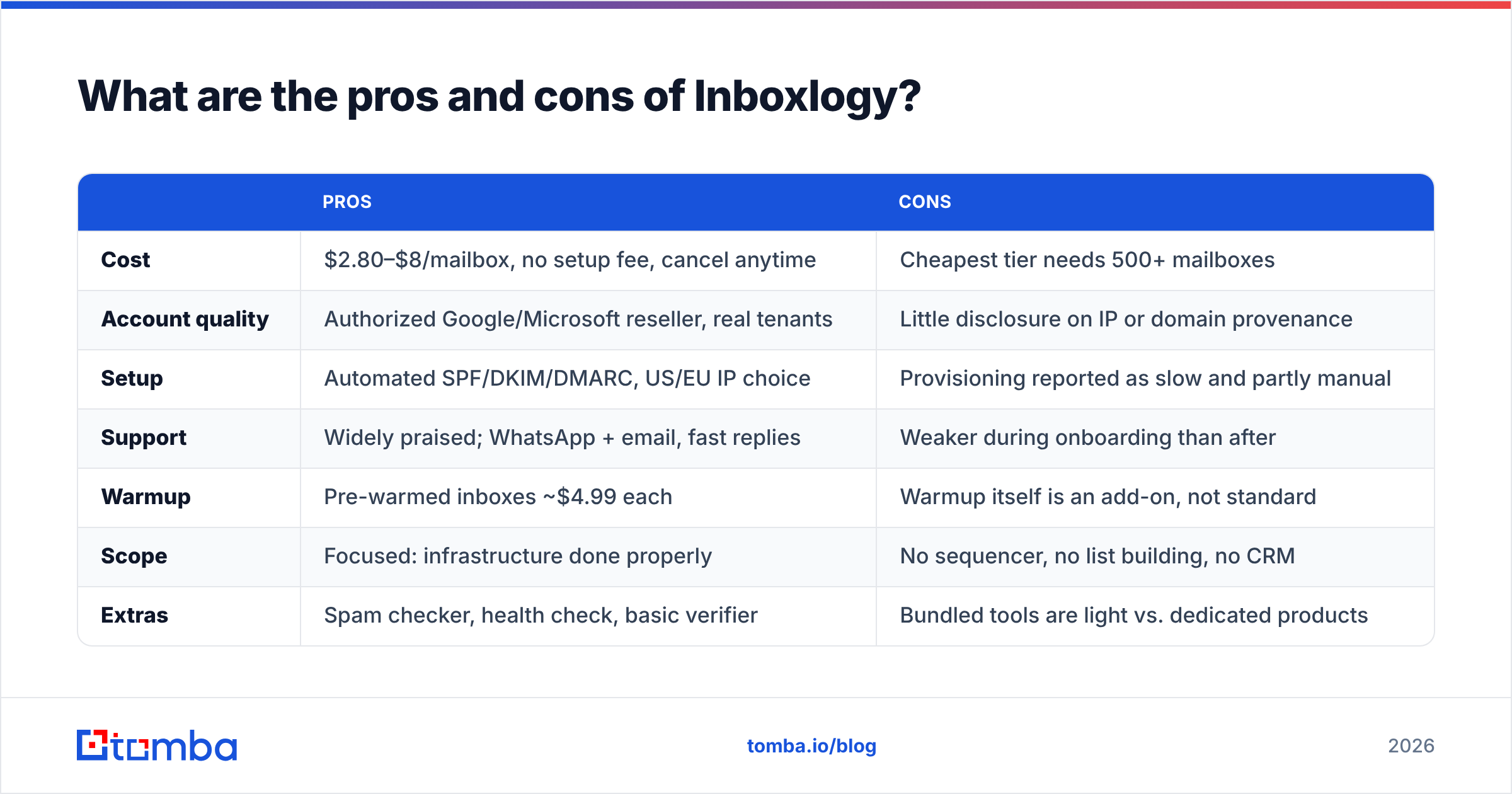
| Cost | $2.80–$8/mailbox, no setup fee, cancel anytime | Cheapest tier needs 500+ mailboxes |
| Account quality | Authorized Google/Microsoft reseller, real tenants | Little disclosure on IP or domain provenance |
| Setup | Automated SPF/DKIM/DMARC, US/EU IP choice | Provisioning reported as slow and partly manual |
| Support | Widely praised; WhatsApp + email, fast replies | Weaker during onboarding than after |
| Warmup | Pre-warmed inboxes ~$4.99 each | Warmup itself is an add-on, not standard |
| Scope | Focused: infrastructure done properly | No sequencer, no list building, no CRM |
| Extras | Spam checker, health check, basic verifier | Bundled tools are light vs. dedicated products |
Is Inboxlogy worth it versus buying Google Workspace directly?#
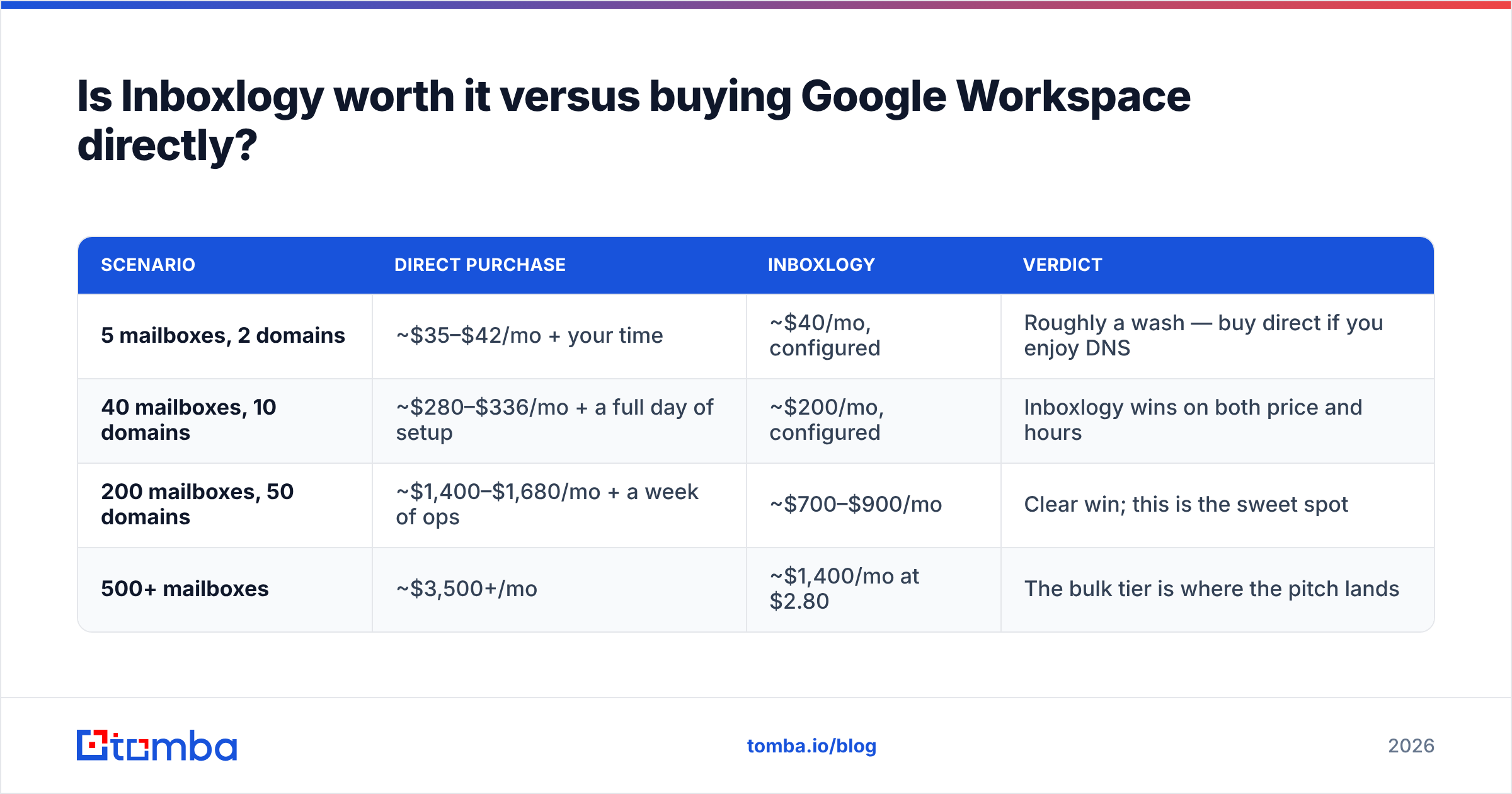
Run the math before you assume the reseller wins.
| Scenario | Direct purchase | Inboxlogy | Verdict |
|---|---|---|---|
| 5 mailboxes, 2 domains | ~$35–$42/mo + your time | ~$40/mo, configured | Roughly a wash — buy direct if you enjoy DNS |
| 40 mailboxes, 10 domains | ~$280–$336/mo + a full day of setup | ~$200/mo, configured | Inboxlogy wins on both price and hours |
| 200 mailboxes, 50 domains | ~$1,400–$1,680/mo + a week of ops | ~$700–$900/mo | Clear win; this is the sweet spot |
| 500+ mailboxes | ~$3,500+/mo | ~$1,400/mo at $2.80 | The bulk tier is where the pitch lands |
The pattern is obvious: below about 20 mailboxes, the savings are thin enough that the convenience is the only real argument. Above 50, the labor savings alone justify it. Above 500, it is simply cheaper.
One caveat that does not show up in any pricing table: mailbox count is not a growth lever on its own. Doubling your inboxes doubles your sending capacity, not your reply rate. If your current campaigns convert at 0.4%, 200 mailboxes will produce twice as many unanswered emails.

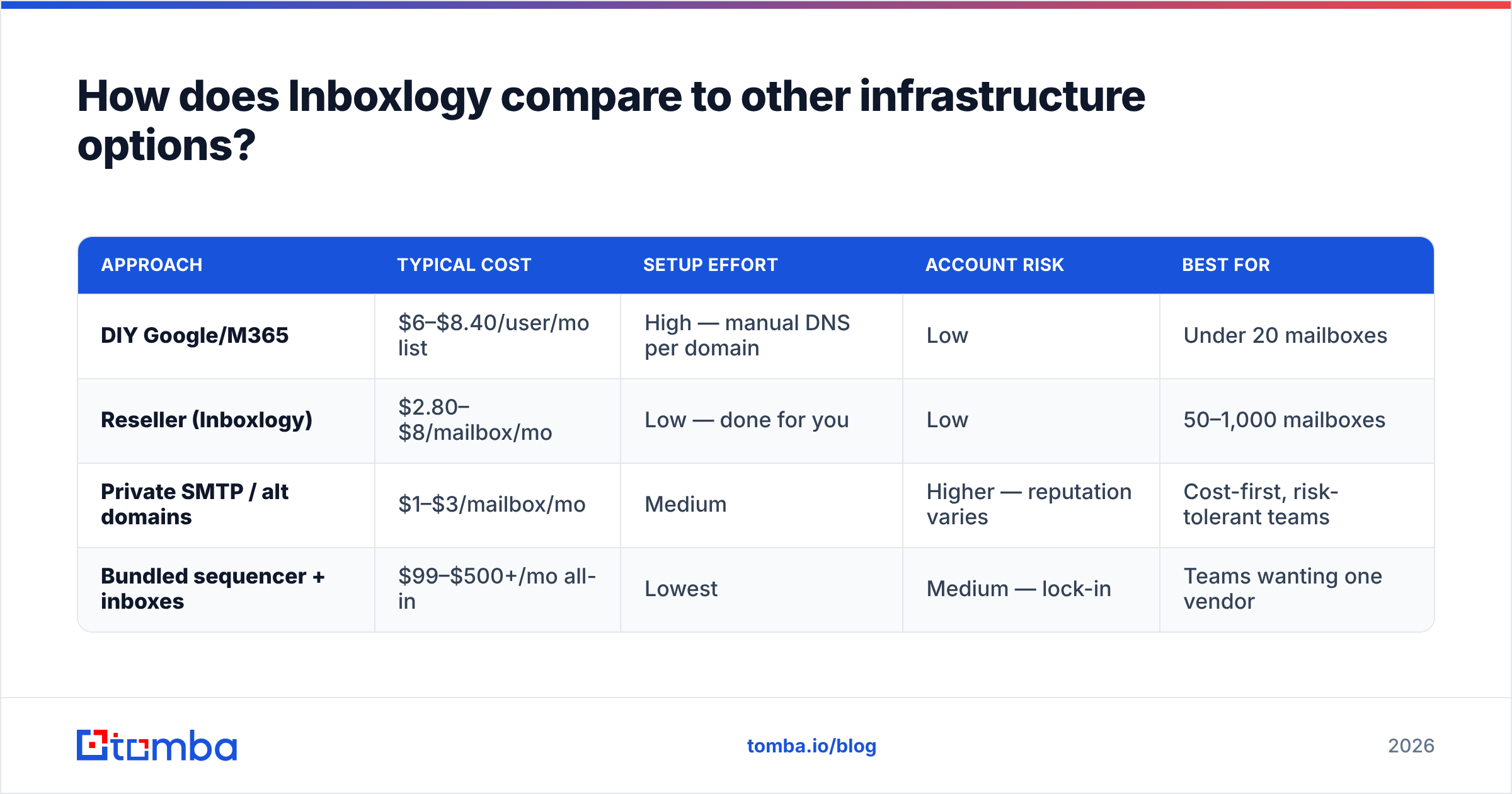
How does Inboxlogy compare to other infrastructure options?#
The cold email infrastructure category has consolidated into three broad shapes. Inboxlogy sits firmly in the middle one.
| Approach | Typical cost | Setup effort | Account risk | Best for |
|---|---|---|---|---|
| DIY Google/M365 | $6–$8.40/user/mo list | High — manual DNS per domain | Low | Under 20 mailboxes |
| Reseller (Inboxlogy) | $2.80–$8/mailbox/mo | Low — done for you | Low | 50–1,000 mailboxes |
| Private SMTP / alt domains | $1–$3/mailbox/mo | Medium | Higher — reputation varies | Cost-first, risk-tolerant teams |
| Bundled sequencer + inboxes | $99–$500+/mo all-in | Lowest | Medium — lock-in | Teams wanting one vendor |
Against the private-SMTP crowd, Inboxlogy costs more but buys you a real Google or Microsoft tenant, which still carries the best inbox placement odds in 2026. Against all-in-one sequencer bundles, Inboxlogy is unbundled — you keep your sending tool and swap infrastructure independently, which is usually the smarter architecture but means one more vendor relationship.
What does Inboxlogy not solve?#
This is the part buyers underweight. Infrastructure controls whether your email can land. It does nothing about whether the address exists or whether the person is worth emailing.
Three failure modes survive a perfect infrastructure setup:
- Bounce-driven reputation damage. A 12% hard-bounce rate will torch brand-new, perfectly authenticated mailboxes within two weeks. Google and Microsoft do not care that your DKIM is valid. Run every list through an email verifier before it touches a sequencer.
- Wrong-contact waste. Pattern-guessed addresses that technically deliver but reach the wrong person burn sends and generate spam complaints. Sourcing accuracy is upstream of everything.
- Catch-all blind spots. Domains that accept everything hide invalid addresses from basic verification. A dedicated catch-all verifier is the only reliable way to score them.
Put crudely: at $5 per mailbox, infrastructure is one of the cheapest lines in your outbound budget. List quality is the expensive one — and the one that decides your results.
Who should buy Inboxlogy, and who should skip it?#
Buy it if: you run 50+ mailboxes, you are an agency provisioning infrastructure for multiple clients, you want authorized Google/Microsoft accounts rather than grey-market seats, and you would rather not spend a week writing DNS records. The support reputation is earned and it matters when a client's mailboxes go sideways at 9pm.
Skip it if: you send from fewer than 15 mailboxes (buy direct, it is barely more expensive), you need mailboxes provisioned within 24 hours reliably, or you require documented IP and domain provenance for compliance reasons.
Negotiate it if: you are between 100 and 500 mailboxes. That gap is where the published tiers get vague, and reviewers report that annual prepay and volume commitments move the number.
What should you do before you buy any mailboxes?#
Order of operations, in the sequence that actually protects your sender reputation:
- Fix the list first. Source contacts from a provider with published accuracy methodology, then verify. See where the data comes from before you trust any vendor's numbers.
- Verify in bulk, not per-send. Clean the whole file up front so your sequencer never learns about a dead address the hard way.
- Buy infrastructure sized to your verified list, not to your ambition. 100 mailboxes for a 3,000-contact clean list is over-provisioning.
- Warm properly or pay to skip it. Either budget three weeks or buy the pre-warmed option — do not split the difference.
- Monitor from week one. Reply rate, bounce rate, and spam-complaint rate per domain. Kill underperforming domains early rather than letting them drag the pool.
The bottom line on Inboxlogy pricing#
Inboxlogy is a solid, fairly priced infrastructure vendor with unusually good support reviews and one honest caveat: the advertised entry price is a 500-mailbox price, and provisioning is slower than the marketing suggests. At 50+ mailboxes it saves you both money and a meaningful amount of operations time versus buying direct. Below 20, the case is thin.
What it will not do is make a mediocre list perform. If you are about to spend $500 a month on pipes, spend the first hour making sure what flows through them is real.
Start there: use the Tomba Email Finder to source verified, deliverability-scored B2B addresses by domain, name, or company before you provision a single mailbox. The free tier covers 25 searches a month so you can benchmark accuracy against your current source, and paid plans start at $49/month — see full Tomba pricing for volume tiers. Clean data first, infrastructure second. That order is the whole game.
Related guides#
Ready to find emails that actually work?
Join 150,000+ professionals who stopped guessing and started sending. Free credits on signup — no credit card required.
Get the Tomba newsletter
Practical outbound tactics and product updates — once every two weeks.
About the author