How to Increase Sales Volume in 2026: A 7-Lever Playbook
Sales volume is a math problem, not a motivation problem. Break it into five inputs, find the one actually capping you, and fix that before you spend another dollar on headcount.
TL;DR
- Sales volume is the product of five inputs: contactable accounts, reach rate, reply rate, meeting-to-opportunity rate, and win rate. Multiply, don't brainstorm.
- Most teams try to increase sales volume by adding headcount, which is the slowest and most expensive lever available to them.
- The cheapest lever for almost every team under 50 reps is contact data quality, because bad data silently caps every downstream number.
- Volume gains that come from sending more mail without fixing deliverability are temporary and usually net-negative within a quarter.
- A realistic 90-day sequence: fix data, fix targeting, fix follow-up cadence, then add capacity.
What does it actually mean to increase sales volume?#
Sales volume is the number of closed deals (or units, or dollars) your team produces in a period. That sounds obvious, but the useful version is the decomposed version, because you cannot improve a number you cannot break apart.
Here is the chain most B2B teams actually run on:
- Contactable accounts — how many companies in your ICP you can actually reach this month. Not how many exist in a database. How many you have a working email, phone, or LinkedIn handle for.
- Reach rate — what percentage of those contacts receive your message. This is where deliverability, bounce rates, and dialer connect rates live.
- Reply rate — what percentage of people who receive a message respond in any direction, including "no."
- Meeting-to-opportunity rate — how many of those conversations become qualified pipeline instead of polite dead ends.
- Win rate — how many opportunities close, and how fast.
Multiply the five and you get volume. Change any one by 20% and volume moves by 20%. That last sentence is the whole strategy: you are looking for the single input that is furthest below benchmark, not a general vibe of "more activity."
A team running 4,000 contacts a month at a 68% reach rate, 4% reply rate, 30% meeting-to-opportunity, and a 22% win rate closes about seven deals. Push reach from 68% to 90% and you close nine. Nobody worked harder. The list just stopped leaking.
Why do most attempts to increase sales volume fail?#
Because they target the input that is easiest to observe rather than the one that is most broken.
Activity is easy to observe. You can see calls dialed and emails sent in any dashboard by lunchtime. So when a VP is told to increase sales volume, the reflex is to raise activity quotas. The problem is that activity sits upstream of four multipliers that are all leaking, and pushing more volume through a leaky funnel produces proportionally more waste, not proportionally more revenue.
Gartner's sales research has been consistent on this point for years: buyers spend a small fraction of their purchase journey with any single vendor's sellers, which means the marginal touch is worth much less than the marginal relevant touch. More noise into the same channel does not buy you more attention.
The three failure patterns worth naming:
- The headcount reflex. Hiring a rep costs you three to six months of ramp before net-new contribution. If your problem is a 42% bounce rate, you just paid six figures to send more mail to invalid addresses.
- The tool reflex. Buying a sequencer when the constraint is list quality moves the bottleneck around without removing it. Faster sending into a bad list is a faster way to burn a domain.
- The pricing reflex. Discounting to close more deals raises unit volume and lowers revenue volume. If the metric you report on is deals, this looks like a win for two quarters.
Which volume lever should you pull first?#
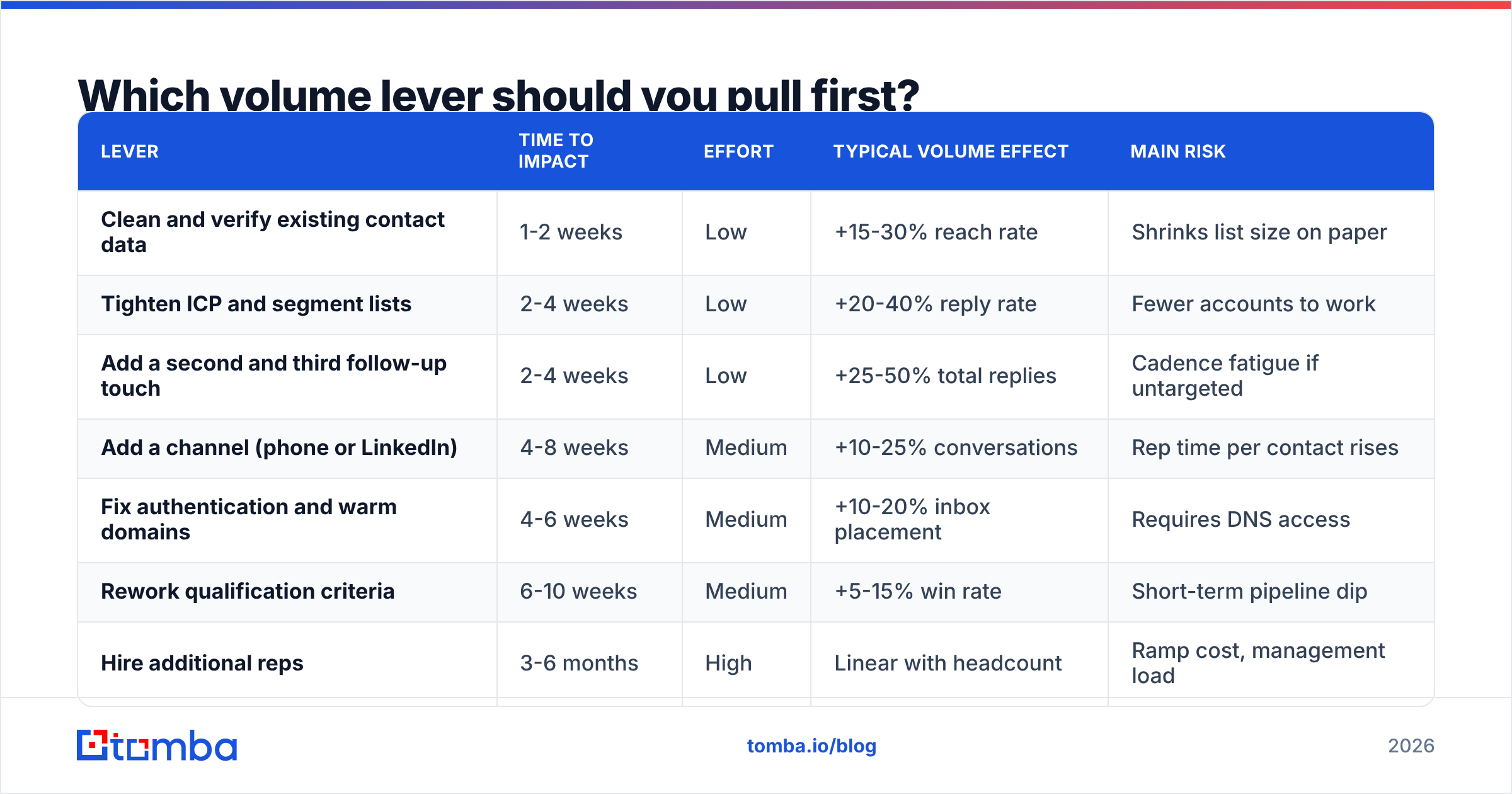
Rank your options by time-to-impact against effort, not by how strategic they sound in a board deck.
| Lever | Time to impact | Effort | Typical volume effect | Main risk |
|---|---|---|---|---|
| Clean and verify existing contact data | 1-2 weeks | Low | +15-30% reach rate | Shrinks list size on paper |
| Tighten ICP and segment lists | 2-4 weeks | Low | +20-40% reply rate | Fewer accounts to work |
| Add a second and third follow-up touch | 2-4 weeks | Low | +25-50% total replies | Cadence fatigue if untargeted |
| Add a channel (phone or LinkedIn) | 4-8 weeks | Medium | +10-25% conversations | Rep time per contact rises |
| Fix authentication and warm domains | 4-6 weeks | Medium | +10-20% inbox placement | Requires DNS access |
| Rework qualification criteria | 6-10 weeks | Medium | +5-15% win rate | Short-term pipeline dip |
| Hire additional reps | 3-6 months | High | Linear with headcount | Ramp cost, management load |
The pattern holds across almost every team I have looked at: the top three rows are cheap, fast, and get skipped, while the bottom row is expensive, slow, and gets approved first because it is the only one that requires no diagnosis.
How much volume is your contact data quietly costing you?#
Run the arithmetic on your own numbers before you accept anyone's benchmark, including mine.
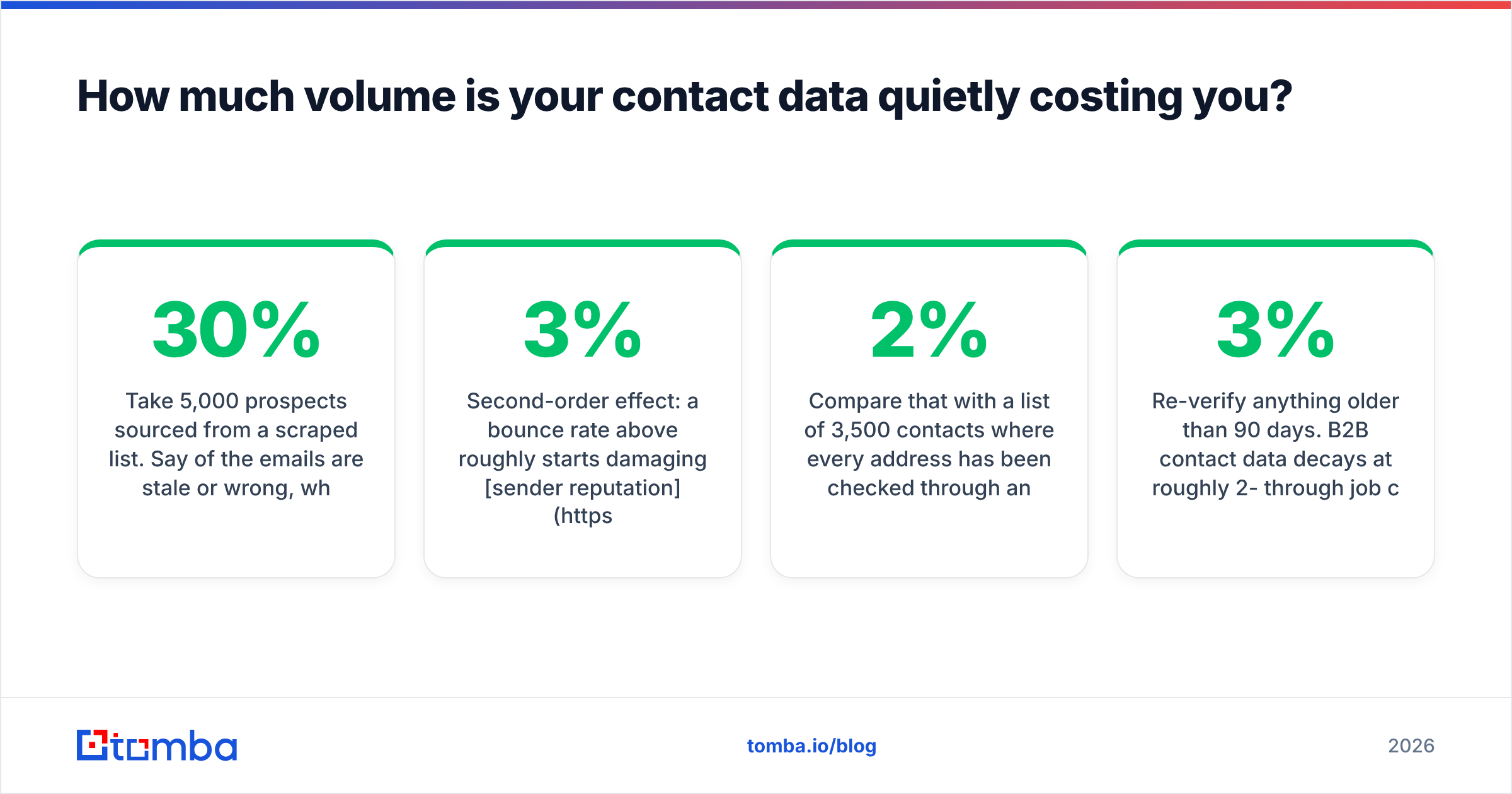
Take 5,000 prospects sourced from a scraped list. Say 30% of the emails are stale or wrong, which is unremarkable for a list built more than six months ago. That is 1,500 addresses that will either hard bounce or land nowhere. You now have 3,500 real recipients, and your bounce rate is high enough that mailbox providers start throttling the 3,500 that were fine.
Second-order effect: a bounce rate above roughly 3% starts damaging sender reputation, which suppresses inbox placement for the next campaign too. So the bad list does not just waste this month. It taxes next month.
Compare that with a list of 3,500 contacts where every address has been checked through an email verifier before it enters the sequence. Same effective audience, bounce rate under 2%, no reputation damage, and the sequencer's reply-rate reporting is finally measuring copy quality instead of measuring list rot.
Two practical rules:
- Verify at the point of import, not the point of send. Once a bad address is in your sequencer, someone will eventually mail it.
- Re-verify anything older than 90 days. B2B contact data decays at roughly 2-3% per month through job changes alone, which compounds fast on a list you built last year.
For teams pulling contacts by company rather than by name, a domain search that returns verified addresses plus role and department beats buying a static CSV that was accurate at some unknowable point in the past.
Should you hire more reps or fix the top of the funnel?#
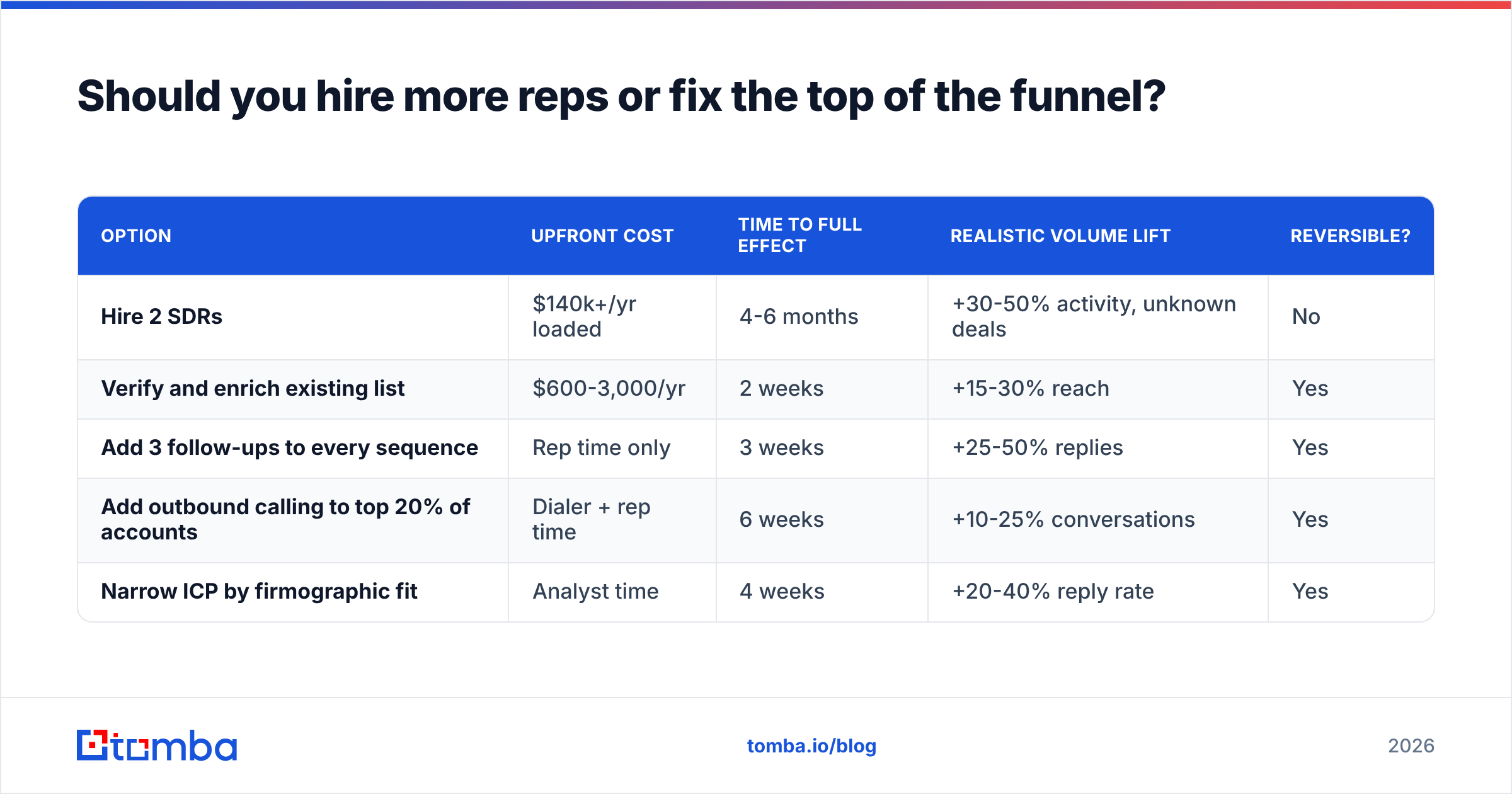
This is the decision most teams actually face, so here it is priced out on a comparable basis. Assume a team currently closing 10 deals a month.
| Option | Upfront cost | Time to full effect | Realistic volume lift | Reversible? |
|---|---|---|---|---|
| Hire 2 SDRs | $140k+/yr loaded | 4-6 months | +30-50% activity, unknown deals | No |
| Verify and enrich existing list | $600-3,000/yr | 2 weeks | +15-30% reach | Yes |
| Add 3 follow-ups to every sequence | Rep time only | 3 weeks | +25-50% replies | Yes |
| Add outbound calling to top 20% of accounts | Dialer + rep time | 6 weeks | +10-25% conversations | Yes |
| Narrow ICP by firmographic fit | Analyst time | 4 weeks | +20-40% reply rate | Yes |
The honest read: hiring is the right answer when your existing reps are at capacity and their conversion metrics are at or above benchmark. If a rep is running 40% bounce rates and a single-touch cadence, a second rep will reproduce those numbers at twice the cost. Fix the process, then clone it.
HubSpot's sales research and Salesforce's State of Sales work both land in the same place: reps spend a minority of their week actually selling, with research and data entry eating the rest. Every hour you remove from manual contact-hunting is an hour returned to the only activity that produces volume. That is why data enrichment tends to beat headcount on cost-per-incremental-deal for teams under about 50 reps.
How do you increase volume without destroying deliverability?#
Volume and email deliverability are in direct tension, and most teams discover this the month after they scale sends.
The constraint is per-mailbox, not per-team. A well-warmed mailbox on a domain with clean authentication handles roughly 30-50 cold sends per day sustainably. Push one mailbox to 300 and you will see open rates collapse within two weeks, at which point every other input in your volume equation collapses with it.
The way to scale sends safely:
- Add mailboxes and domains, not per-mailbox volume. Ten mailboxes at 40/day beats two mailboxes at 200/day, every time.
- Warm every new domain for 3-4 weeks before it carries production traffic. Use a warmup calculator to set the ramp rather than guessing.
- Get SPF, DKIM, and DMARC right on day one. Google and Microsoft both enforce authentication on bulk senders now; unauthenticated mail from a new domain often does not reach a spam folder, it reaches nothing.
- Keep bounce rate under 2% and spam complaints under 0.1%. These are the two numbers that determine whether your next 10,000 sends land.
- Suppress aggressively. Anyone who replied negatively, unsubscribed, or has gone 5 touches without engagement should exit the list.
Volume that comes from more mailboxes on clean infrastructure compounds. Volume that comes from cranking one domain harder is a loan you repay with interest.
What does a 90-day plan to increase sales volume look like?#
Days 1-30: stop the leaks. Export your entire active contact list and verify it. Delete or quarantine anything invalid. Measure the true bounce rate before and after. Audit SPF, DKIM, and DMARC on every sending domain. Pull your last 90 days of closed-won deals and write down what they actually have in common; that is your real ICP, not the one in the deck.
Days 31-60: fix conversion. Rebuild sequences to 5-7 touches minimum across at least two channels. Segment lists by the firmographic signals you found in month one and write one variant per segment. Add B2B phone numbers for the top-fit 20% of accounts so reps can work a real multichannel cadence instead of hoping email carries everything.
Days 61-90: add capacity. Now that reach, reply, and qualification rates are at benchmark, adding volume multiplies something worth multiplying. This is when you add mailboxes, add sourcing volume, and, if the unit economics hold, add reps.
Doing this in the reverse order is the single most common way teams spend a year getting nowhere.
How do you know volume growth is real and not noise?#
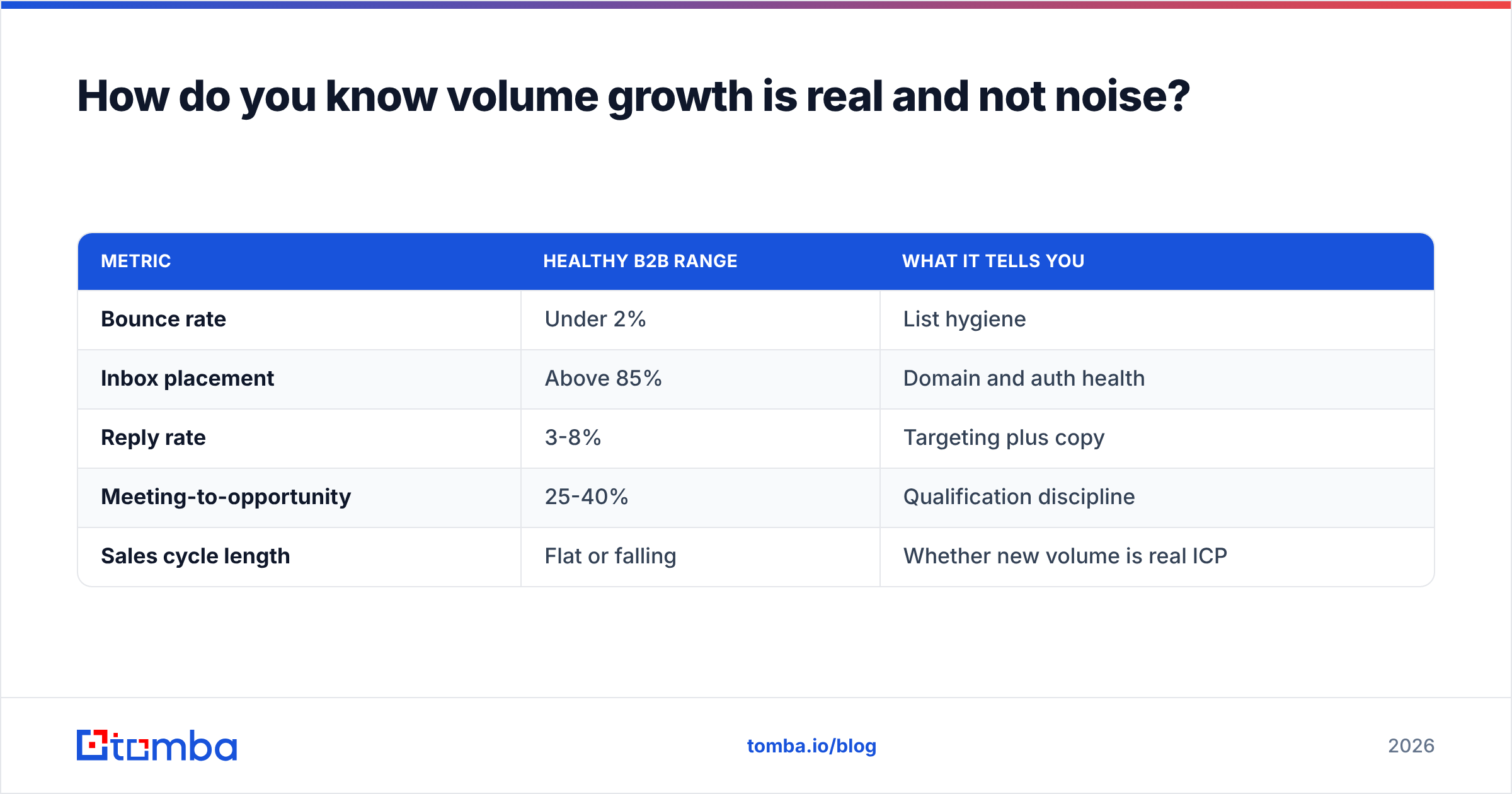
Track the five inputs separately and weekly. If total deals rose but reply rate fell, you bought volume with brute force and it will not repeat. Watch these:
| Metric | Healthy B2B range | What it tells you |
|---|---|---|
| Bounce rate | Under 2% | List hygiene |
| Inbox placement | Above 85% | Domain and auth health |
| Reply rate | 3-8% | Targeting plus copy |
| Meeting-to-opportunity | 25-40% | Qualification discipline |
| Sales cycle length | Flat or falling | Whether new volume is real ICP |
If sales cycle length stretches while volume rises, you are adding poor-fit accounts. That is volume that costs you capacity without adding revenue, and it usually shows up as a win-rate decline two quarters later.
Where should you start this week?#
Start with the number you can fix in ten days: how many of your contacts are actually reachable. Everything downstream of that is a multiplier on a number you have not measured.
Pull a sample of 500 contacts from your CRM and run them through the Tomba Email Finder to see how many resolve to verified, current addresses and how many are stale. If the gap is bigger than 15%, you have found your bottleneck, and it is cheaper to close than any other lever on the list. The free tier gives you 25 searches a month to test the premise, with paid plans starting at $49/mo once you want to run the whole list through bulk verification instead of a sample.
Fix the data, then add the reps. Not the other way around.
Related guides#
// get started
Find, verify and enrich your first contacts today
Start on the free plan with 25 searches a month, then scale when your team is ready.
Free plan · No credit card required · GDPR & CCPA
// about the author