Influno Pricing, Reviews, Pros and Cons: An Honest 2026 Breakdown
Influno bundles sending, warmup, and sequencing into one low-cost outreach plan. Here is what the pricing actually covers, what reviewers praise and complain about, and when a cheaper stack beats it.
TL;DR
- Influno is a cold outreach platform — sending accounts, warmup, sequences, and basic lead management in one subscription. It is priced to undercut Instantly, Smartlead, and Apollo rather than to out-feature them.
- The pricing model matters more than the headline number: Influno meters sending volume and connected mailboxes, not verified contact data. You still pay someone else for accurate emails.
- Reviews skew positive on price-to-value and setup speed, and negative on reporting depth, integration coverage, and support response time during peak periods.
- The honest verdict: good fit for solo founders, agencies running a handful of domains, and teams sending under ~50k emails/month. Weak fit for RevOps teams that need CRM-grade attribution.
- Pair it with a dedicated data layer. Influno does not find or verify emails at the accuracy a cold campaign needs — a tool like Tomba's email finder at $49/mo covers that gap for less than most all-in-one upgrades.
A note before the numbers: outreach vendors change plans often, and Influno does not publish every tier publicly. Everything below reflects what is listed on influno.com and in public review profiles at the time of writing. Confirm the current list price on the vendor's own pricing page before you commit to an annual contract.
What is Influno, and who is it actually for?#
Influno is a cold email execution platform. You connect mailboxes, warm them, build a sequence, upload a list, and let it send. That is the whole product surface — it is not a data provider, not a CRM, and not a full revenue platform.
Think of it like renting a delivery van rather than buying a logistics company. The van moves your packages reliably and cheaply. It does not tell you which addresses are real, which neighborhoods convert, or whether the recipient moved last year. Those are separate problems with separate bills.
That framing explains the pricing. Influno competes in the "send more for less" bracket, where the buyer is usually one of three people:
- The solo founder running 200–500 outbound emails a week off two or three domains, who cannot justify $99+/month for an enterprise sequencer.
- The small agency managing 5–15 client workspaces, where per-seat pricing on Outreach or Salesloft is instantly disqualifying.
- The lean SDR team (2–5 reps) that already has a data source and only needs the sending layer.
If you are none of those three, the pricing math stops working quickly.

How does Influno pricing work in 2026?#
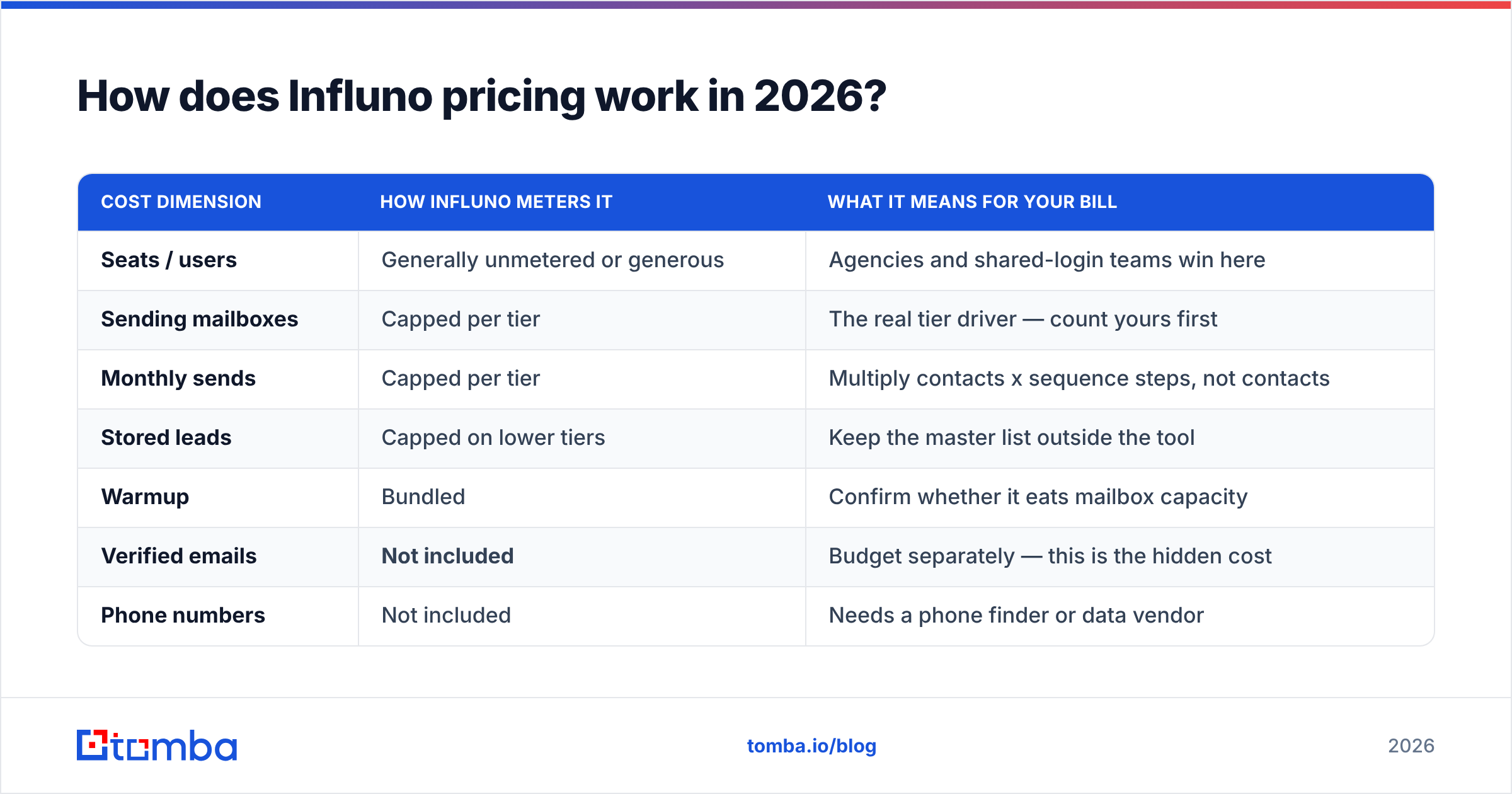
Influno prices on capacity, not seats — the meaningful distinction in this category. Most legacy sales engagement tools (Outreach, Salesloft, Apollo's paid tiers) charge per user per month, which punishes agencies and rewards headcount. Influno, like Instantly and Smartlead, charges by how much you send and how many mailboxes you connect.
Here is what you are actually paying for, in order of how much it affects your bill:
- Connected sending mailboxes. The single biggest cost driver. Every Google Workspace or Microsoft 365 inbox you attach consumes plan capacity. A 10-domain agency setup with 3 mailboxes each is 30 mailboxes — that alone usually pushes you past the entry tier.
- Monthly email volume. Counted as sends, not contacts. A 3-step sequence to 1,000 people is 3,000 sends, not 1,000. This is where buyers most often underestimate their tier.
- Active contacts or uploaded leads. Some plans cap the stored list size. If you keep a 200k-row master list in-platform rather than in a warehouse, this becomes a real constraint.
- Warmup slots. Included on most tiers, but check whether warmup mailboxes count against your connected-mailbox cap. On several competitors they do, and it silently halves your usable capacity.
- Workspaces and sub-accounts. Agency-relevant. Separate client workspaces with separate reporting are typically a higher-tier or add-on feature, not an entry-plan inclusion.
What is not in any Influno tier: verified contact data, phone numbers, firmographic enrichment, or intent signals. That is not a criticism — it is a category boundary. But it is the line item most buyers forget when they compare a $40/month Influno plan to a $99/month all-in-one and call the all-in-one expensive.
| Cost dimension | How Influno meters it | What it means for your bill |
|---|---|---|
| Seats / users | Generally unmetered or generous | Agencies and shared-login teams win here |
| Sending mailboxes | Capped per tier | The real tier driver — count yours first |
| Monthly sends | Capped per tier | Multiply contacts x sequence steps, not contacts |
| Stored leads | Capped on lower tiers | Keep the master list outside the tool |
| Warmup | Bundled | Confirm whether it eats mailbox capacity |
| Verified emails | Not included | Budget separately — this is the hidden cost |
| Phone numbers | Not included | Needs a phone finder or data vendor |
| API access | Higher tiers typically | Matters if you sync to a warehouse |
The practical takeaway: build your estimate bottom-up from mailboxes and sends. A buyer who says "Influno is $X/month" and a buyer running 30 mailboxes at 60k sends are describing completely different invoices.
What do Influno reviews say?#
Public review volume for Influno is thinner than for Instantly or Apollo, which is itself a signal — you are looking at a smaller, younger vendor. Check current profiles on G2 and Capterra yourself rather than trusting any single roundup, including this one, because low-volume profiles move fast when a vendor runs a review campaign.
The patterns that show up consistently across reviews and community threads:
What reviewers praise
- Price-to-capability ratio. Nearly every positive review leads with cost. For teams that were paying per-seat sales engagement pricing, the drop is dramatic.
- Setup speed. Mailbox connection, DNS guidance, and first sequence live in under an hour is a common report.
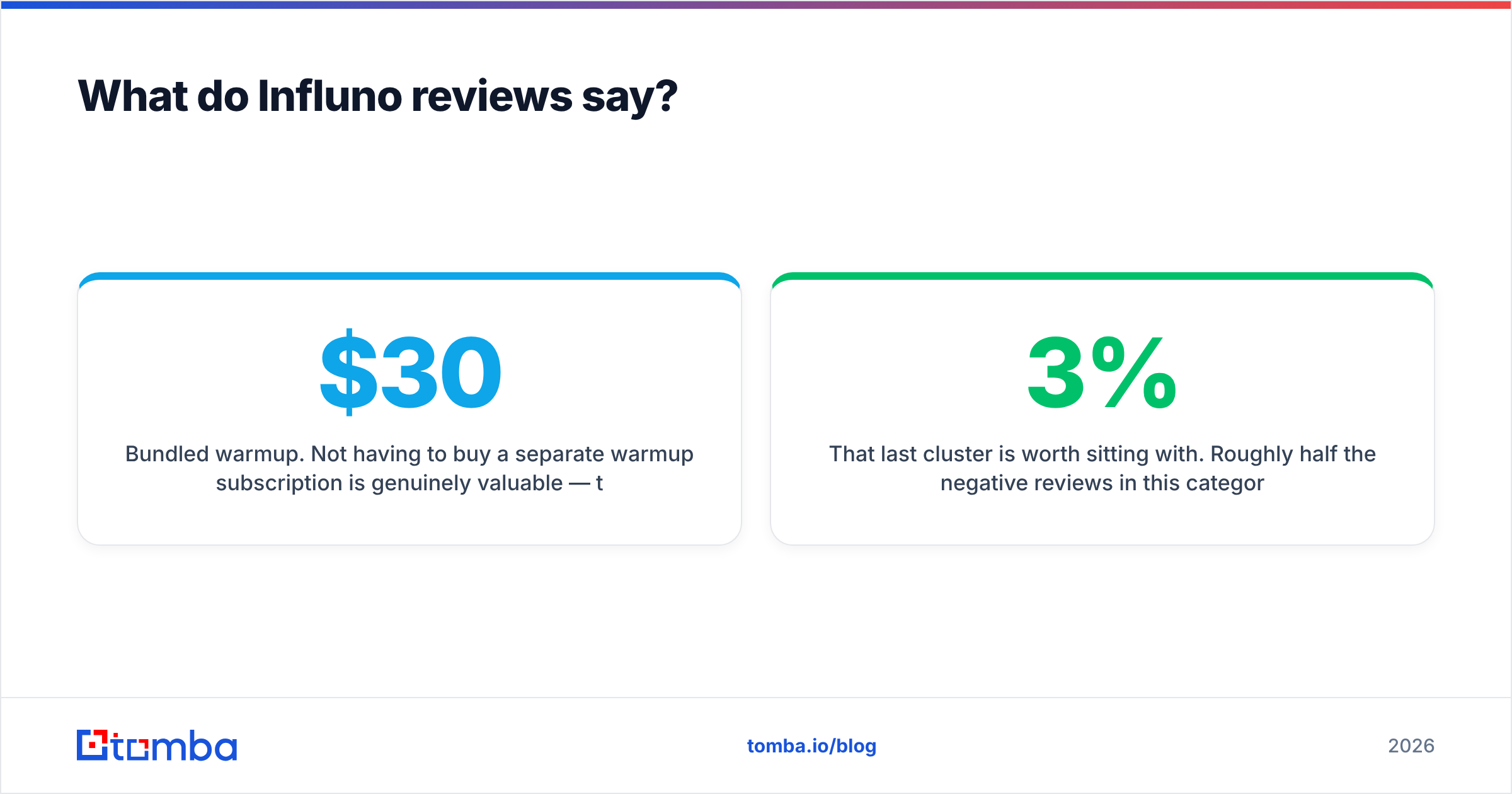
- Bundled warmup. Not having to buy a separate warmup subscription is genuinely valuable — that is $30–$50/month saved versus a standalone tool.
- Responsive product team. Small-vendor advantage: feature requests get acknowledged by humans, and the roadmap moves.
What reviewers complain about
- Reporting depth. Open/click/reply at the campaign level is there. Cohort analysis, per-variant statistical significance, and revenue attribution are not. Teams that need board-ready numbers export to a spreadsheet.
- Integration coverage. Native connectors are fewer than the market leaders. Expect to route through Zapier or Make for anything beyond the obvious CRMs — check whether your stack is covered before buying.
- Deliverability ownership. The tool sends; it does not guarantee inboxing. Reviewers who uploaded unverified lists and blamed the platform for bounce-driven reputation damage are describing a data problem, not a software problem.
- Support latency at scale. Fast on normal days, slower during incidents. Typical of a lean team.
- Documentation gaps. API docs and edge-case guides lag the feature set.
That last cluster is worth sitting with. Roughly half the negative reviews in this category across all vendors trace back to list quality rather than the sending platform. If your bounce rate is above 3%, no amount of warmup fixes it — you need email verification before the send, not better software after it.
How does Influno compare to the alternatives?#
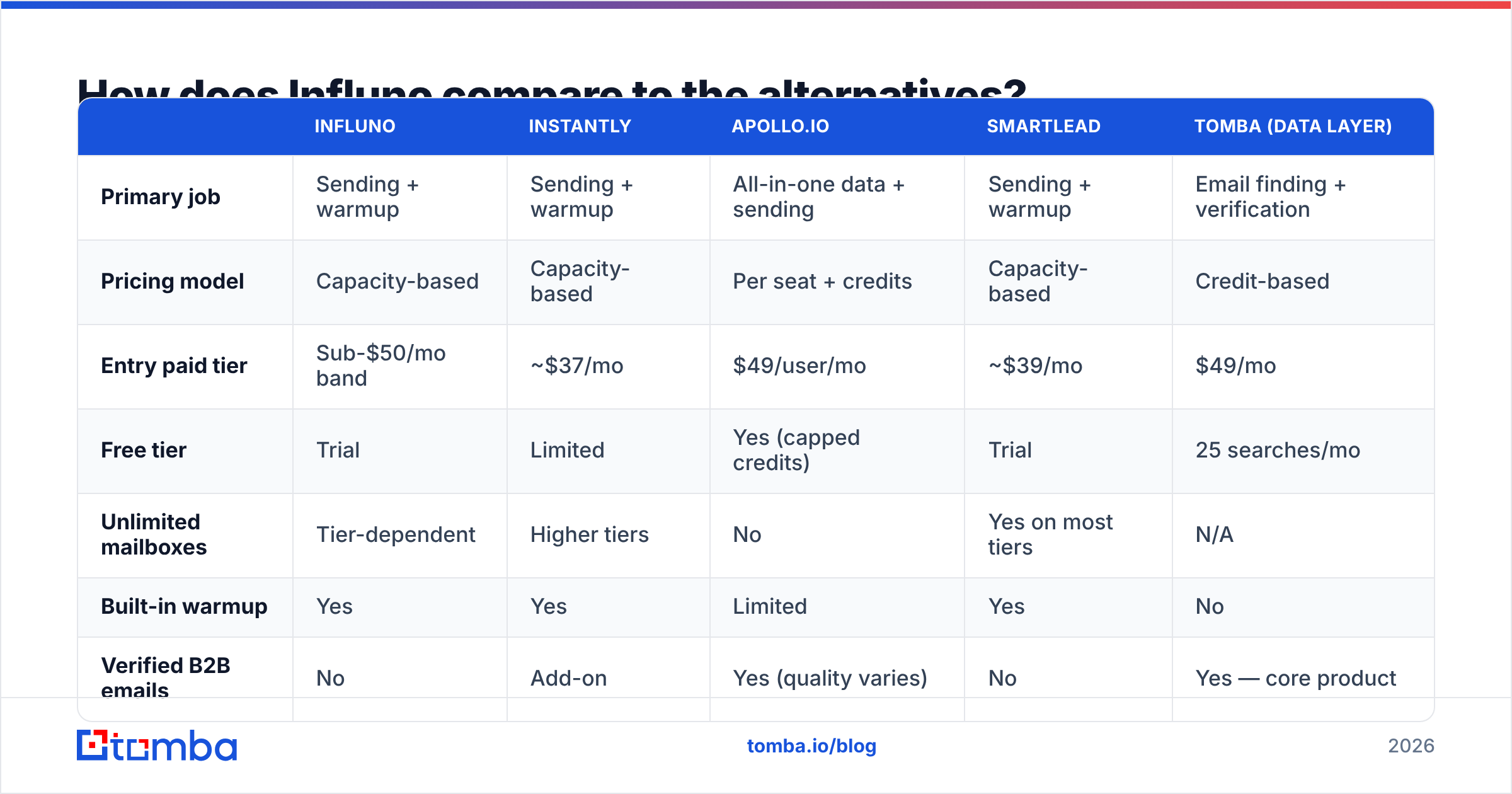
The comparison that matters is not Influno versus one competitor. It is Influno versus the stack you would otherwise assemble. Here is the honest layout, with list prices as published at the time of writing:
| Influno | Instantly | Apollo.io | Smartlead | Tomba (data layer) | |
|---|---|---|---|---|---|
| Primary job | Sending + warmup | Sending + warmup | All-in-one data + sending | Sending + warmup | Email finding + verification |
| Pricing model | Capacity-based | Capacity-based | Per seat + credits | Capacity-based | Credit-based |
| Entry paid tier | Sub-$50/mo band | ~$37/mo | $49/user/mo | ~$39/mo | $49/mo |
| Free tier | Trial | Limited | Yes (capped credits) | Trial | 25 searches/mo |
| Unlimited mailboxes | Tier-dependent | Higher tiers | No | Yes on most tiers | N/A |
| Built-in warmup | Yes | Yes | Limited | Yes | No |
| Verified B2B emails | No | Add-on | Yes (quality varies) | No | Yes — core product |
| Phone numbers | No | No | Yes | No | Yes |
| Catch-all handling | No | No | Partial | No | Yes — dedicated verifier |
| CRM-grade reporting | Weak | Moderate | Strong | Moderate | N/A |
| Best for | Solo + small agency | Volume senders | Teams wanting one bill | Agencies, many mailboxes | Any stack needing accurate data |
Two things jump out.
First, the sending-layer tools are near-commodities. Influno, Instantly, and Smartlead do materially the same job at materially the same price. Your choice among them comes down to mailbox limits, UI preference, and which support team answers faster — not to a feature gap worth agonizing over.
Second, the real fork is all-in-one versus assembled stack. Apollo bundles data and sending for $49/user/month, which looks clean until you have four reps ($196/month) and discover the bundled data needs verification anyway. An assembled stack — Influno for sending plus a dedicated data source — frequently lands cheaper and more accurate. That is the actual pricing argument, and it is why people search for Apollo alternatives in the first place.

What are the real pros and cons?#
Pros
- Capacity pricing rather than seat pricing — agencies and shared teams save meaningfully.
- Warmup included, removing a separate $30–$50/month line item.
- Low switching cost. Sequences are portable; you are not locked into proprietary data.
- Fast onboarding; a non-technical founder can be live the same day.
- Small vendor responsiveness on feature requests.
Cons
- No native data layer. You will buy contacts elsewhere, so the "cheap" plan is only part of your true cost.
- Reporting is campaign-level, not revenue-level. RevOps teams will export.
- Fewer native integrations than category leaders; Zapier dependency is common.
- Thin public review volume makes due diligence harder — smaller sample, more variance.
- Vendor risk. Smaller companies in a consolidating category carry acquisition and sunset risk. Keep your lists exportable.
Is Influno worth it?#
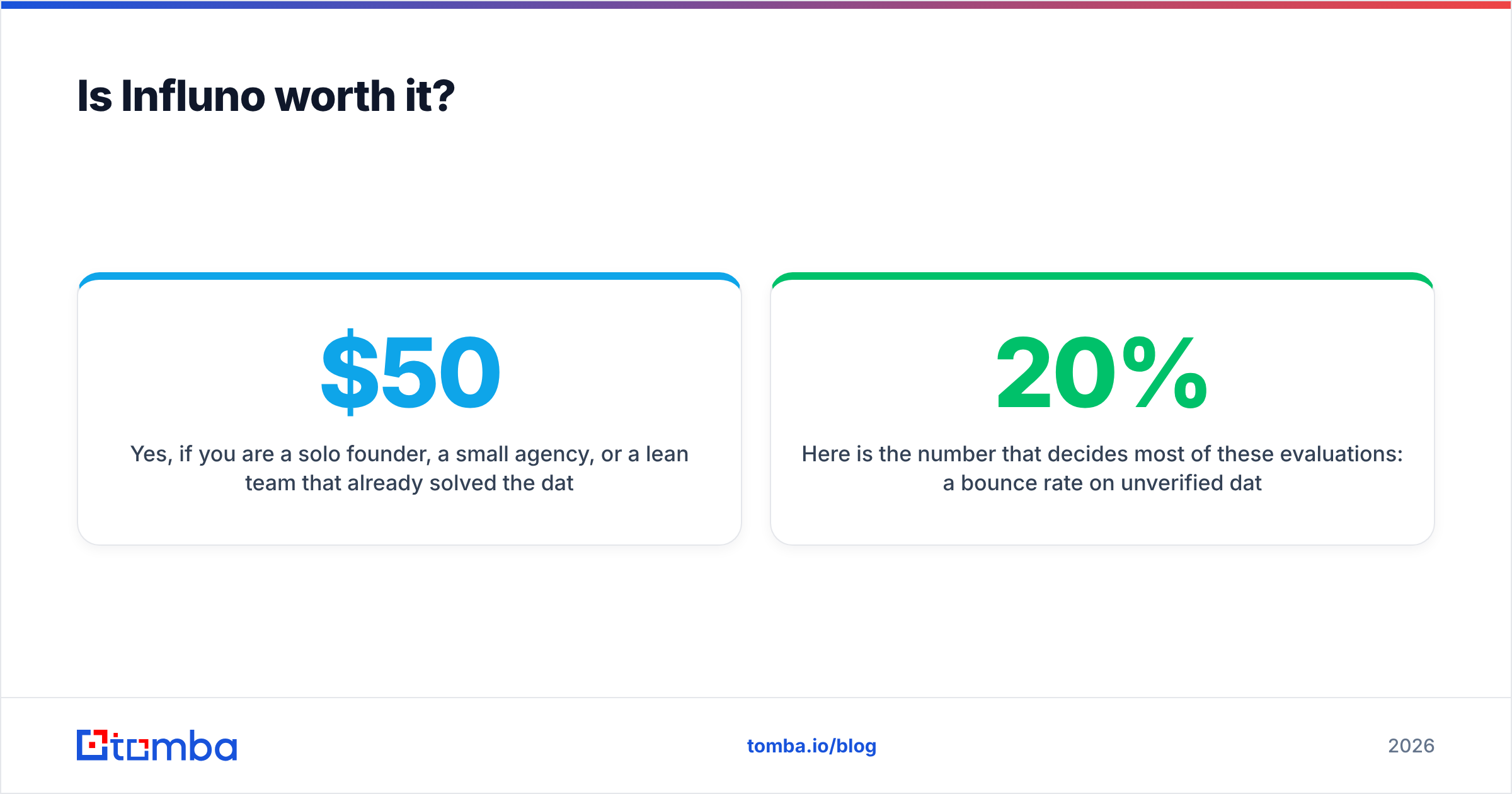
Yes, if you are a solo founder, a small agency, or a lean team that already solved the data problem and needs an inexpensive, competent sending layer. At the sub-$50/month band it is straightforwardly good value against per-seat incumbents.
No, if you need attribution your CFO will accept, a deep native integration map, or a single vendor to handle data and sending together. You will outgrow the reporting before you outgrow the sending limits.
Maybe, if you are choosing between Influno, Instantly, and Smartlead. In that three-way race, run the same 1,000-contact campaign on a trial of each with an identical verified list, and pick on inbox placement and support response. The pricing difference across those three is smaller than the difference a clean list makes.
Here is the number that decides most of these evaluations: a 20% bounce rate on unverified data will destroy sender reputation on any platform, at any price. Fixing email deliverability is 80% data hygiene and 20% software. Buyers who optimize the $12/month difference between sending tools while feeding all of them scraped lists are solving the wrong problem — and they are the ones who later write the one-star review blaming the tool.
What should you pair Influno with?#
Whatever sending platform you land on, the data layer is the part that decides whether the campaign works. Budget for it explicitly:
- Finding the addresses — domain-level prospecting rather than list buying, so your contacts match your ICP instead of someone else's export.
- Verifying before send — SMTP-level checks plus catch-all handling, targeting a bounce rate under 2%.
- Enriching what you have — filling gaps in an existing CRM beats starting from zero.
- Deduplicating — the cheapest bounce reduction available, and most teams skip it.
Tomba covers that layer at $49/mo on Starter and $99/mo on Growth, with a free tier of 25 searches if you want to test accuracy against your own known-good list before paying anyone. Full Tomba pricing is public, and the credits are usable across finding, verification, and enrichment rather than siloed per product.
Start with the data, not the sending tool#
Pick your sending platform on price and mailbox limits — Influno, Instantly, and Smartlead are all defensible choices in that band, and the differences are smaller than the marketing suggests. Then spend the savings where it actually changes results.
Run 50 of your target contacts through the Tomba Email Finder free tier, send them through whichever platform you are trialling, and compare bounce rates against your current list. If the verified batch bounces under 2% and your existing list does not, you have found the real cost in your outbound stack — and it was never the $40/month sending subscription.
Related guides#
Ready to find emails that actually work?
Join 150,000+ professionals who stopped guessing and started sending. Free credits on signup — no credit card required.
Get the Tomba newsletter
Practical outbound tactics and product updates — once every two weeks.
About the author