Influno vs Apollo.io (2026): Which Outreach Tool Wins?
Influno sends cold email well. Apollo.io owns the data layer. Here is an honest, line-by-line look at pricing, deliverability, data quality and which one actually fits your outbound motion in 2026.
Influno vs Apollo.io is not really a feature fight. It is a choice about which half of outbound you are paying for: the sending layer or the data layer. Pick the wrong half and you pay twice.
TL;DR
They are not the same category. Influno is a cold email sending and sequencing tool. Apollo.io is a sales database that also sends email. Compare them on features alone and you will pick wrong.
Pick Influno if you already have contact data. It fits when your problem is send volume, inbox rotation, and deliverability hygiene.
Pick Apollo.io if your problem is finding people. You get a 200M+ contact database, filters, and a Chrome extension in one seat.
Neither one solves data accuracy. Apollo's bundled emails are handy, but quality varies by region and job level. Most teams still run a separate verification step.
The common 2026 stack is simple: a database for contacts, then a verifier, then Influno or Apollo for sending. Paying one vendor for all three usually costs more and works worse.
Influno vs Apollo.io: what does each tool actually do?#
Start with the honest framing, because the marketing pages blur it.
Influno is an outbound email platform. Its main job is sending. You connect mailboxes, rotate across them, warm them, and build multi-step sequences. You personalize at scale and track replies. It assumes you arrive with a list, or that you will source one somewhere else.
Apollo.io is a go-to-market platform built on a contact database. Its main job is discovery. You search 200M+ contacts by title, headcount, tech stack, funding, and intent signals. Then you push those contacts into sequences, a dialer, or your CRM. Sending exists here too, but it is the second act.
So the real question is not "which tool is better." It is this: which half of the outbound problem is costing you deals right now?
Does your team have a list, yet emails keep landing in spam? Influno is the more direct answer. Are reps burning three hours a day hunting for contacts? Apollo is.

Influno vs Apollo.io: a feature-by-feature comparison#
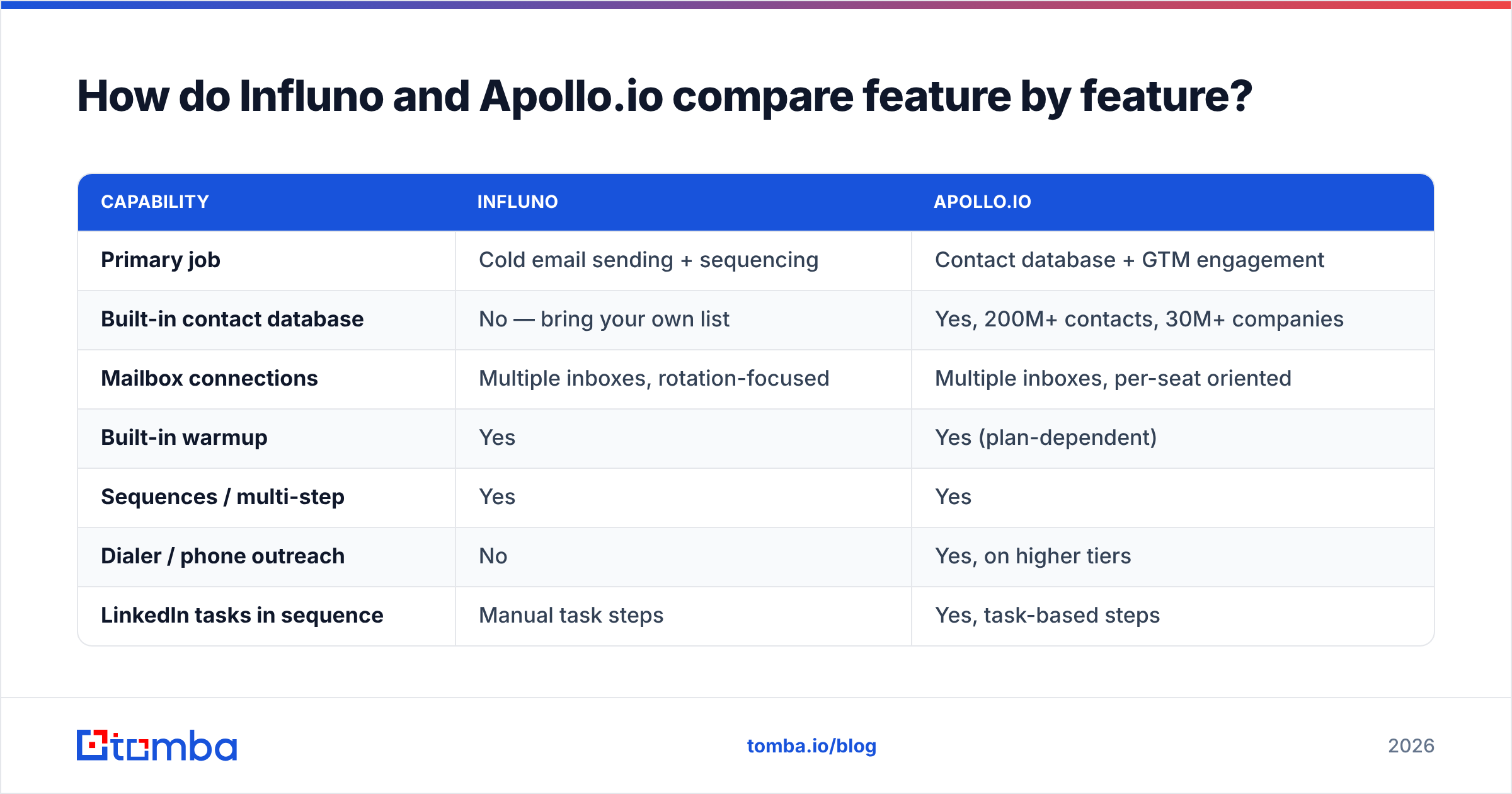
| Capability | Influno | Apollo.io |
|---|---|---|
| Primary job | Cold email sending + sequencing | Contact database + GTM engagement |
| Built-in contact database | No — bring your own list | Yes, 200M+ contacts, 30M+ companies |
| Mailbox connections | Multiple inboxes, rotation-focused | Multiple inboxes, per-seat oriented |
| Built-in warmup | Yes | Yes (plan-dependent) |
| Sequences / multi-step | Yes | Yes |
| Dialer / phone outreach | No | Yes, on higher tiers |
| LinkedIn tasks in sequence | Manual task steps | Yes, task-based steps |
| Chrome extension for prospecting | Not the core use case | Yes, a flagship feature |
| CRM sync (HubSpot, Salesforce) | Integrations / Zapier-style | Native two-way on paid tiers |
| Billing model | Platform / volume oriented | Per user, per month + credits |
| Best fit | Agencies, lean outbound teams | SDR teams needing data + activity tracking |
Two lines in that table matter more than the rest.
"Built-in contact database: No." That is not a flaw in Influno. It is a design choice. Sending tools that stay out of the data business tend to have cleaner deliverability incentives. They are not pushing you to blast a bundled list you never checked.
"Billing model: per user." Apollo's cost scales with headcount. Influno's scales with volume. A 12-rep team and a 2-person agency can send the same volume and still get wildly different quotes.
What does each platform actually cost?#
Pricing changes often on both sides. Treat these numbers as directional, and confirm them on the vendor pages before you buy.
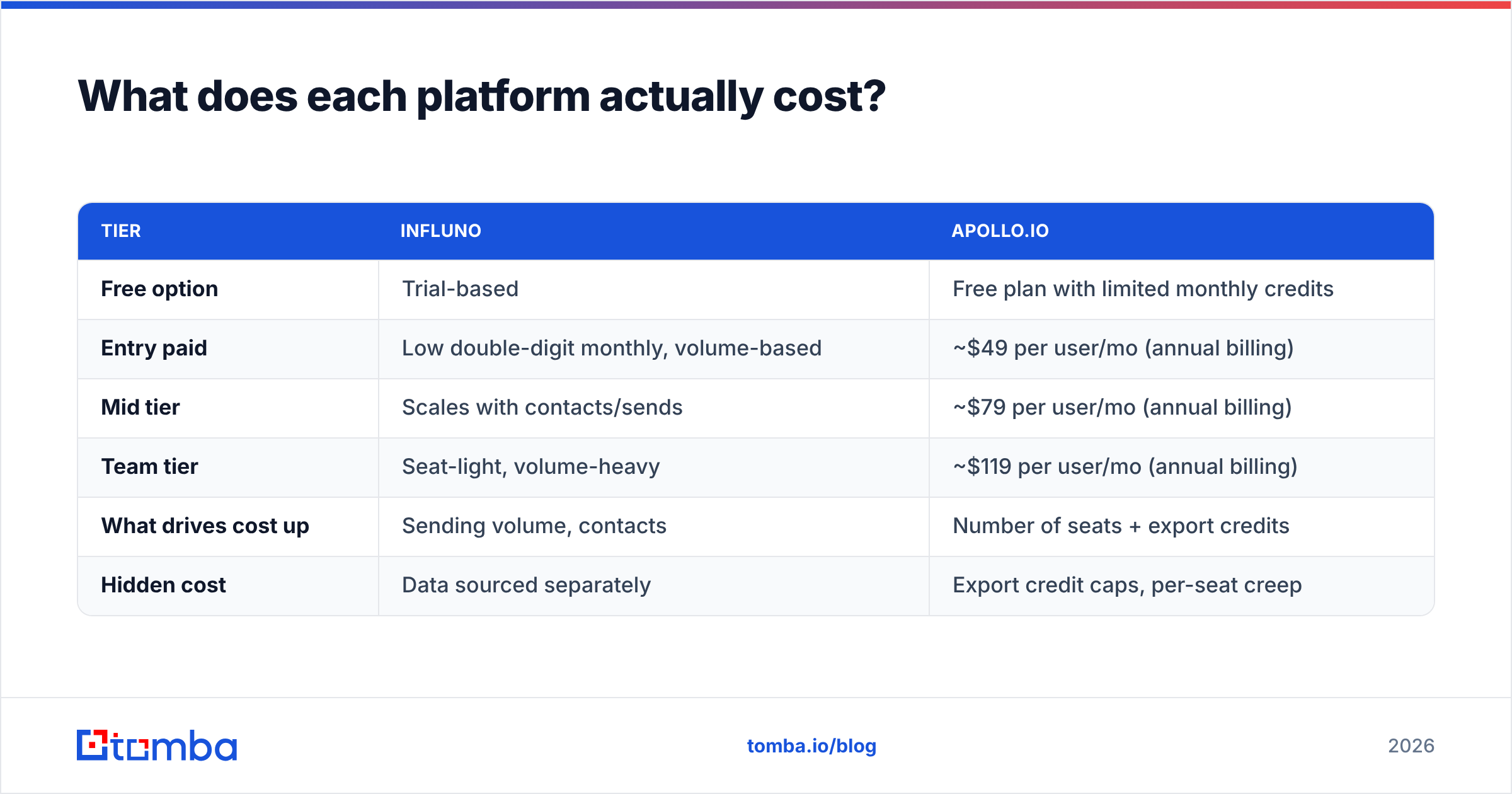
| Tier | Influno | Apollo.io |
|---|---|---|
| Free option | Trial-based | Free plan with limited monthly credits |
| Entry paid | Low double-digit monthly, volume-based | ~$49 per user/mo (annual billing) |
| Mid tier | Scales with contacts/sends | ~$79 per user/mo (annual billing) |
| Team tier | Seat-light, volume-heavy | ~$119 per user/mo (annual billing) |
| What drives cost up | Sending volume, contacts | Number of seats + export credits |
| Hidden cost | Data sourced separately | Export credit caps, per-seat creep |
The trap on the Apollo side is credits. People quote each other the seat price. But export credits are what really gate your throughput. Teams often discover mid-quarter that a cheap plan caps how many records they can pull out.
The trap on the Influno side is the opposite. The platform price looks great until you notice it includes zero contacts. You still have to buy or build the list.
That is why a straight Influno vs Apollo.io price comparison understates one side. Compare the total cost to send 10,000 verified emails a month instead. Include whatever you spend on data. The gap usually shrinks to noise.
Which one gives you better contact data?#
Only one of them gives you contact data at all. So the honest match-up is Apollo's bundled data against whatever you plug into Influno. Here is how to judge either one.
- Coverage by region. Apollo is strongest in North America and other English-speaking markets. Sell into DACH, MENA, or APAC mid-market and the data thins out fast. Expect missing rows, stale titles, and generic info@ addresses standing in for real people.
- Freshness at the seniority you target. Director-level records and above churn fast. A database that was accurate in Q1 is often wrong by Q4. Ask how often records get re-checked, not how many records exist.
- Verification status vs verification claim. "Verified" in an export usually means a syntax and MX check passed. It rarely means an SMTP handshake confirmed the mailbox accepts mail today. Those two produce very different bounce rates.
The last two checks are the ones buyers skip most often.
- Catch-all handling. Many B2B domains accept every address at the server level. If your tooling marks catch-alls as valid, your bounce rate lies to you until the campaign runs. A dedicated catch-all verifier is the only way to get a real answer.
- Export rights and portability. If you cannot get a record out on your own terms, you are renting your pipeline. Check credit caps and export limits before you sign an annual deal.
Run those five checks and most buyers land in the same place. The database is a starting point, not a finished list. Send from Influno or Apollo — either way, a verification pass in front of the sequence pays for itself on the first campaign.
Influno vs Apollo.io: which one wins on deliverability?#
Structurally, Influno does. That is the strongest reason to choose it.
Influno assumes you will send from many mailboxes and spread the load across them. Inbox rotation, warmup, and volume pacing sit up front, not three menus deep. For an agency running ten client domains, that design is the product.
Apollo's sending is solid and perfectly usable. But it is one module inside a much larger platform. Its deliverability also depends on something you do not control. Apollo's bundled data is used by tens of thousands of other teams, and some of them send to the same records with far less care. Shared-list fatigue is real. If a prospect already got eleven cold emails from that source this month, your twelfth one inherits the annoyance.
Neither platform saves you from bad inputs. Email deliverability comes down to three things you own, whatever vendor you pick:
- Authentication. Set up SPF, DKIM, and DMARC on every sending domain. Run an SPF checker before your first send, not after your first bounce spike.
- List hygiene. A bounce rate above roughly 3% starts to damage sender reputation at the big mailbox providers. Verification is not optional at any scale.
- Volume discipline. New domains need weeks of ramp-up. No warmup feature makes up for 500 cold emails from a domain you registered nine days ago.
Google and Yahoo's bulk sender rules made all three non-negotiable. Both vendors will tell you the same thing. The tooling differs; the physics do not.

Which one should you choose for your team?#
Map it to your actual situation, not to a feature checklist.
- Solo founder or 2-person agency. Influno. Per-seat pricing punishes you for nothing here. You are probably sourcing lists by hand or with a finder anyway. Pair it with a bulk email finder and the whole stack costs less than one Apollo seat at the professional tier.
- Outbound agency running client domains. Influno, clearly. Rotation, per-client separation, and volume-based billing match how agencies actually operate. Apollo's per-seat model gets expensive fast across many clients.
The next three profiles are closer calls.
- 5-20 rep SDR team with a sales manager. Apollo.io. You need activity tracking, a shared database, a dialer, and CRM sync in one place. The reporting alone earns back the seat cost when you coach reps.
- Product-led company doing low-volume, high-intent outreach. Either one works. Lean Apollo if you want the intent and technographic filters. Lean Influno if your own signup data already gives you contacts to sequence.
- Enterprise with a data contract already in place. Influno. If you pay ZoomInfo or Cognism today, Apollo's database is redundant and you pay twice for the same rows.
One more pattern deserves a name. Plenty of teams buy Apollo for the data and then send from something else. It is common, it works, and it tells you where each product is strong. If that is your plan, price Apollo as a data vendor. Then compare it against buying data per record from a finder instead of per seat from a platform.
What does the strongest 2026 outbound stack look like?#
Three layers, kept separate on purpose.
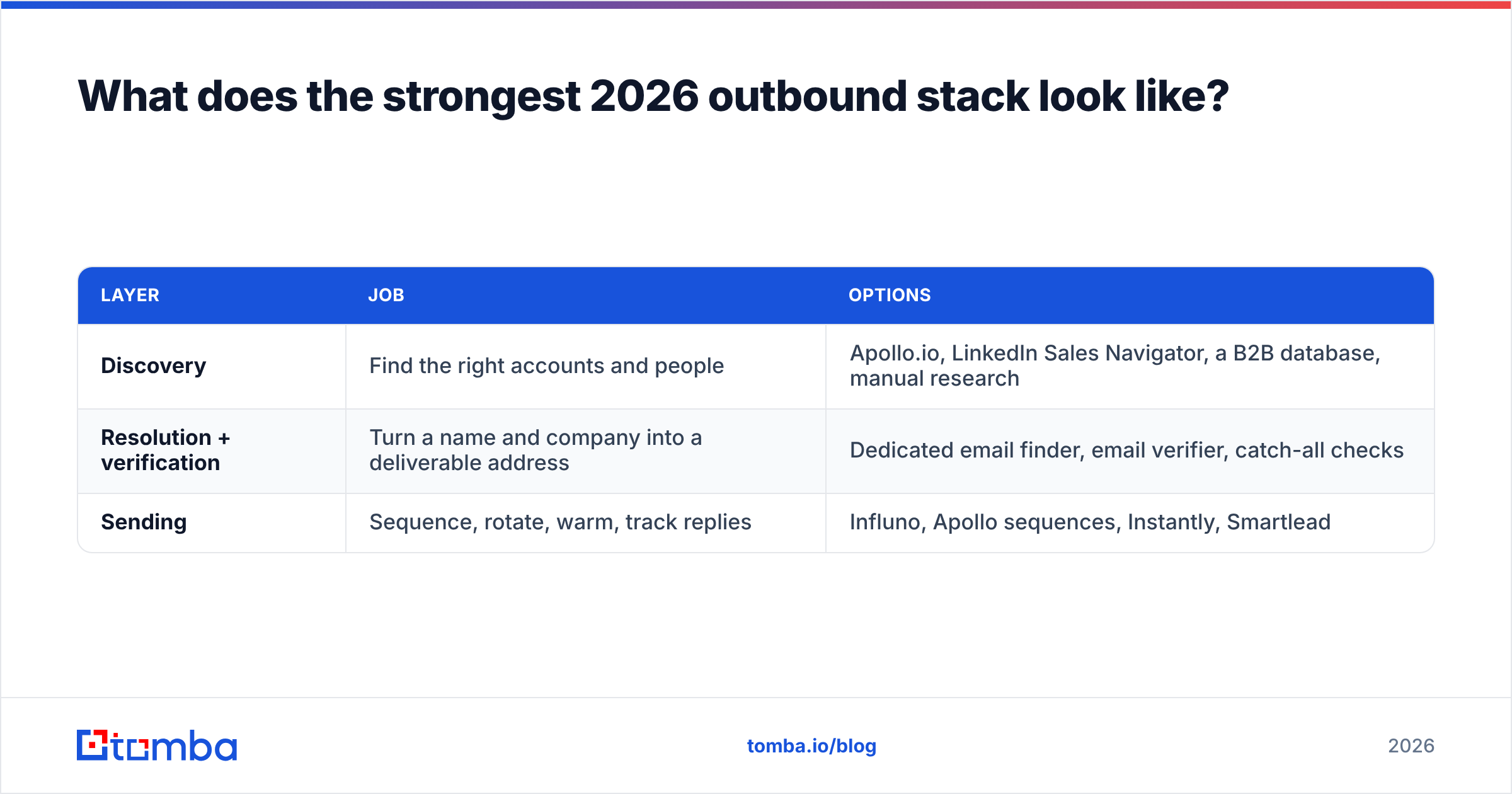
| Layer | Job | Options |
|---|---|---|
| Discovery | Find the right accounts and people | Apollo.io, LinkedIn Sales Navigator, a B2B database, manual research |
| Resolution + verification | Turn a name and company into a deliverable address | Dedicated email finder, email verifier, catch-all checks |
| Sending | Sequence, rotate, warm, track replies | Influno, Apollo sequences, Instantly, Smartlead |
Separating the layers costs a little more in subscriptions. It saves much more in wasted sends. When your verifier is independent of your data vendor, it has no reason to grade that data kindly. That is why bounce rates drop when teams make the switch.
It also makes vendor swaps cheap. If Influno's roadmap stalls, or Apollo repackages credits again, you replace one layer. You do not rebuild the whole motion.
Want a wider view? G2's sales engagement category is a fair place to sanity-check user sentiment. Watch for review-volume skew: Apollo has far more reviews because it has far more seats, not because it performs better per user.
Frequently asked questions#
Can Influno replace Apollo.io entirely? Only if you have another source of contacts. Influno ships no database. So replacing Apollo means replacing both its sending and its data with two different tools.
Can Apollo.io replace Influno entirely? Yes, on paper — Apollo sends email. The open question is whether it sends as well at high volume across many domains. Agencies keep answering that one with "no."
Is Apollo's free plan enough to test with? For judging search quality, yes. For running real campaigns, no. The credit caps bind quickly, and you learn nothing about deliverability at that volume.
Do I still need a separate verifier? Almost always. Treat any bundled "verified" flag as a first pass. Then run an independent check before the list touches a sequence.
Is Influno vs Apollo.io even the right comparison? Often it is not. Many teams end up buying both: one for data, the other for sending.
Where Tomba fits#
By now the pricing section has made the point. The data layer is what you are really trying to solve. Start there, before you pick a sending platform.
The Tomba Email Finder turns names and domains into verified business addresses. You see the sources behind each match. Every result runs through SMTP-level verification, including catch-all handling.
Pricing starts free at 25 searches per month. Starter is $49/mo, Growth is $99/mo, and Pro is $249/mo. There is no per-seat tax, so a two-person agency and a ten-rep team pay for what they use, not for who logs in. See full Tomba pricing for the tier breakdown, or wire it into whichever sequencer you land on with the Tomba API.
So settle Influno vs Apollo.io by asking where your bottleneck actually sits. Then put a verification layer in front of either one. That is the decision that shows up in your reply rate.
Related guides#
// get started
Find, verify and enrich your first contacts today
Start on the free plan with 25 searches a month, then scale when your team is ready.
Free plan · No credit card required · GDPR & CCPA
// about the author