Influno vs LeadIQ (2026): Which Sales Tool Actually Wins?
Influno sends the emails. LeadIQ finds the people. Here is an honest breakdown of pricing, data quality, deliverability controls, and which one belongs in your 2026 stack.
TL;DR
- Influno and LeadIQ are not really competitors. Influno is an outreach and sending platform; LeadIQ is a contact data and prospecting layer that feeds your sequencer. Most teams that compare them end up needing both halves of the job covered.
- Pick LeadIQ if your bottleneck is who to contact — you live in LinkedIn Sales Navigator, you need one-click contact capture, and you need clean pushes into Salesforce or Outreach.
- Pick Influno if your bottleneck is getting the email delivered and replied to — multi-inbox sending, warmup, sequencing, and unified reply management.
- The hidden cost in both is seats. Per-user pricing punishes teams where only two or three reps actually pull data, and neither tool is cheap once you add the other half.
- If you only need verified email addresses at a predictable price, a dedicated finder plus a verifier is usually the cheaper, lower-lock-in path.
What are Influno and LeadIQ, actually?#
They solve different halves of the same pipeline problem.
Influno is an all-in-one cold email platform. It manages multiple sending mailboxes, rotates sends across them, runs warmup, builds multi-step sequences with conditional follow-ups, and pulls every reply into one inbox. Its centre of gravity is the send — what happens after you already have a list.
LeadIQ is a B2B contact data and prospecting platform. Its best-known surface is the browser extension that sits on LinkedIn and Sales Navigator, letting a rep capture a prospect's work email, mobile number, and company data in one click and push it straight to the CRM or sequencer. It also ships Scribe, an AI message writer that drafts personalised openers from the prospect's profile and recent activity.
So the honest framing of influno vs leadiq is this: LeadIQ fills the top of the funnel with contacts, Influno moves those contacts through an email sequence. Asking which one "wins" is like asking whether a water pump beats a pipe. What actually matters is which gap in your stack is currently costing you meetings.

How do Influno and LeadIQ compare feature by feature?#
Here is where the overlap is thin and where it is real.
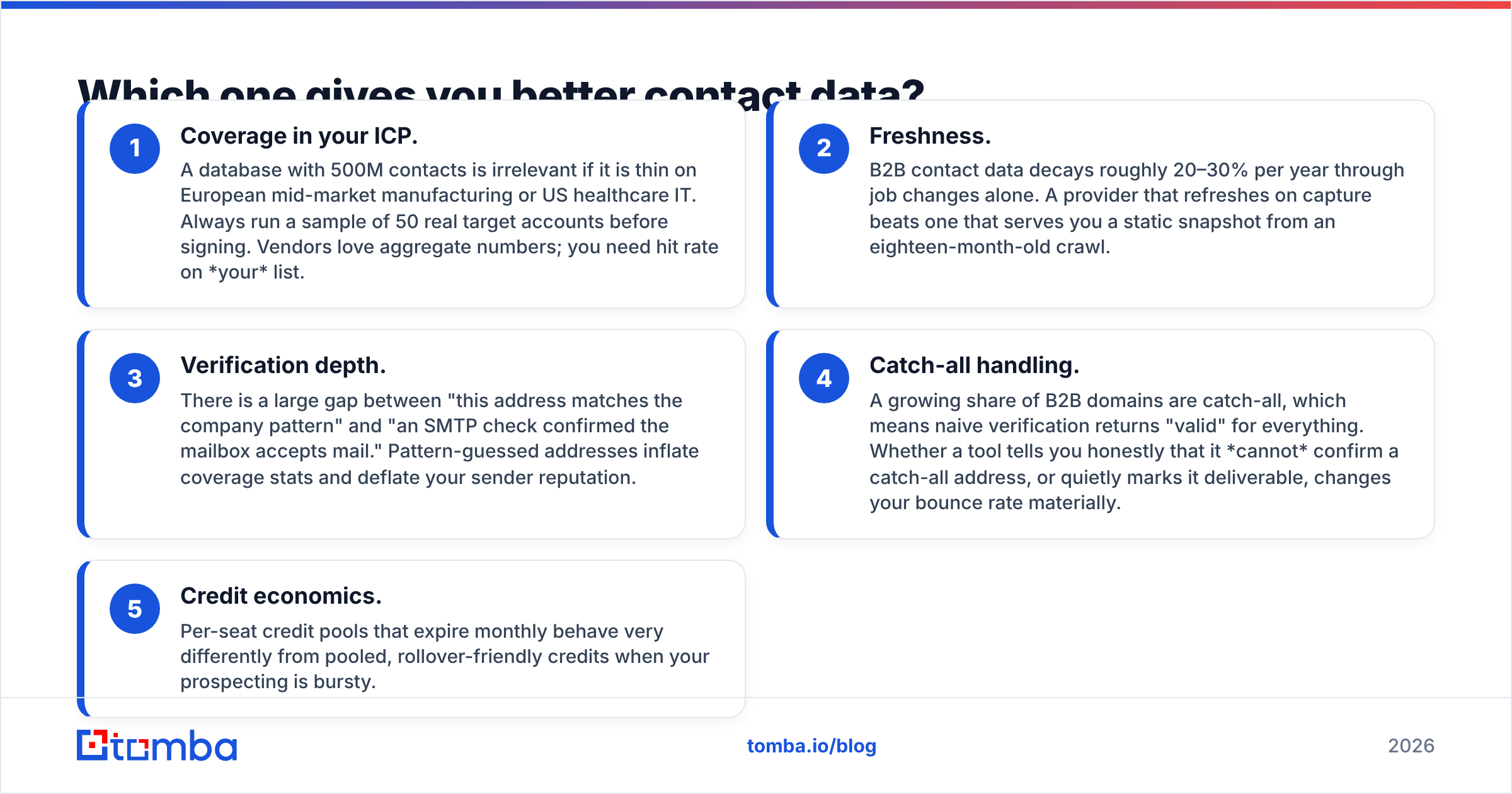
| Capability | Influno | LeadIQ |
|---|---|---|
| Primary job | Cold email sending and sequencing | Contact discovery and CRM capture |
| Contact database | Not a data provider | Core product — emails, mobiles, company data |
| LinkedIn / Sales Navigator capture | No | Yes, browser extension is the main workflow |
| Email verification | Basic list hygiene on import | Verification tiers on captured emails |
| Multi-inbox sending + rotation | Yes | No |
| Built-in warmup | Yes | No |
| Sequences / cadences | Yes, native | No — pushes into Outreach, Salesloft, etc. |
| AI message writing | Template and copy assistance | Scribe, profile-aware personalisation |
| CRM sync | Standard integrations | Deep Salesforce and HubSpot sync, duplicate checks |
| Unified reply inbox | Yes | No |
| Best fit | Founders and SMB outbound teams | SDR teams already running Salesforce + a sequencer |
Read that table row by row and the split is obvious. There is exactly one row where both say yes in a meaningful way — AI copy assistance — and even there they do different things. Influno's helps you write a sequence. LeadIQ's Scribe helps you write a single message to this person based on what they posted last week.
Which one gives you better contact data?#
LeadIQ wins this by default, because Influno is not in the data business.
But "wins by default" is not the same as "solves your data problem." Contact data quality is the single most expensive variable in outbound, and three things determine whether a provider is actually good:
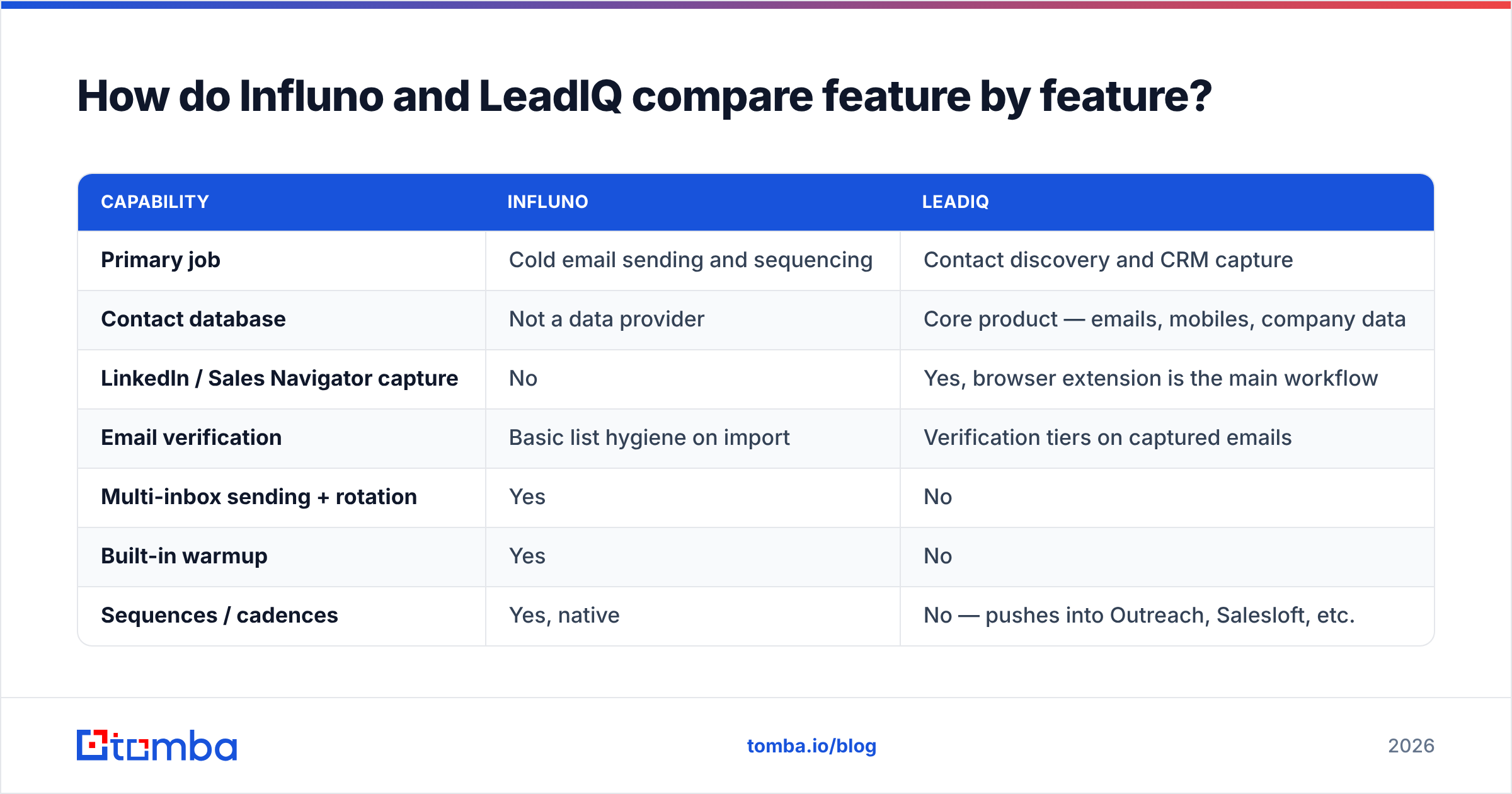
- Coverage in your ICP. A database with 500M contacts is irrelevant if it is thin on European mid-market manufacturing or US healthcare IT. Always run a sample of 50 real target accounts before signing. Vendors love aggregate numbers; you need hit rate on your list.
- Freshness. B2B contact data decays roughly 20–30% per year through job changes alone. A provider that refreshes on capture beats one that serves you a static snapshot from an eighteen-month-old crawl.
- Verification depth. There is a large gap between "this address matches the company pattern" and "an SMTP check confirmed the mailbox accepts mail." Pattern-guessed addresses inflate coverage stats and deflate your sender reputation.
- Catch-all handling. A growing share of B2B domains are catch-all, which means naive verification returns "valid" for everything. Whether a tool tells you honestly that it cannot confirm a catch-all address, or quietly marks it deliverable, changes your bounce rate materially.
- Credit economics. Per-seat credit pools that expire monthly behave very differently from pooled, rollover-friendly credits when your prospecting is bursty.
LeadIQ handles 1 through 3 well for LinkedIn-sourced prospecting, which is its native workflow. Where teams get surprised is 4 and 5 — catch-all domains and seat-bound credit pools. If a big slice of your target list sits on catch-all infrastructure, run those addresses through a dedicated catch-all verifier before they enter any sequence, regardless of which vendor sourced them.
If you want to check a provider's honesty cheaply, take 100 contacts it marked valid, push them through an independent email verifier, and compare. Two providers claiming 95% accuracy will not return the same answer on the same list. That test costs an afternoon and has saved teams entire quarters of burned domain reputation.
Which one is better for sending cold email at volume?#
Influno, clearly — LeadIQ does not send.
The features that matter at volume are unglamorous:
- Mailbox rotation. Spreading 500 daily sends across ten mailboxes at 50 each is survivable. Sending 500 from one mailbox is not. Influno handles the distribution automatically.
- Warmup that ramps. New domains need weeks of gradually increasing, engaged-looking volume before they can carry real campaigns. If you are planning a new sending domain, model the ramp with an email warmup calculator first so you do not schedule a campaign your domain cannot support yet.
- Authentication. SPF, DKIM, and DMARC are non-negotiable in 2026 — Google and Microsoft both enforce bulk-sender requirements that will silently route you to spam if alignment is broken. Run an SPF checker on every sending domain before the first send, not after the first bounce spike.
- Reply routing. Once you run ten mailboxes, replies scatter. A unified inbox is the difference between a 24-hour response and a lead going cold in a mailbox nobody checks.
LeadIQ's answer to all of this is "use Outreach or Salesloft," which is a fine answer if you already pay for one of those. If you do not, Influno is the cheaper way to close that gap — and worth weighing against other Instantly alternatives in the same bracket.
What do Influno and LeadIQ actually cost?#
Pricing on both moves, and both publish less than they used to. Treat the shape below as the thing to verify on their own pages rather than a quote.
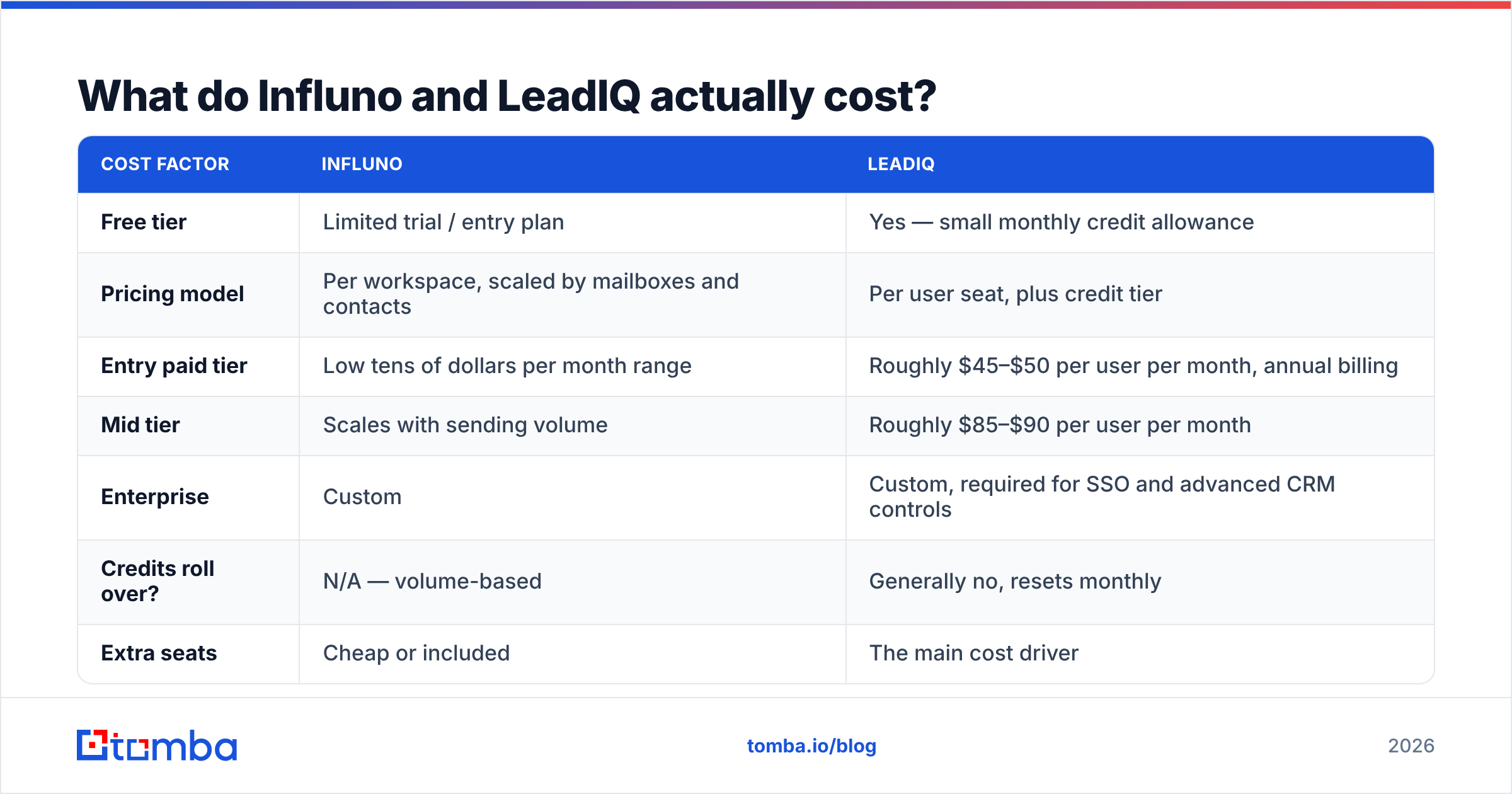
| Cost factor | Influno | LeadIQ |
|---|---|---|
| Free tier | Limited trial / entry plan | Yes — small monthly credit allowance |
| Pricing model | Per workspace, scaled by mailboxes and contacts | Per user seat, plus credit tier |
| Entry paid tier | Low tens of dollars per month range | Roughly $45–$50 per user per month, annual billing |
| Mid tier | Scales with sending volume | Roughly $85–$90 per user per month |
| Enterprise | Custom | Custom, required for SSO and advanced CRM controls |
| Credits roll over? | N/A — volume-based | Generally no, resets monthly |
| Extra seats | Cheap or included | The main cost driver |
| Contract | Monthly available | Annual pushed hard |
The structural difference matters more than the headline numbers. Influno charges by volume. LeadIQ charges by person. A five-rep team where only two do heavy prospecting pays LeadIQ for five seats anyway, or juggles logins in a way most contracts prohibit.
Before you commit, do the arithmetic that vendors never put on the pricing page: divide your annual contract by the number of verified, in-ICP contacts you actually expect to use. Teams routinely discover they are paying $2–$4 per usable contact when the market rate for verified email lookups is a fraction of that. For reference, Tomba pricing runs a free tier at 25 searches per month, Starter at $49/mo, Growth at $99/mo, and Pro at $249/mo — with searches pooled across the workspace rather than locked to a seat.

Where do both tools leave a gap?#
Four gaps show up repeatedly in teams running either product.
- Bulk, non-LinkedIn sourcing. LeadIQ is superb one prospect at a time inside a browser. When you need every marketing contact at 400 companies from a conference exhibitor list, the extension workflow is the wrong shape. That is a job for domain search or a bulk email finder run against a domain list.
- Independent verification. Never let the tool that sold you the address be the only judge of whether it is valid. A second, neutral verification pass is the cheapest deliverability insurance there is.
- Programmatic access. If you are enriching signups in-app or building an internal routing system, you need a real API with sane rate limits, not a browser extension. Check whether the plan you are quoted actually includes API access — on many data tools it is an enterprise-only unlock.
- Catch-all and role-account hygiene.
info@,sales@, andcontact@addresses inflate list size and tank reply rates. Strip them before they reach a sequence.
Independent review corpora on G2 are useful here, but read the one- and two-star reviews specifically — they cluster around contract terms, credit expiry, and coverage gaps in non-US regions, which is exactly what a demo will not show you.
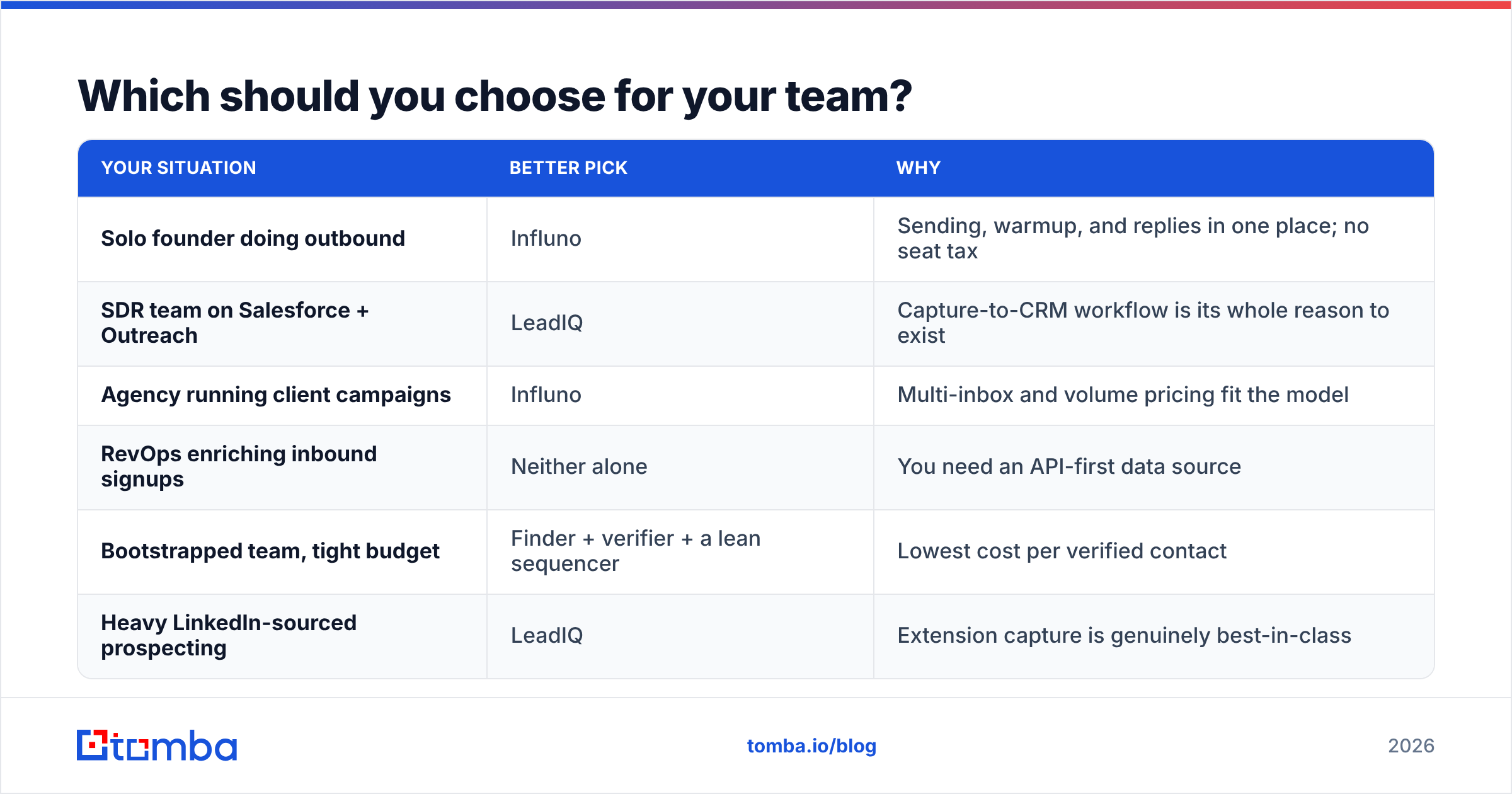
Which should you choose for your team?#
| Your situation | Better pick | Why |
|---|---|---|
| Solo founder doing outbound | Influno | Sending, warmup, and replies in one place; no seat tax |
| SDR team on Salesforce + Outreach | LeadIQ | Capture-to-CRM workflow is its whole reason to exist |
| Agency running client campaigns | Influno | Multi-inbox and volume pricing fit the model |
| RevOps enriching inbound signups | Neither alone | You need an API-first data source |
| Bootstrapped team, tight budget | Finder + verifier + a lean sequencer | Lowest cost per verified contact |
| Heavy LinkedIn-sourced prospecting | LeadIQ | Extension capture is genuinely best-in-class |
The pattern in that table: neither product is a full stack. The common winning configuration is a data layer, a verification layer, and a sending layer — chosen separately, on their own merits, so that replacing one does not mean rebuilding all three.
How do you test either one honestly in a week?#
Run the same five-step evaluation against both, with the same list:
- Day 1. Build a 100-contact target list from your real ICP — not a list the vendor suggests.
- Day 2. Run it through each tool's sourcing or import path. Record hit rate, not just total returned.
- Day 3. Push every returned address through an independent verifier. Record the delta between vendor-claimed valid and independently confirmed valid.
- Day 4. Check authentication on your sending domain and send a 20-contact test batch. Watch bounce rate and inbox placement, not open rate — open tracking is unreliable since Apple Mail Privacy Protection.
- Day 5. Price the annual contract per confirmed-valid contact. Compare.
Whichever tool survives that week deserves your money. Whichever one relies on you not running it does not.
Verdict: which wins?#
For contact data sourced from LinkedIn into a Salesforce-centric stack, LeadIQ is the stronger product and the easier sell to a working SDR team. For actually sending cold email at volume without wrecking your domain, Influno does a job LeadIQ has never claimed to do. Both are legitimate, and both are respected in their lanes — the mistake is buying one expecting it to cover the other.
What neither gives you is a cheap, API-first, per-lookup source of verified professional emails that your whole team shares without paying per seat. That is the layer worth owning independently, because it outlives every sequencer you will switch between.
Start with the data. Try the Tomba Email Finder free — 25 searches a month, no card, no seat minimums — and run it head to head against whatever LeadIQ or your current provider returns on the same 100 accounts. If the verified hit rate is higher and the cost per usable contact is lower, you have just removed the most expensive line item in your outbound stack. If it is not, you have lost an afternoon and gained a benchmark. Either way you stop guessing.
Related guides#
// get started
Find, verify and enrich your first contacts today
Start on the free plan with 25 searches a month, then scale when your team is ready.
Free plan · No credit card required · GDPR & CCPA
// about the author