Influno vs Tomba (2026): Which Tool Fits Your Outreach?
Influno sends the emails. Tomba finds and verifies the addresses you send to. Here is an honest, category-by-category breakdown of where each tool wins, what each one costs, and which to buy first.
TL;DR
- Influno and Tomba are not really competitors. Influno is a cold email sending platform (inboxes, sequences, warmup, replies). Tomba is a data platform (find, verify, and enrich the addresses you send to).
- If your emails are bouncing, your problem is data, and a sending tool will not fix it. Start with verification.
- If you already have clean data and no way to send at volume, a sequencer like Influno is the missing piece.
- Tomba's entry point is a free tier at 25 searches/month, then $49/mo (Starter), $99/mo (Growth), and $249/mo (Pro). Influno prices around inboxes and sending volume, so always check their current plans directly.
- Most teams under 20 reps end up running both: Tomba (or a similar data layer) feeding a sequencer, connected through the API or a CSV.
What are Influno and Tomba, exactly?#
Start with the honest framing, because most "Influno vs Tomba" comparisons pretend these tools do the same job. They do not.
Influno is an outbound email platform. Its center of gravity is the send: connecting mailboxes, warming them up, building multi-step sequences, rotating inboxes so no single domain gets hammered, and tracking opens, clicks, and replies. Like most modern sending tools, it bundles some contact-finding features so you do not have to leave the app to build a list.
Tomba is a B2B contact data platform. Its center of gravity is the address: an email finder that resolves a name plus a domain into a real mailbox, an email verifier that tells you whether that mailbox will accept mail, domain search for pulling every discoverable contact at a company, plus phone lookup, catch-all handling, and enrichment. Tomba does not send campaigns.
So the real question is not "which tool is better." It is which layer of your outbound stack is currently broken, and which of these two fixes it.
How do Influno and Tomba actually differ?#
Six differences matter more than the rest:
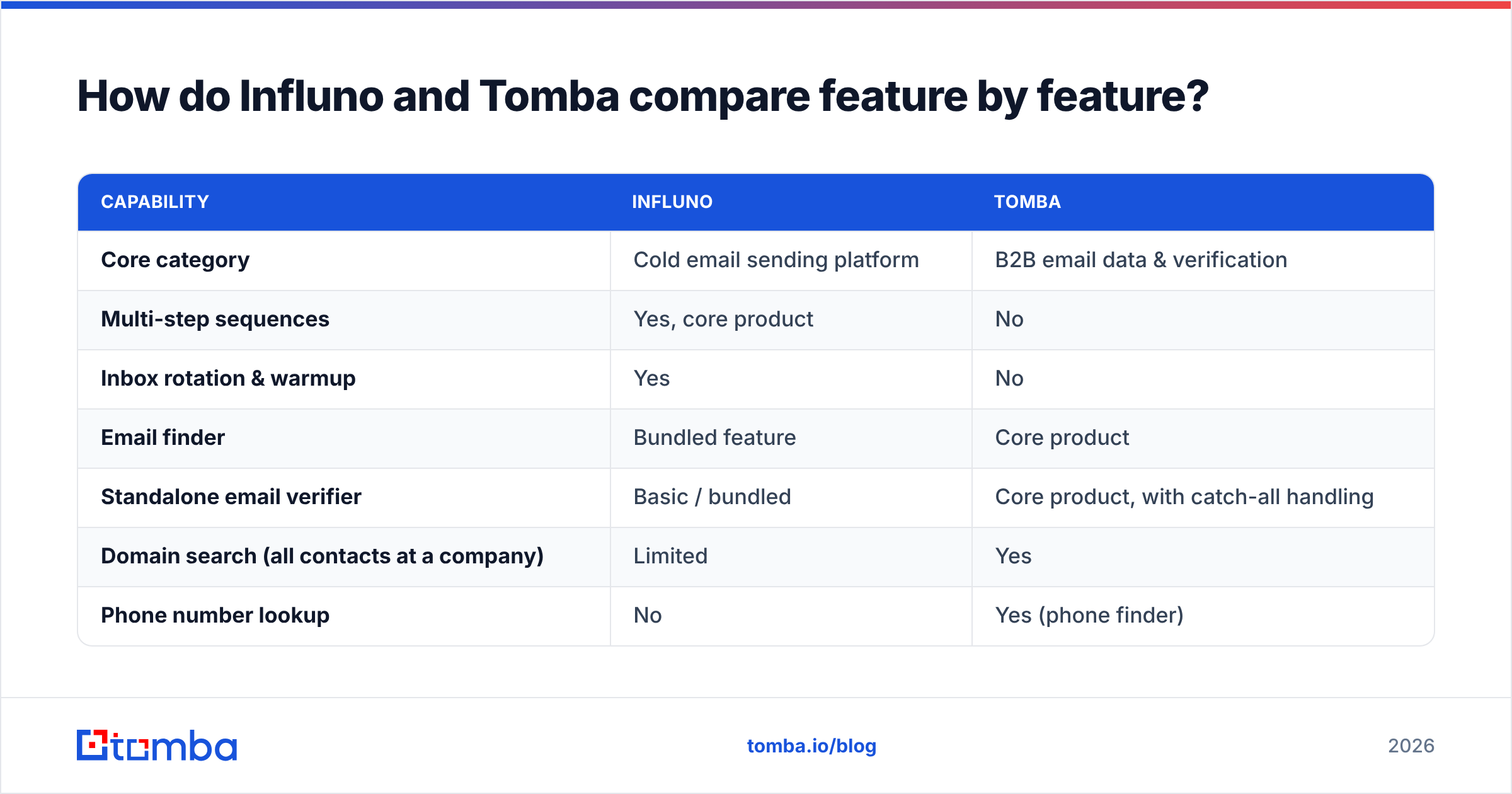
- Primary job. Influno moves messages out of mailboxes at scale. Tomba decides which mailboxes are worth writing to in the first place.
- What you pay for. Sending platforms price on connected inboxes, contacts, or emails sent per month. Data platforms price on credits (one lookup or one verification = one credit). These are different cost curves, and they scale differently as you grow.
- Where failure shows up. A weak sending tool produces spam-folder placement and clunky sequence logic. A weak data source produces hard bounces, which then wreck the sending tool's reputation. Data failures cascade; sending failures usually do not.
- Bundled vs specialized data. Almost every sequencer ships a bundled contact database. Those databases are convenient and usually fine for well-known mid-market accounts. They tend to thin out fast on small companies, non-US domains, and anything outside tech.
- Developer surface. Tomba exposes a Tomba API, a CLI, an MCP server, a Chrome extension, and Sheets/Excel add-ins, which matters if you are building enrichment into your own product or RevOps workflow. Sending platforms typically expose an API for pushing leads into campaigns, which is a narrower surface.
- Compliance posture. Sending tools carry the deliverability and unsubscribe burden. Data tools carry the sourcing and suppression burden. You need both handled, and they are handled in different places.

Which one has better email data?#
This is where the comparison gets concrete, and where a lot of teams pick wrong.
A bundled database inside a sending tool exists to reduce friction. It is a feature, not the product. That means the vendor's engineering budget goes into sequence builders, inbox rotation, and reply detection, because that is what people churn over. Dedicated data vendors spend that same budget on crawl coverage, pattern inference, SMTP verification, and catch-all handling.
The practical consequences:
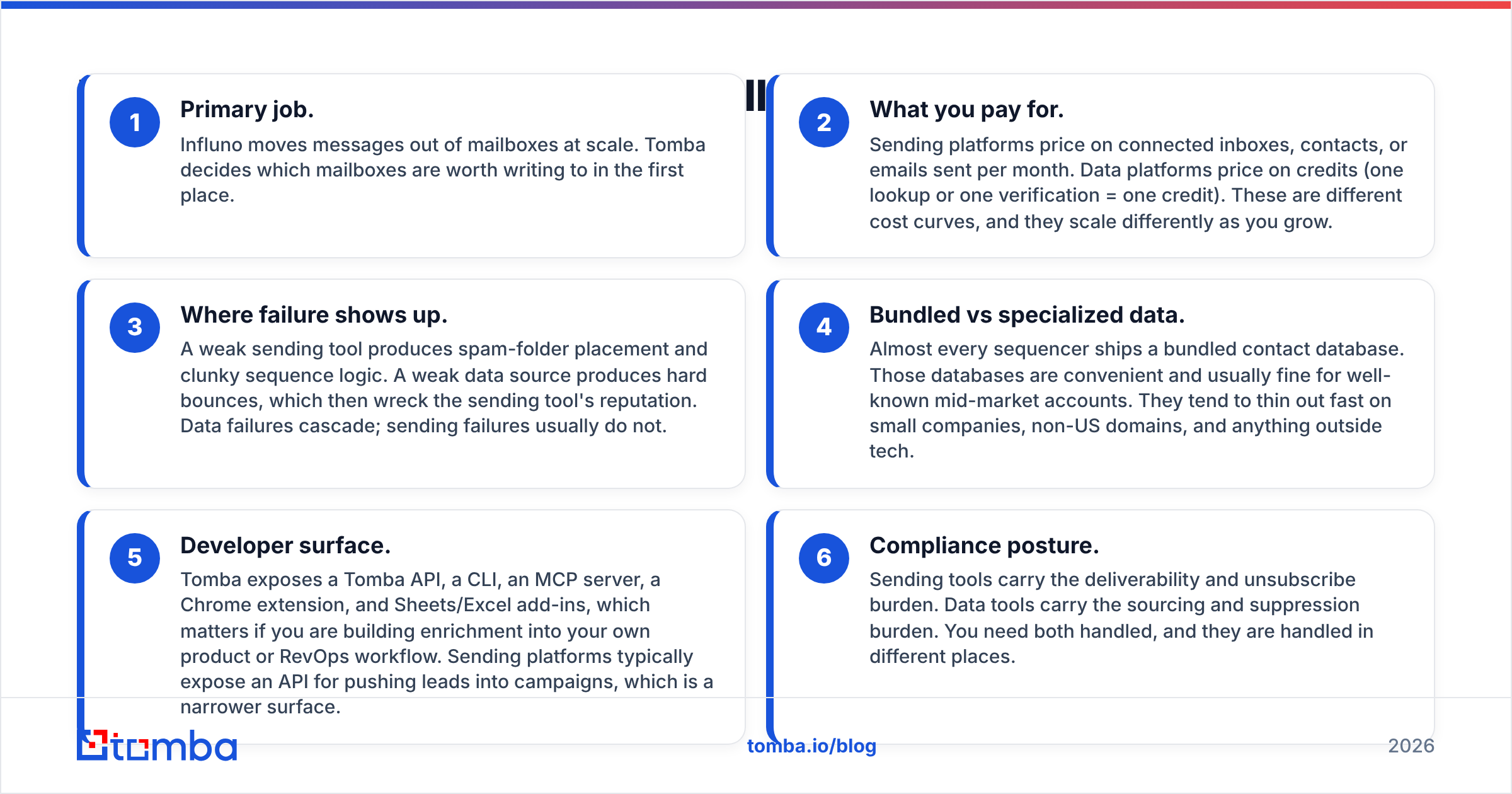
- Coverage on long-tail domains. Ask both for contacts at a 14-person manufacturer in Portugal. Bundled databases frequently return nothing; a domain-search-first tool will at least return the company's email pattern so you can construct and verify candidates.
- Verification depth. "Valid format" is not verification. Real verification runs MX checks, SMTP probing where possible, role-account detection, disposable-domain detection, and an explicit judgement on catch-all servers. A catch-all verifier matters because roughly a third of B2B domains accept everything at the SMTP layer and tell you nothing useful.
- Freshness. People change jobs constantly. A data vendor's whole reason to exist is re-crawling and re-scoring; a sequencer's bundled list is often a licensed snapshot.
- Auditability. You should be able to ask where a record came from. Tomba publishes its data sources, and that transparency is worth more than a vague accuracy percentage on a landing page.
None of this makes Influno's bundled finder useless. If you sell to US SaaS companies with 50 to 500 employees, bundled data will cover a large share of your ICP and save you a tool. It is when your ICP gets specific that the gap opens up.
How do Influno and Tomba compare feature by feature?#
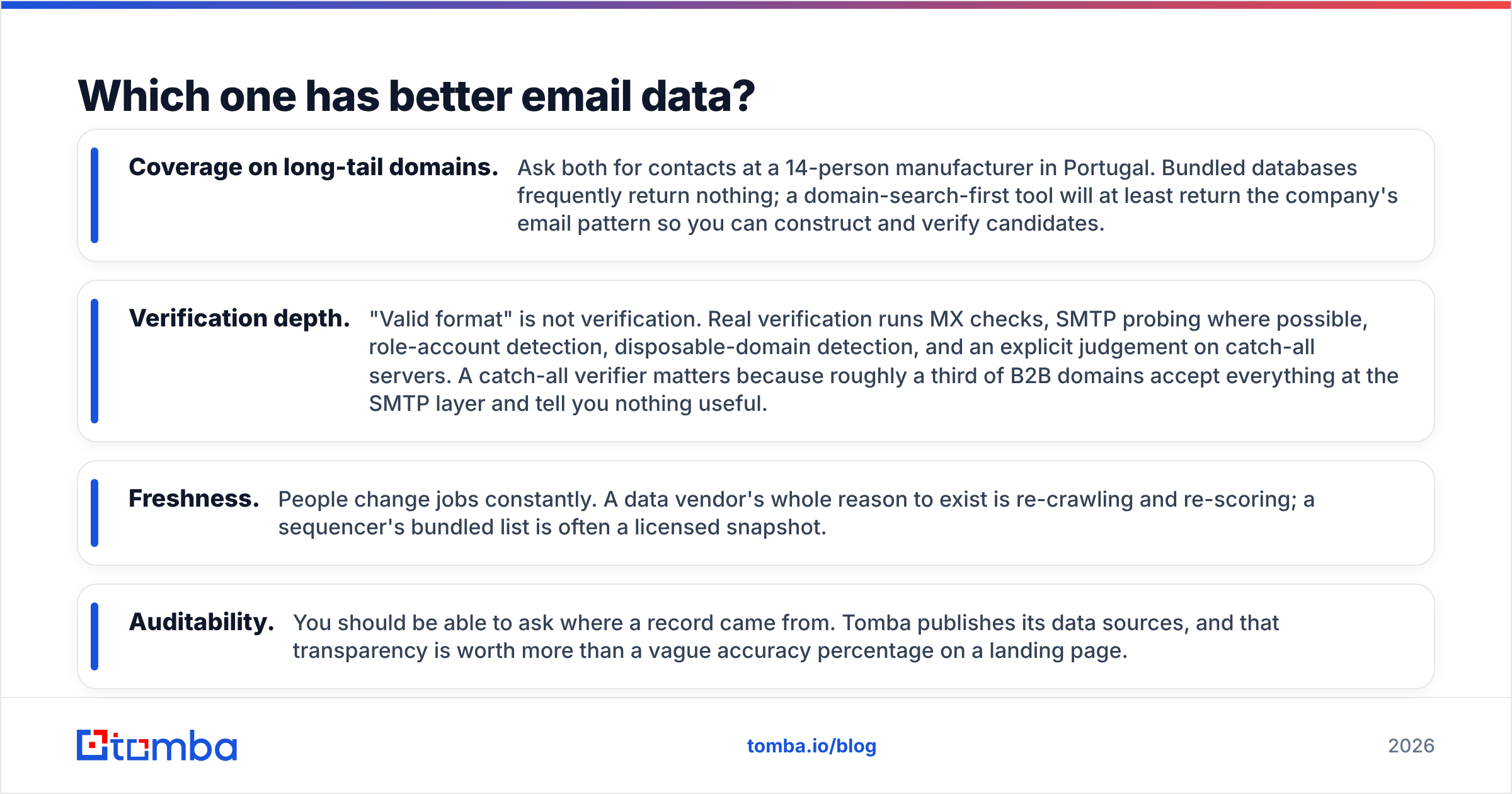
| Capability | Influno | Tomba |
|---|---|---|
| Core category | Cold email sending platform | B2B email data & verification |
| Multi-step sequences | Yes, core product | No |
| Inbox rotation & warmup | Yes | No |
| Email finder | Bundled feature | Core product |
| Standalone email verifier | Basic / bundled | Core product, with catch-all handling |
| Domain search (all contacts at a company) | Limited | Yes |
| Phone number lookup | No | Yes (phone finder) |
| Public API for enrichment | Campaign-oriented | Full find/verify/enrich API, CLI, MCP |
| Spreadsheet add-ins | Limited | Google Sheets, Excel, Airtable |
| Free tier | Trial-based, check current terms | 25 searches/month, no card |
| Typical buyer | SDR team that needs to send | RevOps, growth, developers, agencies |
| Pricing model | Per inbox / per sending volume | Per credit, tiered |
Two notes on reading this table honestly. First, Influno's sending column is genuinely strong ground that Tomba does not contest at all. Second, "limited" is not "bad." It reflects where a vendor chose to invest.
Always confirm current plan details on the vendor's own site before you buy. Sending platforms restructure pricing often, and third-party review aggregators like G2 lag behind real pricing pages by months.
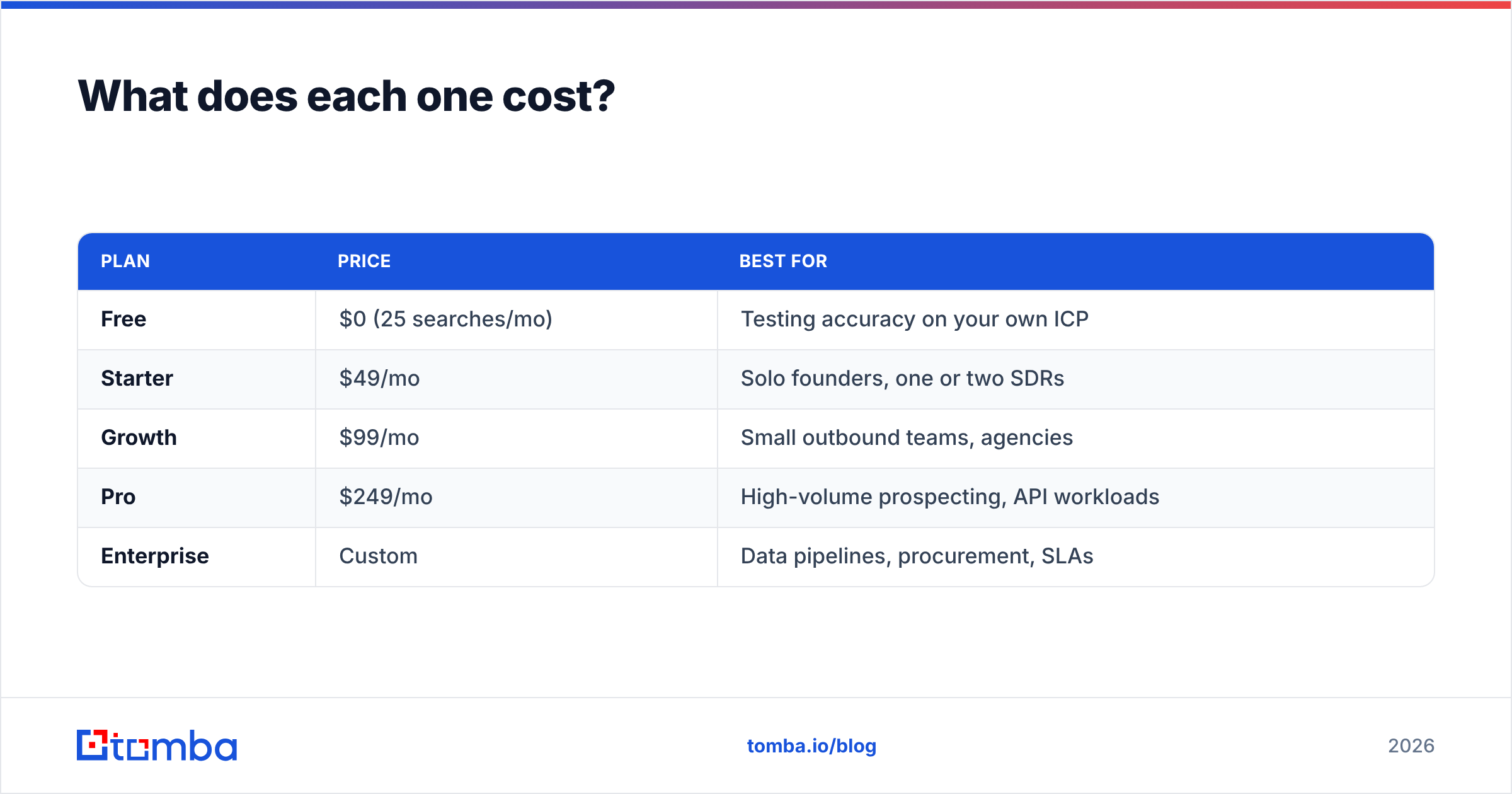
What does each one cost?#
Tomba's pricing is public and easy to model:
| Plan | Price | Best for |
|---|---|---|
| Free | $0 (25 searches/mo) | Testing accuracy on your own ICP |
| Starter | $49/mo | Solo founders, one or two SDRs |
| Growth | $99/mo | Small outbound teams, agencies |
| Pro | $249/mo | High-volume prospecting, API workloads |
| Enterprise | Custom | Data pipelines, procurement, SLAs |
Full details are on the Tomba pricing page.
Influno, like most sending platforms, prices around how much you send and how many mailboxes you connect. That model is fine, but it creates a budgeting trap: sending capacity is cheap to add, data quality is not, and teams routinely buy more sending seats while starving the data layer that feeds them. You end up with the ability to send 40,000 emails a month against a list that can only support 8,000 good ones.
Run the math the other way. Decide how many verified contacts your ICP actually contains per month, then buy exactly the sending capacity that number justifies.
Is Influno better than Tomba for cold outreach?#
For the act of sending cold email, yes. That is not a concession, it is a category definition. Tomba does not build sequences, does not rotate inboxes, and does not warm domains. If you evaluate "Influno vs Tomba" purely on outbound execution, Influno is the only one of the two in the running.
For everything upstream of the send, the answer flips. Your email deliverability is determined more by who you email than by which tool emails them. Google's own sender guidelines are explicit that spam complaints and invalid recipients drive filtering decisions, and every major mailbox provider treats a high hard-bounce rate as a reputation signal. You can run a flawless warmup schedule inside any sending platform and still land in spam if 18% of your list does not exist.
That is the honest verdict: the sending tool determines how well a good list performs, and the data tool determines whether you have a good list at all.
Which should you pick for your use case?#
Pick Influno (or any sequencer) first if:
- You already have a validated list you trust, from a partner, an event, or an existing CRM export.
- You are sending from one or two mailboxes and manual sending is now the bottleneck.
- Your bounce rate is already under 3% and replies are the constraint, not deliverability.
Pick Tomba first if:
- Your bounces are above 4% and your open rates dropped without a copy change.
- Your ICP includes small companies, non-US domains, or non-tech industries where bundled databases go thin.
- You need contacts inside a workflow rather than a campaign: enriching CRM records, cleaning a purchased list, or powering a product feature through the API.
- You are running an agency and need to prove list quality to clients before a single email goes out.
Pick both if: you are a real outbound team. That is the normal end state, and it is not an upsell. The data layer and the sending layer are separately optimizable, and keeping them separate means you can swap either one without rebuilding the other.
Can you use Influno and Tomba together?#
Yes, and it is the configuration most teams converge on. Three practical patterns:
- Batch pipeline. Build the target account list, run it through bulk find and verify, export only the addresses marked valid, and import that file into your sequencer. Simple, no engineering required.
- CRM-mediated. Enrich contacts in HubSpot or Salesforce first, then let the sending platform pull from a filtered CRM view. This keeps one source of truth and prevents the same person getting sequenced twice by two reps. HubSpot's own CRM documentation covers the list-based sync patterns for this.
- API-mediated. Call the email finder and verifier at the moment a lead enters your system, gate on the verification status, and only create the sequence enrollment for verified records. This is the cleanest version and the one that scales past a few thousand contacts a month.
A rule worth enforcing regardless of tooling: no address enters a sequence without a verification status attached to it. Make it a required field. It costs almost nothing and it protects the asset that actually matters, which is your sending domain's reputation.
What about switching costs?#
Switching sending platforms is disruptive. You re-point mailboxes, re-warm domains, rebuild sequences, and lose historical reply data. Budget a couple of weeks.
Switching data providers is nearly free. Credits are credits. You point a different API at the same workflow and compare hit rates on the same 200 contacts. This asymmetry is a reason to be picky about your sequencer and experimental about your data source. Test a data vendor on your real ICP for a week before committing; Tomba's free tier exists for exactly that, and 25 searches is enough to see whether a vendor covers your segment or not.
If you are evaluating other names in the same breath, it is also worth reading through the Apollo alternative and Findymail alternative breakdowns, since those tools sit on the same data-versus-sending boundary and the trade-offs rhyme.
The bottom line#
Influno vs Tomba is a false fight. Influno is the delivery mechanism; Tomba is the ammunition. Teams that buy the delivery mechanism first and starve the data layer end up with excellent sequences aimed at addresses that bounce, and a burned domain to show for it.
Fix the data first. Then send.
Start with the Tomba Email Finder on the free tier: run 25 lookups against the exact accounts in your ICP, verify them, and look at the hit rate before you spend anything. If the coverage holds on your segment, plug it into whatever sending platform you prefer through the API, the Sheets add-on, or a plain CSV, and let your sequencer do the one job it is genuinely good at.
Related guides#
// get started
Find, verify and enrich your first contacts today
Start on the free plan with 25 searches a month, then scale when your team is ready.
Free plan · No credit card required · GDPR & CCPA
// about the author