Infofree vs Apollo.io: Which B2B Lead Database Wins in 2026?
One sells unlimited SMB lists for a flat fee. The other sells a 200M+ contact sales engine per seat. Here is how Infofree and Apollo.io actually compare on data freshness, email accuracy, pricing, and who each one is really built for.
Infofree vs Apollo.io is a choice between two very different tools. One sells flat-fee lists of small local firms. The other sells a full sales engine, priced per seat. Here is how they compare on data, price, and channel fit.
TL;DR
- Infofree is a flat-fee list product for small business data. You pay one monthly price and pull as many lists as you like. You get firm details, mailing addresses, and phone numbers — not verified work emails at scale.
- Apollo.io is a per-seat sales platform with 200M+ contacts, sequences, a dialer, and intent signals. It is better for modern outbound. It also costs far more once you add seats.
- The call is rarely about features. It is about channel. Infofree suits phone and direct mail to local firms. Apollo suits email outbound to tech and mid-market buyers.
- Both share one weakness: email accuracy on the long tail. Neither checks an address at send time. Both will hand you emails that died a year ago.
- If cold email is your main channel, split the job. Use a database to find people, then a dedicated email finder and verifier for the last mile.
What are Infofree and Apollo.io, really?#
They are not the same kind of product. That is the first thing most comparison posts get wrong.
Infofree sells compiled business and consumer lists. The data traces back to the infoUSA and Data Axle school of list building. You get about 14 million U.S. firms and 200+ million consumers. You can filter by SIC code, revenue, staff count, area, and credit rating. It bundles a light CRM and a mobile app for field reps. The pitch is volume at a fixed price, with no credit meter.
Apollo.io sells a go-to-market platform. The database is the front door — 200M+ contacts and 35M+ companies at the time of writing. The real product is the workflow around it: a Chrome extension, LinkedIn lookups, email sequences, a dialer, meeting booking, basic intent data, and CRM sync. You pay per user, per month.
Here is the practical split:
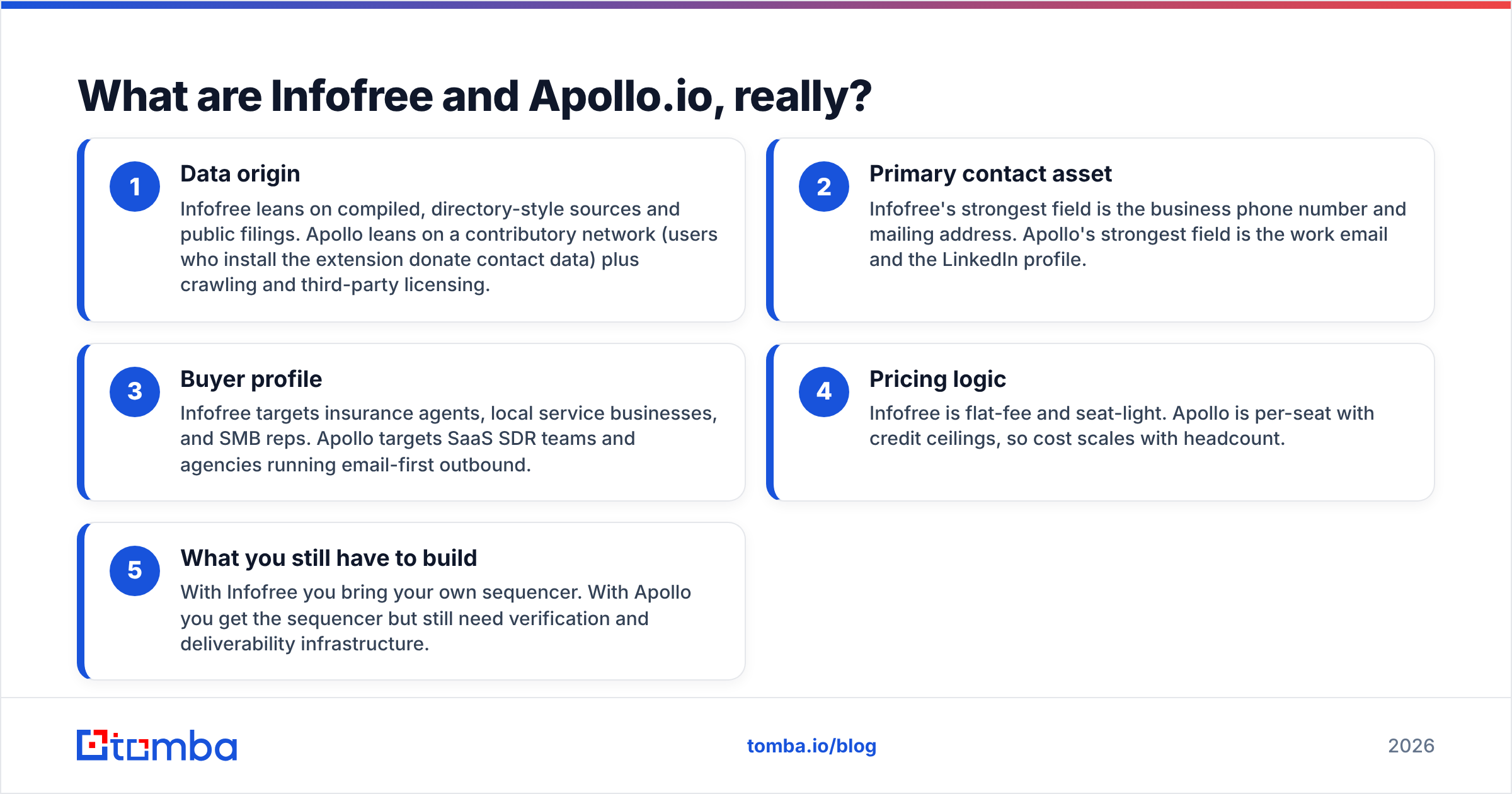
- Data origin — Infofree leans on compiled directories and public filings. Apollo leans on its own users, who install the extension and share contact data. Apollo also crawls the web and licenses third-party files.
- Best contact field — Infofree is strongest on business phone and mailing address. Apollo is strongest on work email and LinkedIn profile.
- Buyer profile — Infofree suits insurance agents, local service firms, and SMB reps. Apollo suits SaaS sales teams and agencies that lead with email.
- Pricing logic — Infofree is flat-fee and seat-light. Apollo charges per seat and caps credits, so cost grows with headcount.
- What you still build — With Infofree you bring your own sequencer. With Apollo you get one, but you still need email checks and deliverability work.

Infofree vs Apollo.io: a feature-by-feature comparison#

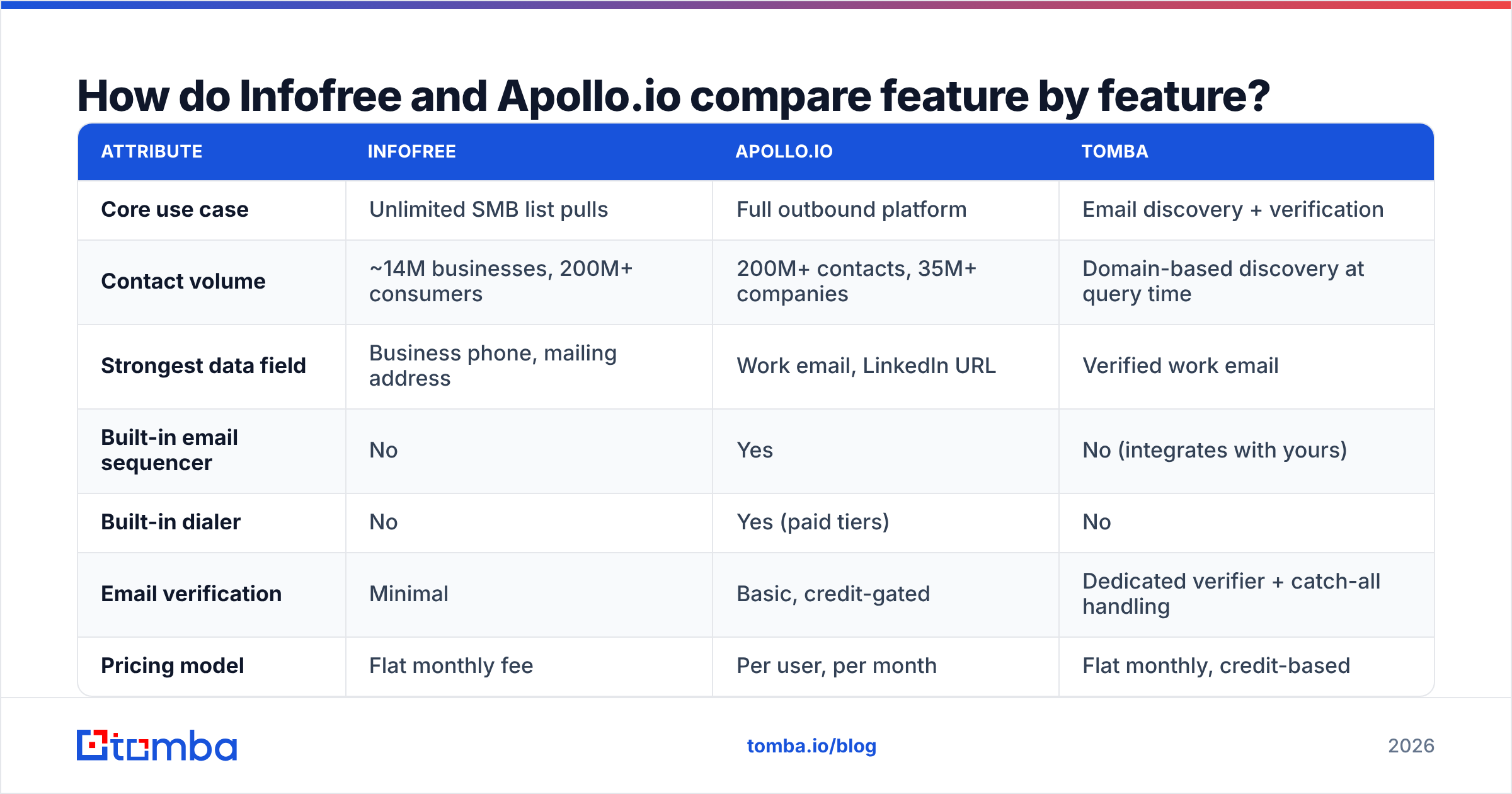
| Attribute | Infofree | Apollo.io | Tomba |
|---|---|---|---|
| Core use case | Unlimited SMB list pulls | Full outbound platform | Email discovery + verification |
| Contact volume | ~14M businesses, 200M+ consumers | 200M+ contacts, 35M+ companies | Domain-based discovery at query time |
| Strongest data field | Business phone, mailing address | Work email, LinkedIn URL | Verified work email |
| Built-in email sequencer | No | Yes | No (integrates with yours) |
| Built-in dialer | No | Yes (paid tiers) | No |
| Email verification | Minimal | Basic, credit-gated | Dedicated verifier + catch-all handling |
| Pricing model | Flat monthly fee | Per user, per month | Flat monthly, credit-based |
| Entry price (list, at time of writing) | ~$99/mo unlimited leads | Free tier, then ~$49/user/mo annual | Free (25 searches/mo), then $49/mo |
| Best channel fit | Phone, direct mail, local | Email + multichannel, mid-market | Email, any vertical |
| API access | Limited | Yes, on higher tiers | Yes, on all paid plans |
Read that table as three different jobs, not three rivals. Infofree wins on cost per record if you call local firms. Apollo wins by putting the whole workflow in one place. A dedicated finder and verifier wins on the one number that decides whether cold email works at all: will the address accept mail today?
Which one has more accurate data?#
Neither is reliable on work email, and you should plan for that.
Compiled lists like Infofree's decay fastest on the person layer. A phone number for a 12-person HVAC firm stays good for years. The name of the office manager does not. Reviews on G2 flag stale contact names and dead direct lines as Infofree's weak spot. The same reviews praise the flat price and the coverage of small local firms that Apollo never indexes.
Apollo fails the other way round. Coverage of tech and mid-market firms is strong. If your ICP is a Series B SaaS firm in North America, Apollo will find the VP of Engineering. But a record is only as fresh as the last time someone with the extension opened that profile. Contacts at firms nobody prospects go stale in silence. Apollo does run its own checks, and that is not the same as an SMTP check at the moment you export.

Here is the honest framing. Expect a real share of any bulk export to bounce, from either tool. Teams that skip a check before they load a list into a sequencer are the ones who post 20% bounce rates. Then they wonder why their domain got throttled.
So the last mile matters more than the database. Run each export through a dedicated email verifier before it touches your sending domain. It is the cheapest insurance in outbound. It costs less than a seat, and it protects your sender reputation, which takes months to rebuild.
Infofree vs Apollo.io pricing: what does each one cost?#
Pricing pages move. Treat these as shapes rather than quotes, and confirm on the vendor sites.
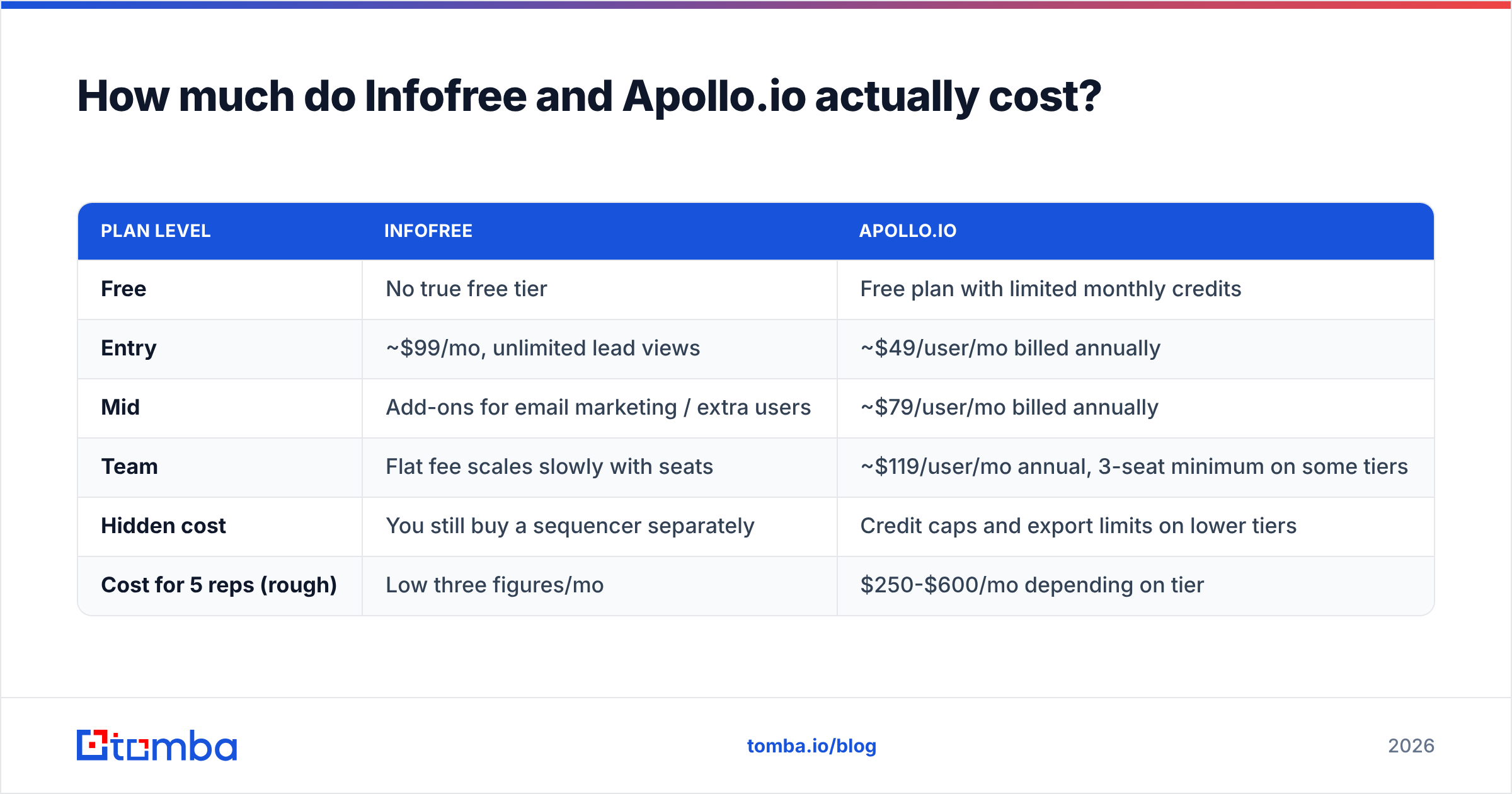
| Plan level | Infofree | Apollo.io |
|---|---|---|
| Free | No true free tier | Free plan with limited monthly credits |
| Entry | ~$99/mo, unlimited lead views | ~$49/user/mo billed annually |
| Mid | Add-ons for email marketing / extra users | ~$79/user/mo billed annually |
| Team | Flat fee scales slowly with seats | ~$119/user/mo annual, 3-seat minimum on some tiers |
| Hidden cost | You still buy a sequencer separately | Credit caps and export limits on lower tiers |
| Cost for 5 reps (rough) | Low three figures/mo | $250-$600/mo depending on tier |
The math flips with team size. One rep calling local firms? Infofree is far cheaper, and there is no real argument the other way. Five reps running email sequences? Apollo folds three tools into one bill, and the per-seat cost stops looking absurd.
The credit ceiling on Apollo's lower tiers is what catches teams out. The site says 200M contacts. Your plan says how many you may export each month. Mobile number credits are metered on their own. Teams budget for seats, then learn mid-quarter that the export cap is the real limit.

Who should choose Infofree?#
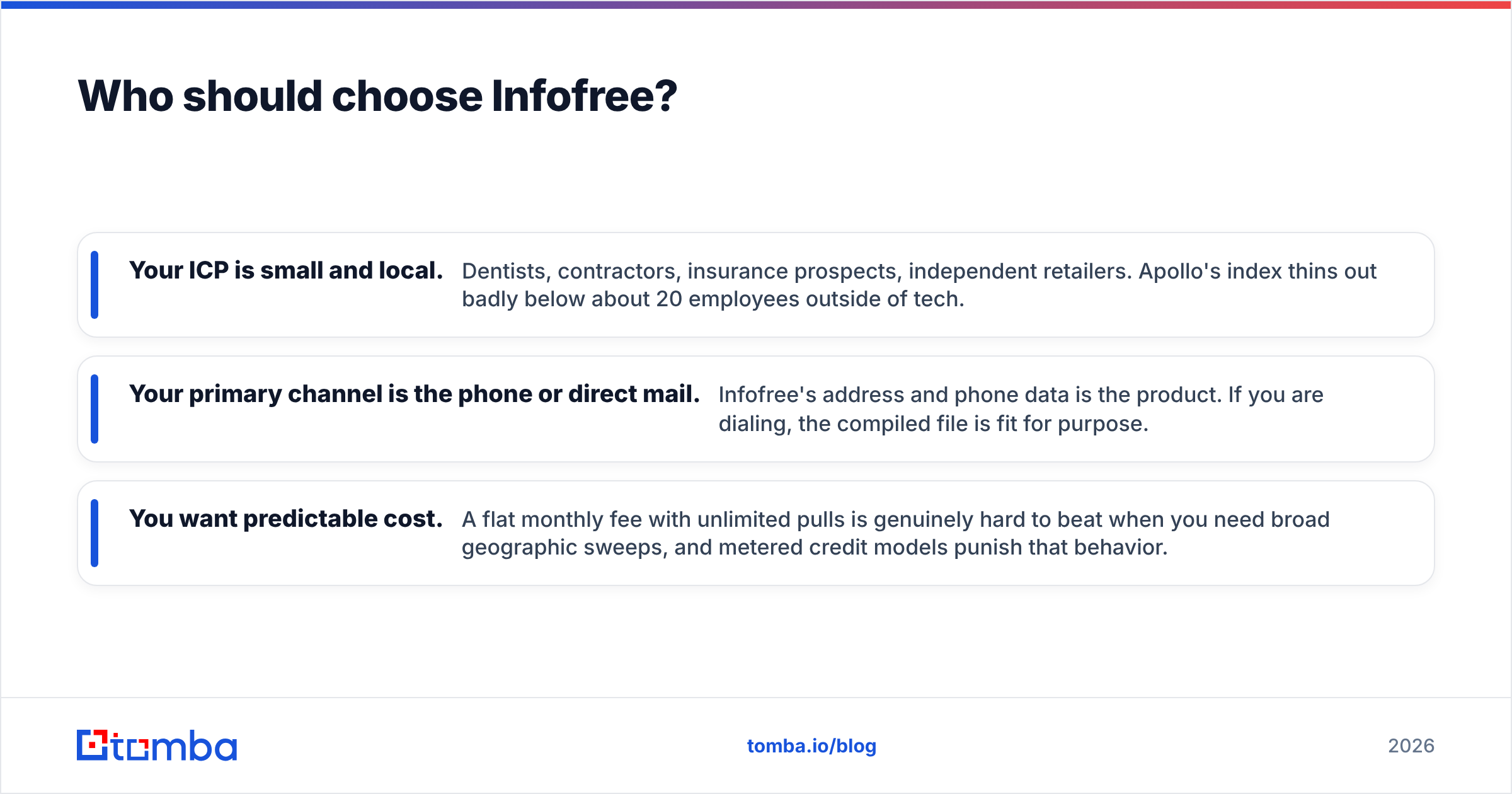
Pick Infofree if three things are true:
- Your buyers are small and local. Dentists, contractors, insurance prospects, independent shops. Apollo's index thins out fast below about 20 staff outside tech.
- You sell by phone or direct mail. Infofree's address and phone data is the product. If you dial, the compiled file does the job.
- You want a price you can predict. A flat monthly fee with unlimited pulls is hard to beat for broad sweeps by area, and credit models punish that habit.
Do not pick Infofree if you plan to cold email the exports raw. The person-level data is not built for that, and neither is the bundled email tool. Go this route and you should budget for bulk verification every month, not once.
Who should choose Apollo.io?#
Pick Apollo if you run email-led outbound into firms with a real web footprint.
The one-tool argument holds up. Finding, sequencing, dialing, and CRM sync live in one place, which removes three integrations and three vendor relationships. For a 3-10 person sales team selling software, that is worth the per-seat premium. The Chrome extension and LinkedIn flow are good too, and most rivals copy them.
Apollo frustrates people in other ways. Exports get gated. The "unlimited email credits" line has carried asterisks by tier and billing term. Support on the lower tiers is thin. Teams that outgrow it tend to split the stack again — one database, one sequencer, one verifier — because each part gets better and the total often costs less. If you are near that point, read an Apollo alternative breakdown before you renew for a year.
What do you still have to solve after picking either one?#
Both tools leave the same three gaps.
A check at send time. A database row is a claim about the past. An SMTP check is a claim about now. Catch-all domains muddy this further. A catch-all accepts every address at the server, so a naive tool marks it valid and you learn the truth from a bounce. A proper catch-all verifier leans on pattern confidence and other signals instead.
Coverage on the long tail. Every database has holes. When a record comes back empty you need a backup. That backup is pattern-based lookup against the company domain, which is what domain search does. Guessing first.last@ is not a plan. Reading the pattern from known addresses at that domain is.
The records you already own. Most teams hold thousands of half-empty CRM rows that predate any tool they bought. Neither Infofree nor Apollo cleans an old file well. A purpose-built data enrichment pass does.
One more note for completeness. Maybe you want a one-time list rather than a subscription. Then a pay-per-record provider like BookYourData fits a different and fair niche. That model suits teams who need 5,000 good contacts once, not a seat license forever.
Is there a simpler stack than either platform?#
For email-first teams, usually yes.
The pattern that holds up splits the job in four. Use a database to decide who to contact. Use a finder to get the address. Use a verifier to check it will land. Use a sequencer you like to send. Each part is easy to swap, so no single vendor owns your pipeline at renewal.
That stack also costs less than most people expect. A $49/mo finder and verifier plus a $30-50/mo sequencer beats a three-seat Apollo contract. You also keep the right to swap any piece when a better one ships. Compare it against Tomba pricing and the math is plain. The free tier gives 25 searches a month, enough to test accuracy on your own ICP before you spend a cent.
Run this test before you commit to either platform. Take 50 contacts you know are correct. Hide them from the tool. See what each vendor returns. Measure match rate and accuracy, not database size. Every headline contact count is marketing. Your match rate on your ICP is the only number that pays.
The verdict#
Infofree vs Apollo.io comes down to your channel. Pick Infofree if you dial local SMBs and want a flat fee. Pick Apollo if you run email sequences into tech and mid-market accounts and want one platform. Pick neither if email accuracy is your bottleneck, because that is a finder and verifier problem, not a database problem.
If cold email drives your pipeline, start with the layer that decides whether the rest works. Try the Tomba Email Finder — free for 25 searches a month, no card required. Point it at the same 50 contacts you test Infofree and Apollo with. Compare the match rates yourself. Let the numbers pick your stack, not a pricing page.
Related guides#
// get started
Find, verify and enrich your first contacts today
Start on the free plan with 25 searches a month, then scale when your team is ready.
Free plan · No credit card required · GDPR & CCPA
// about the author