7 Best Innovative Marketing Pro Alternatives for B2B Data in 2026
Shopping for Innovative Marketing Pro alternatives? Here are seven B2B contact-data tools compared on accuracy, verification, pricing model and bounce risk — plus a 30-day test plan you can run before you commit budget.
TL;DR
- Most teams leave a bulk marketing-list vendor for one of three reasons: unclear pricing, unverifiable data, or bounce rates that wreck a sending domain.
- The strongest replacements split into two camps — pay-per-record list providers (BookYourData, Cognism, ZoomInfo) and on-demand lookup APIs (Tomba, Apollo, RocketReach, Lusha).
- If your motion is targeted outbound rather than mass email blasts, an on-demand finder plus verification almost always costs less per booked meeting.
- Tomba starts free (25 searches/month) and moves to $49/month, with verification, catch-all checks and an API on the same credit pool.
- Don't switch on a demo. Run the 200-contact bake-off in the last section — it takes an afternoon and settles the argument with data.
What is Innovative Marketing Pro?#
Innovative Marketing Pro is marketed as a B2B marketing data and email-list service — the category of vendor that sells access to contact records so you can run outbound email, direct mail or paid audience matching.
One honest caveat before anything else: this class of vendor rarely publishes a standard pricing page, a documented data-refresh cadence, or a public accuracy guarantee. Quotes arrive by email, list sizes are negotiated, and terms change between sales reps. So treat any figure you were quoted as specific to your deal, and verify current terms on the vendor's own site before you renew. Nothing in this post should be read as a claim about a price you were personally offered.
What we can do is compare the alternatives on criteria that are publicly checkable: pricing model, whether verification is included, API access, and how the data is sourced. That's what the rest of this guide does.
Why do teams look for alternatives in the first place?#
After enough migration conversations, the same five triggers keep showing up:
- Bounce rates above 5%. A static list ages roughly 2–3% per month as people change jobs. A list bought in January and mailed in June is a different list. Mailbox providers read hard bounces as a sender-quality signal, and the damage lands on your domain, not the vendor's.
- No way to audit a record. If you can't see where an email came from or when it was last confirmed, you can't triage a bad campaign. You just know it underperformed.
- Pricing that doesn't scale down. Annual minimums make sense at 40 reps. At four reps, you're paying for seats and records you'll never touch.
- Volume-first data doesn't match targeted outbound. Buying 50,000 records to email 800 ideal-fit prospects is a rounding error of value against a large invoice.
- No API or workflow integration. If enrichment means exporting a CSV, cleaning it, and re-importing to the CRM, the data team becomes the bottleneck for every campaign.

If none of those describe you — your lists convert, your bounce rate sits under 2%, and finance likes the invoice — there's no reason to switch. Renewal is the cheapest decision available. The rest of this is for everyone else.
How should you judge accuracy before you buy?#
Accuracy claims are the least reliable thing on any data vendor's website, because "95% accurate" is defined differently by every provider. Some measure syntax validity. Some measure SMTP acceptance. Some measure whether the record existed at the moment of collection, which tells you nothing about today.
Here's the definition that actually matters to you: of the emails delivered to your campaign, what percentage hard-bounced? That's the only number your sending reputation cares about.

Three practical rules when you test:
- Test on your own ICP, not the vendor's sample. Every provider is strong somewhere — US mid-market SaaS, EU manufacturing, APAC enterprise. Coverage on a 200-row slice of your target accounts is the only relevant benchmark.
- Separate "not found" from "found and wrong." A tool that returns nothing on 30% of rows is annoying but harmless. A tool that returns a confident guess on 30% of rows is actively expensive.
- Check catch-all handling explicitly. Catch-all domains accept everything at the SMTP layer, so naive verifiers mark them valid. A proper catch-all verifier treats them as a separate risk tier rather than a green light.
Run every candidate's output through the same independent email verifier before you compare. Otherwise you're comparing each vendor's marketing to its own marketing.
Which Innovative Marketing Pro alternatives are worth testing in 2026?#
Tomba — best for targeted, verified outbound on a small budget#
Tomba is an email finder first: give it a domain, a name, or a LinkedIn profile and it returns a deliverable address with a confidence score and its sources. Verification, domain search, catch-all checks, phone lookup and enrichment all draw from the same credit pool, so you're not stacking three subscriptions to complete one workflow.
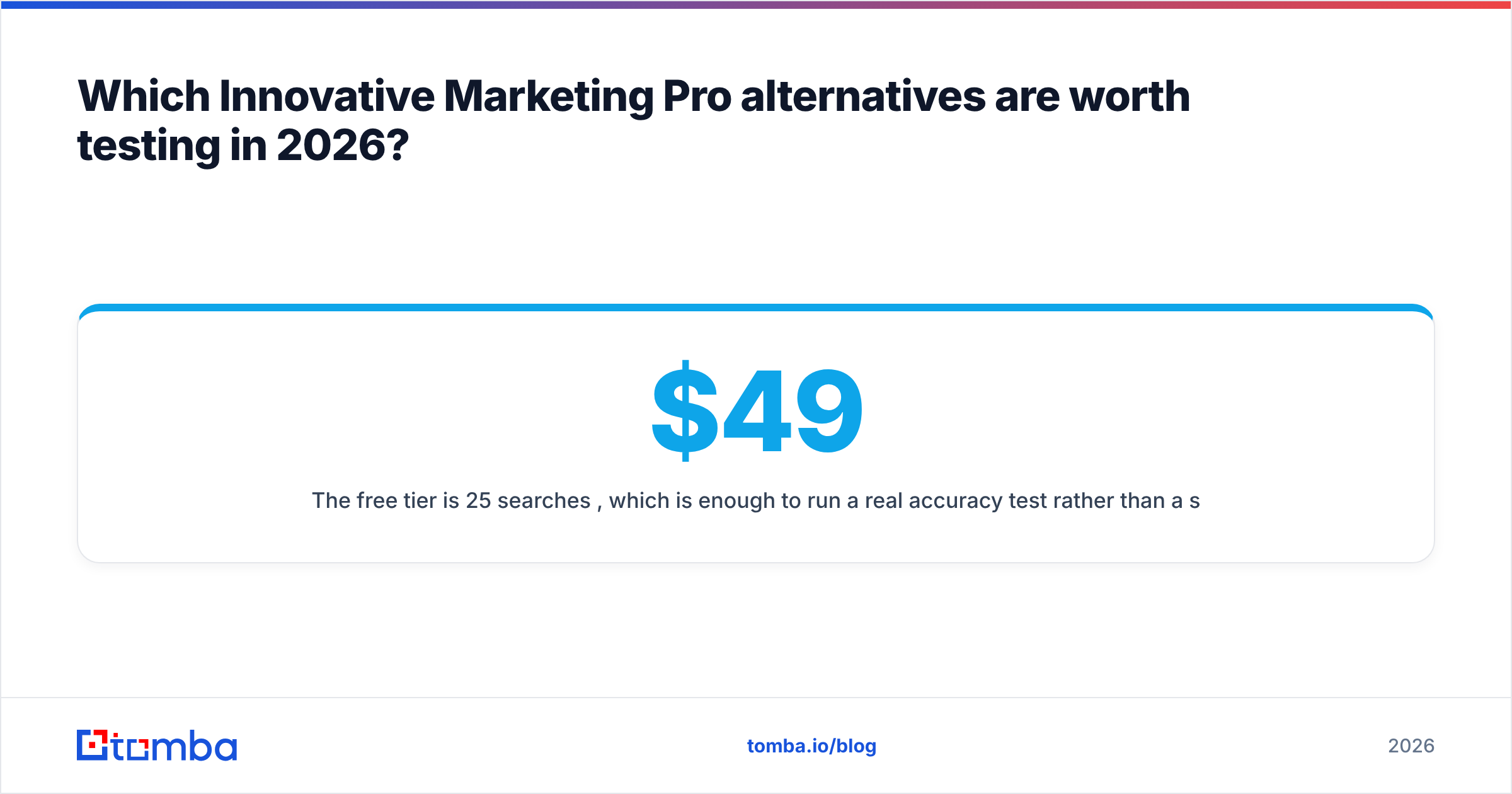
The free tier is 25 searches per month, which is enough to run a real accuracy test rather than a sales demo. Paid Tomba pricing runs $49/month (Starter), $99/month (Growth) and $249/month (Pro), with Enterprise quoted. There's a full REST API, a Chrome extension, Google Sheets and Excel add-ins, and native HubSpot, Pipedrive and Zapier connections.
Weakness to know: Tomba is built for finding and verifying contacts, not for sending sequences or scoring intent. You'll pair it with a sending tool.
BookYourData — best for buying a clean, targeted list outright#
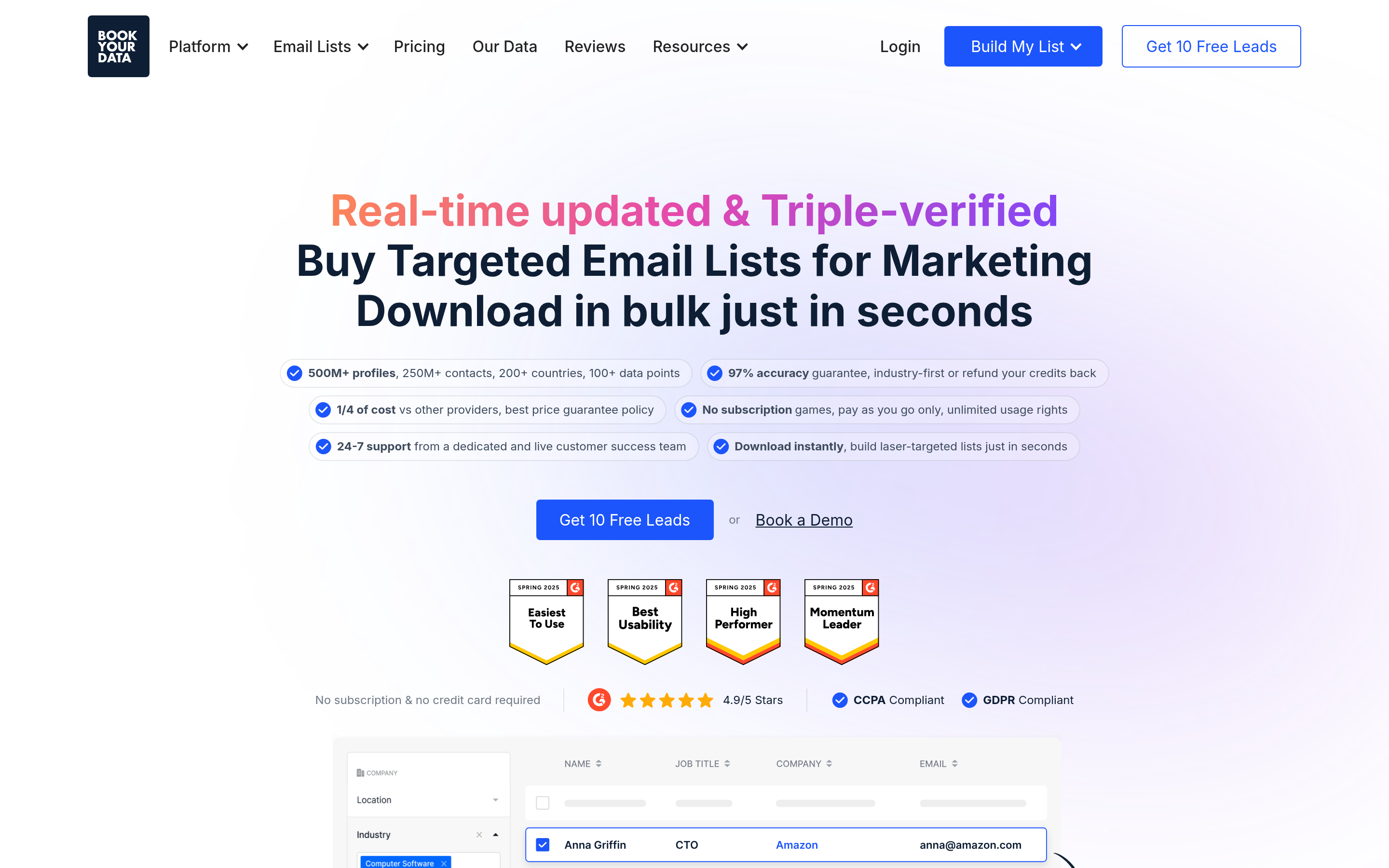
BookYourData is a respected direct-purchase provider with a pay-as-you-go credit model rather than an annual seat contract, plus filtering by industry, title, geography and company size. For teams that genuinely want a finished list — event follow-up, a regional ABM push, a channel-partner campaign — buying records directly is often faster than building them lookup by lookup, and the pay-per-record structure avoids the classic problem of paying for a year of access you use for six weeks. Confirm current credit pricing and the bounce guarantee on bookyourdata.com before purchase.
Best fit: campaign-shaped needs with a defined start and end, where you want the whole list on day one.
Apollo.io — best for an all-in-one prospect-and-send platform#
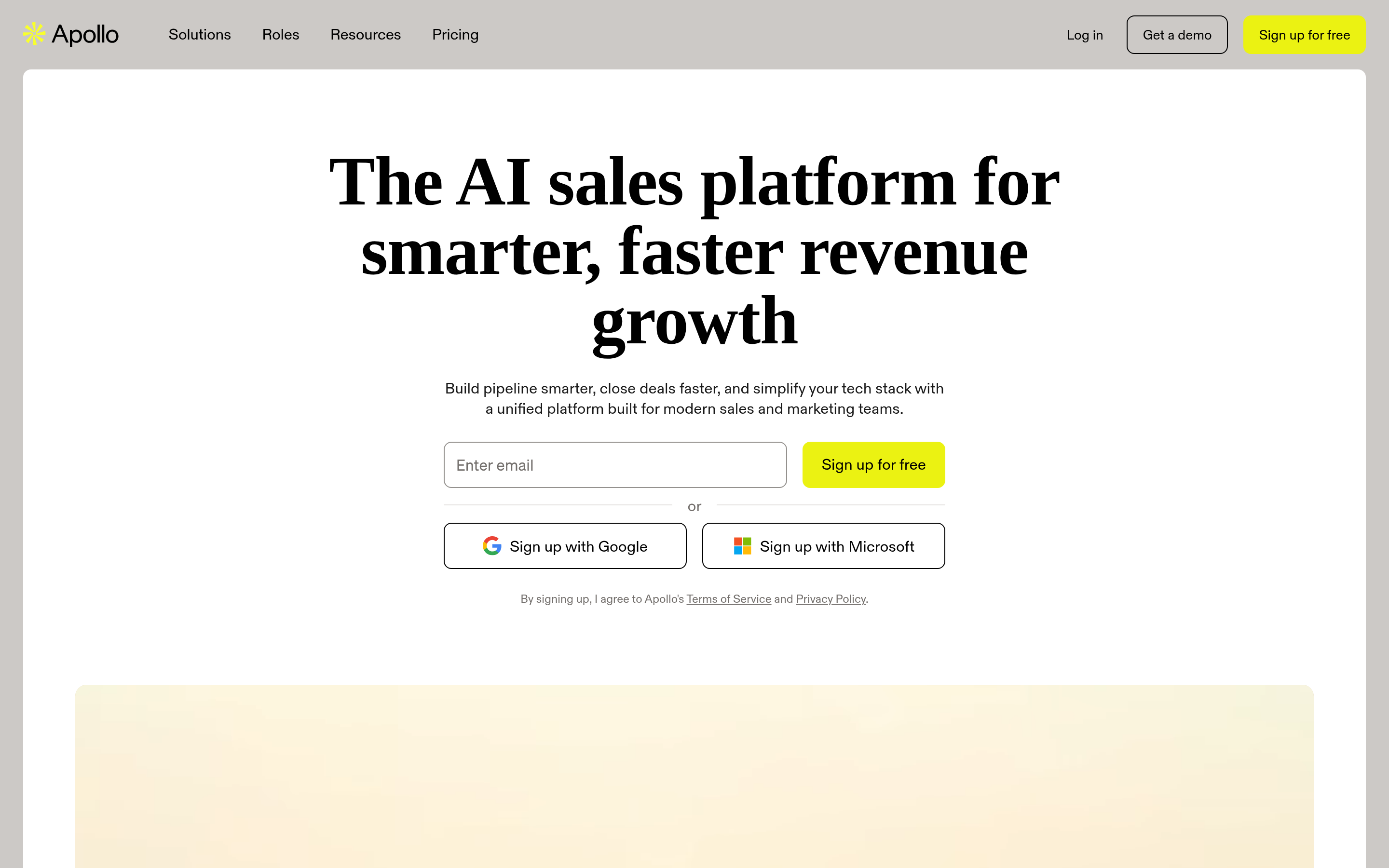
Apollo bundles a large contact database with sequencing, dialer and basic CRM functions. If you want one login for the entire outbound motion, it's the obvious candidate. There's a free tier and published paid plans; check apollo.io for current per-seat rates, since they move.
Weakness to know: per-seat pricing scales with headcount even when data usage doesn't, and teams frequently report needing a separate verifier before sending. See the Apollo alternative breakdown if you're weighing it specifically.
Cognism — best for EU/UK compliance-sensitive outbound#
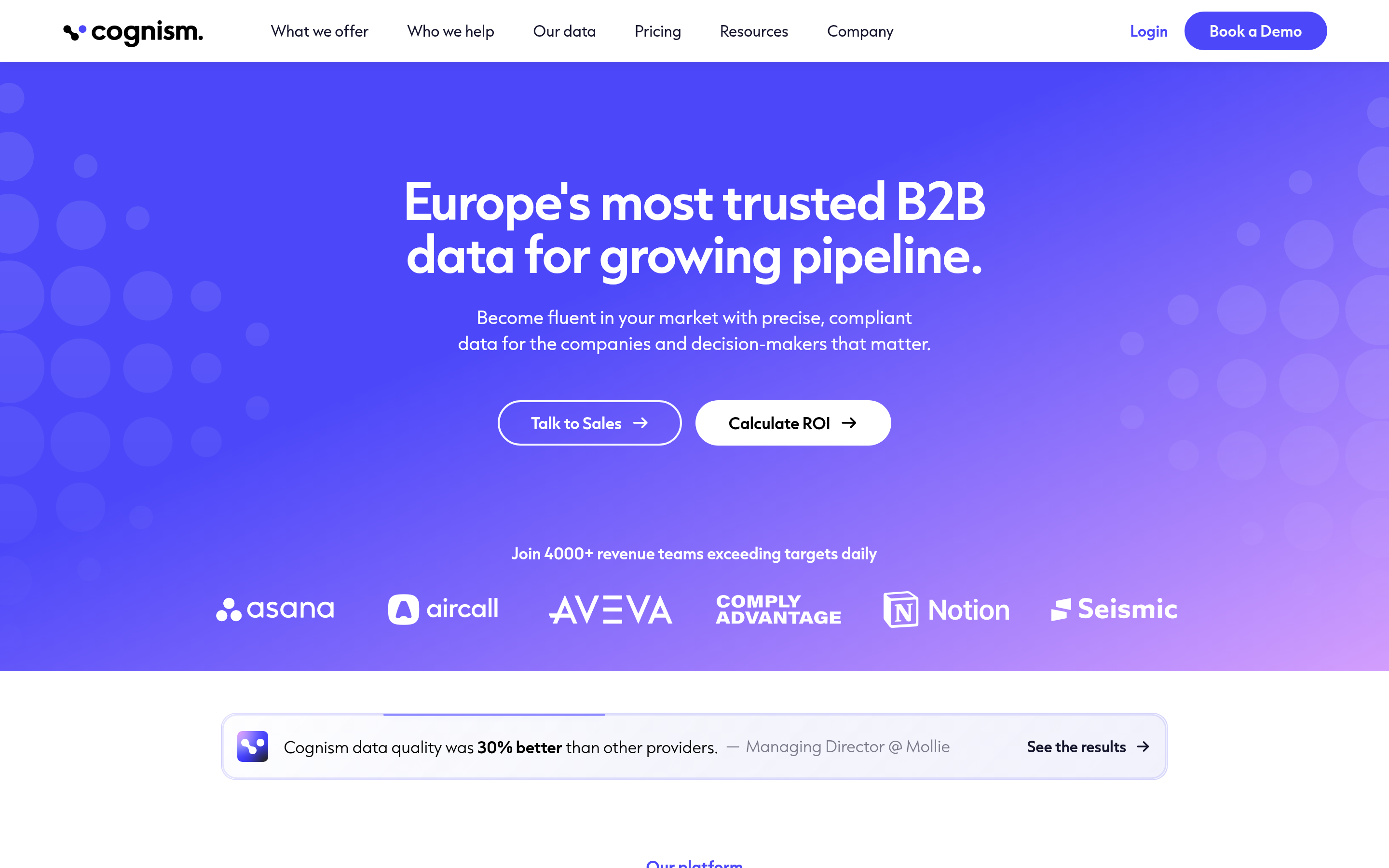
Cognism's differentiator is phone-verified mobile data and a documented approach to GDPR notification across European markets. Pricing is quote-only with annual commitments, which puts it out of reach for small teams but makes it a serious option for enterprise sales orgs selling into Europe.
RocketReach — best for one-off lookups at low volume#
RocketReach covers a very large contact index with a straightforward per-lookup interface and modest entry pricing. It's the tool for recruiters, founders and partnership managers doing dozens — not thousands — of lookups a month. Depth of firmographic filtering is thinner than the platform vendors.
Lusha — best for LinkedIn-first prospecting#
Lusha's browser extension is fast and the free tier is usable for evaluation. Reps live in LinkedIn all day, and Lusha meets them there. Coverage tends to be strongest in North America and weaker in long-tail international markets, and per-seat pricing again ties cost to headcount.
ZoomInfo — best for large enterprise with intent requirements#
ZoomInfo remains the heavyweight: the broadest firmographic and technographic dataset, plus intent signals and workflow automation. It's also the most expensive, sold on multi-year contracts with steep minimums. If your buying committee wants one vendor of record and budget isn't the constraint, it's a defensible choice. Check current user sentiment on G2 before signing, particularly around contract flexibility.
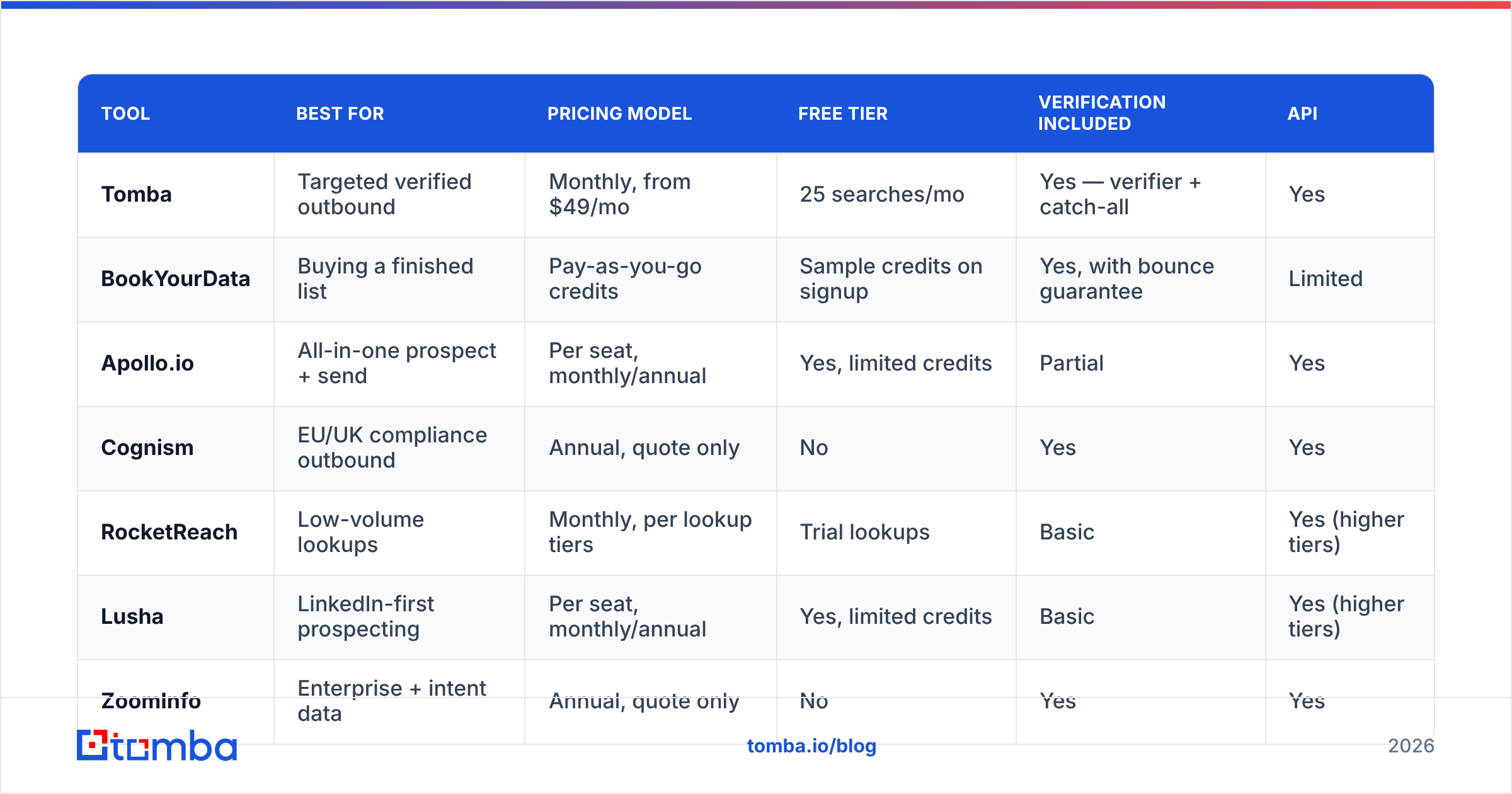
How do the alternatives compare side by side?#

| Tool | Best for | Pricing model | Free tier | Verification included | API |
|---|---|---|---|---|---|
| Tomba | Targeted verified outbound | Monthly, from $49/mo | 25 searches/mo | Yes — verifier + catch-all | Yes |
| BookYourData | Buying a finished list | Pay-as-you-go credits | Sample credits on signup | Yes, with bounce guarantee | Limited |
| Apollo.io | All-in-one prospect + send | Per seat, monthly/annual | Yes, limited credits | Partial | Yes |
| Cognism | EU/UK compliance outbound | Annual, quote only | No | Yes | Yes |
| RocketReach | Low-volume lookups | Monthly, per lookup tiers | Trial lookups | Basic | Yes (higher tiers) |
| Lusha | LinkedIn-first prospecting | Per seat, monthly/annual | Yes, limited credits | Basic | Yes (higher tiers) |
| ZoomInfo | Enterprise + intent data | Annual, quote only | No | Yes | Yes |
Prices and tiers reflect publicly listed information at the time of writing; quote-only vendors negotiate per deal. Confirm on each vendor's site before you budget.
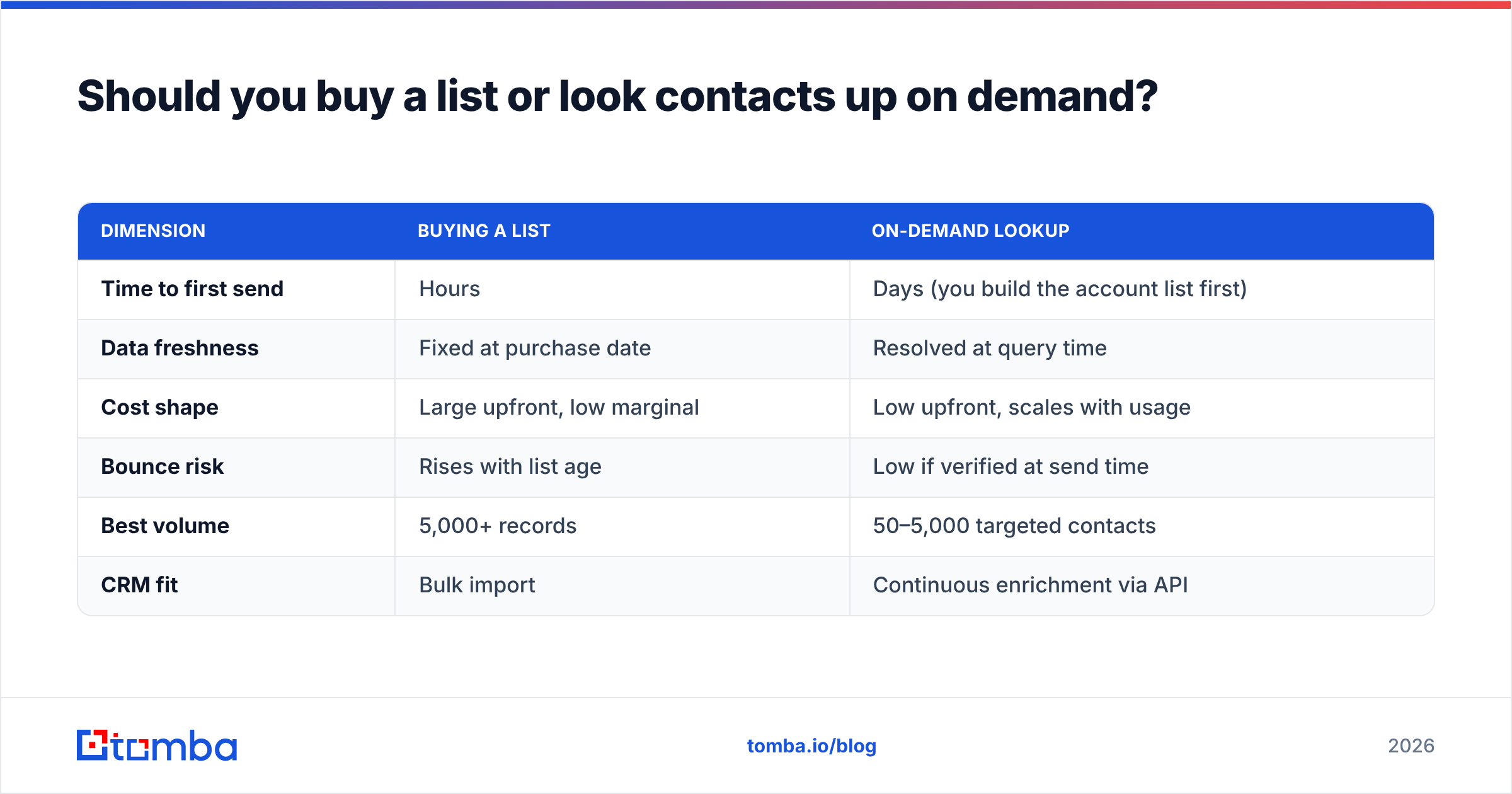
Read the table as two clusters, not seven options. The list vendors — BookYourData, Cognism, ZoomInfo — sell you records in bulk, and the value is coverage and filtering. The lookup tools — Tomba, Apollo, RocketReach, Lusha — sell you answers on demand, and the value is freshness and unit economics. Picking the wrong cluster is a more expensive mistake than picking the wrong vendor inside a cluster.
Should you buy a list or look contacts up on demand?#
| Dimension | Buying a list | On-demand lookup |
|---|---|---|
| Time to first send | Hours | Days (you build the account list first) |
| Data freshness | Fixed at purchase date | Resolved at query time |
| Cost shape | Large upfront, low marginal | Low upfront, scales with usage |
| Bounce risk | Rises with list age | Low if verified at send time |
| Best volume | 5,000+ records | 50–5,000 targeted contacts |
| CRM fit | Bulk import | Continuous enrichment via API |
The decision rule is simple: if you can name the accounts you want, look them up. If you can only describe them, buy the list.
Most B2B teams selling a considered product can name their accounts. They have a territory, a tier-one list, a conference attendee roster. For them, on-demand lookup with verification at send time produces a materially lower bounce rate, because the address is resolved the week it's used rather than the quarter it was collected. Teams running broad awareness plays across a whole vertical are in the other bucket, and a purchased, guaranteed list is the honest answer.
Plenty of teams run both: a purchased list for the top-of-funnel sweep, and contact enrichment on demand for the accounts that actually respond.

How do you run a 30-day switch test without wasting budget?#
Vendor demos are designed to win. A bake-off is designed to inform. Run this before you sign anything:
- Build a 200-row golden set. Pull 200 real target contacts from your ICP — company domain and full name only, no emails. Mix company sizes and at least two geographies so you catch coverage gaps.
- Run the same 200 rows through every candidate. Use free tiers and trials. Record match rate (rows returned), and keep every result in one sheet with the source vendor tagged.
- Verify all outputs with one neutral verifier. Same tool, same settings, for every vendor's results. Tag catch-all domains as a separate bucket — do not count them as valid or invalid.
- Send a 100-contact pilot from a warmed secondary domain. Never test new data on your primary sending domain. Measure hard bounce rate, spam complaints and reply rate per vendor.
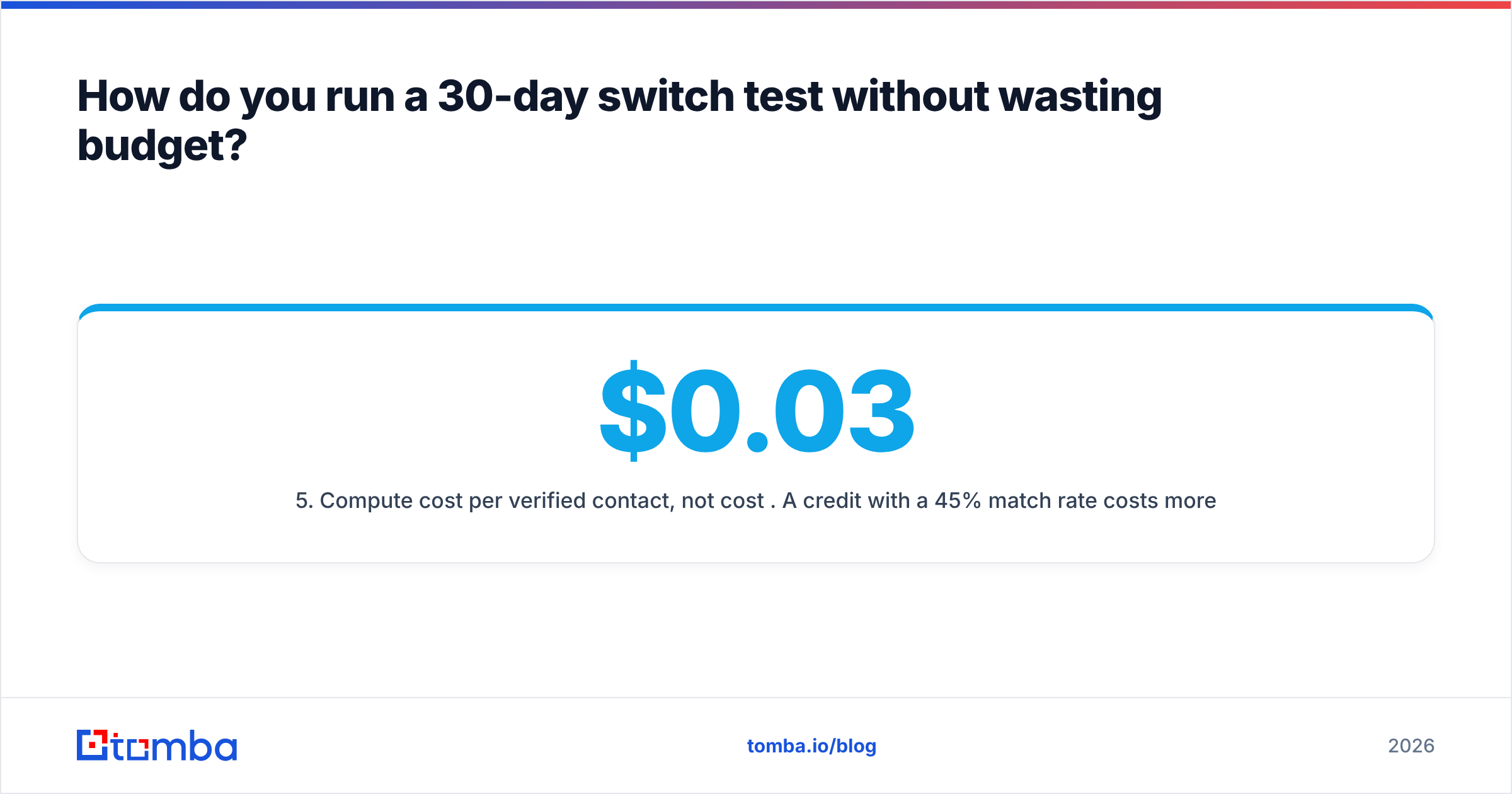
- Compute cost per verified contact, not cost per credit. A $0.03 credit with a 45% match rate costs more per usable contact than a $0.08 credit at 90%. This is the number that should decide the contract.
- Re-test the same 50 contacts after 30 days. Freshness is invisible on day one. A vendor whose data decays fastest will show it here.
For step two at scale, a bulk email finder handles the CSV upload and returns match rate and confidence per row, so you're not pasting domains one at a time. HubSpot's sales research library is a reasonable outside reference if you want to benchmark your reply-rate targets against broader survey data.
One last thing worth saying plainly: whichever vendor wins, keep verification as a permanent step rather than a one-time cleanup. Contact data is perishable. The teams with clean sending reputations aren't the ones who found a magic dataset — they're the ones who re-verify before every send.
What's the right pick for your team?#
- Small team, targeted outbound, tight budget → start with Tomba's free tier, upgrade to $49/month when you outgrow it.
- One-off campaign, need a finished list today → BookYourData's pay-as-you-go credits.
- You want prospecting and sending in one login → Apollo, budgeted per seat.
- Selling into the EU with compliance scrutiny → Cognism.
- Enterprise with intent-data requirements and budget → ZoomInfo.
Ready to test the lookup side of that list? Start with the Tomba Email Finder — 25 free searches a month, no card, with verification and catch-all detection built into the same credit pool. Run your 200-row golden set through it this afternoon and let the match rate, not a sales deck, decide your next contract.
Related guides#
Ready to find emails that actually work?
Join 150,000+ professionals who stopped guessing and started sending. Free credits on signup — no credit card required.
Get the Tomba newsletter
Practical outbound tactics and product updates — once every two weeks.
About the author