Inside Sales Management in 2026: A Practical Playbook
Inside sales management is not just outside sales with a headset. Here is how the metrics, coaching cadence, team structure, and tooling actually differ — and what breaks when you get it wrong.
TL;DR
- Inside sales management is a distinct discipline, not a remote version of field sales — the coaching loop is shorter, the data is richer, and the failure modes are different.
- The single biggest predictor of an inside team's performance is not rep talent. It's contact data quality. A rep working a 62% deliverable list loses roughly a third of their working day to bounces, wrong numbers, and dead ends.
- Manage three ratios, not thirty metrics: activity-to-conversation, conversation-to-meeting, and meeting-to-opportunity. Everything else is diagnostic.
- Ratio of 1 manager to 6–8 reps is the sweet spot for real coaching. Above 10, you are a reporting layer, not a coach.
- Pick tooling in this order: data source → engagement layer → CRM hygiene → AI assist. Teams that invert that order buy expensive automation that amplifies bad lists.
What is inside sales management?#
Inside sales management is the practice of running a revenue team that sells remotely — by phone, email, video, and chat — rather than in person. The manager's job is to design the motion, staff it, instrument it, and coach against it.
The everyday analogy: field sales management is like coaching a marathon team. You see the runners at the start, at three checkpoints, and at the finish. Inside sales management is like coaching a swim team in a 25-metre pool. Every stroke is visible, every lap is timed, and the feedback loop is measured in minutes rather than quarters.
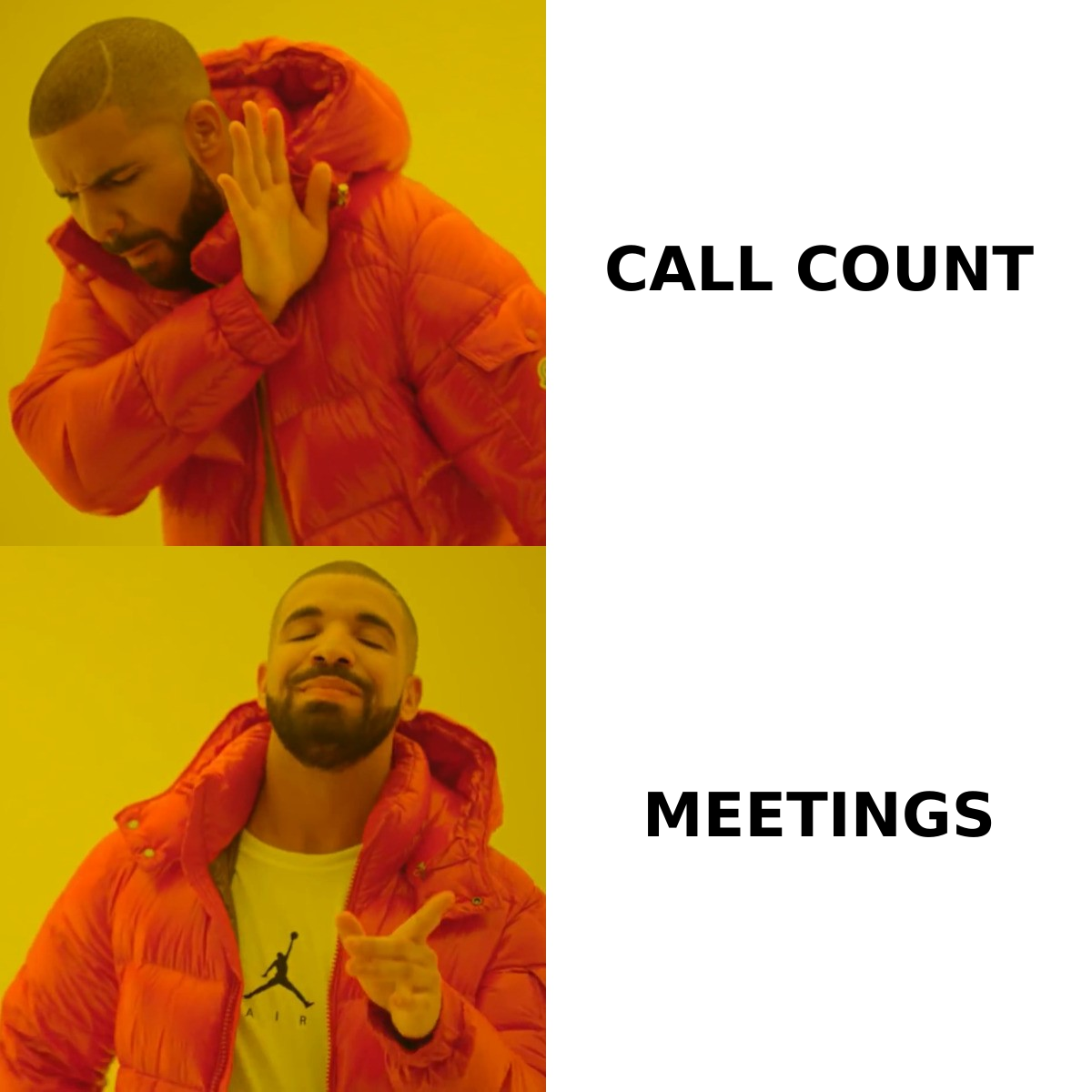
That visibility is the whole game. It's also the trap. Because you can measure 40 things, managers frequently measure 40 things — and then coach none of them well.
What separates inside sales management from generic sales management:
- Velocity over territory. Field reps are managed against accounts and geography. Inside reps are managed against throughput — how many qualified conversations they can create and convert per week.
- Data dependency. An outside rep can drive to an office and ask the receptionist. An inside rep cannot. If the email bounces and the number is disconnected, the rep is stuck. Contact data is not a nice-to-have; it is the raw material.
- Shorter coaching cycles. You can listen to a call recording from this morning and change behaviour by this afternoon. Weekly one-on-ones are too slow to be your only coaching mechanism.
- Higher tooling leverage. A well-instrumented inside rep with a good stack can touch 10x the accounts of an unequipped one. The same stack with bad data produces 10x the noise.
- Different burnout curve. Rejection density is higher. Inside reps hear "no" more times per hour than any other sales role, and management has to design for that explicitly.
How does inside sales differ from outside sales in 2026?#
The old split — inside sells small deals, outside sells big ones — collapsed years ago. Gartner's research on buyer behaviour has consistently shown B2B buyers preferring digital-first, rep-free interaction for much of the journey, which pushed enterprise deal sizes into the inside model. What's left is a difference in management method, not deal size.
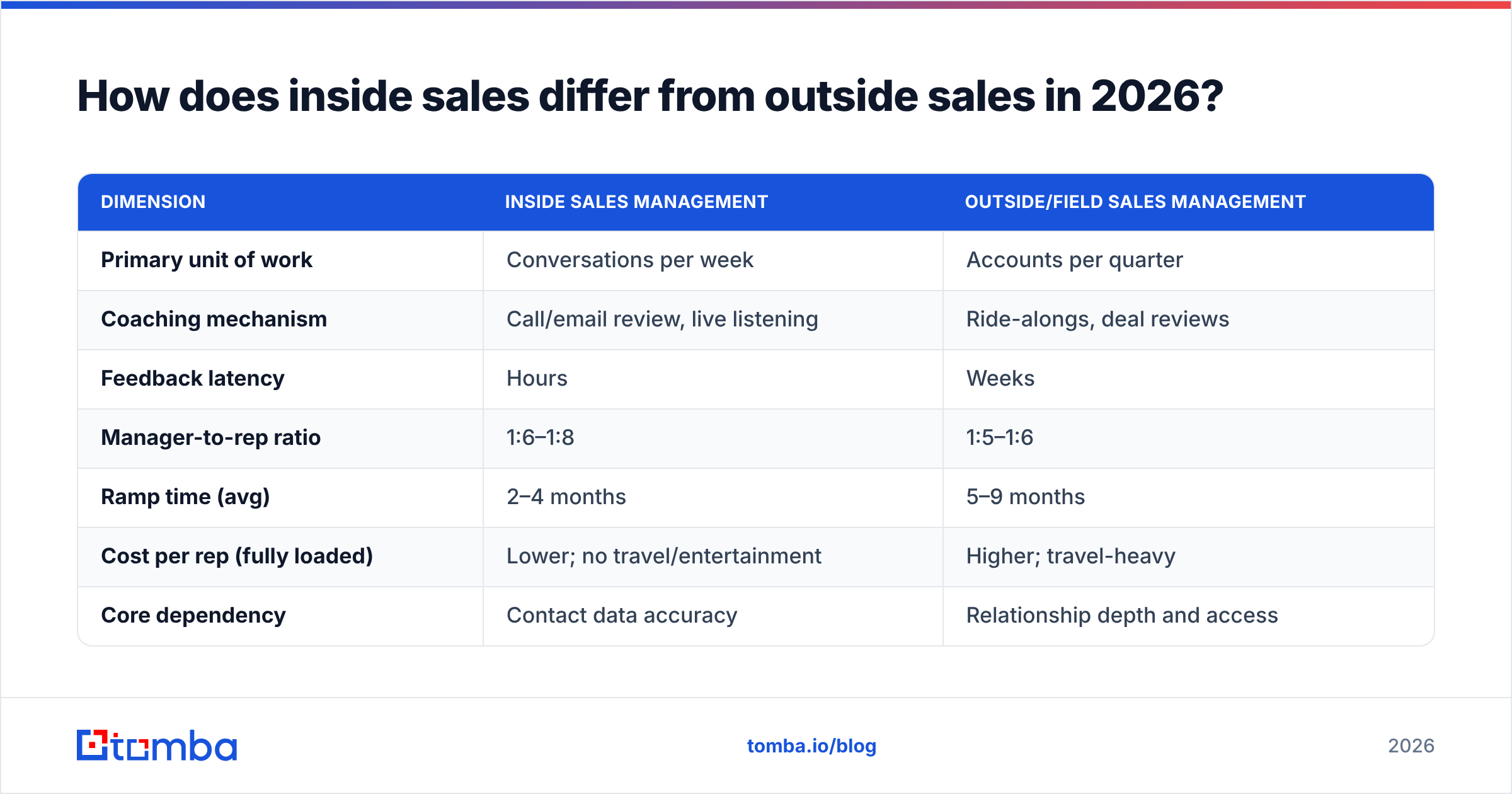
| Dimension | Inside sales management | Outside/field sales management |
|---|---|---|
| Primary unit of work | Conversations per week | Accounts per quarter |
| Coaching mechanism | Call/email review, live listening | Ride-alongs, deal reviews |
| Feedback latency | Hours | Weeks |
| Manager-to-rep ratio | 1:6–1:8 | 1:5–1:6 |
| Ramp time (avg) | 2–4 months | 5–9 months |
| Cost per rep (fully loaded) | Lower; no travel/entertainment | Higher; travel-heavy |
| Core dependency | Contact data accuracy | Relationship depth and access |
| Typical comp split | 60/40 or 70/30 base/variable | 50/50 |
| Biggest failure mode | High activity, zero pipeline | Low activity, long cycles |
The last row is the one that should worry you. Inside teams fail loudly and visibly at the top of the funnel — the dashboard looks busy while the pipeline stays flat. That pattern almost always traces back to either bad lists or an unqualified ICP, not lazy reps.
Which inside sales metrics actually matter?#
Three ratios. Everything else exists to explain movement in one of the three.
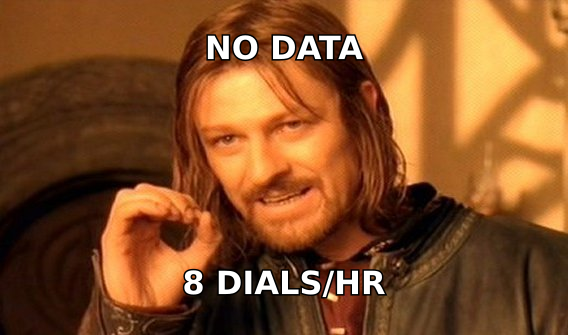
1. Activity-to-conversation ratio. Dials, emails, and LinkedIn touches divided by real human conversations. If this is degrading, you have a data problem or a targeting problem — never a motivation problem. A rep who makes 60 dials and reaches 2 people is not lazy; their list is wrong.
2. Conversation-to-meeting ratio. Conversations divided by booked, held meetings. This is the purest measure of rep skill. It's where coaching pays. Industry benchmarks vary wildly, but a healthy SDR team lands somewhere between 15% and 30% depending on segment.
3. Meeting-to-opportunity ratio. Held meetings that convert into qualified pipeline. If this sags while ratio 2 is healthy, your reps are booking the wrong people — a qualification criteria issue that lives with the manager, not the rep.
Secondary metrics worth instrumenting but not coaching directly:
- Speed-to-lead. Inbound response time. HubSpot's sales research and a decade of lead-response studies consistently show conversion collapsing after the first few minutes.
- Bounce rate. Anything above 3% is actively damaging your sender reputation and will eventually degrade ratio 1 for the whole team, not just the offending rep.
- Sequence completion rate. How often reps finish the full touch pattern versus abandoning at touch 3. Abandonment is a leading indicator of low list confidence.
- Talk-to-listen ratio. Useful for coaching individual calls, useless as a team KPI.
Resist the urge to build a scorecard with fifteen weighted components. Reps optimise what you rank them on. Rank them on three things they can actually control.
Why does contact data quality decide the outcome?#
Because everything downstream is a multiplier on it.
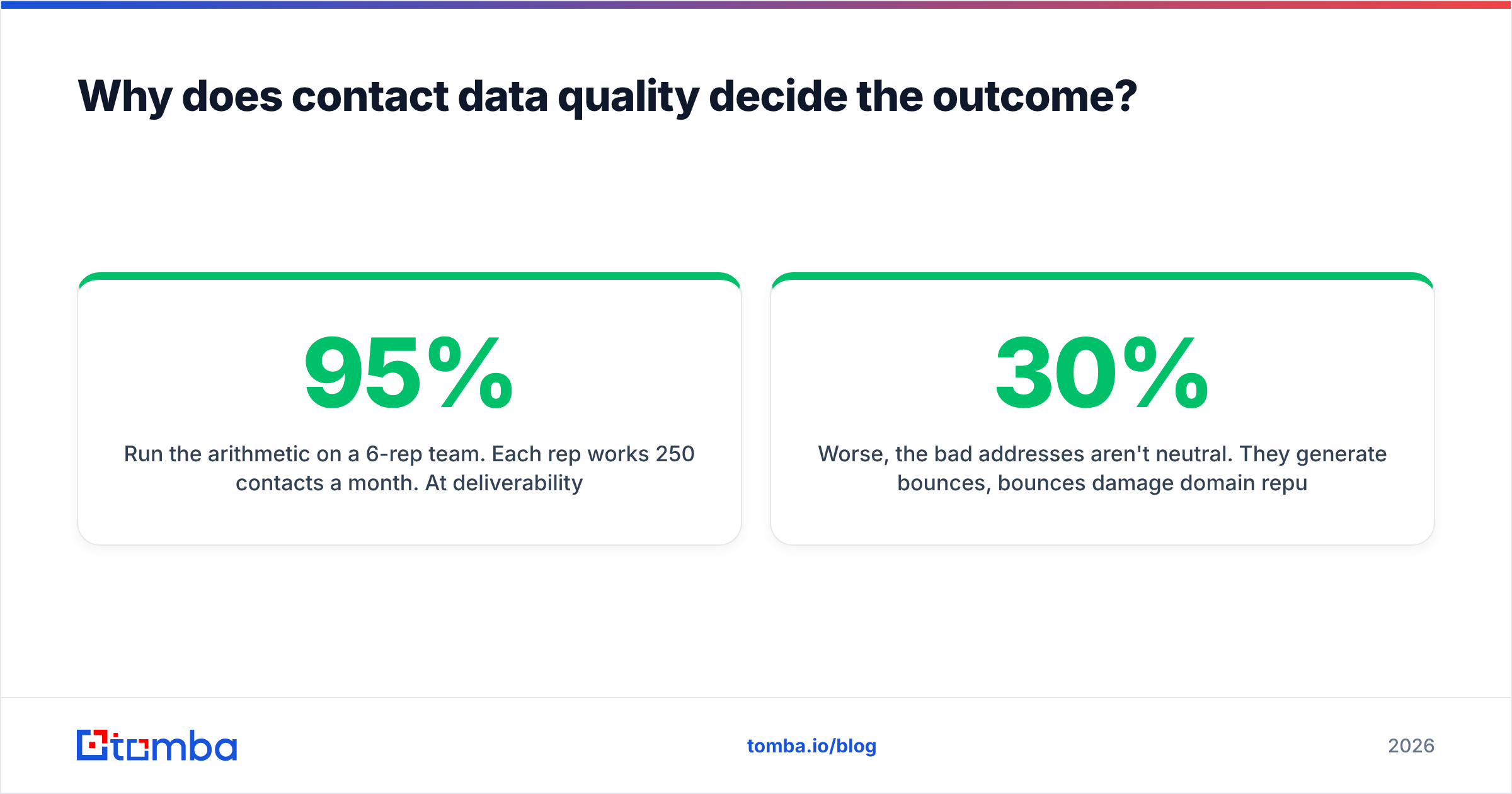
Run the arithmetic on a 6-rep team. Each rep works 250 contacts a month. At 95% deliverability, 237 contacts are reachable. At 65% deliverability — which is what you get from a scraped list or a stale CRM export — 162 are reachable. That's 450 lost reachable contacts per month across the team, before a single word of copy is written.
Worse, the bad addresses aren't neutral. They generate bounces, bounces damage domain reputation, and damaged reputation quietly suppresses the deliverability of your good addresses too. B2B contact data decays at roughly 25–30% per year as people change jobs, so a list that was clean in January is materially degraded by October.
The management implication is blunt: you cannot coach your way out of a bad list. Before you redesign the call script, verify the data.
Practical controls to put in place:
- Verify before load, not after bounce. Run every import through an email verifier before it touches the sequencer. Catching a bad address costs a credit; sending to it costs reputation.
- Handle catch-all domains explicitly. A large share of enterprise domains accept everything at the SMTP layer, which makes standard verification return "unknown." A dedicated catch-all verifier gives you a confidence score instead of a shrug.
- Refresh quarterly, not annually. Re-verify the whole active database every 90 days. Budget for it as a line item.
- Enrich at the account level. When a contact leaves, you want the replacement, not a deleted row. Contact enrichment keeps the account workable through personnel churn.
- Own the sourcing. Reps who hand-build lists at 11pm are reps who are not selling. Centralise sourcing through a bulk email finder workflow or an API-driven pipeline so reps receive work-ready lists.
How should you structure an inside sales team?#
Structure follows motion, and there are three common motions.
The pod. One AE, two SDRs, shared CSM or solutions support. Pods work when deal cycles are long enough that the AE needs consistent feed and short enough that the SDRs see the outcome of their work. Best for mid-market.
The assembly line. SDRs book, AEs close, account managers expand. Maximum specialisation, maximum efficiency per seat, but handoff quality becomes the constraint. Every handoff is a leak point; instrument it.
The full-cycle desk. One rep prospects, demos, and closes. Works for transactional deals under roughly $15k ACV, or when your team is under eight people and specialisation overhead isn't worth it. Falls apart when reps start protecting closing time by skipping prospecting.
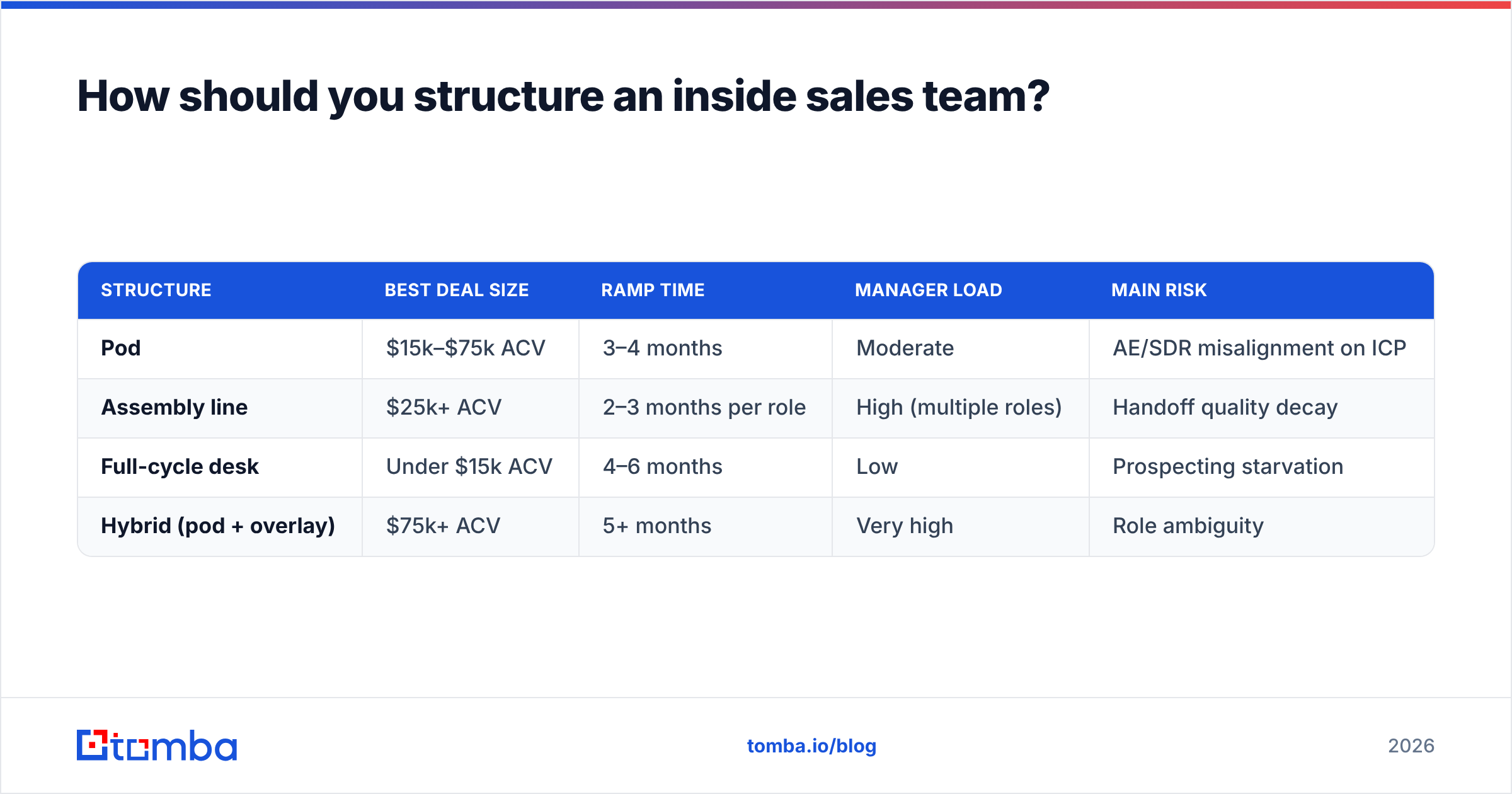
| Structure | Best deal size | Ramp time | Manager load | Main risk |
|---|---|---|---|---|
| Pod | $15k–$75k ACV | 3–4 months | Moderate | AE/SDR misalignment on ICP |
| Assembly line | $25k+ ACV | 2–3 months per role | High (multiple roles) | Handoff quality decay |
| Full-cycle desk | Under $15k ACV | 4–6 months | Low | Prospecting starvation |
| Hybrid (pod + overlay) | $75k+ ACV | 5+ months | Very high | Role ambiguity |
On span of control: 1:6 to 1:8 is where inside sales management stays coaching-shaped. At 1:12, the honest math is 25 minutes of attention per rep per week, which is enough to inspect a dashboard and nothing else. If your headcount plan pushes you past 8, budget a team lead before you budget another rep.
What does a weekly inside sales management cadence look like?#
The cadence is the product. Without it, "coaching" becomes whatever fits between fire drills.
A cadence that holds up under pressure:
- Monday — pipeline stand-up (20 min, team). Not a status round-robin. Two questions only: what changed since Friday, and what's blocked. Blockers get owners and deadlines in the room.
- Tuesday/Thursday — call review block (45 min, rotating pairs). Reps bring one call they're proud of and one that went sideways. Managers listen more than they talk. This is where ratio 2 moves.
- Wednesday — one-on-ones (30 min each). Half career, half number. Reps who only ever discuss the number churn.
- Friday — data and list review (30 min, manager + ops). What bounced, what's stale, what segment underperformed. This meeting is the one everyone skips and the one that protects ratio 1.
- Monthly — deal post-mortems (60 min). Two wins, two losses, structured template. No blame, no vague "they went with a competitor" — find the actual moment the deal turned.
- Quarterly — territory and ICP reset. Re-cut the list based on what actually closed, not what you hoped would close.
Two rules that make the cadence stick. First, the manager prepares more than the rep — showing up without having reviewed the calls signals that the meeting is theatre. Second, never cancel the Friday data review to make room for a forecast call. Forecast accuracy is downstream of list quality.
Which tools does an inside sales manager actually need?#
Buy in dependency order. Data first, because everything else multiplies it.
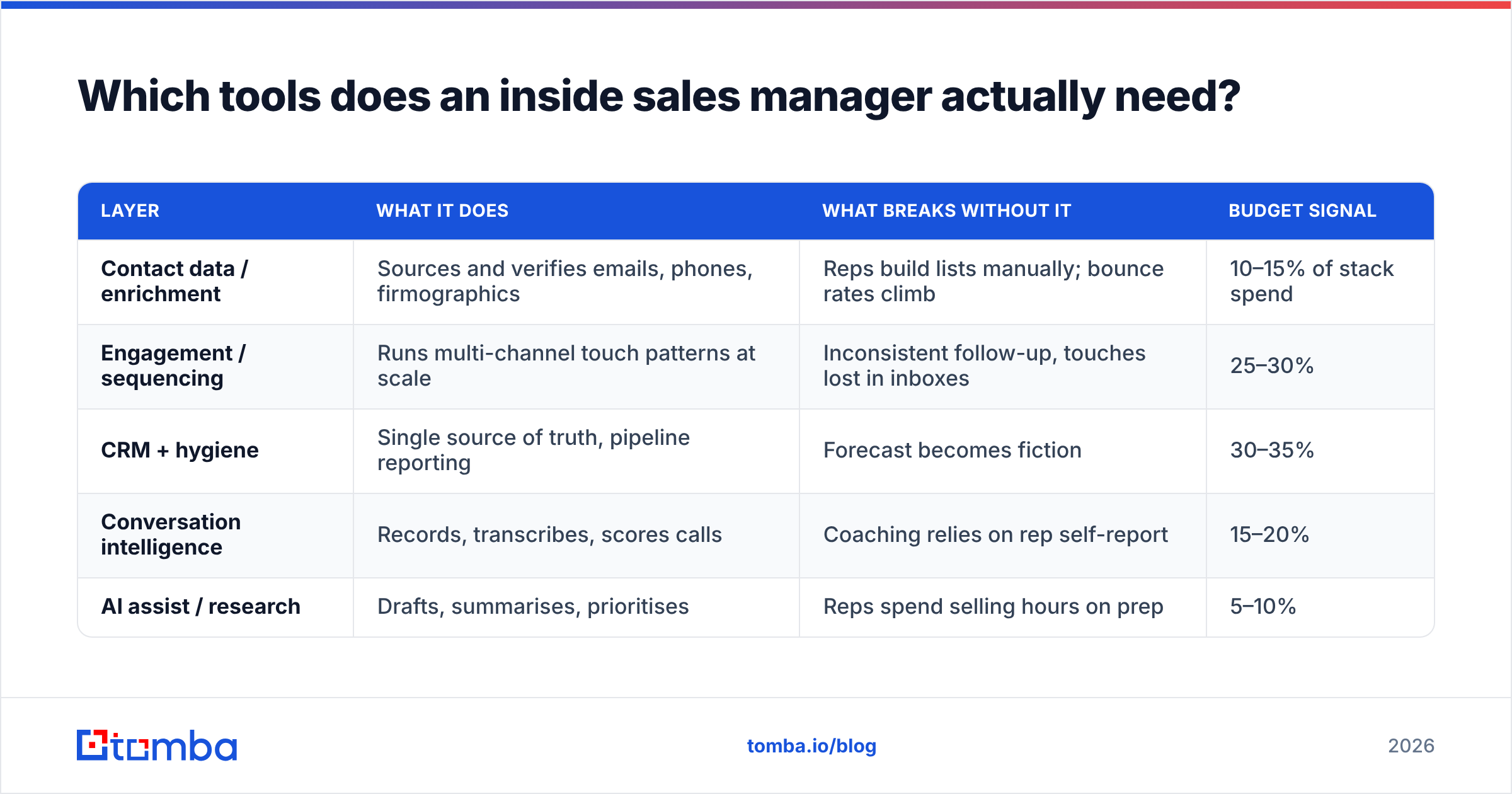
| Layer | What it does | What breaks without it | Budget signal |
|---|---|---|---|
| Contact data / enrichment | Sources and verifies emails, phones, firmographics | Reps build lists manually; bounce rates climb | 10–15% of stack spend |
| Engagement / sequencing | Runs multi-channel touch patterns at scale | Inconsistent follow-up, touches lost in inboxes | 25–30% |
| CRM + hygiene | Single source of truth, pipeline reporting | Forecast becomes fiction | 30–35% |
| Conversation intelligence | Records, transcribes, scores calls | Coaching relies on rep self-report | 15–20% |
| AI assist / research | Drafts, summarises, prioritises | Reps spend selling hours on prep | 5–10% |
On the data layer specifically, the market splits into database-first vendors and search-first vendors. Database-first providers like BookYourData sell pre-built, verified lists — strong when you need volume against a well-defined segment today, and their verification guarantees are genuinely useful for teams that don't want to run their own enrichment pipeline. Search-first providers find and verify contacts on demand against a domain or a name, which suits teams whose ICP shifts or who prospect account-by-account.
Most mature inside teams end up running both: a purchased base layer for coverage, plus on-demand lookup for the accounts that matter. Tools like Tomba's domain search sit in the second bucket — you give it a company domain and get back the verified addresses and the org's email pattern, which is what a rep actually needs 20 minutes before a call.
Check G2's inside sales category before committing to anything in the engagement layer; the switching cost there is higher than vendors admit.
A practical warning on AI tooling: it's the last layer for a reason. AI that drafts personalised openers against a list of bounced addresses produces beautifully written nothing. Sequence the purchases correctly and the AI layer earns its keep; invert them and you've bought an expensive way to be wrong faster.
What should you do in your first 90 days managing an inside team?#
Days 1–30: measure, don't move. Pull 90 days of historical data and calculate the three ratios per rep. Listen to at least 20 calls. Audit the contact database — take a random 200-row sample and verify it. You'll learn more from that sample than from any rep interview.
Days 31–60: fix the input. Whatever the audit surfaced, fix it before touching the script. Replace or re-verify the list. Tighten ICP definition to whatever actually closed last year. Rebuild the qualification criteria with the AEs, in writing.
Days 61–90: install the cadence. Now change behaviour. Launch the weekly rhythm, set the three ratios as the scorecard, and run the first post-mortems. Publish the ratios openly — inside teams respond well to visible, controllable benchmarks and badly to opaque rankings.
Resist the urge to rewrite the cold email templates in week one. It's the most visible change and almost never the binding constraint.
Start with the input layer. If your reps are burning selling hours hunting for addresses or working a list that bounces one in three, no cadence or scorecard will rescue the number. Tomba's Email Finder gives inside teams verified, work-ready contacts by name, company, or domain — with a free tier at 25 searches a month to audit your current list quality, and paid plans from $49/mo when you're ready to run it across the team. Check the pricing details and run your own 200-row sample against it before you commit to anything bigger.
Related guides#
// get started
Find, verify and enrich your first contacts today
Start on the free plan with 25 searches a month, then scale when your team is ready.
Free plan · No credit card required · GDPR & CCPA
// about the author