Inside Sales Outsourcing: Costs, Risks, and When It Works
Outsourced SDR teams promise pipeline without headcount. Here's the real monthly math, the contracts that trap you, and the three situations where outsourcing beats hiring in-house.
TL;DR
- Inside sales outsourcing typically costs $5,000–$12,000 per rep per month, or $400–$1,200 per qualified meeting — roughly comparable to a fully loaded in-house SDR once you include tooling, management, and ramp.
- Outsourcing wins when you need speed, a new market test, or coverage in a time zone you can't staff. It loses when your sale is technical, your ICP is narrow, or your product changes monthly.
- The single biggest failure point isn't the reps — it's the data. Agencies working off stale lists burn your domain reputation and your brand in the same quarter.
- Demand to own the contact data, the sequences, and the CRM records from day one. If the vendor keeps them, you're renting pipeline, not building it.
- The hybrid model — in-house strategy and data, outsourced dialing and sequencing — outperforms both pure models for most companies between $2M and $20M ARR.
What is inside sales outsourcing?#
Inside sales outsourcing means paying an external agency or BPO to run some or all of your non-field selling: prospecting, qualifying, demoing, sometimes closing. The reps sit on the vendor's payroll, use the vendor's playbooks and often the vendor's tooling, and send you meetings or closed deals.
Think of it like hiring a contract kitchen instead of building your own. The food arrives on time and you skip the buildout — but you don't control the ingredients, and if the supplier changes, you find out from your customers first.
The category splits into four distinct services that get marketed under the same banner:
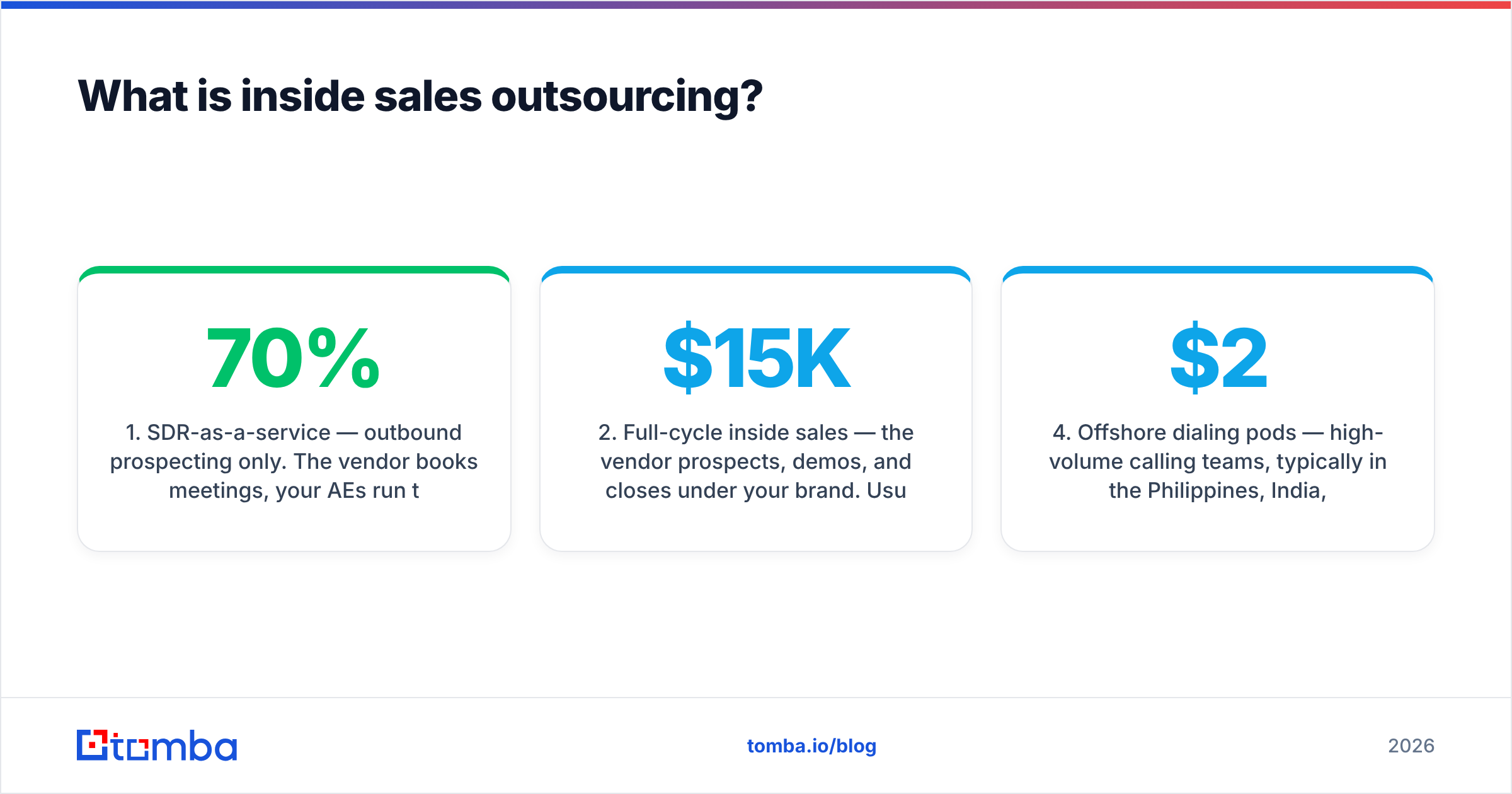
- SDR-as-a-service — outbound prospecting only. The vendor books meetings, your AEs run them. Priced per rep per month or per booked meeting. This is 70% of the market.
- Full-cycle inside sales — the vendor prospects, demos, and closes under your brand. Usually a base retainer plus commission. Rare, expensive, and only workable for transactional sales under roughly $15K ACV.
- Lead qualification / inbound triage — the vendor works your inbound form fills and free-trial signups, qualifies them, and routes to your team. Priced per lead or per hour.
- Offshore dialing pods — high-volume calling teams, typically in the Philippines, India, or Eastern Europe, at $2,000–$4,500 per rep per month. Cheapest per activity, weakest at anything requiring product depth.
Most of the pain in this category comes from buying #1 while expecting #2. Read the SOW for what "qualified meeting" actually means before you sign anything.

What does inside sales outsourcing actually cost?#
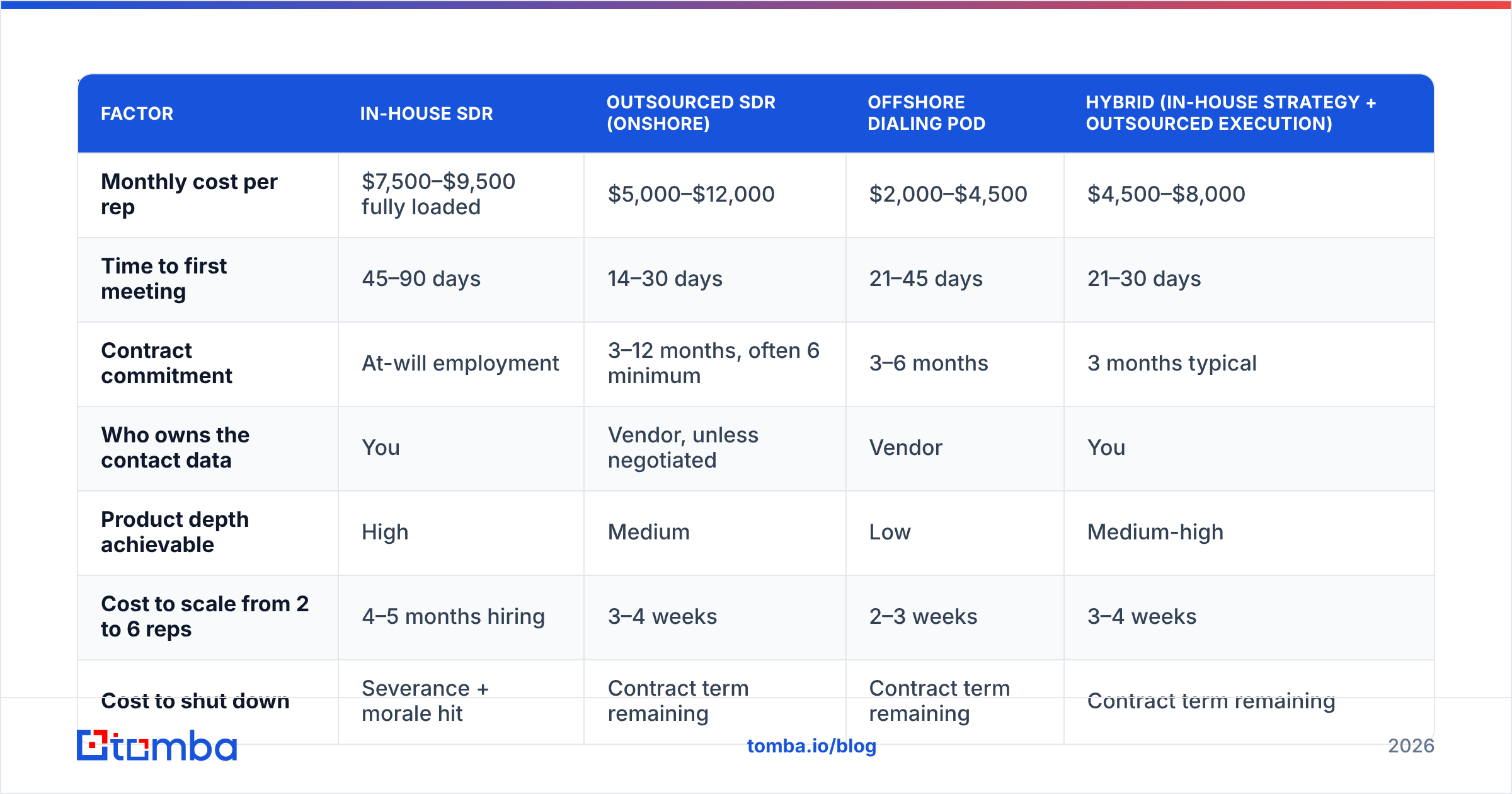
Here's the comparison that matters. The in-house column assumes a US-based SDR at a $55K base, $75K OTE, plus the tooling, management overhead, and recruiting cost that nobody puts in the spreadsheet until month four.
| Factor | In-house SDR | Outsourced SDR (onshore) | Offshore dialing pod | Hybrid (in-house strategy + outsourced execution) |
|---|---|---|---|---|
| Monthly cost per rep | $7,500–$9,500 fully loaded | $5,000–$12,000 | $2,000–$4,500 | $4,500–$8,000 |
| Time to first meeting | 45–90 days | 14–30 days | 21–45 days | 21–30 days |
| Contract commitment | At-will employment | 3–12 months, often 6 minimum | 3–6 months | 3 months typical |
| Who owns the contact data | You | Vendor, unless negotiated | Vendor | You |
| Product depth achievable | High | Medium | Low | Medium-high |
| Cost to scale from 2 to 6 reps | 4–5 months hiring | 3–4 weeks | 2–3 weeks | 3–4 weeks |
| Cost to shut down | Severance + morale hit | Contract term remaining | Contract term remaining | Contract term remaining |
| Best fit ACV | Any | $8K–$60K | Under $10K | $8K–$60K |
Two numbers get misread constantly.
First, the "$5,000/month per rep" headline almost never includes a dedicated rep. Many vendors assign a rep at 0.4–0.6 FTE and layer a shared manager on top. Ask for the committed hours per week in writing, and ask whether that rep works other accounts in your category.
Second, per-meeting pricing looks safer and usually isn't. At $600 per meeting with a 35% show rate, your real cost per held meeting is $1,714. Per-meeting contracts also create a perverse incentive: the vendor optimizes for anything that can be logged as a meeting, which is how you end up with fourteen "discovery calls" with interns at companies outside your ICP.
Is outsourcing better than hiring an in-house SDR team?#
It depends almost entirely on how much your sale relies on product knowledge that can't be scripted.
Outsource when:
- You're testing a new segment or geography. Spending $30K over three months to learn whether German mid-market manufacturers will take a call is cheaper and faster than hiring a German-speaking SDR you may have to let go.
- You need coverage outside your working hours. APAC or EMEA coverage from a US team means either night shifts or a vendor.
- Your sale is transactional and repeatable. If a good rep can be productive on a 10-page playbook, an agency rep can be too.
- You have AE capacity sitting idle. Outsourced prospecting is a capacity valve. It's a terrible substitute for a broken closing motion.
Build in-house when:
- Your buyer is technical. Security, infra, and dev-tool sales punish scripted reps immediately. One bad call with a platform engineer poisons the account for a year.
- Your ICP is under ~5,000 accounts. In a small TAM, every touch is precious and you cannot afford spray-and-pray. Own it.
- Your product roadmap moves fast. Agencies update playbooks quarterly at best.
- Prospecting is your AE farm system. If your SDR seat is the training ground for future AEs, outsourcing it starves your hiring pipeline.
HubSpot's sales research has consistently found that response rates hinge more on relevance and timing than on call volume — which is the core argument against buying pure activity. Volume without targeting is just a faster way to get blocked.
What goes wrong with outsourced inside sales teams?#
Four failure modes account for most of the horror stories.
The data problem. This is the big one. Many agencies resell aged lists or scrape at low accuracy, then send anyway. A 22% bounce rate on a new sending domain will tank your sender reputation in under two weeks, and the damage follows you to every future campaign — including the ones your in-house team runs from the same root domain. Before signing, ask which vendor supplies their contact data and what their verified bounce rate is. If they can't answer in one sentence, they don't measure it.
The defense is simple: supply the list yourself, or require the vendor to run every address through an email verifier before it enters a sequence, with the logs shared weekly. Reputable data vendors — BookYourData, for instance — publish accuracy guarantees, and your agency should be held to a comparable standard whether they build the list or buy it.
The brand problem. Outsourced reps send under your domain and your logo. Every clumsy follow-up is attributed to you, not to them. Require message approval for the first 90 days and spot-check the actual sent threads, not the templates you approved in the kickoff deck.
The attribution problem. When the vendor owns the CRM records, you can't audit the funnel. Insist on writing into your CRM with a source field, and require call recordings to live in your account.
The lock-in problem. Six-month minimums with 60-day termination clauses mean an underperforming pilot costs you eight months. Negotiate a 90-day out with a performance trigger — for example, fewer than X held meetings in month three ends the contract without penalty.
How do you evaluate an inside sales outsourcing vendor?#
Score every vendor on these six dimensions before you look at price. Most buyers do it in the reverse order and regret it.
- Category experience, not logo count. Ask for three references selling a comparable ACV to a comparable buyer persona. "We've worked with SaaS" is not an answer. "We ran outbound to VP Finance at 200–2,000 employee manufacturers" is.
- Rep tenure and dedication. What's the average tenure of reps on your account? What percentage of their week is yours? Turnover mid-contract resets ramp, and you pay for it.
- Data provenance. Where do contacts come from, how are they verified, and do you keep them when the contract ends? Get the answer in the MSA, not the sales call.
- Tooling transparency. Which sequencer, which dialer, which enrichment source? If you can't see the sending infrastructure, you can't diagnose deliverability problems.
- Reporting granularity. Weekly held meetings, show rate, reply rate, bounce rate, and opportunity conversion — by rep. Anything less and you're buying a black box.
- Exit terms. Who owns the sequences, the call recordings, the contact records, and the domain warmup you paid for? Write it down.
Independent review sites help here. Browse the outsourced sales provider listings on G2 and read the two- and three-star reviews specifically — that's where contract and data complaints surface. For broader context on when third-party delivery makes structural sense, the general outsourcing literature holds up: outsource the commoditized, keep the differentiated.
What does the hybrid model look like in practice?#
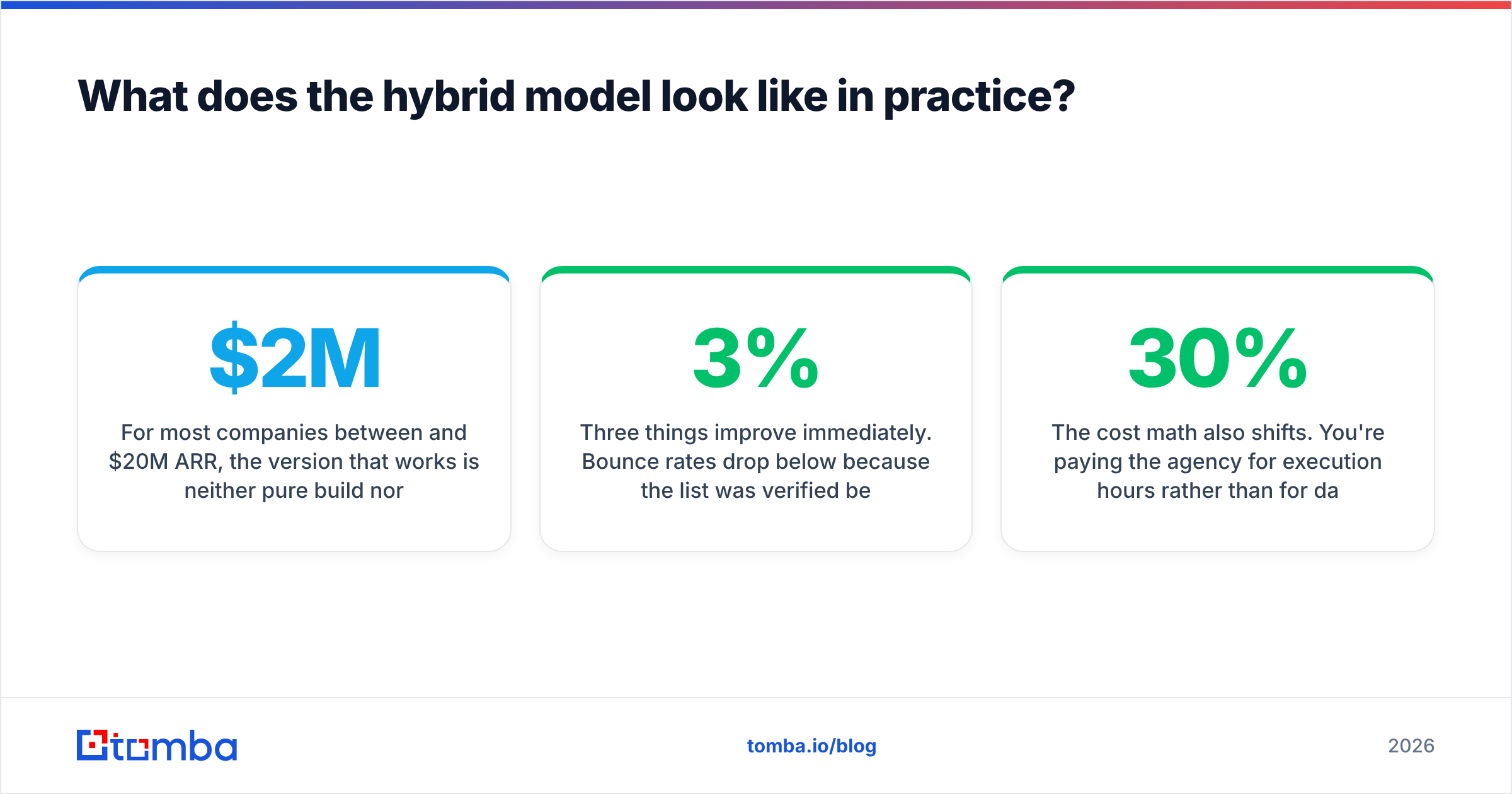
For most companies between $2M and $20M ARR, the version that works is neither pure build nor pure buy. You keep the parts that compound and rent the parts that don't.
You keep: ICP definition, account selection, contact data, messaging, the CRM, and the domains. These are assets. They appreciate.
You rent: dialing hours, sequence execution, meeting scheduling, and calendar chasing. These are labor. They don't appreciate.
Operationally, that means your RevOps or growth person builds the target account list in-house — pulling contacts with a bulk email finder, verifying them, and enriching with role, seniority, and tech-stack signals — then hands a clean, verified, prioritized list to the agency. The agency's job becomes execution against a list they didn't build, with quality gates they can't bypass.
Three things improve immediately. Bounce rates drop below 3% because the list was verified before it shipped. Targeting stops drifting, because the vendor can't pad volume with off-ICP contacts. And when the contract ends, you still have the accounts, the contacts, the notes, and the sequences — you're not starting from zero.
The cost math also shifts. You're paying the agency for execution hours rather than for data and strategy you're already producing, which typically knocks 20–30% off the per-rep rate. Vendors will agree to this; it lowers their delivery cost too.
What should you measure in the first 90 days?#
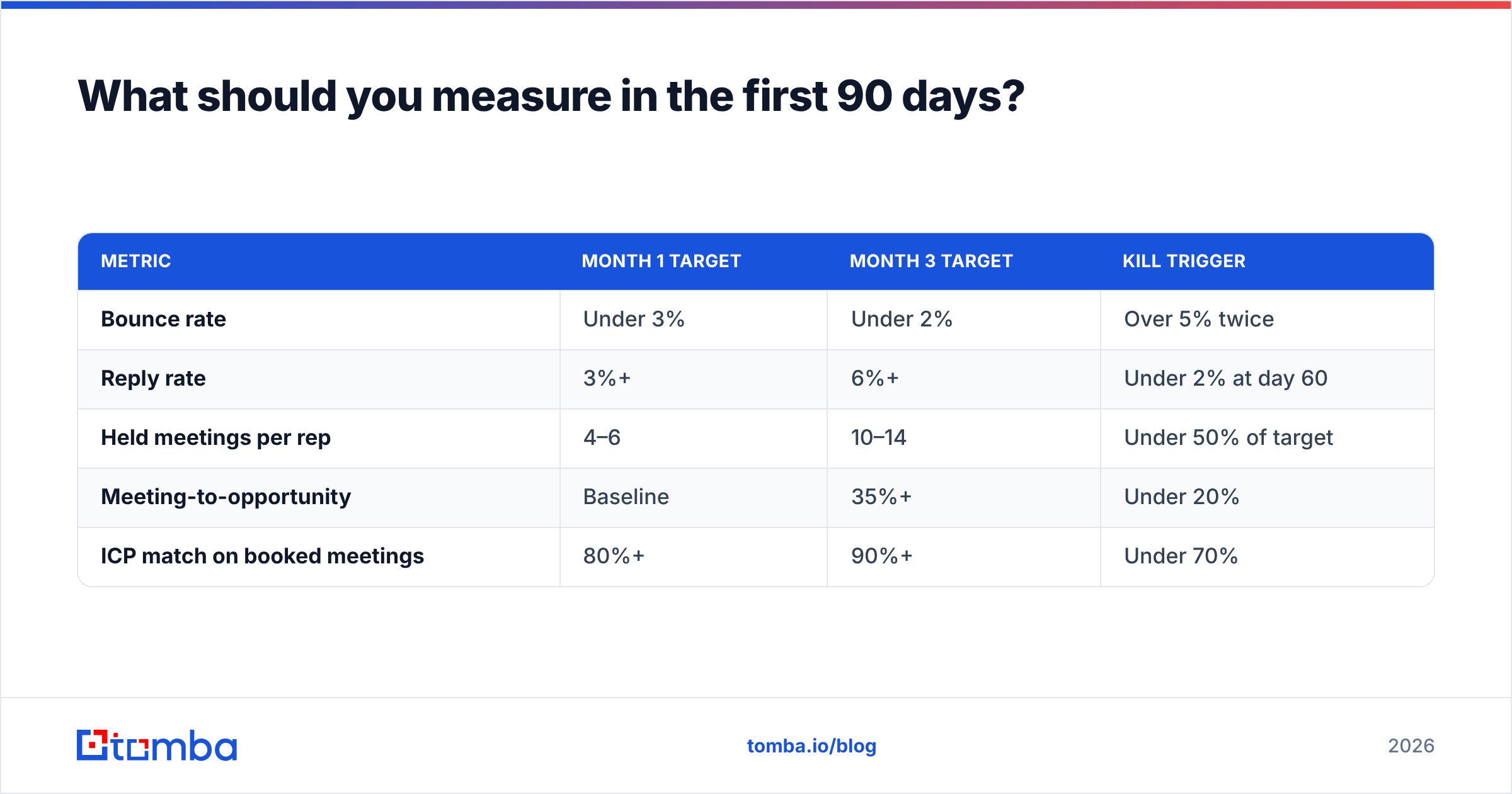
Set these before kickoff, not after the first disappointing QBR:
| Metric | Month 1 target | Month 3 target | Kill trigger |
|---|---|---|---|
| Bounce rate | Under 3% | Under 2% | Over 5% twice |
| Reply rate | 3%+ | 6%+ | Under 2% at day 60 |
| Held meetings per rep | 4–6 | 10–14 | Under 50% of target |
| Meeting-to-opportunity | Baseline | 35%+ | Under 20% |
| ICP match on booked meetings | 80%+ | 90%+ | Under 70% |
That last row is the one nobody tracks and everybody should. Have your AEs tag every agency-sourced meeting as in-ICP or out-of-ICP in the CRM. A vendor hitting meeting quota with 55% ICP match is destroying value, not creating it — and the number makes the conversation factual instead of emotional.
Should you outsource inside sales in 2026?#
Outsource execution, never own judgment. If your playbook is documented, your ICP is defined, and your data is clean, an agency can pour fuel on it within 30 days. If any of those three are missing, outsourcing converts an internal problem into an external one — at $8K a month, with a six-month minimum.
Fix the data layer first. It's the cheapest lever and the one that determines whether every downstream dollar works.
Whether you hire, outsource, or run a hybrid pod, the contact list underneath decides the outcome. Tomba Email Finder gives you verified, source-traceable business emails you own outright — so your agency executes against real people instead of guesses, and your domain reputation survives the quarter. Start free with 25 searches a month, or check Tomba pricing — Starter runs $49/mo and Growth $99/mo, which is roughly one percent of what an outsourced SDR seat costs.
Related guides#
Ready to find emails that actually work?
Join 150,000+ professionals who stopped guessing and started sending. Free credits on signup — no credit card required.
Get the Tomba newsletter
Practical outbound tactics and product updates — once every two weeks.
About the author