Inside Sales Rep vs Outside Sales Rep: 2026 Cost Comparison
Inside reps cost less and close more deals per month. Outside reps win bigger contracts. Here is the cost, quota, ramp, and win-rate math that tells you which one your next hire should be.
TL;DR
- An inside sales rep sells remotely (phone, email, video, LinkedIn). An outside sales rep sells in person (field visits, on-site demos, events, dinners).
- Fully loaded, an outside rep typically costs 40–70% more per year than an inside rep once travel, vehicle, entertainment, and expense overhead are counted.
- Inside reps win on activity volume and cost per opportunity. Outside reps win on average contract value and complex, multi-stakeholder deals.
- Ramp is the hidden variable: inside reps usually reach quota in 3–5 months, outside reps in 6–9.
- Most teams in 2026 are not choosing one. They route by deal size and buyer preference, and both models collapse without accurate contact data.
What is the difference between an inside sales rep and an outside sales rep?#
The short version: location changes almost everything downstream of it.
An inside sales rep works from a desk (office or home) and never meets the buyer physically. Their day is calls, sequenced email, video demos, and CRM hygiene. An outside sales rep — also called a field rep or territory rep — spends a large share of their week in front of buyers: site visits, lunches, trade-show booths, regional conferences.
That single difference cascades into five structural gaps:
- Cost structure. Inside reps are a mostly fixed cost: salary, seat licenses, dialer, data. Outside reps add a variable layer — flights, mileage or a car allowance, hotels, client entertainment — that scales with activity rather than results.
- Deal profile. Outside reps are usually deployed where contract value justifies a plane ticket. Inside reps handle deals where the math of a visit never works.
- Activity volume. An inside rep can touch 40–80 accounts a day. A field rep covering a region realistically manages 3–6 meaningful buyer interactions a day, travel included.
- Coverage model. Inside teams are organized by segment, vertical, or inbound queue. Outside teams are organized by geography, because geography is the constraint.
- Data dependency. Inside reps fail instantly on bad contact data — a wrong email is a bounce and a dead sequence. Outside reps fail slower but more expensively, because a wrong contact means a wasted trip.
That last point is the one most hiring plans ignore. Both roles are only as good as the list in front of them, which is why a verified email finder and a working phone finder sit upstream of every comp model below.
How do inside and outside sales reps compare on cost, quota, and ramp?#
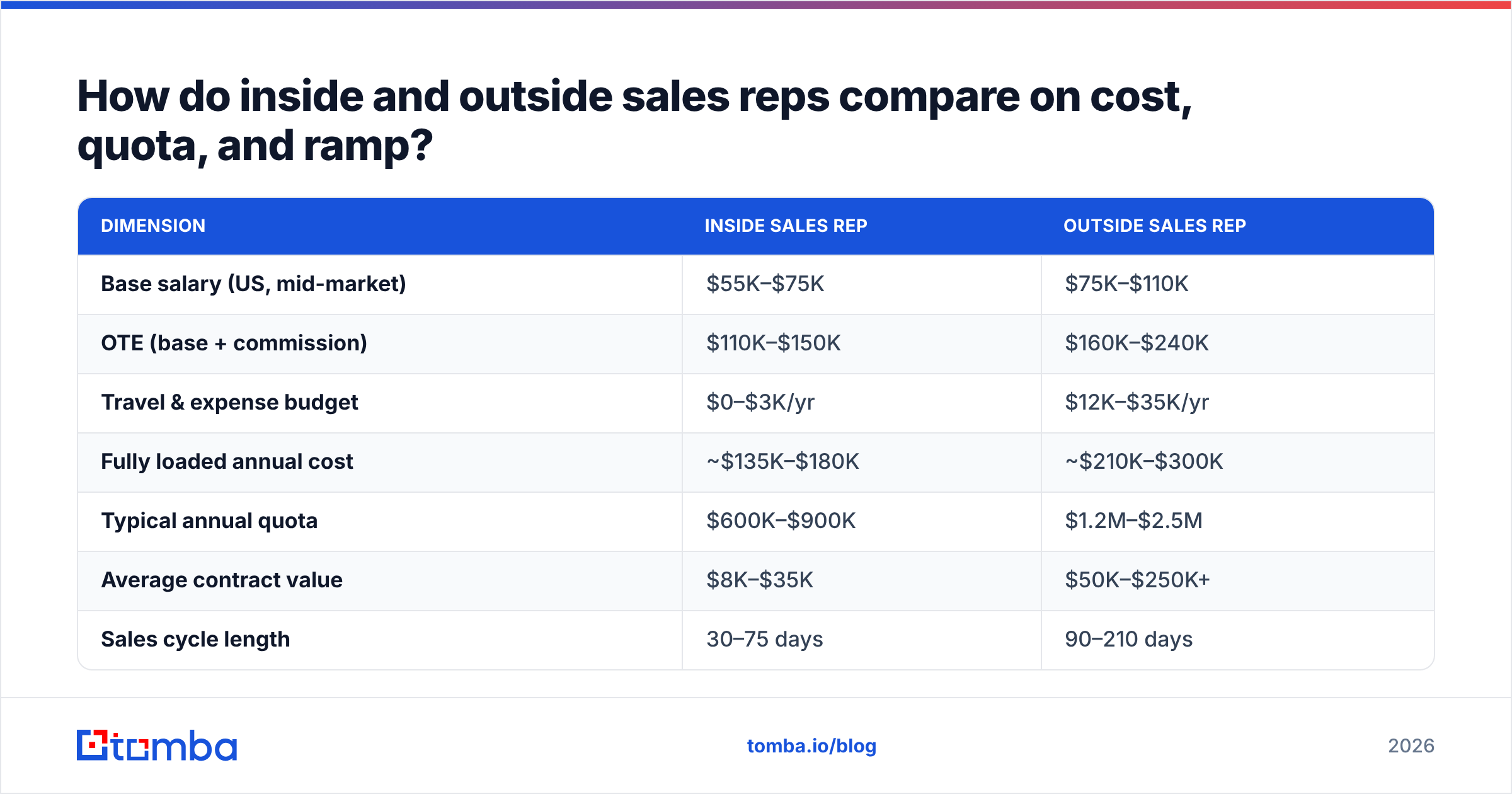
Here is the side-by-side that actually drives the hiring decision. Figures are typical 2026 B2B SaaS and mid-market ranges in the US; adjust for your region and vertical.
| Dimension | Inside Sales Rep | Outside Sales Rep |
|---|---|---|
| Base salary (US, mid-market) | $55K–$75K | $75K–$110K |
| OTE (base + commission) | $110K–$150K | $160K–$240K |
| Travel & expense budget | $0–$3K/yr | $12K–$35K/yr |
| Fully loaded annual cost | ~$135K–$180K | ~$210K–$300K |
| Typical annual quota | $600K–$900K | $1.2M–$2.5M |
| Average contract value | $8K–$35K | $50K–$250K+ |
| Sales cycle length | 30–75 days | 90–210 days |
| Meetings held per week | 12–20 | 5–10 |
| Time to full productivity | 3–5 months | 6–9 months |
| Cost per closed-won deal | Lower | Higher (but higher revenue per deal) |
| Best fit | Volume, SMB/mid-market, product-led | Enterprise, regulated, hardware, channel |
| Manageability / coachability | High (calls recorded, live QA) | Lower (field visibility gap) |
Two numbers in that table deserve attention.
First, cost per closed deal is not the metric that decides this. An outside rep costing double an inside rep is still the right hire if their average deal is five times larger. Run the ratio, not the absolute.
Second, ramp is a cash-flow event. A six-to-nine-month ramp on a $250K fully loaded field rep means you are spending roughly $150K before the first renewal-grade deal lands. Inside reps get to payback materially faster, which is why capital-constrained teams over-index there.
What does an inside sales rep actually do all day?#
An inside rep's week is measurable in a way a field rep's is not. A healthy pattern looks like:
- Morning block (2–3 hours): prospecting — cold calls, sequenced email, LinkedIn touches against a target list built that week.
- Midday: discovery calls and demos over video, back to back, usually 4–6 per day at full ramp.
- Afternoon: follow-up, proposal edits, CRM updates, multithreading into secondary stakeholders.
- Weekly: pipeline review with a manager who can listen to recorded calls and coach on specific moments.
The role lives or dies on list quality. A rep running 60 touches a day against a list with a 25% bounce rate is not doing 60 touches — they are doing 45, plus damaging their domain. Teams that run bulk verification before a sequence launches routinely see bounce rates drop under 3%, and that alone is worth more than any new dialer.
Inside sales also compounds. Because everything is logged, patterns surface: which subject lines get replies, which personas answer the phone at 8:10am, which objection kills deals at stage three. HubSpot's sales research has documented this feedback loop for years — remote selling generates the telemetry that in-person selling hides.
What does an outside sales rep actually do all day?#
Field selling is lumpier. A representative week:
- Monday: territory planning, route optimization, CRM catch-up from the previous week.
- Tuesday–Thursday: on the road. Two to four buyer meetings per day if the territory is dense, one or two if it is not. Plus travel, waiting, and the informal conversations that are the actual value of being there.
- Friday: proposals, internal handoffs, forecast calls.
What the field rep buys you is access and trust in situations where a video call cannot carry the weight: a $400K manufacturing contract, a regulated healthcare procurement, a channel partnership with four executives in the room, a renewal where the incumbent relationship is the entire moat. Gartner's sales research has repeatedly found that complex B2B buying groups now involve six to ten stakeholders, and in-person selling remains disproportionately effective at moving the stakeholders who never join a Zoom.
The trade-off is visibility. You cannot review a hallway conversation. Managing field reps means managing outcomes and CRM discipline rather than behavior, which raises the bar on who you hire.
Which model wins for your deal size?#
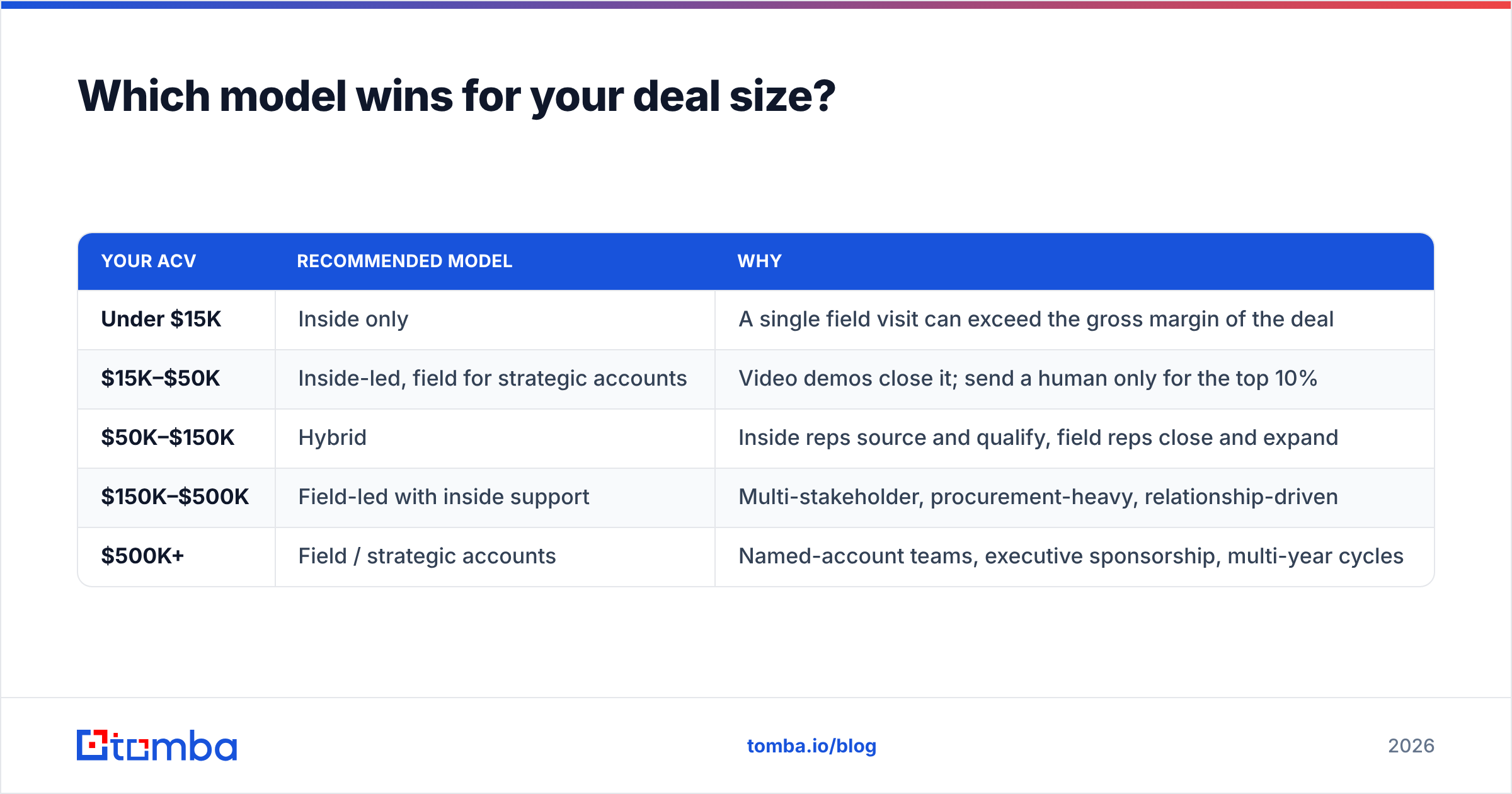
Use average contract value as the primary router, then adjust for buyer preference.
| Your ACV | Recommended model | Why |
|---|---|---|
| Under $15K | Inside only | A single field visit can exceed the gross margin of the deal |
| $15K–$50K | Inside-led, field for strategic accounts | Video demos close it; send a human only for the top 10% |
| $50K–$150K | Hybrid | Inside reps source and qualify, field reps close and expand |
| $150K–$500K | Field-led with inside support | Multi-stakeholder, procurement-heavy, relationship-driven |
| $500K+ | Field / strategic accounts | Named-account teams, executive sponsorship, multi-year cycles |
Two overrides to that table:
- Buyer preference beats ACV. If you sell to municipal government, construction, agriculture, manufacturing, or medical devices, buyers often expect a visit regardless of deal size. If you sell to software engineers, a visit is friction.
- Geography beats both. A field rep is only economical where accounts cluster. Scattering one rep across five states produces a travel budget with a quota attached.

Is the hybrid model replacing both roles?#
Mostly, yes — and the job titles have not caught up.
The dominant 2026 structure is not "inside team versus outside team." It is a single pipeline with a routing rule: everything is worked remotely by default, and physical presence is spent as a scarce resource on deals that clear a value threshold. Look at how the roles on G2's sales engagement category are described now and you will see the same blur — sequencing, dialing, and video are baseline expectations for reps who also fly to a QBR twice a quarter.
Practically, hybrid means three things:
- One source of truth. Field and inside reps share the same CRM records, the same sequences, and the same contact data. No parallel spreadsheets.
- Shared credit. If an inside rep sources a deal that a field rep closes, comp has to split cleanly or the handoff will break within a quarter.
- Travel as a spend decision. Every trip should have an approval logic attached: stage, deal size, stakeholder count. Otherwise travel expands to fill the budget.
The teams that get this wrong usually do so at the comp plan, not the org chart. Two reps working the same account with misaligned incentives will burn the account faster than no rep at all.
How should you comp and staff each role?#
Rough starting points, then tune against your actual win rates:
- Inside sales rep: 50/50 to 60/40 base-to-variable split. Commission on closed-won, accelerators above 100%. Quota at roughly 5–6x fully loaded cost.
- Outside sales rep: 60/40 to 70/30, weighted more toward base because cycles are long and lumpy. Quota at roughly 6–8x fully loaded cost, with multi-quarter smoothing so one slipped enterprise deal does not zero a rep's year.
- SDR support ratio: 1 SDR per 2–3 inside reps; 1 SDR per 1–2 field reps, because field reps have less time to self-source.
- Manager span: 6–8 inside reps per manager (call coaching is time-intensive but co-located); 5–6 field reps per manager.
- Territory sizing: for field, cap drive time at roughly 90 minutes to the 80th-percentile account. Past that, the model quietly becomes inside sales with a car allowance.
One more staffing rule that rarely makes the spreadsheet: hire inside first, field second. Inside reps teach you your ICP cheaply. Once you know which segments convert and where the money concentrates, you know where a field rep's territory should be drawn. Doing it the other way around means paying enterprise-rep prices for market research.
What data does each model actually need?#
Different failure modes, same root cause.
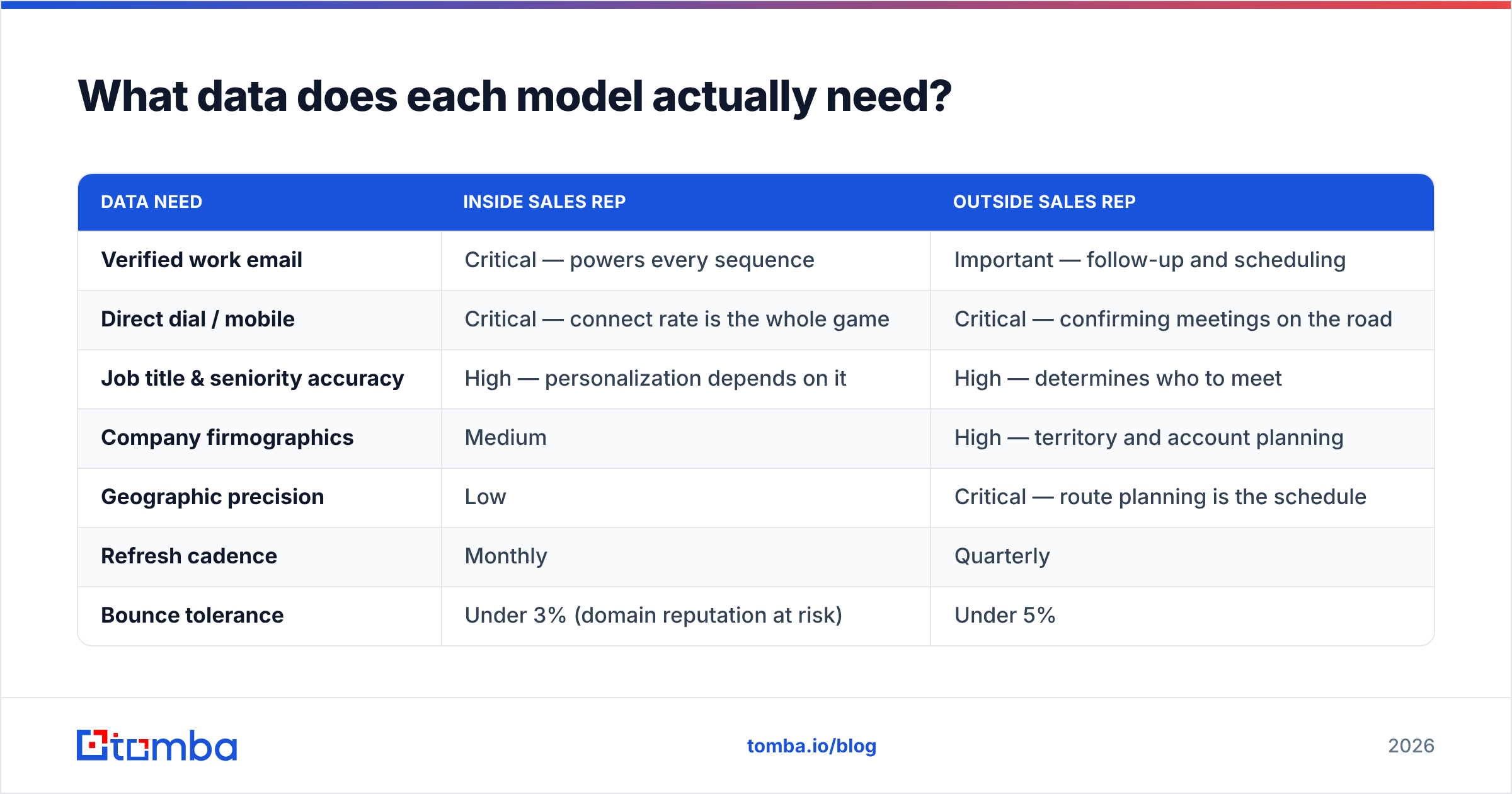
| Data need | Inside sales rep | Outside sales rep |
|---|---|---|
| Verified work email | Critical — powers every sequence | Important — follow-up and scheduling |
| Direct dial / mobile | Critical — connect rate is the whole game | Critical — confirming meetings on the road |
| Job title & seniority accuracy | High — personalization depends on it | High — determines who to meet |
| Company firmographics | Medium | High — territory and account planning |
| Geographic precision | Low | Critical — route planning is the schedule |
| Refresh cadence | Monthly | Quarterly |
| Bounce tolerance | Under 3% (domain reputation at risk) | Under 5% |
For inside teams, the leverage is in list hygiene at scale: run every import through an email verifier before it touches a sequence, and re-verify quarterly because roughly a quarter of B2B contact data decays every year. For field teams, the leverage is in enrichment: knowing the org chart, the headcount, and the tech stack of an account before you burn a day driving to it. That is what data enrichment is for — turning a company name into a briefing.
The economics are blunt. A bounced email costs an inside rep a few minutes. A wasted field visit costs $600 and a day. Data quality is not an ops nicety in either model; it is the difference between the quota math working and not.
Which should you hire next?#
Answer four questions:
- What is your average contract value? Under $50K, hire inside. Over $150K, hire field. In between, hybrid.
- Where are your best accounts geographically? Clustered means field is viable. Scattered means it is not.
- How much runway do you have? Short runway favors the 3–5 month inside ramp over the 6–9 month field ramp.
- What do your buyers expect? Ask ten closed-won customers whether a visit would have mattered. Their answer outranks any benchmark table, including this one.
If you are still genuinely split, hire the inside rep. It is the cheaper experiment, it produces more data per dollar, and a strong inside rep can be promoted into a field territory once you have proven one exists.
Give both models a list worth working#
Whatever mix you land on, the bottleneck is the same: reps need verified, current contact data for the exact people who can sign.
Tomba Email Finder finds professional email addresses by name, domain, or company, with verification built into the same workflow — so inside reps launch sequences that land and field reps confirm the right stakeholder before they book the flight. Start on the free tier (25 searches a month) to test accuracy against your own known-good contacts, then scale up; Tomba pricing runs $49/mo for Starter, $99/mo for Growth, and $249/mo for Pro, with Enterprise available for larger data volumes.
Build the list first. The org chart is the easy part.
Related guides#
Ready to find emails that actually work?
Join 150,000+ professionals who stopped guessing and started sending. Free credits on signup — no credit card required.
Get the Tomba newsletter
Practical outbound tactics and product updates — once every two weeks.
About the author