Inside Sales Representative Skills: The 2026 Skill Stack
Most inside sales skill lists are recycled filler. This breakdown separates the skills that actually correlate with quota attainment from the ones that just look good on a job description.
TL;DR
- Inside sales representative skills split into three layers: data hygiene, conversation control, and pipeline discipline. Most training programs only teach the middle layer, which is why reps plateau.
- The single highest-leverage skill is not objection handling — it is building a clean, verified contact list before dialing. Bad data caps every downstream skill.
- Discovery quality (question depth, silence tolerance, multi-threading) separates top-quartile reps from the median more reliably than talk track polish.
- Tool fluency is now a hiring criterion: CRM hygiene, sequencer logic, and enrichment APIs are expected on day one, not month six.
- A realistic ramp for a new inside sales rep is 90 days across four skill blocks — not a single onboarding week.
What does an inside sales representative actually do in 2026?#
An inside sales representative sells remotely — phone, email, video, chat — without traveling to the buyer. That definition has held for two decades. What changed is the ratio of work.
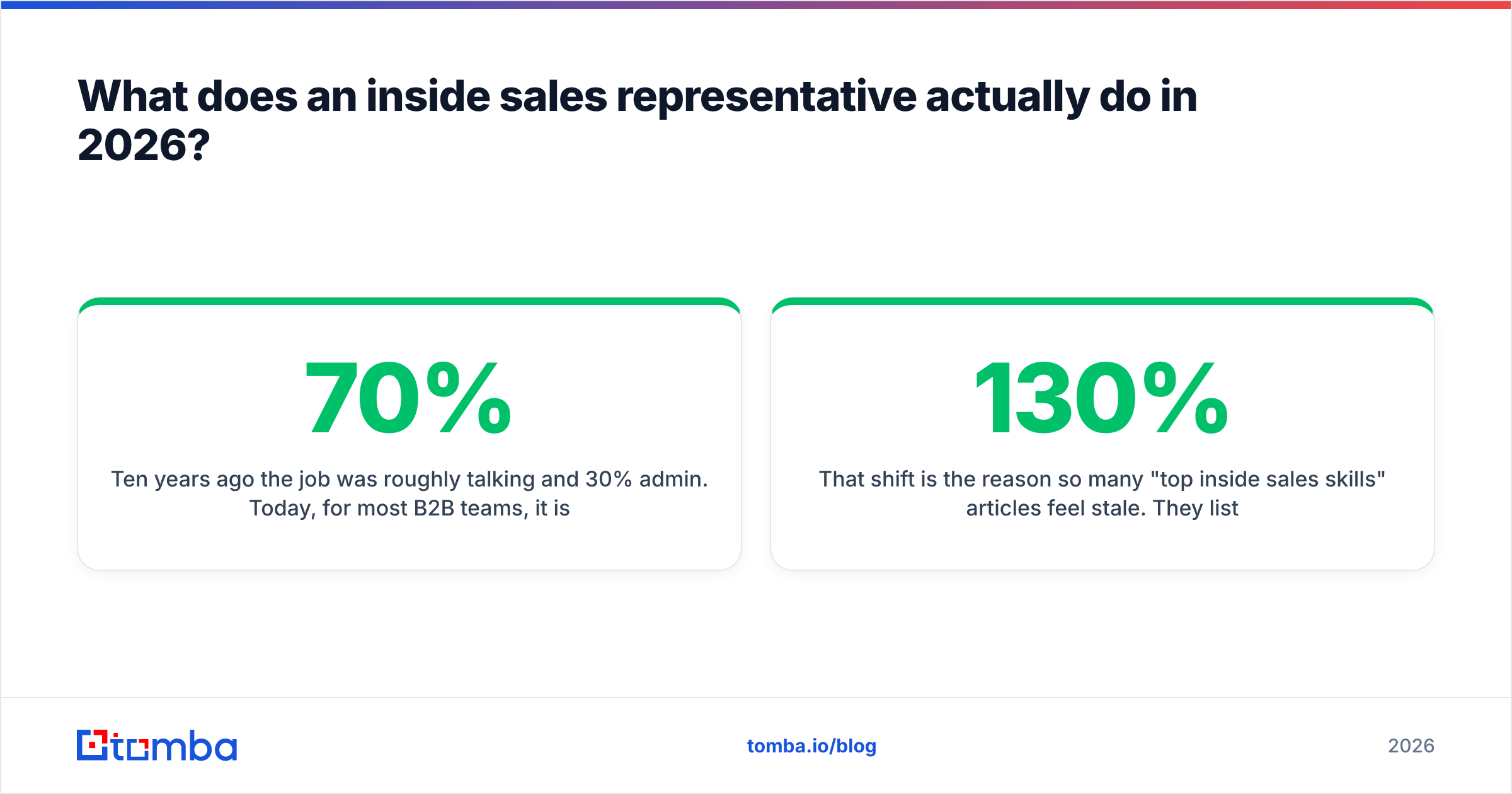
Ten years ago the job was roughly 70% talking and 30% admin. Today, for most B2B teams, it is closer to 40% talking, 35% research and list building, and 25% CRM and sequencer operations. Buyers are harder to reach, mailbox providers are stricter, and a rep who cannot assemble their own target list is dependent on whatever marketing hands them.
That shift is the reason so many "top inside sales skills" articles feel stale. They list persistence, active listening, and product knowledge — all real, all necessary, none sufficient. The rep who hits 130% of quota in 2026 is usually the one who does the boring pre-call work better, not the one with the smoothest voice.
Think of it like a restaurant kitchen. Everyone focuses on the chef's knife technique, but the restaurants that fail usually fail at sourcing and prep. Technique applied to bad ingredients still produces a bad plate.
Which inside sales representative skills actually correlate with quota?#
Here is the stack that matters, ordered by leverage rather than by how often it appears on a job posting.
- List construction and data verification. Knowing how to go from an ideal customer profile to 200 verified, correctly-titled contacts without waiting on ops. This includes running a domain search against target accounts and verifying before import so bounces never touch your sending domain.
- Discovery questioning. Asking a question, then not filling the silence. Top reps average noticeably longer prospect talk time in first calls because they ask second- and third-layer questions instead of moving to the next item on a checklist.
- Written brevity. Cold and follow-up email that fits on a phone screen. The skill is deletion, not composition — cutting a 140-word draft to 60 without losing the ask.
- Multi-threading. Deliberately building relationships with three or more contacts in an account before the deal reaches procurement. Single-threaded deals are the most common source of late-stage slippage.
- CRM discipline. Logging outcomes the same day, keeping next steps dated, and maintaining a pipeline that a manager can read without translation. Unglamorous, and the fastest way to lose a forecast conversation if missing.
- Objection triage. Distinguishing a real blocker (no budget cycle until Q3) from a reflex ("send me some info"). Different responses, and treating them identically wastes half a rep's week.
Everything else — product knowledge, competitive positioning, negotiation, tone on the phone — sits on top of these six. Strong fundamentals make them learnable in weeks. Weak fundamentals make them irrelevant.
How do inside sales skills differ from outside sales skills?#
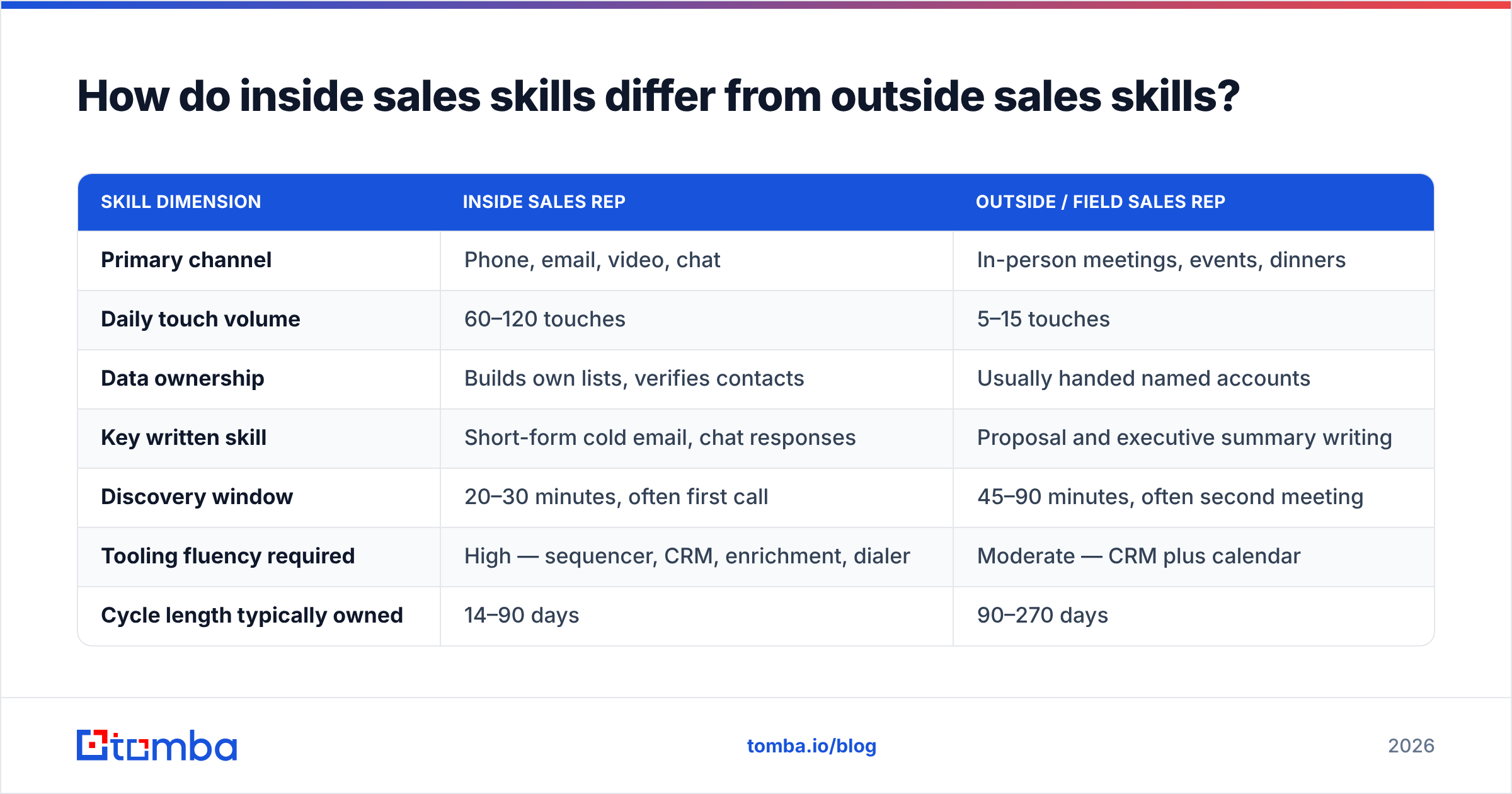
The overlap is large but the emphasis is different, and hiring the wrong profile for the motion is a common and expensive mistake.
| Skill dimension | Inside sales rep | Outside / field sales rep |
|---|---|---|
| Primary channel | Phone, email, video, chat | In-person meetings, events, dinners |
| Daily touch volume | 60–120 touches | 5–15 touches |
| Data ownership | Builds own lists, verifies contacts | Usually handed named accounts |
| Key written skill | Short-form cold email, chat responses | Proposal and executive summary writing |
| Discovery window | 20–30 minutes, often first call | 45–90 minutes, often second meeting |
| Tooling fluency required | High — sequencer, CRM, enrichment, dialer | Moderate — CRM plus calendar |
| Cycle length typically owned | 14–90 days | 90–270 days |
| Failure mode | Volume without qualification | Relationship without pipeline math |
The practical takeaway: an inside sales rep is judged on throughput and quality, and the tooling layer is not optional. A field rep can survive mediocre CRM habits because they carry fewer deals. An inside rep carrying 40 open opportunities cannot.
Why is data quality an inside sales skill and not an ops problem?#
Because the feedback loop is too slow when you outsource it.
Run the math on a typical week. A rep sends 250 cold emails. If the list is 88% deliverable, roughly 30 bounce. Thirty bounces in a week is enough to push a sending domain's reputation into the range where mailbox providers start filtering the good sends too. The rep's reply rate drops, and they attribute it to messaging. They rewrite the copy. Nothing improves, because copy was never the variable.
The rep who verifies first never enters that loop. They also never have the second, quieter problem: emailing a contact who left the company nine months ago and reading the silence as disinterest.
Three habits make up this skill:
- Verify before import, not after bounce. Run every new list through an email verifier and drop anything not marked deliverable. Treat catch-all domains as a separate bucket with their own send limits.
- Re-verify quarterly. B2B contact data decays meaningfully every year through job changes alone. A list that was clean in January is not clean in October.
- Know your patterns. If you can identify a company's email format from two known contacts, you can build the rest of the org chart yourself instead of filing a data request and waiting three days.
HubSpot's sales research consistently shows prospecting as the step reps rate hardest — and most of that difficulty is mechanical, not psychological. It is hard because the inputs are messy.
What conversation skills separate top reps from average ones?#
Four behaviors show up repeatedly in call reviews of high performers.
They ask a follow-up to their own question. Average rep: "What's your current process?" — gets an answer — moves on. Top rep: "What's your current process?" — gets an answer — "What breaks first when volume doubles?" The second question is where the deal actually lives.
They tolerate four seconds of silence. After a prospect finishes a thought, most reps jump in within one second. Holding for three to four seconds reliably produces an addendum, and the addendum is usually more honest than the first answer.
They name the negative. "It sounds like this isn't a priority until your renewal in March — is that fair?" Giving the prospect permission to disqualify themselves saves weeks and, counterintuitively, often produces a correction: "No, actually, we need this sooner."
They set the next step before ending the call. Not "I'll follow up next week" — a specific day, time, and attendee list, confirmed on the call. A dated next step in the CRM is the difference between a pipeline and a wish list. Gartner's sales research has been pointing at buying-group complexity for years; a next step with the wrong single attendee is a next step that stalls.
These are trainable. Record calls, review three per week, and score only for these four behaviors. Skill development collapses when you score for twenty things at once.

Which tools should an inside sales rep be fluent in?#
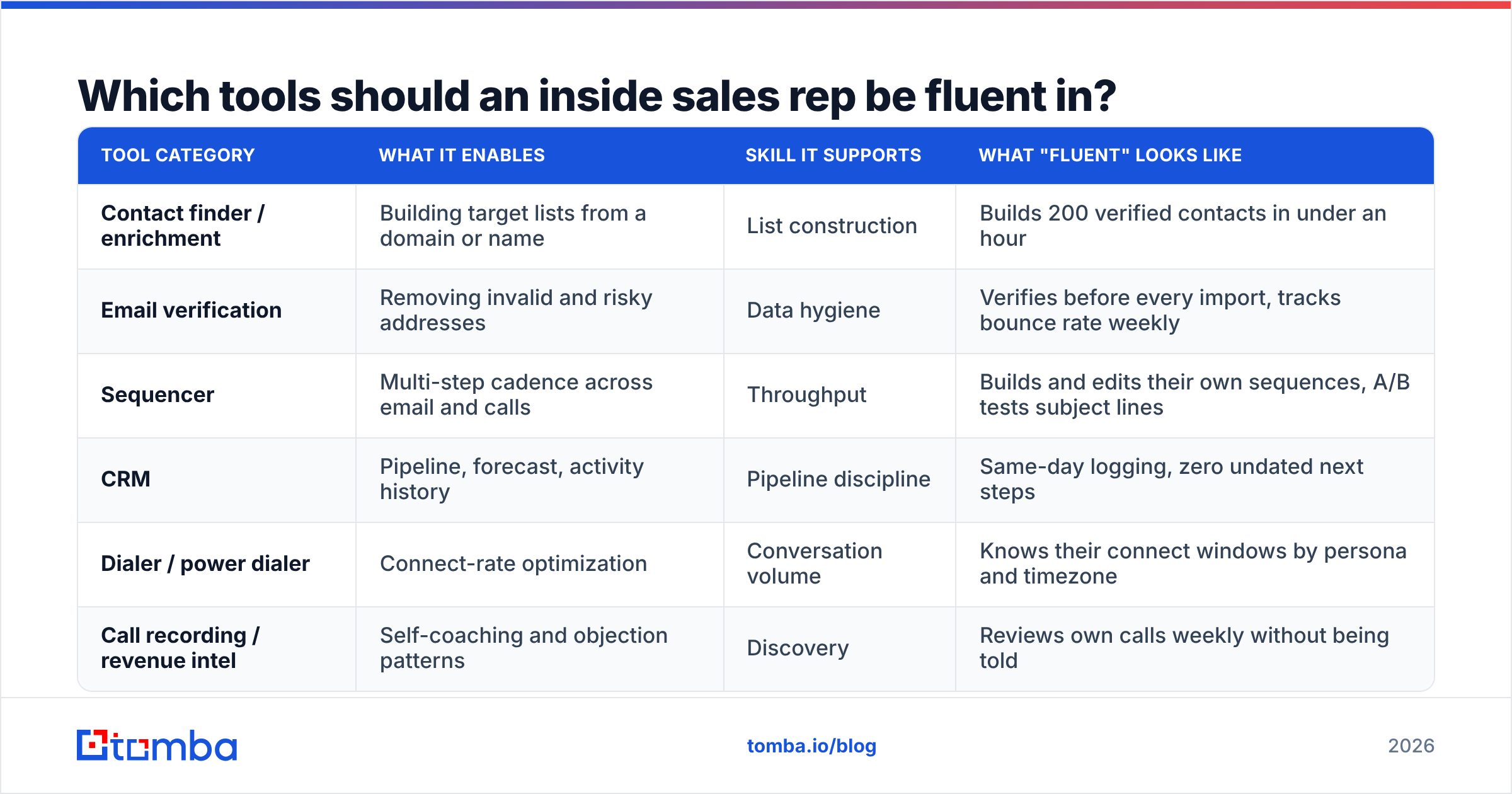
Fluency means you can operate the tool without a ticket, not that you have heard of it. Here is how the categories map to the skills above.
| Tool category | What it enables | Skill it supports | What "fluent" looks like |
|---|---|---|---|
| Contact finder / enrichment | Building target lists from a domain or name | List construction | Builds 200 verified contacts in under an hour |
| Email verification | Removing invalid and risky addresses | Data hygiene | Verifies before every import, tracks bounce rate weekly |
| Sequencer | Multi-step cadence across email and calls | Throughput | Builds and edits their own sequences, A/B tests subject lines |
| CRM | Pipeline, forecast, activity history | Pipeline discipline | Same-day logging, zero undated next steps |
| Dialer / power dialer | Connect-rate optimization | Conversation volume | Knows their connect windows by persona and timezone |
| Call recording / revenue intel | Self-coaching and objection patterns | Discovery | Reviews own calls weekly without being told |
A note on stack sprawl: the rep does not need six vendors. Several of these collapse. A platform that handles finding, verifying, and enriching in one place removes an entire class of CSV-shuffling work, which is why teams increasingly consolidate the data layer and keep the sequencer and CRM separate. Salesforce's sales resources make the same point from the CRM side — data quality is the input to everything the CRM reports on.
How do you build these skills in 90 days?#
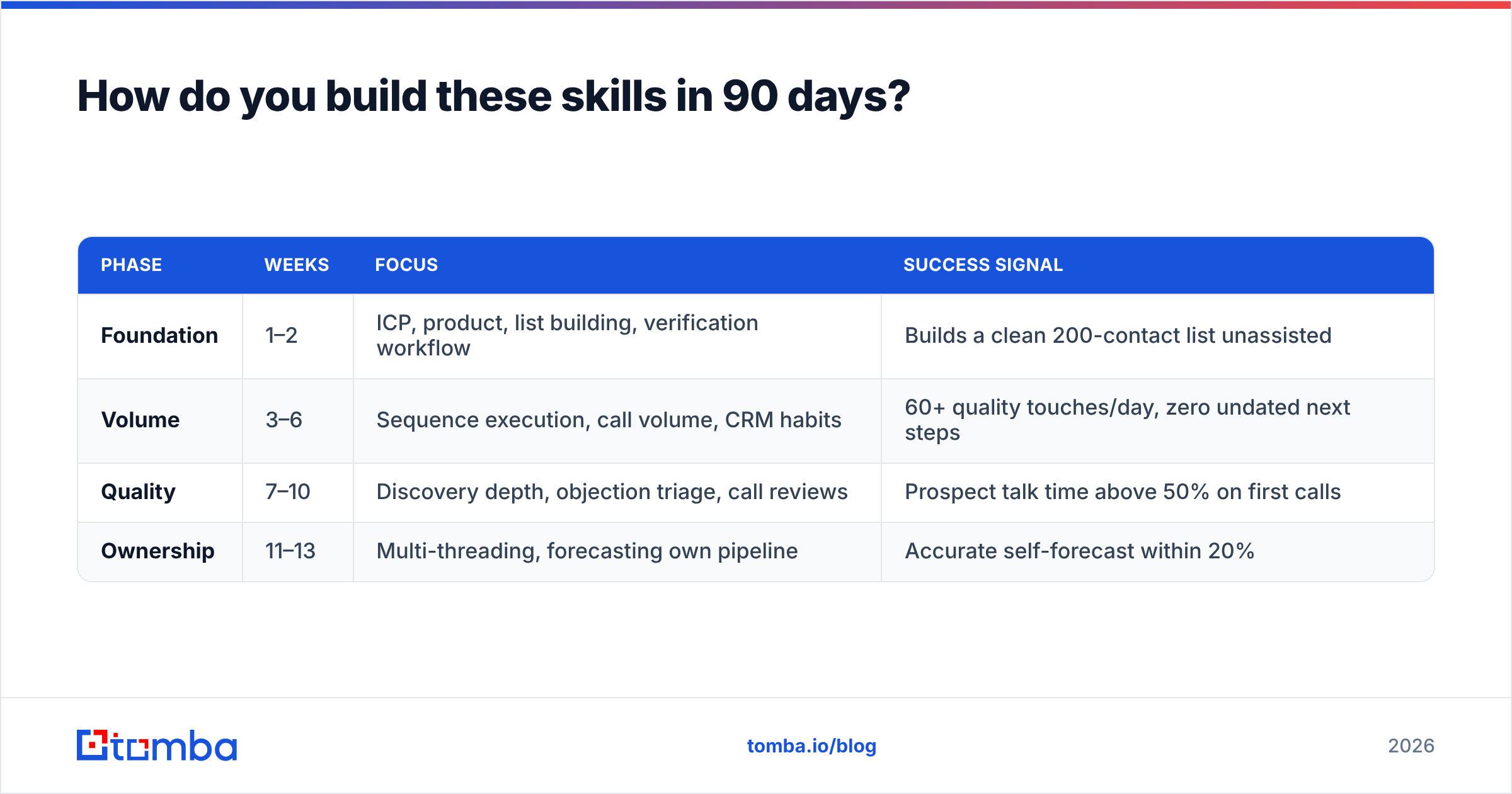
A realistic ramp plan for a new inside sales representative, or for an existing rep resetting after a bad quarter.
| Phase | Weeks | Focus | Success signal |
|---|---|---|---|
| Foundation | 1–2 | ICP, product, list building, verification workflow | Builds a clean 200-contact list unassisted |
| Volume | 3–6 | Sequence execution, call volume, CRM habits | 60+ quality touches/day, zero undated next steps |
| Quality | 7–10 | Discovery depth, objection triage, call reviews | Prospect talk time above 50% on first calls |
| Ownership | 11–13 | Multi-threading, forecasting own pipeline | Accurate self-forecast within 20% |
Two rules make this work. First, do not compress it — a rep pushed to "quality" in week three without volume reps has no sample size to learn from. Second, measure leading indicators per phase, not revenue. Revenue in week six tells you nothing about skill; verified-list size, talk-time ratio, and next-step hygiene tell you plenty.
Track response rate as the bridge metric. It moves before revenue does and it responds to both data quality and message quality, so a flat response rate with a clean list points squarely at the conversation layer.
Frequently asked questions#
What are the most important soft skills for an inside sales rep?#
Curiosity and emotional regulation. Curiosity drives the second and third discovery question. Emotional regulation is what lets a rep make call 41 with the same energy as call 4 after forty rejections. Everything else — empathy, resilience, coachability — tends to follow from those two.
Do inside sales reps still need cold calling skills?#
Yes, though the shape changed. Connect rates are lower, so the skill is now about timing and pretext — calling within minutes of a trigger event with a specific reason — rather than sheer dial volume. Reps who pair a call with a relevant email and a LinkedIn touch on the same day outperform single-channel dialers consistently.
How technical does an inside sales rep need to be?#
Not a developer, but comfortable with structured data. Filtering a spreadsheet, understanding what a deliverable-versus-catch-all result means, and reading a sequence's step logic are baseline. Reps who can work with a bulk email finder or a simple API call move faster than those who file requests.
How long until a new inside sales rep is productive?#
Assume 90 days to consistent activity quality and four to six months to a full quota contribution in a mid-market motion. Shorter cycles compress this; enterprise motions extend it. Any plan promising productivity in two weeks is measuring activity, not outcomes.
Where should you start?#
Start with the input, not the pitch. Every skill on this list compounds off a contact list that is actually correct — right person, right title, right address, verified this month.
Tomba's Email Finder is built for exactly that first block of the ramp: give it a company domain or a name, get verified professional email addresses back, and start your sequence with a list you trust instead of one you hope about. The free tier includes 25 searches a month so you can test it against accounts you already know, and paid plans start at $49/mo when you are ready to build lists at team scale. See Tomba pricing for the full breakdown.
Fix the ingredients first. The technique gets a lot easier after that.
Related guides#
// get started
Find, verify and enrich your first contacts today
Start on the free plan with 25 searches a month, then scale when your team is ready.
Free plan · No credit card required · GDPR & CCPA
// about the author