Inside Sales Reps in 2026: Role, Comp, Tools, and Quota
Inside sales reps now close deals that used to need a plane ticket. Here is what the role actually involves in 2026, what it costs, what quota is realistic, and the stack that keeps reps selling instead of researching.
TL;DR
- Inside sales reps sell remotely — phone, email, video, LinkedIn — and now handle deal sizes that used to require a field rep and a plane ticket.
- A fully loaded inside sales rep in the US costs roughly $110k–$160k per year (base + commission + tools + management overhead). Ramp takes 3–5 months before that number starts paying for itself.
- The single biggest drag on inside sales productivity is not talent or scripts. It is bad contact data: reps burning 8–10 hours a week hunting for emails and phone numbers that a lookup API returns in seconds.
- Quota should be 4–6x fully loaded cost for mid-market SaaS, 3x for longer enterprise cycles. If your reps are at 2x, you have a coverage or targeting problem, not a hustle problem.
- Hire inside sales reps when you have a repeatable ICP and a proven message. Before that, founders or a hybrid SDR/AE pod will out-perform a full team.
What is an inside sales rep?#
An inside sales rep sells without leaving the building. Everything — prospecting, discovery, demo, negotiation, close — happens over phone, email, video call, and social channels. Compare that to outside (field) sales, where the rep travels to the buyer's office, works trade shows, and closes across a conference table.
The line used to be about deal size: small deals inside, big deals outside. That line broke years ago. Buyers under 45 now overwhelmingly prefer a Zoom call to a site visit, and six- and seven-figure contracts routinely close without either party boarding a plane. What survives of the distinction is the motion, not the price tag.
Two labels get mixed into "inside sales rep," and confusing them wrecks your comp plan:
- SDR / BDR (Sales Development Rep) — top of funnel only. Prospects, qualifies, books meetings. Paid on meetings held or pipeline created. Does not close.
- Inside AE (Account Executive) — runs discovery through close. Paid on closed revenue. May self-source a portion of pipeline.
- Full-cycle inside sales rep — does both. Common in companies under ~$10M ARR and in high-velocity, low-ACV motions where handoffs cost more than they save.
- Account manager / expansion rep — sells into the existing base. Same remote toolkit, radically different skill emphasis (renewal risk, usage data, multithreading).
- Inbound rep — works demo requests and trial signups only. Highest conversion rate, smallest addressable volume, easiest to over-hire.
Pick the version you actually need before you write the job description. Hiring a full-cycle closer and then handing them an SDR's calendar is the fastest way to lose a good rep in month four.
Is inside sales better than outside sales?#
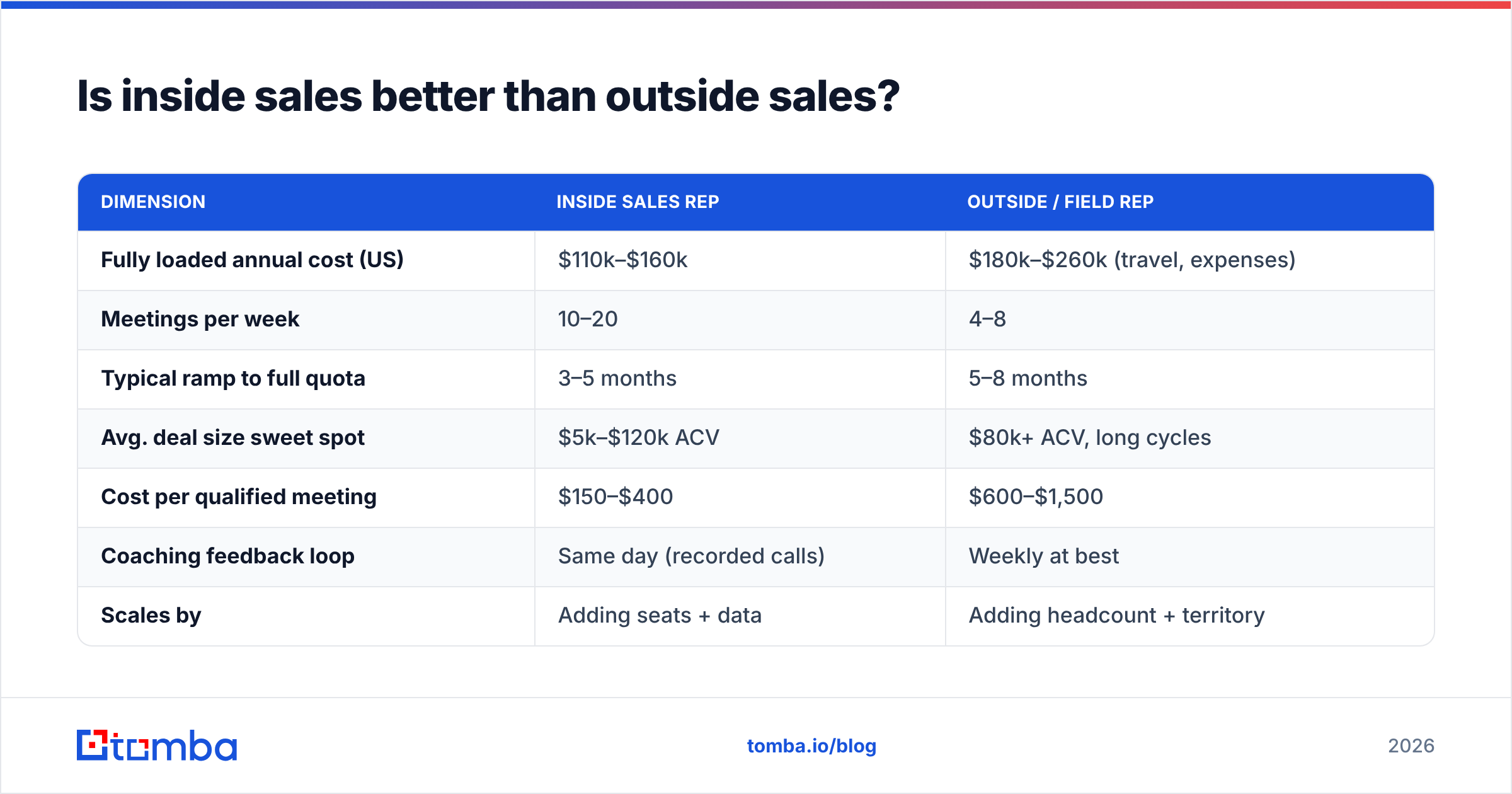
For most B2B categories in 2026, yes — on cost per meeting, cost per dollar of pipeline, and speed of iteration. Outside sales still wins in a few places: complex multi-stakeholder infrastructure deals, regulated industries where procurement wants a face, and markets where relationships are genuinely local (construction, medical devices, regional manufacturing).
Here is the honest comparison:
| Dimension | Inside sales rep | Outside / field rep |
|---|---|---|
| Fully loaded annual cost (US) | $110k–$160k | $180k–$260k (travel, expenses) |
| Meetings per week | 10–20 | 4–8 |
| Typical ramp to full quota | 3–5 months | 5–8 months |
| Avg. deal size sweet spot | $5k–$120k ACV | $80k+ ACV, long cycles |
| Cost per qualified meeting | $150–$400 | $600–$1,500 |
| Coaching feedback loop | Same day (recorded calls) | Weekly at best |
| Scales by | Adding seats + data | Adding headcount + territory |
| Best fit | SaaS, services, high-velocity B2B | Enterprise infra, regulated, local trades |
The practical takeaway: inside sales scales linearly with two inputs — seats and contact data. Field sales scales with headcount, geography, and travel budget, all of which are slower and lumpier. That is why almost every net-new sales hire in B2B SaaS since 2020 has been an inside role.
What does an inside sales rep actually do all day?#
Ask ten sales leaders and you get ten org charts. Look at actual calendar data and the week is remarkably consistent. A productive inside sales rep spends roughly:
- Selling conversations — 30–40%. Discovery calls, demos, negotiation, multithreading with the champion's boss. This is the only block that directly creates revenue.
- Prospecting and outreach — 25–30%. Dials, sequenced email, LinkedIn touches, referrals. High-performing reps protect this block with the same seriousness as a customer call.
- Research and list building — 15–25%. Finding the right accounts, the right contacts, and their contact details. This is the block you want to shrink to near-zero with tooling.
- CRM hygiene and admin — 10–15%. Notes, stage updates, forecasting, quote building. Anything above 15% here is a process tax you are paying for no reason.
- Coaching, training, and internal meetings — 5–10%. Call reviews, pipeline reviews, enablement sessions.
That third bullet is where most teams quietly bleed. A rep manually verifying emails, guessing at formats, and cross-referencing LinkedIn is doing $18/hour work on a $60/hour salary. Pushing that 20% block down to 5% gives every rep an extra half-day of selling per week — the equivalent of adding a tenth rep to a team of nine, at a fraction of the cost.
The fix is boring and it works: give reps a lookup layer instead of a research project. A domain search returns every known contact at a target company with role and confidence score, an email verifier confirms the address is live before it costs you a bounce, and a phone finder attaches a direct dial so the rep is not routed through a switchboard. Three lookups, thirty seconds, versus twenty minutes of tab-hopping.
What should you pay inside sales reps in 2026?#
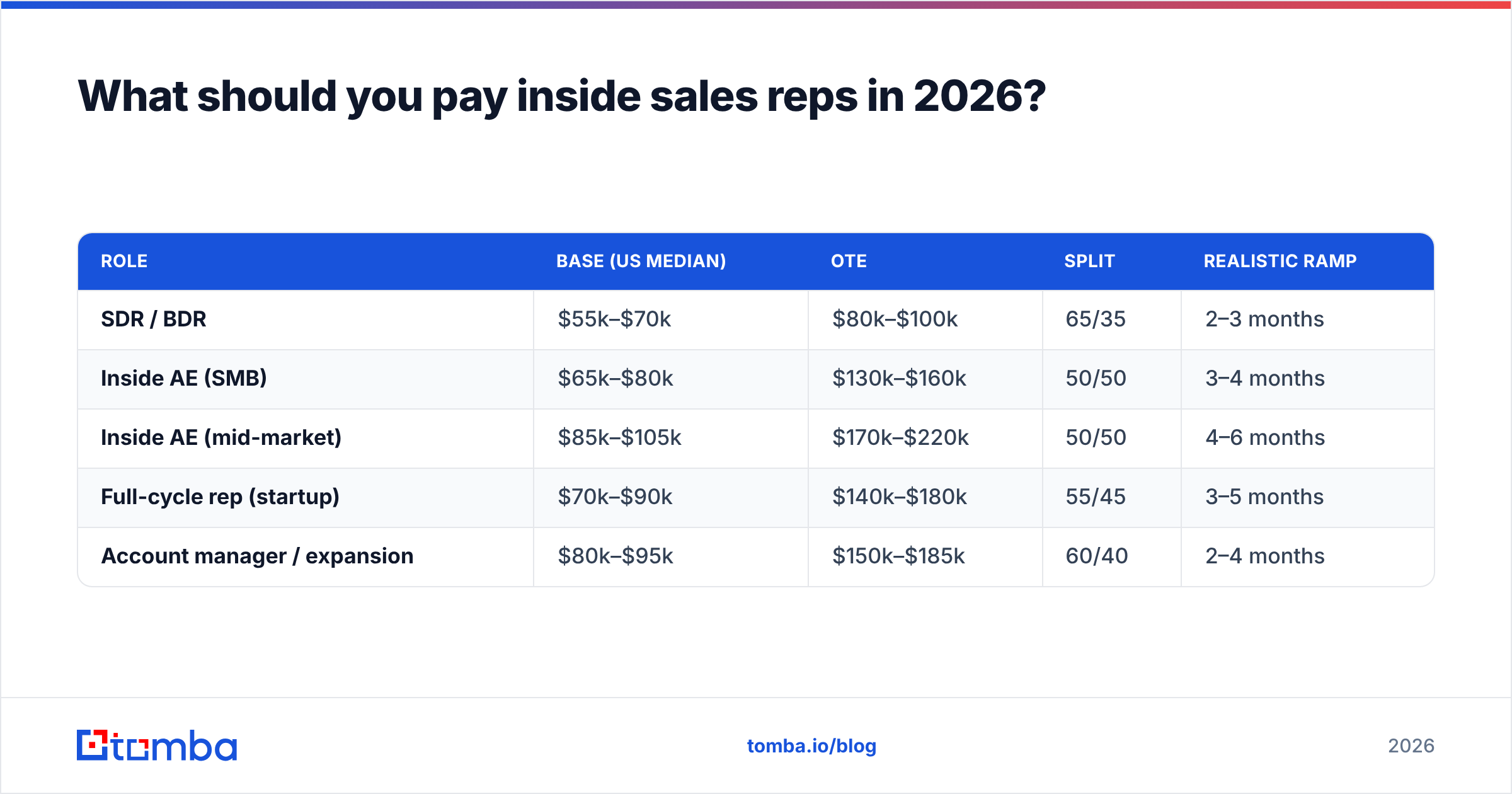
Base-to-variable splits have stayed stable even as absolute numbers drifted upward. The standard is 50/50 for closing roles and 60/40 or 70/30 for SDRs, whose output is less directly tied to revenue.
| Role | Base (US median) | OTE | Split | Realistic ramp |
|---|---|---|---|---|
| SDR / BDR | $55k–$70k | $80k–$100k | 65/35 | 2–3 months |
| Inside AE (SMB) | $65k–$80k | $130k–$160k | 50/50 | 3–4 months |
| Inside AE (mid-market) | $85k–$105k | $170k–$220k | 50/50 | 4–6 months |
| Full-cycle rep (startup) | $70k–$90k | $140k–$180k | 55/45 | 3–5 months |
| Account manager / expansion | $80k–$95k | $150k–$185k | 60/40 | 2–4 months |
Add 20–30% on top of OTE for the fully loaded number: payroll taxes, benefits, laptop, seat licenses for CRM, dialer, sequencer, and data tools, plus a share of manager time. A $150k OTE rep really costs you about $190k. Budget against that figure, not the OTE.
Two comp design rules that save arguments later. First, cap nothing in year one — if a rep blows past quota, that is a quota problem you fix at the next planning cycle, not a payout you claw back. Second, pay SDRs on meetings held and qualified, not meetings booked. Booked-meeting comp creates no-shows; held-and-qualified comp creates research.
What quota should an inside sales rep carry?#
Start from cost, not from ambition. The working ratio is quota = 4–6x fully loaded cost for velocity and mid-market motions, and 3x for longer enterprise cycles where each deal takes two-plus quarters.
So a mid-market inside AE costing you $190k fully loaded should carry roughly $760k–$950k in annual quota. If you set $1.4M because the board wants a number, you will get attrition instead of revenue.
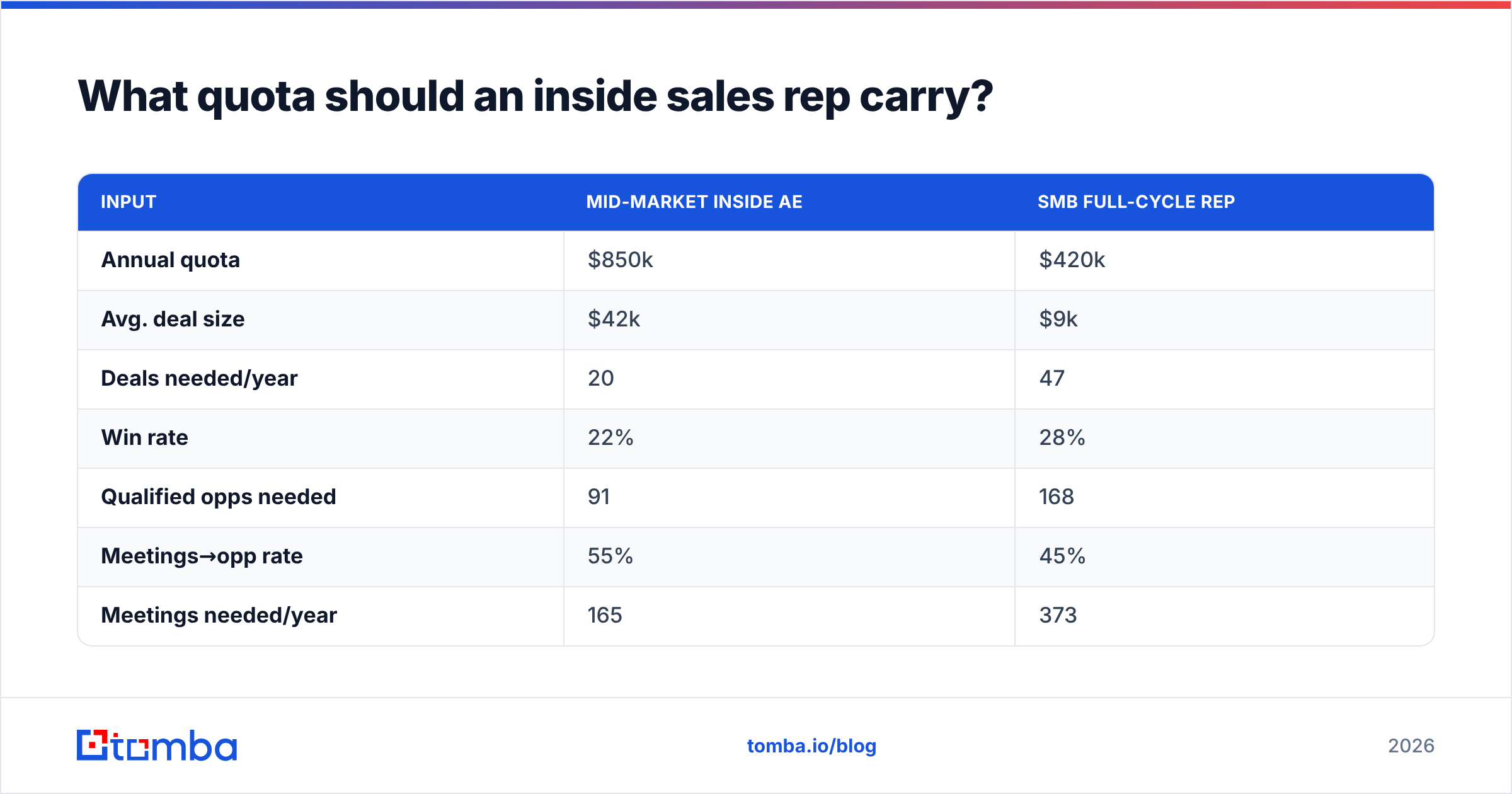
Then sanity-check coverage. A rep needs 3–4x their quota in pipeline to reliably land it, which back-solves into an activity model:
| Input | Mid-market inside AE | SMB full-cycle rep |
|---|---|---|
| Annual quota | $850k | $420k |
| Avg. deal size | $42k | $9k |
| Deals needed/year | 20 | 47 |
| Win rate | 22% | 28% |
| Qualified opps needed | 91 | 168 |
| Meetings→opp rate | 55% | 45% |
| Meetings needed/year | 165 | 373 |
| Meetings/week | ~3.5 | ~8 |
Run this math before you hire, not after the first miss. Nine times out of ten, a rep "underperforming" is actually a rep who was handed a quota that required 14 meetings a week in a market where the total addressable contact list is 400 people. That is an addressable market problem wearing a performance-management costume. Know your win rate and your true contactable universe before you sign the offer letter.
What tools does an inside sales team actually need?#
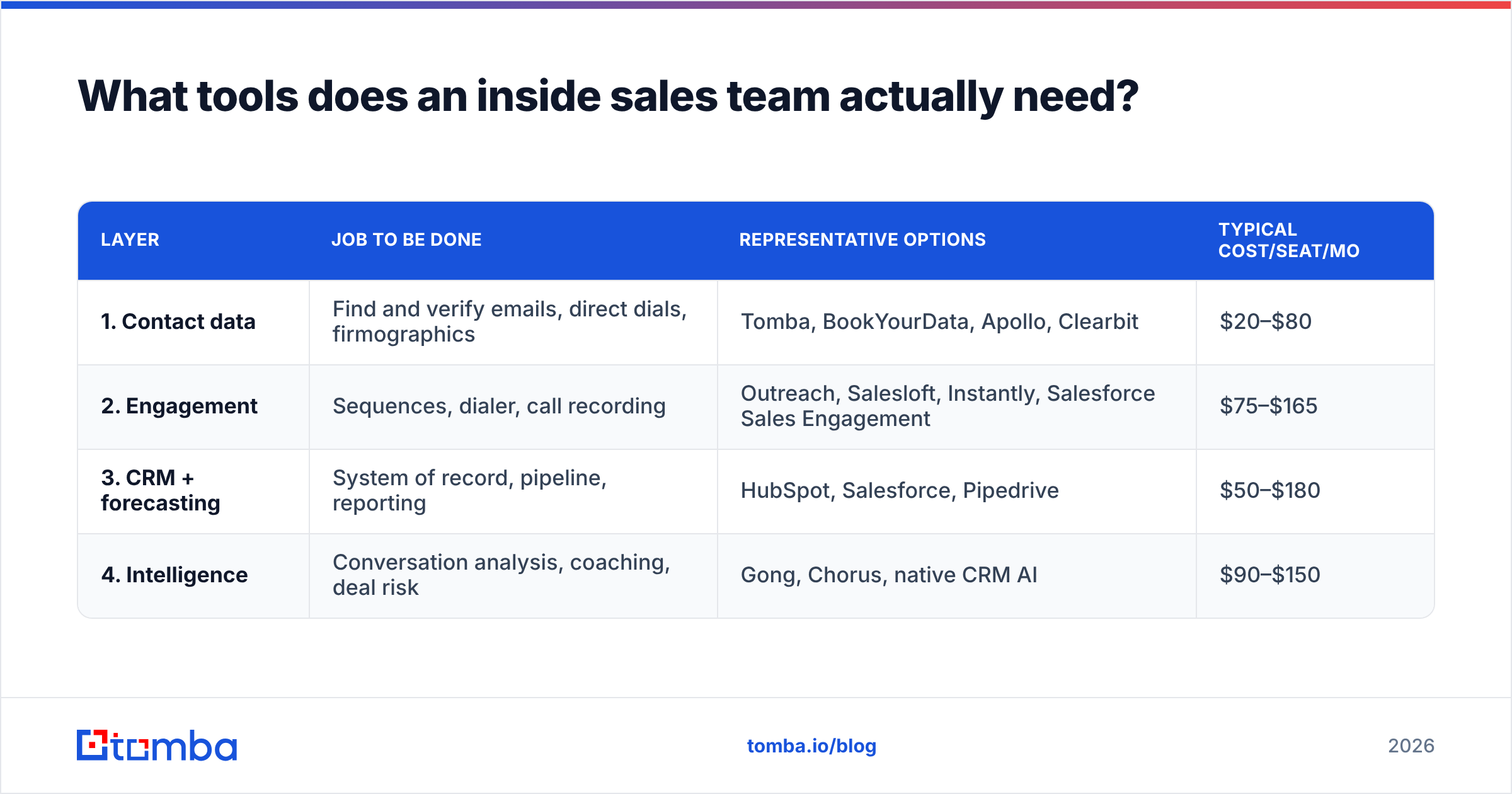
The modern inside sales stack has four layers, and teams consistently over-buy in layer three while starving layer one.
| Layer | Job to be done | Representative options | Typical cost/seat/mo |
|---|---|---|---|
| 1. Contact data | Find and verify emails, direct dials, firmographics | Tomba, BookYourData, Apollo, Clearbit | $20–$80 |
| 2. Engagement | Sequences, dialer, call recording | Outreach, Salesloft, Instantly, Salesforce Sales Engagement | $75–$165 |
| 3. CRM + forecasting | System of record, pipeline, reporting | HubSpot, Salesforce, Pipedrive | $50–$180 |
| 4. Intelligence | Conversation analysis, coaching, deal risk | Gong, Chorus, native CRM AI | $90–$150 |
A few honest observations. Layer 4 is genuinely useful, but only once you have enough call volume to find patterns — below about six reps, a manager listening to five calls a week beats any AI summary. Layer 2 is where teams overspend: if your reps send 40 emails a day, a $165/seat sequencer is not delivering $165 of incremental value over a $60 one. And layer 1 is where teams underspend, which is baffling, because every other layer's output degrades when the input list is wrong.
BookYourData is a solid choice when you want a pre-built, pay-as-you-go list with strong coverage in specific verticals. Tomba fits a different shape of need: real-time lookup and verification against a live source, which matters when you are enriching accounts one at a time as they enter the pipeline rather than buying a static file. Many teams run both — a purchased base list for coverage, live lookups for accuracy at the moment of outreach.

How do bad contact records kill inside sales performance?#
Quietly, and in four places at once.
Deliverability. A 5% bounce rate is the threshold where mailbox providers start deprioritizing your domain. Hit 8–10% and your clean, well-written emails to real prospects stop reaching inboxes. One bad list can suppress an entire team's email deliverability for weeks after you stop sending. This is why verification before send is not optional hygiene, it is revenue protection.
Connect rate. Switchboard numbers convert to conversations at roughly a quarter the rate of direct dials. If half your phone records are main lines, you have effectively cut your calling hours in half without changing a single dial target.
Rep morale. Reps do not quit because of hard quotas. They quit because of hard quotas plus tooling that makes hitting them feel arbitrary. A rep who dials 60 numbers and reaches four people because the data is stale will update their LinkedIn before they update your CRM.
Forecast accuracy. Garbage contact records produce garbage account hierarchies, which produce a pipeline report your CFO stops trusting by Q3.
The fix is procedural, not heroic: verify every address before it enters a sequence, re-verify anything older than 90 days, and make list building a system call rather than a rep task. HubSpot's own sales research and vendor comparisons on G2's sales engagement category both land in the same place — data quality outranks tooling sophistication in every productivity study that separates the two.
How do you hire and ramp inside sales reps?#
Hire for the motion you have, not the one you want. If your average cycle is 21 days and your ACV is $8k, an enterprise rep from a six-month-cycle company will struggle, regardless of their logo quality. The reverse is equally true.
A ramp plan that works:
- Week 1–2: Product, ICP, competitive landscape. Rep shadows 15 recorded calls and writes their own discovery framework rather than memorizing yours.
- Week 3–4: Live prospecting on a warm-ish segment. Manager reviews every email before send. First meetings booked.
- Week 5–8: Full activity target, 50% quota. Rep runs discovery solo, manager joins demos.
- Week 9–16: 75% quota, full autonomy, weekly call review on one deal of the rep's choosing.
- Month 5+: Full quota. If they are not at 70% of target by month six, the problem is fit or territory, and neither gets better with a PIP alone.
Two hiring signals that predict inside sales success better than résumés: a candidate who asks about your data and list-building process in the interview (they have felt the pain), and one who can run a cold discovery roleplay without slipping into a pitch.
What should you measure?#
Track five numbers per rep and ignore the rest until something breaks:
| Metric | Healthy range | What a miss tells you |
|---|---|---|
| Meetings held / week | 3–8 (role dependent) | Targeting or data coverage problem |
| Meeting→opportunity rate | 45–60% | Qualification or ICP mismatch |
| Win rate | 20–30% | Product fit, pricing, or competitive gap |
| Pipeline coverage | 3–4x quota | Prospecting volume, or stale deals inflating it |
| Email bounce rate | Under 2% | List hygiene — fix before it costs deliverability |
The bounce-rate row belongs on this list even though it looks like an ops metric. It is the earliest leading indicator you have. Bounce rate climbs weeks before response rate falls, and months before the quarter misses.
Where should you start?#
If you are building or fixing an inside sales team, fix the input layer first. It is the cheapest change with the largest multiplier: every hour a rep stops spending on research becomes an hour of selling, and every verified address is a bounce that never touches your sending domain.
Run your next target account list through the Tomba Email Finder and see how much of it your current data provider is missing or getting wrong. The free tier covers 25 searches a month so you can benchmark against your existing list before committing, and paid plans start at $49/mo with bulk lookups, verification, and API access included — full Tomba pricing is public, no demo required. Give your reps the half-day back and let them spend it on calls.
Related guides#
// get started
Find, verify and enrich your first contacts today
Start on the free plan with 25 searches a month, then scale when your team is ready.
Free plan · No credit card required · GDPR & CCPA
// about the author