Inside Sales SDR: Role, Quota, Comp, and Ramp Guide 2026
The inside sales SDR role got harder in 2026: lower reply rates, bigger quotas, and AI absorbing the busywork. Here is what the job really is, what it pays, and how to ramp a new rep in 90 days.
TL;DR
- An inside sales SDR is a remote-first sales development rep who books qualified meetings for closers. They do not carry a revenue quota, they carry a meeting quota.
- The job split that matters in 2026 is not SDR vs BDR. It is "who owns the list" vs "who owns the conversation." Reps who own both burn out.
- Realistic benchmarks today: 10-18 qualified meetings per month in SMB, 6-10 in mid-market, 4-8 in enterprise. Anyone promising 30 is counting no-shows.
- Typical US OTE lands roughly in the $55k-$95k band depending on segment and city, usually a 70/30 base-to-variable split.
- The biggest performance lever is not activity volume. It is contact data quality. Bad emails inflate bounce rates, kill domain reputation, and make good messaging look broken.
What is an inside sales SDR?#
An inside sales SDR is a sales development representative who prospects entirely from a desk, phone, and laptop. No territory driving, no trade-show booth duty, no field visits. They find accounts, find the humans inside those accounts, and start conversations until enough of those conversations turn into booked meetings for an account executive.
Think of a restaurant. The AE is the chef. The SDR is the person who decides which ingredients come through the back door. If the ingredients are wrong, the chef's skill barely matters. That is the whole role in one sentence: the SDR controls input quality for the revenue engine.
Technically, "inside sales" just means the selling happens remotely rather than face-to-face. Since most B2B buying now happens over video, email, and phone anyway, "inside sales SDR" and "SDR" have collapsed into nearly the same job title. The distinction survives mostly in companies that still run a field team and need a word for the desk-based half.
What an inside sales SDR is not: a closer, a customer success rep, or a list-builder-with-a-headset. When a company blurs those lines, pipeline quality drops within a quarter, because prospecting is the first thing a rep abandons when they get a shiny closable deal.
How is an inside sales SDR different from a BDR, AE, or outside rep?#
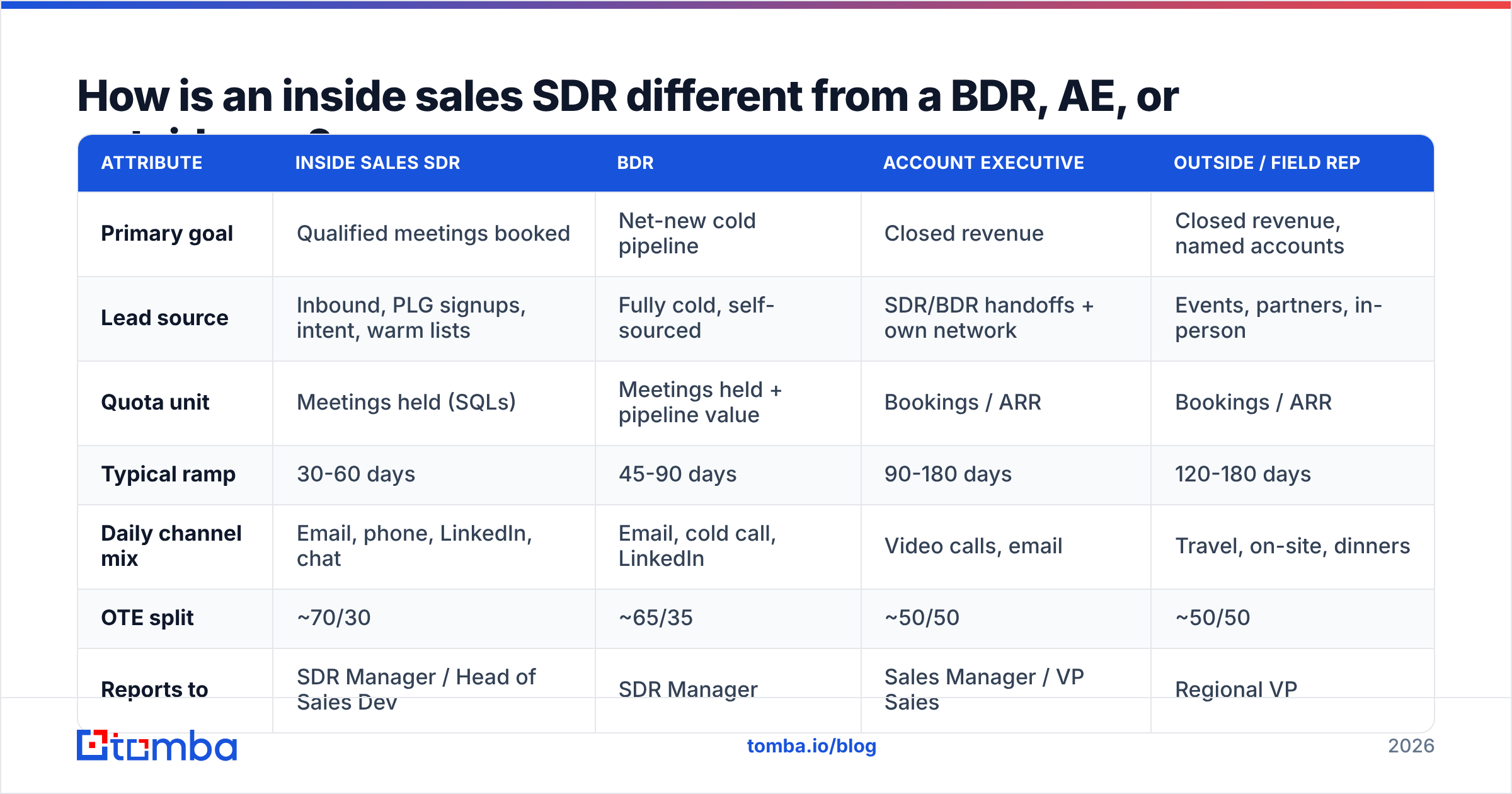
Titles vary by company, but the functional split is consistent enough to plan headcount around. The usual convention: SDRs work inbound and warm signals, BDRs work cold outbound, AEs close, AMs expand.
| Attribute | Inside Sales SDR | BDR | Account Executive | Outside / Field Rep |
|---|---|---|---|---|
| Primary goal | Qualified meetings booked | Net-new cold pipeline | Closed revenue | Closed revenue, named accounts |
| Lead source | Inbound, PLG signups, intent, warm lists | Fully cold, self-sourced | SDR/BDR handoffs + own network | Events, partners, in-person |
| Quota unit | Meetings held (SQLs) | Meetings held + pipeline value | Bookings / ARR | Bookings / ARR |
| Typical ramp | 30-60 days | 45-90 days | 90-180 days | 120-180 days |
| Daily channel mix | Email, phone, LinkedIn, chat | Email, cold call, LinkedIn | Video calls, email | Travel, on-site, dinners |
| OTE split | ~70/30 | ~65/35 | ~50/50 | ~50/50 |
| Reports to | SDR Manager / Head of Sales Dev | SDR Manager | Sales Manager / VP Sales | Regional VP |
Two practical consequences fall out of that table.
First, if you hire "SDRs" but feed them zero inbound, you have hired BDRs and priced them wrong. Cold outbound is a harder job and the comp plan should reflect it.
Second, the ramp column is why SDR churn is expensive. A rep who quits at month seven has produced maybe four months of full-quota output. At a 35% annual attrition rate, roughly a third of your sales development capacity is permanently in ramp.
What does an inside sales SDR actually do all day?#
The honest version of the job, in order of how much it decides the outcome:
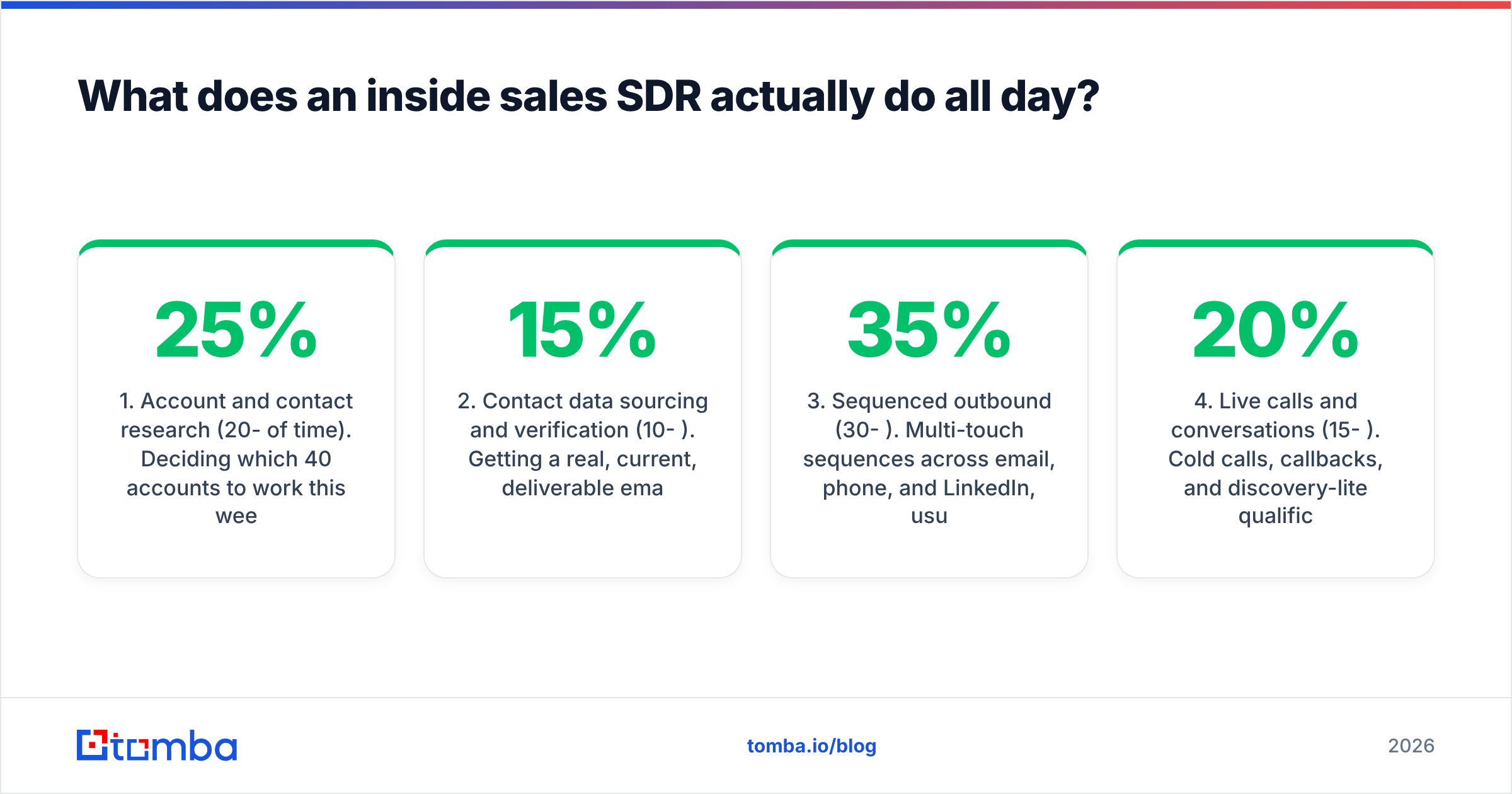
- Account and contact research (20-25% of time). Deciding which 40 accounts to work this week, and which 3-5 people inside each one matter. This is where the quota is won or lost, and it is the part most reps under-invest in.
- Contact data sourcing and verification (10-15%). Getting a real, current, deliverable email and a direct dial. A rep working a list with a 20% bounce rate is not working a list, they are damaging a sending domain.
- Sequenced outbound (30-35%). Multi-touch sequences across email, phone, and LinkedIn, usually 8-14 touches over 3-4 weeks. Not one blast.
- Live calls and conversations (15-20%). Cold calls, callbacks, and discovery-lite qualification. The only part of the day where objection handling skill compounds.
- Handoff and CRM hygiene (10%). Writing a briefing the AE can actually use, logging outcomes, keeping stage definitions honest. Skipped constantly. Costs the team more than anyone measures.
- Coaching and call review (5-10%). Listening to recordings, running role-plays, reading the messaging that is actually getting replies this month rather than last quarter.
Notice that pure "sending" is barely a third of the job. The teams that treat SDR work as an activity-count game end up optimizing the one input with the weakest correlation to booked meetings.

What quota should an inside sales SDR carry in 2026?#
Quota should be derived, not copied from a LinkedIn post. Work backwards from AE capacity: how many meetings does a closer need per month to hit number, and how many SDRs does that imply?
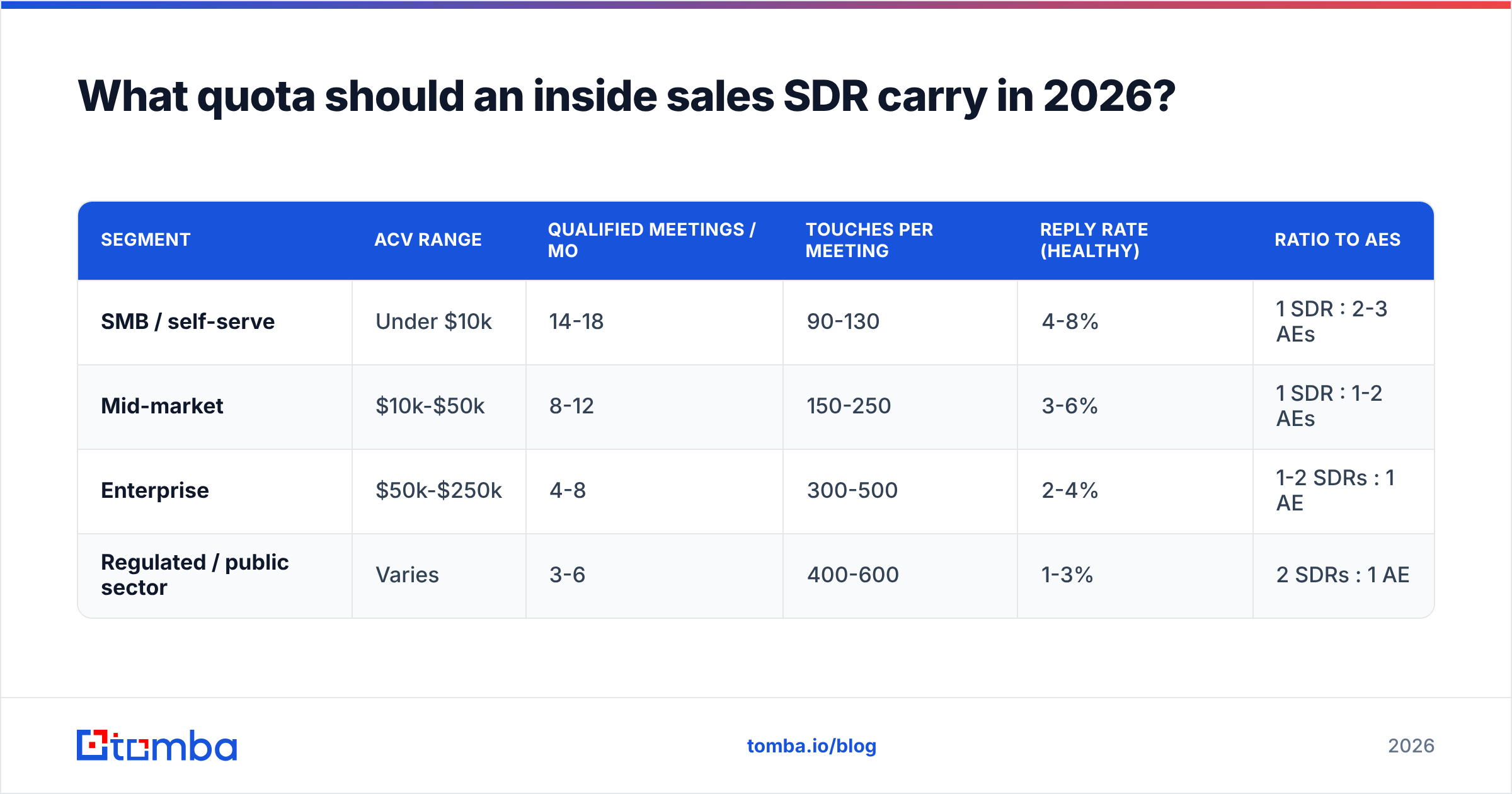
Rough benchmarks that hold up across mid-market B2B SaaS right now:
| Segment | ACV range | Qualified meetings / mo | Touches per meeting | Reply rate (healthy) | Ratio to AEs |
|---|---|---|---|---|---|
| SMB / self-serve | Under $10k | 14-18 | 90-130 | 4-8% | 1 SDR : 2-3 AEs |
| Mid-market | $10k-$50k | 8-12 | 150-250 | 3-6% | 1 SDR : 1-2 AEs |
| Enterprise | $50k-$250k | 4-8 | 300-500 | 2-4% | 1-2 SDRs : 1 AE |
| Regulated / public sector | Varies | 3-6 | 400-600 | 1-3% | 2 SDRs : 1 AE |
Three caveats before you paste these into a comp plan.
Count meetings held, not meetings booked. No-show rates run 20-35% on cold-sourced meetings. If you pay on booked, you will get booked meetings with people who never intended to show.
Define "qualified" in writing. The cheapest fix in sales development is a one-page SQL definition that both the SDR manager and the AE manager signed. Disputed meetings are the single most common source of SDR-AE friction.
Reply rate is a leading indicator, deliverability is the hidden one. If replies fall off a cliff, check inbox placement before you rewrite the copy. A domain with rising spam complaints produces the exact same symptom as bad messaging, and teams misdiagnose it constantly. Watch your sender reputation alongside your response rate and you will stop rewriting sequences that were never the problem.
How much does an inside sales SDR earn in 2026?#
Published ranges vary widely by source and city, so treat these as planning bands rather than precise figures. In the US market, an inside sales SDR typically sits somewhere around $45k-$65k base with $55k-$95k OTE, weighted toward the top of that range in enterprise segments and expensive metros, and toward the bottom in SMB or fully remote roles hired outside major hubs. Europe generally runs 20-35% lower in absolute terms.
The structure matters more than the headline number:
- 70/30 split is standard. Base carries the rep; variable rewards consistency.
- Per-meeting bonuses beat pure percentage plans at the SDR level, because they are legible. A rep should be able to calculate their commission in their head.
- Pipeline or closed-won kickers (a small bonus when an SDR-sourced deal closes) align SDRs with quality instead of volume. Cheap to run, high behavioral return.
- Accelerators above 100% are what separate a team with three top performers from a team with one. If overachievement pays the same rate as the first meeting, your best rep will coast in week three.
For broader market context on how sales org structures and quota attainment are trending, HubSpot's sales statistics roundup and Gartner's sales research hub are the two references worth checking each year.
What tech stack does an inside sales SDR need?#
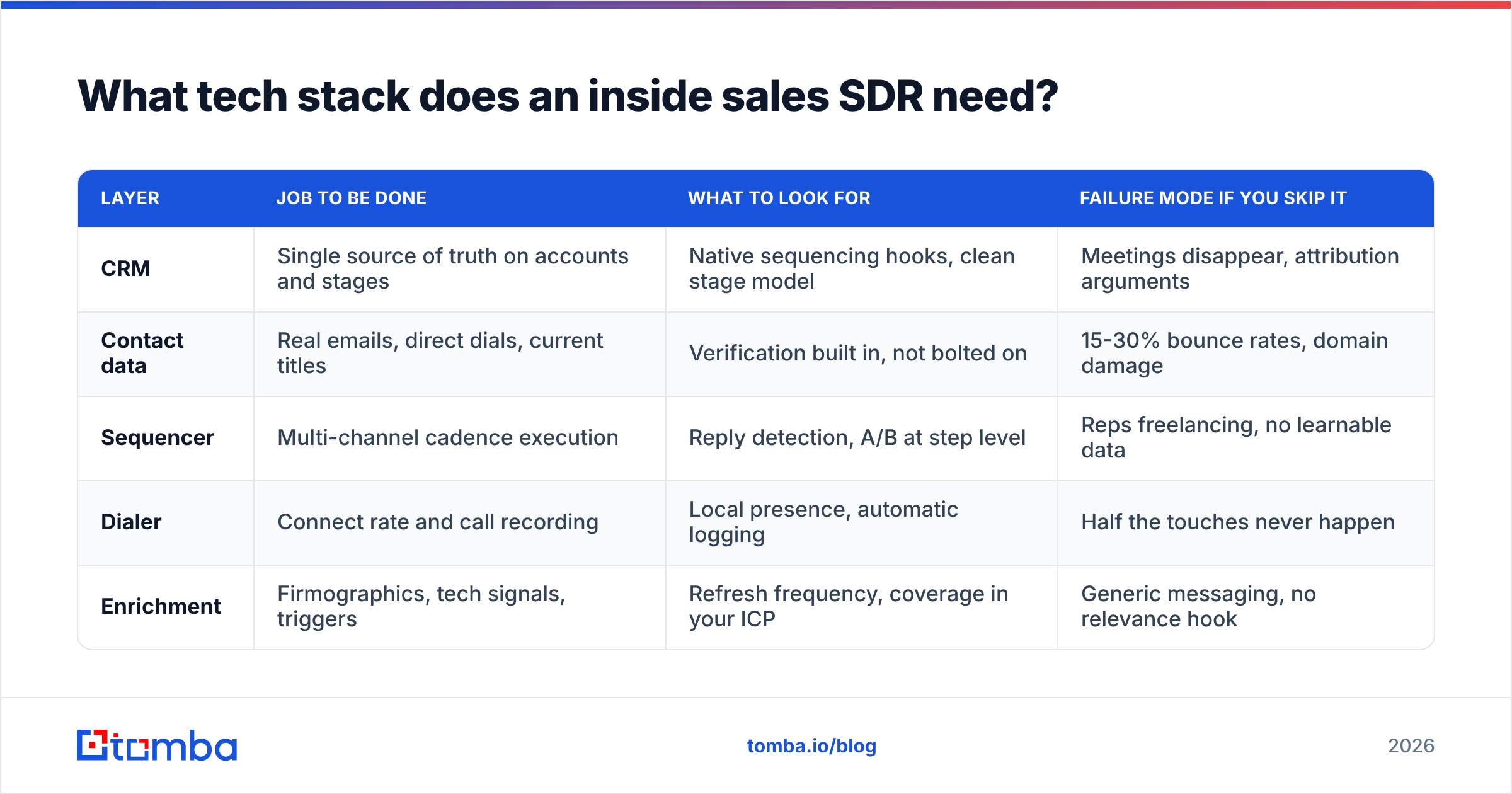
Keep it to five layers. Every additional tool adds a tab, and tabs cost calls.
| Layer | Job to be done | What to look for | Failure mode if you skip it |
|---|---|---|---|
| CRM | Single source of truth on accounts and stages | Native sequencing hooks, clean stage model | Meetings disappear, attribution arguments |
| Contact data | Real emails, direct dials, current titles | Verification built in, not bolted on | 15-30% bounce rates, domain damage |
| Sequencer | Multi-channel cadence execution | Reply detection, A/B at step level | Reps freelancing, no learnable data |
| Dialer | Connect rate and call recording | Local presence, automatic logging | Half the touches never happen |
| Enrichment | Firmographics, tech signals, triggers | Refresh frequency, coverage in your ICP | Generic messaging, no relevance hook |
On the data layer specifically: this is where most stacks quietly fail. Providers differ less on raw record counts than on freshness and verification behavior. Tools like Tomba and BookYourData approach the problem from different angles - real-time search-and-verify versus curated prebuilt lists - and plenty of teams run both, using one to build the base list and the other to confirm the addresses are still live before a single send goes out. Whatever you pick, insist on a catch-all verifier step, because catch-all domains are where "verified" lists go to lie to you. For a neutral read on category coverage, G2's sales intelligence category is a reasonable starting point.
How do you ramp a new inside sales SDR in 90 days?#
Ramping is a curriculum problem, not a motivation problem. The plan below assumes a manager who reviews work weekly.
Days 1-30: comprehension. Product basics, ICP definition, competitor landscape, the SQL definition, and shadowing 20 live calls. The rep should end month one able to explain what the product does to a skeptical stranger in 30 seconds, and should be running low-volume outbound to a tier-3 account list where mistakes are cheap. Target: 30-40% of quota.
Days 31-60: reps. Own a real territory slice. Build lists themselves, write their own first-touch variants, hold 10+ live conversations a week. The manager's job here is call review, not pipeline pressure. Target: 60-75% of quota.
Days 61-90: independence. Full territory, full quota expectation by day 90, weekly self-reported pipeline review. If a rep is under 60% at day 75 with clean activity and good call recordings, the problem is usually list quality or ICP fit, not effort. Check the data before you check the rep.
Two accelerators that consistently shorten ramp:
- A swipe file of the last 20 replies that worked. New reps copy patterns faster than they invent them.
- A pre-built account list for week one. Making a new hire build their first list from scratch adds two weeks of ramp for no learning benefit.
Is the inside sales SDR role dying because of AI?#
No, but the low-skill version of it is already dead.
AI has absorbed the parts of the job that were mechanical: drafting first-touch variants, summarizing account research, logging activity, transcribing calls, and suggesting next steps. That was maybe 30% of the old workday. The response from buyers has been predictable. When everyone can generate 500 personalized-sounding emails an hour, the value of a personalized-sounding email goes to zero, and reply rates on generic outbound have fallen accordingly.
What has appreciated in value:
- Judgment about who to contact. Targeting is the last thing automation does badly, because it requires knowing which signals actually predict a deal at your company.
- Live conversation skill. Phone connect rates are lower than they were, but a rep who can hold a hostile first 20 seconds is worth more than ever, precisely because fewer people practice it.
- Data discipline. Volume automation punishes bad lists at scale. Sending 3,000 emails a week to a list with a 20% invalid rate does not get you 3,000 chances, it gets you blocked.
The practical version of that last point: verify before you send, every time. Run your list through an email verifier and drop anything that does not come back clean. A rep who sends 40% fewer emails to a fully validated list will out-book a rep spraying a raw scrape, and their domain will still be usable next quarter.
What metrics actually predict inside sales SDR success?#
Track five. Ignore the rest until these are healthy.
- Meetings held per month - the quota, and the only number the business feels.
- Positive reply rate - replies that are not "unsubscribe" or "wrong person," divided by contacts touched. The truest measure of targeting plus messaging.
- Bounce rate - should be under 2%. Above 5%, stop sending and fix the list today.
- Connect rate on dials - tells you whether your phone data is real. Under 4% usually means the numbers are stale, not that nobody answers phones.
- SQL-to-opportunity conversion - the AE-side check on whether "qualified" means anything. Under 50% means your definition is broken.
Activity counts (dials, emails sent) belong in a coaching conversation, not on a leaderboard. The moment you put raw activity on a wall, you get raw activity, and the quality drops to match.
Where should you start?#
If you are building or fixing an inside sales SDR function, fix the data layer first. It is the cheapest intervention with the largest downstream effect: better contact data raises reply rates, protects deliverability, cuts wasted dials, and makes every other diagnosis honest. You cannot tell whether your messaging works until you know your messages arrived.
Start with the Tomba Email Finder to source verified professional emails by domain, name, or company, then layer in the phone finder for direct dials so your reps stop burning calls on switchboards. The free tier gives you 25 searches a month to sanity-check coverage on your own ICP before committing, and paid plans start at $49/mo; full Tomba pricing is public if you want to model cost per booked meeting. Run one week of outbound on verified data, compare the bounce and reply numbers against your current list, and let the delta make the decision for you.
Related guides#
// get started
Find, verify and enrich your first contacts today
Start on the free plan with 25 searches a month, then scale when your team is ready.
Free plan · No credit card required · GDPR & CCPA
Get the Tomba newsletter
Product and data updates
// about the author