How to Build an Inside Sales Team in 2026: Roles, Costs, KPIs
An inside sales team is cheaper per rep than field sales and faster to ramp — but only if the roles, quotas, and contact data are right. Here is the 2026 blueprint, with real cost ranges and the KPIs that predict quota attainment.
TL;DR
- An inside sales team sells remotely — phone, email, video, LinkedIn — instead of flying to meetings. It costs roughly 40-60% less per rep than field sales and ramps in 3-5 months instead of 6-9.
- The smallest team that actually works is four roles: SDR, AE, sales manager, and someone owning data/ops. Skip the fourth and your first three burn their week on list-building.
- Fully loaded cost per rep in 2026 runs about $85K-$135K for an SDR and $160K-$260K for a mid-market AE, once you add tooling, benefits, and management overhead.
- Data quality is the hidden variable. A team dialing a 70%-accurate list does 30% less real selling than the same team on a verified list — same headcount, same effort.
- Track meetings held, pipeline coverage, and ramp-to-quota. Ignore activity counts as a standalone metric; they reward noise.
What is an inside sales team?#
An inside sales team is a group of sellers who close business remotely, from a desk, using phone, email, video calls, and social channels rather than in-person visits. Think of it like the difference between a delivery kitchen and a dine-in restaurant: same food, radically different cost structure, and the delivery model only works if the addresses on the orders are correct.
That last part is the whole game. Field reps get handed a territory and a conference badge. Inside reps get handed a list. If the list is wrong, everything downstream — the sequence, the talk track, the CRM hygiene, the manager's forecast — is built on sand.
The model has become the default for B2B. Most SaaS, most professional services, and an increasing share of manufacturing and logistics now run remote-first revenue teams, with field sellers reserved for enterprise deals above a certain threshold. HubSpot's sales research has tracked this shift for years: remote selling stopped being the cheap alternative and became the primary motion, with outside sales as the escalation path.
Is an inside sales team better than outside sales?#
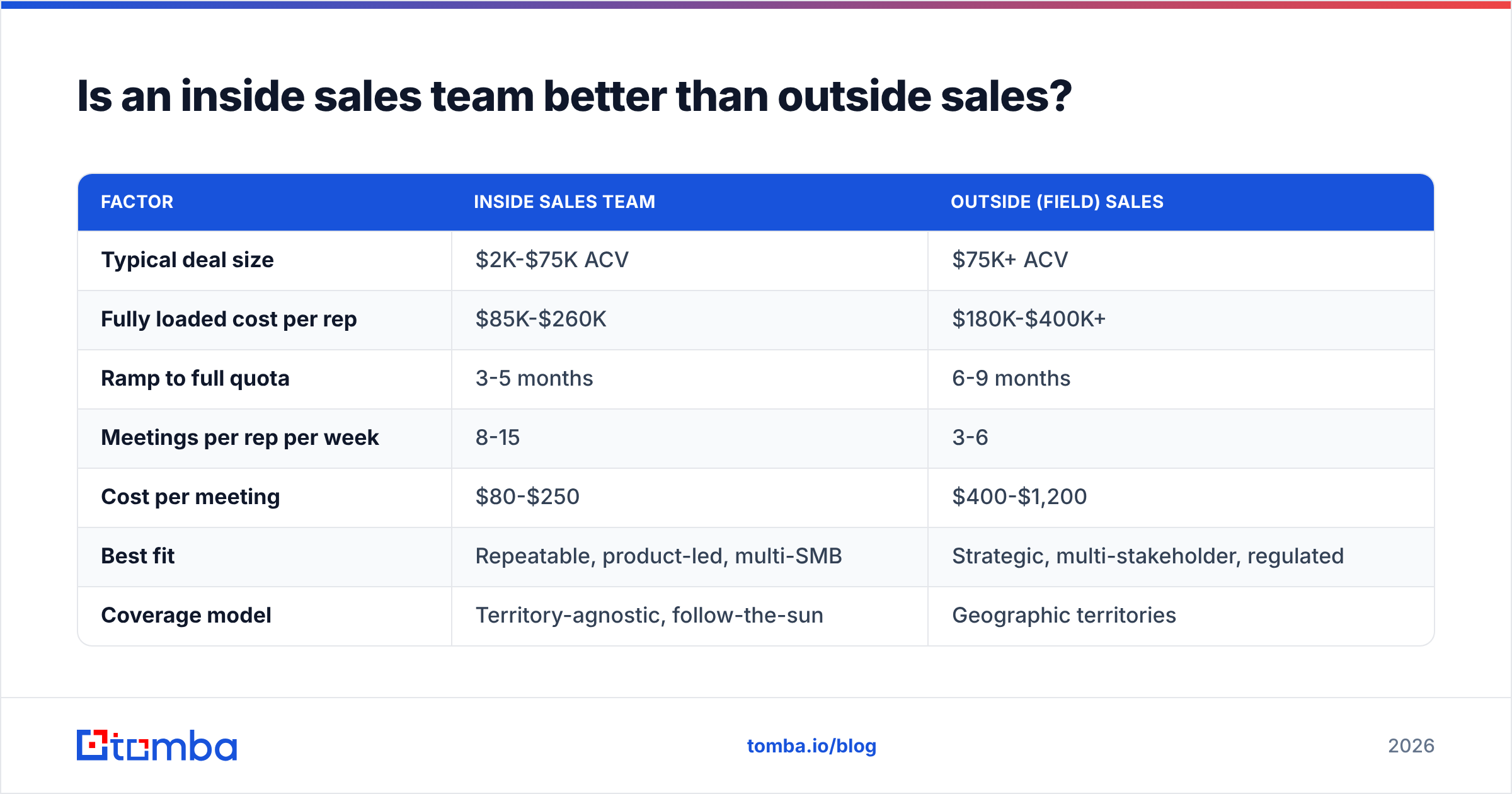
Better for what? The honest answer depends on deal size, buying-committee complexity, and how much of your product can be demonstrated on a screen.
| Factor | Inside sales team | Outside (field) sales |
|---|---|---|
| Typical deal size | $2K-$75K ACV | $75K+ ACV |
| Fully loaded cost per rep | $85K-$260K | $180K-$400K+ |
| Ramp to full quota | 3-5 months | 6-9 months |
| Meetings per rep per week | 8-15 | 3-6 |
| Cost per meeting | $80-$250 | $400-$1,200 |
| Best fit | Repeatable, product-led, multi-SMB | Strategic, multi-stakeholder, regulated |
| Coverage model | Territory-agnostic, follow-the-sun | Geographic territories |
| Main failure mode | Bad contact data, sequence fatigue | Long cycles, low activity volume |
The practical pattern in 2026 is hybrid: an inside team owns everything up to a dollar threshold and generates pipeline for the field team above it. If you are choosing a first motion and your ACV is under $50K, build inside. The math is not close.
What roles does an inside sales team need?#
Do not hire five AEs and hope. A functioning team is a small assembly line where each station has one job.
- Sales Development Rep (SDR) — Owns top of funnel: research, outbound sequences, cold calls, inbound speed-to-lead. Success metric is qualified meetings held, not emails sent. Ratio: 1-2 SDRs per AE in outbound-heavy motions.
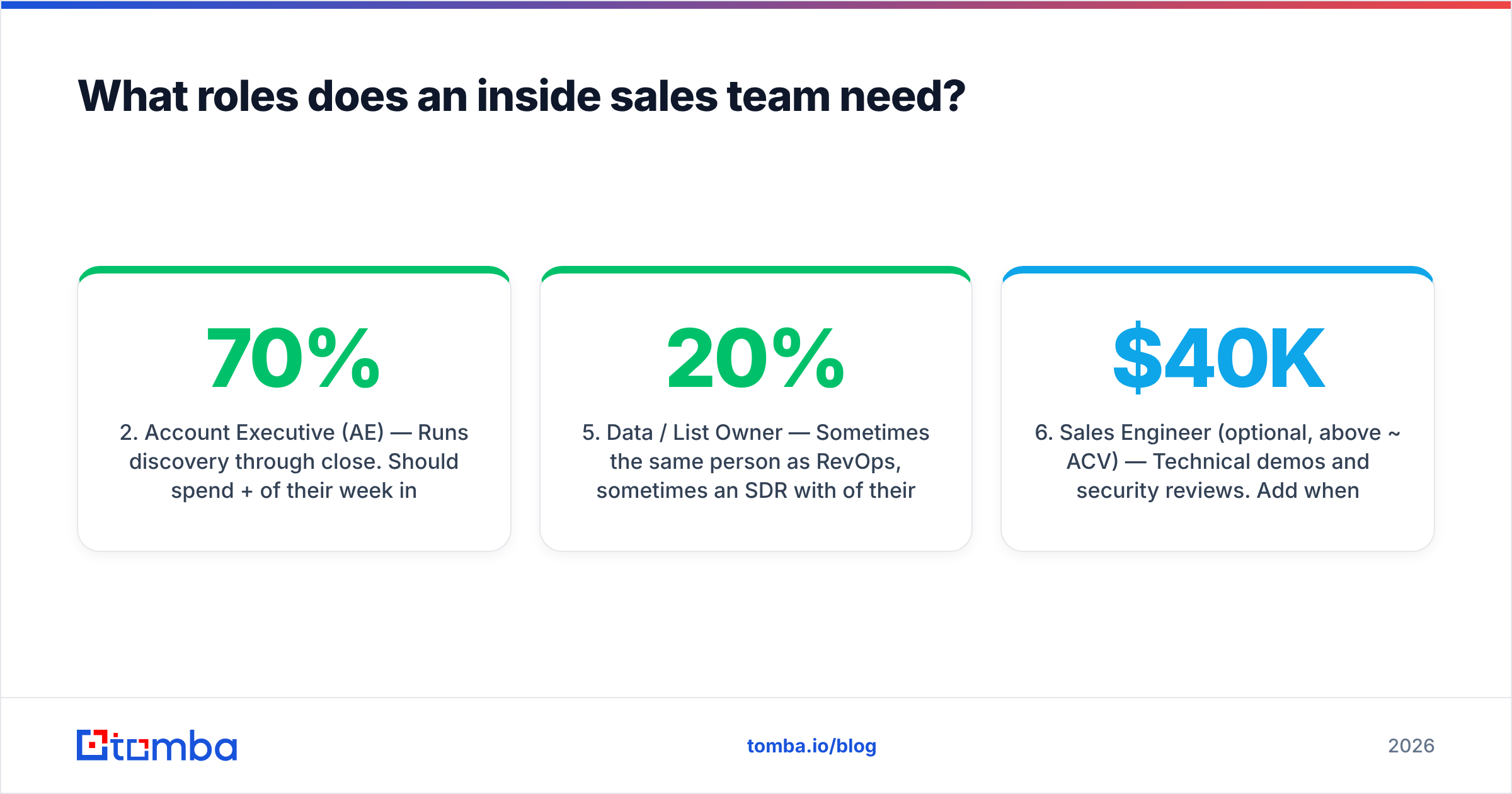
- Account Executive (AE) — Runs discovery through close. Should spend 70%+ of their week in live conversations. If your AEs are prospecting more than 20% of their time, your SDR layer is under-resourced or your data is bad.
- Sales Manager — One manager per 6-8 reps, maximum. Below that ratio coaching disappears and the role becomes forecast admin. The manager owns call reviews, deal inspection, and ramp plans.
- Sales Ops / RevOps — Owns CRM hygiene, routing rules, enrichment, reporting. Often a fractional or shared role at under 10 reps, but never a role you skip. This person is why the revenue operations function exists as a discipline.
- Data / List Owner — Sometimes the same person as RevOps, sometimes an SDR with 20% of their time carved out. Their job is making sure the accounts and contacts entering sequences are real, current, and in-ICP.
- Sales Engineer (optional, above ~$40K ACV) — Technical demos and security reviews. Add when AEs start losing deals on implementation questions rather than price.
At six people you have a real team. At three you have three people doing nine jobs badly.
How much does an inside sales team cost in 2026?#
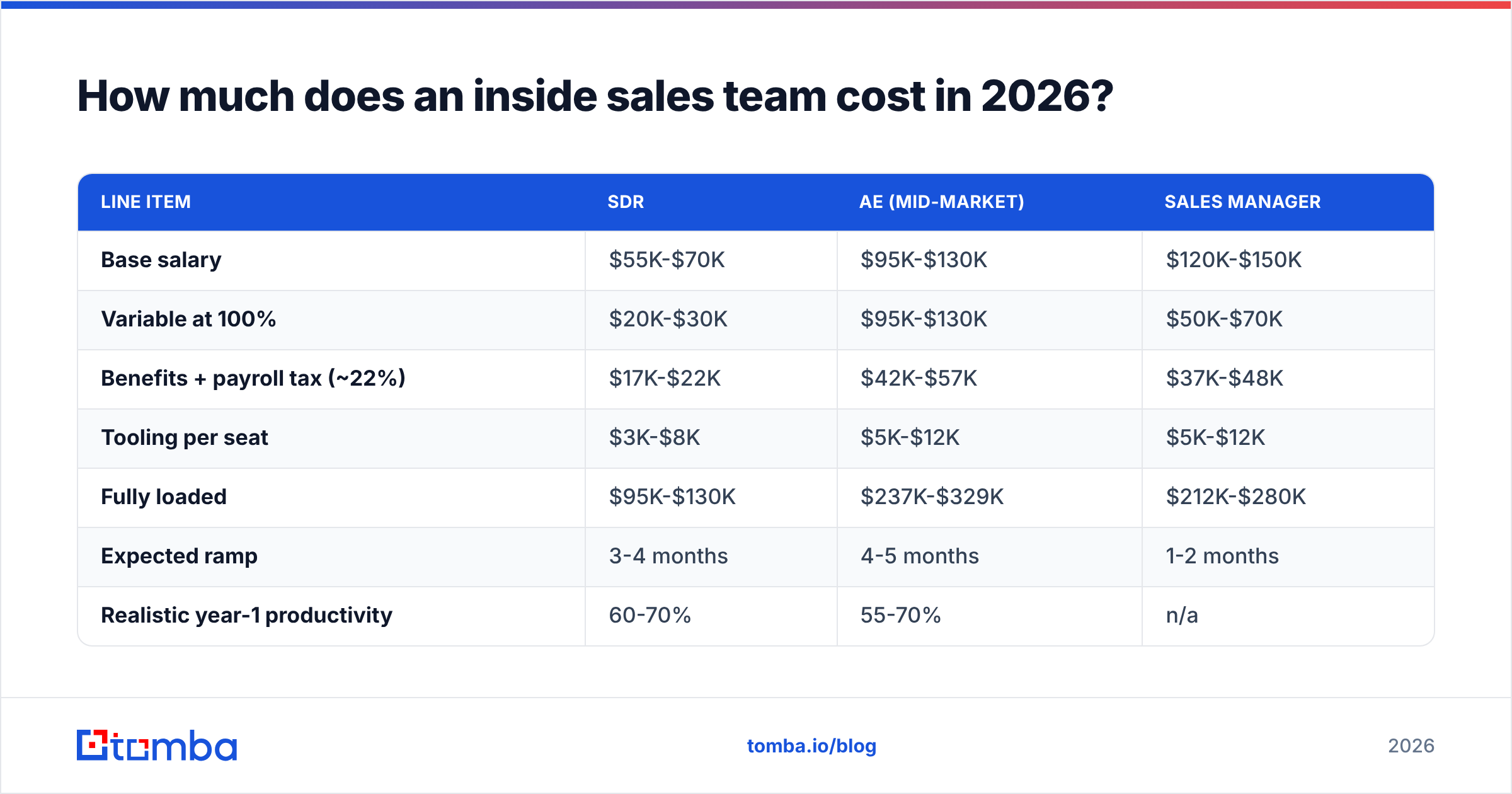
Salary is roughly 60-70% of the true number. Here is what a five-person US-based team actually costs, annualized:
| Line item | SDR | AE (mid-market) | Sales Manager |
|---|---|---|---|
| Base salary | $55K-$70K | $95K-$130K | $120K-$150K |
| Variable at 100% | $20K-$30K | $95K-$130K | $50K-$70K |
| Benefits + payroll tax (~22%) | $17K-$22K | $42K-$57K | $37K-$48K |
| Tooling per seat | $3K-$8K | $5K-$12K | $5K-$12K |
| Fully loaded | $95K-$130K | $237K-$329K | $212K-$280K |
| Expected ramp | 3-4 months | 4-5 months | 1-2 months |
| Realistic year-1 productivity | 60-70% | 55-70% | n/a |
Two numbers people forget. First, ramp is a cost — a rep at 60% productivity for four months is roughly $30K of unrecovered payroll. Second, tooling stacks quietly. A dialer, a sequencer, a CRM seat, a data provider, a call-recording tool, and an enrichment API can cross $800/rep/month before anyone notices. G2's category pricing pages are a reasonable sanity check before you sign anything annual.
What does an inside sales tech stack need to include?#
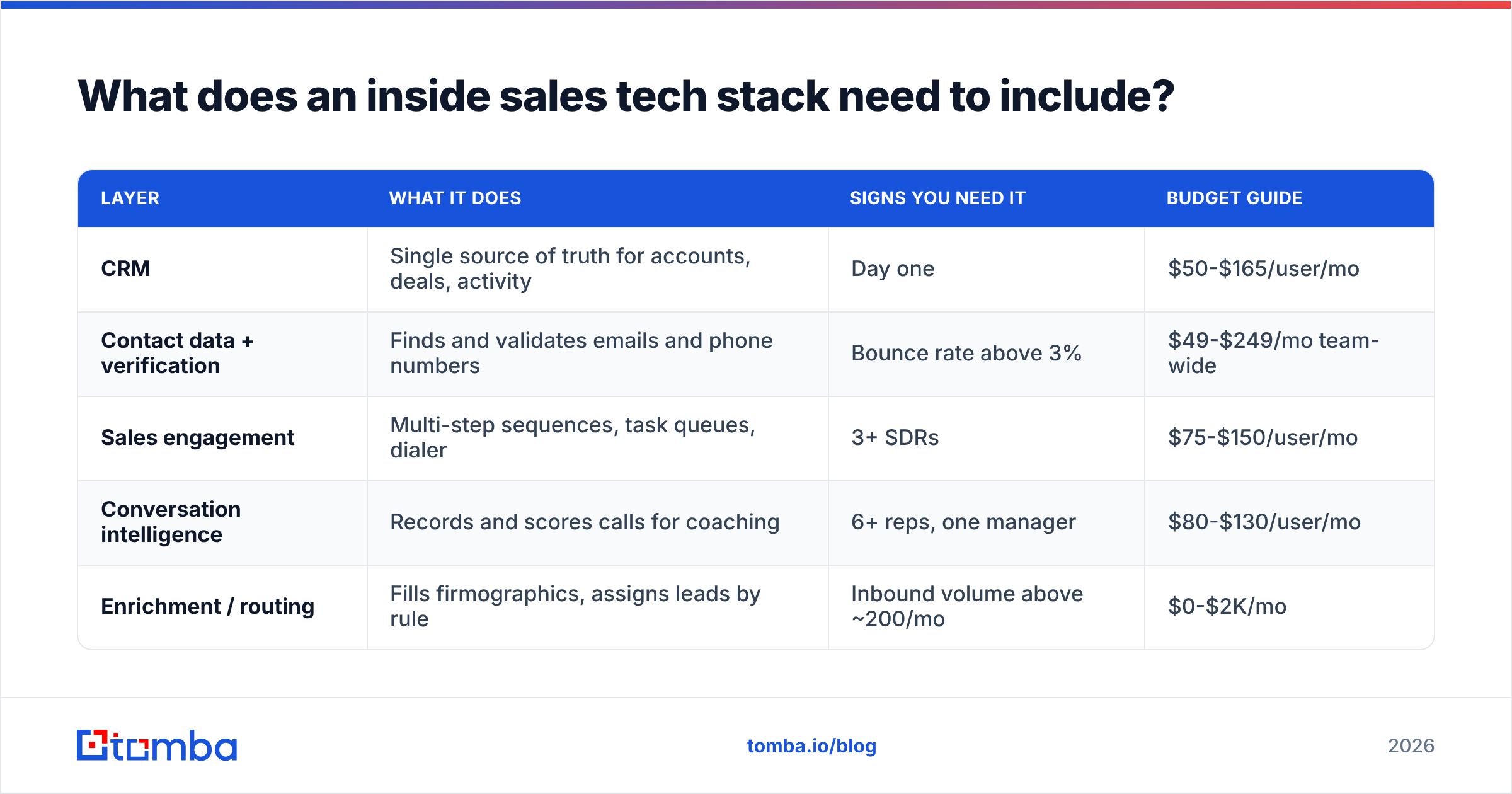
Five categories. Everything else is nice-to-have until you have 15+ reps.
| Layer | What it does | Signs you need it | Budget guide |
|---|---|---|---|
| CRM | Single source of truth for accounts, deals, activity | Day one | $50-$165/user/mo |
| Contact data + verification | Finds and validates emails and phone numbers | Bounce rate above 3% | $49-$249/mo team-wide |
| Sales engagement | Multi-step sequences, task queues, dialer | 3+ SDRs | $75-$150/user/mo |
| Conversation intelligence | Records and scores calls for coaching | 6+ reps, one manager | $80-$130/user/mo |
| Enrichment / routing | Fills firmographics, assigns leads by rule | Inbound volume above ~200/mo | $0-$2K/mo |
The contact-data layer is the one most teams under-invest in and then blame the reps for. A Salesforce State of Sales finding that keeps repeating across editions: reps spend under a third of their time actually selling. The single biggest recoverable chunk is manual research and list cleanup.
That is a tooling problem with a tooling fix. Running contacts through an email verifier before they enter a sequence, and using domain search to pull every reachable contact at a target account in one pass, removes hours per rep per week. For teams buying static lists, providers like BookYourData sit alongside real-time lookup tools — the useful setup is usually both: purchased coverage for breadth, live verification before send so nothing stale reaches your sending domain.

What KPIs should an inside sales team actually track?#
There are about forty metrics you can track and six that change decisions.
- Meetings held per rep per week. Not booked — held. Booked-to-held under 70% means your qualification or your confirmation process is broken.
- Pipeline coverage. Open pipeline divided by quota for the period. Below 3x, you are already behind; the fix is 60 days upstream, not this week.
- Ramp-to-quota (days). The clearest signal of whether onboarding works. If it drifts upward as you hire, your enablement isn't scaling with headcount.
- Contact reachability rate. Percentage of contacts in a sequence that produce a delivered email or a connected call. This is the cleanest proxy for data quality, and it is the one nobody instruments.
- Reply-to-meeting rate. A high response rate with few meetings usually means your targeting is off, not your copy.
- Win rate by source. Outbound, inbound, partner, and expansion behave differently. Blending them hides which channel deserves next quarter's budget.
Deliberately absent: dials per day and emails sent. They are useful as diagnostics when a rep is struggling, and actively harmful as targets. Set a dial quota and you will get 100 dials into disconnected numbers.
How do you ramp new inside sales reps without burning the list?#
New reps break things. That is normal and survivable — as long as the damage is contained to accounts you can afford to lose.
Give week-one reps a "practice tier": real accounts, genuinely in-ICP, but from the lower-priority half of the territory. Let them make the awkward calls there. Meanwhile, run a structured 30-60-90:
Days 1-30 — Product, ICP, and objection handling. Shadow ten live calls. Own only inbound follow-up. Record everything and review three calls a week with the manager.
Days 31-60 — Own a small outbound territory. Target is 50-60% of a ramped rep's meeting number. Weekly call review continues. Start writing their own sequences with manager approval.
Days 61-90 — Full territory, 80% of quota. Coaching moves from call mechanics to deal strategy.
The failure mode here is subtle: new reps, anxious about activity numbers, will blast every contact they can find. If those contacts are unverified, you get bounces, and bounces damage your sending domain for everyone on the team. That is why verification belongs before the sequence, not as cleanup after. Teams running high volume typically automate it with a bulk email finder or wire verification directly into the CRM through the Tomba API so no rep can push an unchecked address into a sequence.
What are the most common inside sales team mistakes?#
Hiring AEs before SDRs. AEs who have to self-source become expensive, unhappy SDRs. If budget is tight, hire one AE and two SDRs, not three AEs.
One manager for 12 reps. Coaching evaporates above eight. You will see it first as rising ramp time and falling win rates among your newest hires.
Treating data as a one-time purchase. B2B contact data decays 25-30% per year through job changes alone. A list bought in January is meaningfully wrong by October. Refresh cadence matters more than initial list size.
Optimizing copy before targeting. Most teams rewrite subject lines when the real problem is that they are emailing the wrong titles at the wrong companies. Fix the ICP filter first; copy improvements compound on top of good targeting and do nothing on top of bad targeting.
No definition of a qualified meeting. Write it down, in one sentence, and have the AE accept or reject each meeting against it. Without this, SDR and AE incentives quietly diverge and your funnel math becomes fiction.
Ignoring deliverability until it breaks. Warmup, SPF/DKIM alignment, and list hygiene are boring right up until your domain gets throttled and the entire team's pipeline stops. Check your SPF record before you scale sending volume, not after.
Build the team, then feed it clean data#
An inside sales team is a machine with a known cost per unit of output. You can model it: roles, ramp, quota, coverage, cost per meeting. What you cannot model away is bad input. Every dollar of that $95K-$329K fully loaded cost per rep is multiplied or divided by whether the contacts they work are real.
Start with Tomba Email Finder to source verified professional emails by name, domain, or company — the free tier gives you 25 searches a month to test accuracy against your own known-good contacts before committing. When your team is ready to scale, Tomba plans run from $49/mo Starter to $99/mo Growth and $249/mo Pro, with bulk processing and API access so verification runs automatically instead of depending on a rep remembering to do it. Get the data layer right first; the quota math gets a lot friendlier after that.
Related guides#
// get started
Find, verify and enrich your first contacts today
Start on the free plan with 25 searches a month, then scale when your team is ready.
Free plan · No credit card required · GDPR & CCPA
// about the author