7 Best InsideSales Alternatives in 2026: Pricing & Features Compared
InsideSales.com became XANT, then got absorbed by Aurea, and self-serve buyers were left without a clear upgrade path. Here are seven alternatives covering dialing, sequencing, and the contact data underneath.
TL;DR
- InsideSales.com rebranded to XANT in 2019 and was acquired by Aurea Software in 2021. The Playbooks product still exists, but self-serve pricing, public docs, and an obvious growth path largely went away.
- If you loved Playbooks for its Salesforce-native cadence engine, Groove (now part of Clari) and Salesloft are the closest architectural matches.
- If you loved it for the PowerDialer, a dedicated dialer like Kixie or Orum replaces that piece for a fraction of an enterprise seat price.
- If you want data plus sequencing in one bill, Apollo.io is the cheapest credible swap; HubSpot Sales Hub wins if your CRM is already HubSpot.
- None of these fix bad contact data. Budget separately for an email finder and phone finder layer, or your shiny new dialer just misses faster.
What actually happened to InsideSales.com?#
Short version: the company you remember does not sell the way it used to.
InsideSales.com launched in 2004 out of Utah and spent a decade as the loud, well-funded pioneer of "sales acceleration" — predictive dialing, lead prioritization, and the Neuralytics AI engine that promised to tell reps who to call and when. In 2019 it rebranded to XANT. In 2021 it was acquired by Aurea Software, part of the ESW Capital family, which has a well-documented pattern of buying mature enterprise software and running it for profitability rather than growth.
The Playbooks product did not disappear. What disappeared was the buying experience most mid-market teams need: transparent pricing, a trial, active roadmap communication, and a sales motion that answers a form fill in under a week. If you are searching for InsideSales alternatives in 2026, you are almost certainly hitting one of three walls — renewal pricing that no longer maps to the value, a support queue that got quieter, or a product roadmap that stopped moving while Salesloft and Outreach shipped AI features monthly.
That context matters, because it changes what you are shopping for. You are not replacing one monolith. You are replacing three separate jobs that Playbooks happened to bundle.
What did Playbooks actually do for your team?#
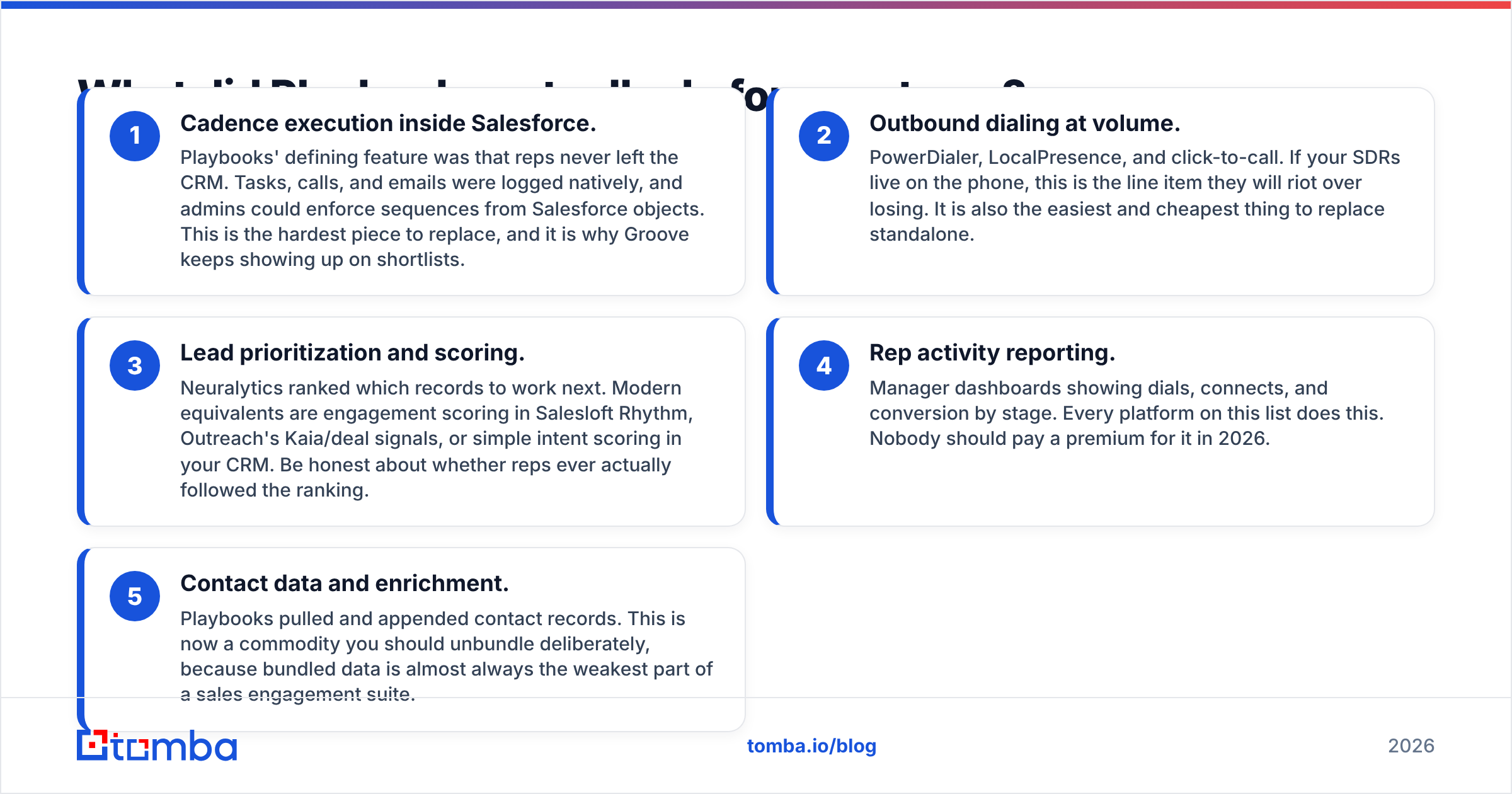
Before you look at a single pricing page, write down which of these five jobs you are actually paying for. Most teams discover they only need two or three, and the replacement bill drops by half.
- Cadence execution inside Salesforce. Playbooks' defining feature was that reps never left the CRM. Tasks, calls, and emails were logged natively, and admins could enforce sequences from Salesforce objects. This is the hardest piece to replace, and it is why Groove keeps showing up on shortlists.
- Outbound dialing at volume. PowerDialer, LocalPresence, and click-to-call. If your SDRs live on the phone, this is the line item they will riot over losing. It is also the easiest and cheapest thing to replace standalone.
- Lead prioritization and scoring. Neuralytics ranked which records to work next. Modern equivalents are engagement scoring in Salesloft Rhythm, Outreach's Kaia/deal signals, or simple intent scoring in your CRM. Be honest about whether reps ever actually followed the ranking.
- Rep activity reporting. Manager dashboards showing dials, connects, and conversion by stage. Every platform on this list does this. Nobody should pay a premium for it in 2026.
- Contact data and enrichment. Playbooks pulled and appended contact records. This is now a commodity you should unbundle deliberately, because bundled data is almost always the weakest part of a sales engagement suite.
Score each job from 1 to 5 on "would the team notice within a week if this vanished." The rows that score 4 or 5 define your shortlist. Everything else is negotiating leverage.
How do the main InsideSales alternatives compare?#
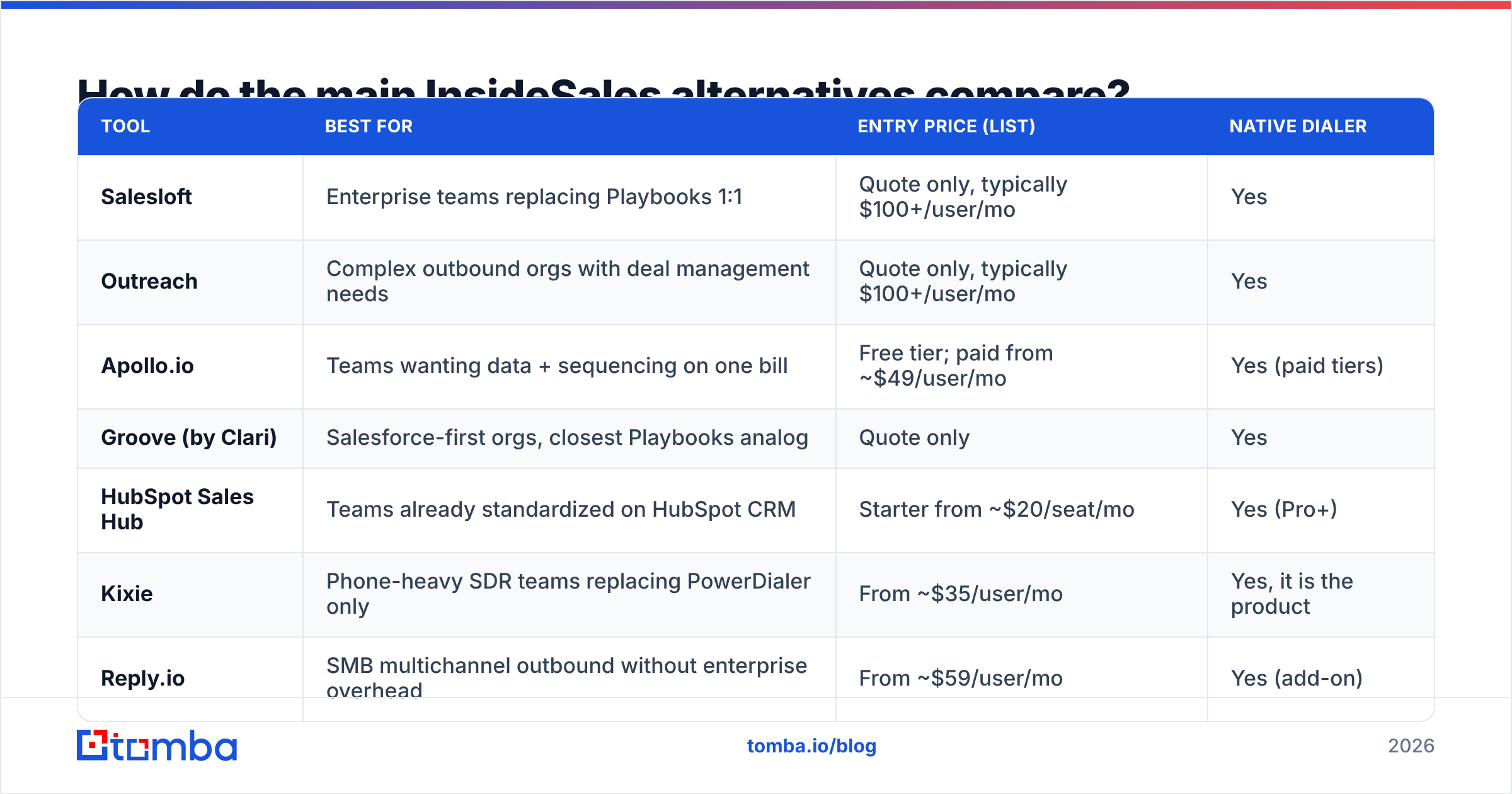
Pricing below is public list pricing at the time of writing. Enterprise sales engagement vendors negotiate heavily, and several publish nothing at all — treat quote-only entries as "expect a six-week procurement cycle." Always verify current numbers on the vendor's own pricing page before you build a business case.
| Tool | Best for | Entry price (list) | Native dialer |
|---|---|---|---|
| Salesloft | Enterprise teams replacing Playbooks 1:1 | Quote only, typically $100+/user/mo | Yes |
| Outreach | Complex outbound orgs with deal management needs | Quote only, typically $100+/user/mo | Yes |
| Apollo.io | Teams wanting data + sequencing on one bill | Free tier; paid from ~$49/user/mo | Yes (paid tiers) |
| Groove (by Clari) | Salesforce-first orgs, closest Playbooks analog | Quote only | Yes |
| HubSpot Sales Hub | Teams already standardized on HubSpot CRM | Starter from ~$20/seat/mo | Yes (Pro+) |
| Kixie | Phone-heavy SDR teams replacing PowerDialer only | From ~$35/user/mo | Yes, it is the product |
| Reply.io | SMB multichannel outbound without enterprise overhead | From ~$59/user/mo | Yes (add-on) |
| BookYourData | Buying verified contact lists by ICP filter | Pay-as-you-go credits | No, data only |
Two things jump out. First, the enterprise tier of this market has effectively standardized on quote-only pricing in the $100–$150 per seat per month range, which is roughly where XANT renewals landed anyway. Second, the SMB tier has gotten genuinely good — a Kixie plus Apollo stack runs under $100 per rep and covers most of what Playbooks did.
Which alternative fits which team?#
Salesloft is the default answer for teams that want a like-for-like enterprise replacement. Cadences, dialer, conversation intelligence, and forecasting sit in one platform, and Rhythm applies AI-generated priority to a rep's task list in a way that echoes what Neuralytics promised. It is the safest migration if your executive team wants a category leader on the invoice. See their product overview for the current module breakdown. Downside: you will pay enterprise money and you will need an admin who owns it.
Outreach competes at the same tier with a stronger bias toward deal execution — pipeline health, forecast rollups, and meeting intelligence alongside sequencing. Pick Outreach over Salesloft when your problem is not "reps do not do enough activity" but "we cannot see which deals are real." If you are running a comparison, the G2 sales engagement category is a reasonable neutral read on how buyers rate the two against each other.
Groove, now part of Clari, deserves more attention than it usually gets on these lists. Groove was built Salesforce-native from the start, which is exactly the architectural property that made Playbooks sticky. If your Salesforce org has heavy customization, validation rules, and custom objects that other tools choke on, Groove is the lowest-friction migration on this list. If you are not on Salesforce, skip it entirely.
Apollo.io is the price-disruption option. You get a B2B contact database, sequencing, a dialer, and basic enrichment for what a single Salesloft seat costs. The trade-off is depth: admin controls, compliance features, and Salesforce sync fidelity are thinner than the enterprise tier, and database accuracy varies by region and seniority. For a 5–20 rep team that was overpaying for Playbooks, it is usually the right call. Teams that outgrow it often keep the sequencing and swap the data layer — which is why an Apollo alternative comparison is a common second search.
HubSpot Sales Hub wins on one condition: your CRM is HubSpot. Sequences, the dialer, task queues, and reporting all live inside the CRM record, so there is no sync layer to break at 2 a.m. Starter tiers are genuinely cheap; Professional gets expensive fast once you add seats. The Sales Hub product page lists current tier limits. If you are on Salesforce, this is a CRM migration disguised as a tooling decision — do not do it casually.
Kixie is the surgical option. If the only thing your team actually mourns is PowerDialer and local presence numbers, buy a dialer and stop there. Kixie does multi-line power dialing, local presence, SMS, and CRM logging at a price point that lets you keep your existing sequencer. Orum is the alternative here if you want parallel dialing with AI-driven connect detection for a high-volume SDR floor.
Reply.io covers multichannel outbound — email, LinkedIn steps, calls — for SMB teams that never needed Salesforce-grade governance. It is a reasonable landing spot for a two-to-ten-person outbound team. Compare it honestly against Apollo; the decision usually comes down to whether you want the built-in database or plan to bring your own data.
BookYourData is the odd one out because it is not a sequencing platform at all. It is a self-serve source of verified B2B contact lists you filter by industry, title, geography, and tech stack, with pay-as-you-go credits rather than a seat license. Several teams migrating off Playbooks use it to rebuild their target-account lists before they even pick a sequencer, which is a sensible order of operations.
What about the data layer under your dialer?#
Here is the part most migration plans skip, and it is the part that decides whether the new platform looks like a win in 90 days.
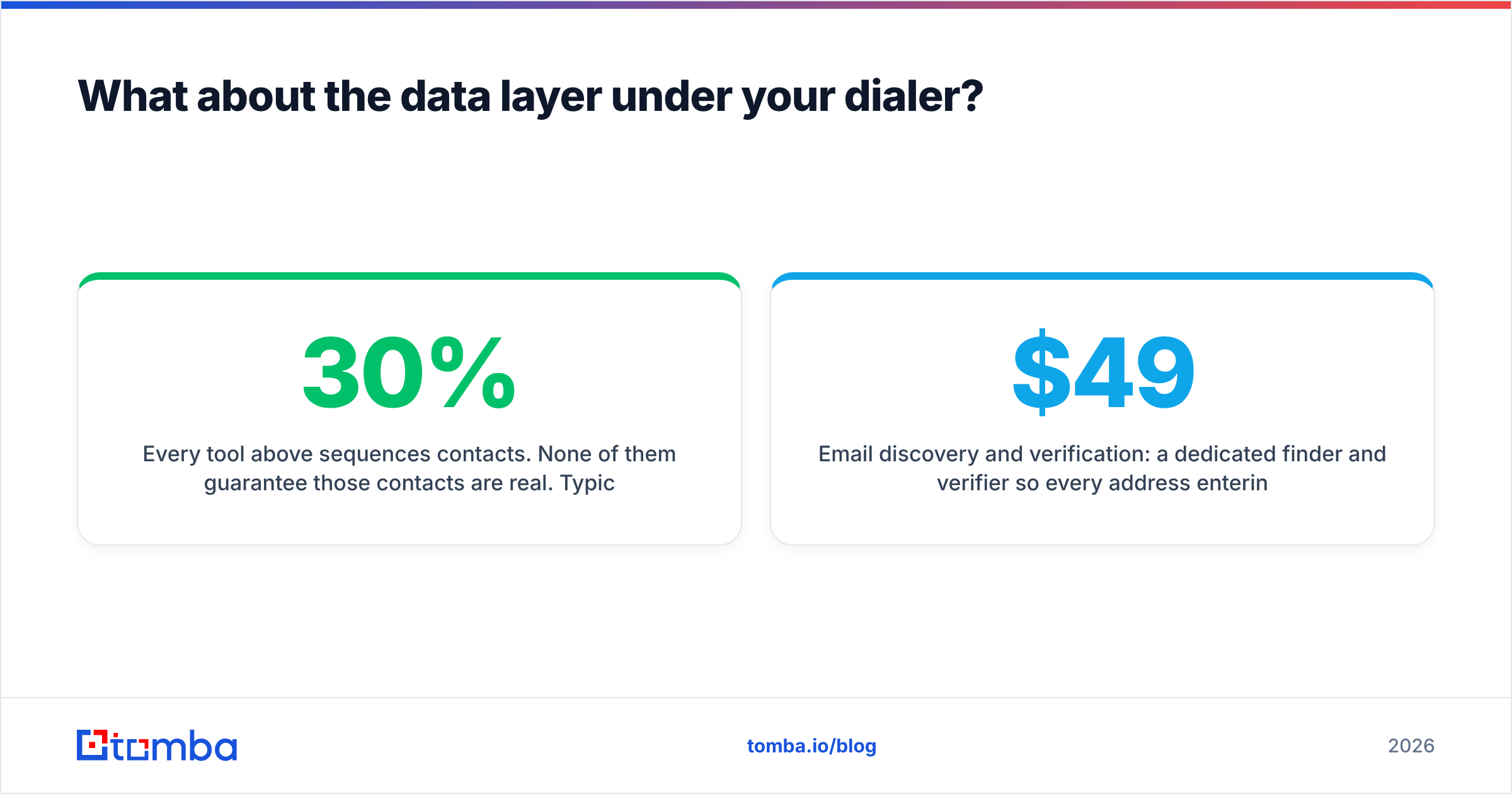
Every tool above sequences contacts. None of them guarantee those contacts are real. Typical B2B contact data decays somewhere in the 25–30% per year range as people change roles, companies rebrand, and domains consolidate — a figure that is broadly consistent across vendor studies and the B2B data literature, so treat it as a planning assumption rather than a precise constant. If you port a two-year-old Salesforce list into Salesloft, you have bought a faster way to hit disconnected numbers and bounced sends.
Bounce rate is not just a wasted send. It is a sender reputation problem that follows your domain into every subsequent campaign, and it is why teams who "switched platforms and results got worse" usually had a data problem the whole time.
A practical unbundled stack looks like this:
- Sequencing and dialing: one platform from the table above.
- Email discovery and verification: a dedicated finder and verifier so every address entering a sequence has been checked against live SMTP and catch-all logic — Tomba's free tier covers 25 searches a month, with paid plans starting at $49/mo and Growth at $99/mo. Full Tomba pricing is public, which is a refreshing change after shopping quote-only enterprise tools.
- Phone numbers: direct dials sourced and validated separately, because dialer vendors rarely sell good numbers.
- Ongoing enrichment: a scheduled data enrichment job that refreshes CRM records rather than a one-time import you never touch again.
The pricing math usually favors unbundling. Buying data inside a sales engagement suite means paying seat-based prices for something that should be credit-based, and it means your data quality is capped by a vendor whose core competency is workflow, not databases.
How do you migrate off Playbooks without losing history?#
Give yourself four to six weeks, not one. The sequence that works:
Week 1 — export everything. Pull cadence definitions, step content, call dispositions, and activity history out of Playbooks and Salesforce while your contract is still live. Activity history lives in Salesforce task records in most Playbooks implementations, which means it survives the cutover, but verify that with your admin before you assume it.
Week 2 — rebuild, do not lift-and-shift. Half your cadences are dead weight. Rank them by reply rate and rebuild only the top performers in the new tool. This is the cheapest content audit you will ever run.
Week 3 — clean the list. Run every contact through verification before it touches the new platform. Deduplicate, kill role-based addresses, and flag catch-all domains for separate handling. A bulk verify pass on 20,000 records takes minutes and routinely removes 10–20% of a neglected database.
Week 4 — pilot with two reps. Run the new stack alongside the old one with a small group. Measure connect rate and reply rate, not "does the tool feel nice." Roll out only when the pilot beats the baseline.
Weeks 5–6 — cut over and negotiate. Do not cancel until the new system is logging cleanly into your CRM. And use the live migration as leverage in your final renewal conversation; teams frequently get a short, cheap extension to de-risk the overlap.
Is there a single best InsideSales alternative?#
No, and any list that claims otherwise is guessing at your stack.
If you need one recommendation per profile: enterprise Salesforce shop — Groove or Salesloft. Mid-market wanting one bill — Apollo.io. HubSpot org — Sales Hub. Phone-first SDR floor — Kixie or Orum, keeping your existing sequencer. SMB multichannel — Reply.io. Rebuilding target lists from scratch — start with a data source like BookYourData or a finder API before you sign any seat licenses.
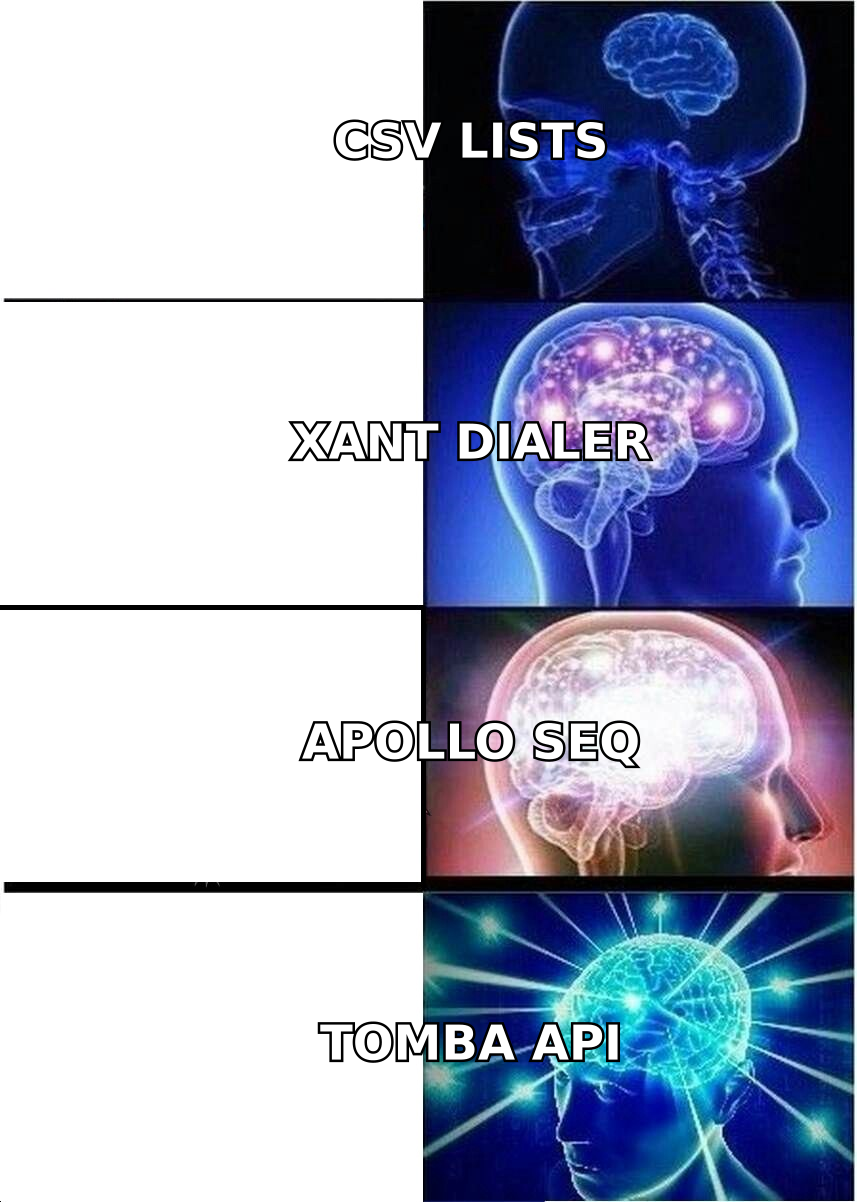
Whichever platform you land on, the variable you actually control is data quality. Tomba's Email Finder verifies addresses against live mail servers before they enter a sequence, handles catch-all domains explicitly instead of guessing, and exposes everything through an API so it plugs into whatever sequencer you end up choosing. Start on the free tier at 25 searches a month, run it against a list you already think is clean, and see how much of your pipeline was never reachable in the first place.
Related guides#
// get started
Find, verify and enrich your first contacts today
Start on the free plan with 25 searches a month, then scale when your team is ready.
Free plan · No credit card required · GDPR & CCPA
// about the author