Instantly Pricing in 2026: Plans, Real Costs, and Value
Instantly's sticker price looks cheap until you add lead credits, extra mailboxes, domains, and verification. Here is what Instantly pricing really costs a working outbound team in 2026 — and when a cheaper stack wins.
TL;DR
- Instantly sells two separate things: a sending/warmup plan and a Lead Finder plan. Most teams assume the first includes the second. It does not.
- Entry sending plans start in the $37–$47/mo range on annual billing, mid-tier lands near $97/mo, and high-volume tiers climb past $350/mo. Monthly billing costs meaningfully more.
- The real budget line is rarely the subscription. It is mailboxes, domains, lead credits, and verification — the four things that scale with your send volume, not with your plan name.
- Instantly is strong at sending infrastructure. It is not the cheapest or most accurate place to source and verify contact data.
- The cheapest credible 2026 stack for most SMB teams: a mid-tier sending platform plus a dedicated data provider. That split usually beats an all-in-one bundle on both cost and bounce rate.
What are you actually paying for with Instantly?#
Think of Instantly like renting a delivery fleet. The monthly fee covers the trucks, the dispatcher, and the route software. It does not cover the packages — you still have to buy those somewhere, and if you load the trucks with bad addresses, the fleet gets fined.
Instantly is a cold email sending platform. Its core value is infrastructure: connecting many mailboxes, rotating sends across them, warming them up, and reporting on replies. Over the last two years it has bolted on a B2B lead database, a lightweight CRM, a deliverability suite, and an inbox placement checker.
That bolting-on is exactly why Instantly pricing confuses people. The product you demo and the product you end up paying for are usually two different SKUs.
Three buckets exist:
- Sending & warmup — the base plan. Mailbox connections, campaign sequencing, warmup pool, unibox.
- Lead Finder — a separate subscription measured in monthly lead credits from the contact database.
- Add-ons — deliverability tooling, CRM upgrades, extra API volume, agency/white-label features.
Budget for all three or your forecast will be wrong by roughly half.
How much does Instantly cost in 2026?#
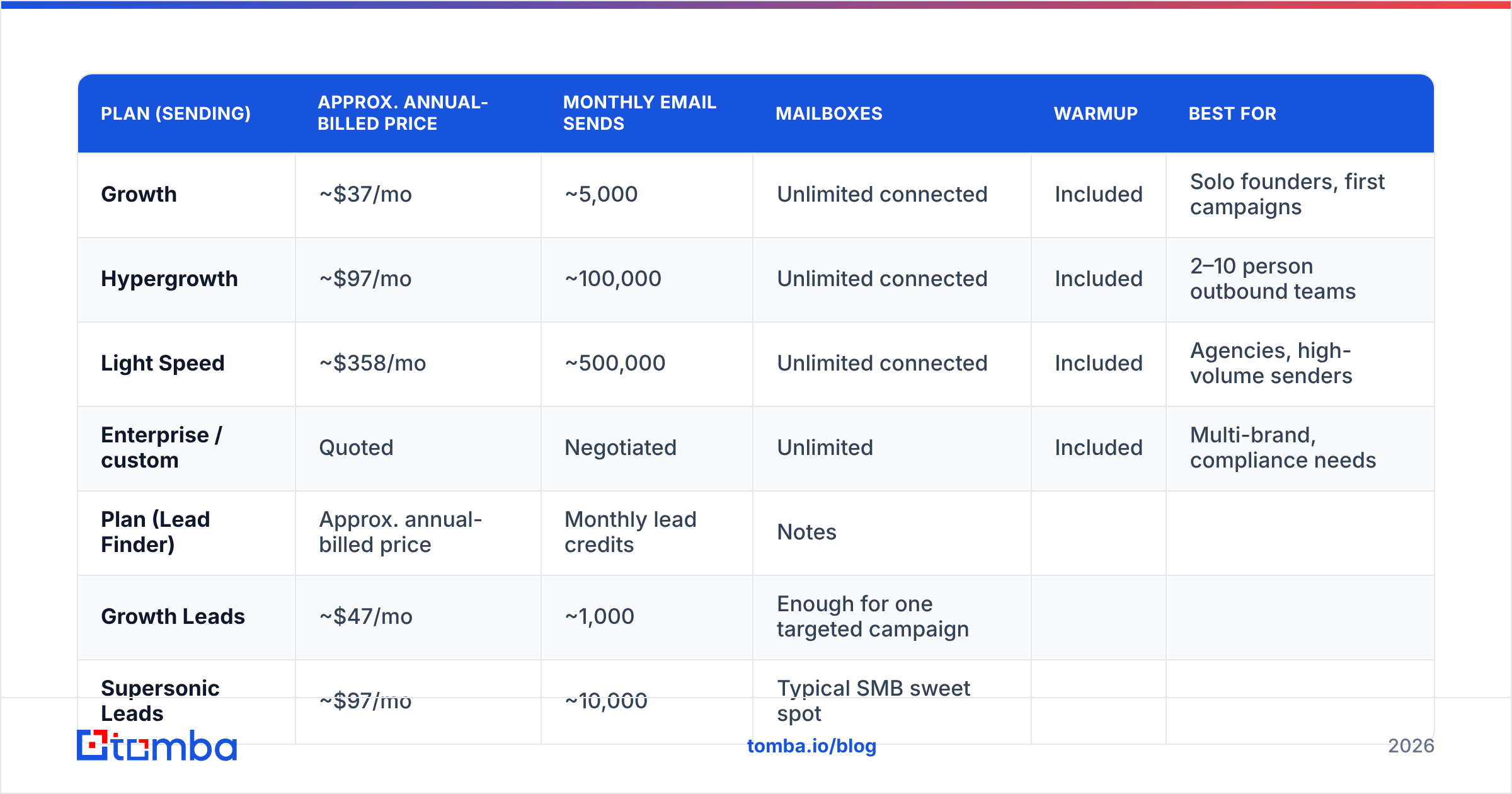
List prices below reflect annual billing at the time of writing. Monthly billing typically runs 20–40% higher, and Instantly adjusts tiers more often than most vendors — always confirm against the official pricing page before you build a model.
| Plan (sending) | Approx. annual-billed price | Monthly email sends | Mailboxes | Warmup | Best for |
|---|---|---|---|---|---|
| Growth | ~$37/mo | ~5,000 | Unlimited connected | Included | Solo founders, first campaigns |
| Hypergrowth | ~$97/mo | ~100,000 | Unlimited connected | Included | 2–10 person outbound teams |
| Light Speed | ~$358/mo | ~500,000 | Unlimited connected | Included | Agencies, high-volume senders |
| Enterprise / custom | Quoted | Negotiated | Unlimited | Included | Multi-brand, compliance needs |
And the data side, sold separately:
| Plan (Lead Finder) | Approx. annual-billed price | Monthly lead credits | Notes |
|---|---|---|---|
| Growth Leads | ~$47/mo | ~1,000 | Enough for one targeted campaign |
| Supersonic Leads | ~$97/mo | ~10,000 | Typical SMB sweet spot |
| Hyperleads | ~$197/mo | ~50,000 | Volume prospecting |
| Light Speed Leads | ~$297/mo+ | ~100,000+ | Agency-scale list building |
The pattern is clear: a realistic working setup is a sending plan plus a leads plan. A two-person team sending 30k emails a month and pulling 10k contacts is looking at roughly $194/mo annual-billed, not the $37 headline.
What's included, and what quietly costs extra?#
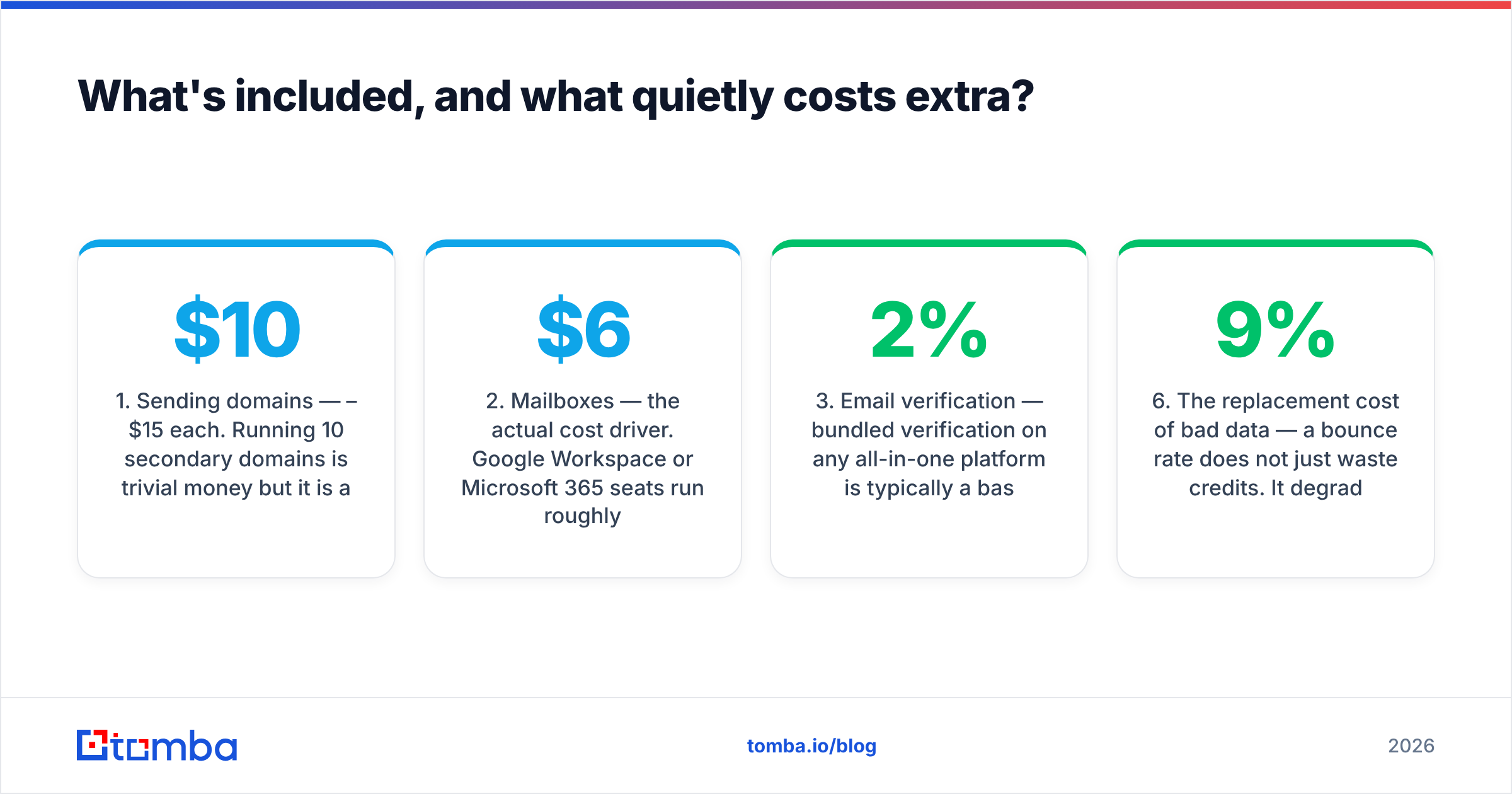
This is where most pricing comparisons stop being useful, so be specific. Here is what sits outside the subscription line for essentially every cold email platform, Instantly included:
- Sending domains — $10–$15/year each. Running 10 secondary domains is trivial money but it is a real line item, and you need them to protect your primary domain.
- Mailboxes — the actual cost driver. Google Workspace or Microsoft 365 seats run roughly $6–$8/mailbox/month. Twenty mailboxes is $120–$160/mo, which likely exceeds your Instantly subscription. Reseller mailboxes are cheaper but carry reputation risk.
- Email verification — bundled verification on any all-in-one platform is typically a basic syntax-and-MX pass. Catch-all domains, role accounts, and stale records slip through. A dedicated email verifier run before import is what keeps bounce rate under 2%.
- Lead credits that don't roll over — most plans reset monthly. Pulling 12,000 contacts in a launch month on a 10,000-credit plan means an upgrade or a top-up, not a rollover.
- Deliverability add-ons — inbox placement tests, DFY setup packages, and premium warmup pools are frequently priced on top.
- The replacement cost of bad data — a 9% bounce rate does not just waste credits. It degrades sender reputation across every domain in the rotation, and recovery takes weeks. Google's bulk sender guidelines put the practical spam-complaint ceiling at 0.3%, which is unforgiving if your list quality is mediocre.
Point 6 is the one finance teams never see and revenue teams always pay for.
Is Instantly's pricing competitive against alternatives?#
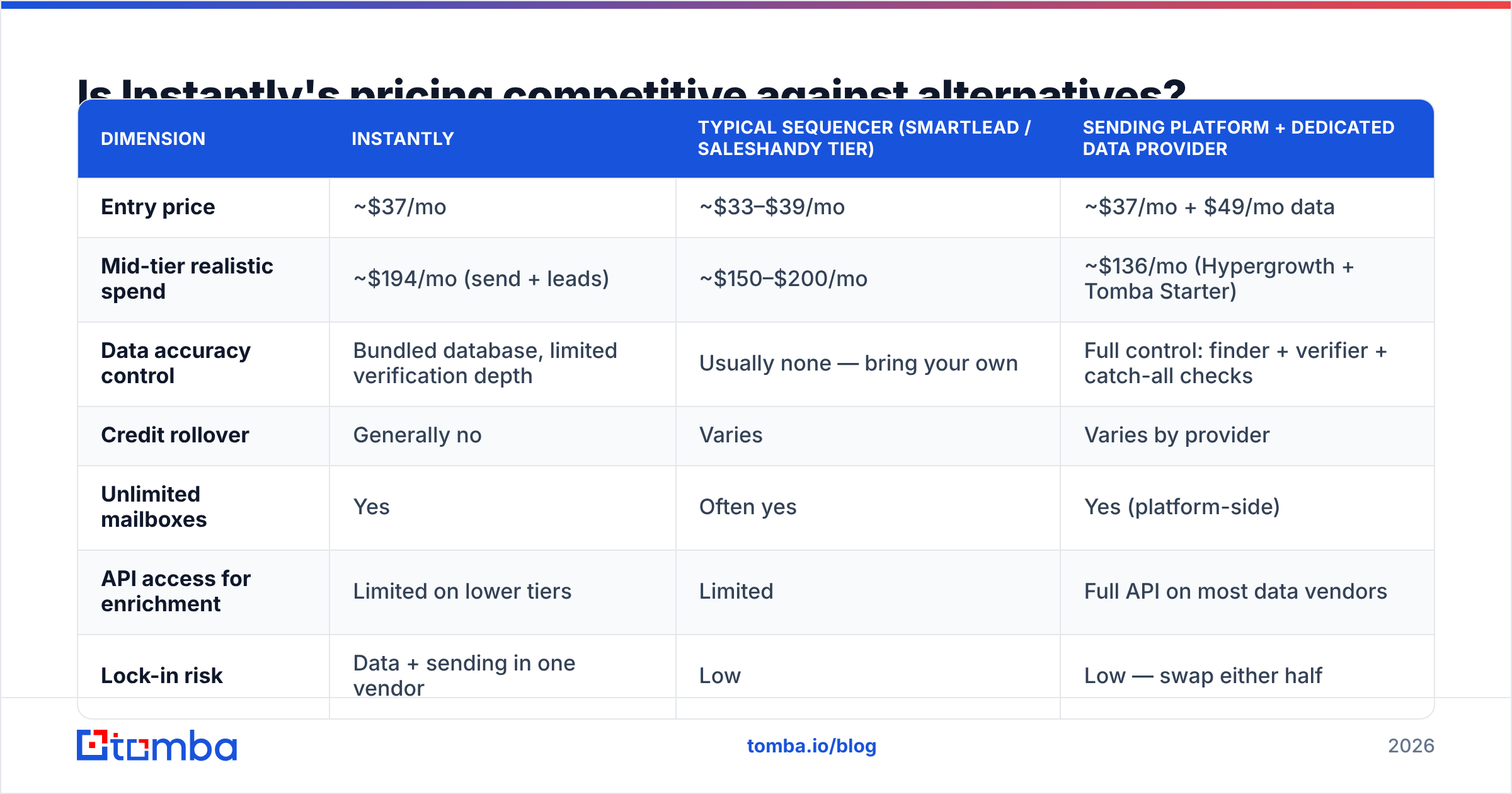
Compared against other sending platforms, Instantly's base tier is genuinely aggressive. Compared against the full stack cost, the picture is more even.
| Dimension | Instantly | Typical sequencer (Smartlead / Saleshandy tier) | Sending platform + dedicated data provider |
|---|---|---|---|
| Entry price | ~$37/mo | ~$33–$39/mo | ~$37/mo + $49/mo data |
| Mid-tier realistic spend | ~$194/mo (send + leads) | ~$150–$200/mo | ~$136/mo (Hypergrowth + Tomba Starter) |
| Data accuracy control | Bundled database, limited verification depth | Usually none — bring your own | Full control: finder + verifier + catch-all checks |
| Credit rollover | Generally no | Varies | Varies by provider |
| Unlimited mailboxes | Yes | Often yes | Yes (platform-side) |
| API access for enrichment | Limited on lower tiers | Limited | Full API on most data vendors |
| Lock-in risk | Data + sending in one vendor | Low | Low — swap either half |
Two honest reads of that table:
Instantly wins on simplicity. One login, one invoice, one support queue. If you send fewer than 10k emails a month and your ICP is broad, the bundle is fine and the mental overhead saved is worth real money.
The split stack wins on cost-per-connected-conversation. Once your volume passes roughly 20k sends a month, data quality drives your economics more than seat price does. Independent review data on G2 reflects this split consistently: users rate Instantly highly for deliverability tooling and ease of setup, with the more mixed feedback clustering around database coverage and credit limits.
It is also worth naming the honest middle ground. Providers like BookYourData sell verified, pay-as-you-go B2B lists with no monthly commitment — a sensible option if your prospecting is campaign-based rather than continuous, and a useful benchmark when you're deciding whether a recurring lead-credit subscription earns its keep.
What does a realistic monthly bill look like?#
Model three profiles rather than trusting a single headline number.
Solo founder, 3,000 sends/month
- Instantly Growth: ~$37
- 5 mailboxes: ~$35
- 3 domains (amortised): ~$4
- Data: free-tier email finder + manual research: $0
- Total: ~$76/mo
Small outbound team, 30,000 sends/month
- Instantly Hypergrowth: ~$97
- 20 mailboxes: ~$140
- 10 domains (amortised): ~$12
- Data + verification: ~$49 (dedicated provider Starter)
- Total: ~$298/mo
Agency, 250,000 sends/month across clients
- Instantly Light Speed: ~$358
- 120 mailboxes: ~$840
- 40 domains (amortised): ~$50
- Data + verification at volume: ~$99–$249
- Total: ~$1,350–$1,500/mo
Notice what dominates each row. At every tier, mailboxes cost more than the software. Any pricing debate that ignores mailbox count is theatre. If you want a sanity check on how many mailboxes your target volume actually requires, run the numbers through an email warmup calculator before you buy seats — most teams over-provision by 30% or more.

Where does Instantly pricing stop making sense?#
Four signals that you have outgrown the bundle:
- Your bounce rate sits above 3%. Bundled data is the usual culprit. Adding a verification layer is cheaper than upgrading your sending plan, and it fixes the actual problem.
- You keep topping up lead credits. If you buy overage two months running, the credits are mispriced for your motion. A per-search or annual-credit data plan will be cheaper.
- You need enrichment inside your own systems. Once you want contact data flowing into a CRM, a warehouse, or an internal scoring model, you need an API, not a UI. Sequencer-bundled databases rarely expose enough.
- You run multiple brands or clients. Separate data sourcing from sending so you can swap either side without migrating campaigns.
If any two of those are true, split the stack. Our full breakdown of what a split looks like in practice is in the Instantly alternative comparison.
How should you cut the data half of the bill?#
Buy sending capacity where it's cheap, and buy accuracy where it matters. Concretely:
- Source with a dedicated finder. A purpose-built email finder resolves contacts from domain, name, or company with far better coverage on long-tail and non-US companies than most bundled databases.
- Verify everything before import. Never trust a list you did not verify yourself, including lists you bought. Catch-all domains in particular need explicit handling rather than a blanket "accept" or "reject".
- Deduplicate across campaigns. Sending the same prospect from two domains is the fastest way to a spam complaint.
- Enrich, don't re-buy. If you already have company records, enrichment is cheaper per row than pulling fresh contacts.
- Keep the sending plan at the volume you actually send. Upgrading a tier to unlock credits you only need in one month is a common and avoidable mistake.
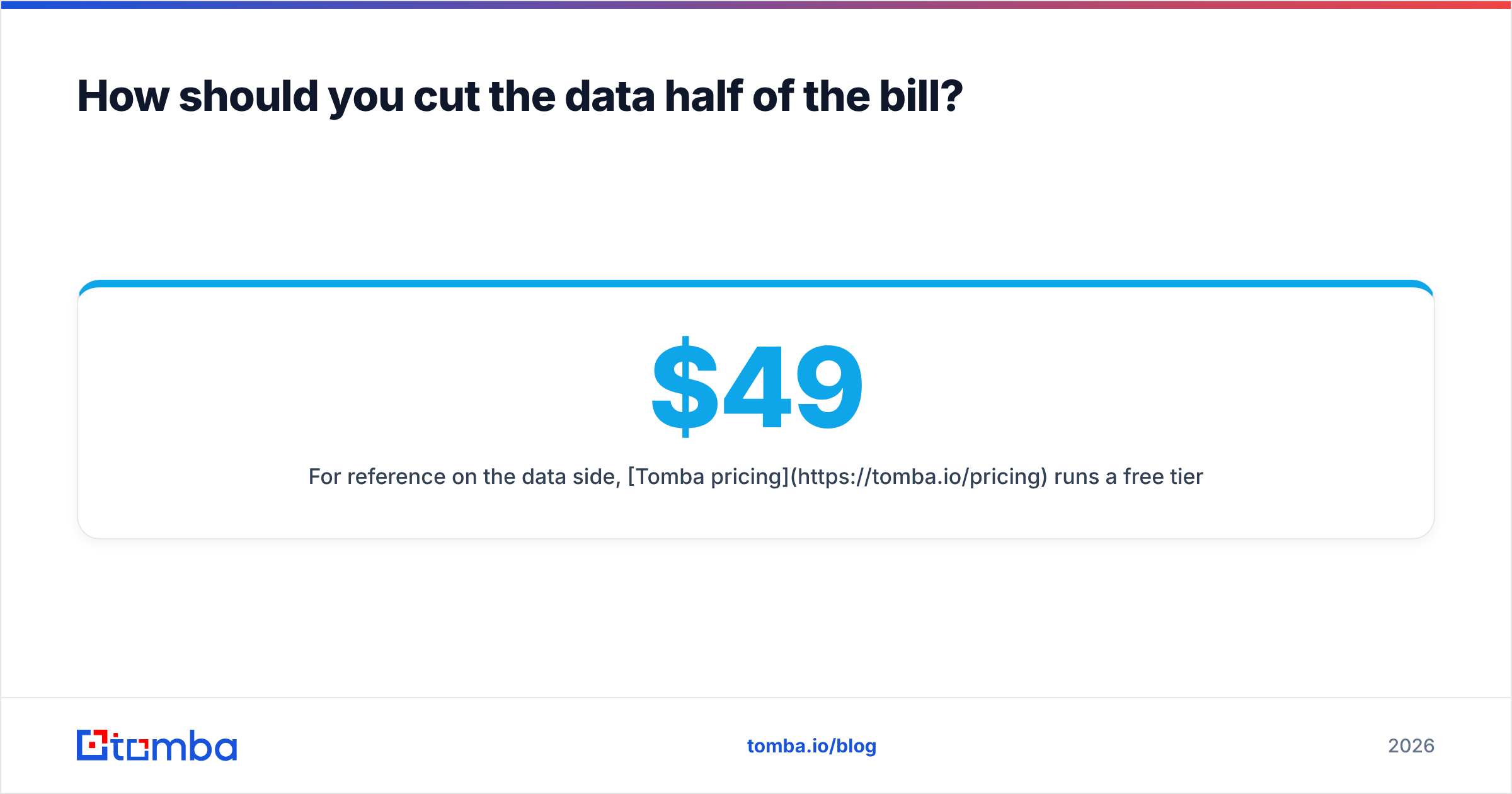
For reference on the data side, Tomba pricing runs a free tier at 25 searches/month, Starter at $49/mo, Growth at $99/mo, Pro at $249/mo, and custom Enterprise — which means a Hypergrowth + Starter stack lands near $146/mo before mailboxes, with verification and catch-all checks included rather than sold separately.
Is Instantly worth it in 2026?#
Yes — for sending. It is a well-built delivery layer with genuinely useful warmup and a clean unibox, and the entry price is fair for what it does.
No — as a single source of truth for contact data. The Lead Finder tiers are priced as a convenience, not as a best-in-class database, and the moment your bounce rate or credit overage starts showing up in reports, you are paying twice for the same outcome.
The decision is not "Instantly or not Instantly." It is "how much of my outbound budget belongs to infrastructure versus data?" In 2026 the honest answer for most teams is roughly 60/40 in favour of infrastructure — but only if the 40% buys data you can actually trust.
Fix the expensive half first. Before you upgrade a sending tier, upgrade your list. Start free with the Tomba Email Finder — 25 searches a month at no cost, verified results with confidence scores, catch-all handling, and an API when you're ready to wire it into your stack. Run one campaign's list through it, compare the bounce rate against your last send, and let the number decide your budget for you.
Related guides#
// get started
Find, verify and enrich your first contacts today
Start on the free plan with 25 searches a month, then scale when your team is ready.
Free plan · No credit card required · GDPR & CCPA
// about the author