Instantly vs Woodpecker: Which Cold Email Tool Wins in 2026?
Instantly and Woodpecker both send cold email at scale, but they optimize for opposite things: volume infrastructure versus agency deliverability control. Here's which one fits your team.
Instantly vs Woodpecker comes down to one choice: raw sending volume or careful account control. Here is the short version.
TL;DR
- Instantly wins on volume. Every paid plan gives you unlimited mailboxes. It also bundles a lead database and a warmup pool. That makes it the default for teams sending 10,000+ emails a month.
- Woodpecker wins on control. It sends per prospect, splits clients into real workspaces, and reads replies well. The engine is slow on purpose. That suits teams where every account matters.
- Pricing splits fast at scale. Woodpecker bills per contacted prospect. Instantly bills for seats and features, with no cap on inboxes. Under ~1,500 prospects a month, Woodpecker is often cheaper. Above that, Instantly is.
- Neither tool fixes bad data. Both bounce at the same rate on an unverified list. List hygiene sits upstream of the sending tool.
- Our pick: Instantly for outbound teams chasing volume. Woodpecker for agencies and consultants running fewer, higher-value sequences.
What are Instantly and Woodpecker actually built for?#
Same category, opposite philosophies.
Instantly started with one problem. Google and Microsoft cap how much you can send from a single mailbox. So serious outbound means running many mailboxes at once. Instantly's whole design follows from that. Connect unlimited inboxes. Rotate sends across them. Warm them in a shared pool. Treat mailboxes as cheap, swappable parts. Later it added a B2B lead database, an AI inbox, and a CRM layer.
Woodpecker came from the other direction. It was built in Poland for agencies and consultants. Those teams send to a few hundred hand-picked prospects per client. They cannot afford to burn a domain. So the sending engine stays cautious. It uses human-like gaps, adaptive throttling, and a separate workspace per client. Its reply detection has been tuned for years.
Think of it like freight versus courier. Instantly is a container ship. Huge throughput, low cost per unit, and one wet container does not stop the trip. Woodpecker is a bonded courier. Fewer parcels, signed for, and you always know where each one is.
Neither approach is wrong. They serve different business models.

Instantly vs Woodpecker: how do they compare head to head?#
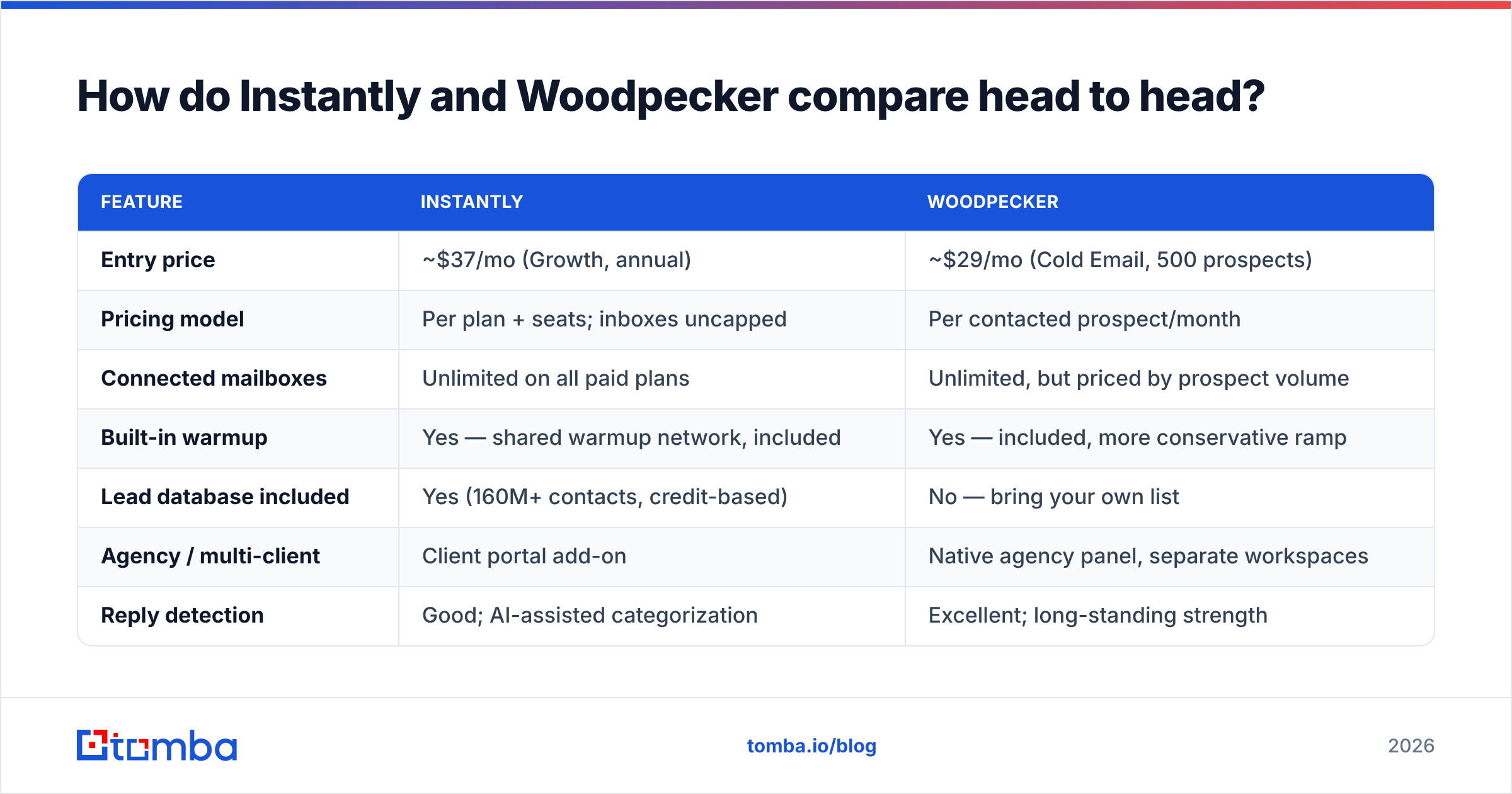
Here is the practical breakdown. Prices reflect public plans as of early 2026. Always check the vendor page before you buy, since both iterate often.
| Feature | Instantly | Woodpecker |
|---|---|---|
| Entry price | ~$37/mo (Growth, annual) | ~$29/mo (Cold Email, 500 prospects) |
| Pricing model | Per plan + seats; inboxes uncapped | Per contacted prospect/month |
| Connected mailboxes | Unlimited on all paid plans | Unlimited, but priced by prospect volume |
| Built-in warmup | Yes — shared warmup network, included | Yes — included, more conservative ramp |
| Lead database included | Yes (160M+ contacts, credit-based) | No — bring your own list |
| Agency / multi-client | Client portal add-on | Native agency panel, separate workspaces |
| Reply detection | Good; AI-assisted categorization | Excellent; long-standing strength |
| Sending behavior | Aggressive rotation across many inboxes | Human-paced intervals, adaptive throttle |
| LinkedIn / multichannel | Limited native; via integrations | Native multichannel (email, LinkedIn, calls) |
| API + integrations | Strong API, Zapier, Make, HubSpot | Strong API, Zapier, HubSpot, Pipedrive |
| Best for | Volume outbound, lead gen agencies | Boutique agencies, consultants, low-volume high-value |
| Learning curve | Low — opinionated UI | Moderate — more settings exposed |
Pricing model decides most purchases. Woodpecker bills for prospects you actually contact. Instantly bills for capability, then lets you send as much as your mailboxes survive.
Say you contact 400 prospects a month with a five-step sequence. Woodpecker is cheaper and better behaved. Contact 8,000 instead, and Instantly wins on cost by a wide margin.
Which one has better deliverability?#
Honest answer: neither tool decides your deliverability. Your domain setup, list quality, and copy do that. But the two tools shape risk in different ways.
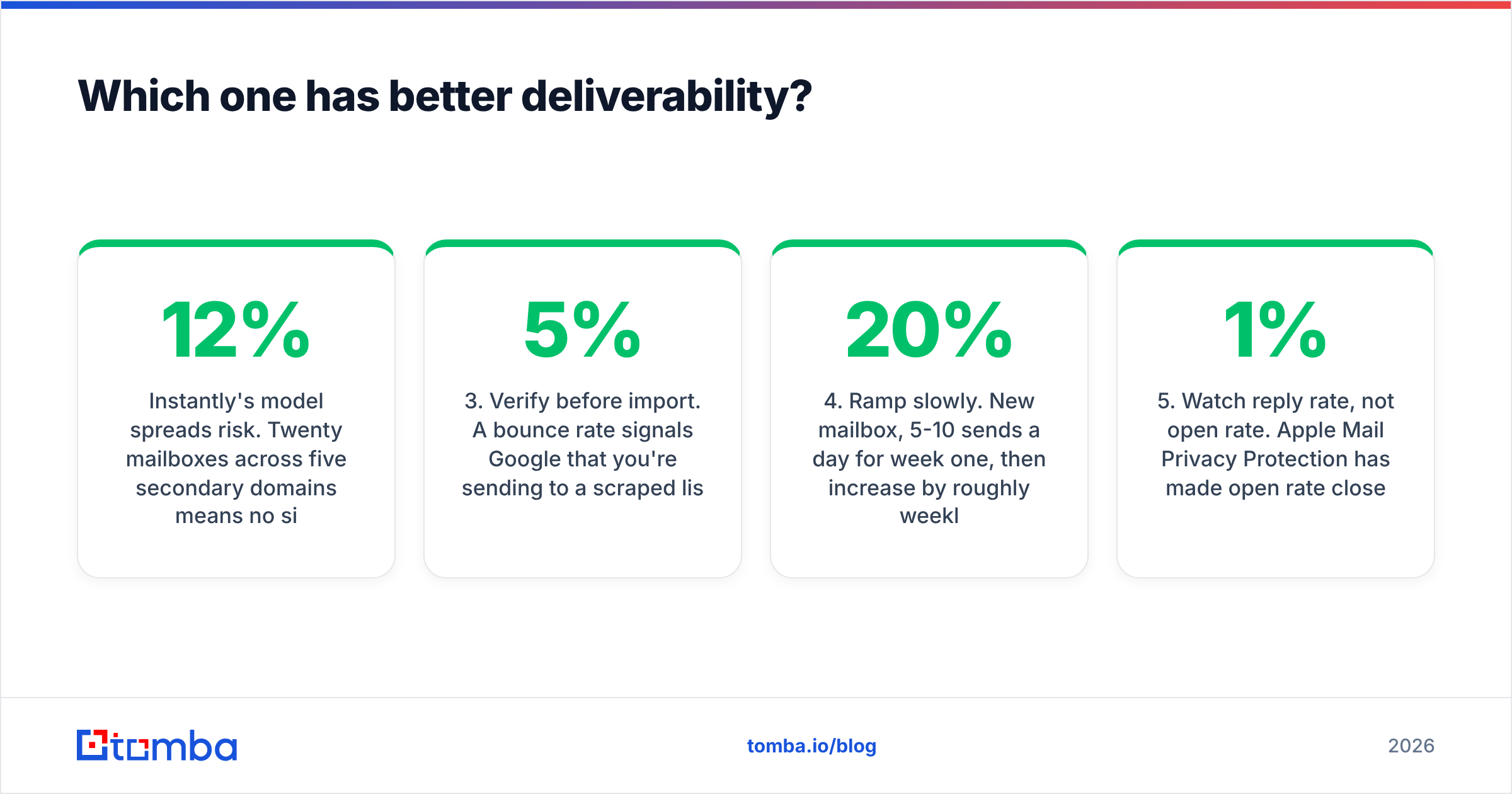
Instantly spreads risk. Twenty mailboxes across five spare domains means one burn will not kill your outbound. But spreading risk is not the same as cutting it. Teams often add mailboxes instead of fixing the cause. They end up with twenty warm, worthless inboxes and a 12% bounce rate.
Woodpecker cuts risk per account. Its throttling and send gaps are more careful by default. It will slow a campaign down rather than push through. For a consultant sending from a real, primary domain, that caution is the product.
Both tools rest on the same basics. This is where most teams lose:
- Authentication first. SPF, DKIM, and DMARC must pass before the first send. Run an SPF checker on every sending domain. Fix soft-fails before you build a sequence.
- Use separate sending domains. Never run cold outbound from your main company domain. Buy lookalike domains, point them at the main site, and warm them for three to four weeks.
- Verify before import. A 5% bounce rate tells Google you bought a scraped list. Run the file through an email verifier and drop anything undeliverable.
- Ramp slowly. Start a new mailbox at 5-10 sends a day. Raise it about 20% a week. Both tools allow this. Only one nags you to do it.
- Watch reply rate, not open rate. Apple Mail Privacy Protection made open rate close to useless. A reply rate under 1% means your list or your copy is broken. More volume only makes it worse.
- Check sender reputation weekly. Google Postmaster Tools is free. It warns you when domain reputation slips from High to Medium.
Skip step three and your platform choice stops mattering. Both tools bounce at exactly the same speed.

Is Instantly better than Woodpecker for agencies?#
This is the closest call. The answer flips based on the kind of agency you run.
Lead-gen agencies selling meetings by the unit should look hard at Instantly. Unlimited mailboxes let you run fifteen clients on one subscription, with no per-seat penalty. The built-in database means you can source lists without a second data tool. The Unibox pulls replies from every client account into one queue. That alone saves hours when you manage thirty campaigns.
Boutique agencies and fractional SDR consultants usually prefer Woodpecker. Its agency panel gives each client a real workspace. That means their own domains, sending settings, and reports — not a filtered view of one shared account. Client reporting is cleaner too. When a client asks which domain sent what, you answer on one screen.
Woodpecker also runs native multichannel sequences: email, LinkedIn outreach, and call tasks. That matters more when every touch is deliberate.
A third pattern is worth naming. Some teams run Woodpecker for named accounts and Instantly for broad-net testing. It costs more, but it matches the tool to the risk. Your top 200 accounts get the careful engine on the real domain. Your 5,000-contact experiment runs on throwaway domains, where a burn costs $12.
Want to see how buyers in your segment score them? Check G2's cold email software category. Review volume leans toward Instantly. Scores for support and deliverability lean toward Woodpecker.
What does each tool cost at real volumes?#
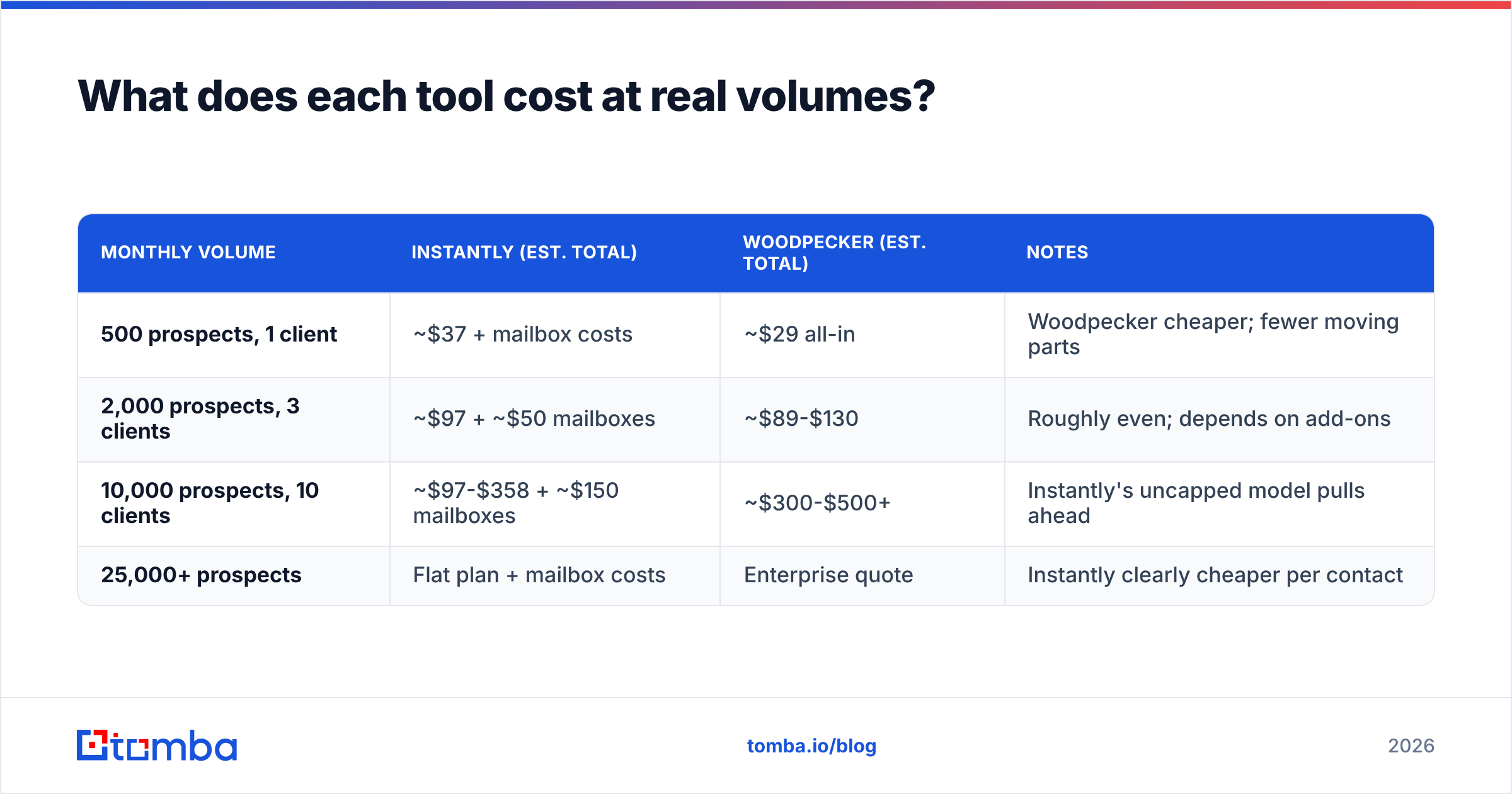
Starting prices mislead on both sides. Here is what the bill looks like once you are running.
| Monthly volume | Instantly (est. total) | Woodpecker (est. total) | Notes |
|---|---|---|---|
| 500 prospects, 1 client | ~$37 + mailbox costs | ~$29 all-in | Woodpecker cheaper; fewer moving parts |
| 2,000 prospects, 3 clients | ~$97 + ~$50 mailboxes | ~$89-$130 | Roughly even; depends on add-ons |
| 10,000 prospects, 10 clients | ~$97-$358 + ~$150 mailboxes | ~$300-$500+ | Instantly's uncapped model pulls ahead |
| 25,000+ prospects | Flat plan + mailbox costs | Enterprise quote | Instantly clearly cheaper per contact |
Two costs people forget:
Mailbox infrastructure. "Unlimited inboxes" does not mean free inboxes. You still pay Google Workspace, Microsoft 365, or a reseller. That runs about $2-$6 per mailbox per month, plus domain registrations. Twenty-five mailboxes is a real $75-$150 line item on top of the software.
Data. Instantly bundles a lead database. Woodpecker does not. Compare software prices alone and you are comparing a bundle against a standalone. Already have a data source, like a B2B database or an enrichment pipeline? Then Instantly's bundled credits are worth less than the sticker suggests.
Now compare a dedicated data layer. Tomba pricing starts free at 25 searches a month. Starter is $49/mo and Growth is $99/mo. Those credits cover finding, verifying, and enriching — not one bundled list pull. If you want data quality kept separate from sending, splitting the two is usually cheaper and always more portable.
What are the real limitations of each?#
Instantly's weak points:
- Support has drawn steady complaints as the user base grew. You lean on docs and the community.
- The bundled lead database is broad but uneven. Coverage is thin on European mid-market and non-tech verticals.
- Uncapped mailboxes invite bad habits. Scaling a broken campaign gets as easy as scaling a working one.
- Native multichannel is thin. If LinkedIn is core to your motion, you will stitch tools together.
Woodpecker's weak points:
- Per-prospect pricing punishes big tests. A 10,000-contact experiment gets expensive fast.
- No bundled data. You need a separate source, so another vendor and another invoice.
- The UI looks dated next to newer tools, and some settings are buried.
- Fewer integrations and community templates than the larger ecosystem around Instantly.
Like Instantly's economics but worried about mailbox sprawl? Read through Instantly alternative options before you commit. The category has far more solid entrants in 2026 than it did two years ago. That includes specialists like BookYourData, which ships verified data instead of asking you to assemble it.
How should you choose between them?#
Answer four questions honestly.
How many prospects will you contact each month? Under 1,500, pick Woodpecker. Over 5,000, pick Instantly. In between, the next three questions decide it.
Are you sending from your primary domain? Maybe you are a consultant whose name is the brand, or a founder doing founder-led sales. Then Woodpecker's careful engine is worth the premium. Instantly's volume-first defaults were not built to protect a domain you cannot replace.
Do you already have a data source? If enrichment and verification are handled, Instantly's database is a discount you will never use. The choice then narrows to sending economics. If you have nothing, the bundle really does lower your day-one stack cost.
Do your clients need their own workspace? Woodpecker's agency separation works differently from Instantly's client portal. If a contract or a security review demands real separation, that is a hard requirement, not a preference.
One point applies either way. Whichever tool you pick, plan to rebuild your list hygiene process. The highest-ROI change most outbound teams make is not switching sequencers. It is cutting bounce rate from 6% to under 2%. That is a data problem, and you solve it before anything reaches either tool.
What should you do next?#
Pick the sequencer that matches your volume and your domain risk. Then fix the layer underneath it.
Both tools are competent, and both have users booking real meetings. Teams that fail with either one usually fail the same way. They feed a good sending engine a list full of guesses, catch-alls, and role addresses. Then they blame the software when domain reputation craters.
Start with data you can trust. The Tomba Email Finder returns verified professional emails by name and domain. Each result carries a confidence score and its sources. So you know what you are importing before a single send goes out. The free tier gives you 25 searches a month. Run 50 known-good contacts through it, compare, and let the match rate decide.
Get the data right, and Instantly vs Woodpecker becomes what it should be: a budget decision, not a survival one.
Related guides#
// get started
Find, verify and enrich your first contacts today
Start on the free plan with 25 searches a month, then scale when your team is ready.
Free plan · No credit card required · GDPR & CCPA
// about the author